Night Gunner
Arcade Game: Shoot-em-up · ZX-Spectrum 48K · 2 players · English
Digital Integration · 1983 · Pound sterling 6.95
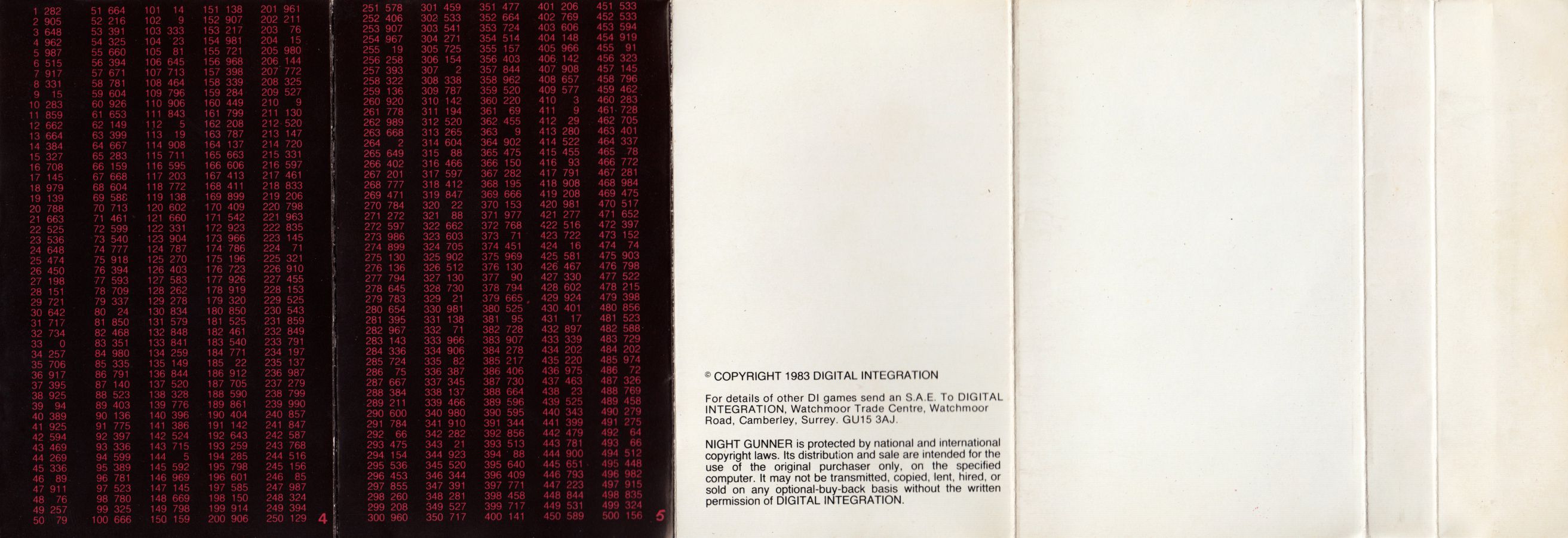
_Back.jpg)
.jpg)
.jpg)
.jpg)
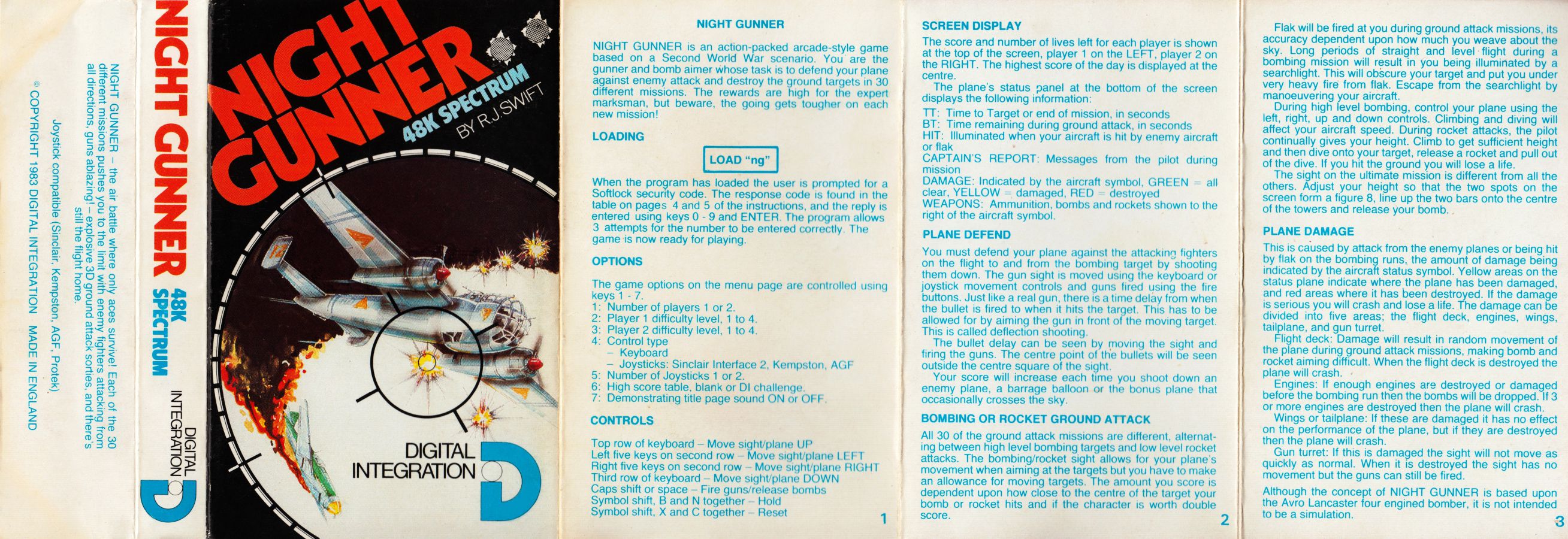
_Media.jpg)
Discussion
Nobody has started a thread about this yet.
- Control Option
- Cursor, Interface 2 (right), Kempston Joystick
Releases
- 1983Digital IntegrationPound sterling 6.95
- 1983ABC SoftSpanish peseta 1695.00
- 1986Zafi Chip
- 1987Z Cobra
- 1989Silverbird Software LtdPound sterling 1.99
- 1991Byte Back
Play
- NightGunner.tzx.zipTape image English27 KB
- NightGunner.tap.zipTape image English29 KB
- NightGunner(ByteBack).tzx.zipTape image English29 KB
- NightGunner(SilverbirdSoftwareLtd).tzx.zipTape image English27 KB
Documents
- NightGunner(ZCobra).pdfInstructions Spanish22 KB
- NightGunner(SilverbirdSoftwareLtd)(MULTI-LANG).pdfInstructions Multi-language: English, German231 KB
- NightGunner.txtInstructions English5 KB
Other files
- Night Gunner (1983)(Digital Integration).pokPOK pokes file 0 KB
Files and rights
Distribution permission is on record, granted to another archive rather than to this one. Screens and pictures are copied here; everything else links to the archive that holds it.
- AllowedDigital Integration → WorldOfSpectrum
- AllowedSilverbird Software Ltd → WorldOfSpectrum
Credits
- Rod J. Swiftcredited
Sign in to credit somebody, or say what these people did.
Awards
Scores
In the magazines
- Sinclair User #331984 · Gilbert Factor6/10
- Your Computer #61984 · Overall3/5
- Crash #31984 · Overall91%
- Big K #61984 · Overall2/3
- Personal Computer Games #61984 · Overall9/10
- Crash #611989 · Overall91%
Elsewhere on the web
- WorldOfSpectrum 15 votes7.80
In the magazines 82
Crash #61Feb 1989 · p.4091%91%
Overall 91%
Phil King 91%
OLDIES UNLIMITED! What? Spent all your Christmas money already? Well, never fear, the golden oldie himself, PHIL KING, takes you on a tour of the latest budget-price rereleases... Night Gunner Producer: Silverbird Price: £1.99 Original Rating: 91% Another old Digital Integration classic is rolled out of the hangar doors. This was first reviewed in Issue 3 where it was Game Of The Month - CRASH Smashes had yet to be invented. The game has you as the gunner and bombardier of a WWII Lancaster. There's thirty missions in all, each divided into three sections. In the two gunner sections you're defending the plane on its journey to, or from, the target area. Enemy fighters appear as specks in the distance, then coming sweeping into attack, machine guns flashing. A gunsight is moved around the screen to intercept them, fail and damage builds up - sometimes jamming the gunsight! When you arrive at the target you start your attack. Missions alternate between high-level bombing strikes (looking down on the scrolling target area) and low-level rocket attacks (flying into the screen and diving down to attack targets). A true measure of a great game is how it stands up to the ravages of time and Night Gunner has certainly aged well. The sheer amount of missions, the variety of gameplay and toughness make this a formidable challenge which should keep you playing for ages. If you haven't already got it - get it now!
Sinclair User #33Dec 1984 · p.446/106/10
Gilbert Factor 6/10
Richard Price 6/10
BANDITS BY MOONLIGHT... Memory: 48K Price: £6.95 Joystick: Kempston, AGF, Protek, Sinclair By the light of the bombers' moon a Lancaster weaves its way into enemy territory. Strapped in, shivering in the cold of high altitude, you clear the breeches of your machine guns and watch the night sky in apprehension. Barrage balloons drift across occasionally but suddenly the speck you thought was a star grows into the shape of a twin engined night-fighter. Here they come. Jinking and banking the fighters swarm up, guns twinkling in the darkness. Night Gunner from Digital integration is a multi-task arcade scenario casting you in the role of the turret gunner of the Lancaster. The main screen features the night-fighter attack. Against the starry background the enemy planes zoom closer and, by using deflection shooting, you must knock them out be- fore they cause serious damage to the bomber. Pilot reports and damage status are shown beneath the screen and there are three bombers available. After surviving the fighters you progress to a ground attack screen in which you must either bomb various targets from above or dive the plane to take out enemy tanks with rockets. Flak or searchlights will hinder you. During dive-bombing you need to watch the altimeter carefully as it is easy to crash into the ground. Once that is finished you make the return journey to base, again fighting off savage attacks. Difficulty is progressive and there are thirty missions all told. The night fighter graphics are quite impressive and are fast, smooth and distinct. There is a good feel of a dogfight though the balloons sometimes seem a little out of place as they swerve across the sky. The other screens are not as accomplished but remain exciting and taxing. The overall style has similarities with Zzoom, making this shoot-em-up a compulsive and demanding program.
Big K #6Sep 1984 · p.232/32/31/32/32/3
Graphics 2/3
Playability 2/3
Addictiveness 1/3
Overall 2/3
Steve Keaton 2/3
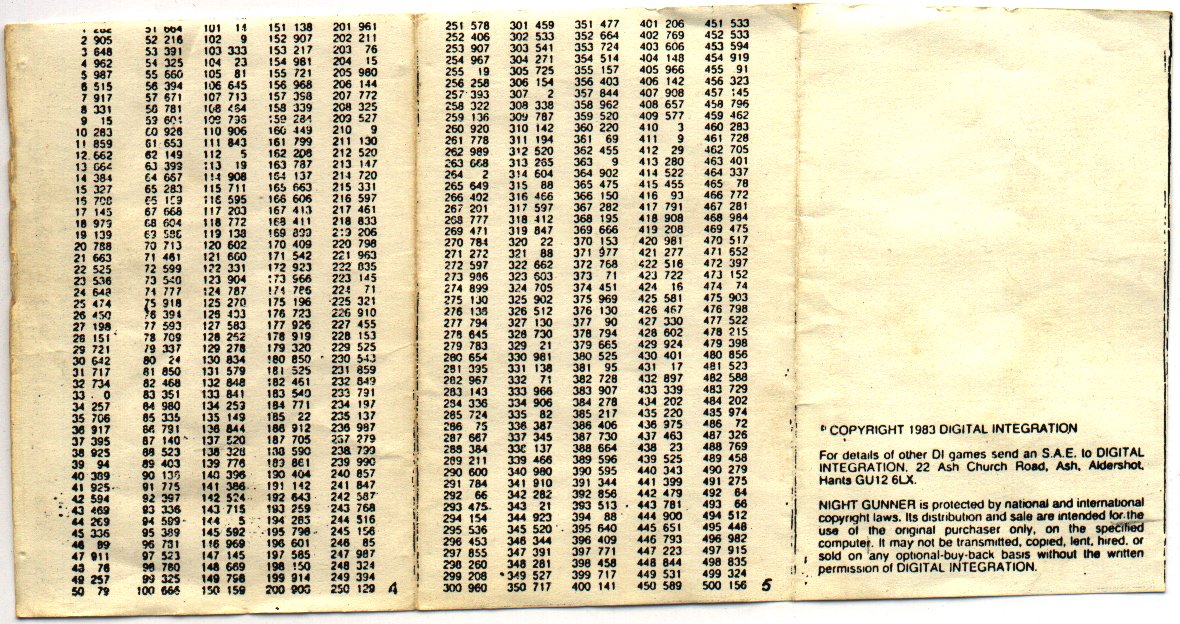
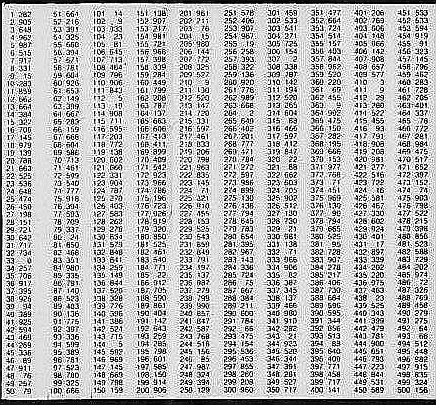
TAIL END CHARLIE MAKER: Digital Integration FORMAT: cassette PRICE: £7.95 Star Raiders circa World War II. Despite the army fatigues this is pretty standard shoot'em-up fare, in which enemy fighter planes whirl and tease your straining gunsight. You've four difficulty levels and thirty missions to complete, which vary between high-level bombing sorties and low-level rocket attacks (phew!). It must be said that considerable effort has been made to turn this into an authentic flight simulation/arcade hybrid. Rather cleverly height and movement all have relative effects upon the action and the flight deck details any damage done to the ship. You also receive messages from the pilot during the mission - nothing inspires confidence like being rubbished over the airways! But despite this fine realisation I found the game a little lacklustre. All the careful embellishments tend to slow down the on-screen action. I also disliked having to negotiate the Softlock security code every time I donned my flying goggles. Like Jet Set Willy the game comes with an numerical grid which must be consulted prior to entering your Lancaster. At least this version isn't colour coded and so doesn't alienate those colour blind/black 'n white TV owners. Small mercies eh?
Your Spectrum #5Jul 1984 · p.527/108/107/10
Ian Simmonds 7/10
Jon Warner 8/10
Simon Cox 7/10
Sticks at the ready, the Chiltern Computer Club buckled down to some concentrated critique as they sifted through the latest bundle of software to give us their unbiased evaluations. Any club wishing to offer their reviewing services should contact Ron Smith, Spectrum Soft, [redacted]. This month, the reviewers in the YS jury hot-seat are all members of Chiltern Computer Club, Eaton Bray, near Dunstable. They are (in alphabetical order) Simon Cox, Ian Simmonds and Jon Warner. To be honest it wasn't an easy job for them, with many of the latest offerings falling short of an acceptable level - in fact, sheer crud in some cases. Read on to find out what (and what not) to buy. The Chiltern Computer Club was formed around two years ago, and usually it manages to attract about 35 members - ages ranging from 13 years to near senility. Membership is currently £4 per year, for which potential members can expect practical help with their computer problems, and guest speakers and lecturers from time to time. Club contacts can be made via Steve Betts, [redacted]. Finally thanks go to Steve for the ultra-fast speed at which he pulled the test together. NIGHT GUNNER Digital Integration £6.95 An arcade game with a Second World War scenario in which you must defend your plane against attack from enemy aircraft as you try to destroy ground targets.
Your Computer #6Jun 1984 · p.553/5
Overall 3/5
Spectrum 48K £6.95 Digital Integration From the people who brought you the excellent Fighter Pilot F-15 Eagle simulator, this program obliquely relives the experiences of a World War Two air-gunner on a bombing mission over enemy territory. Three types of mission are available. First you defend the bomber from nightfighters. Twin engine aircraft swoop towards you as you manipulate the keyboard/joystick to get them in your sights. The delicate tracery of bullets weaves a fine mesh of death in the night sky. Oops, getting carried away there. There is also a variety of ground attack options. As you unleash your cargo of destruction on the unsleeping factories of the enemy your view of the terrain is occasionally obscured by clouds. You can manoeuvre looking for a break in the cloud-cover. The ground attack display shows you planes and sometimes lorries on the ground. You strafe them mercilessly with rockets, but watch your altimeter in case you turn your plane into a rather expensive lawmnower. Plane damage is caused by attack from enemy aircraft or being hit by flak on the bombing runs. The plane's status panel at the bottom of the screen displays damage on an aircraft symbol. Time to target or end of mission are also displayed in seconds as is time remaining during ground attack. You periodically get messages from the captain during the mission. Damage to the flight deck results in random movement of the aircraft making it difficult to hit your targets. The sight on the ultimate mission is different from the others, in true Barnes-Wallis style. Adjusting your height so that the two spots on the screen form a figure of eight, you line up the two bars on to the centre of the rowers and release your bomb. Barrage balloons and bonus planes periodically cross the sky.
C&VG (Computer & Video Games) #32Jun 1984 · p.296/108/108/107/10
Getting Started 6/10
Graphics 8/10
Value 8/10
Playability 7/10
MACHINE: Spectrum 48k SUPPLIER: Digital Integration PRICE: £6.95 Having played Digital Integration's first flying game, Fighter Pilot, I was expecting the second, Night Gunner, to be quite similar to its widely successful predecessor. But the only thing the two games have in common is they are both set aboard aeroplanes. In the game, you take on the duties of a rear gunner, perched at the back of a fighter bomber, shooting at enemy jets and bombing fuel dumps and military bases on the ground. You control a sight which you use to home in on planes and reconnaissance balloons that are circling your plane. My main criticism of the game is that the keys are placed in such awkward positions, its almost impossible to play it without a joystick, or three pairs of hands, so control of the sight is difficult. The game's fast graphics more than make up for difficulties I had playing the game for the first half hour. And I'm sure anybody who is lucky enough to have a joystick won't have very many complaints. Each of the three missions are completely different graphically and tactically. The first obstacle you will have to overcome is the enemy's air defences of jet planes and balloons. The second mission is a low level bombing run over the countryside, and the third and final mission is a blind bombing raid at 20,000 ft. The display also flashes warning messages from the pilot detailing the damage the plane has incurred and the likelihood of it blowing up and crashing to the ground. Keeping an eye on the information from the pilot and trying to concentrate on actually bombing the targets takes some time to master, but it's definitely worth it! Night Gunner is an interesting and enjoyable follow-on from Fighter Pilot, but don't expect the game to be similar, because it's nothing of the kind.
Personal Computer Games #6May 1984 · p.67PCG Hit9/109/107/109/109/109/10
Personal Computer GamesPCG Hit
Graphics 9/10
Sound 9/10
Originality 7/10
Lasting Interest 9/10
Overall 9/10
Stuart N Cooke 9/10
MACHINE: Spectrum 48K JOYSTICK: Optional SUPPLIER: Digital Integration PRICE: £6.95 If you've ever fancied yourself as a World War Two hero, Night Gunner will give you the chance. With this program you can go back in time and try your luck as the gunner and bomb aimer in an Avro Lancaster four-engined bomber. There are two sections to the game. First, you see the view out of the rear gun turret of the plane and the enemy aircraft moving towards you as you fly to your target. As the tail machine-gunner you must shoot down the enemy before hey destroy you. They swoop towards you in true 3D at an alarming speed with guns blazing from their wings. The damage they inflict on your aircraft can be seen on the pictorial representation of the plane at the bottom of the display. Lose a wing tip or your flight deck and you've had it. When you've finally made it to the target, you take control of the bombing - just press the 'drop' button and it's bombs away. Whenever you are flying over enemy territory flak will be fired at you. Its effectiveness depends on how much you weave about the sky. Fly in a straight line for too long and you'll be blinded by a searchlight and easily shot to pieces. Digital Integration say that each of the 30 bombing raids are different; I've only managed to see planes, tanks and trucks so far, I've never survived the trucks! The sound in Night Gunner is the most realistic that I've ever heard from the Spectrum: put it through your hi-fi and you'll really believe that World War Two is taking place in your living room. A game to be thoroughly recommended, offering exciting action for the average arcade player and a tough challenge for the player who thinks he can beat everything. Go and win your DFC today.
Crash #3Apr 1984 · p.31Crash Game Of The Month96%93%96%93%78%89%91%
Use of Computer 96%
Graphics 93%
Playability 96%
Getting Started 93%
Addictive Qualities 78%
Value For Money 89%
Overall 91%
Unknown
Unknown
Unknown
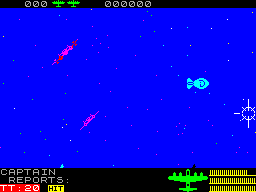
Producer: Digital Integration Memory Required: 48K Retail Price: £6.95 Language: Machine code Author: R. J. Swift Before going on to this new game from Digital Integration, we must first put something right from last month's review of their simulation, Fighter Pilot. One reviewer noted: 'Key control is a fraction slow, you have to keep a key pressed for results...' Dave Marshall of Digital Integration demonstrated to us that this remark was a little unfair. The reason being that the control keys were designed to simulate an aircraft's performance. in fact the control in Fighter Pilot is proportional, i.e. the longer you keep a key pressed the more effect it has, moving, for instance, from a slow to a very fast bank or turn. So we were a little wrong to criticise this. Night Gunner is a massive program, one which the inlay is at pains to point out is more of a game than a simulation, and which is based on a Second World War scenario. You are the gunner and bomb aimer whose aim is a good one - defend your plane against enemy attacks and destroy the ground targets in 30 different missions. Each mission comes in two parts, firstly the flight to the target, and then the actual bombing run. in the first part you get a cockpit view with your gun sights in front of you. Three types of target appear, barrage balloons, enemy fighter planes, and very large bombers which cross your flight path occasionally. Points are received for hitting any of these. The attacking fighter planes fly at you with their cannons blazing. Below the display area, the Captain reports time to target with a countdown figure. There is also a visual display of how many shells you have and a small aircraft shape for damage reports. A flashing indicator also tells you when you have been hit and the status symbol changes colour in areas accordingly. Flight deck damage will result in random movement of the plane during ground attack missions - if it's destroyed you crash. If enough engines are destroyed before a bombing run, then the bombs will be automatically dropped, and if 3 or more engines go then you will crash (seems reasonable). Wings and tailplane may suffer damage without affecting performance, but if destroyed they will crash the plane. And if the gun turret is damaged it slows down your gun traverse, and if destroyed means that you can still fire but not aim. The ground attack missions are all different and alternate between high level bombing and low level rocket attacks. You have a limited number of bombs and rockets and the mission is terminated when the ammo is all used up. High level runs start off with static planes on the ground and the direction control will move the plane and therefore the sight as you pass over them. Another variation is moving tanks where deflection bombing techniques must be used to take into account the movement of the target. Low level runs are even more fraught. You are given a maximum height of 400 feet and must then dive to fire the rockets without crashing into the ground. During these low level attacks flak is being fired at you, so you must weave the plane about to avoid it. Again, the 'HIT' indicator tells you when damage is occurring. The producers say that Night Gunner's concept is based upon the Avro Lancaster four engined bomber although it is not intended as a simulation. Between missions there is a screen showing a very large graphic of the bomber crossing a city skyline and dropping bombs which turn into the letters, MISSION 1, or whatever mission you are about to play. COMMENTS Control keys: Top row = up, second row = left/right, third row = down, CAPS or SPACE = fire. The cursor keys may be selected through the joystick facility marked 'AGF', then use 0 to fire Joystick: Sinclair 2, Kempston, AGF, Protek, cursor clip ons Keyboard play: very responsive, your sight moves at a realistic speed Colour: used very subtly, excellent Graphics: excellent with 3D Sound: excellent Skill levels: 4 and with progressive difficulty Lives: 3 Features: 1 or 2 player games with ability to select difficulty level for each player independently
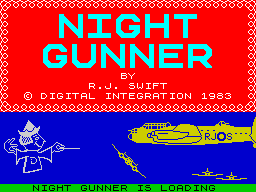
An enemy bomber crosses our path and bandits are coming in fast, 10 o'clock high - Night Gunner takes aim, but there's no respite.
The Lanc flies over to announce the next mission.
4 Crash Smashes carries this game and has 8 references of its own.
Kidsplay carries this game and has 29 references of its own.
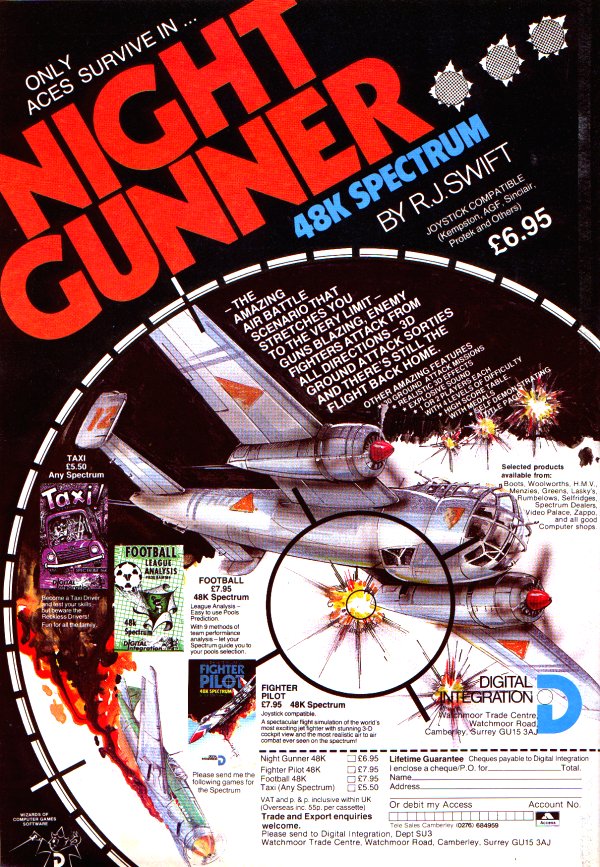
Advert54
- Sinclair User #40Jul 1985 · p.27
- Crash #17Jun 1985 · p.4
- Sinclair User #39Jun 1985 · p.73
- Crash #16May 1985 · p.6
- Sinclair User #38May 1985 · p.50
- Sinclair User #37Apr 1985 · p.76
- Crash #15Apr 1985 · p.97
- Sinclair User #36Mar 1985 · p.89
- Crash #14Mar 1985 · p.33
- Sinclair User #35Feb 1985 · p.105
- Crash #13Feb 1985 · p.33
- Sinclair User #34Jan 1985 · p.96
- Crash #12Jan 1985 · p.85
- Sinclair User #33Dec 1984 · p.25
- Your Computer #12Dec 1984 · p.259
- Crash #11Dec 1984 · p.6
- Sinclair User #32Nov 1984 · p.76
- Crash #10Nov 1984 · p.158
- Sinclair User #31Oct 1984 · p.147
- Crash #9Oct 1984 · p.49
- Crash #8Sep 1984 · p.63
- Sinclair User #30Sep 1984 · p.16
- Sinclair Programs #22Aug 1984 · p.22
- Your Spectrum #5Jul 1984 · p.66
- Sinclair User #28Jul 1984 · p.98
Full-page ad10
- Sinclair User #29Aug 1984 · p.18
- Crash #6Jul 1984 · p.16
- Sinclair Programs #21Jul 1984 · p.59
- Sinclair User #27Jun 1984 · p.2
- ZX Computing #13Jun 1984 · p.84
- C&VG (Computer & Video Games) #31May 1984 · p.138
- Crash #4May 1984 · p.89
- Sinclair User #26May 1984 · p.122
- Sinclair User #25Apr 1984 · p.128
- ZX Computing #12Apr 1984 · p.27
News/Note4
- ACE (Advanced Computer Entertainment) #18Mar 1989 · p.82
- ACE (Advanced Computer Entertainment) #17Feb 1989 · p.70
- ACE (Advanced Computer Entertainment) #13Oct 1988 · p.9
- Personal Computer News #57Apr 1984 · p.7
Review3
- Sinclair Answers #1Sep 1984 · p.34
- Games ComputingSep 1984 · p.16
- Popular Computing Weekly #16Apr 1984 · p.57
Information2
- SSD-IISep 1999
- Die Speccy CDJan 1996
Feature1
- C&VG (Computer & Video Games)1985 · p.88
Related
- Versions
- Night Gunner (Another platform for)
- Compilations
- 4 Crash Smashes, Kidsplay, 4 Aces
- Ports
- (Amstrad CPC)
- Same entry at
- Spectrum ComputingZXInfo
Reviews from people here
Sign in to write about this, or make an account. It takes a minute and lets you correct the catalogue too.
No description recorded.
Sign in to correct or add to this.
Hold the rights to this and want it taken down?