
Nodes of Yesod
Arcade Game: Adventure · ZX-Spectrum 48K · 1 players · English
Odin Computer Graphics Ltd · 1985 · Pound sterling 9.95
Yesod, 1 of 2
Discussion
Nobody has started a thread about this yet.
Remarks
On "I've Started So I'll Finish", Stuart Fotheringham reveals that the programmers of Nodes lost the code when a Microdrive they were storing it on crashed. The game had to be completed in a rush with the result that the "final version wasn't as good as our original".
During development the working title was: "Moon Munching Moles From Mars".
Credits
The digitized voice at the start of the game belongs to Mark Butler. The full text is "Welcome to Nodes of Yesod from the Odin Computer Graphics Team".
- Control Option
- Cursor, Interface 2 (right), Kempston Joystick
Releases
- 1985Odin Computer Graphics LtdPound sterling 9.95
- 1985Serma SoftwareSpanish peseta 2995.00
Play
- NodesOfYesod.rzx.zipwithheld by rights holder
- NodesOfYesod(48K).tzx.zipwithheld by rights holder
Documents
- NodesOfYesod.txtInstructions English8 KB
- NodesOfYesod(EN).pdfInstructions English483 KB
Music
- NodesOfYesod.ay.zipRipped in-game/theme music in AY format 6 KB
Other files
- NodesOfYesod(SermaSoftware).jpgAdvertisement 246 KB
- NodesOfYesod.jpgAdvertisement 105 KB
- NodesOfYesod.jpgGame map 149 KB
- NodesOfYesod_2.jpgGame map 348 KB
- NodesOfYesod_3.pngGame map 328 KB
- NodesOfYesod_4.jpgGame map 1,332 KB
- NodesOfYesod_5.jpgGame map 287 KB
- NodesOfYesod_2.jpgInlay - Front 361 KB
- NodesOfYesod(48K)_Media.jpgMedia scan 67 KB
- NodesOfYesod(48K)_Media_2.jpgMedia scan 88 KB
- Nodes of Yesod (1985)(Odin Computer Graphics).pokPOK pokes file 1 KB
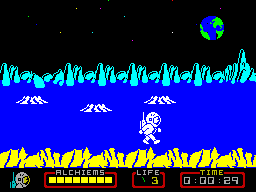
- NodesOfYesod.gifRunning screen 3 KB
.jpg)


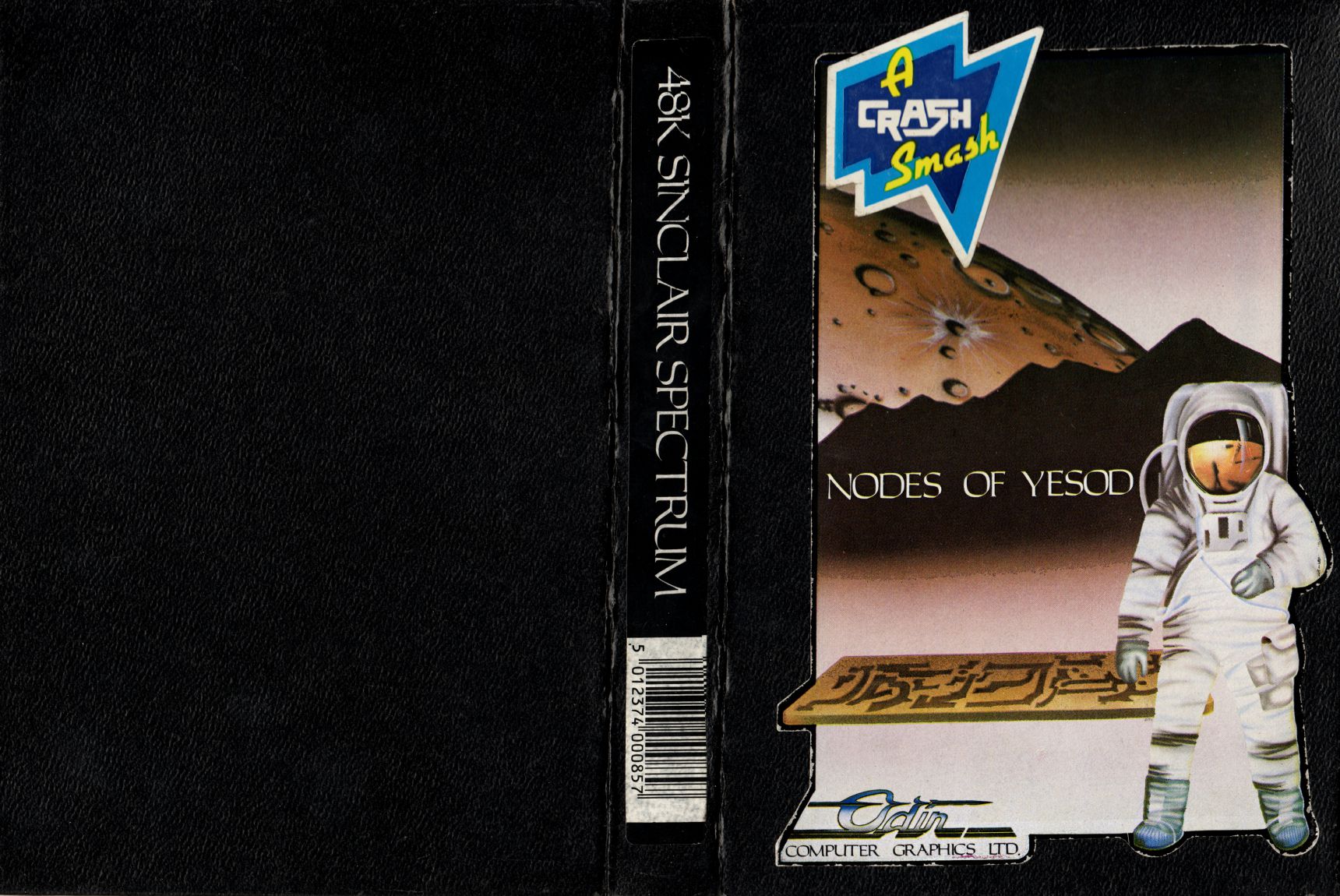
_Media.jpg)
_Media_2.jpg)
Files and rights
The rights holder has refused distribution. Files are listed because their existence is a catalogue fact, and none are served from here.
- DeniedOdin Computer Graphics Ltd → WorldOfSpectrum
Credits
- Steve WetherillCode
- Keith RobinsonCode
- Colin GrunesIn-game Graphics
- Stuart James FotheringhamIn-game Graphics
- Paul SalmonIn-game Graphics
- Fred GrayMusic
- Gerry FisherInlay/Poster Art
Sign in to credit somebody, or say what these people did.
Awards
Scores
In the magazines
- Sinclair User #411985 · Overall4/5
- Your Computer #81985 · Overall4/5
- ZX Computing #201985 · Overall4/5
- Sinclair Programs #341985 · Rating78%
- Crash #191985 · Overall93%
- Sinclair User #501986 · Overall4/5
Elsewhere on the web
- WorldOfSpectrum 121 votes8.17
Awards and competitions
Crash Readers Awards 1985
- 3Best Platform Game
In the magazines 45
Your Sinclair #6Jun 1986 · p.73
Rachael Smith
128 GAMES And so they came - the first trickle of 128 games. Sinclair cleverly made sure that the software was there, ready for the new machine. But most of the first releases have been expanded versions of existing titles, and we all know, don't we, that bigger doesn't necessarily mean better? After all, it's what you do with it that counts. So here it is - the highly personal, Rachael J Smith guide to those first ten releases. NODES OF YESOD/THE ARC OF YESOD Odin/Thor £9.95 Reviewer: Rachael Smith Nodes Of Yesod was something of a classic in its 48K version - not because of great sophistication or great complexity but because of its charm and good humour. I mean, any game that has you tunneling through the moon with a rock eating mole has to be something special! I'm not sure if the expanded version has added to the size of the caverns but it really scores in its use of music and sound effects. The tunes are catchy and the 'Burp' of your ill-mannered miner after chewing the green cheese is a nice touch. Newcomers to the Spectrum should certainly have this. Arc was seen as merely more of the same, with a robot sphere instead of a rodent assistant. Actually it adds a zapping element and the game seems to play rather faster. Still, unless you're a real fan of the original it's hardly a big enough leap for its hero, Rt Hon Charlemagne Fotheringham-Grunes, despite the zero gravity. I found that it kept returning to the opening screen for no apparent reason. So there they are, ten offerings for the 128. All benefit from having their amplified sound blasted out through the TV, and where the new sound chip has been used to full effect it's like suddenly being able to hear after years of deafness. But while there are things here to appeal to the person who's never owned a Spectrum before, I can't see much point in duplicating a game unless you were a big fan of the original. And that means that we're not yet in a position to say whether the 128 itself is worth buying. We'll have to wait until games that make full use of that extra memory - that do things that can't be achieved in 48K - appear before we all decide to trade in our old machines.
Sinclair User #50May 1986 · p.564/54/5
Overall 4/5
Chris Bourne 4/5
Publisher: Odin Programmers: The Odin team Price: £9.95 Memory: 128K Joystick: Kempston, Sinclair, cursor Charlemagne Fotheringham-Grunes is back again in a souped-up 128 version of Nodes of Yesod. Charlie gets sent to the moon to terminate the emission of signals from a large monolith of alien origin which... are you really reading all this? What you get is a slick, fast Underwurlde lookalike with Charlie somersaulting gaily around lunar caverns, tracking down the eight alchiems which are the key to halting the monolithic transmissions. The graphics are clear and detailed, with a fine variety of monsters, some of which are deadlier than others. Nastier creatures include a mysterious red spaceman who eats your alchiems, and shimmering creatures which cause you to lose energy. The sound effects are extremely good. The initial music is faintly reminiscent of an old Watch with Mother theme tune, but the music in the game is rather more atmospheric. Speech has also been attempted with varying results, but Charlie's cries for help are surprisingly audible, even if they sound like Kermit with a frog in his throat. Nodes of Yesod should take you a long time to complete. It looks good, sounds good, and has enough quirks and surprises to keep your interest for quite a while. An enjoyable game and no disgrace to the 128. However, other than the addition of music and speech, Nodes of Yesod remains the same as the 48K version.
Crash #27Apr 1986 · p.34
Julian Rignall
ALL THE LITTLE EXTRA BITS Julian Rignall, for it is he, puts down the joystick attached to his Commodore 64, wanders into the CRASH office and has a quick look at the game we've received for the 128K Spectrum. Between thee and me, he ended up well impressed - a diehard Commie 64 man, Jaz left the office muttering about buying the new Spectrum. Can't be bad news for Sinclair, that.... Hmmmm, a Spectrum with added bits? What would they be? I wondered. Wheels, a bit of whoosh, twiddly things? Nope, none of these - just extra RAM and an on-board hot plate to keep your coffee warm as you bash the baddies through the night. Well, it's not really a hot plate, but it doesn't half act like one. Anyway, what do these extra features mean to yer average gamesplayer on the street? Two 128 games are given away with the computer: Daley Thompson's Supertest and The Neverending Story. Daley's appeared on the Spectrum some time ago, and the original game had eight events which were loaded in two parts. The new 128 version has an extra four events: the javelin, 100m sprint, 110m hurdles and the triple jump along with the eight others and they're all loaded in a single go, making the game far more jolly and varied to play. Ocean have also made use of the 128's three-channel sound capability: excellent music accompanies the title screen and jingles play before and after each event. The whole game is far better than the 48K original and is a great freebie! The other game in the package is the official adventure of the film The Neverending Story. Again, the original version was a multiloader, although this time the game came in four chunks. The 128 version is another single load program, which makes it far more enjoyable to play. Again it's free, so you can't really complain. IN THE CHIP FACTORY Moving on to the 128 games you'll have to pay money for, Hewson's take the prize for releasing the very first 128K game - Technician Ted - the Megamix. Technician Ted 48K first appeared early last year, earning a CRASH Smash for programmers Steve Marsden and David Cooke. What Hewson have done is taken the original torturous platform arcade adventure and expanded it, making it twice as big - now there are over 100 different screens and thirty tasks to complete. AAAAAGGGH you might say, those lousy sadists... the original Tech Ted was bad enough!! The gameplay is radically different and the whole program has been 'tweaked' to take advantage of the new machine's capabilities. But don't fret poor things, each of the tasks has now been numbered so at least you know which task you're supposed to tackle next; the only problem is finding out how you complete them. Three channel music adds extra atmosphere to the game as you whizz around the factory. A special mention must go to the loader - it tells a story whilst the game loads and the music is superbly done. £7.95 buys you this piece of arcade adventuring action, only £2 more than the 48K original. ALL A BIT OF A WHIRL Gargoyle Games have also taken a tentative leap upon the 128 bandwaggon and whizzed out Sweevo's Whirled(sic) which is available for £9.95 - no increase. Capturing all those horrible Wijurs has now been made an even more difficult task with an extra fifty rooms to confuse and confound all you budding androids. There are some new images too - ginormous noses stick up through the floor (but luckily there are no huge bogeys to foul up our intrepid android's workings), fingers which make strange indecipherable (LMLWD) signs and there is also a curious lampost... I don't know what it does because I haven't seen the light (laugh, you philistines). Obviously there are no musicians at Gargoyle because there is no three channel sound, but the tune does sound better because it comes through the telly. CHATTY AND TUNEFUL Odin's Robin of the Wood and Nodes of Yesod have been souped up and join the handful of titles currently available for the 128K machine. The game elements and playing area of both 128 versions are unchanged but they now feature excellent music (as good as the Commodore any old day, believe me 'cos I'm a horrible ZZAP! reviewer). Also, a nice surprise awaits you... both programs talk. Yup, they do, and it's not too bad - a lot better than the dalek with laryngitis stuff that the old Spectrums used to burble out. 128 owners can hear Robin shouting "OW" when he gets an arrow in a painful place, and "give me a chance!!" a few seconds before he shuffles off this mortal coil. The game welcomes the player by saying "Can you help Robin in his quest for the silver arrow" upon loading - real arcade stuff! Nodes follows a similar path on the 128, with Champagne Charlie moaning and groaning as he trundles round the moon's underground caverns in his search for alchiems. You're also told when his life energy is running low, just in case you don't notice... wheee! Arc of Yesod is expected in the office any day now, and includes the fire option that was missing from the 48K version which should make it much more fun to play. Once again Odin have kept pretty much to the same game, but enhanced the product with speech and music. Odin are selling their 128 games for £9.95 - the same price charged for the originals. PARADISE EXPANDED Mikro-Gen's game Three Weeks in Paradise, which collected a CRASH Smash in its 48K incarnation last month, has been extended for the new machine and costs a pound extra, making it £10.95. The plot has grown a little, so completing the 128 game involves a lot more adventuring. Six new screens have been patched onto the game (go through the plug to find them). Some three channel music kicks the game off, otherwise the sound is much the same. FOR SKUFFLE FANS Fighting fans will no doubt be pleased to hear that Domark have added a pound to the price of Gladiator for the 128, making it £9.95. For the extra pennies you get two different graphics for the combatants - in the original version both gladiators were identical except for their weapons. Sound hasn't been upgraded a great deal - a sort of fairground tune plays on the menu screen and after a gladiator has been killed, and bopping noises indicate a hit on your opponent. One, two or four people can play the 128 version which includes ten new screens and a fairly polished demo mode. Essentially, however, the gameplay remains the same.
ZX Computing #24Apr 1986 · p.11
The Spectrum 128's that were ghosted into software houses around the country during the past few months came out into the open at the official 128 launch. Programmers have been feverishly preparing games to ensure the machine has credible software support. Despite assurances that 48k games run on the 128, to potential buyers this may seem like fitting a moped engine into a Ferrari. Compatibility is of course an asset but the machine's viability rests on the utilisation of its added features for games writing. The software houses have come up with a miscellany of revamped classics using the 128's new capabilities to varying degrees. Games written specifically for the 128 are in the pipeline but the first offerings are reviewed below. NODES OF YESOD Odin £9.95 The main difference between this and the 48K version of Nodes is not the size of the game, but the excellent speech synthesis that has been made possible by the 128's new sound chip. The game begins with "Welcome to The Nodes of Yesod, from the Odin Computer Graphics Team" - speech as good as I've heard on any home computer. The game itself is the same as the original version, in which you must help Charlie Fotheringham-Grunes locate the eight keys which will allow him to enter a cavern beneath the moon's surface where lurks a great monolith which is sending out signals to potential alien invaders. But now, in addition to the excellent animation and maze of monster infested lunar caverns, the game boosts a continuous and quite atmospheric soundtrack, as well as the occasional spot of speech synthesis such as 'Your energy is running low' or 'Ouch' when you fall from a height. Like Sweevo's World, this was an excellent and addictive game when released for the 48K Spectrum, and the addition of sound has only improved it. Mind you, it would have been good to see some of the memory used to expand the number of playing screens, which, as far as I can tell remains the same.
Nodes of Yesod
Sinclair User #41Aug 1985 · p.244/54/5
Overall 4/5
Clare Edgeley 4/5
Publisher: Odin Price: £9.95 Memory: 48K Joystick: Kempston, Cursor, Sinclair Lunar adventure awaits anyone brave enough to accompany the infamous Sloane Ranger, Charlemagne Fotheringham-Grunes, on his mission to save the earth. Odin's Nodes of Yesod is startlingly similar in theme to Quicksilva's Bugaboo but there the similarity ends. You play the pan of the intrepid Charlie who has to search the caverns of the moon for a monolith, which scientists believe is used to transmit coded messages through space. On docking, your best bet is to find a friendly mole who will be of considerable help later on in the game. Moles are able to gnaw through some cavern walls, opening up larger areas for exploration. For some unknown reason, Charlie keeps the mole in the helmet of his space suit. Dropping through one of the many craters, Charlie descends to a world inhabited by many wonderful alien types. Fish swim quite happily in zero gravity, firebirds and walking limes stalk the cavern floors - all of which will send you reeling. Dancing teddy-bears decrease your energy, but the mole can be sent to kill them. Dressed in a space suit, Charlie is able to somersault from platform to platform as he makes his way through the caverns. The graphic detail is excellent. Eight alchiems - unidentifiable objects - must be picked up if you are to find the monolith which is cunningly hidden. A grid at the bottom of the screen keeps count of alchiems collected, energy levels and has a real time clock. If your energy gets too low you may have to sit down for a rest. One alien in a red pressure suit must be avoided at all costs - he cannot be killed. As soon as you have found an alchiem he will be along to steal it. Control of movement when switching from Charlie to the mole is simple and animation is smooth - except when two bears land on the same spot, when they flicker wildly. The game more than makes up for the reams of waffling prose, spelling mistakes and lack of story on the cassette inlay. What are Rhodendendrons anyway? Despite that, Nodes of Yesod is definitely worth adding to your library of games.
Your Computer #8Aug 1985 · p.294/54/5
Overall 4/5
Peter Connor 4/5
Spectrum 48K Odin Computer Graphics Arcade Adventure £9.95 This evocatively named game features a home computer breakthrough - the first-ever Spectrum speech with Liverpudlian accent. But don't worry, it's only the introduction. It bears certain similarities to Ultimate's Underwurlde, not least in the quality of production. You play a spaceman who must descend into the depths of the moon, collect eight alchiems - coloured shapes - and then get to the Monolith. All this to save the universe from some horrendous evil. One of the game's nicest touches is that you're not alone in your quest. Before you disappear down a lunar pothole you need to catch a mole from its hole. When needed, the little crittur can be activated to chew through walls to new caverns, or to destroy the many creepy crawlies in the moon's depths. The subterranean playing area has many platforms which you hop around on. Progress is made in a series of athletic somersaults which will often land you at the very bottom of a cave - minus a life.
Your Spectrum #17Aug 1985 · p.41Your Spectrum Dave's Rave Of The Month5/5 HIT5/5 HIT4/5 HIT
Your SpectrumYour Spectrum Dave's Rave Of The Month
Dave Nicholls 5/5 HIT
Roger Willis 5/5 HIT
Ross Holman 4/5 HIT
JOYSTICK JURY Our three-ring circus of Roger Willis, Ross Holman and Dave Nicholls is back in town. Watch 'em put all the latest arcade games through the hoops - and have a laugh at the clowning around. What's the score? Well, the marks out of five at the end of each review is a shorthand way of summing up what each reviewer thought of the game. But will it be a commercial success? For that you'll have to check out the HIT and MISS system. Simple, eh? NODES OF YESOD Odin Software £9.95 Dave: Well, It must be said... this game features the best music on the Spectrum this side of Top Of The Pops (That's not saying much! Ed.) And not only that, but the animation is up to the standard set by Ultimate, and the speech... well, words fail! OK, you've probably gathered by now that I like this one, so let's get down to the nitty-gritty of the actual game. First off, you're briefed by Commander Smith in an appalling German accent and then it's into the action. Your task is to make your way across the lunar surface, jumping on to a moon-mole as soon as it pops its head out of one of the craters. You then move underground in search of the eight Alchiems that go to make up the great master key. On your journey under the lunar surface watch out for all sorts of baddies, such as the Liver Birds, a big red fish, an alien pirate and a bouncing Teddy Bear. Of course, if you choose you can transform yourself into a mole and deal with your enemies in a most animalistic fashion. You can jump all over the place, but mind you don't fall too far or else you'll find your space-suit develops leaks in the most unpleasant of places and you'll lose a life. The action is fast and furious throughout Nodes of Yesod, which is amazing when you consider the quality of the sprites and the flicker-free animation. The game really does pale into insignificance when you see it being played... the way the spaceman bounces off the lunar surfaces is a joy to behold. Some programming person has gone to the most meticulous detail to make sure that everything is just right. This one gets a resounding yesod from me!
Here we have it - the all-essential Alchiem. All you have to do now is collect the other seven Alchiems and then go in search of the monolith. Dressed to kill, here's our hero wearing the trendiest space gear this side of Carnaby Street. Note the tres chic Xammo jet pack on his back - how else does your average space-person get around these days? According to the instructions, this is a Spring Monster... but it looks more like a Teddy Bear to me! S'shame it's not so friendly. Watch out for this creature... it's none too friendly, and won't take kindly to the normal way of dispatching with unwelcome meanies. If you bounce this one on the head, it'll bounce you all over the screen.
This is a mole-hill - if you watch it closely, you may be lucky enough to see a moon-mole stick its head out for a couple of seconds. If you do, jump on it quickly as it'll enable you to transform into a mole during the rest of the proceedings. A mole-hole is the only way you're going to be able to get down into the underground world of Yesod. Down here you'll find all sorts of marauding meanies and badtempered baddies... so watch out! This is the heartbeat monitor - as you draw near to the end of your life the sine wave begins to slow down. A nice touch! This is the Alchiem counter. Each time you find a piece of the Alchiem, a square is filled in.
ZX Computing #20Aug 1985 · p.794/54/54/5
Graphics 4/5
Addictiveness 4/5
Overall 4/5
Odin Computer Graphics £9.95 Looking at the packaging and glossy, Ultimate style instruction booklet, I was expecting 'Nodes' to be simply over-hyped and underwhelming, as so many "mega-games' have proved to be. However, I was pleasantly surprised by Nodes once I started playing, and spent the best part of an evening bouncing around the surface of the moon and trying to complete the game. In many ways, Nodes is simply a platform-collect-the-object game, but it is nonetheless a very good one, and well enough designed to keep you interested in it for a long time. You play the part of the Rt Hon Charly Fotheringham-Grunes, 'apprentice saviour of the universe', and must guide him through caverns in the depths of the moon, in search of a monolith which is transmitting signals to another planet. To aid you in your search, you can recruit an extremely cute and nicely animated moon-mole, who can eat through moon rock and sometimes discover new passages and caverns. The figure of Charly himself is also very well animated - a large sprite, that actually seems to have a real character, and which somersaults delightfully, rather than just hopping across the screen. His somersaults are some of the smoothest animation I have yet seen on the Spectrum, and I spent a long time just bouncing around in order to enjoy the quality of the animation. As usual, there are various monsters out to stop him from reaching his goal, but here again his friendly moon-mole can help, by running around and eliminating them. Nodes isn't really state of the art, but it is a very well designed game and very enjoyable. My only criticism is that at £9.95, it's rather expensive, though not outrageously so.
Sinclair Programs #34Aug 1985 · p.1578%78%
Rating 78%
Colette McDermott 78%
PRICE: £9.95 GAME TYPE: Arcade A bouncing hero explores underground passages, leaping from ledge to ledge, often falling from a great height, hindered in his progress by a variety of strange creatures. Yes, you are right, Nodes of Yesod does seem remarkably similar to Underwwurlde. Smoothly scrolling graphics depict your search, beneath the surface of the moon, for a Monolith buried somewhere in its core. The weak gravity leads to a strange form of movement, so each large jump neatly encompasses a somersault, or two, or three. The aims is to reach the monolith, having first collected the eight alchiems which give access to that chamber. This involves negotiating the majority of the maze, a task which is made slightly easier by the fact that there are several entrances, and it is possible to enter and leave the maze at ground level. Matters are made more difficult by the other animated creatures. As in Underwurlde, most of these appear at random, materialising while you are in a room, getting in your way but generally doing very little more. Creatures which are a little more fixed and solid are the flying fish, quickly flowering plants, crawling insects and hopping birds. These are not lethal, but whenever you hit them, you bounce away again, often in an unexpected direction. Also to be avoided are the red spacemen, who will steal your alchiems. Whatever you do, too, do not fall from a great height, as this means almost certain death. A novel feature of Nodes of Ye sod are the moles which burrow on the moon's surface. These friendly little creatures can eat through the moon's surface so, if you can persuade one to travel with you, they will make life considerably easier. Nodes of Yesod is produced for the 48K Spectrum by Odin, [redacted].
Crash #19Aug 1985 · p.12Crash Smash92%96%93%91%90%89%93%
Use of Computer 92%
Graphics 96%
Playability 93%
Getting Started 91%
Addictive Qualities 90%
Value For Money 89%
Overall 93%
Unknown
Unknown
Unknown
Producer: Odin Computer Graphics Memory Required: 48K Retail Price: £9.95 Language: Machine code Author: The Team The blurb sheet that comes with the game goes on at length to describe the home, breakfast and lifestyle of The Rt. Hon. Charlemagne 'Charlie' Fotheringham-Grunes (our hero, and alleged apprentice saviour of the universe). You may fancy the mission, set him by a little chap in a rhodedendron bush, rather less than the breakfast (butter dripping kippers etc) he has just downed. What the chap form ICUPS tells him in rather broken English (either that or the Odin spell-checker needs a good kick) is that they are getting some rather strange signals from the moon. Would Charlie be so kind (and so stupid) as to go and find the 'erbschectt' responsible? The game begins with you wandering about on the surface of the moon (it must be the moon because in the background there is a very nice piccy of the earth). As you amble along, try to avoid falling down the holes before finding a friendly mole - the lunar moles are a helpful bunch compared to the peskies found on (and in) your average earth lawn. To give you some idea of the humour incorporated into this game the wall chewing tunnel finding mole has braces! With mole in tow leap down one of the holes and you will find yourself in a cavern with ledges and monsters, and more ledges and monsters! Most of the monsters are a nuisance - they merely get in your way rather than doing you harm - but they are quite fun to squash. Lower down in each of the caverns you find monsters of a different composition; they are not so easy to kill, and if you get too close you will be thrown all over the place and lose a great deal of energy. Monsters aside it's best not to forget the main purpose of Charlie's trip and which is to find the Monolith. He has already worked out that to get to it he needs to find and collect eight 'keys' or alchiems, so he must explore the caverns and stay alive. The alchiems are rather attractive crystal objects. Indeed, it is so attractive that you are not the only one collecting them, so proceed with great care if you don't want to become a victim of what could be the first lunar mugger. The task is pretty simple but is hugely complicated by the size of the cavern system; not all of the access routes are clear so you will have to use the mole to make extra tunnels. The game includes features such as whirlwinds that teleport you to somewhere that you would rather not be. Huge and deep shafts also exist, which can mean the certain loss of a life if you tumble down one - unless you get lucky and find that the one you just fell into has a very powerful updraft. Extra lives can be found scattered about the sub-lunar environment, which is just as well because on the bottom of the screen you can see your vital signs ticking away, your current life force ebbing away and your movements slow with every beating you take. When you get an extra life you will also find yourself with some things called gravity sticks. These are very useful because not only do they render galactic muggers harmless but also induce a gravity field in the immediate area causing all monsters (if you can count a cuddly teddy on a spring as a monster) to fall to the bottom of the cavern. COMMENTS Control keys: Q-R/A-F up/down, alternate bottom row keys for left/right Joystick: Kempston, cursor and Interface 2 Keyboard play: probably better than using a joystick Use of colour: exceptional Graphics: superlative Sound: not extensive, but when it is used it's great Skill levels: one Lives: three but more can be found Screens: 256
'Charlie' explores the lunar caverns.
Full-page ad11
- Crash #21Oct 1985 · p.128
- Crash #20Sep 1985 · p.23
- Your Spectrum #17Aug 1985 · p.50
- Crash #19Aug 1985 · p.53
- Your Spectrum #16Jul 1985 · p.14
- Your Computer #7Jul 1985 · p.26
- Your Spectrum #15Jun 1985 · p.22
- Your Computer #6Jun 1985 · p.123
- Your Computer #5May 1985 · p.107
- Crash #16May 1985 · p.131
- Your Spectrum #14May 1985 · p.27
Hack/Poke5
- YS Smash TipsAug 1988 · p.33
- Crash #27Apr 1986 · p.11
- Your Sinclair #2Feb 1986 · p.76
- Crash #20Sep 1985 · p.64
- Crash #19Aug 1985 · p.68
Tips5
- MicroHobby #107Dec 1986 · p.39
- Your Computer #8Aug 1986 · p.68
- Your Sinclair #2Feb 1986 · p.35
- C&VG (Computer & Video Games) #50Dec 1985 · p.46
- Your Computer #10Oct 1985 · p.37
Map4
- FIFO #101991 · p.35
- C&VG (Computer & Video Games) #49Nov 1985 · p.22
- Crash #21Oct 1985 · p.80
- Your Computer #10Oct 1985 · p.37
Review4
- MicroHobby #47Oct 1985 · p.12
- Computer Gamer #5Aug 1985 · p.75
- Home Computing Weekly #119Jul 1985 · p.14
- Popular Computing Weekly #25Jun 1985 · p.45
Information1
- SSD-IISep 1999
CompoResult1
- Crash #22Nov 1985 · p.135
Feature1
- MicroHobby Especial #1Nov 1985 · p.21
Letters1
- Crash #21Oct 1985 · p.68
CompoEntry1
- Crash #20Sep 1985 · p.80
Preview1
- Crash #18Jul 1985 · p.8
Remakes
- Nodes of Yesod2010iOS
Odin Computer Graphics Ltd & Uztek Games
Related
- Compilations
- Load 'n' Run issue 26, Load 'n' Run issue 62, Spectrum Load'n'Run v2 issue 06, The Spectrum
- Ports
- (Amstrad CPC), (BBC Micro), (Commodore 64), (Enterprise 64/128)
- Tags
- Beeper Speech
- Elsewhere
- Speccy Screenshot MapsWikipediaCentre for Computing HistoryMobyGamesRZX ArchiveThe TipshopUVLRZX Archive - YouTube
- Same entry at
- Spectrum ComputingZXInfo
Reviews from people here
Sign in to write about this, or make an account. It takes a minute and lets you correct the catalogue too.
Everything ZXDB can hold about this is here.
Sign in to correct or add to this.
Hold the rights to this and want it taken down?