
Nuclear Countdown
Arcade Game: Action · ZX-Spectrum 48K · 1 players · English
Atlantis Software Ltd · 1987 · Pound sterling 1.99
Discussion
Nobody has started a thread about this yet.
- Control Option
- Cursor, Interface 2 (right), Kempston Joystick, Redefineable keys
Releases
- 1987Atlantis Software LtdPound sterling 1.99
- 1987Zafiro Software DivisionSpanish peseta 399.00
Play
- NuclearCountdown.z80.zipSnapshot image English16 KB
- NuclearCountdown.tzx.zipTape image English14 KB
Documents
- NuclearCountdown.txtInstructions English2 KB
Other files
- Nuclear Countdown (1987)(Atlantis Software).pokPOK pokes file 0 KB
Files and rights
No permission is on record either way. Screens and pictures are copied here on a take-down basis: if you hold the rights and want something removed, say so and it goes.
Credits
- Adrian Longlandcredited
Sign in to credit somebody, or say what these people did.
Scores
In the magazines
- Sinclair User #601987 · Overall4/5
- Your Sinclair #151987 · Overall8/10
- Crash #381987 · Overall72%
Elsewhere on the web
- WorldOfSpectrum 14 votes7.21
In the magazines 7
C&VG (Computer & Video Games) #66Apr 1987 · p.348/103/109/107/10
Graphics 8/10
Sound 3/10
Value 9/10
Playability 7/10
Brian Webber
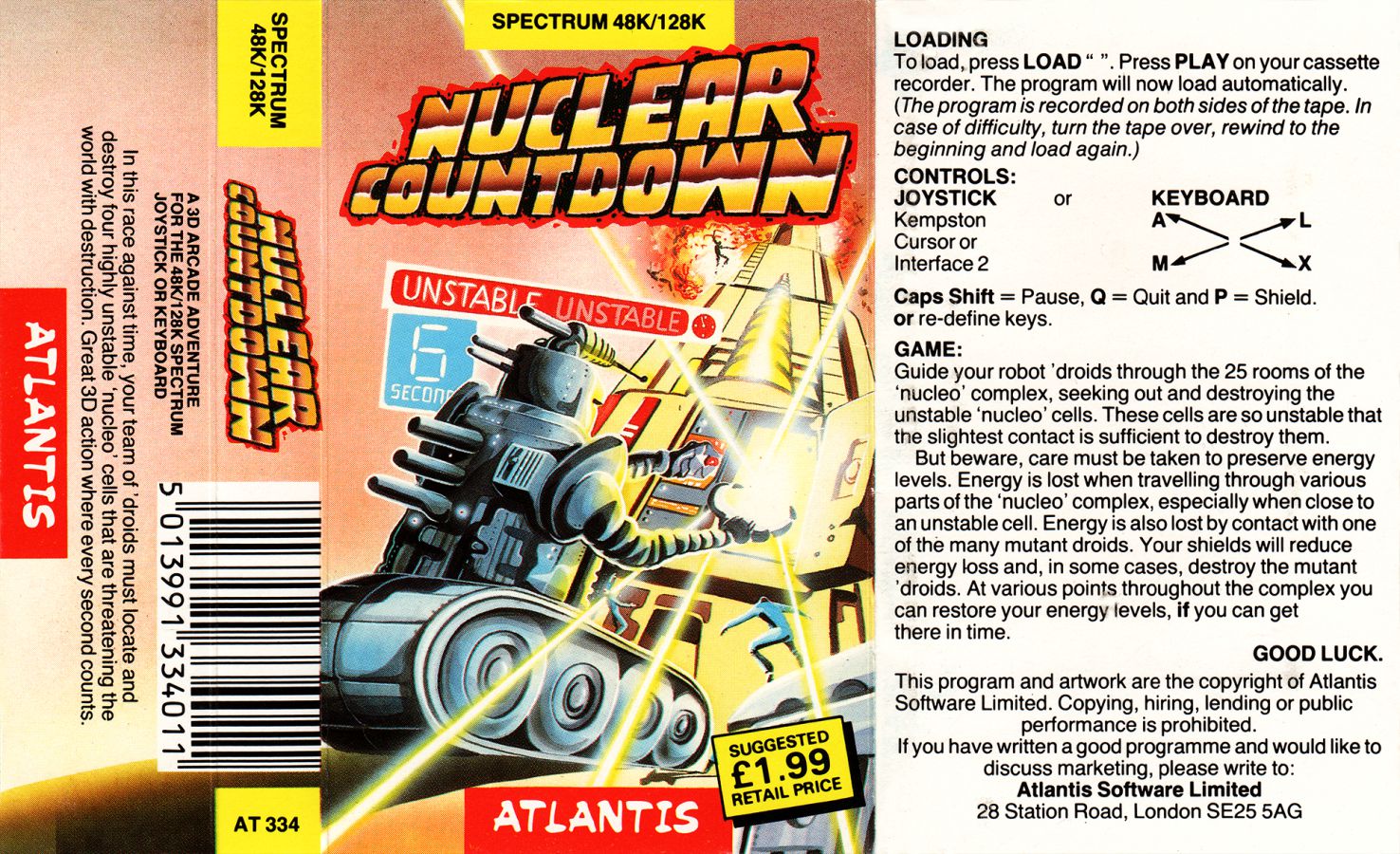
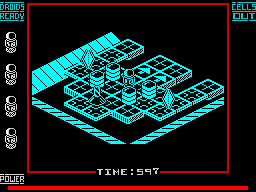
MACHINES: Spectrum 48/128 SUPPLIER: Atlantis PRICE: £1.99 If anybody out there fancies saving the world from a nuclear explosion yet again, then this offering from Atlantis will certainly be worth the £1.99 asking price. The idea is to guide your robots around 25 rooms to locate and destroy four unstable 'nucleo' cells that are threatening the world. Care must be taken to preserve your energy levels, energy is lost when travelling through various parts of the 'nucleo' complex, especially when close to an unstable cell. Energy is also lost by contact with one of the many mutant droids. Your shields will reduce energy loss and in some cases destroy the mutant droid. At various points throughout the complex you are able to restore your energy levels. When you start, the playing area scrolls onto the screen from below. The playing area is in the now worldwide famous Knightlore style. 3D for those of you who are new to the computer game terminology. The movement of your droid is very smooth as is the movement of the other droids that will drain your energy. You are given a time limit of 600 on the countdown clock to locate and destroy all the unstable 'nucleor cells. Nuclear Countdown is a very good try at 3D and will keep a lot of Spectrum owners happy.
Sinclair User #60Mar 1987 · p.724/54/5
Overall 4/5
Graham Taylor 4/5
Label: Atlantis Author: Adrian Longland Price: £1.99 Joystick: various Memory: 48K/128K Reviewer: Graham Taylor Amazing how last year's state of the art is this year's budget offering. A year or so back Nuclear Countdown would have been a Classic. This year it's a grade A top quality budget title. That's an advance I guess. Visually Nuclear Countdown reminds me of a cross between Gyroscope and Highway Encounter, there are the 3D grids, holes and sliding platforms that remind me of the former The funny little pyramids, barrels and other objects are inspired by the tatter. The game is played on a time limit. Your robot droid (yes another one of those) has to find its way through a maze of 25 rooms seeking out unstable cells and neutralising them (curiously this is achieved by blowing the thing up). Inevitably there are the usual bumper assortment of robot droids lurking around each screen in the game. These scuttle about and should you bump into them - Zing! - back you go to the first screen again. This can get very frustrating The grid-like rooms are not easy to negotiate either. Some sections forcibly slide you in one direction or another, whichever its the wrong way. you can be sure of that. Some squares drain energy shields (which defend you from at least some of the droid onslaught) others restore it. Some objects can be moved around, though I haven't found much reason to do so yet. Your continuing problem is to get to an energy restoring area before your shield energy drains completely. It isn't terrifically original, and 25 rooms is not that awesome, but its very slickly programmed and well worth investigating. As I said, a year ago it would have been £9.95.
Your Sinclair #15Mar 1987 · p.707/108/109/108/108/108/10
Graphics 7/10
Playability 8/10
Value For Money 9/10
Addictiveness 8/10
Overall 8/10
Phil South 8/10
Atlantis £1.99 Reviewer: Phil South Any game called Nuclear Countdown is bound to be a tacky little depressarama, right? Well, you're wrong! The aim of the game is to neutralise a series of nucleo cells distributed around the playing area, and you do this by simply bumping into them. The style of play is somewhere between Spindizzy and Bombscare, with a soupçon of the best qualities of both. The graphics are great - my favourite sprites are the little robot that you control, and the lumpy power cells you absorb on your way around the complex. The gameplay is slow at first, as you discover how to work your way round the rooms. After the first few goes, though, you can sprint around, using the moving floor sections for speed, as fast as you can handle. If you run out of time the reactor in the complex explodes, blasting every pixel from the screen in a huge nuclear explosion. This is a really good solid little game, which although not stupendously original in concept (man), is very good value!
Crash #38Mar 1987 · p.11367%72%70%68%78%72%
Presentation 67%
Graphics 72%
Playability 70%
Addictiveness 68%
Value For Money 78%
Overall 72%
Ben Stone
Mike Dunn
Paul Sumner
Producer: Atlantis Retail Price: £1.99 Author: Adrian Longland It's back to the old 'nuclear reactor going crazy' scenario. One thing games designers never tire of is the prospect of some hideous nuclear accident dumping radioactivity all over the place. Once again, you are at the controls trying to stop the world from glowing in the dark. Naturally, you are not expected to go down into the trouble zone in person - you have a little robot to guide around and do the dirty work. Four nucleo cells are unstable and about to blow any second, and they have to be destroyed by nudging into them. The game is played over a terrain displayed from an isometric 3D viewpoint, in a strange complex made up from blocks and floor sections. Some of the blocks can be shoved around, and the floor doesn't always cover the entire screen in view. Some segments drain energy while others propel your droid off in a given direction rather violently. Energy recharging points are scattered round the building. Mutant droids inhabit the complex and come in two basic flavours: some tromp around following a set patrol path and other, really mutant robots, home in on your droid. Contact with the guard droids saps energy, which is monitored by a horizontal bar at the base of the screen. The hero of the piece can fight back, however - he's equipped with a shield that drains energy when it's used but comes in handy for battering the baddies. The game is divided into four sections, one for each nucleo. Five droids are supplied, and when the current servant expires, the next mechanoid clanks off from the start of the current section. There's no score: just a rating based on the number of nucleos neutralised. To make life that bit more difficult, the game is played against the clock. COMMENTS Control keys: definable; left, right, up, down, shield, pause, quit Joystick: Kempston, Cursor, Interface 2 Use of colour: monochrome Graphics: excellent detail, good animation Sound: good effects, no tune Skill levels: two Screens: 25
Your droid is very close to a nucleo, buried in the middle of the screen.
CoverGame1
- Crash #76May 1990 · p.4
Hack/Poke1
- Your Sinclair #21Sep 1987 · p.53
Review1
- Computer Gamer #24Mar 1987 · p.53
Related
- Compilations
- Crash issue 76: Presents 12, ZX-Spectrum Vega
- Same entry at
- Spectrum ComputingZXInfo
Reviews from people here
Sign in to write about this, or make an account. It takes a minute and lets you correct the catalogue too.
No description recorded.
Sign in to correct or add to this.
Hold the rights to this and want it taken down?