
Olympimania
Arcade Game: Action · ZX-Spectrum 48K · 1 players · English
Automata UK Ltd · 1984 · Pound sterling 6.00
Discussion
Nobody has started a thread about this yet.
Remarks
Includes an audio track with a theme song.
- Control Option
- Kempston Joystick
Play
- olympimania.zipRZX playback file
- Olympimania.tzx.zipTape image English17 KB
- Olympimania.tap.zipTape image English18 KB
Documents
- Olympimania.txtInstructions English1 KB
Music
- PilandInternationalAnthemThe.mp3.zipBonus soundtrack(s) in MP3 format 8,695 KB
Files and rights
Distribution permission is on record, granted to another archive rather than to this one. Screens and pictures are copied here; everything else links to the archive that holds it.
- AllowedAutomata UK Ltd → WorldOfSpectrum
Credits
- Mel CroucherGame Design/Concept
- Christian PenfoldGame Design/Concept
- Andrew StaggCode
- Andrew StaggGame Design/Concept
- Robin Grenville EvansInlay/Poster Art
Sign in to credit somebody, or say what these people did.
Scores
In the magazines
- Sinclair User #271984 · Gilbert Factor6/10
- Your Computer #51984 · Overall2/5
- Crash #41984 · Overall66%
- Personal Computer Games #81984 · Overall6/10
- Sinclair User #291984 · Gilbert Factor6/10
Elsewhere on the web
- WorldOfSpectrum 16 votes5.44
In the magazines 29
Sinclair User #29Aug 1984 · p.566/106/10
Gilbert Factor 6/10
John Gilbert 6/10
SOFTWARE FOR THE SPECTRUM SPORTSMAN John Gilbert goes for gold in a bid to find the best computer sports simulations. OLYMPIMANIA Memory: 48K Price: £6 OLYMPICS Memory: 48K Price: £6.95 WORLDCUP FOOTBALL Memory: 48K Price: £6.95 FOOTBALL MANAGER Memory: 48K Price: £6.95 UNITED Memory: 48K Price: £6 TROON Memory: 48K Price: £6.95 NEW BIRKDALE Memory: 48K Price: £6.95 ROYAL BIRKDALE Memory: 48K Price: £5.90 SUPER SOCCER Memory: 48K Price: £7 SUPER-LEAGUE Memory: 48K Price: £6.50 ASHES Memory: 48K Price: £1.99 CRICKET CAPTAIN Memory: 48K Price: £4.95 HOWZAT Memory: 48K Price: £6.95 TEST MATCH Memory: 48K Price: £5.95 GOLF Memory: 16K Price: £5.95 Summer is here, or so we are told by the weathermen, and instead of spending hours in front of a television set watching the Olympics or a Test match, why not spend hours creating your own little piece of history with one of the Spectrum sports packages on the market? The Olympic Games have always brought with them a mass of souvenirs, ranging from flags to cuddly toys. This year is the same but there is an added dimension as computer software companies have tried to cash in with high-pressure selling of their sports programs, including ones which simulate Olympic events. Automata, of Pimania fame, has a spoof version of the Games with the Pi-man working his way to gold in five events. The events include the Pi-Jump, Alpi-Skiing, Steepi-Chase, the Pitathlon, and the Butter-Pi, which is the swimming contest. Each contest is animated smoothly and the graphics are detailed down to the last member of the crowd. After every contest has been lost or won the awards are given on the familiar three-position pedestal. If the Pi-man wins he takes a bow but if he loses he runs round the stadium shaking his fist at the crowd. Pi-man may have learned to be an athlete but he is certainly no sportsman. Olympimania, being from Automata, is a joke but should provide the usual hours of fun if you can suffer the inane humour of the Pi-man. You might also like to try the experience of listening to the soundtrack of the Pi-Land International Anthem on the reverse side of the cassette. The game should also appeal to people who find the real Olympics dull but if you take a more serious interest you will want to run Olympics, which is another spin-off from CRL. The program includes 14 events and is LOADed in two 48K parts. Side one of the cassette includes events such long jump, discus, shot putt and javelin. The other side contains six events which are held outside the stadium. They include cycling, swimming, canoeing and yachting. A marathon has also been included, run in five sections, each part between the other events. In the standard game you will take the part of the British team. The computer will challenge the might of three other teams consisting of the United States, the Soviet Union and the Rest of the World - this might be the only opportunity you have to see the Soviet Union compete in the Games. Once you have been through the first half of the Games the medals your team has won will be added to the score you accumulate in the second half. Unfortunately, only gold medals are awarded and you receive no points for being second or third. That detracts from authenticity as the Olympics are not the same without silver and bronze. The graphics which show the events taking place are not so good as those of Olympimania but the ways in which the athletes compete in terms of skill and energy levels have been well thought out. Sufficient realism has been incorporated into the program that athletes will start to slow during the events if you over-stretch their limits. The games are written in Basic with a corresponding slowness in the speed of graphics and the way in which results are calculated. Olympics will interest fans who buy anything to do with the Games but will disappoint others who are looking for good sporting software. The World Cup is to football enthusiasts what the Olympics is to athletics fans. Artic Computing has decided to produce its own World Cup Football for the Spectrum two years early. You take the part of one of the teams playing in the cup and take it through a series of games to reach the final. Each game has the usual time-scale, including injury time if necessary, but the time factor is scaled-down so that each game takes about five minutes to play. The graphics representation of play shows part of the field and the life-like actions of the players. The players even return to the dressing rooms at half-time. Your control is limited to the footballer who is nearest to the ball in your team. That player will light up when in possession of the ball. World Cup Football can be played at nine levels and there are 40 teams in contention. The game is addictive and should even be of interest to people who know nothing about football. United, from CCS, on the other hand is a poor relation of the Addictive Games Football Manager and has none of the thrills of the Artic game. The four league tables are there, you can pick your team, and you can spy on the other teams to find their weak spots. The only people who will like it, however, are those who like looking at tables of figures, as the graphics displayed when games are taking place are appalling, having a green background with little pin-men making a brave effort to keep contact with the ball. United is so uninteresting that it cannot be recommended, even to beginners. If you want a good game buy Football Manager, which is still the best value for money. Super Soccer is much the same as United. It is poorly-presented, slow, and we also had difficulty in LOADing our copy, which could point to the use of low-quality cassettes for reproduction. Winters is a small company which exists solely because of its range of sports programs. Super Soccer is not one of its better efforts, which is a pity, as some thought appears to have been put into the game. It can be obtained from Winters Ltd, 24 Swannington Close, Cantley, Doncaster, South Yorkshire DN4 6UA. Super-League, for the 48K Spectrum, is from Cross Software and, thankfully, different from the other play-and-get-to-the-top-of-the-league games. At the start you have to decide the skill level at which you are to play. That is based, as ever, on the league position but, in the case of Super-League, you have either to finish in the top six, in the top half, or avoid relegation. Unfortunately the game is limited, as there is only one division in which to play. If you are relegated you join the losers and the game finishes. Like many other football games on the market, the program is just a database which manipulates numbers to produce the league results. It would not be half so bad if the players were shielded from all the calculations by more varied methods of input but numbers have to be balanced on the skill sheets to provide marks for dribbling skill, strength of kick and supporting energy in attack and defence. Everything is entered as numbers and the computer then plays the game for you. That is followed by a 30-second wait for results, which would deter the strongest of us from football for life. It is obvious that the major criticism of the game is that you are not given sufficient involvement during play. Although Super-League will become tedious for hunters for action, there are sufficient aspects in it to hold the attention of a fanatic. It is pity that most of the game is played by the computer but if you prefer to plot strategy quietly and slowly, Super-League is for you. The cricket season is in full swing and there are many games for the Spectrum which will support fans when their teams have walked off out of the rain. Ashes, from Pulsonic, is the cheapest in the range at £1.99. It provides a good graphic simulation of the game for the 48K Spectrum. At the start you are given a choice of venues. There are 10 of them, five in England and five in Australia. Your choice will, of course, affect the type of bowlers you can select. Each team has 11 players you can choose, or you can use the two teams which are already in the computer. You can specify the type of bowler you require as fast, swing/seam or spin. The toss is made and the winner automatically bats first. If you are not batting you will have to field your players to take advantage of the ground and particular batsmen. Positioning is limited as you can choose only from those positions indicated by the computer. Like so many sports games, Ashes relies heavily on numeric input. If you are batting you have to match your stroke with the way the bowler pitches at you by entering a numeric option. The same is true of bowling. You must press a number to signify your choice of line and length. Howzat, from Wyvern Software, is one of the best cricket games available. The graphics display is freer than Ashes, as you can decide where you want to put your players without restriction on field areas. You can also change the field if you think it is necessary at most points in the game. Wyvern has opted for realism as it has included 17 first-class county squads and seven Test squads with which you can play. As with Ashes you can choose a standard team or select one of your own. Howzat, however, has an edge over Ashes as you have a wider range of teams from which to select your 11 players. Details of matches and information about the state of players is given quickly and efficiently. Wyvern has even included a realistic scoreboard to show the events while play is taking place. Its depth of play and proximity to the real thing could not be beaten even by such games as Test Match, from CRL, or Cricket Captain, from Allanson Computing, which aim to produce the same effect. If your game is golf rather than cricket, there are many simulations of courses round Britain, including the Troon and New Birkdale classics from Hornby Software. Among the newer releases Royal Birkdale, from Ocean, is one of the best. The game takes you to the famous course which has hosted the Open championship and has been the haunt of many famous players. At the start you are given the opportunity to alter the wind speed conditions. You then select your club and take a position at the first tee. There are 10 clubs in all, the first being a driver and the last a sand iron. Directions are entered using a clock-face technique in which 0 and 360 degrees point north. That is the method used by all computer golf games, although some vary the directions round the clock. The instructions on the cassette insert are more than adequate and provide hints on how to play in the rough and which clubs to use on any occasion. The course is laid out hole by hole and when your ball hits the green a close-up of the hole is given so that you have a better chance of holing the ball. The only criticism is that the graphics representing the course are too detailed and the different areas of the course tend to clash with each other. If you can tolerate the cluttered screen display, Royal Birkdale should give you many hours of pleasure. Like any of the other sports games on the Spectrum it can be just as much fun for a non-sports player as for an enthusiast. Virgin has recently issued its version of Golf but, unlike most of the other companies specialising in sports, it has aimed its program at the 16K Spectrum. The game, for one to four players, scores points on graphics display, which is more inviting and easier to read than that of Ocean, but it does not have the same feel of a real course Royal Birkdale offers. The Virgin version offers play at a varying number of holes, from one to 18, and will allow you to use one of six clubs for each shot. Wind direction and speed are not taken into account so noticeably during the game but the names of the clubs and strength with which you hit the ball are important factors. Golf uses the same direction input system as Royal Birkdale but is more precise as to the points of the compass in relation to the player. It is certainly a match for Royal Birkdale but the Ocean game wins for its authenticity. If we were to apply a rule that all sports games had to be representative of reality, none of those reviewed would be worth playing. The best, such as World Cup Football, Troon and Royal Rirkdale, are just barely simulations. A fairer rule to apply would be that all the games provide entertainment for people who enjoy real sports, and most of those reviewed clearly do. Games using soccer, golf or cricket for their basis are not meant as full simulations and they are more likely to be played by computer users and sporting computer owners than sports enthusiasts. Undoubtedly few Spectrums have been bought solely to play sports games and if they have that is a sad prediction for the future of the sporting world, which relies heavily on co-operation and team spirit. Computer games can go nowhere near to simulating that type of experience. Most sports are outdoor activities and, like nothing else, lose much in translation to computer. Computers are limited in the way they store information and cannot take all the variables of game play into account. Most sports programs are, therefore, very limited in what they achieve. Players using computers to play football or golf may be trying to ind a substitute for the real thing. If you are satisfied with that substitute, the games available for the Spectrum should keep you entertained. None of the so-called simulations on the market, however, is anywhere near the real thing.
Olympics
Olympimania
Royal Birkdale
Test Match
World Cup Football
Your Spectrum #5Jul 1984 · p.538/108/106/10
Ian Simmonds 8/10
Jon Warner 8/10
Simon Cox 6/10
Sticks at the ready, the Chiltern Computer Club buckled down to some concentrated critique as they sifted through the latest bundle of software to give us their unbiased evaluations. Any club wishing to offer their reviewing services should contact Ron Smith, Spectrum Soft, [redacted]. This month, the reviewers in the YS jury hot-seat are all members of Chiltern Computer Club, Eaton Bray, near Dunstable. They are (in alphabetical order) Simon Cox, Ian Simmonds and Jon Warner. To be honest it wasn't an easy job for them, with many of the latest offerings falling short of an acceptable level - in fact, sheer crud in some cases. Read on to find out what (and what not) to buy. The Chiltern Computer Club was formed around two years ago, and usually it manages to attract about 35 members - ages ranging from 13 years to near senility. Membership is currently £4 per year, for which potential members can expect practical help with their computer problems, and guest speakers and lecturers from time to time. Club contacts can be made via Steve Betts, [redacted]. Finally thanks go to Steve for the ultra-fast speed at which he pulled the test together. OLYMPIMANIA Automata £6.00 You, as the Pi-Man, must compete in five events at the Olympics in an effort to win as many gold medals as you can.
Personal Computer Games #8Jul 1984 · p.456/105/107/105/106/106/10
Graphics 6/10
Sound 5/10
Originality 7/10
Lasting Interest 5/10
Overall 6/10
Steve Mann 6/10
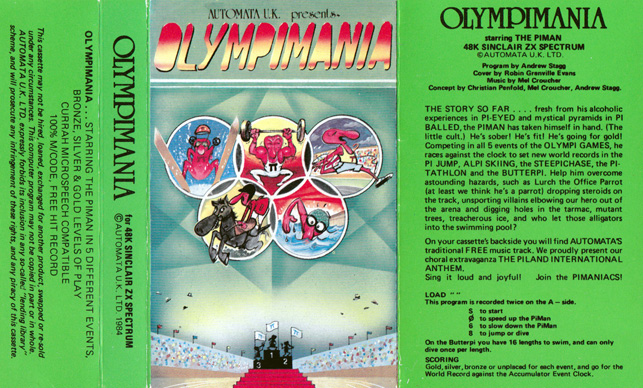
MACHINE: Spectrum 48K CONTROL: Keys, Kemp FROM: Automata, £6.00 Even if only half the world competes at Los Angeles in this year's Olympics, Automata's latest offering will enable you to control that little cult figure the Pi-Man in his search for gold and glory in five Olympic events. Now sober and fit, the Pi-Man is bidding for glory in the Pi Jump, Alpi Skiing, the Steepichase, the Pitathlon and the Butterpi. As ever with the Pi-Man, things do not always go smoothly, and hazards to watch out for include Lurch the office parrot dropping steroids on the track, alligators and octopuses in the swimming pool, treacherous foreign competitors with no sense of fair play - in fact, just about everything you'd expect from the weirdos at Automata. Controls are kept very simple - just S to start, 0 to make the Pi-Man run or swim faster, 6 to slow him down and 8 to make him jump or dive. There's a Kempston joystick option - but really in a game of this kind a 'stick is more of a hindrance than a help. Scoring is kept very simple - each event gives the Pi-Man the chance to win gold, silver or bronze or to finish unplaced, and there is a 'world record' to set this is an accumulated time for all five events. The Currah Microspeech unit may be connected for better sound effects and, as always in a Pi-Man game, there is a free piece of 'music' on the flipside of the cassette. It's as excruciating as you'd expect. It's certainly a novel enough game, and the simplicity of it means that its appeal is instant - but I doubt if I'll still be playing Olympimania when the real thing's on TV.
Sinclair User #27Jun 1984 · p.356/10
Gilbert Factor 6/10
PI-MAN'S GOLD GAMBLE Memory: 48K Price £6 Anyone concerned about the fate of the Pi-man will be relieved to hear that after the alcoholic excesses of Pi-eyed, he is now utterly reformed, even to the extent of entering for five events in the Olympic Games. That, however, is probably the best piece of news about the latest game from Automata, Olympimania. Apart from the usual excellent graphics - the most spectacular sequence is the Olympic stadium with its rostrum and wildly waving crowds - the game has a limited amount to offer in the way of entertainment. The five events - Pi- jump, Alpi skiing, Pitathlon and so on - are all similar, with a series of obstacles to jump and some unlikely hazards to overcome, such as rival competitors who dig holes beneath the Pi-man, or fish and alligators in the case of the swimming event. In all the events, it is extremely difficult to win a bronze medal, let alone a gold, and as a result the interest soon palls in spite of the amusing graphics. The reverse side of the tape, true to Automata traditions, has a pop music track, described as a choral extravaganza of the Piland International Anthem. The kindest thing to be said about it is that by comparison it places its companion game in a favourable light.
Your Computer #5May 1984 · p.572/5
Overall 2/5
Spectrum 48K Automata £6.00 Cashing in on the wave of apathy sweeping the country as regards the 1984 Olympic games in Los Angeles this year, Automata have rushed out another Pi-game. Tracing its line of descent from games like Jumping Jack, the Pi-man competes in all five events of the Olympic Games. He races against time to achieve world records in the Pi Jump, the Alpi skiing, the Steepichase, the Pitathlon, and the Butterpi. All of these events consist of jumping over things. In the first game, he is jumping over pi-signs, in the second game, he ski-jumps over pine-trees, in the Steepichase over pi-signs, over musclemen in the pitathlon. There is original departure from this in the Butterpi which is a swimming race viewed from overhead. There is an octopus in your lane, and you have to punch 8 to dive, leaving a swirl of ripples on the surface. Lurch the office parrot - at least they think he's a parrot - makes a sudden appearance in some of the games dropping steroids on the track - at least they think they're steroids. Other sportsmen are always elbowing you out of the way, and even alligators show up in the swimming pool as the game progresses. The worst thing about this latest presentation is the PiLand International Anthem on the back. While we may look forward to a future free from tsetse flies, piles and hangovers, using a Martin Luther King voice-over is just plain bad taste in this context. It's an averagely enjoyable game but as regards commercial popularity we suspect Malcolm X's "No Sell-out" would have been a better track to put on the back.
Crash #4May 1984 · p.11569%72%68%70%59%55%66%
Use of Computer 69%
Graphics 72%
Playability 68%
Getting Started 70%
Addictive Qualities 59%
Value For Money 55%
Overall 66%
Unknown
Unknown
Unknown
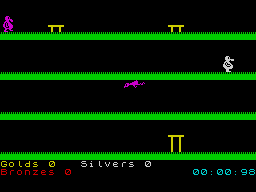
Producer: Automata Memory Required: 48K Retail Price: £6.00 Language: Machine code Author: Andrew Stagg Automata, never laggards for a bit of topicality, have taken the noble sporting event known to the sane world as the Olympics, and turned it into a travesty of running, jumping and swimming. The Piman, having recovered from his drunken binge in Pi-Eyed and the bouncing balls of Pi-Balled, has taken himself in hand and is going for gold. Olympimania offers the average armchair pimaniac not three, not four, but an astonishing FIVE events in which to compete. The Pijump, Alpiskiing, Steepichase, the Pitathalon and, for a soggy finish in the Olympi pool, the Butterpi. The game takes the form of a platform game (of sorts). In all but the last event, each screen contains four layers. Along each the Piman, suitably attired for the particular event, must travel, jumping over obstacles, avoiding the faster competitiors by jumping and letting them pass underneath, and thus finish the screen. A following screen offers more hazards. Should the Piman achieve a high score (per frame) and get a bronze, silver or gold medal, he may mount the winners' rostrum. Between each event, there is a screen set in a crowded auditorium with the rostrums in the centre. Medal winners get to take their places, failed Pimen dash over the rostrum to collapse in a fit of tears and ground thumping on the other side, while the crowd behind applaud. The game is compatible with the Currah Microspeech unit which offers amplified sound and an intoning voice saying, 'On your marks, get set, GO!' it also announces the name of each event in which the Piman is about to take part. The Pijump involves jumping over hurdles while avoiding another jumper and an overflying bird. In ski-ing there are fir trees and the same other mad competitor. Steepichasing sees him mounted on a prancing horse with fences to jump and another rider. In Pitathlon he has to leap weight lifters and then compete against other swimmers in the Butterpi. Unfortunately the Piman's swimming lane is monster infested, but he may dive under them once per length. It's all quite silly and charming. COMMENTS Controls keys: 0 speed up, 6 slow down, 8 jump or dive Joystick: Kempston Keyboard play: simple and responsive Use of colour: good Graphics: very good, smooth and fast Sound: fair Skill levels: three difficulties by screen on each vent Lives: calculated as the three difficulty levels, ie Bronze, Silver and Gold Features: Currah Microspeech compatible
On your marks, get set, Go - and the Olympimaniacs are off.
Automata 10 Pack Volume One carries this game and has 17 references of its own.
Advert16
- Your Spectrum #9Nov 1984 · p.25
- Sinclair Programs #25Nov 1984 · p.46
- Big K #8Nov 1984 · p.13
- C&VG (Computer & Video Games) #37Nov 1984 · p.36
- Sinclair Programs #24Oct 1984 · p.34
- Your Spectrum #8Oct 1984 · p.84
- Big K #7Oct 1984 · p.13
- Popular Computing Weekly #32Aug 1984 · p.52
- C&VG (Computer & Video Games) #33Jul 1984 · p.77
- Personal Computer Games #8Jul 1984 · p.27
- Big K #4Jul 1984 · p.32
- C&VG (Computer & Video Games) #31May 1984 · p.24
- Crash #3Apr 1984 · p.91
- Micro Adventurer #6Apr 1984 · p.38
- C&VG (Computer & Video Games) #30Apr 1984 · p.22
- Personal Computer Games #5Apr 1984 · p.123
Feature4
- Crash #16May 1985 · p.41
- Personal Computer Games #9Aug 1984 · p.27
- Sinclair User #29Aug 1984 · p.56
- Computer ChoiceJul 1984 · p.60
News/Note2
- ZX Computing #13Jun 1984 · p.97
- C&VG (Computer & Video Games) #30Apr 1984 · p.24
Review1
- Popular Computing Weekly #14Apr 1984 · p.60
Licensed from
- Olympic Games '84, Los AngelesSports eventunofficial
Related
Reviews from people here
Sign in to write about this, or make an account. It takes a minute and lets you correct the catalogue too.
Everything ZXDB can hold about this is here.
Sign in to correct or add to this.
Hold the rights to this and want it taken down?