
The Oracle's Cave
Adventure Game: RPG · ZX-Spectrum 48K · 1 players · English
Doric Computer Services · 1984 · Pound sterling 7.95
Discussion
Nobody has started a thread about this yet.
Remarks
ZXSR: Produces a random dungeon each time you play.
Awards
Rank #48 - 1984 Sinclair User Top 50 Spectrum Software Classics
Play
- oraclescave.rzxRZX playback file
- OraclesCaveThe.tzx.zipTape image English19 KB
- OraclesCaveThe.tap.zipTape image English21 KB
Documents
- OraclesCaveThe.txtInstructions English3 KB
Other files
- Oracle's Cave, The (1984)(Doric Computer Services).pokPOK pokes file 0 KB
Files and rights
No permission is on record either way. Screens and pictures are copied here on a take-down basis: if you hold the rights and want something removed, say so and it goes.
Credits
- Chris Dorrellcredited
Sign in to credit somebody, or say what these people did.
Scores
In the magazines
- Sinclair User #211983 · Gilbert Factor8/10
- Crash #11984 · Overall70%
- Crash #21984 · Overall70%
- Crash #41984 · Overall70%
- Sinclair User #231984 · Gilbert Factor8/10
- Personal Computer News #581984 · Overall Value2/5
Elsewhere on the web
- WorldOfSpectrum 36 votes8.12
In the magazines 62
Sinclair User #32Nov 1984 · p.50
Adventures with randomly generate dungeons tend to be unsatisfactory due to the lack of plot and coherent logic. The Oracle's Cave suffers slightly on that count but makes up for it in other respects. In one of the first full graphical adventures, your heroic character explores a network of caves, battling a variety of monsters. You may choose from four separate quests, and must complete the game within a time limit. The animated graphics were a new development at the time, and looked forward to Valhalla. Short on problems, but long on violence, The Oracle's Cave has won itself many devoted followers since its launch early in 1983. Position 48/50
Sinclair Programs #20Jun 1984 · p.29
June Mortimer
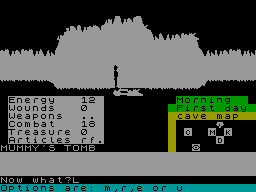
This month we focus on a selection of games and on the new range of software for students of Shakespeare from Penguin Books. Oracle's Cave is a superb animated adventure for the 48K Spectrum. The player's quest is to negotiate the Oracle's Cave complex, find the chosen quest item, collect four items of treasure, kill the oracle and escape. Each movement through the caves is shown on-screen, in a display which scrolls smoothly from left to right and up and down. The screen display is divided into several areas - a map of the cave showing areas which have been explored and which do not contain monsters; a list of options open to the player; a response to the player's last choice; a chart showing the player's progress; and the display of the action. The game has a time limit of five days, which means that the player must always clock-watch and avoid taking too many rests. The time limit means that the game never continues for too long and it can easily be played several times in one session. Playing the game several times is important, since there are several strategies to be worked out. It is important to collect sufficient weapons to be able to escape to freedom, to know where the most valuable treasure can be found, and to know when to explore and when not. The key is important, so do not try to finish the game without it, or you will never see the blue sky and the mountainside outside but will perish in the caves. Oracle's Cave is produced for the 48K Spectrum by Doric Computer Services, [redacted] and costs £7.95.
Crash #4May 1984 · p.7670%
Overall 70%
Producer: DORIC, 48K £7.95 (1) Author: Chris Dorrell Using the classic D&D format, this is an animated graphics adventure. You must seek the entrance to the caves in which you are trapped, collecting 40 units of treasure on your way. You must also collect treasure guarded by four special monsters, The Mummy, The Centaur, The Fiery Dragon or The Black Knight. With each game the layout of the caves is randomly generated to make each play different from the last. Commands are entered in resonse to a menu of limited options which allow you to move, rest, explore, use (a carried article) or, if in the presence of a monster, fight or run. If you elect to move the menu is replaced by another offering left/right/up/down. When 'you' move there is an animation sequence which is very well done expecially the descent of stairs. The fights are fun, but you must watch your combat strength and that of your opponent very carefully. Another point is to use the explore facility all the while. The game grows on you as you begin to realise its potential. Reasonable response times, good graphics and good value for money. Overall CRASH rating 70%. BASIC.
Personal Computer News #58Apr 1984 · p.343/52/53/52/5
Lasting Appeal 3/5
Playability 2/5
Use Of The Machine 3/5
Overall Value 2/5
Barry Miles
Bob Chappell
Geof Wheelwight
John Lettice
Kevin Bergin
Russel Jones
Simon Williams
Tony Harrington
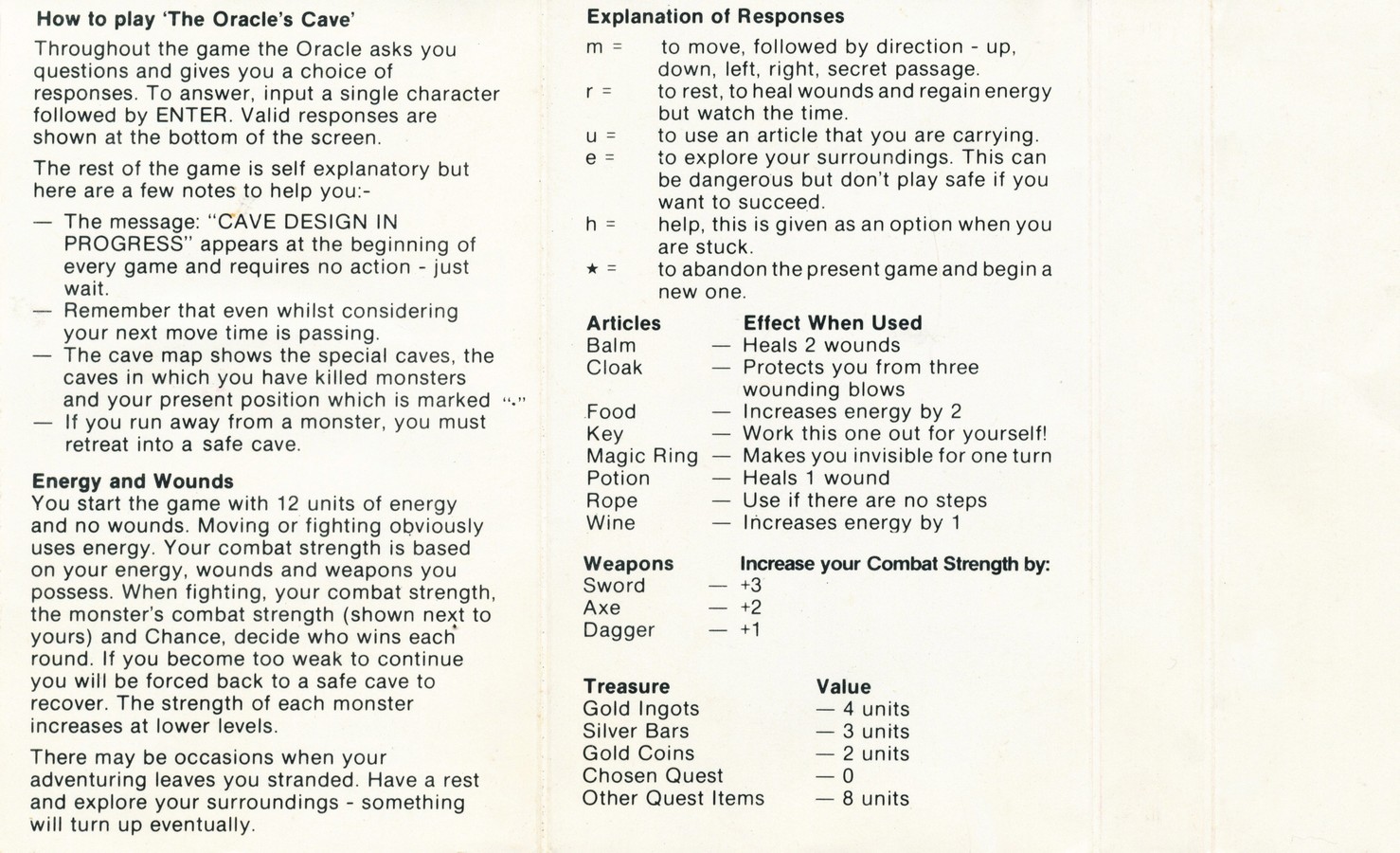
PCN MICROPAEDIA VOL 21 PART 1 GAMES COMPENDIUM Atari Arcade Action BBC Blast-off Commodore 64 Cavalcade Spectrum Spectacular Dragon Digressions Welcome to gameplayers' heaven. This week sees the beginning of our two part Micropaedia devoted exclusively to games reviews. We have collected together a large selection of arcade, adventure and educational games for six of the most popular micros: the BBC B, Electron, Sinclair Spectrum, Dragon, Commodore 64 and Atari. NAME: The Oracle's Cave SYSTEM: 48K Spectrum PRICE: £7.95 PUBLISHER: Doric Computer Services, [redacted] FORMAT: Cassette LANGUAGE: Machine code OTHER VERSIONS: None OUTLETS: Mail order/retail The Oracle's Cave could be a parable of what is wrong with humanity today. As you plod through the cave complex, you bump into a whole range of elaborate graphics characters, beautiful creations, and what do you do? You kill them... You're a nasty piece of work. You've gone into the Oracle's Cave on a treasure hunt, and you can't leave until you've killed the Thing of your choice plus the Oracle itself, and collected a large store of treasure. Gambling debts? Saving up for an IBM PC? The instructions do not elaborate. You have just five days - which works out at about an hour's play - to leave the place looking like a turkey factory. The field of play is a vertical cross-section of a series of caverns, on a number of levels, where you meet and generally kill the Giant Rat, Ogre, Mummy or whatever before you can go anywhere but back the way you came. As you fight them, your strength and energy decrease which you build up again by eating and resting. Commands are single key, presented in the form of a menu of single letter options. So, initially you opt to move, explore, rest or use an object, then if you opt to move, you'll be given the options left, right, up, down or secret passage. Once you're locked into one of these menus, it's not possible to get out - you say move, you move. This explains the h for help function, which sends you straight back to the start. Winning is about tooling up with axe and sword, and using the magic ring and the magic cloak to improve the odds. In principle, an adventure where you hit things rather than solve puzzles makes a nice change, but this one may be too simple.
C&VG (Computer & Video Games) #29Mar 1984 · p.150
Keith Campbell
QUITE A SPECTRACLE! Following closely on the heels of Valhalla, but from Doric and relatively unsung, comes The Oracle's Cave, for Spectrum (what with Doric and Oracle, somehow this seems the wrong micro for the game!). Since animated graphics are again the order of the day, comparison is inevitable. In Oracle, the graphics are used in an entirely different way. Your little figure not only moves around, but the location 'pans' with him, so there is no sharp cut-off of one picture to be replaced by another thus movement is smooth and continuous. Response is fast compared with Valhalla, making the game a pleasure to play. At the outset, you may choose one of four quests - obtaining a treasure guarded by a mummy, centaur, dragon or knight. You must collect, in all, 40 units of treasure to complete the quest. The game is played in real time, and the maximum playing time is one hour (Oh happy reviewer!) Each game starts off with a new network of caves. Commands are entered as single letters, and the permissible options are displayed at all times. For example, if you type 'in' for move, then your next options might be l, r, u, d, s, meaning left, right, up, down and secret passage. Unfortunately, this very good game is let down by its lack of instructions to the user. The cassette inlay gives some instructions, true, but they in no way make it clear exactly how to use and manipulate things, nor how to use or interpret the cave map inset to the bottom right of the display. This can be easily overcome, of course - produce an instruction booklet quick, Doric! The Oracle Cave is from Doric for 48k Spectrum, and costs a modest £7.95. Reviewer: Keith Campbell
Crash #2Mar 1984 · p.6770%
Overall 70%
Producer: DORIC, 48K £7.95 (1) Author: Chris Dorrell Using the classic D&D format, this is an animated graphics adventure. You must seek the entrance to the caves in which you are trapped, collecting 40 units of treasure on your way. You must also collect treasure guarded by four special monsters, The Mummy, The Centaur, The Fiery Dragon or The Black Knight. With each game the layout of the caves is randomly generated to make each play different from the last. Commands are entered in resonse to a menu of limited options which allow you to move, rest, explore, use (a carried article) or, if in the presence of a monster, fight or run. If you elect to move the menu is replaced by another offering left/right/up/down. When 'you' move there is an animation sequence which is very well done expecially the descent of stairs. The fights are fun, but you must watch your combat strength and that of your opponent very carefully. Another point is to use the explore facility all the while. The game grows on you as you begin to realise its potential. Reasonable response times, good graphics and good value for money. Overall CRASH rating 70%. BASIC.
Sinclair User #23Feb 1984 · p.1358/108/10
Gilbert Factor 8/10
Quentin Heath 8/10
NEW PATHS EXPLORED IN NORSE ADVENTURE Quentin Heath's latest round-up. There is a change in direction for adventure games. The path taken so far by authors has been through text-only displays, which left a great deal to the imagination, through graphics adventures which looked like board games and then on to animated games. The progression was by necessity rather than design. The first adventures were produced on large mainframe computers. The original Adventure, written by Crowther and Woods, occupied most of the memory capacity of one of those giant machines and included more than 200 locations. A micro version of the game is available from CP Software, Syrtis Software and Abersoft. The reason it was text-only is that 10 years ago computers communicated mostly using teletypewriters or line printers. There was no room for graphics on those relatively primitive machines. The arrival of the microcomputer and its reliance on fairly inexpensive television sets or visual display units gave adventure authors the opportunity for which they had been waiting. Few people, however, accepted the challenge of adding graphics to adventures. There was a gap of at least two years before authors began to use the full potential of the machines. Until then users of micros had to tolerate text-only creations, such as the Artic adventures for the ZX-81 and the Spectrum. The next step was into software which generated still pictures of some of the locations which could be visited during the game. That type included The Hobbit from Melbourne House, the Mysterious Adventures from Digital Fantasia and the illustrated games, such as Magic Mountain and Greedy Gulch from Phipps Associates. A progression of the technique followed a few months later with the bunch of the Carnell Software Black Crystal for the ZX-81 and Spectrum. It is like a board game as it uses several maps of the terrain on which the player moves. In the proper circumstances the player can move into a castle on one of the maps and on to another map showing the castle interior. Not content with that limited form of moving graphics adventure, some companies decided to go a step further and produce something which was a cross between the Hungry Horace cartoons and the original adventure game concept. The two companies to the fore of this move are Legend and Doric Computer Services. Doric has produced Oracle's Cave, the Spectrum version of a ZX-81 game which bears some resemblance to the Wumpus-hunt type of adventures which were, at one time, all the rage in the ZX-81 market. It involves your player-character who has decided to explore a cave system in which an evil oracle stands guard over some treasure. The exceptional aspects of the game include a set time limit of five game-days and the sprite animated graphics which depict your character and the monsters. As you move through the cave system the scenery scrolls up, down or sideways, depending on where you are going. Valhalla from Legend, which is proving as popular as The Hobbit for many people, also uses animation. It is, however, closer to the original adventure goal of completing certain logical tests or solving some puzzles. Unlike Oracle's Cave, Valhalla also allows you to use English sentence structures to give commands to the characters. Every scene in the adventure is shown graphically and when you ask a character to perform an action that character will move on the screen. In many respects the game is more technically-advanced than The Hobbit, although much of the code is written in Basic. The graphics are drawn more quickly than those of The Hobbit and the characters taking part seem to have more independence. Through a kind of time-sharing system between the gamer and the program it is possible for a player to be entering a command and for the computer to be moving one of the characters across the screen. The author has used a novel command entry system. If part of the command is not in the command recognition database, or is unintelligible, the computer will mark it in red and not accept the command. It may, however, allow it to be entered and then make no reply to the player or forget about the last command. The plot of Valhalla, in essence, is like that of Oracle's Cave. There are several quests you have to complete before you can go to the Norse warrior's Hell and live out the rest of your death. You have to get a series of sacred objects, including a key, a helmet and an axe which will give you certain powers. To do so you have the help and the hindrance of the characters of Norse mythology including Thor, Odin and Loki. During the quest you have to eat and drink to stay alive. The authors have not been content just to make your characters pick up food or drink on the screen. You can watch them put the bottle or meat to their mouths, mimicking the act of drinking or eating. Next month I will be looking at Circus, an adventure from Digital Fantasia, and launching into the first part of the Penguin Korth Trilogy, Escape From Arkaron.
Crash #1Feb 1984 · p.9480%73%75%64%60%70%70%
Use of Computer 80%
Graphics 73%
Playability 75%
Getting Started 64%
Addictive Qualities 60%
Value For Money 70%
Overall 70%
Unknown
Unknown
Unknown
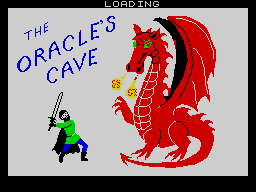
Producer: Doric Memory Required: 48K Recommended Retail Price: £7.95 Language: Basic Author: Chris Dorrell The Oracle's Cave isn't an epic quite on the scale of Valhalla, but then it's almost half the price, and for what you pay you also get animated graphics. This is a dragons and dungeons adventure, but it is much more oriented towards the graphics than to the text, which makes a refreshing change from most of its kin. The story outline is a familiar one; you have ventured into a dark and mysterious cave complex and are trapped near the entrance. The only exit is four levels down through the dreaded Oracle's Cave. The game provides four quests. In each you must collect forty units of treasure; these take the form of gold bars, coins and silver, each type giving you a number of treasure units. You must also collect the treasure guarded specially by the four monsters after whom each quest is named. For this sterling effort you are rewarded with no treasure points - it's simply your duty! At the start of the game you are asked to select a quest. They are to gain treasure guarded by The Mummy, The Centaur, The Fiery Dragon or The Black Knight. Each time you play the game the layout of the caves is altered. The way in which Oracle's Cave differs from so many other adventures is the way in which commands are typed in. The top half of the screen shows the cave, with an animated figure of 'you', plus any objects or monsters. The lower half shows you your energy level, wounds, weapons, combat strength, treasures and articles carried. Below that is a description of the location, then an input line, and below that a line telling you what your options are. The options are abbreviated to m = move, r = rest, e = explore, u = use (any article carried). If you elect to move, the cursor line asks, 'Which way?', while the option line tells you: u = up, d = down, l = left, r = right. There are also s = secret passageway if there is one there, and h = help. Both seem to return you automatically to the entrance cave. Inputting a direction results in an animated sequence as 'you' walk through a passageway into the next cave. On arriving any monster present will appear and so will the treasure it's guarding. You are then presented with a limited option of f = fight or move. It is not possible to move past a monster until it's been defeated. Each quest has a '5 days' time limit, and a section on the right of the screen lets you know - morning of the second day, and so on. Below that is a simple diagram of the cave showing only the locations of the four quest beasts and your position. COMMENTS Keyboard positions: menu driven, simple abbreviations makes the program user-friendly Keyboard play: good responses despite being in BASIC Use of colour: sparing but good
Run or fight? It's all choices, choices in THE ORACLE'S CAVE.
Micro Adventurer #2Dec 1983 · p.19
Tony Bridge
TRAPPED INTO A QUEST MICRO: Spectrum 48K PRICE: £7.95 FORMAT: Cassette SUPPLIER: Doric Computer Services, [redacted] Oracle's Cave, by Chris Durrell, is an implementation of an old ZX81 program, a graphic version of the original Wumpus program. In the game, you are an adventurer trapped in the entrance to the Oracle's cave complex - you cannot get out, you are forced to go on a quest. You may, however, choose from a variety of quests fight the Black Knight, or the Dragon, and so on. Along the way, treasure of various kinds may be collected. These are of no use to you, but add to your treasure points. The final objective is to find and vanquish the Oracle and then return to the entrance and all this in just five game days! Twelve units of energy are yours to start with, and, luckily you have no wounds. This information is shown in the status panel, along with objects and weapons carried, combat rating and so on. To begin with, you may explore the present cave, use one of the objects, or move. Exploring the cave may be lucky for you, yielding up a little key, or a magic cloak, or food. On the other hand, choking gas may overcome you. Sometimes useful hints are given about a monster in the room, allowing you to make an educated guess about your chances against the beast. If you decide to move, your little man walks across the stalagmite-encrusted floor to the next location. This may be left or right, or, if you have a rope, up or down. This is all accomplished in superb high resolution, with smooth scrolling. As you enter the new location, your position within the complex is charted on the on-screen display. When a monster is met, guarding treasure and useful objects, you may decide to fight or move back out of danger. The monster's combat rating is displayed alongside your own, and this will help you decide whether to fight or run. The fight is graphically displayed and, after each bout, the combat ratings of both parties are adjusted downwards - in true Dungeons and Dragons style the first one to reach zero is, unfortunately, dead. If you survive you are then able to pick up the treasure, and any objects, although you may have to drop one you currently carry, three being the maximum. In this way, you move around the complex, mapping your way to the completion of your quest. Although five days will seem to pass very quickly, you will certainly have to rest and restore you sapped energy after a number of fights unlike some other programs, bashing monsters is not rewarded with an increased strength. Oracle's cave is an interesting intellectual approach to adventuring with many ponderables having to be weighed by the player in order to complete the game - your reviewer failed repeatedly to get through more than about a quarter of the caves before succumbing. With the nights drawing in, this program should give you plenty to think about.
Sinclair User #21Dec 1983 · p.538/10
Gilbert Factor 8/10
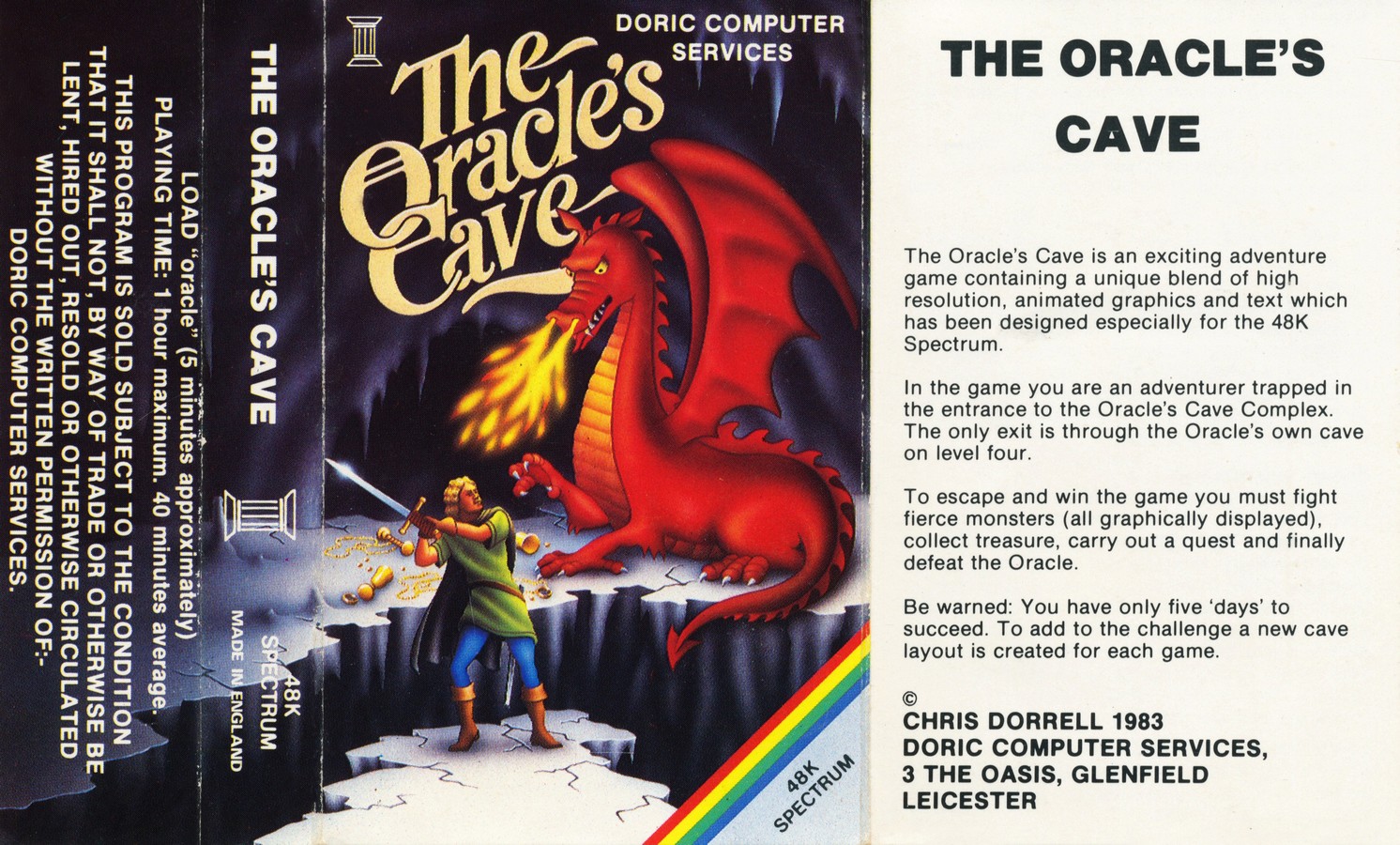
BREAKING WITH TRADITION Oracle's Cave, for the 48K Spectrum, hints at the way in which adventure games might develop in the near future. It is a graphics adventure but like nothing which you have seen previously. The screen is split into two parts and the scene is set in a matrix of caverns. The caves and your player-character are shown in silhouette and when you want to move around, the cave system will scroll in the direction of movement and the player will walk or climb. The screen display also includes a chart showing the level of your energy and combat strength, together with the weapons, items and treasures you have found. Each quest is selected by you at the beginning of the game and you will have five game days in which to complete it. The time factor is exceptional in adventure games. Oracle's Cave breaks away from the traditional concept of adventure gaming. It provides moving graphics displays which enable you to imagine the situation in which you are playing as if it were real. One criticism, however, is that the command words are shown throughout the game. Unlike other adventures they are not hidden for the player to find. If you want to find a keyword you will often have to refer to the textual instruction on the cassette insert. For instance, k stands for key and r for rope. Memory restrictions may have interfered with putting more into the program but it would have been better to include explanations of words on the screen. Oracle's Cave can be obtained from Doric Computer Services, [redacted].
Advert31
- Sinclair Programs #33Jul 1985 · p.48
- Sinclair Programs #31May 1985 · p.48
- Sinclair Programs #30Apr 1985 · p.44
- Sinclair Programs #29Mar 1985 · p.18
- Sinclair Programs #28Feb 1985 · p.13
- Crash #13Feb 1985 · p.105
- Sinclair User #34Jan 1985 · p.80
- Micro Adventurer #15Jan 1985 · p.52
- Sinclair Programs #27Jan 1985 · p.2
- Crash #12Jan 1985 · p.129
- Sinclair User #33Dec 1984 · p.20
- C&VG (Computer & Video Games) #38Dec 1984 · p.115
- Micro Adventurer #14Dec 1984 · p.30
- Crash #11Dec 1984 · p.107
- Crash #10Nov 1984 · p.102
- Popular Computing Weekly #47Nov 1984 · p.22
- Personal Computer Games #10Sep 1984 · p.22
- Crash #6Jul 1984 · p.85
- C&VG (Computer & Video Games) #33Jul 1984 · p.129
- Crash #5Jun 1984 · p.93
- C&VG (Computer & Video Games) #32Jun 1984 · p.161
- Crash #4May 1984 · p.110
- Crash #2Mar 1984 · p.18
- Your Computer #3Mar 1984 · p.96
- Your Spectrum #2Mar 1984 · p.25
Full-page ad14
- C&VG (Computer & Video Games) #34Aug 1984 · p.139
- Sinclair User #27Jun 1984 · p.124
- Sinclair User #24Mar 1984 · p.16
- Micro Adventurer #5Mar 1984 · p.38
- Micro Adventurer #4Feb 1984 · p.33
- Sinclair User #23Feb 1984 · p.102
- Sinclair User #22Jan 1984 · p.70
- Micro Adventurer #3Jan 1984 · p.33
- Your Computer #1Jan 1984 · p.15
- Sinclair User1984 · p.78
- Sinclair User #21Dec 1983 · p.162
- Micro Adventurer #2Dec 1983 · p.30
- Sinclair Programs #14Dec 1983 · p.84
- Popular Computing Weekly #45Nov 1983 · p.40
News/Note2
- Crash #5Jun 1984 · p.42
- Micro Adventurer #1Nov 1983 · p.7
Feature2
- Sinclair Programs #19May 1984 · p.44
- Sinclair User #23Feb 1984 · p.135
Tips1
- Your Sinclair #5May 1986 · p.62
Letters1
- Crash #3Apr 1984 · p.14
Review1
- Popular Computing Weekly #39Sep 1983 · p.53
Related
- Versions
- The Oracle's Cave (Another platform for)
- Ports
- (Commodore 64)
- Tags
- Random Levels
- Elsewhere
- MobyGamesRZX ArchiveThe TipshopUVLSpectrum Computing RZX - YouTubeModern ZX-Retro GamingRZX Archive - YouTube
- Same entry at
- Spectrum ComputingZXInfo
Reviews from people here
Sign in to write about this, or make an account. It takes a minute and lets you correct the catalogue too.
Everything ZXDB can hold about this is here.
Sign in to correct or add to this.
Hold the rights to this and want it taken down?