
Back to the Future
Arcade Game: Adventure · ZX-Spectrum 48K/128K · 1 players · English
Electric Dreams Software · 1985 · Pound sterling 9.99
Back to the Future, 1 of 3
Discussion
Nobody has started a thread about this yet.
- Control Option
- Cursor, Kempston Joystick
Releases
- 1985Electric Dreams SoftwarePound sterling 9.99
- 1985Firebird Software LtdPound sterling 1.99
- 1987Proein Soft Line
- 1988MCM Software S.A.
Play
- BackToTheFuture.rzx.zipwithheld by rights holder
- BackToTheFuture.tzx.zipwithheld by rights holder
Documents
- BackToTheFuture(ProeinSoftLine).pdfInstructions Spanish46 KB
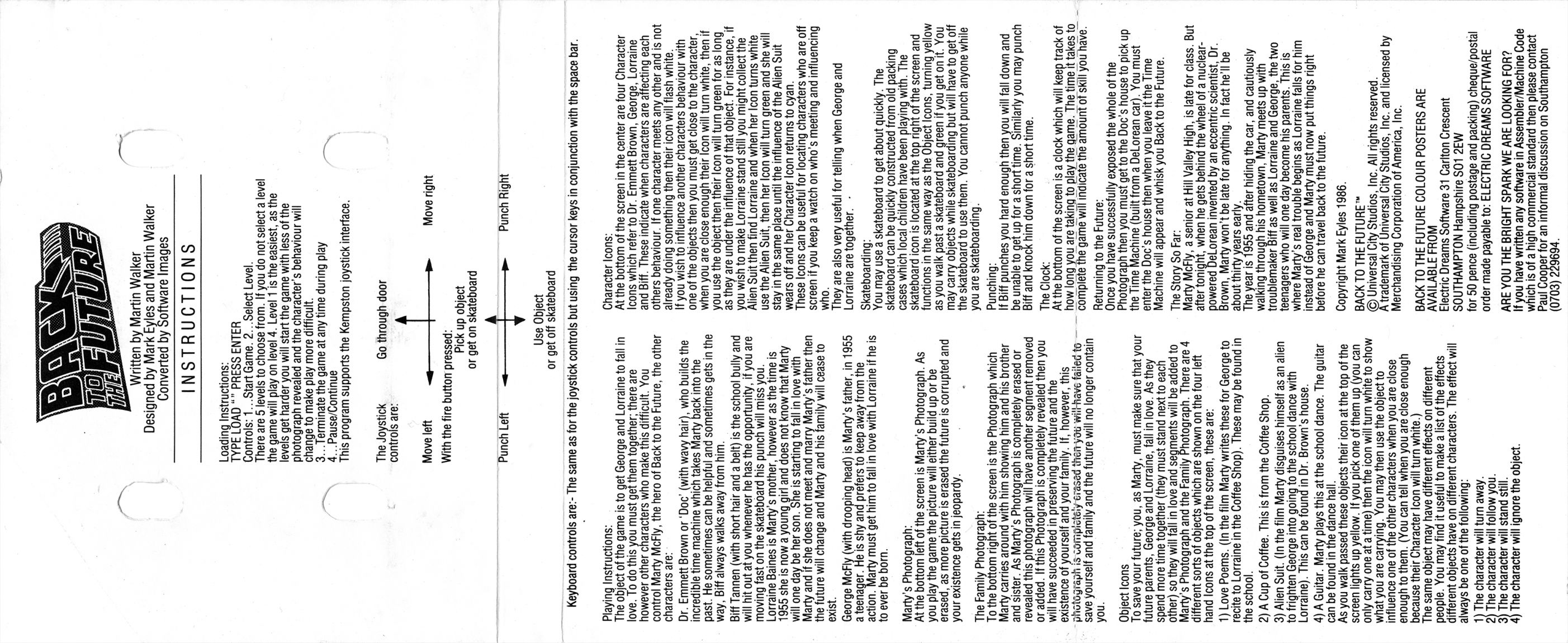
- BackToTheFuture.txtInstructions English4 KB
Music
- BackToTheFuture.ay.zipRipped in-game/theme music in AY format 1 KB
Other files
- BackToTheFuture.jpgAdvertisement 182 KB
- BackToTheFuture(FirebirdSoftware)_Back.jpgInlay - Back 278 KB
- BackToTheFuture_Back.jpgInlay - Back 750 KB
- BackToTheFuture(MCMSoftwareS.A.).jpgInlay - Front 94 KB
- BackToTheFuture(ProeinSoftLine).jpgInlay - Front 101 KB
- BackToTheFuture(FirebirdSoftware).jpgInlay - Front 362 KB
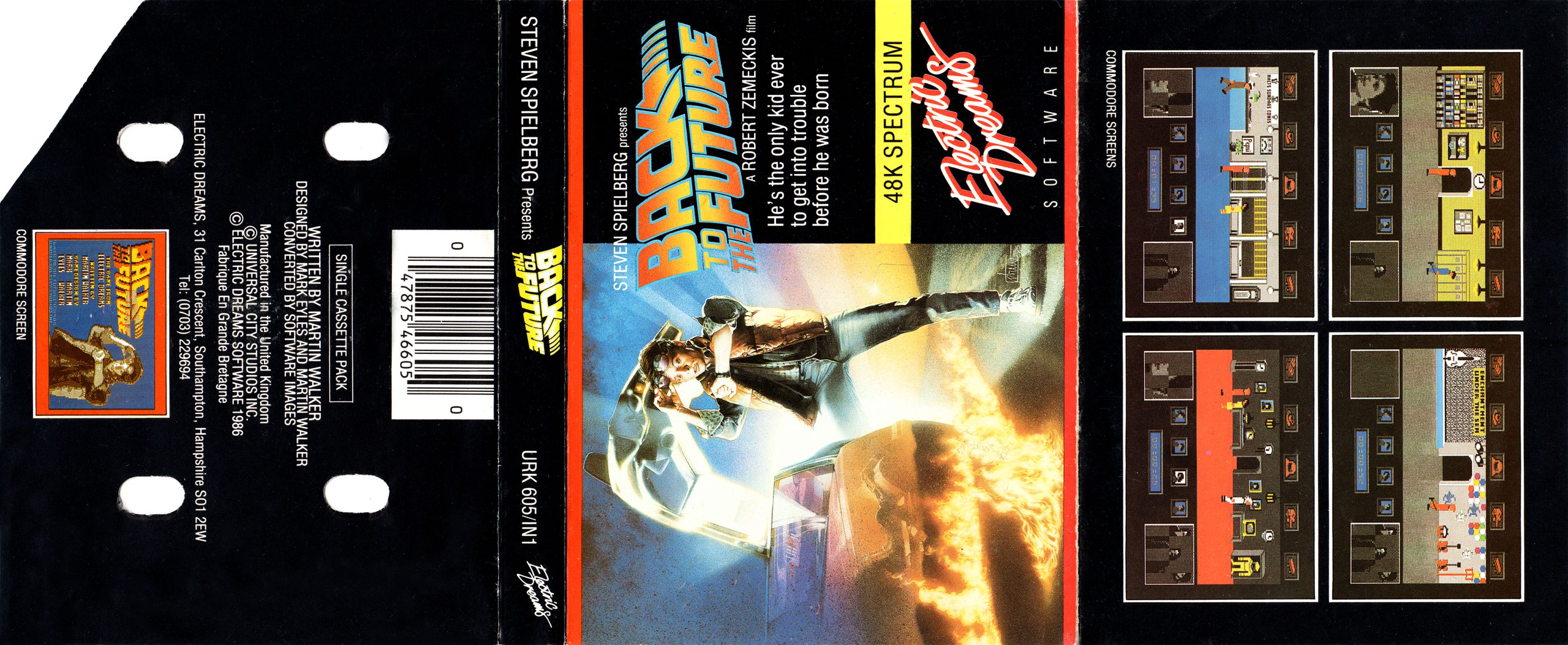
- BackToTheFuture.jpgInlay - Front 677 KB
- BackToTheFuture.scrLoading screen 7 KB
- BackToTheFuture(FirebirdSoftware)_Media.jpgMedia scan 111 KB
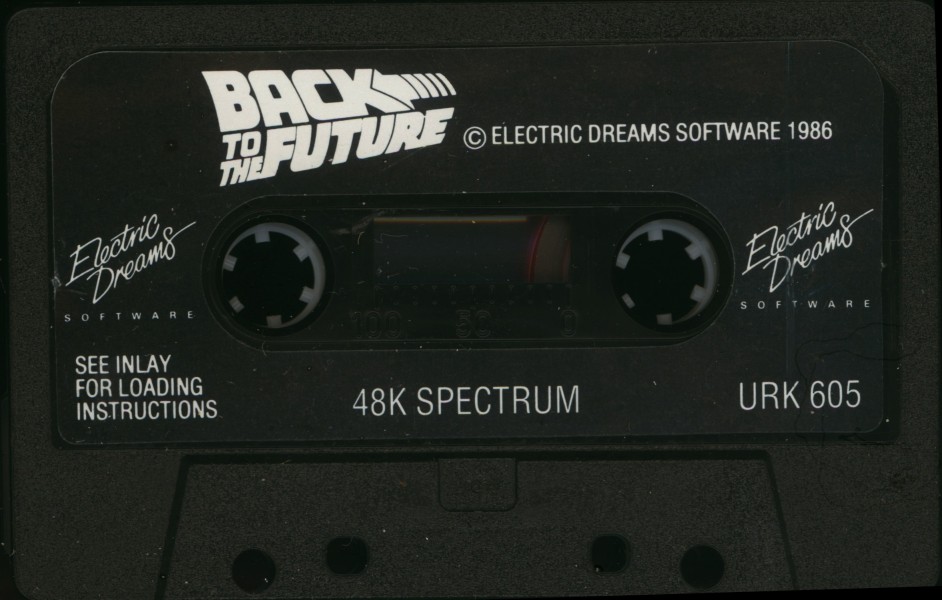
- BackToTheFuture_Media.jpgMedia scan 104 KB
- Back to the Future (1985)(Electric Dreams Software).pokPOK pokes file 0 KB
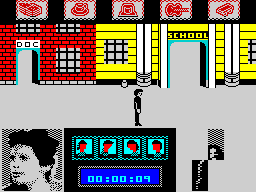
- BackToTheFuture.gifRunning screen 5 KB

_Back.jpg)
.jpg)
.jpg)
.jpg)
_Media.jpg)
Files and rights
The rights holder has refused distribution. Files are listed because their existence is a catalogue fact, and none are served from here.
- DeniedElectric Dreams Software → WorldOfSpectrum
- AllowedFirebird Software Ltd → WorldOfSpectrum
Credits
- Mark EylesGame Design/Concept
- Martin Walker [2]Code
- Martin Walker [2]Game Design/Concept
- Merv JonesIn-game Graphics
- Mike SaxbyIn-game Graphics
- Mark AlexanderMusic
- Drew StruzanInlay/Poster Art
Sign in to credit somebody, or say what these people did.
Awards
Scores
In the magazines
- Sinclair User #501986 · Overall2/5
- Your Sinclair #61986 · Overall4/10
- ZX Computing #261986 · OverallGood
- Crash #281986 · Overall42%
- Sinclair User #671987 · Overall4/10
- Your Sinclair #191987 · Back to the Future3/10
- Your Sinclair #481989 · Back To The Future30%
Elsewhere on the web
- WorldOfSpectrum 29 votes3.48
In the magazines 28
Sinclair User #67Oct 1987 · p.394/104/10
Overall 4/10
Tony Dillon 4/10
Label: Firebird Price: £1.99 Memory: 48K/128K Joystick: various Reviewer: Tony Dillon That's the power of love, da na na na. Yeah, get down Huey, get down Marty, get down Shep. They say you can't keep a good game down. With this game I had trouble keeping my lunch down. Don't get me wrong, it's a good idea - just badly implemented. You take the role of Marty McFly, who has gone back in time and met his mummy and daddy and mummikins has fallen in luv with him. He's got to get them back together with the help of Dr Emmett Brown and with the hindrance of Biff the bully. But it's not all bad. There are two very good digitised photographs and it's now very cheap!
Your Sinclair #6Jun 1986 · p.225/105/102/102/104/104/10
Graphics 5/10
Playability 5/10
Value For Money 2/10
Addictiveness 2/10
Overall 4/10
Max Phillips 4/10
Electric Dreams £9.95 Reviewer: Max Phillips Back to the Future? Back to the 1K ZX81 more like. Imagine an arcade/adventure with five locations, five objects and, yes, five interactive characters. How do they get it to fit in 48K? What's it stuffed with? However, this game is a little different. As the super skateboarding all-American teenager who's suddenly jetted back 30 years in a souped-up De Lorean, you've got to wander round and persuade your parents to fall in love before its too late - a job made harder 'cos Lorraine-the-sprite looks just like Maria out of JSW. Just like the film, your family photo fades away on-screen as time runs out. To help you, there are five objects scattered around the set that will attract, repel or stun the other characters. By using the objects you can get George and Lorraine together (aaarh!) and keep the dotty Prof and bully Biff out of the way. But be warned, characters have minds of their own and it'll take a lot of running around to get to the gooey bits. Not a bad conversion of the plot. Nice to see an original game concept. It may even be very clever. But I can't say it's very much fun to play. For the money, I could get a decent poster and go see the film again... twice! But if the game fails to capture the spirit of a film that deserved fifty more Oscars than Out Of Africa, at least it's got the essence of the De Lorean sports car just right. Although Back To The Future is very different, it's poorly designed, put together in a rush and not a little overpriced. The game is like the car - a non-starter.
ZX Computing #26Jun 1986 · p.11ZX Computing GlobertGood
ZX ComputingZX Computing Globert
Overall Good
Electric Dreams £9.95 Is there any need to mention that this is a film spin off? I thought not. An interesting idea, get your mum and dad together before you cease to exist, well it worked for Spielberg so why not for Electric Dreams? The game display is in three sections, a centre portion which shows your actions and position in the city, those who are around you and objects available. Characters are animated and the main screen scrolls as you move. Behind you are a few doors to the Doc's house, the School, the Hall and the Snack Bar. In each of these locations are poems, tea, an alien suit and a guitar - you have to discover which is where, which takes about three minutes playing time if you are not bright enough to work it out beforehand. Only one of these objects can be carried at a time and each object may or may not have an effect on one of the four other characters wandering about. These other bods are Doc, George, Lorraine, Biff and you, the hero, Marty. At the top of the screen is a picture of each of the four items and they change colour depending on whether they are carried or not. On the far right is a picture of a Skateboard which Marty can use to move around faster, once he has 'built' it from the two piles of crates on the main screen. Below the main display on the extreme left and right are two pictures on the left is Marty and on the right is a family photo. These represent 'lives' and 'death' and either fade or build up depending on how well you are doing. Between these two large pictures are the four other characters' pictures and these change colour depending on what effect Marty has produced on them with the various objects. The main object of the game is to get Lorraine and George to spend time with each other by the use of the objects and their effects on them. Biff will thump you and cause a delay though you can thump him back and put him out of action, and others will hamper you. All this sounds very complicated but in fact is very simple. This is the biggest fault of the game, the action is fairly repetitive and I found it boring, even with the five levels which give you less time and make the characters more unpredictable. The graphics are reasonable but slow, and the scrolling main screen is jerky, characters having a disconcerting habit of disappearing, actually they are entering or leaving buildings and the playing area is small. Still, I've seen worse, but at £9.95 it is overpriced and over-hyped. Frankie goes to Hollywood from Ocean is similar but much, much better.
Sinclair User #50May 1986 · p.342/52/5
Overall 2/5
Jerry Muir 2/5
Publisher: Electric Dreams Programmer: Martin Walker Price: £9.95 Memory: 48K Joystick: Kempston Gee, I guess I must be the only kid on my block not to have seen Back to the Future - that latest blockbustin' slice of small town hokum from the Spielberg stable. But now I've got the computer game and I still want to see it. And that's no thanks to Electric Dreams which deserves a highly commended prize in the Friday 13th Awards for tie-ins. For other unfortunates who've not yet seen the movie, the plot concerns Marty McFly, a regular teenage guy who makes the mistake of accepting a lift from a stranger. It's a mistake because that stranger happens to be Dr Emmett Brown, a scientist who got his PhD in whacky ideas, and the car is a converted DeLorean - one which travels through time. For the first time in his life Marty is early for something. Thirty years early! Luckily Marty has benefited from the fine American education system, so when he meets his parents as teenagers 1955 vintage - he realises that unless they... well, you know... get together then he won't be born. To add to the complications his mother, Lorraine, falls for him rather than shy, head-hanging wimp, George. Not stopping to consider the Freudian potential of becoming his own father, Marty attempts to unite his parents-to-be, and avoid the school bully, Biff. Apologies for going on at such length about the plot, but it is this that the Electric Dreams programmers have seen fit to try and convert into a game. The action - and I use the word lightly - takes place along the main street of a small American town and in four buildings off it - the school, Doc's lab, the dance hall and the coffee bar. Each one has its own associated object. You find love poems on the school shelves; an alien suit in the lab; a guitar in the dance hall and you'll never guess where the coffee comes from. You'll need all of these for Marty to arrange the marriage. The main screen is taken up with a view of the main street or the rooms. I've always associated Spielberg's films with a certain visual richness, and not the rather plain looking scenery here. Down these bland streets the characters wander aimlessly. At either end of the street you'll find a pile of packing crates which Marty can convert into a skate board. This is the only time there's any real speed as Marty leaps onto the board and zooms along for the length of a full four screens. Beneath this positively underwhelming vista lie the status panels. First up is a picture of Marty which fades as he becomes less of a potential twinkle in his parents' eye. Centre screen are four unrecognisable portraits of the major protagonists in this drama of love and intrigue, and below them is a clock so you can judge how you are doing. To the right is a family picture. Each time you lose a photo of Marty another section fades, and once it's all gone there's no future for our hero. If you choose a higher level of difficulty you'll get fewer sections to start with, and people's behaviour will become more erratic. Above the main screen are five little icons for the objects already mentioned. When Marty passes the location of one its icon turns yellow, which is just as well because, apart from the guitar and alien suit, you'd never know they were there. Providing Marty is close enough, each object will interact with another character causing one of four results when the person's icon turns white. The character may turn away, stand still, follow Marty or ignore the object. People being people they also respond individually so that, in theory at least, Biff always walks away from the loony Doc but hits Marty at every opportunity. Yes, you ask, but what about the... nudge, nudge, wink, wink... other bit? All you have to do is get George and Lorraine to stand together long enough to fall in love. Stand together! is that all it took back in '55?! You do this by exploiting the effects of the objects, just as in the film when Marty dresses up in the alien suit to scare George into going to the dance with Lorraine. Of course, it's not easy with everyone wandering about, living their own lives, and I think if all the future held for me was games like this I'd prefer not to be born, thank you. I'm sure the game is playable as a sort of frustrating puzzle if you want to persist. The main problem is that, apart from the opening rock 'n' roll theme, and the reproduction of the poster on the packaging, it's so unappetisingly presented that I can't see why anybody would want to persist. The stick figures may be slightly better than those in Friday 13th, but at heart this shows all the same failings of game play and lack of sophistication. I can't see those who enjoyed the film having good memories revived by this. Back to the Future? Back to the ZX81 more like!
Got 'em together at last, in the library of all places.
It's the start of the game and Marty's picture is almost all there but Doc's already leaving.
Outside the coffee shop with the photo of Marty fading away. And here's Biff, goose stepping in from the left.
Crash #28May 1986 · p.3154%49%43%47%42%36%42%
Use of Computer 54%
Graphics 49%
Playability 43%
Getting Started 47%
Addictive Qualities 42%
Value For Money 36%
Overall 42%
Unknown
Unknown
Unknown
Producer: Electric Dreams Retail Price: £9.99 Author: Martin Walker For every smash hit film there's usually a computer game to match and Back to the Future is no exception to this economically sound rule. From the bonny bay of Southampton, land of Electric Dreams comes what was predictable, Back to the Future the computer game! For those people who've lived within a cardboard box in Kirkcaldy for the last year and don't know the plot it is as follows: Marty McFly is the archetypal god-fearing, bomb-loving American kid and, due to some freak accident involving a DeLorean sporty car and an addled professor, is hurled backwards into time to his home town around the nineteen fifties. In fact it's just about the time that his parents, George and Lorraine, first got together but this is where the problem comes in, they aren't getting together and it soon becomes apparent that Marty is the person who has to perform the matchmaking since no one else seems to be. If Marty fails then by simple logic he ceases to exist and that just doesn't add to anyone's street credibility. If he succeeds, then there's a happy ending and everybody can leave the cinema with dry hankies. A happy ending is what you, playing hero Marty McFly, have to strive for. Getting the two potential parentals together is not an easy task, especially considering that Marty's mum fancies her future son. Dissuading Lorraine's attentions and foisting her onto an unsuspecting George McFly is far from simple and the problem manifests itself as an arcade adventure using a type of mini icon system for interaction with people and objects. There are different objects to be found in the five different locations. These can be used on the five different characters that wander aimlessly within the binary backstreets. Five is obviously a significant number for the designer. Objects can be picked up, dropped and used. Objects are used on characters and result in one of three responses: run away from Marty, follow Marty or completely ignore Marty. Being completely ignored is the game's way of telling you you've done something stupid. The idea is to force George and Lorraine to spend as much time together as is possible. If they do then love will most certainly be in the air and to indicate the level of George and Lorraine's harmony, a family photo bottom right of the screen shows by its completeness how things are going. If it fills in then the game is over and everyone lives happily every after. If, however, the picture totally and utterly disintegrates then 'Game Over' throws itself into the middle of the screen. As said before there are five locations and one main screen that gives access to the other four. This is where a majority of the action takes place. Trogging left and right causes the screen to scroll in the opposite direction with Marty to the left of centre. Along the street there are four portals to the lesser rooms, each exactly a screen in size, and these can entered by pressing up. Within these rooms are found the objects that can be used to influence the potential parents' petting patterns. Trolling along is not the only form of transport, to be the speedy man around town you can use the skateboard. With board and wheels beneath your feet you can really whizz, avoiding any trouble from Biff. Biff is the school bully and is so called because he Biffs people. Get biffed and precious time wastes away while breath is caught. Biff can be rebiffed though since punching is something that is handily supplied to your repertoire of commands. Biff the bully and he won't be in the mood to hit anybody for a good minute or so. COMMENTS Control keys: cursors and Space to 'fire' Joystick: Kempston Keyboard play: simple enough Use of colour: hardly pretty, garish is a better word Graphics: awfully animated characters plus nastily jerking background scroll Sound: very neat title tune but apart from that there's near to nothing. Skill levels: 51 Screens: 5
Now Games 4 carries this game and has 8 references of its own.
The Story So Far Vol 4 carries this game and has 9 references of its own.
Full-page ad7
- Sinclair User #48Mar 1986 · p.39
- Computer Gamer #12Mar 1986 · p.61
- Your Computer #2Feb 1986 · p.30
- C&VG (Computer & Video Games) #52Feb 1986 · p.60
- Popular Computing Weekly #6Feb 1986 · p.39
- Popular Computing Weekly #4Jan 1986 · p.2
- Popular Computing Weekly #3Jan 1986 · p.8
News/Note6
- Popular Computing Weekly #32Aug 1987 · p.45
- Your Sinclair #3Mar 1986 · p.3
- Crash #26Mar 1986 · p.14
- Sinclair User #47Feb 1986 · p.8
- Your Computer #1Jan 1986 · p.23
- Popular Computing Weekly #47Nov 1985 · p.1
Review4
- Your Sinclair #48Dec 1989 · p.105
- Your Sinclair #19Jul 1987 · p.61
- MicroHobby #91Aug 1986 · p.15
- Computer Gamer #15Jun 1986 · p.63
CompoEntry3
- C&VG (Computer & Video Games) #52Feb 1986 · p.85
- Your Computer #2Feb 1986 · p.39
- C&VG (Computer & Video Games) #51Jan 1986 · p.32
Hack/Poke2
- Sinclair User #131Jan 1993 · p.15
- Crash #58Nov 1988 · p.56
Preview1
- C&VG (Computer & Video Games) #51Jan 1986 · p.30
Licensed from
- Back to the FutureMovieAmblin Entertainment Inc
Related
- Ports
- (Amstrad CPC), (Commodore 64), (MSX), (NES)
- Elsewhere
- WikipediaThe Cutting Room FloorCentre for Computing HistoryCentre for Computing HistoryMobyGamesRZX ArchiveThe TipshopUVLModern ZX-Retro GamingSpectrum Computing RZX - YouTubeRZX Archive - YouTube
- Same entry at
- Spectrum ComputingZXInfo
Reviews from people here
Sign in to write about this, or make an account. It takes a minute and lets you correct the catalogue too.
No description recorded.
Sign in to correct or add to this.
Hold the rights to this and want it taken down?