Overlord
Strategy Game: War · ZX-Spectrum 48K · 1 players · English
CCS · 1988 · Pound sterling 9.95
Also known as The Invasion 6th June 1944 (English)
Discussion
Nobody has started a thread about this yet.
Play
- Overlord.tzx.zipTape image English21 KB
- Overlord.tap.zipTape image English20 KB
Documents
- Overlord(EN).pdfInstructions English2,655 KB
Files and rights
Distribution permission is on record, granted to another archive rather than to this one. Screens and pictures are copied here; everything else links to the archive that holds it.
- AllowedCCS → WorldOfSpectrum
Credits
- Ken Wrightcredited
Sign in to credit somebody, or say what these people did.
Scores
In the magazines
- Sinclair User #741988 · Overall9/10
- Your Sinclair #331988 · Overall8/10
- Crash #511988 · Overall84%
- ACE (Advanced Computer Entertainment) #81988 · Ace Rating845/1000
Elsewhere on the web
- WorldOfSpectrum 17 votes7.76
In the magazines 10
Your Sinclair #33Sep 1988 · p.908/108/108/109/107/108/108/108/10
Graphics 8/10
Playability 8/10
Value For Money 8/10
Addictiveness 9/10
Strategy 7/10
Overall 8/10
Audrey Bishop 8/10
Owen Bishop 8/10
CCS £9.95 Reviewer: Owen Bishop, Audrey Bishop Ironically I am polishing off this review on 8th May - which, as the historians among Your Sinclair's readers will know is the 43rd anniversary of VE Day, the day the Germans finally surrendered to the Allied forces, so bringing the war in Europe to a close. If the 8th May was the grand finale in the European theatre of war, then 6th June 1944 - just over 11 months before - was the beginning of the final act. It was on that day - the 44th anniversary of which will have passed by the time you read this - that the British and American forces finally landed in Normandy, to open the Second Front. Now, CCS - known for the excellence of its strategy games - gives you the chance to command the invasion forces as you re-fight Operation Overlord. As you pit your wits against Rommel - soon to be forced to take poison by the Gestapo after being implicated in the July 24th plot to assassinate Hitler - you have a momentous choice. Do you follow the plans made by Eisenhower and the Allied Chiefs of Staff? Do you land on the beaches the invasion forces really landed on - Sword, Juno, Gold, Omaha and Utah, still marked to this day by the wreckage of 44 years ago - or do you think you can do better? Perhaps a landing in force around Cherbourg would mean that you could get your troops ashore with ease, and it would give you a major port: but then, the German forces could easily seal off the neck of the penninsula, denying you access to the open land beyond, and forcing your armour to fight in unfavourable terrain. Or should you land further to the east, much closer to Paris - but also in an area with much heavier defences, and closer to German reinforcements? Do you use your airborne units to protect the flanks of your invasion - which would be historically accurate - or should you reserve them, to be used either as ordinary ground troops, or dropped later when they might tip the balance at a vital moment? Life's not easy commanding the invasion of Europe! It's a lot easier, however, playing CCS's version, than it would be commanding the real thing. Overlord is a one player war game - which I personally prefer, as I have never understood the point of two player computer war games. You the player control the disposition and movement of the Allied invasion forces. The computer plays the Germans. The first choice you have to make is to decide what difficulty level you want to set the game at. There are three, with one being the easiest and three the hardest. I chose level one for my first game, but still managed to completely mess things up. You decide which of your divisions are landing on which beach. There are 12 beaches to choose from, the historical five plus another seven which the allies might have chosen. You can land on five of the 12 beaches and as you do so, markers appear on the map window, indicating where the landing areas are. It's not a good idea to spread your landing areas out too much, as your forces won't be able to support each other efficiently. Once you've picked the beaches, you have to decide which division will land on each one - although you could decide to land units from the same division on different beaches. But again, this is not really a good idea unless the beaches are very close to each other, because if you scatter the parts of your divisions too far apart, they will not be able to fight at their best. You can land one unit on a particular beach at a time; and, in the first turn, you may only land rifle units. The heavier troops, artillery and armour, have to wait until later. Once you've picked who goes where, you then get a chance to land your airborne forces. You have to land them within three squares of a landing beach which is being used by the division they are a part of, so you can't parachute into gay Paris on the first turn. You should probably use them to attack the enemy forces closest to the landing beaches, to stop them from counter-attacking your troops on the sand. Once you've started landing your units, it is important to get them off the beaches as fast as you can. You can only bring in new units if the beach-head is clear, so you must start off by creating a protective perimeter around your landing areas. Once you have the bulk of your forces ashore, you can then start expanding the beach-head and trying to break-through the defending Germans. At first, it will be a war of attrition; but once you have ground down the enemy, gaps should start appearing in his lines and you should be able to punch through. Ordering your units is simplicity itself. Simply give them an objective to make for, and tell them where you want the division's left and right flanks to be. I would have preferred an extra option, giving you the ability to order individual units, but I accept that the way the game works now is a very good simulation of real warfare, within the restrictions of the memory of a 48K Spectrum. You also have to tell your forces what to do if they run into the enemy. You can either attack, defend, or use your initiative. If you attack, then you will do more damage to the enemy, but also suffer more casualties. And that is basically it. The mechanics of the game are sufficiently simple for the player to be able to devote his time to the real challenge, the strategic decision making. And challenging it is - working out the right way to winkle the Germans out of their defensive positions without exposing your own troops, is a fine art. I only have two criticisms. First of all, nowhere in the rule book does it tell your what the symbols on the unit counters actually stand for. I can work it out, but then I have been a wargamer and military history buff for a long time now. But it would probably have been useful for a beginner if the unit symbols had been identified. Also, I found it very difficult to tell my left from my right - or rather, my units' left from their rights. This is not because of any personal problem with orientation, but because it is never made clear whether left and right refer to the player's left and right, or the units'. As the player is facing in the opposite direction to the units he controls, it can be confusing. Quibbles apart, Overlord is an excellent game. It offers hours of challenging entertainment, and could even teach some history at the same time (though I wouldn't be too put off by that!). Another winner from CCS.
C&VG (Computer & Video Games) #80Jun 1988 · p.548/105/106/105/10
Graphics 8/10
Realism 5/10
Value 6/10
Playability 5/10
Steve Badsey
MACHINES: Spectrum 48/128 SUPPLIER: CCS PRICE: £9.95 Tape Described as "based on" the historical Overlord by Max Hastings, this is a fairly straightforward one-player game of the D-Day invasion and subsequent campaign by Ken Wright, designer of Blitzkrieg and Napoleon at War. The game starts with the Allied invasion, and the player, taking the Allies, has a choice of invasion beaches, allowing alternatives such as the Pas de Calais landings to be tested. The game ends when the Allies reach Paris or one side falls below 40 per cent strength. The best feature of the game, and the one into which most effort has gone, is the computerised German defence, which is very good and never predictable. Unfortunately, the game is based on the same playing mechanism as Ken Wright's earlier work. This has now had most of the bugs taken out of it, and gives more realistic combat results, but it can still cause unpredictable movement. It is true that perfect control cannot be achieved in war, but at the strategic level of the Normandy landings there was better control than the game provides. Also, Corps and Army formations are lumped together as having seven subunits each. This means that Second British Army (real strength 12 divisions) is the same size and of lower fighting value than II SS Panzer Corps (2 divisions). It is right to suggest, as Max Hastings does, that some German units were stronger than some Allied, but overall the Allies were far stronger, which is why they won. At all but the easiest of the three levels offered by the game, they are lucky to scrape a draw. This is an average game, neither particularly accurate or inaccurate, interesting or boring. But every game that Ken Wright has designed has been better than the last one. Some day he may produce something very good indeed.
Average game play.
Watch for unpredicatble movements.
Amiga and ST owners will have to wait until August for Overlord to appear on their machines. The computer simulation of the famous Allied Liberation of France promises many extra features and superb detail in the 16-bit version.
Sinclair User #74May 1988 · p.579/109/10
Overall 9/10
Jon Riglar 9/10
Label: CCS Author: Ken Wright Price: £9.95 Memory: 48K/128K Joystick: various Reviewer: Jon Riglar The date is 6th June 1944, the location is the coast of Normandy. In CCS' latest strategy wargame, Overlord, you are the commander in charge of the Allied forces about to undertake one of the most historic battles in World War 2 - the invasion of Normandy. One of the very first decisions you'll have to take is at what level to play the computer opponent. (Not that it matters at first because whether you choose level one, two or three the computer is likely to hammer you in your very first game). Next, the screen will clear and a map of Normandy will be displayed. This is the playing area and extends to the left and right to display major French cities and rivers. Also placed to the left and right to display types of terrain - an all important factor in the battle ahead. The computer is in command of all German forces - a small amount will be placed in a defensive role on the coastline, and by using the cursor keys you can scroll the screen in all directions to locate the rest. The German force consists of infantry and armoured units and at any point you can identify which is which - German reinforcements further inland cannot always be identified i.e. you know there are some on the way by a small German symbol, but you can't be sure what they are. Deploying your troops is a simple process. You have access to different units of American, Canadian and British forces and one of the major decisions to be taken will be what to land, and on which beach to land it. Access to all beaches is possible at first, you don't have to follow history at all. Landing troops is simply a process of accessing a division, and then selecting one of 5 beaches by pressing a key from A to E. Because you have such a wide range of divisions, you also have several airborne units at your disposal - they exist in the US 7th and British 2nd Army. Before any movement takes place, you'll have to decide where to land these units. It's a pretty liberal process provided they land somewhere close to an allied beach. All action in Overlord takes place in 'turns'. The first turn is taken up by positioning of troops and airborne divisions and you cannot move as yet. Once the computer has had its go, control will be passed back to the player and all units will have landed on the beaches. At this point the battle really begins. Orders should now be sent to each of your units, a series of key presses will access each division in turn. You can now order them to move in a specific direction by setting a centre point and left and right flank points. This means that once movement takes place, all units in that specific division will head for the set centre point and follow the flank. Obviously, if you only have one division on the map, it will head solely for the centre point. If two are present they will split up and head one for each flank. Such orders should be sent to each army that has landed. You will also have to tell the units whether to attack or defend if they meet any German forces whilst on the move. Attack will mean a thrust no matter what the size of the opposition; defend gives you the advantage because allowances are made for what sort of terrain is present; thirdly there's a discretion order where the unit will only attack if profitable. At this point you can access details of units, the terrain present and can also scan the map for German forces. When in combat their morale acts as an indicator of the units' present strength i.e. If the morale of an attacking unit is lower than that of a defending unit, the attacking unit will come off worse. The game continues in this manner until either all German units or Allied units are destroyed or until the Allies reach the righthand side of the map and are victorious. Reinforcements for the Allied forces can be landed provided beaches are still in Allied control and new beaches can be used if the player manages to capture the ground. Overlord is a clever strategy game - the more thought the player puts into new movements, the more progress is made.
ACE (Advanced Computer Entertainment) #8May 1988 · p.747/108/107/108/10845/1000
ACE (Advanced Computer Entertainment)
Opposition 7/10
Display 8/10
Ease Of Use 7/10
Game Depth 8/10
Ace Rating 845/1000
Spectrum, £9.95cs June 6th 1944 saw the start of operation Overlord - the invasion of Normandy by the allied British, American and Canadian forces. This latest release from CCS attempts to re-create this operation, widely regarded as the decisive western battle of the Second World War. Inspiration for the game was drawn extensively from the Max Hastings book 'Overlord'. The program is for one player and allows you to control the allied forces only, though there are three difficulty levels. The object of the game is to land your forces, secure the beaches (to allow reinforcements to land) and then break out and reach the right hand edge of the game map. The game can end before then, however, should either side's effectiveness be reduced to below 40 per cent. The game breaks down into two broad phases - the landing of reinforcements and the issuing of orders. Your limited supply of reinforcements can only come ashore at beaches which are in your control and which are clear of other units. Issuing orders is effected unit by unit, and involves placing a cursor at the required destination, first for the unit's centre, and then for each of its flanks. Once all the units have been positioned, movement of the allies occurs - followed by any resulting combat. Then the German forces move and combat is resolved again. The game plays well, and the screen layout is simple but effective, though mistakes are hard to correct so each step has to be carefully considered. The easiest level poses no great problems while the hardest will provide you with a tough challenge. The additional beaches available to the player at the start of the game (those not used for the real landings but which easily could have been) allow the player to play several 'what if' scenarios.
Crash #51Apr 1988 · p.5190%71%85%81%79%84%84%
Presentation 90%
Graphics 71%
Rules 85%
Authenticity 81%
Playability 79%
Overall 84%
Philippa Irving 84%
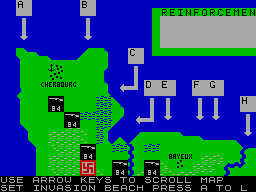
FRONTLINE With Philippa Irving ME, MYSELF, I Reviews in FRONTLINE are printed for two purposes: one, so that you the reader can enjoy a fairly full description of games that you have no intention of buying. Two, so that, having enjoyed the description, you might decide that you do want to buy the game after all. The primary function of a review magazine like Crash is undoubtedly to enable you to make sense of all the brightly coloured little boxes on the dealer's shelf, and to choose which ones you actually want to part with money for. I also think that it helps to circulate ideas and a general awareness of the computer gaming scene to add to your enjoyment of the hobby; I always prefer reading bad reviews, but for utilitarian purposes - that is, deciding what I want to buy - I admit that the good ones are more useful. And it has occasionally been the case that I've bought a game on the strength of a review to be disappointed in it; it helps to know the reviewer's methods and criteria. And so, for your own information. I shall describe mine. Games are sent to me through the Crash offices in Ludlow to my home in Oxford, sometimes weeks before I have to write the review, and sometimes days. No matter when they arrive, I always try to have at least two sessions on a game. Often, if I like it, and I have a lot of spare time, I play it much more extensively for the sheer enjoyment of it. If a game has extremely complex rules and lots of reading material with it I try not to be irritated by the extra time that entails, and remember what a delight it would be if I'd actually paid for the game. Software which arrives with instructions covering the back of an inlay has my sneaking sympathy, although I try to suppress it. However, I do want to be forced to waste my time with a game, even if I don't enjoy having to plough through lots of salutary background material. A game which forces me to play for ten hours when I really only have two to spare has certainly got something going for it. Some games are impossible to play for more than an hour, either because I finish them on my first attempt (that always has me pulling out the plug) or because they're desperately boring. I usually go back to the desperately boring games a day later, to see if they improve upon acquaintance (several have, quite significantly); some just get played for another hour. It's much easier to write a review of a game I've played extensively and enjoyed. The most difficult reviews to write are those of games which I can see are good but which I don't like or enjoy myself, I don't entirely subscribe to the view that reviews are necessarily a reviewer's personal opinion, I hope I can see that some games which do not appeal to me at all, and which I would never voluntarily play, have lots of strong and interesting qualities which readers who like that sort of thing will enjoy. That's why my reviews are predominantly descriptive. I give my opinion very much 'for what it's worth', and try on the whole to let you the reader understand what sort of a game is on offer. But that doesn't mean that I don't occasionally enjoy doing a really bad review of a game that I can't stand... and I hope you enjoy reading them. THE MORAL DILEMMA Last year the question was raised in FRONTLINE FORUM about whether it's morally justifiable to base games on war. The correspondence raised strong feelings on both sides. It's an issue which probably has to be faced by any thoughtful wargamer, and is worth further discussion. However, this isn't the place to debate the absolute moral issue of whether war is ever justifiable. The universal moral standard, that is always met - though never fully obeyed - in every society, condemns murder. But it also commends bravery, when it takes the form of defending one's immediate circle from danger; and it has to be true that this overrides the killing of another person, and does not categorise it as the murder which the same code forbids, Whether individuals choose to rise above this distinction and categorise all killing as murder doesn't alter the fact that the 'loophole' in human conscience is there, and that's why many sincerely good people have felt comfortable with the concept land indeed the experience) of going to war. So much for the irresolvable; the issue we're interested in is whether buying and playing wargames implies moral agreement with war in general is intrinsically wrong, or has nothing to do with the matter. Can you be an ardent pacifist and yet enjoy a game which simulates closely a historical battle? Or does such a game inevitably imply some sort of acquiesence in the fact of the battle? Should the large-scale slaughter of thousands of men (to put it emotively) be used as the background for a game? The attitude of mind implied in the last question (one that's quite often raised, especially in connection with games based on recent conflicts like Falklands '82) is that a game is of necessity a trivial thing, because games are played for pleasure. Most mental activities voluntarily undertaken are undertaken in the expectation of pleasure. If you read about the battle of Waterloo under duress, it is because you are doing it as part of a school exam. If you read about it for any other reason, it is because you are interested; you mean - if you're honest-that thinking about it and finding out about it is enjoyable to you. If you decide to take history as your subject at university or college, you do so -at least at first-because you think you're going to enjoy history. Two years later, as you plough through the book on Waterloo at half past three in the morning, you may not see it like that, but basically your pursuit of knowledge about Waterloo is for your own enjoyment. The research historians who wrote the book presumably gained pleasure from it, too, but nobody would reasonably suggest that because people enjoy learning about, thinking about and even imagining the battle of Waterloo - a matter concerning the deaths of many men that books about it are wrong. Logically this means that every unpleasant thing that has ever happened ought to be hushed up. The fact that we have a game based on the battle is merely an extension of the principle. Those who play miniature wargames often have a genuine and elaborate historical interest in the subject, and so - sometimes-do those who play computer wargames. But it would surely be wrong to think that a serious, grown-up 'historical interest' would sanction something intrinsically wrong, if it were intrinsically wrong. This holds true so long as the battle or war is a fact, which cannot be altered; and most wargames based on past wars are extremely deadpan, dry and factual. They reduced the experience to numbers, to a greater or lesser extent. If a particular game does not have a two-player option it is more often because of memory restrictions than any bias to one side. Even the potentially unsettling Falklands '82 was an unemotional and dull a game as could be imagined. It seems to me that wargames start to wander into dangerous territory when they approach the ideological: when they assume an inclination towards one side. Fantasy games irritate me in this respect, although of course they bear no relation to the real world; it is always the straight-limbed, clean-living humans from the south battling against the black and twisted evil ghouls from the north. On the other hand, people have as much right to write a game about apolitical opinion they may have as to write a book or an article about it. It doesn't follow that the act of playing the game will imply acquiescence with the view, any more than reading the book or article does. I come to the unexciting conclusion that playing wargames has nothing to do with agreeing with or disagreeing with war. That remains as much a separate issue from wargames as it does from books describing wars. It is merely a different way of exploring the seine material. OVERLORD Producer: CCS Author: Ken Wright Price: £9.95 This is the second game that I've reviewed in FRONTLINE which deals with the famous Normandy landings, and last year I dealt with a Commodore game in ZZAP! on exactly the same subject. It seems that the Overlord campaign, when the Allied forces swept across the north coast of France in a well planned but not often well coordinated effort to liberate Europe, captures the imagination of wargame designers. It was the largest amphibious assault in history, it was the turning-point of the war that means most to us today, and the dramatic nature of events make it a perfect template for any wargame. The campaign had been in planning for over a year, and was launched with five amphibious forces - assigned to their own landing beaches - backed up by three airborne divisions. It was two members of that airborne division who first touched occupied soil, at sixteen minutes past midnight on 6th June 1944. Their plane landed so abruptly that they were both catapulted forward out of the cockpit. This first contact was rapidly followed by waves of troops flooding onto the beaches. The American divisions found themselves scattered and uncoordinated; unable to concentrate their attack force at any one point they ended up fighting haphazardly wherever they met resistance. Ironically this disorganisation probably contributed to the success of the assault. The enemy was unprepared and confused, and was unable to discern any pattern in the landings simply because there wasn't one! By contrast, the landing of the British 6th Airborne Division between the Orne and Dives rivers came off perfectly, and they achieved their pre-planned objectives within minutes. This, of course, was the scenario concentrated upon in Pegasus Bridge. More ambitiously, Overlord attempts to recreate the entire sweep of the campaign. Overlord comes from Ken Wright, who now has Waterloo, Yankee and Blitzkrieg to his credit. Whereas the first of these two games are battle simulations, both Blitzkrieg and Overlord take a long-range overview of a whole campaign, complementing each other thematically. Blitzkrieg was based on the first sweep of the Axis armies into Europe, and Overlord lakes up the counter-attack. The most fundamental question about Overlord is whether the scale chosen is correct for this kind of campaign. The Normandy landings were tightly-packed, individualistic events, and recreating them really requires attention to detail and a degree of precision. In Overlord, we have divisions represented by the usual square counters bearing slightly dubious symbols to identify them. In the context of these battles, they seem large and clumsy and are, by design, almost impossible to manipulate. The on-screen appearance of the game is identical to that of Blitzkrieg and indeed the author's earlier games. A clear, though rather sparse map fills the screen without extraneous clutter, and all communication takes place in the small message strip at the bottom. One innovation is the reinforcement box: a panel which floats in the English Channel and allows the player access to the units of each of the seven armies which have not yet entered the game. The area represented is the northern coast of France, not unnaturally, but the map goes southwards for quite a bit further than I imagine it is generally possible to move your units. The whole map is seven times larger than the screen (according to the rulebook) and scrolls smoothly by means of the cursor keys. The player has command of seven armies: five American corps, plus British and Canadian forces. The division types are divided into infantry, mechanised and armoured units, and each corps has seven units. There are also airborne divisions, which are few in number and function as normal infantry when they've made their landing. These units are defined only by a morale rating and a percentage strength. They do not even have individual designations, though which tends to make them seem bland and somewhat anonymous. The way that the movement system works makes it impossible to place them precisely, however, so a certain interchangeability is useful. After selecting a difficulty level from one to three (the morale of your units is affected by the choice) the game begins without further preamble. Due to memory restrictions, and the large amount of the program dedicated to driving the enemy's artificial intelligence routine, there is no choice of sides or option for a two-player game. The turn structure, as in Blitzkrieg is divided into a single orders phase and a sit-back-and watch execution phase. At the start of the game, however, all the player's units are floating in some nebulous region to the north of the map. The continent is occupied only by enemy units which, although they disappear into a fog of limited intelligence after the first turn, are clustered in full and frighteningly prolific view. The invasion must in initiated on the first turn, and to this end the first thing the player does is to 'activate' five beaches to land on from a choice of twelve. The beaches are effectively points on the northern coastline where units can be brought onto the map, and are lettered A to L. Further beaches can be activated by moving units close to them. On the first turn only infantry units can be mobilised, and only one can land on each beach. This means that the strategic decisions possible on the first turn are limited to the choice of landing areas - not unimportant - and of the corps to be used in the first assault. On the action phase of the first turn, the chosen units are moved onto the beaches. The thing to do in the next turn is to get them off them as soon as possible, so that others can be moved in. On the first turn there is also an airborne units option, if a corps with such units has been chosen for the initial assault. The airborne unit can form a spearhead by landing up to three squares away from one of the active beaches. The movement orders are entered in much the same way as in Blitzkrieg the general line of advance of the corps is set by a central, right and left flank position; it is not possible to give orders to individual units. Combat orders are limited to a choice of three approaches: whether to attack any enemy unit that they might encounter, not to engage in combat at all, or to attack when the general thinks there is a good chance of success. Once these orders are entered for each army, the execution phase moves the units in some approximation to your intentions and then resolves combat in a leisurely and intelligible way. In combat, mechanised and armoured units have the advantage, and units with a low morale are seriously at a disadvantage. Terrain has its effect too, though it is not possible to use terrain to the same advantage as one could in the author's smaller-scale games. In fact, the impossibility of positioning units precisely makes it difficult to care much about this aspect. The results of combat, instantaneously displayed, are somewhat monotonous: strength, or effectiveness, is chipped off units in 5% blocks. I have never seen damage greater than 20% in one combat round, although in a single combat phase a unit might suffer considerable damage from repeated attack by enemy units surrounding it. The author lays great emphasis on the artificial intelligence driving the enemy, but the first thing this routine is called upon to simulate is confusion as the enemy dots about helplessly in response to the unexpected invasion. But they soon rally and come streaming up to the beaches in alarmingly large and solid numbers. The first stage of the game is very much about the problem of getting sufficient numbers of units onto the map before the enemy closes in and makes it difficult to move units off the beaches. Quick inland movement is essential, but going too far is dangerous because the units get trapped amongst the encroaching Germans. The ideal is to build up a solid defensive wall along the coast, with more than the initial five beaches activated and all units in play. Then the player can meet the German army on equal terms, wear it down, and start to advance. The difficulty is that the movement system makes it hard to manipulate the units into doing anything sensible. The lack of control over movement - unique in the Spectrum wargaming world to Ken Wright's games - is interesting and unusual in its proper application, but frustrating in this scenario. It is true that most of the divisions landed in disorder, but the simulation - if it is supposed to be a simulation of that aspect - has very little reality. There are no specific victory conditions to strive for: play is stopped if either army falls before 40% effectiveness, if Allied units reach the right hand edge of the map, or if all become deactivated. Victory for either side is decided purely on the respective strengths of each army at the time of play ceasing, which is infuriatingly artificial. It is much more satisfactory to have structured goals in this type of game, especially when it aims, as this one does, for sophistication. Despite these negative aspects, the potential for varied development of strategy is very great and this is certainly an extremely well designed and well presented wargame. I would have no hesitation in recommending it's a purchase and I'm looking forward to the next offering from the same keyboard.
Advert3
- Sinclair User #75Jun 1988 · p.73
- Your Sinclair #29May 1988 · p.95
- Crash #52May 1988 · p.41
Preview1
- Your Sinclair #29May 1988 · p.12
Feature1
- ACE (Advanced Computer Entertainment) #8May 1988 · p.74
Licensed from
- OverlordBookMax Hastings
Related
- Compilations
- Overlord + Stalingrad, Arnhem + Overlord
- Same entry at
- Spectrum ComputingZXInfo
Reviews from people here
Sign in to write about this, or make an account. It takes a minute and lets you correct the catalogue too.
No description recorded.
Sign in to correct or add to this.
Hold the rights to this and want it taken down?