Pacific War
Strategy Game: War · ZX-Spectrum 48K · 1 players · English
KW Software · 1984 · Pound sterling 6.00
_Back.jpg)
_Front.jpg)
_Media.jpg)
Discussion
Nobody has started a thread about this yet.
Releases
- 1984KW SoftwarePound sterling 6.00
- 1984CCS
Play
- PacificWar(CCS).tzx.zipTape image English11 KB
- PacificWar(CCS).tap.zipTape image English11 KB
Documents
- PacificWar.txtInstructions English5 KB
Files and rights
Distribution permission is on record, granted to another archive rather than to this one. Screens and pictures are copied here; everything else links to the archive that holds it.
- AllowedCCS → WorldOfSpectrum
Credits
- Ken Wrightcredited
Sign in to credit somebody, or say what these people did.
Scores
Elsewhere on the web
- WorldOfSpectrum 3 votes5.33
In the magazines 28
ZX Computing #14Aug 1984 · p.74
Greg Turnbull
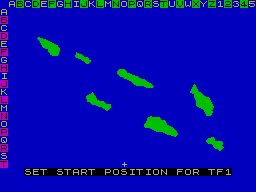
MINDPLAY Intrepid Adventurer Greg Turnbull continues his series of reviews for lovers of 'arcade-alternatives'. PACIFIC WAR Cases Computer Simulations Ltd. Price: £5.95 PACIFIC WAR is a wargame simulation of the battle of Guadalcanal in the Eastern Solomons, August 1942. Only one player is allowed; he controls the American, and the computer the Japanese, forces. The objective is to find, and destroy the enemy's fleets, before they land reinforcements, or destroy you. The format is similar to the Lothlorien games; but uses slightly better graphics. Play is shown on a grid-map of the area (the references are strangely double letters, e.g. KS?). There are nine levels of play, although there isn't much apparent difference between each one. A screen dump of the initial map will prove very useful during the game. Play consists of setting up your task-forces, selecting (alterable) courses; then sequential game turns (G.T.) of three operations turns (O.T.) each. You control three task-forces; battleships, cruisers, aircraft-carriers and transporters; plus Henderson air field. The computer has six task-forces (doesn't it always have the advantage?) Progress is made on a points system after 'Battleships', on which this game is based. Set numbers of hits being required to sink each ship. The scores are totalled, and the first to reach a set value wins the 'battle'. Half of this large program is in machine code; although play is often slow and very repetitive, eg. target movement by cursor keys, form the lower border, one square per time! (three would have been better.) Each task-force may have up to 3 air missions (which move 2 squares per O.T.), and only move one square per G.T. Early play entails sending numerous search missions to locate the enemy. Once found, airstrikes (of fighters, torpedos, or dive-bombers) can be sent out, to try and destroy the opposing task-force. Previous sightings are shown on the map, for a few turns, by an expanding square. The only defence against Japanese air attacks is to launch a C.A.P. (combat aircraft patrol), which decreases your fighter strength. Strong air strikes are most effective, but once sent they cannot be recalled. Status reports on each task-force are available, and after each G.T. a full fleet damage report is given. Note-making and tactics are all-important. This is a long game, and inexplicably no 'SAVE/LOAD' option is provided! The rules are complex but easily learnt, but the game becomes somewhat boring due to constant repetition, and slowness. The only outstanding feature being the moving-graphic 'planes on the map. Each game is varied because of the random start positions, but soon become the same as the last (despite the level chosen). To re-play the game you are required to re-load the entire program! In all, an interesting strategy game; only just recommended. It could have been so much better with just a little more careful thought, and variety in play.
Micro Adventurer #7May 1984 · p.22
DD
VARIATION ON WAR GAME SCENARIOS MICRO: Spectrum 48K PRICE: £6.00 FORMAT: Cassette SUPPLIER: Cases Computer Simulations, [redacted] I suspect that whereas the attraction of adventuring lies in exploring new worlds, the lure of war gaming is the opportunity to change our own history. In this naval simulation you take the place of the American fleet in the Pacific while the computer plays your Japanese opponent. The setting is the Solomon Islands, whose green outline on a blue background forms a very attractive playing field. Pictured on the screen, as well as the islands, are the three American task-forces (represented by flashing numerals) and the American Henderson airfield. At the beginning of the game you are shown three extensive areas of ocean in which the six Japanese task forces may be lurking, and in which you may accordingly position your own forces. Each task force includes an aircraft carrier. The fighting is carried out by planes. An aircraft carrier can launch up to three missions concurrently (as can the airfield). The purpose, target and complement (chosen from available fighters, torpedo planes and dive-bombers) is up to you. When the planes are despatched, charming little UDGs mark their progress. Since only the US fleet appears constantly on the screen, your first task is to find the enemy. When one of your planes flies over a Japanese ship, its location will be revealed and you can attack. Thus far the game is remarkably similar to that old favourite, Battleships. However, in Pacific War everything is in a state of fluidity so the ship you found may be lost again by the time you can get an attack squadron to it. Although I didn't have the full instructions, which the game will include in the shops, the clear and sensible prompts, as well as simple menu selection made this a thoroughly enjoyable game to play. With nine skill levels and new starting positions for the enemy each time, I'm sure it will retain its compulsion and challenge, for a long time. It's a shame CCS couldn't have made it possible to play more than one game without reloading, but with each battle taking more than an hour, that's only a minor drawback. Overall I would call this a thoroughly praiseworthy version of a theme all too easy to make boring.
Advert22
- Micro Adventurer #17Mar 1985 · p.24
- Micro Adventurer #16Feb 1985 · p.36
- Micro Adventurer #15Jan 1985 · p.38
- Micro Adventurer #13Nov 1984 · p.57
- Sinclair User #31Oct 1984 · p.45
- Micro Adventurer #12Oct 1984 · p.42
- Sinclair User #30Sep 1984 · p.64
- Micro Adventurer #11Sep 1984 · p.30
- Sinclair User #29Aug 1984 · p.62
- Popular Computing Weekly #35Aug 1984 · p.37
- Popular Computing Weekly #28Jul 1984 · p.39
- Crash #5Jun 1984 · p.6
- Personal Computer Games #7Jun 1984 · p.44
- Personal Computer Games #6May 1984 · p.52
- Crash #4May 1984 · p.6
- Popular Computing Weekly #21May 1984 · p.34
- Sinclair User #26May 1984 · p.58
- Your Computer #11Nov 1983 · p.226
- Popular Computing Weekly #45Nov 1983 · p.25
- Popular Computing Weekly #46Nov 1983 · p.48
- Popular Computing Weekly #40Oct 1983 · p.42
- Popular Computing Weekly #41Oct 1983 · p.46
Review2
- Games ComputingSep 1984 · p.70
- Home Computing Weekly #58Apr 1984 · p.27
News/Note2
- Crash #3Apr 1984 · p.45
- Home Computing Weekly #50Feb 1984 · p.3
Related
- Same entry at
- Spectrum ComputingZXInfo
Reviews from people here
Sign in to write about this, or make an account. It takes a minute and lets you correct the catalogue too.
No description recorded.
Sign in to correct or add to this.
Hold the rights to this and want it taken down?