
Adventure C: Alien Spaceship
Adventure Game: Text-Only · ZX81 16K · 1 players · English
Artic Computing Ltd · 1982
Also known as Adventure C (English), Adventure C: Alien Space Ship (English), Adventure C: Ship of Doom (English), Adventure C: The Ship of Doom (English)
Discussion
Nobody has started a thread about this yet.
Remarks
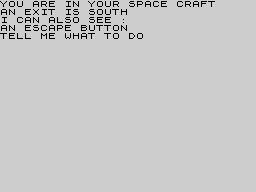
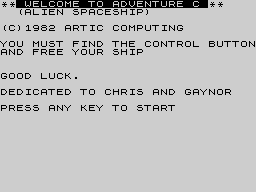
Text adventure: find the control button and free your ship. This game was released as "Ship Of Doom" on other platforms.
SPOT: Depending on your emulator and system, you may find the key repeat so fast as to make this unplayable.
Commercial
Releases
- 1982Artic Computing Ltd Sold as Adventure C: Alien Space Ship
- 1982Artic Computing Ltd Sold as Adventure C: Ship of DoomPound sterling 8.00 · Pound sterling 7.00 budget
- 1982Sinclair Research Ltd Sold as Adventure C: The Ship of Doom
- 1982Artic Computing Ltd Sold as Adventure CPound sterling 8.00 · Pound sterling 7.00 budget
Play
- Adventure_C.p.zipTape image English8 KB
- ADVENTUR.ZIPZX81 archive file English8 KB
Other files
- Adventure_C.ZIPArchive file 8 KB
Files and rights
Distribution permission is on record, granted to another archive rather than to this one. Screens and pictures are copied here; everything else links to the archive that holds it.
- AllowedSinclair Research Ltd → WorldOfSpectrum
Credits
- Artic Computing Ltdcredited
Sign in to credit somebody, or say what these people did.
Scores
In the magazines
- Sinclair User #271984 · Gilbert Factor7/10
In the magazines 13
Sinclair User #27Jun 1984 · p.377/10
Gilbert Factor 7/10
FAVOURITES OF YESTERYEAR Ship of Doom Memory: 16K Price: £6.95 Volcanic Dungeon Memory: 16K Price: £5 Pimania Memory: 16K Price: £10 Trader Trilogy Memory: 16K Price: £6.95 Football Manager Memory: 16K Price: £5.95 Dallas Memory: 16K Price: £5 FAVOURITES OF YESTERYEAR THE ZX-81 may leave much to be desired as an arcade games machine but it is perfect if you want to play adventures. A good keyboard is not necessary and high-resolution colour graphics is not an integral part of adventures which are, in most cases, text only. The ZX-81 also has 16K of usable memory, so a programmer is not restricted by RAM requirements. It is not surprising therefore that many good adventures have been developed for the machine. One of the first to be produced was Ship of Doom from Artic Computing. It has a text-only format and follows the usual space plot where your player-character is stranded on a strange and alien ship which you have gone to investigate. You have to suffer the perils of ice and metal rooms while trying to find the key to the control room of the spaceship. As one of the first adventures it was accepted with glee by the addicts. Few people have managed to solve it, although it is one of the easiest adventures in the Artic series. Ship of Doom can be obtained from Artic Computing. The area of graphics adventures has not been left unexplored by eager programmers. Carnell Software was the first to exploit that field with Volcanic Dungeon. The major part of that adventure consisted of text but the player is given a map of the caverns in which play takes place. The map is not very helpful and it is all too easy to be burned to a crisp, frozen, or blasted by the evil witch Magra and her denizens. Play in the dungeon is undemanding, as nearly every turn is taken up with fighting monsters. The monster conflicts are so random that one of every three or four is likely to end your life and leave you waiting for the game to be initialised again. The game is slow in execution - most of it is written in Basic - and death is always too swift. It is as if the computer is playing the player and not the other way around. Our experience shows that Magra gets the better of an adventurer. The Volcanic Dungeon is available from Carnell Software. Pirnania is another graphics adventure from Automata. The graphics are short intervals between moving or solving problems but they contain some important clues as to how to solve the central problem and find the Golden Sundial of PI. The Pi-man is an irritating little charaCIer who appears at seemingly random moments during the adventure or when you ask for help. In return for some favour, he will give you a clue as either a riddle or a jig which he dances in classic cartoon style. You might feel as if you could do without the Pi-man but he is necessary for the completion of the adventure, so you should keep on the right side of him. Pimania is a clever and classic graphic adventure. Whether you want to buy it is another matter. You might be drawn by the prize in the competition but is a game which could take more than two years to solve worth playing? The Trader Trilogy, from Quicksilva, could be loosely termed a graphics adventure. In the set of three games you are in charge of a spaceship which roams the galaxy in search of adventure. You are a trader and in your planet-hopping experiences you meet many types of alien creature. The monsters include a fluff-ball which survives on your brainwaves, a whole population 'high' on a drug with effects like Mescalin, and robots giving way to rust. On the first run of the adventure, which has to be played in a sequential format, the graphics and plot are entertaining and you will keep playing until you are killed or find sufficient supplies to make a profit. On the second and succeeding runs you will become less pleased with the game. The Trader Trilogy may be of some interest to children but even they, if they are discriminating, will grow tired of always answering the same mathematical problems to find cargo. The trilogy is the least promising of Quicksilva games for any machine and deserves to be zapped into space. Continuing the coverage of strategy games, Football Manager from Addictive Games puts you into the seat of a team manager looking for division in which it starts to the first division and make sure that you are not relegated. success or, on the other hand, failure, on the pitch and bankruptcy. There are seven skill levels, although we found the first three difficult enough. You have to make sure that your team moves from the Dallas is another strategy game but more down-toearth than the others in the roundup. As you might expect, it contains all the elements necessary to turn you into an oil baron who wants to take over the Ewing empire. You have to prospect for the best land and build a pipeline and production plant on it. All kinds of problems will crop up including tornados, heavy rain and earthquakes. If you are not quick enough you will find the Ewings have taken over your little empire. Dallas is an excellent strategy-simulation which improves the more you play it. The game is addictive, which is a comment which could not be applied to many games of its type. If you fancy a trip into the world of the Ewings, Dallas can be obtained from Cases Computer Simulations.
ZX Computing #6Apr 1983 · p.24
Nick Pearce
SINCLAIR SOFTWARE FOR YOUR '81 Our intrepid reviewer, Nick Pearce, inspects the new range of software from the Sinclair stable. PLANET OF DEATH, SHIP OF DOOM, AND ADVENTURE ISLANDS - ARTIC COMPUTING LTD Firstly for this month's ZX81 software review, some adventures from Artic. Three of Artic's adventures have been given attractive boxes and more interesting titles (they were known formerly as Adventures A, C and D) for marketing by Sinclair as part of their fast expanding software range. For the benefit of readers new to computer adventures, a brief explanation of this type of role playing game will not go amiss. An adventure is a game in which you explore strange new worlds with your computer in the comfort of your own home. As the introduction to the Artic games puts it, during an adventure 'the computer acts as your puppet and controls your senses'. Plenty of imagination, patience, and some lateral thinking are necessary if you are to succeed. An adventure is a game with an object - to enter a castle, rescue a princess from the clutches of an evil wizard, and escape with her to safety, for example. You move from one location to another and there are objects along the way, some of which should be collected as you will need them later on. Hazards of one sort or another abound, and you will need to overcome them all. Each location is described by the computer, and you instruct it with short phrases such as 'Go East', 'Get knife', 'Use torch', etc. The computer then provides an appropriate response such as a new location description, 'I can't' or quite often 'I don't understand'. It is a good idea to make a map as you proceed to stand any chance at all of retracing your steps to safety. All the Artic adventures are written in machine code and are very fast; response to commands is practically instantaneous. They each have an impressively large vocabulary of over 100 words. The programs are long, and take 5.5 minutes (Adventure A) to 7 minutes (Adventure D) to LOAD. FORBIDDEN PLANET Planet Of Death (Adventure A) has about 20 locations and a similar number of objects. You are stranded on an alien planet, and the object is to escape by finding your space ship which has been captured and disabled. You really are in a strange world of the imagination. There are caves, a prison, a lift (but the buttons are rather high, and where does it go?), guards and green men, and much more besides. There is also a maze, a feature common to many adventures and which, as usual, I found very quickly. Once that happens in an adventure I quit and start again, making sure from then on that I stay well clear of the maze at all times! In Ship of Doom (Adventure C), your ship, whilst on a reconnaissance flight, has been drawn by a Graviton Beam onto an alien cruiser. Your aim is to free your ship by pressing the control button in the main computer room. You commence in your ship, and begin by moving into the airlock of the alien cruiser. This is a long adventure with some 40 locations - a radio room, robot factory, weaponry, cold room, galactic bar, an android conversion room to name a few. There are also about 40 objects including a sonic screwdriver, infra-red spectacles, even a body frozen in ice and a beautiful android girl. I won't go into too much detail over what can be done with her, suffice to say that she is programmed for satisfaction - some parts of this adventure are definitely for adults only. There is the odd spelling slip in my copy of the program, (exits becomes exitw in the log room, for example), but nothing is seriously wrong. In some places the program is surprisingly flexible, it accepts both the instructions 'turn' and 'rotate', for example, although some other commands have to be infuriatingly precise. In all the Artic adventures you can speed up data entry, by typing 'N' for North and 'Y' for yes, for example. All the Artic adventures are extremely absorbing. They can also be very frustrating; it is possible to spend a whole evening stuck in one small area of the game unable to solve a problem that will allow you to move further. However, some time later and after giving up all hope of completing the game, the answer will hit you in a flash of inspiration and you can move on - until you reach another seemingly intractable problem a few locations later. An adventure can take days to complete! Both Adventures C and D are very long and incorporate a cassette routine with which a partly completed game can be SAVEd, and LOADed at a later date - a very necessary feature. I SPY... So absorbing were the previous two adventures that the deadline for this issue dawned before I had managed to complete Artic's final adventure - Espionage Island (D), so I am afraid much of it remains uncharted for the present. On the basis of the part I have so far explored, I am confident that it will prove an excellent game. Perhaps in another edition of this magazine I will be able to give away a few of its secrets. For the present, the plot is as follows. The intrepid adventurer is sent on a reconnaissance mission to observe an enemy island; there is a secret hidden somewhere on this island which must be discovered. Unfortunately, your plane has to be abandoned when one of its engines is hit by enemy fire. The adventure begins in the aeroplane and leads into the heart of the enemy stronghold, from which you must eventually return to safety. This is a very difficult game, only to be attempted by the experienced adventurer. Even getting out of the aeroplane and safely onto the island is a problem - or at least I found it so - and I haven't yet managed to get much further forward. All the Artic adventures seem to be from the same original master program, but I don't think that once you've mastered one, the others will be a doddle. Each is original in content, and challenging. Planet of Death is the shortest, with the fewest locations and objects but will nevertheless provide many hours of enjoyment. The quality of software for the ZX81 is constantly improving, and at the same time prices are, if anything, falling. Some readers might feel these Artic cassettes are still a little expensive; however, there can be little doubt that they are very good adventures indeed. Artic Adventures A, C and D cost £5, £7 and £8 respectively, and are available from Artic Computing Ltd, [redacted], or through Sinclair Research Ltd (see below).
A sample screen dump from Espionage Island.
A sample screen dump from Planet of Death.
Sinclair User #12Mar 1983 · p.62
John Gilbert
SINCLAIR ACTS TO IMPROVE THE STANDARD OF ITS NAMED SOFTWARE John Gilbert looks at the latest group of cassettes issued by Sinclair and finds that it is now setting the standards. A new batch of Sinclair Research software for the ZX-81 and Spectrum shows a marked improvement in the quality of programs and a continuation of fine artwork on the cassette inserts. The reason is that the company is selling programs from other independent companies, such as Melbourne House and Artic, instead of continuing to rely on Psion, Mikro-Gen and ICL. The Hobbit which takes first place in the new releases for quality and value for money. This adventure game, which the makers claim uses artificial intelligence, is discussed in Mind Games on page 93. VU-3D, for the 48K Spectrum, is another good offering from Psion. It allows the user to create a three-dimensional representation of an object on the television screen. The object can then be rotated and viewed from any angle. The objects can be displayed as wirework figures or can be shaded. They can also be magnified and reduced. It is possible to store the figure on tape in a data file and re-load it to view again. The program costs £9.95 but even though it has some good features it still seems over-priced. Games feature strongly in the new tapes. Sinclair is selling the Artic range of adventures, A, C and D. Adventure A works on the 16K or 48K Spectrum and 16K ZX-81 and is called Planet of Death. You are stranded on a planet and must return to your spaceship. There is no guide to the keywords but with a little thought you can discover the help command. At times the suggestions can be very unhelpful and it is a good idea to construct a map, as some of the help suggestions may make you retrace your footsteps. The next adventure so far released is C, called Ship of Doom. It can be run on the 48K Spectrum and 16K ZX-81. Your ship is captured by aliens who are searching for humanoids to replace their brains with microchips. The object of the game is to escape from the alien craft by breaking the gravitational field. To do so you must find the control room of the alien ship. The help command is a little more useful in this game and it is easier to get further when playing the game. Adventure D, called Espionage island, can be used on the 48K Spectrum or 16K ZX-81. You must escape from an aircraft which is about to crash into the Atlantic. You must the reach the island safely, avoid capture, and try to discover the secret of the island. The game is more difficult than the others and many people have not managed to get out of the aircraft, even though there is a parachute. All the adventures cost £6.95. Leaving adventure games, Reversi, or Othello as it is sometimes called, can be played on the 16K Spectrum or 16K ZX-81. The game has nine levels, from novice to expert, and the computer is difficult to beat. The makers claim that Reversi reflects the strict contemporary morality of Victorian society but we believe that it can traced to Arabic origins. Reversi costs £7.95. An interesting addition to the range of software is the Artic 1K Chess. It takes some technical wizardry to squeeze this kind of game into the unexpanded ZX-81. The game can be played using one of two opening moves. Because of the lack of memory, castling, pawn promotion and capturing en passant are not allowed. The game loads in approximately 40 seconds and that is ideal for someone who wants a quick game of chess without having to load from a tape which takes several minutes. The computer also makes its moves very fast for the amount of memory available to it. 1K Chess costs £4.95. Super Glooper is an amusing game of Pac-man on the 16K ZX-81. Glooper must paint the maze before the aliens kill him. Unfortunately it is difficult to evade those aliens using the standard ZX-81 keyboard but it is not impossible. Glooper can also pick up one of the shields at the corners of the maze to protect himself and chase the aliens. On the other side of the tape is Frogs, a game of Frogger. You must get the frogs over the river via the moving boats to the jetties on the other bank. If froggie falls into the river, it drowns. You score points for each frog you get across the river and you can have eight frogs to send to their deaths. Super Glooper and Frogs cost £4.95. Another game with a familiar-sounding theme is Through the Wall. It is based on Breakout and is available for the 16K ZX-81. On the other side of the cassette is Scramble, also a familiar theme. Both games on one cassette represent good value at £4.95. A package for the 1K ZX-81, called 1K Games, has also been released. The games include Jackpot, in which you must try to win the 25 pence jackpot from a one-armed bandit; Etch and Sketch, where you can draw pictures on the screen; and Maze Game, where you must find your way out of the conventional maze. The release of this cassette, costing £4.95, is a good idea at a time when so many people are buying ZX-81s. A basic Toolkit is available for the 16K ZX-81. It provides a series of machine code routines to make the job of programming easier. It includes a re-number routine, a search and replace routine, a merge routine to put together two separate Basic programs, and a routine to put a Basic program above RAMTOP and out of the way of the NEW command. The Toolkit costs £5.95. Two database programs are available in the range for the 48K Spectrum. They are called Collector's Pack and Club Record Controller. Collector's Pack can be used to store information about coins, stamps or even records. The Club Record Controller will store information about people such as addresses and telephone numbers. It would be useful to schools or even someone who runs a private club. Both packages are easy to use and cost £9.95. Adventure B, Inca Curse, for the 48K Spectrum is an upgrade of an adventure which Artic wrote for the 16K ZX-81. The adventurer is exploring in the jungle when he finds an Incan Temple. The aim is to go in and drag out all the treasure, or as much a you can carry. It all seems so easy until you enter the game and step into the temple. The authors have managed to cram a good deal into this adventure and the Artic top score of 3,200 points will take some beating. We must admit that it is not one of the adventures in which we have made much progress. Adventure B costs £6.95. The latest release of tapes is certainly better than the previous one. The games, utility, and business areas have been covered well but there is still a lack of good educational software. The only tapes available tend to be multi-choice and question-and-answer sessions. The Psion tapes seem to be the best for quality at the moment and the ones with the most interesting concepts. None of the cassettes reviewed was bad but The Hobbit, Vu-3D, 1K Chess, and Super Glooper seem best.
Sinclair User #3Jun 1982 · p.22
Phil Garrett
FIGHTING AGAINST ASSORTED TERRORS OF THE IMAGINATION In the second and final part of his series on adventure games, Phil Garrett comes to grips with Inca temples, catacombs and nasty mountains. Artic Computing advertises three Adventures, with the rather uninspired titles of A, B and C. They are written in machine code and seem to be from the same original master program, so we can probably expect more adventures in the future. Adventure A appears to be 12.5K long but on closer inspection a fair amount of this seems to be empty. It has about 20 locations, a similar number of objects, and along with the other Artic games, a large vocabulary of more than 100 words. The setting is an alien planet which you are trying to leave, and there is a green man to deal with, a spaceship to find, and even a computer - they get everywhere. Unlike the other two games, you cannot save your present position to return later. Adventure B is set in an Inca temple, is 11K long and is the only one of the three to give you a score. For what it is worth, mine never went above zero. This game has 50 locations with short descriptions and more than 25 objects, not including the treasures, which, as in all the Artic games, need to be used at the proper time and in the proper combination to be useful. I had some problems with this game. It was sometimes very strict about the word required at a certain point; for example you cannot go "Up" the stairs, they must be "Climbed". The 13K Adventure C is the largest of the three and is set on an alien spaceship. The object is to press a control button somewhere which will release your own ship from the fiendish Gravitron Beam and allow you to escape. The program contains more than 35 locations and 40 objects, and is, I think, on two levels separated by a hidden door. Despite having spent hours exploring, and manipulating objects on the first level, I still have not been able to break through. Having cheated furiously I know that, apart from the control button, the other level contains more rooms and objects, and a distinctly X-rated Android I would like to meet. All three programs respond to "Help", although rarely helpfully, and "R" repeats the room description. Despite the large vocabulary, the response time is, to all intents and purposes, instantaneous, which makes a difficult and frustrating adventure easier to hear. All the programs use the Artic keyboard scanning routine, which means that there is no response to the break key. The only way I have found to stop the programs, so that I could make a security copy, is by entering three or four "Newlines", and then a complete line of letters which overloads the display file and stops the program with a "5" error. Having done this. I discovered that the instructions for Adventure C got the name of the program wrong. The filename is ADVENT C not ADVENT as stated. At £5, £7 and £7 for A, B and C respectively, they are all good value, and will take many, many hours to master. Catacombs from J K Greye is an all-graphics-real time game. There is no chance of having a think about where to go next on this one, as your strength steadily drops whether or not you are doing anything. As you move around using the standard cursor controls, the surrounding area is revealed. Each level of the catacombs is made up of a random set of inter-connected rooms containing random amounts of food, F, gold, £, and monsters, O for Ore, D for Dragon. Depending on your strength you can either fight the monsters or run away and, if necessary, you can even tunnel through the walls. The program is written in 9.5K Basic and 2K of machine code. Despite the machine code, the game takes more than two minutes to set up. Something else to watch for is the Exit, X. If you go through it you have a two-minute wait for the next level to be set up. This is a nicely-done graphics game with your strength and score, the amount of gold you have amassed, shown on-screen. At £5.95 it is a little expensive and would be greatly improved if the setting-up could be converted to machine code, since beginners may find the setting-up lasts longer than the game. I have to admit that Giltrole's Nasty Mountain nearly had me beaten. After playing the game, studying the listing, and cheating furiously. I finally managed to get out with a score rated as "awful". The idea is to cross a mountain via a set of seven logically-connected caves. Your tortuous path from one cave to the next is shown graphically. and the caves may contain objects, mainly edible, such as apples and carrots. The nasties are not all that fearsome, being rabbits and chickens, but they have to be treated the proper way if you want to get anywhere. The program is written in 12K of Basic and runs at a gentle pace. Movement and picking-up objects can be done with whole words or abbreviations if preferred, but you are told your score only if you manage to get out. You can enter "Help" if you get stuck but all that happens is that the program determines whether or not it is still possible for you to escape, which is scarcely helpful. This is a well-presented logical adventure, and £4.95 is a fair price. Philip Joy's non-graphics Cathedral Adventure is written in 15K of Basic and describes more parts of a cathedral than I ever knew existed - more than 30 in fact. Shortish descriptions are given, sometimes including a cryptic clue̶no pun intended̶and more than 70 words are recognised, although the input processing routine can be slow, sometimes nearly 30 seconds. Some of the treasures which are scattered around may be required later in the adventure, although I have not yet got past the Mad Monk to find out. Plenty of invention has been used in working-up the locations, and some of the spelling, too. In this game, which costs £7.50. Psion offers a tape with two sci-fi adventure-style games,, written in 9K and 14.5K of Basic. The task facing the intrepid adventurer in Perilous Swamp is to rescue a princess and return safely, having fought, or bribed, monsters at every turn. You are given a map to help you and a new layout is produced for each game. The monsters, their strength, and the amount of treasure they are guarding are generated randomly at each step; you have to decide how much strength to use in overcoming them, or how much to offer as a bribe. This program is really a fairly simple guessing game rather than an adventure; there are no objects and no special locations but it has been well done, and was a welcome relief from some of the more brain-taxing games. The second Psion program, Sorcerers Island is a cross between the first and more traditional adventures. The detailed map is the same for each game and takes nearly a minute to display. There is a small vocabulary, move, fight, and so on entered as single letters, some objects, and even a rather ponderous maze. As you try to find the way off the island you use up your Life Points and hope to increase your Treasure Points. In the process of reviewing these adventures I have been attacked by snakes and spiders, pirates and prawns, rats and rabbits, dragons and dwarfs, and countless more terrors of the imagination but it was worth it when the puzzle set by the writers of the programs was finally cracked. What is so good about a computer is that it is limited only by our own imagination. With each new program, you can load up entire new world. Artic Computing, [redacted]. J K Greye, [redacted]. Giltrole, [redacted]. Philip Joy, [redacted]. Psion Computers, [redacted].
C&VG (Computer & Video Games) #6Apr 1982 · p.14
HERE'S THE LATEST IN BRAINWARE A band of roving aliens are scanning the universe for humanoids with the decidedly unfriendly aim of taking out their brains and replacing them with microchips. What do you mean you know someone they found already!? Your task is to defend your ship from the aliens and escape the gravity beam which has sucked your ship into the alien cruiser's flight path. It is during a reconnaissance mission that your android Fred spots the alien ship and warns you of their intentions. Your adventure leads you through space into all sorts of hazards. You explore computer rooms, an android pleasure room, penetrate force shields and fend off laser guns. Adventure C makes full use of the Sinclair ZX81's 16K memory packing in as much as possible. Artic Computing in Hull is the supplier and will sell it for £9. Artic Computing is establishing a series of adventure games which are written in-house in machine code for speed.
Advert8
- Sinclair User #8Nov 1982 · p.40
- Sinclair User #7Oct 1982 · p.48
- Sinclair User #6Sep 1982 · p.18
- Sinclair User #5Aug 1982 · p.42
- Sinclair User #4Jul 1982 · p.44
- Sinclair User #3Jun 1982 · p.45
- Sinclair User #2May 1982 · p.40
- Sinclair User #1Apr 1982 · p.39
Related
- Same entry at
- Spectrum ComputingZXInfo
Reviews from people here
Sign in to write about this, or make an account. It takes a minute and lets you correct the catalogue too.
No tag recorded.
Sign in to correct or add to this.
Hold the rights to this and want it taken down?