
Chess
Game: Board · ZX81 16K · 1 players · English
Mikro-Gen Ltd
Also known as Chess also CHESS-CLOCK (English)
.jpg)
.jpg)
Discussion
Nobody has started a thread about this yet.
Remarks
Fairly fast (considering) machine code chess program.
Releases
- UnknownMikro-Gen Ltd
- 1981Mikro-Gen LtdPound sterling 6.50
- 1982Mikro-Gen LtdPound sterling 6.50
- 1982Mikro-Gen LtdPound sterling 6.90 · Pound sterling 6.50 budget
- 1982Timex Computer Corporation
- 1981Psion Software Ltd
- May 1982Sinclair Research Ltd Sold as Chess also CHESS-CLOCKPound sterling 6.95
Play
- Chess.p.zipTape image English4 KB
Other files
- Chess.ZIPArchive file 4 KB
Files and rights
Timex Computer Corporation granted distribution to all free sites.
- AllowedMikro-Gen Ltd → WorldOfSpectrum
- AllowedSinclair Research Ltd → WorldOfSpectrum
- AllowedTimex Computer Corporation → ALL FREE SITES
- AllowedTimex Computer Corporation → WorldOfSpectrum
Credits
- Mikro-Gen Ltdcredited
Sign in to credit somebody, or say what these people did.
In the magazines 14
ZX Computing #3Oct 1982 · p.120
Nick Pearce
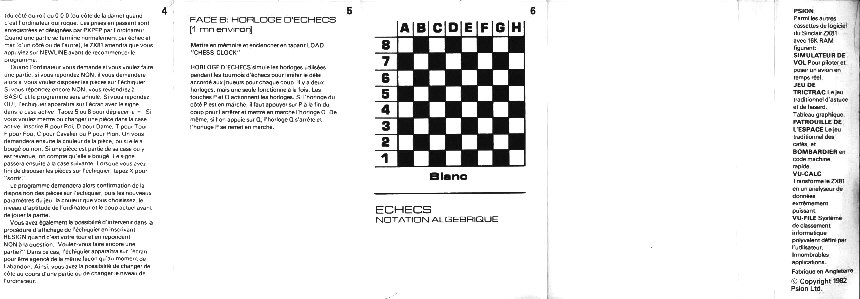
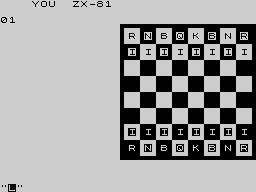
THE CHESS GIANTS GRAPPLE Sinclair Research is selling a chess program for the ZX81, developed by Psion/Microgen. Reviewer Nick Pearce tried it out, and played it off against Artic's Chess II. Originally I intended just to review the Psion program, as part of my review of the new Sinclair ZX81 software, but decided that a comparison with ZX Chess II by Artic, fast becoming the standard for ZX chess, would be more appropriate. The comparison, although interesting, is perhaps a little unfair. Chess II currently retails at £9.95, while the Psion program, together with CHESS CLOCK on the other side of the cassette, sells for £3.00 less. Both programs display the board on the screen, and pieces are represented by letters, K for King, Q for Queen, B for Bishop and so on, with the colour of the piece being the colour of the displayed letter, inverse letters for black pieces. Both games use the standard algebraic system of chess notation for the board co-ordinates, although the Artic program is the only one which actually puts these co-ordinates on the screen. The Artic board is always displayed the same way up, no matter which end the human is playing from, while the Psion board is shown with the player at the bottom. I feel this makes the Psion program rather easier to play. Although I expected to, I did not find the lack of co-ordinates on the screen a disadvantage, as I found with both programs it was only really possible to play a normal game by having a proper board set up beside the TV anyway. Both programs give you the option of setting up a game position. The Artic program requires you to set up a piece by first defining the co-ordinates, then entering a code for the piece you want there. On the Psion board, you use a cursor (=) to move pieces around the board. A deficiency with the Psion program for the serious player is the lack of a 'game save' facility, which the Artic program includes. Psion's also lacks the ability to print out a copy of the screen at any time, or a list of moves. Against this, I particularly liked the Psion feature of being able to resign at any time to start a new game. If you get fed up with a game on the Artic program, you have to either continue to the bitter end, or switch off and reload to start a new game. So much for the immediately apparent differences between the two programs. I'll look now at how well they actually play. Both allow castling and enpassant moves, and neither permits illegal moves. I do not play a particularly good chess game, and consequently found both programs hard to beat, even on the lowest levels. Both games seemed to go for check whenever possible, even if they were not in a position to sustain an effective attack. During one game with the Psion program, the program repeatedly went for check from a losing position, and in so doing sacrificed its remaining valuable pieces. This left me with an overwhelming piece advantage, from which I was able to win easily. However, this was a rather unusual finish to a game against the Psion program. In most games I played, the Psion program put up a good, solid defence, and was not easy to beat. In order to obtain a comparison between the two programs, a friend lent me his ZX81, and I played one program against the other. The levels of play of each program are related to the time taken to respond to a move, and are not directly compatible between the two programs. I rang the changes between the three easiest Artic, and the two easiest Psion, levels of play. I must stress that this comparison is a little unfair, as the Psion does not claim to play chess to the standard of the more expensive Artic game. As you may have anticipated, the Artic program played the stronger game. To Psion's credit, three of the ten games were held to a draw. Artic won six, Psion won one. In a game between Psion on the ZX81, playing white, and Sargon II on Tandy, Sargon won, but took some 45 moves to do so. Both played at level one. Both the Psion and the Artic chess programs play a reasonable game. The Artic program plays a stronger, more sophisticated game, and with its save and move listing features will be the more attractive for serious users. For the casual player, who wants just an occasional game of chess, Psion is a reasonable alternative. The Psion program is more user-friendly, and I particularly liked its 'resign' facility. There is little doubt that most ZX81 owners will learn a bit more about their computers, and the game of chess, through playing against any of these programs. On the B side of Psion's chess is CHESS CLOCK. This simulates the clock used in tournaments to limit the amount of time taken for each move. Two digital readouts display the time taken by each player. I thought that CHESS CLOCK was a bit of a gimmick, and unlikely to be used seriously. There might be a few dedicated players who would be prepared to use a ZX81 and a television to time-keep during serious games. I thought the Sinclair advertisement for CHESS CLOCK somewhat misleading. It cannot be used at the same time as the chess program itself as it implied by the statement "... can be used at any time", unless you happen to have two television sets and two ZX81s.
C&VG (Computer & Video Games) #12Oct 1982 · p.799/108/106/10
Getting Started 9/10
Value 8/10
Playability 6/10
A NICE LITTLE MOVER There was something very sinister about the way this chess program went about assuring itself of a good review. My first encounter with it came on level two where it boasted a 35 second response time to the average move. (Careful timing put it a little above this but perhaps my moves were just above average). It started brightly despite not having a book opening repertoire to fall back on. Snapping up my queen's bishop's pawn gambit, it held onto the extra piece tenaciously enough during the opening and also developed its pieces well. Doing, just enough, in fact, to make me think I had found a worthy opponent and, then, when it sensed I was ripe for the taking, it capitulated to a particularly sweet queen and bishop attack and allowed itself to become mated soon afterwards so that I didn't get bored by the endgame. The result: one reviewer feeling particularly pleased with himself and more than willing to write nice things about the opponent which had just given in so graciously. Further testing on its other levels still suggested that the 35 second response game is the best to play unless you have something to do whilst awaiting in next move in the higher levels. At lowest response level (five seconds) I felt I was getting my own way rather too easily. The screen disappears while the computer is thinking, so you will need your own board to study if you are going to take the game seriously. The computer display does take a little getting used to, as does algebraic notation but the extensive instructions are a help here. The computer will not allow illegal moves, it will let you play black, it understands castling and en passant. I miss not being able to play through my favourite openings with impunity but what can you expect for £6.95? Sinclair ZX81 Chess is produced for the 16K machine by Psion.
Advert10
- Sinclair User #8Nov 1982 · p.28
- Sinclair User #7Oct 1982 · p.6
- Sinclair User #6Sep 1982 · p.36
- Sinclair User #6Sep 1982 · p.54
- Sinclair User #5Aug 1982 · p.52
- Sinclair User #4Jul 1982 · p.46
- Sinclair User #4Jul 1982 · p.54
- Sinclair User #3Jun 1982 · p.40
- Sinclair User #2May 1982 · p.40
- Sinclair User #1Apr 1982 · p.62
Review1
- Personal Computer World (PCW)Sep 1982 · p.155
Feature1
- Sinclair User #3Jun 1982 · p.51
Licensed from
- ChessBoard/Tabletopunofficial
Related
- Same entry at
- Spectrum ComputingZXInfo
Reviews from people here
Sign in to write about this, or make an account. It takes a minute and lets you correct the catalogue too.
No tag recorded.
Sign in to correct or add to this.
Hold the rights to this and want it taken down?