
Backgammon
Game: Board · ZX-Spectrum 16K · 1 players
Hewson Consultants Ltd · 1983 · Pound sterling 5.95
_Back.jpg)

.jpg)
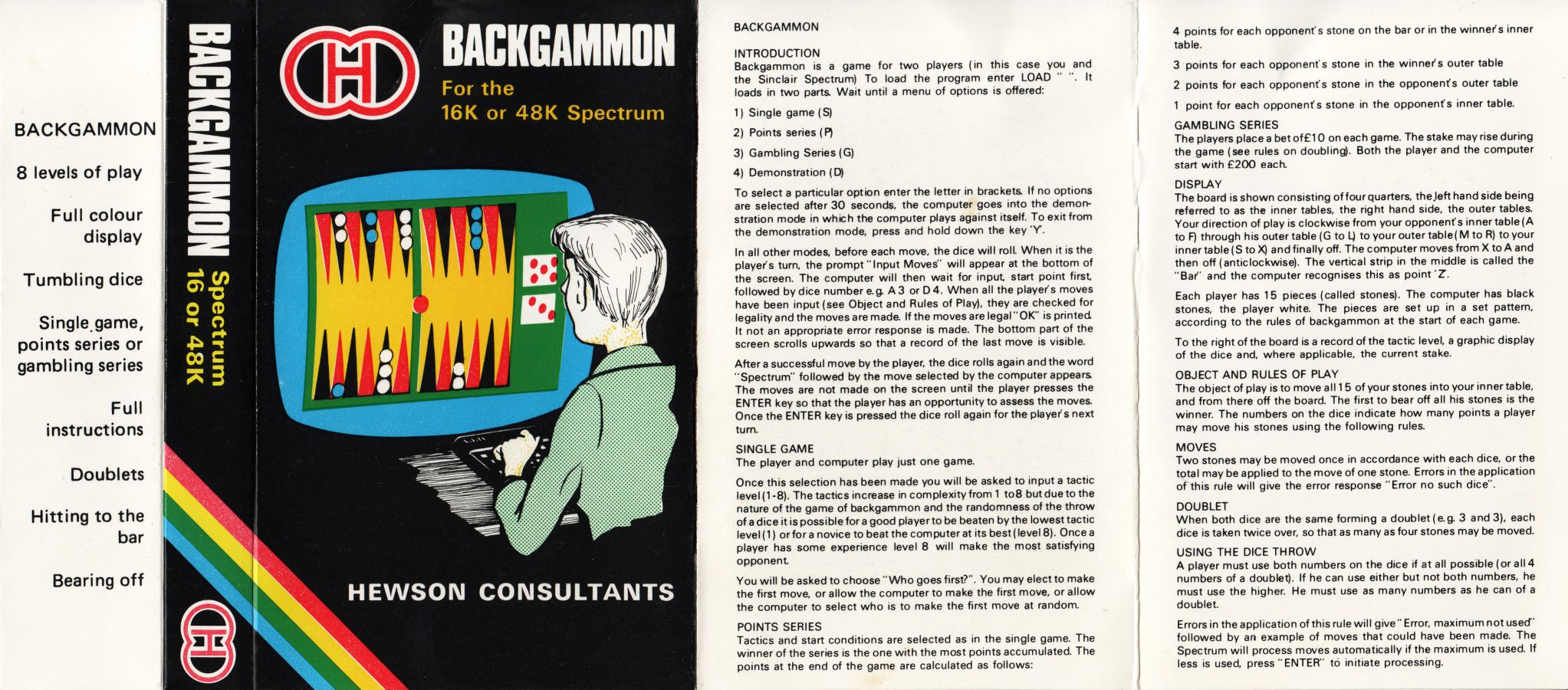
_Front.jpg)
.png)
_SideB.jpg)
_SideA.jpg)
.gif)
Discussion
Nobody has started a thread about this yet.
Releases
- 1983Hewson Consultants LtdPound sterling 5.95
- 1984Microparadise Software
- 1983ZX DataDanish krone 140.00
Play
- Backgammon_2.tzx.zipTape image English5 KB
- Backgammon_3.tap.zipTape image English5 KB
- Backgammon(MicroparadiseSoftware).tzx.zipTape image Spanish6 KB
- Backgammon(MicroparadiseSoftware).tap.zipTape image Spanish6 KB
- Backgammon(ZXData).tzx.zipTape image English5 KB
Documents
- Backgammon(MicroparadiseSoftware).pdfInstructions Spanish14 KB
- Backgammon(EN).txtInstructions English10 KB
Files and rights
Distribution permission is on record, granted to another archive rather than to this one. Screens and pictures are copied here; everything else links to the archive that holds it.
- AllowedHewson Consultants Ltd → WorldOfSpectrum
Credits
- Mike Malecredited
Sign in to credit somebody, or say what these people did.
Scores
In the magazines
- Personal Computer News #181983 · Overall Value3/5
Elsewhere on the web
- WorldOfSpectrum 3 votes4.67
In the magazines 37
Crash #4May 1984 · p.62
Producer: Hewson, 16K £5.95 Clear and simple graphics make this a good version which does well within 16K. Full instructions on program and game contained in insert. Invalid moves refused with alternate moves suggested. On-screen dice, four game options. For a single player against the computer.
Crash #1Feb 1984 · p.59
Producer: Hewson, 16K £5.95 Clear and simple graphics make this a good version which does well within 16K. Full instructions on program and game contained in insert. Invalid moves refused with alternate moves suggested. On-screen dice, four game options. For a single player against the computer.
Sinclair User1984 · p.26
ANCIENT GAME HAS VARIED SUCCESS ON THE SPECTRUM Backgammon has long been a popular game which requires a mixture of luck and skill. John Lambert reports on three versions. Backgammon is an ancient game involving much more skill than draughts, yet dependent more on luck than chess. It is as old, or possibly older than any of them. The ancient civilisations of China, India and Greece all offer possible birthplaces. There are three versions of the game for the Spectrum by Psion, 16K; Hewson Consultants, 16K; and CP Software 48K; all priced at £5.95. Each cassette has instructions for those new to the game. Those written for CP are good, clear and detailed. Backgammon is a complex game and the notes make play easy for a complete beginner. The Psion instructions are equally useful but those provided by Hewson are not nearly as well put together and might be confusing for the novice. When playing Backgammon, the visual impact of the board and layout of the 'men' is vitally important - you need to be able to assess your position and your opponents at a glance, so the graphics are a prime consideration. On loading, Hewson offers a choice of single game, points series, gambling series or a demonstration game. The latter is very helpful for the newcomer and compensates a little for the deficiency in written instructions. There is also a choice of static levels and you can choose who starts the game, although, strictly speaking, that is against the rules. The board is swiftly presented hut unfortunately it is not easy to see, either in colour or black and white. The 'men' do not stand out from the board and the computer moves are made much too quickly for the experienced player to follow, let alone the novice. A record of the moves appears on screen below the table. The Hewson graphics are simple and not very effective compared to the others. Load the CP version and you are presented with brief instructions for play, which neither of the others provides on-screen, but there is no choice of skill level. The graphics are much better than those of Hewson, though the board is drawn very slowly, that part of the program being in Basic. The definition is good, making the men easily visible in colour, and only a little less so in black and white, but since the points are not coloured alternately as they should be it is often difficult to calculate your moves. In this program the chosen pieces flash before a move is made so that it is easy to follow and a record is kept below of the moves, but it is SLOW and your moves have to be entered singly, which can be frustrating when a double is thrown. In its normal fashion, Psion presents a screen display for you to look at while the game is loading, even though the screen takes almost as long as the game to load. Incidentally that was a black mark for Psion; whoever drew its screen should have realised that opposite faces on a dice add to seven rather than adjacent ones. That criticism, however, should not detract from the spectacular nature of board display. You select from four skill levels, with a demonstration game available, and then are given the opportunity to input your own dice throws. It is the only one of the three which allows this, a feature which other games programmers would be wise to copy since your faith in the randomness of the RND generator will be shaken by the dice thrown in all the programs. The board is drawn quickly with the points coloured alternately in black and white and the pieces, large enough to see easily, four character squares, in red and cyan. The definition is not lost when using a black and white television. The dice 'roll' in 3D up the screen and the pieces move across the board from point to point, making it simple to follow the course of the game. On the points with more than five men, the pieces appear to stand on their edges to make space, whereas the other two games resort to using numbers in that situation. When blots are hit, they travel gracefully to the bar, where a maximum of two men of any one player are shown at a time. In the middle of the bar is the doubling cube, which moves from player to player in use. Hewson is the only other game to offer doubles but only in its gambling series. Moves can be changed after they have been made by use of the DELETE key, the men retracing their steps across the screen. EDIT elicits suggested moves to help the novice player throughout the game. The graphic display is well-designed and effective. All the games use the conventional rules of play, as published by Hoyle, but for scoring CP has no doubling option, an integral part of the modern game. Hewson uses its own method of calculating points instead of the accepted one. Only Psion scores correctly. Hewson plays erratically, sometimes being very conservative and at other times taking wild risks. Moreover, by moving about frequently within its own inner table it is unable to take full advantage of the dice. When playing a back game it does not persevere long enough and on one occasion when one of its men was on the bar and most of its opponent pieces had been borne off leaving a blot on the three, Hewson threw five/three and came in on the five, thus losing a gammon. Apart from that instance it usually 'hits' at almost every opportunity and so it can be trapped by a skilful opponent. On the whole the level of play, even at its highest, is moderate and does not provide a stimulating challenge to an experienced player. It is interesting to note that M Male, the author, also wrote the excellent air traffic control simulation, Heathrow, for Hewson. CP is another fanatical taker, but rarely takes the conventional precaution of building houses in its inner table. On the rest of the board its moves are generally conservative but its defeats of Hewson, as indeed when Hewson beat it, depended on some very lucky dice throws towards the end of the game. The two programs are well matched, their skill levels being about the same and their strategies very similar. Psion plays a much more sensible game and provides more of a challenge. It makes better and more frequent use of the standard openings and its strategy throughout the game is more consistent. It protects its inner table and leaves few unnecessary blots but once again when playing a back game it tends to lack conviction and runs for home too soon. To test the abilities of the games a 'tournament' was arranged. Each program played five games against each of the others. The results, shown in the table, were surprisingly even. It was expected, on the basis of playing the game individually, that the result to be would Psion first, Hewson and then CP. None of those programs, however, can assess the play of its opponent, which is why they fail to take advantage of each other's faults. Human players would assess and eventually predict their opponent's moves, frustrating a back game by refusing to hit blots, or avoiding blots left as obvious traps. Since the programs cannot do that, the Psion game, for example, fails to realise that its opponents play consistently badly, and cannot capitalise on that as a human player does. For the same reasons, Hewson and CP opposed each other three times with identical strategies and neither was able to realise that and alter its play accordingly. The results therefore depended often merely on the luck of the dice. The Psion game is programmed entirely in machine code and so uses the comparatively small space available on a 16K machine efficiently, even using the spare space in the printer buffer for the table of the positions of the men on the boards. When the Microdrive becomes available it may be a problem to fit it in. On the other hand Hewson and CP are written, predominantly in Basic, Hewson about 70 percent and CP nearly 90 percent; that makes them somewhat cumbersome and would, particularly in the case of CP, welcome the use of a good compiler. RESULTS Psion vs Hewson 12345 WBW Psion G W Hewson Psion wins 5/3 Hewson vs CP 12345 W Psion G GWW Hewson CP wins 8/1 CP v Psion 12345 G G CP WWG Psion Draw W= Win, G = Gammon, B = Backgammon
'Results depended often merely on the luck of the dice.'
'The CP graphics are much better than those of Hewson, though the board is drawn very slowly, that part being in Basic. The definition is good, making the men easily visible.'
RESULTS W = Win, G = Gammon, B = Backgammon Psion v Hewson Game 1: G (Hewson) Game 2: W (Psion) Game 3: B (Psion) Game 4: W (Psion) Game 5: W (Hewson) Psion wins 5/3 Hewson v CP Game 1: G (CP) Game 2: W (Hewson) Game 3: G (CP) Game 4: W (CP) Game 5: W (CP) CP wins 8/1 CP v Psion Game 1: G (CP) Game 2: W (Psion) Game 3: W (Psion) Game 4: G (Psion) Game 5: G (CP) Draw
Sinclair User #19Oct 1983 · p.48
John Lambert
ANCIENT GAME HAS VARIED SUCCESS ON THE SPECTRUM Backgammon has long been a popular game which requires a mixture of luck and skill. John Lambert reports on three versions. Backgammon is an ancient game involving much more skill than draughts, yet dependent more on luck than chess. It is as old, or possibly older than any of them. The ancient civilisations of China, India and Greece all offer possible birthplaces. There are three versions of the game for the Spectrum by Psion, 16K; Hewson Consultants, 16K; and CP Software 48K; all priced at £5.95. Each cassette has instructions for those new to the game. Those written for CP are good, clear and detailed. Backgammon is a complex game and the notes make play easy for a complete beginner. The Psion instructions are equally useful but those provided by Hewson are not nearly as well put together and might be confusing for the novice. When playing Backgammon, the visual impact of the board and layout of the 'men' is vitally important - you need to be able to assess your position and your opponents at a glance, so the graphics are a prime consideration. On loading, Hewson offers a choice of single game, points series, gambling series or a demonstration game. The latter is very helpful for the newcomer and compensates a little for the deficiency in written instructions. There is also a choice of static levels and you can choose who starts the game, although, strictly speaking, that is against the rules. The board is swiftly presented hut unfortunately it is not easy to see, either in colour or black and white. The 'men' do not stand out from the board and the computer moves are made much too quickly for the experienced player to follow, let alone the novice. A record of the moves appears on screen below the table. The Hewson graphics are simple and not very effective compared to the others. Load the CP version and you are presented with brief instructions for play, which neither of the others provides on-screen, but there is no choice of skill level. The graphics are much better than those of Hewson, though the board is drawn very slowly, that part of the program being in Basic. The definition is good, making the men easily visible in colour, and only a little less so in black and white, but since the points are not coloured alternately as they should be it is often difficult to calculate your moves. In this program the chosen pieces flash before a move is made so that it is easy to follow and a record is kept below of the moves, but it is SLOW and your moves have to be entered singly, which can be frustrating when a double is thrown. In its normal fashion, Psion presents a screen display for you to look at while the game is loading, even though the screen takes almost as long as the game to load. Incidentally that was a black mark for Psion; whoever drew its screen should have realised that opposite faces on a dice add to seven rather than adjacent ones. That criticism, however, should not detract from the spectacular nature of board display. You select from four skill levels, with a demonstration game available, and then are given the opportunity to input your own dice throws. It is the only one of the three which allows this, a feature which other games programmers would be wise to copy since your faith in the randomness of the RND generator will be shaken by the dice thrown in all the programs. The board is drawn quickly with the points coloured alternately in black and white and the pieces, large enough to see easily, four character squares, in red and cyan. The definition is not lost when using a black and white television. The dice 'roll' in 3D up the screen and the pieces move across the board from point to point, making it simple to follow the course of the game. On the points with more than five men, the pieces appear to stand on their edges to make space, whereas the other two games resort to using numbers in that situation. When blots are hit, they travel gracefully to the bar, where a maximum of two men of any one player are shown at a time. In the middle of the bar is the doubling cube, which moves from player to player in use. Hewson is the only other game to offer doubles but only in its gambling series. Moves can be changed after they have been made by use of the DELETE key, the men retracing their steps across the screen. EDIT elicits suggested moves to help the novice player throughout the game. The graphic display is well-designed and effective. All the games use the conventional rules of play, as published by Hoyle, but for scoring CP has no doubling option, an integral part of the modern game. Hewson uses its own method of calculating points instead of the accepted one. Only Psion scores correctly. Hewson plays erratically, sometimes being very conservative and at other times taking wild risks. Moreover, by moving about frequently within its own inner table it is unable to take full advantage of the dice. When playing a back game it does not persevere long enough and on one occasion when one of its men was on the bar and most of its opponent pieces had been borne off leaving a blot on the three, Hewson threw five/three and came in on the five, thus losing a gammon. Apart from that instance it usually 'hits' at almost every opportunity and so it can be trapped by a skilful opponent. On the whole the level of play, even at its highest, is moderate and does not provide a stimulating challenge to an experienced player. It is interesting to note that M Male, the author, also wrote the excellent air traffic control simulation, Heathrow, for Hewson. CP is another fanatical taker, but rarely takes the conventional precaution of building houses in its inner table. On the rest of the board its moves are generally conservative but its defeats of Hewson, as indeed when Hewson beat it, depended on some very lucky dice throws towards the end of the game. The two programs are well matched, their skill levels being about the same and their strategies very similar. Psion plays a much more sensible game and provides more of a challenge. It makes better and more frequent use of the standard openings and its strategy throughout the game is more consistent. It protects its inner table and leaves few unnecessary blots but once again when playing a back game it tends to lack conviction and runs for home too soon. To test the abilities of the games a 'tournament' was arranged. Each program played five games against each of the others. The results, shown in the table, were surprisingly even. It was expected, on the basis of playing the game individually, that the result to be would Psion first, Hewson and then CP. None of those programs, however, can assess the play of its opponent, which is why they fail to take advantage of each other's faults. Human players would assess and eventually predict their opponent's moves, frustrating a back game by refusing to hit blots, or avoiding blots left as obvious traps. Since the programs cannot do that, the Psion game, for example, fails to realise that its opponents play consistently badly, and cannot capitalise on that as a human player does. For the same reasons, Hewson and CP opposed each other three times with identical strategies and neither was able to realise that and alter its play accordingly. The results therefore depended often merely on the luck of the dice. The Psion game is programmed entirely in machine code and so uses the comparatively small space available on a 16K machine efficiently, even using the spare space in the printer buffer for the table of the positions of the men on the boards. When the Microdrive becomes available it may be a problem to fit it in. On the other hand Hewson and CP are written, predominantly in Basic, Hewson about 70 percent and CP nearly 90 percent; that makes them somewhat cumbersome and would, particularly in the case of CP, welcome the use of a good compiler. RESULTS Psion vs Hewson 12345 WBW Psion G W Hewson Psion wins 5/3 Hewson vs CP 12345 W Psion G GWW Hewson CP wins 8/1 CP v Psion 12345 G G CP WWG Psion Draw W= Win, G = Gammon, B = Backgammon
'Results depended often merely on the luck of the dice.'
'The CP graphics are much better than those of Hewson, though the board is drawn very slowly, that part being in Basic. The definition is good, making the men easily visible.'
Personal Computer News #18Jul 1983 · p.483/54/54/53/53/5
Lasting Appeal 3/5
Playability 4/5
Use Of The Machine 4/5
Overall Value 3/5
Mike Gerrard 3/5
NAME: Backgammon SYSTEM: Spectrum 16K/48K PRICE: £5.95 PUBLISHER: Hewson Consultants [redacted] FORMAT: Cassette LANGUAGE: Basic OTHER VERSIONS: None OUTLETS: Mail Order PASS THE OUZO There is no doubt that the best place to play backgammon is in a Greek taverna on a hot day with a generous supply of ouzo to hand, but due to a distinct lack of all three it is back to the trusty Spectrum to try and brush up the game. FIRST IMPRESSIONS The tape from Hewson Consultants comes well documented, with four pages of instructions on the insert, both about the game in general and this version in particular While the rules are necessarily brief, there is certainly enough information for the absolute beginner to learn how to play, though if you want to know about tactics too, you'll need to read up on the game. IN PLAY This version is purely you against the Spectrum, which is preferable to sacrificing some quality just to enable two people to play - if you have a real opponent you should be using a proper board, not the TV screen. But within that limit, the menu presents you with four options: a single game, a points series of up to nine games, a gambling series at £10 per game, each player starting with £200, or finally a demonstration game. On the right of the screen are the two large dice, while the information printed below the board shows the previous move as well as the current one, if you make an invalid move the computer points out exactly what was wrong, and suggests the move you might have made instead, if that applies. The counters are easily and quickly moved by inputting first the start point (lettered from A-Z) and then the number on the dice. In deliberately trying to crash the program or get away with an incorrect move, my opponent never behaved other than impeccably, letting me get away with nothing. It offers you eight levels of play, the response time on the highest being as instantaneous as the beginners' level. VERDICT Given the confines of 16K, this is a good value game for those just learning Backgammon. The operation is smooth and clear, with plenty of time to study moves. But the more experienced player might prefer to look round for a tougher opponent - or book that holiday in Greece.
Advert27
- Your Computer #1Jan 1984 · p.211
- Sinclair User #21Dec 1983 · p.126
- Personal Computer News #40Dec 1983 · p.62
- C&VG (Computer & Video Games) #26Dec 1983 · p.200
- Your Computer #12Dec 1983 · p.30
- Sinclair User #20Nov 1983 · p.46
- C&VG (Computer & Video Games) #25Nov 1983 · p.168
- Your Computer #11Nov 1983 · p.16
- Sinclair User #19Oct 1983 · p.36
- Your Computer #10Oct 1983 · p.174
- Sinclair User #18Sep 1983 · p.62
- Your Computer #8Aug 1983 · p.92
- Your Computer #7Jul 1983 · p.195
- Sinclair User #16Jul 1983 · p.79
- ZX Computing #7Jun 1983 · p.99
- Your Computer #6Jun 1983 · p.30
- Home Computing Weekly #17Jun 1983 · p.4
- Sinclair User #15Jun 1983 · p.15
- Your Computer #5May 1983 · p.36
- Sinclair User #14May 1983 · p.41
- Your Computer #4Apr 1983 · p.46
- Sinclair User #13Apr 1983 · p.94
- Personal Computer News #4Apr 1983 · p.79
- Home Computing Weekly #2Mar 1983 · p.2
- Your Computer #3Mar 1983 · p.10
Review2
- ZX MagazínFeb 2001 · p.7
- Home Computing Weekly #27Sep 1983 · p.8
Feature2
- Sinclair User1984 · p.26
- Sinclair User #19Oct 1983 · p.48
CoverGame1
- Sinclair User #114Aug 1991 · p.7
Licensed from
- BackgammonBoard/Tabletopunofficial
Related
- Compilations
- Sinclair User issue 114: Great Eight 4
- Elsewhere
- UVL
- Same entry at
- Spectrum ComputingZXInfo
Reviews from people here
Sign in to write about this, or make an account. It takes a minute and lets you correct the catalogue too.
No language, description, tag recorded.
Sign in to correct or add to this.
Hold the rights to this and want it taken down?