
Pegasus Bridge
Strategy Game: War · ZX-Spectrum 48K · 2 players · English
PSS · 1988 · Pound sterling 12.95 · Pound sterling 17.95 disk
_Back.jpg)
.jpg)
_Tape.jpg)
Discussion
Nobody has started a thread about this yet.
- Control Option
- Cursor, Interface 2 (left), Interface 2 (right), Kempston Joystick
Releases
- 1988PSSPound sterling 12.95 · Pound sterling 17.95 disk
- 1988Summit Software [1]
Play
- PegasusBridge.tzx.zipTape image English15 KB
- PegasusBridge.tap.zipTape image English35 KB
- PegasusBridge(SummitSoftware1).tzx.zipTape image English15 KB
Documents
- PegasusBridge.txtInstructions English55 KB
- PegasusBridge(EN).pdfInstructions English1,244 KB
- PegasusBridge(SummitSoftware[1])(EN).pdfInstructions English819 KB
Files and rights
No permission is on record either way. Screens and pictures are copied here on a take-down basis: if you hold the rights and want something removed, say so and it goes.
Credits
- Stewart Greencredited
Sign in to credit somebody, or say what these people did.
Scores
In the magazines
- Sinclair User #711988 · Overall7/10
- Your Sinclair #271988 · Overall4/10
- Crash #481988 · Overall78%
Elsewhere on the web
- WorldOfSpectrum 6 votes6.50
In the magazines 6
Your Sinclair #27Mar 1988 · p.548/101/101/101/108/104/104/104/10
Graphics 8/10
Playability 1/10
Value For Money 1/10
Addictiveness 1/10
Strategy 8/10
Overall 4/10
Audrey Bishop 4/10
Owen Bishop 4/10
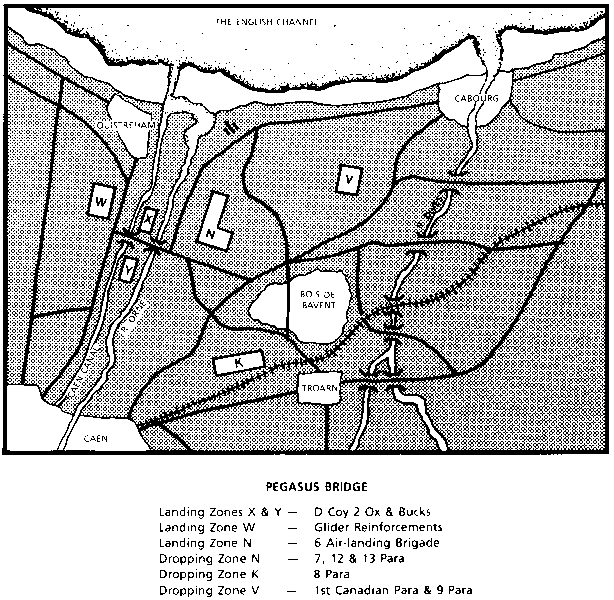
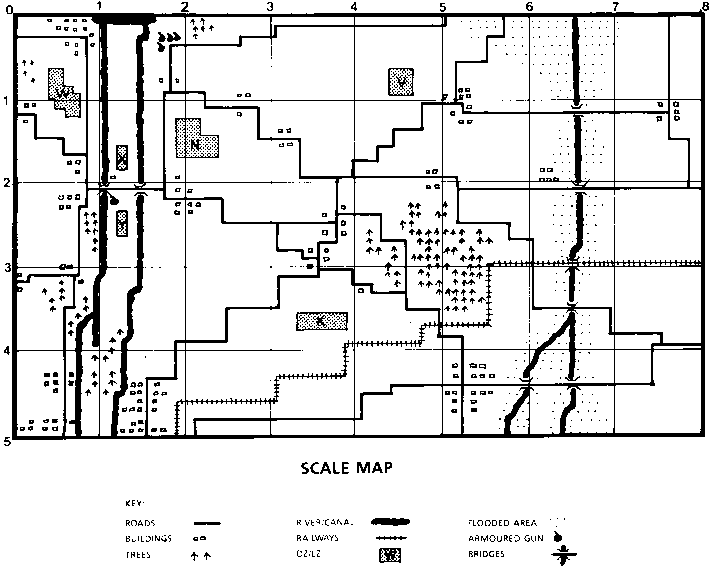
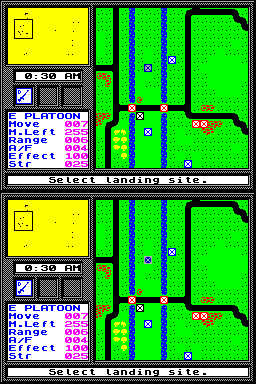
PSS Cassette £12.95, Disk £17.95 Reviewer: Owen Bishop, Audrey Bishop D-day 1944 and the landings begin! The British 6th Airborne Division are parachuting in, detailed to secure the east flank of the beach-heads. Their main objective is me bridge over the Caen Canal, later renamed Pegasus Bridge in their honour after their divisional emblem. Pegasus Bridge has certainly been well researched - in each turn British Airborne units land at the spots where they really landed on that eventful day. German troops and other British troops arrive by road. If you command the British side, your task is to capture and preserve certain bridges, destroy or occupy others and to capture the tactically important Merville battery. If you play the German side, your aim is to hold off the Brits for 18 vital hours. Plenty to think about and some interesting tactical simulations. The game is for 1 or 2 players - single players can command either side, the computer commanding the other. Command is by keyboard or joystick (Kempston, Interfaces I and 2 supported). Graphics consist of a very large scrolling map, with a small-scale map on which the outline of the target map moves as it's scrolled. Dots on this indicate the position of your units. These flash until you have moved or fired them, so it's easy to find your way about. The glossy-paged handbook includes a detailed map of the area, full instructions and plenty of info about the forces involved. A panel on the screen displays full details of all units on the Cursor square. The game follows the usual sequence at phases for each side, including a Support Phase in which you call up fighter or bomber strikes, and naval gunfire on any target. We thought this game sounded just the ticket and were excited as we sat down to give the Jerries a good going-over. Probably we could have done, for suddenly, in the middle of our (true blue Brits) turn, we found that the computer had handed control of the German forces over to us! Being Brits we were obviously too gentlemanly to take advantage of such a situation. In short there was a bug in our version (and in the replacement copy sent us) which lets the game go its own way, jumping from one phase to another inexplicably. What with that and the excessively high speed at which the messages flash on and off the screen we just gave up trying to play.
Sinclair User #71Feb 1988 · p.747/107/10
Overall 7/10
Gary Rook 7/10
Label: PSS Author: In-house Price: £12.95 (£17.95 disc) Memory: 48K Joystick: various Reviewer: Gary Rook Pegasus Bridge is a well designed and provoking game which looks capable of providing earnest strategists with a consistent challenge. It concentrates on one particular target, a bridge over the Caen canal which saw some heroic and heavy fighting between the German and British troops. Taken by glider borne forces at the start of D-Day, they managed to hold on to it in the face of heavy enemy pressure until eventually relieved. After the war was over, the bridge was officially renamed Pegasus Bridge, after the winged horse used as a unit symbol by the British forces. You get quite a bit of choice with this one, as you can elect to command either the British or the Germans, with the computer commanding whoever you don't want. Alternatively, you can two player with (obviously) one person commanding each side. The game follows what is by now a fairly familiar format, used by most if not all strategy games. A central scrolling map window is surrounded by various other displays indicating time, date, status of troops. The graphics are crisp and clear, but the symbols used to depict the various forces involved are smaller than I'm used to. In fact, my main problem with the game was attacking a German unit or a speck on the screen. At the start of the game, assuming that you choose to play the British against a computer-controlled German army as I did, you get to choose where your gliders are going to land. Do this carefully - remember the main objective is to capture and hold Pegasus Bridge. Also remember that just because you want a glider to land in a particular spot doesn't mean that it necessarily will. High winds may bring it down well away from your chosen target! Once down, moving troops is easy enough - you just indicate a target point by moving the on-screen cursor there and hit Fire. The cursor is also used to tell your units which enemy forces to attack. Move the cursor on to the target, hit Fire etc. You have a number of different attack options; you can just wade in and beat someone over the head with your rifles, or you can use ranged fire from your artillery; the Allies also have access to naval gunfire support from the fleet of warships steaming around off-shore, and air power. There's not really much more that needs to be said. Pegasus Bridge is an entertaining strategy game, which is in general (pun - geddit?) well thought out and programmed. My main complaint is the relatively small size of the map window and of the units which are depicted on it. I have a lot of difficulty seeing them - maybe I need new glasses.
Crash #48Jan 1988 · p.13670%81%89%80%70%78%78%
Presentation 70%
Graphics 81%
Rules 89%
Authenticity 80%
Playability 70%
Overall 78%
Philippa Irving 78%
FRONTLINE With Philippa Irving WARGAMES NEED REVITALISING To my great relief things have picked up again this month; which is just as well, for I was beginning to fear for the future of wargaming on the Spectrum. And for my job! The wargame world concentrates heavily on World War II scenarios. I don't have statistics to hand, but it seems that in the last year most of the games which have relied on traditional troop-moving have concerned the years 1939-1945. Many of the public prefer games based on familiar battles (especially those in the last war) because they are still very recent history; film critic Barry Norman has commented that Nazis make perfect cinematic villains. The imagination is excited by the kind of baddie whose image is still part of everyday life, but who is no longer a threat. Practical considerations are also an important factor: designers can take advantage of the many diaries and memoirs of the last war which have been published, and photographs are abundant. However, there many people, myself included, who would like to see wars from the much more distant past, and imaginary wars, treated in the same way. If reliable historical information is lacking, then surely a resourceful designer could make it up. Games based on events many centuries ago could be just as realistic as those of World War II. What about a game, with a series of scenarios and a campaign, about some of the wars fought by the Israelites in the Old Testament? Or Hannibal's invasion of Italy? Another possibility is Boadicea's uprising. I'm not a programmer and I'm not a military historian, but I can think of half a dozen ideas off the top of my head. The Spectrum's memory does have limitations, which do affect the way strategies are devised. However, a bit of imagination and innovation would revitalise things. PEGASUS BRIDGE Producer: PSS Retail Price: £12.95 June 5 1944 was the night of action: after a year of secret planning, the British Sixth Airborne Division landed in Nazi-occupied Normandy. What makes a game based on this operation interesting is that the objectives of capturing and bombing bridges - or defending them - are more important than killing large numbers of enemies, and so the gameplay feels more realistic than usual. The player is given a choice of sides to play against the computer, which always makes a game more satisfying, and there is a two-player option. At the beginning of Pegasus Bridge, the British have not yet made their parachute drops and so there are no British units on the map. The German forces are distributed around various rather remote comers, with only a handful of men already positioned near the all-important bridges. Maps and other information are provided in the booklet and on the screen. The booklet assumes you have a detailed geographical knowledge of the area, which makes things frustrating; as with most computer-wargame maps, what appears on the screen is barely recognisable as landscape. There are ten different types of terrain, which affect the movement of the troops and the defensibility of particular areas. The Sixth Airborne Division and German forces are both divided into many battalions, with the characteristics of each listed in the booklet. If you take the German side, your objective is to keep as many key positions as possible till the end of the 36-turn game. But I took the British side, and will describe Pegasus Bridge from that perspective. The game begins when you give the Sixth Airborne Division clearance to start out for Normandy, though the number of aircraft is not enough for a rapid invasion. The Germans are alerted and hurry to defend the territory they occupied four years earlier. When controlling the British side, the first thing the player has to do is decide where each unit is going to parachute (later some ground units arrive at positions preset by the program). Landing on open ground is recommended, since landing in towns or woods will divide the unit and make it less effective. But the wind makes things difficult. Having set enough troops on French soil, the British player's task is to capture and hold the river and canal bridges in Caen, to destroy or occupy the five crossings of the river Dives, and to occupy the Merville Battery area. Movement follows in a straightforward fashion: units, each represented on the screen by very small squares like minute postage stamps, can be stacked and moved together at the speed of the slowest unit in the stack. Yet it's annoyingly difficult to control the cursor using the keyboard, and great care has to be taken in selecting units and then trying not to overshoot their destination. Combat operates on similar principles, with strength and weaponry affecting the outcome. After engaging in combat and capturing a bridge, a British unit can, if it has the means, blow it up. (It's stating the obvious to say that the unit must be removed from the bridge first!) The bridges over the Caen canal and Orne river should be preserved to meet the victory conditions, though. The booklet is well-written and full of detail, including a description of the course of the actual battle and that useful section called 'author's notes' in which the game's designer defends its idiosyncrasies and points out its more obscure merits. With matter-of-fact modesty the author comments that the computer opponent is 'neither particularly clever, nor particularly stupid', and points out the precariousness and daring uncertainty of the original operation. And Pegasus Bridge reflects that rather well. This is a solidly-designed game with an interesting scenario closely based on history and plenty of play in it.
Review1
- C&VG (Computer & Video Games) #80Jun 1988 · p.54
Letters1
- Crash #51Apr 1988 · p.51
News/Note1
- Popular Computing Weekly #39Oct 1987 · p.43
Related
- Compilations
- ZX-Spectrum Vega
- Ports
- (Amstrad CPC), (Commodore 64)
- Same entry at
- Spectrum ComputingZXInfo
Reviews from people here
Sign in to write about this, or make an account. It takes a minute and lets you correct the catalogue too.
No description recorded.
Sign in to correct or add to this.
Hold the rights to this and want it taken down?