
The Nowotnik Puzzle
Puzzle Game: Problem-Solving · ZX81 16K · 1 players · English
Discussion
Nobody has started a thread about this yet.
Remarks
Sliding blocks puzzle, similar to a 2D Rubik cube.
Commercial
Play
- NOWOTNIK.ZIPZX81 archive file English3 KB
Files and rights
No permission is on record either way. Screens and pictures are copied here on a take-down basis: if you hold the rights and want something removed, say so and it goes.
Credits
- David Nowotnikcredited
Sign in to credit somebody, or say what these people did.
In the magazines 4
ZX Computing #11Feb 1984 · p.58
Nick Pearce
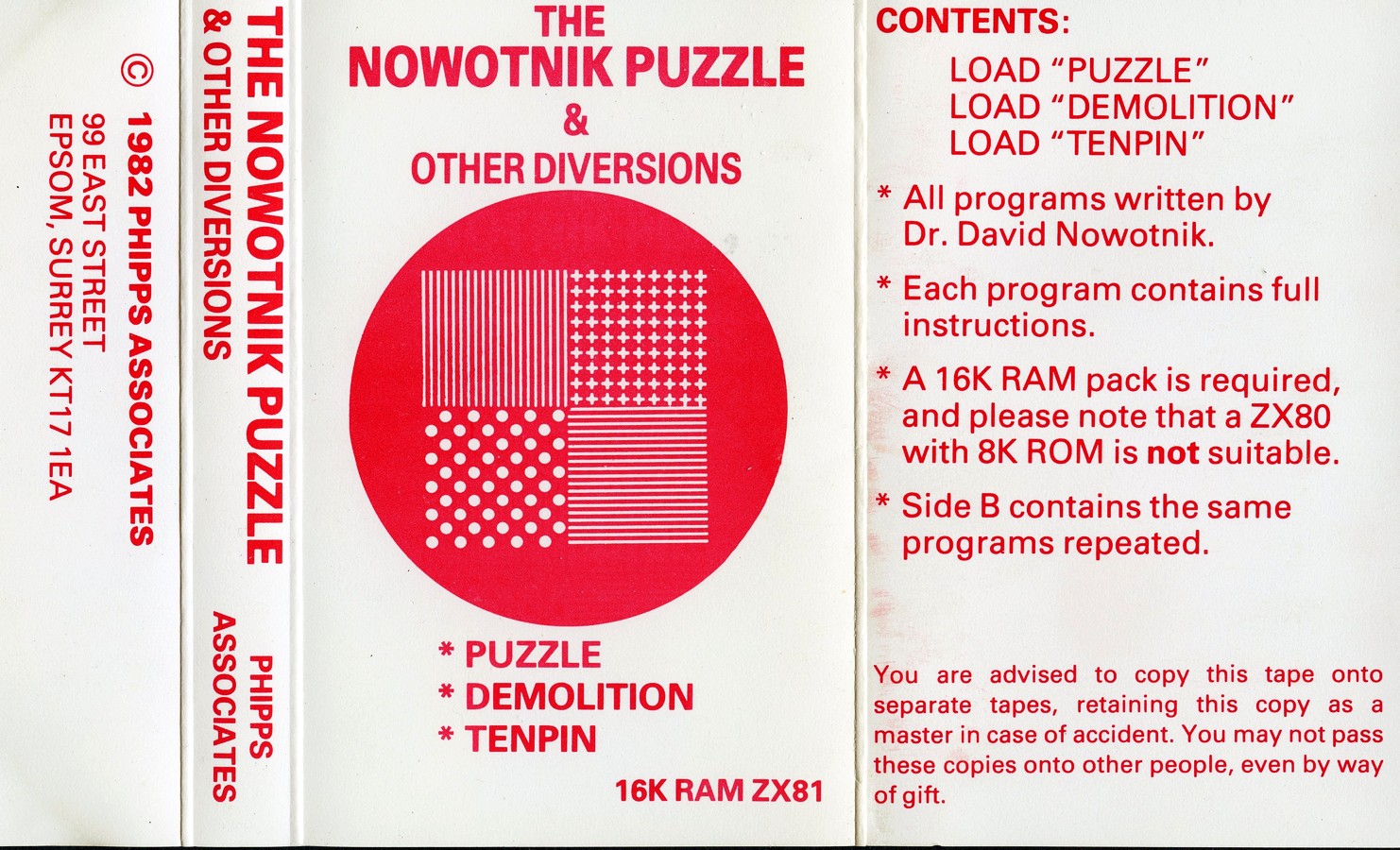
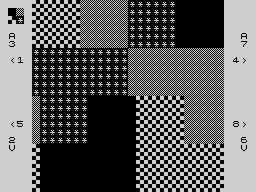
THE ZX81 SOFT SELECTION Nick Pearce looks over the latest (and some of the greatest) software available for the ZX81. Two new cassettes feature in this article, together with re-reviews of three popular cassettes to give new ZX81 owners an insight into the software available for their machines. All the cassettes are for the ZX81 with 16K RAM. NOWOTNIK PUZZLE Phipps Associates Finally, a program that continues to tantalise since its release in 1982. The Nowotnik Puzzle is an original concept in computer games and requires the warped thinking of the Rubik Cube devotee to solve it. Whilst only two dimensional it is nevertheless frustratingly difficult to solve. At the beginning, and when (and if!) completed, the puzzle is in the form of four large squares. These squares are shuffled by the computer using a random selection of eight possible movements and the idea of the game is to use these eight movements to get the four squares back to their original layout. At the simplest level each of the four large squares is broken up into four by the shuffle giving sixteen smaller squares; at the hardest level the four squares are each divided into 144 pieces, giving a total of 576 elements altogether! If you complete the puzzle you are told the number moves taken. There is also a game save facility so that a partly completed puzzle can be continued (and hopefully) finished) sometime later. I would have liked an option to reduce the number of shuffles so that a logical method solution could be developed by trial and error during the first few attempts: the sight of a well shuffled puzzle on the first attempt is itself rather daunting. Conceptually, the puzzle is similar to the dratted Cube. It is relatively easy to complete one square (or face), but it is solving the whole puzzle without ruining what you have already accomplished that is so infuriatingly difficult. But, also like the Cube, the Nowotnik puzzle is an addictive game and with two other games included in the price (an interactive game called Demolition and a tenpin bowling simulation) this cassette is a very good buy. The Nowotnik Puzzle costs £5.00 and is available Phipps Associates, [redacted].
Personal Computer News #9May 1983 · p.544/53/54/54/5
Lasting Appeal 4/5
Playability 3/5
Use Of Machine 4/5
Value For Money 4/5
Sandra Grandison
NAME: Nowotnik Puzzle SYSTEM: 16K Spectrum PRICE: £4.95 PUBLISHER: Phipps Associates, [redacted] FORMAT: Cassette LANGUAGE: Machine Code OUTLETS: Mail Order PLANNED TO PERPLEX To compare the Nowotnik Puzzle with the Rubik Cube wouldn't be far off. It's a battle of wits and anyone can play it. Whether you solve or not is a matter of stamina. OBJECTIVES You have a choice of two puzzles; each has four levels of difficulty and the start position is also the completed form of the puzzle - four large coloured squares. To solve puzzle one you have to move one half of the puzzle at a time horizontally or vertically. The keys one to eight move the halves, and the numbers and arrows on the screen indicate directions. In puzzle two, the screen is divided into vertical and horizontal strips. Again the finished puzzle is four brightly coloured squares. When you play this puzzle the strips rotate about the centre and the squares on the trips rotates to their opposite positions. When solving this puzzle you select C for column or R for row, then press an identifying letter to move it into the position you want. The aim of the game is solving the puzzle in the minimum number of moves. IN PLAY I opted for puzzle one, at level one. On the screen appeared four large brightly coloured squares. Then the fun began. On went the music and the squares danced merrily on the screen into a jumbled form. To remind you what you're aiming for, the right-hand corner of the screen shows a picture of the finished puzzle, and in the left hand corner a counter keeps tabs on the number of moves. The puzzle certainly baffled me - I had clocked up 300 moves and was still no nearer to solving it. Admitting defeat, I confronted puzzle two. It took me a while to get the hang of this one. I had to carefully work out where I wanted the vertical and horizontal strips to go, by identifying the column or row on the screen I wanted moved. Sometimes a column would disappear from its position on a musical note and reappear in an unexpected position. VERDICT This game is well suited to the Spectrum and makes good use of graphics and sound. The musical theme each time you move a piece adds a touch of originality to the art of puzzle solving.
ZX Computing #5Feb 1983 · p.38
Nick Pearce
SOFT OPTIONS FOR YOUR ZX81 Puzzled by Dr. Nowotnik, after a glass of wine Nick Pearce settles down to checking out some of the software commercially available for your ZX81. THE NOWOTNIK PUZZLE AND OTHER DIVERSIONS - PHIPPS ASSOCIATES If you're bored with that dratted Rubik cube, then the Nowotnik puzzle is an original concept in computer games that might be just the thing for you. The chances are you'll be tearing out your hair in handfuls trying to solve the puzzle at the simplest level of play, knowing that there are four progressively harder levels to move onto if you ever do manage to get it worked out. "Easy - it's only two dimensional", I hear you say, as I myself commented - until, that is, I had seen the pieces shuffled and attempted a few exploratory moves. It is indeed a puzzle of merely two dimensions, but don't be under the misapprehension that it is, therefore, a doddle. At the beginning, and when (and if!) completed, the puzzle is in the form of four large squares. These squares are shuffled by the computer using a random selection of eight possible movements. The problem is then to use these eight movements to get back the four squares in their original layout. At the simplest level, each of the four large squares is broken up into four by the shuffle, giving sixteen smaller squares; at the hardest level, the four squares are each divided into 144 elements, giving a total of 576 elements altogether! If you complete the puzzle, you are told the number of moves taken, and there is a game save facility so that a partly completed puzzle can be continued, and hopefully finished, later. I would have liked an option to reduce the number of shuffles so that some logical method of solution could be developed by trial and error during the first few tries; the sight of a well-shuffled puzzle on the first attempt is itself rather daunting. The person who has mastered the magic cube will have a head start in tackling the Nowotnik puzzle. Conceptually, the problem is similar; it is relatively easy to complete one square, or face, but it is solving the whole puzzle without ruining those squares, or faces, already completed that is so infuriatingly difficult. A very addictive game, and as is so often the case with this kind of competition of self versus the computer, it is very hard to admit defeat and one tends to persist, thinking that a few more moves will have it cracked. Perhaps it is fortunate that the ZX81 is less portable than the cube, otherwise it would undoubtedly make its appearance at parties with the nonchalant admission, by devotees, of the number of moves or time taken to solve the puzzle. A DYNAMIC DUO Two other games, routine in comparison to the puzzle but nonetheless absorbing, complete this cassette and make it good value for money. In Demolition, a wall appears at the bottom of the screen and the object is to knock down as many bricks as possible using a '*' fired repeatedly at the wall. There is a catch - the wall moves upwards at a slightly faster rate than you can knock bricks out. and also more walls appear; eventually the game ends when a wall reaches the top of the screen. Points are awarded for each brick removed, and the total for the game is displayed so that a competition between a number of players can be held. A fast moving interactive game and completely idiot proof - my four year old daughter played for about an hour without managing to crash the program! Finally, Tenpin simulates a standard game of tenpin bowling. The alley is displayed at the top of the screen, with score cards for either one or two players displayed below. The game is played over ten frames. When bowling, you indicate the strength of delivery; a stronger delivery is less accurate but increases the number of pins which fall if you make a hit. Not being a tenpin bowling afficionado, I was intrigued by the scoring which apparently is true to life and is coupled with 'strikes' and 'spares'. The graphics are fair; the ball disappears when it hits the pins and the effect as the pins fall and also disappear is rather disconcerting. Nonetheless, a novel simulation to complete the package. All the games on this cassette require a ZX81 with more than 1K, and each program is duplicated on the reverse side. The programs can all be LISTed, and instructions for making security copies are given. Dr. David Nowotnik, the author of the three programs, is a member of the Aylesbury Computer Club. 'The Nowotnik puzzle and Other Diversions' costs £5.00 and is available from Phipps Associates, [redacted].
The Nowotnik Puzzle & Other Diversions carries this game and has 2 references of its own.
Review1
- Personal Computer World (PCW)Sep 1982 · p.154
Related
- Compilations
- The Nowotnik Puzzle & Other Diversions
- Elsewhere
- UVL
- Same entry at
- Spectrum ComputingZXInfo
Reviews from people here
Sign in to write about this, or make an account. It takes a minute and lets you correct the catalogue too.
No year, publisher, tag recorded.
Sign in to correct or add to this.
Hold the rights to this and want it taken down?