
P.H.M. Pegasus
Game: Simulation · ZX-Spectrum 48K · 1 players · English
Electronic Arts · 1988 · Pound sterling 8.95 · Pound sterling 6.99 disk
.jpg)
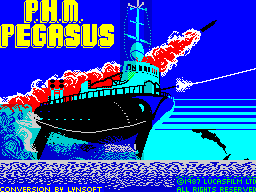
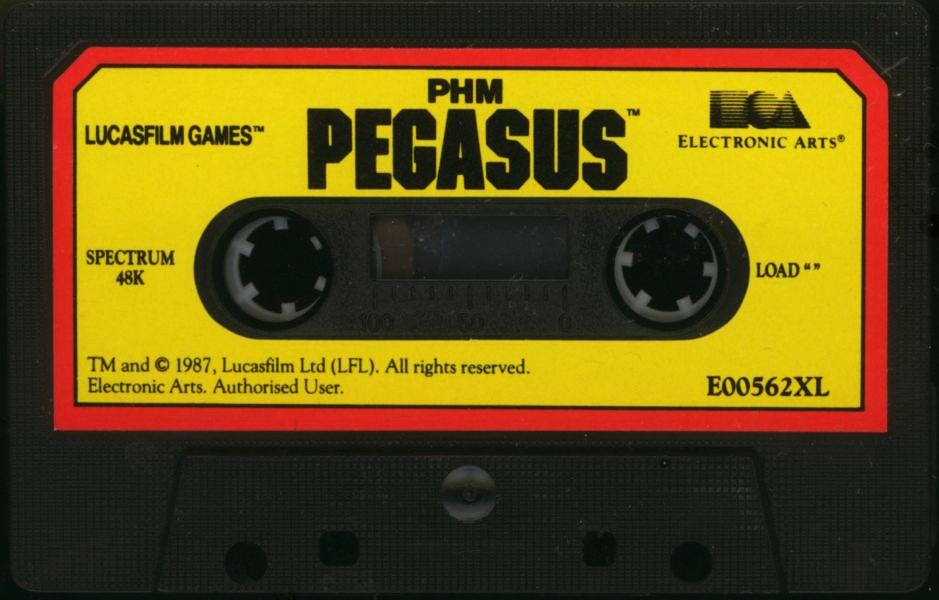
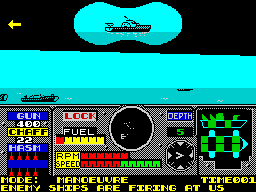
Discussion
Nobody has started a thread about this yet.
- Control Option
- Kempston Joystick
Releases
- 1988Electronic ArtsPound sterling 8.95 · Pound sterling 6.99 disk
- 1988Dro Soft
Play
- P.H.M.Pegasus.dsk.zipDisk image English29 KB
- P.H.M.Pegasus.tzx.zipTape image English25 KB
- P.H.M.Pegasus.tap.zipTape image English24 KB
- P.H.M.Pegasus(SmallCase)(DroSoft).tzx.zipTape image English24 KB
Documents
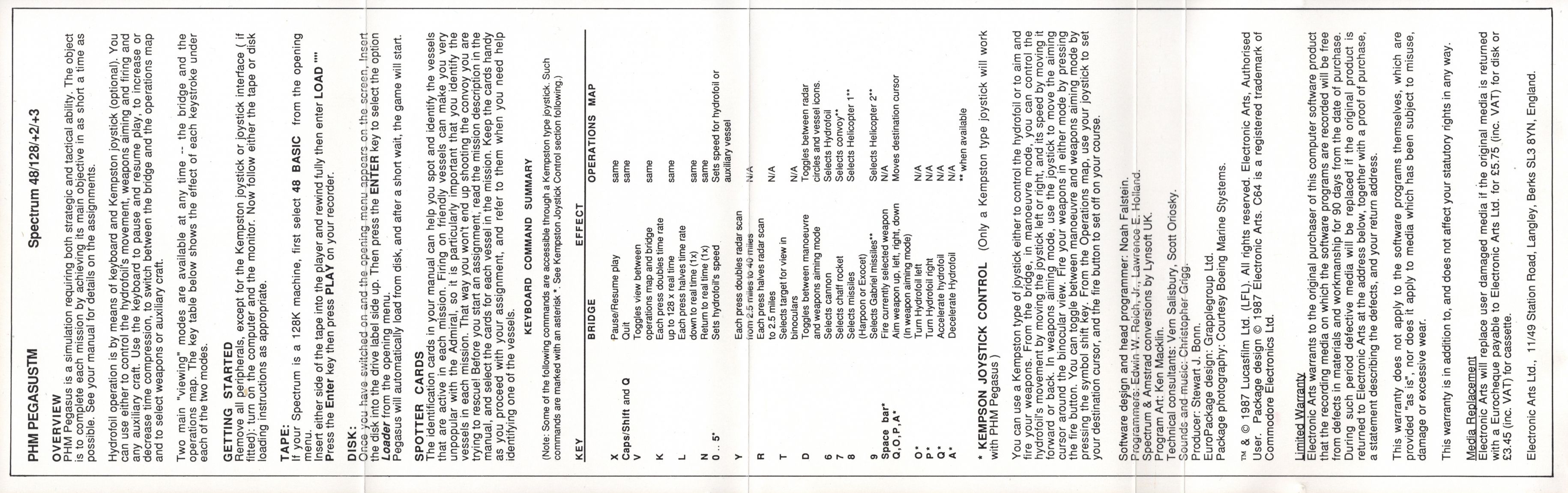
- P.H.M.Pegasus.zipInstructions English226 KB
- P.H.M.Pegasus(DroSoft).pdfInstructions Spanish43 KB
- PHMPegasus(EN).pdfInstructions English695 KB
Files and rights
No permission is on record either way. Screens and pictures are copied here on a take-down basis: if you hold the rights and want something removed, say so and it goes.
Credits
- Gordon Fongcredited
Sign in to credit somebody, or say what these people did.
Scores
In the magazines
- Sinclair User #721988 · Overall6/10
- Your Sinclair #281988 · Overall6/10
- Crash #501988 · Overall79%
Elsewhere on the web
- WorldOfSpectrum 7 votes7.43
In the magazines 27
Your Sinclair #28Apr 1988 · p.445/107/106/105/106/106/10
Graphics 5/10
Playability 7/10
Value For Money 6/10
Addictiveness 5/10
Overall 6/10
Jonathan Davies 6/10
Electronic Arts £8.95 Reviewer: Jonathan Davies Simulations of boats and planes are getting pretty old hat these days, but when did you last get the chance to try your hand in a hydrofoil? A what? You know, one of those boats that rise up out of the water on legs. Not the ones pecked with holiday makers crossing the channel to the hypermarkets for the day, but the military variety. Fast, sleek and dangerous. A bit like a certain well-known reviewer actually, but not nearly so much fun at parties! So now you're at the helm of this hydro-job, whaddya gonna do with it? Might I suggest taking on one of the eight missions you're presented with, ranging from a simple (?) training exercise to a full blown sortie in the Gulf. On the other hand, maybe you'd have been better off staying in bed. The game display is spread over two screens. The first is the operations map where you can plan your route and command your choppers (the flying variety), when they're provided. Then there's the bridge, with a standard out-of-the-cockpit view and your control panel. Having picked up a ship on your radar, jammed any missiles it may throw at you and brought it within range, you may as well knock it about a bit. This can be done either with your cannon or a guided missile, which needs to be... well, guided, to its target. The resulting explosion rivals even a Marathon for satisfaction. While there definitely potential for a good game in here somewhere, I'm afraid the overall result looks a bit tacky. Graphics are sparse, just the inevitable expanses of ocean and not much attempt to animate the enemy when you finally track him down. I can't say I found the gameplay too thrilling either. Cruising around the high seas is fun for a while, but not even the most frenzied of battles really gets the adrenalin flowing. Maybe it's just that Pegasus can't decide whether to be a strategy game or a shoot 'em up. There really isn't enough of either in it for me.
Crash #50Mar 1988 · p.2380%79%75%74%79%79%87%70%
Presentation 80%
Graphics 79%
Playability 75%
Addictive Qualities 74%
Overall 79%
Mark Caswell 79%
Nathan Jones 87%
Paul Sumner 70%
Producer: Electronic Arts Retail Price: £8.95 Author: Lucasfilm Top American software house Electronic Arts, which established itself in Britain last autumn, has finally released a Spectrum product - PHM Pegasus, one of the flashy, complicated simulations for which the company is famous. But this is no ordinary flight or driving simulation: PHM stands for 'patrol hydrofoil missile craft'. The eponymous PHM Pegasus is a hydrofoil, a fast, light craft that hardly touches the water's surface. The hull of a hydrofoil is supported high above the waves by fin-like vanes which minimise friction and improve the craft's efficiency - deadly efficiency where PHM Pegasus is concerned. With basic training complete, you're flung into sea combat against other vessels, at first in training missions, and later in a series of increasingly difficult forays. Fleeing terrorists must be intercepted, two missile corvettes sought and destroyed, vital convoys escorted through dangerous waters and a secret photographic mission undertaken. Though the game title suggests a single craft, you can choose to command any one of three NATO hydrofoils from the US, Israel and Italy. Your hydrofoil operates in two states. In manoeuvre mode a large-scale sea-and-land map of the operational area appears onscreen, marking the positions of your craft, enemy forces, and friendly bases and controllable back-up helicopters. Information about the hydrofoil's speed, the time remaining for your mission, and the speed at which the game is set to run is displayed beneath. In weapons mode, the operational map is replaced by a view from the hydrofoil's bridge, showing the sea ahead - and any enemy craft. Beneath this is the instrument console of PHM Pegasus. At the centre is the vessel's radar screen indicating enemy shipping within a 40-mile range, and there's a gyrocompass and depth indicator for navigational purposes. Engine revs, the hydrofoil's speed and its fuel level are displayed on bar indicators. Your hydrofoil carries a cannon, chaff rockets to deflect oncoming enemy missiles, and Gabriel, Exocet or Harpoon missiles. Weapon system displays indicate the weapon currently engaged and how much ammunition remains. When weaponry is activated, a binocular view of the prospective target appears at the top of the screen, and a gun sight can be focused on the enemy vessel within it. Aim-correctors at the sides of the binocular view help greater accuracy, though a missile automatically locks onto its target when fired. On certain missions, one or two reconnaissance helicopters can be called up to supplement your resources and provide invaluable help. They're directed by positioning onscreen cross hairs over their destination and setting their speed. A 'lock' light provides ominous warning that an enemy missile has, or is about to, lock on to the vulnerable Pegasus - and in the damage sector of PHM Pegasus's console two profiles of your hydrofoil and its watertight compartments monitor the effect of enemy attacks. When one of the compartments is damaged, it is coloured yellow or red, depending upon the seriousness of the damage. Weaponry, fuel and systems can become inefficient or useless when damaged. and different NATO vessels can withstand different amounts of damage before sinking. Points are awarded based on your success in achieving the mission objective. the number of enemy kills, the number of enemy craft damaged and the mission time remaining - and there's a bonus for bringing PHM Pegasus through its difficult mission with as little damage as possible. At the end of each mission the player is given a rank, ranging from Deck-Mopper to Admiral. COMMENTS Joysticks: Kempston Graphics: a well-set-out display, but indistinct enemy ships Sound: atmospheric - ie few spot effects Options: choice of eight missions and three boats; playable in real time or at any of seven other speeds, up to 128 times real time
'The Elite of the seas' or 'lacking polish and addictiveness'?
A simulation with a difference - this time it's a high-tech hydrofoil.
Sinclair User #72Mar 1988 · p.646/106/10
Overall 6/10
Chris Jenkins 6/10
Label: Electronic Arts Author: Lucasgames Price: £8.95 Memory: 48K/128K Joystick: Kempston Reviewer: Chris Jenkins Yo-ho-ho, splice the mainbrace (what is a mainbrace anyway?), here's another chance to put to the open sea, visit exotic surroundings, and then blow them to bits. This time, you man not a battleship or a pirate galleon, but an oh-so-modern hydrofoil, a sort of boat that thinks it's on skis. The game take you all the way from basic training, through various search-and-destroy, surveillance and escort missions, and on to a megaapocalyptic total war scenario. The opening screen consists of a map depicting the area off Key West. From this you move to your bridge display, which shows a view from the cockpit, your controls, a radar display and weapons aiming system. Various weapons are at your disposal; guns, for short-range work finishing off enemy ships; sea-to-sea and sea-to-air missiles for distant targets and aircraft; and chaff (clouds of radar-confusing reflective foil) to ward off homing missiles from enemies. Points are awarded according to how close you get to completing the mission; for instance, in "terrorist attack", for sinking enemy gunboats, but in 'The Better Part of Valour" you're rewarded for the speed with which you escape from a war zone. You are also awarded a rank for each stage. The instrument display is pretty complex without being too detailed but the screen graphics are pretty unremarkable. The gyrocompass indicates your current heading, while the RPM shows your engine speed, the Speed meter your actual rate in knots. The range of the radar can be adjusted to show only close targets, or long distance ones, and there are also depthmeters, fuel gauges, weapons status indicators and a graphic display of damage sustained. The manual goes into a great deal of detail about your weapons systems, scenarios, and possible enemies you will encounter. In this sense PHM Pegasus is very much like the popular Microprose simulations such as Gunship. The large number of easily-confused control keys are also familiar, but there doesn't seem to be much of the excitement of the Microprose programs. Time compression allows you to play through the scenarios at up to 128 times faster than normal, so you can speed up to skip the long journeys. This can lead to missiles pursuing you at eight times normal speed, though. PHM Pegasus was developed by the Lucasfilm games team, responsible for several Activision hits including Rescue on Fractalus, The Eidolon and Ballblazer. It isn't as innovative as any of these; falling half-way between a simulation and an arcade game. Sadly, it doesn't quite capture the depth of the one or the excitement of the other. But there's plenty of material there, and if you enjoy this kind of mixture you might just get hooked.
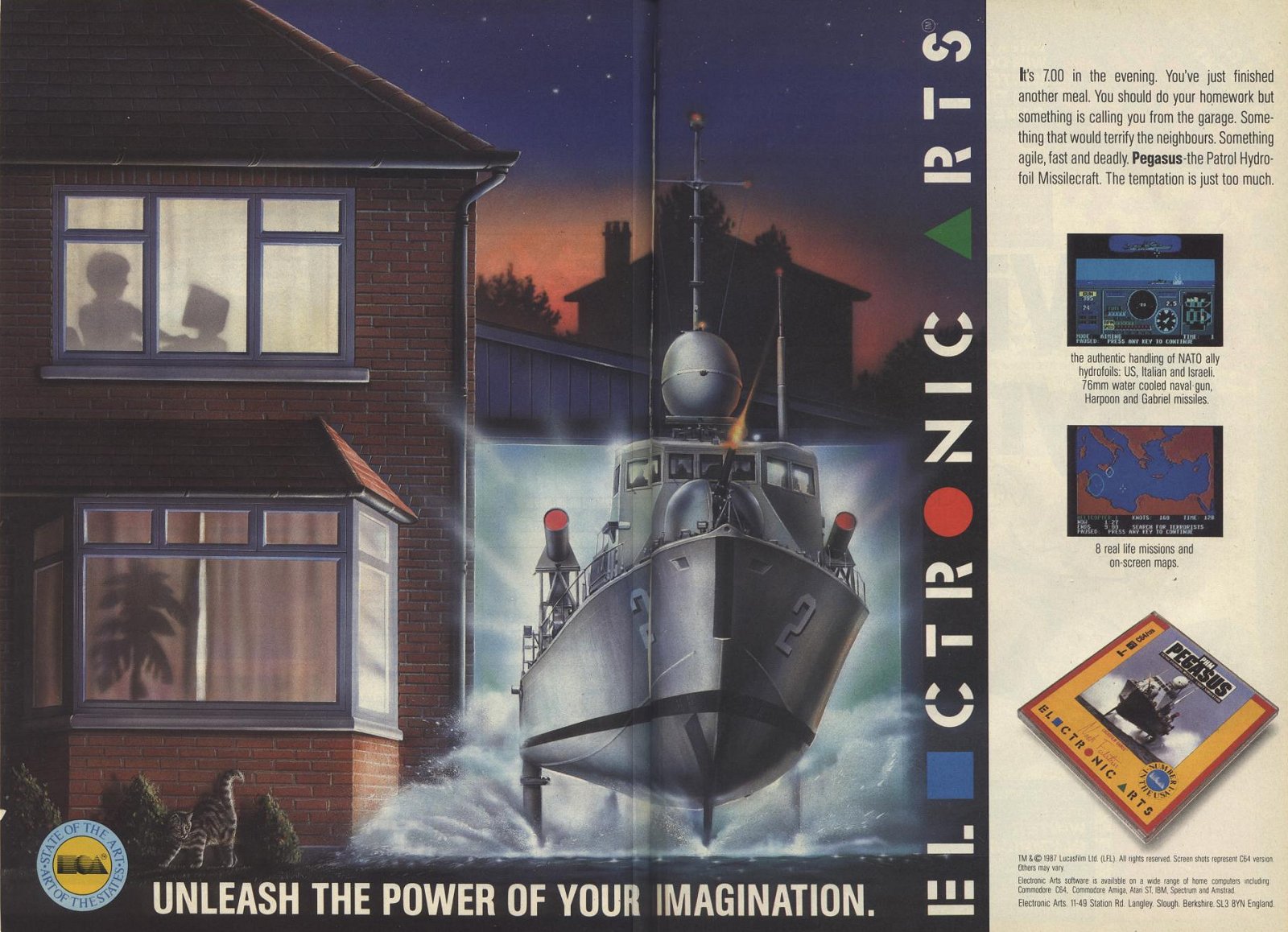
Two-page ad10
- Crash #51Apr 1988 · p.26
- Crash #49Feb 1988 · p.68
- Sinclair User #69Dec 1987 · p.18
- Crash #47Dec 1987 · p.124
- Your Sinclair #24Dec 1987 · p.36
- Crash #46Nov 1987 · p.48
- Your Computer #10Oct 1987 · p.2
- The Games Machine #1Oct 1987 · p.18
- ACE (Advanced Computer Entertainment) #1Oct 1987 · p.16
- C&VG (Computer & Video Games) #72Oct 1987 · p.48
Review3
- MicroHobby #171Jun 1988 · p.32
- The Games Machine #3Feb 1988 · p.48
- ACE (Advanced Computer Entertainment) #3Dec 1987 · p.77
Preview3
- MicroHobby #168Apr 1988 · p.15
- Your Sinclair #24Dec 1987 · p.10
- Sinclair User #69Dec 1987 · p.136
Advert2
- C&VG (Computer & Video Games) #99Feb 1990 · p.13
- C&VG (Computer & Video Games) #98Jan 1990 · p.13
News/Note2
- Popular Computing Weekly #6Feb 1988 · p.20
- C&VG (Computer & Video Games) #72Oct 1987 · p.9
Feature1
- ACE (Advanced Computer Entertainment) #13Oct 1988 · p.57
Tips1
- ACE (Advanced Computer Entertainment) #13Oct 1988 · p.57
CompoResult1
- Sinclair User #75Jun 1988 · p.62
CompoEntry1
- Sinclair User #72Mar 1988 · p.56
Licensed from
- P.H.M. PegasusSoftwareLucasfilm Games
Related
- Compilations
- Load 'n' Run issue 50
- Ports
- (Amstrad CPC), (Commodore 64)
- Same entry at
- Spectrum ComputingZXInfo
Reviews from people here
Sign in to write about this, or make an account. It takes a minute and lets you correct the catalogue too.
No description recorded.
Sign in to correct or add to this.
Hold the rights to this and want it taken down?