
Ball Crazy
Arcade Game: Action · ZX-Spectrum 48K · 1 players · English
Mastertronic Added Dimension · 1987
Discussion
Nobody has started a thread about this yet.
Releases
Play
- ballcrazy.rzxRZX playback file
- BallCrazy.tzx.zipTape image English16 KB
- BallCrazy.tap.zipTape image English19 KB
Documents
- BallCrazy.txtInstructions English4 KB
- BallCrazy(DroSoft).pdfInstructions Spanish38 KB
Other files
- Ball Crazy (1987)(Mastertronic Added Dimension).pokPOK pokes file 0 KB
Files and rights
No permission is on record either way. Screens and pictures are copied here on a take-down basis: if you hold the rights and want something removed, say so and it goes.
Credits
- Mike Talbotcredited
- Jim Trippcredited
- Sarah Daycredited
- Nigel Browncredited
- John SmythInlay/Poster Art
Sign in to credit somebody, or say what these people did.
Scores
In the magazines
- Sinclair User #651987 · Overall4/10
- Your Sinclair #201987 · Overall5/10
- Crash #421987 · Overall73%
Elsewhere on the web
- WorldOfSpectrum 16 votes5.56
In the magazines 9
Sinclair User #65Aug 1987 · p.804/104/10
Overall 4/10
John Gilbert 4/10
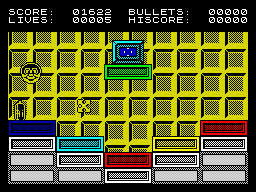
Label: Mastertronic Price: £2.99 Memory: 48K/128K Joystick: Kempston Reviewer: John Gilbert Breakout-style ball games have been all the rage with Gremlin, Imagine and their likes, but Mastertronic has tried a reversal of the trend in its MAD image. Instead of knockin' the bricks out of a wall at the top of the screen you've got to build a wall at the bottom, one level of bricks at a time. To add a new level to the wall you bounce a ball across the bricks of the existing level and try to turn each brick to the same key colour as that of the score block at the centre of the screen. Each bounce against the top side of a brick changes its colour once, in line with a pattern of colour changes. When you've bounced the correct colour on to one square you move to another. When you've finished one level another appears and takes you further up the screen until the bottom half of the screen is filled with brick ballast. The score block also dispenses chasers - like the house of spooks in Pacman - and they hinder your progress and knock lives out of you unless you hit them with one of your limited supply of bullets. Bullets themselves look like the large unimaginative exclamation marks that used to crop up in Basic program magazine listings. On top of that, they won't rapid fire and you can only aim them up vertically. No great programming shakes here. You can pick up bonus objects to increase score or protect you from the chasers. Ball Crazy is repetitive, too. One wall looks very like another, and it also falls down on play niceties, such as the use of joysticks. The special joystick control program was, according to the packaging, written by The Firm. Well, they obviously forgot that a 128K +2 compatible game does nicely with an Interface II standard. The Firm's only included a Kempston compatibility and there's no way you can change key configuration. MAD hasn't gone out of its way to bring player enjoyment in Ball Crazy but you put up with the 'no great shakes' because it's a budget game. However, you could take me back to prehistoric times when Breakout was the in thing and I still wouldn't be too happy.
Your Sinclair #20Aug 1987 · p.346/106/105/105/105/105/10
Graphics 6/10
Playability 6/10
Value For Money 5/10
Addictiveness 5/10
Overall 5/10
Tony Lee 5/10
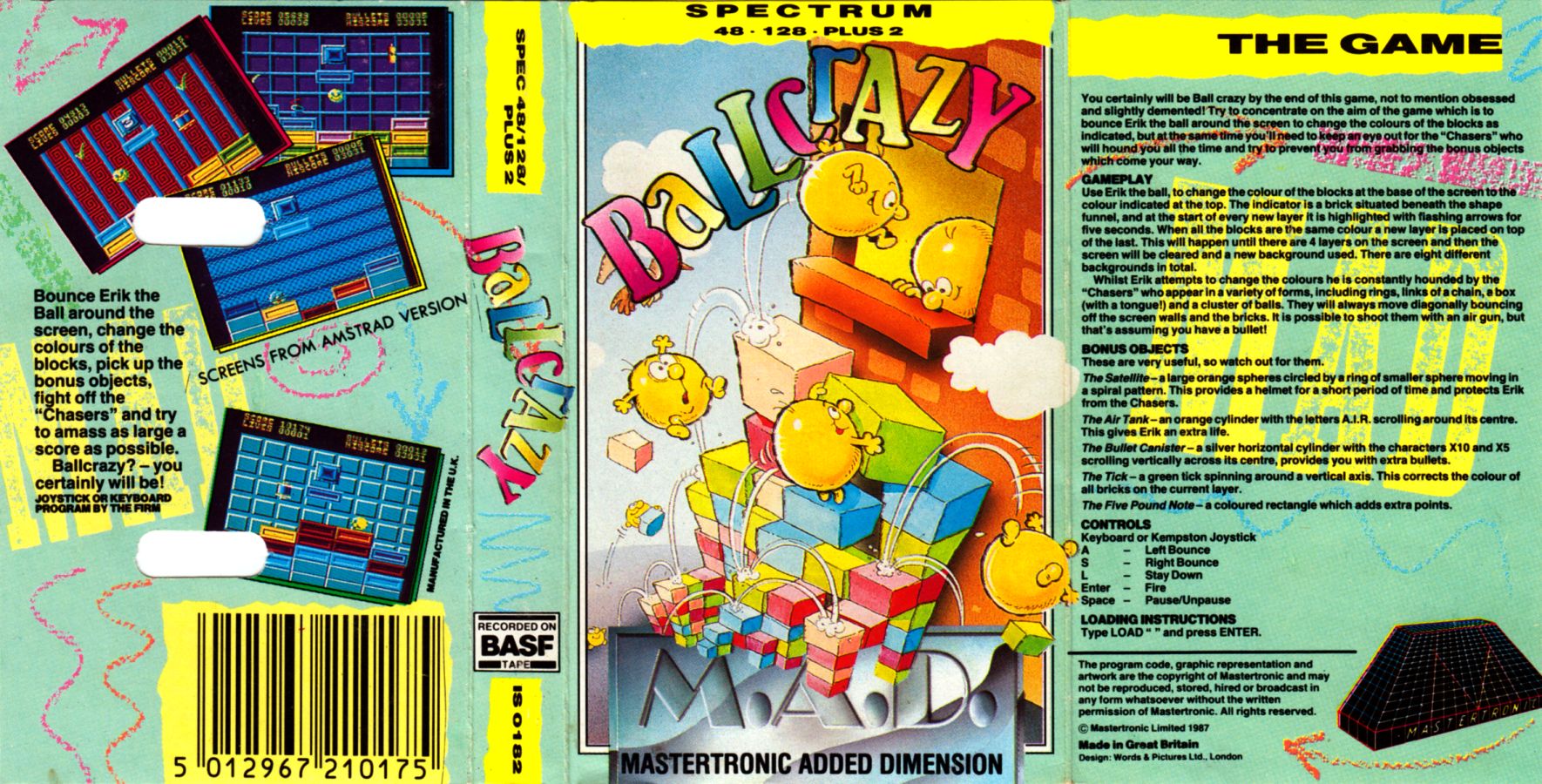
M.A.D. £2.99 Reviewer: Tony Lee When I got this from the Ed, I felt like yelling "No, no, not another bouncy ball game! Give it to some other mug!" I didn't, but now I wish I had. You play Erik, a bouncy little ball and, as the blurb puts it, "the aim is to bounce Erik around the screen." Fine, I thought, so I tried to. I know now that the only thing you can bounce around on is the ground, which rather limits things. Still, the gameplayis simple enough. Erik bounces over five different coloured blocks, each of which changes colour whenever bounced on. All the blocks have to be changed to a uniform colour, as shown by a block at the top of the screen. While doing this you also have to blow away various aliens which float around and hamper you because, if you touch one, you lose a life, and poor ol' Erik deflates pitifully, with a last Pss (What, a wargame? Ed) as he dies. But you'll find that bullets literally drop into your hot, grubby little hands, as will all the other Items that you can pick up. These include a crash helmet which makes you invincible for a while, an air tank which supplies extra lives, money for extra points, and ticks - you know, the things that teachers (not the whisky) put on the end of work when it's right. (I really wouldn't know myself - mine usually had crosses.) That's basically the game. After each row is completed, a new row appears on top, gradually building a wall. I found the screenshots on the cassette inlay misleading, as when loaded the game (important note - the game does not load with every joystick interface) the yellow pacman creature in the Amstrad pic turned out to be a transparent pacman creature which changed colour as it went through the top brick - colour clash alert! All in all it's a fairly average budget game - and it would have been better value at £1.99. Definitely a "yup" game - you look at it, go "yup" and turn it off. It's supposed to turn you "ball crazy", but to go crazy over this you'd have to be crazy!
Crash #42Jul 1987 · p.3473%75%79%64%73%
Presentation 73%
Graphics 75%
Playability 79%
Addictive Qualities 64%
Overall 73%
Mark Rothwell
Mike Dunn
Robin Candy
Producer: M.A.D. Retail Price: £2.99 Erik is a bouncing ball, obsessed with changing the colours of the blocks that share his screen. This he does by bouncing upon blocks at the bottom of the screen; with each bounce the block's colour changes, and when it matches another block at the top of the screen then Erik can move sideways to adjacent bouncing grounds. There's a point for each bounce. When all the five blocks that make up a level are the same colour, another level is automatically introduced, and Erik repeats the exercise. But things aren't that easy for this cherubic rotundity. He's chased by a collection of puncture-producing articles - rings, chain links and boxes - released after a short countdown. Erik can defend himself with fish-shaped bullets which he fires upward from his head. And he can replenish his ammunition by collecting the falling bullet canisters. He can also stop his bouncing to avoid the chasers. Bonus objects keep falling on his head: a cylindrical satellite (nicknamed Ring On A Thing) gives temporary protection against chasers, an air cylinder gives an extra life, a 'tick' corrects the colour of the present level blocks, and a five-pound note increases points. When Erik has successfully completed four levels the next of the eight backgrounds is introduced and away our bouncer goes... COMMENTS Control keys: A/S left/right, L to stay down, ENTER to fire Joystick: Kempston Use of colour bright, and plays an essential part in the time Graphics: straightforward, but with good ball movement Sound: some spot FX Skill levels: one
Cue Bert, the bouncing crazy ball.
Hack/Poke4
- YS Smash TipsAug 1988 · p.5
- Your Sinclair #25Jan 1988 · p.39
- Crash #46Nov 1987 · p.47
- Your Sinclair #21Sep 1987 · p.53
Review1
- MicroHobby #169May 1988 · p.44
News/Note1
- Popular Computing Weekly #22Jun 1987 · p.53
Related
- Compilations
- Sinclair Game Compilation
- Ports
- (Amstrad CPC), (Commodore 64)
- Elsewhere
- Speccy Screenshot MapsCentre for Computing HistoryMobyGamesRZX ArchiveThe TipshopUVLSpectrum Computing RZX - YouTubeRZX Archive - YouTubeModern ZX-Retro Gaming
- Same entry at
- Spectrum ComputingZXInfo
Reviews from people here
Sign in to write about this, or make an account. It takes a minute and lets you correct the catalogue too.
No description, tag recorded.
Sign in to correct or add to this.
Hold the rights to this and want it taken down?