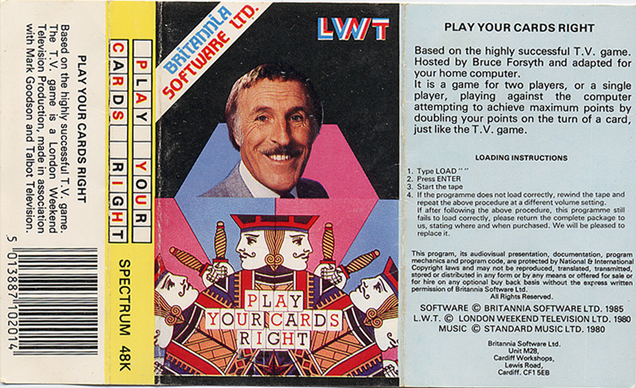
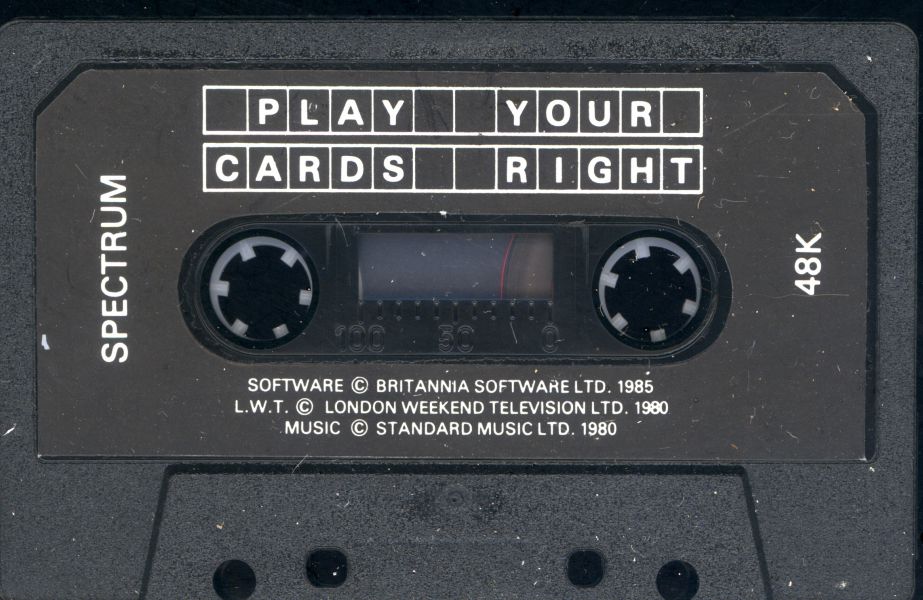
Play Your Cards Right
Casual Game: Gambling · ZX-Spectrum 48K · 1 players · English
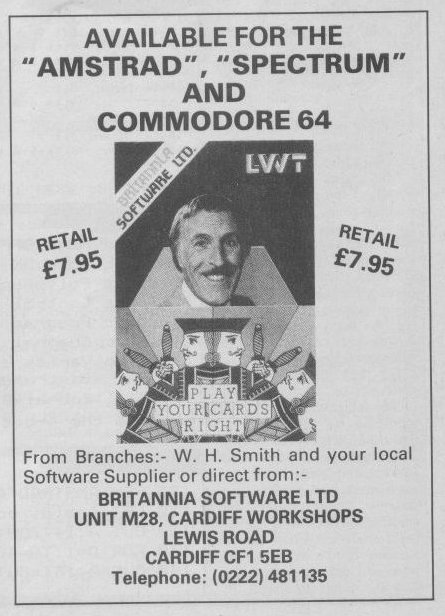
Britannia Software Ltd · 1986 · Pound sterling 7.95
Also known as Bruce Forsyth's Play Your Cards Right (English)
Discussion
Nobody has started a thread about this yet.
Play
- playyourcardsright.rzxRZX playback file
- PlayYourCardsRight_2.tzx.zipTape image English13 KB
- PlayYourCardsRight.tap.zipTape image English13 KB
Files and rights
No permission is on record either way. Screens and pictures are copied here on a take-down basis: if you hold the rights and want something removed, say so and it goes.
Credits
- Steve Gardenercredited
Sign in to credit somebody, or say what these people did.
Scores
In the magazines
- Sinclair User #491986 · Overall1/5
- Crash #271986 · Overall38%
Elsewhere on the web
- WorldOfSpectrum 8 votes5.75
In the magazines 9
Sinclair User #49Apr 1986 · p.501/51/5
Overall 1/5
Clare Edgeley 1/5
Publisher: Britannia Price: £7.95 Memory: 48K Your first sight is of alleged entertainer Bruce Forsyth - host of the TV show - leering out of the screen. Pressing enter to get rid of him starts the game. Choose the number of players - one or two - and enter your names to bring up the first daft question. "100 men were asked: are you afraid of spiders?" Hang on. Where are the instructions? Not everybody has watched this 'highly successful' TV program. And Britannia Software shouldn't presume otherwise, highly successful or not. As some of you might know, Play Your Cards Right is a gambling game based on guesswork rather than skill. On TV it is played with couples and a great many of the questions are of the husband and wife variety. Revolting posers like "100 married men were asked: which do you usually notice first - a girl's face or her figure?" come from the official LWT question sheets. Anyway, on with the game. On your turn you must decide how many men hate spiders, or how many women have dented their husband's car and lied about it, and enter a figure from one to 99. Your opponent then decides whether that figure should be higher or lower. If she is wrong, you begin gambling. Five cards are laid face down and the first is then turned over. Yours is the brain-numbing decision as to whether the next card is higher or lower. If the card is a five you can change it, or you may freeze on any card and wait for the next go. Freezing is the quickest way to win. If you freeze on the fourth card and get the fifth wrong, you won't have to start from the beginning again on your next turn. The computer answers its questions before you've had time to read the first line, which means that when a question with an alternative crops up you're in the dark. For instance, "100 photographers were asked: would you prefer to work on Vogue or Playgirl?" You are asked to guess higher or lower with no clue as to which alternative the computer gambled on. Who wants to know anyway? The game is run on a best-of-three basis. If you manage to gamble successfully on your five cards and reach the end of the line you win. If that happens twice you can go onto yet another tedious gambling game, but this time you bet with points. There seems to be no end to the game. Higher or lower, higher or lower... To think that someone at LWT took the trouble to compile these incredibly stupid questions and find 100 people willing to answer them... It's dreadful.
Crash #27Apr 1986 · p.1845%37%43%41%37%36%38%
Use of Computer 45%
Graphics 37%
Playability 43%
Getting Started 41%
Addictive Qualities 37%
Value For Money 36%
Overall 38%
Unknown
Unknown
Unknown
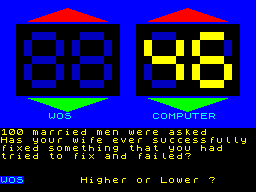
Producer: Britannia Software Ltd Retail Price: £7.95 Author: Steve Gardener Britannia Software started out with a Spectrum version of the TV Quiz show Blockbusters - now they have expanded their TV tie-in activities with a version of Bruce Forsythe' s Play Your Cards Right. When the program has loaded you are greeted with a large picture of Brucie himself, leering out of the screen and inviting you to play the game, accompanied by the Spectrum's rendition of the theme tune to the TV show. Once you've chosen whether to play against the computer or a human opponent and have entered names appropriately, the display flips to the question screen. Two large digital displays occupy two thirds of the screen, with an area below used for text. The digital displays, one for each player, emulate LEO displays as found on calculators and consist of blocks which light up to form numbers. A question which was asked of a group of one hundred people is flashed onto the screen. One player has to guess how many people answered 'yes' to the question and enter the number into his display. The other player then has to decide whether the actual number of positive responses to the question was higher or lower and press H or L followed by ENTER. If the player guessing whether the responses were higher or lower gets it right, then he wins and has first go on the next screen where both players are presented with a horizontal row of five cards. On the card screen, players guess whether the next card in their line will be higher or lower than its predecessor before it is turned face up. A player can change the current card once during his turn, and can freeze play at any point, carrying the cards that have been turned face up over to the next visit to the card screen. The aim is to to get all five cards turned face up - if a player guesses the value of the next card in sequence incorrectly then all his cards except the first one are turned face over and replaced with new ones before control passes to the other person. If neither player manages to get all five cards face up on the card screen, the game returns to the question screen, another question is flashed onto the screen and the game continues as before with the players changing places. If one of the players gets through the card screen then he gets a chance to gamble the points collected on the final screen, where bets can be laid on the turn of cards. The game ends when the winner runs out of points to gamble with or has turned all the cards face up. What do points make? Prizes. Well, not in the computer version of the game... COMMENTS Control keys: H for higher, L for Lower, Number keys to enter your guess and gamble on the final screen, F to freeze play on the card screen, and C to change card Joystick: N/A Keyboard play: no problems Use of colour: simplistic Graphics: well detailed cards, little else Sound: silence, apart from the theme tune at the start Skill levels: one Screens: 3
Ace CRASH photography person, Cameron, takes on the computer in PLAY YOUR CARDS RIGHT. He's not doing to badly, either, when it comes to guessing the turn of the card.
Vogue or Playgirl eh? Which one would our photographer like to work for... PLAY YOUR CARDS RIGHT, Cameron!
Advert4
- Your Computer #3Mar 1986 · p.53
- Popular Computing Weekly #6Feb 1986 · p.25
- Popular Computing Weekly #7Feb 1986 · p.15
- Popular Computing Weekly #8Feb 1986 · p.31
News/Note2
- Sinclair User #48Mar 1986 · p.8
- Your Computer #3Mar 1986 · p.20
Review1
- Popular Computing Weekly #8Feb 1986 · p.44
Licensed from
- Play Your Cards RightTV showLondon Weekend Television
Related
- Ports
- (Amstrad CPC), (BBC Micro), (Commodore 64), (Commodore Plus/4)
- Same entry at
- Spectrum ComputingZXInfo
Reviews from people here
Sign in to write about this, or make an account. It takes a minute and lets you correct the catalogue too.
No description, tag recorded.
Sign in to correct or add to this.
Hold the rights to this and want it taken down?