
Plummet
Arcade Game: Platform · ZX-Spectrum 48K · 1 players · English
Interceptor Software · 1984 · Pound sterling 7.00
Also known as Plummet! (English)
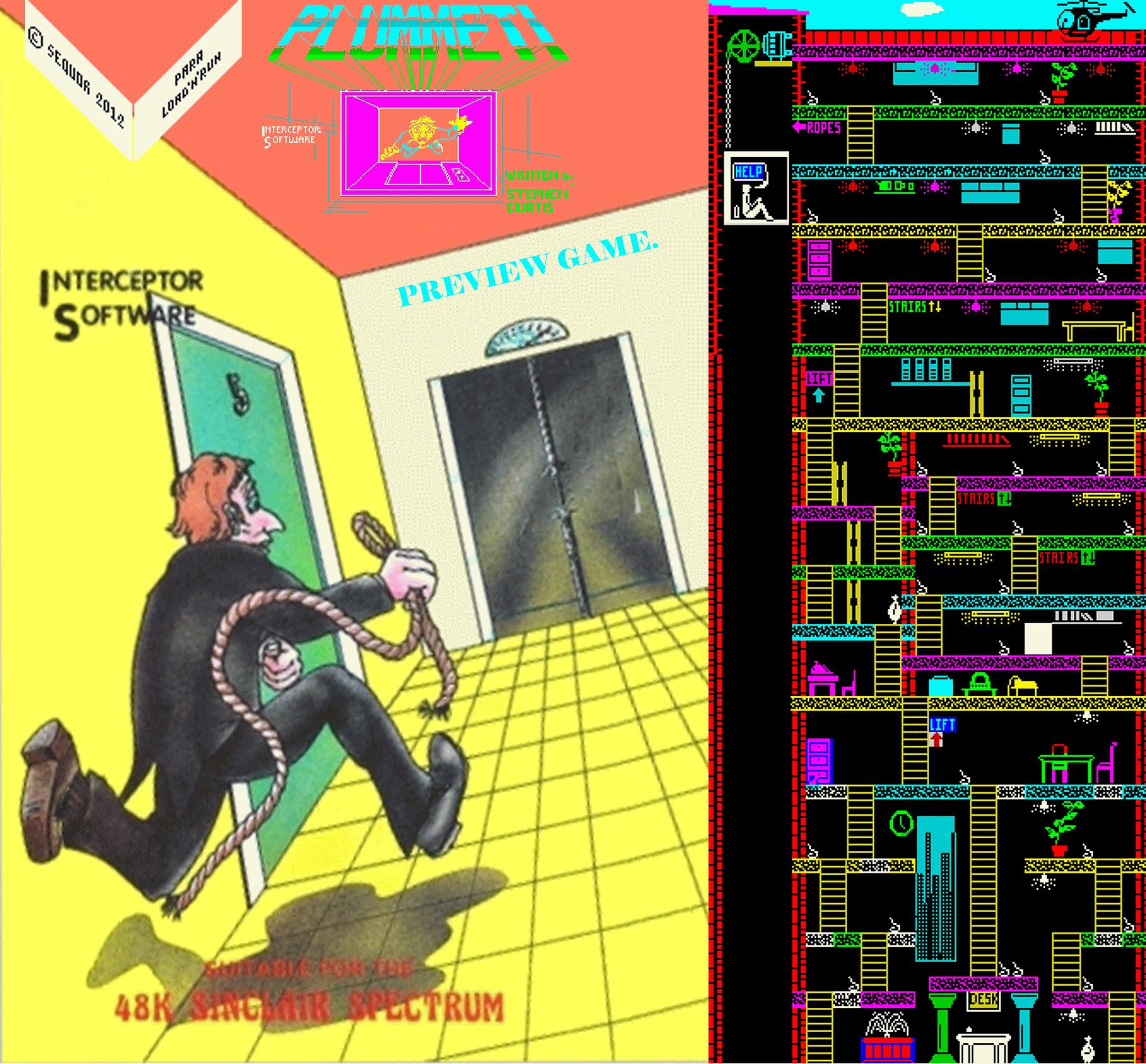
.jpg)
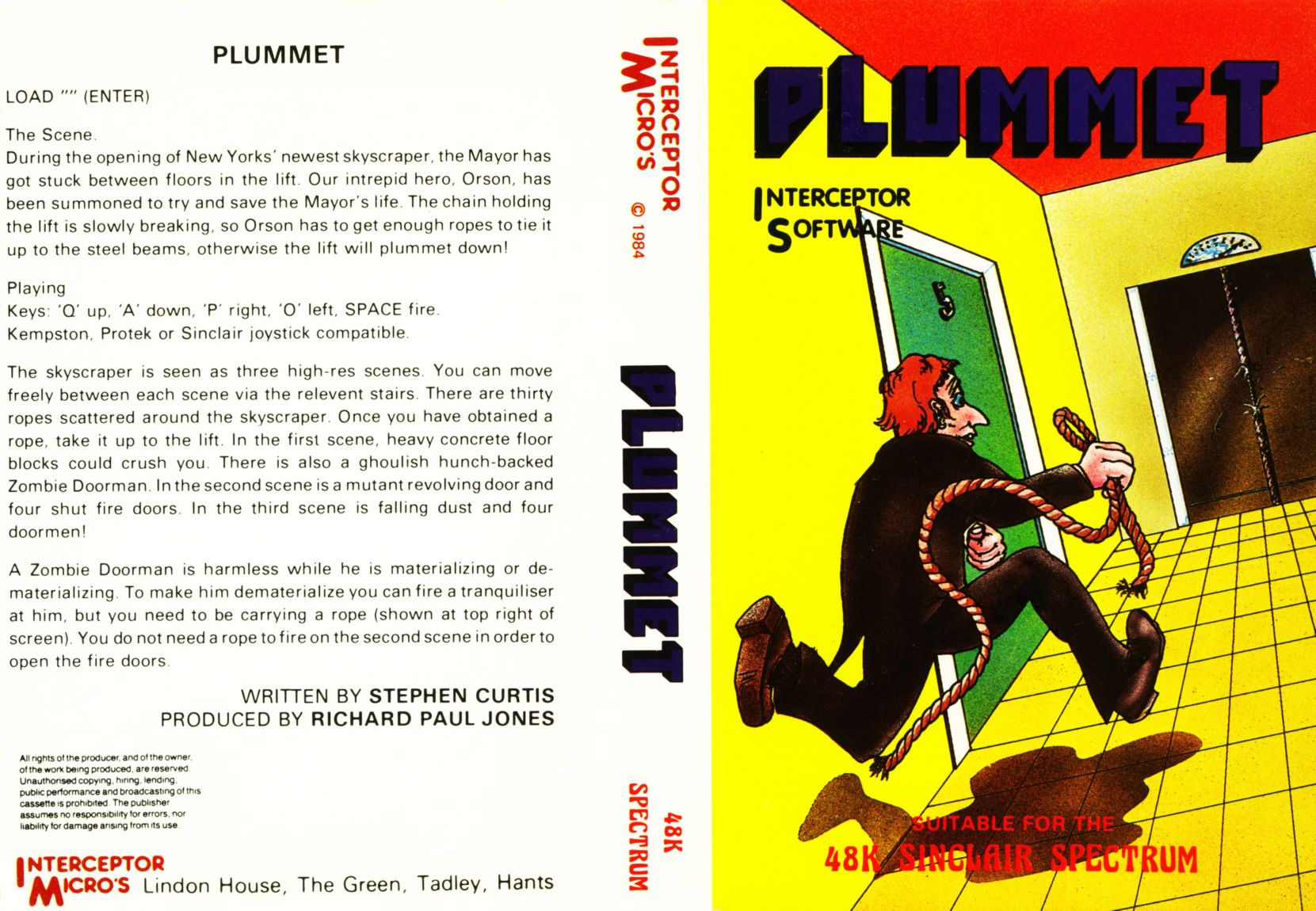
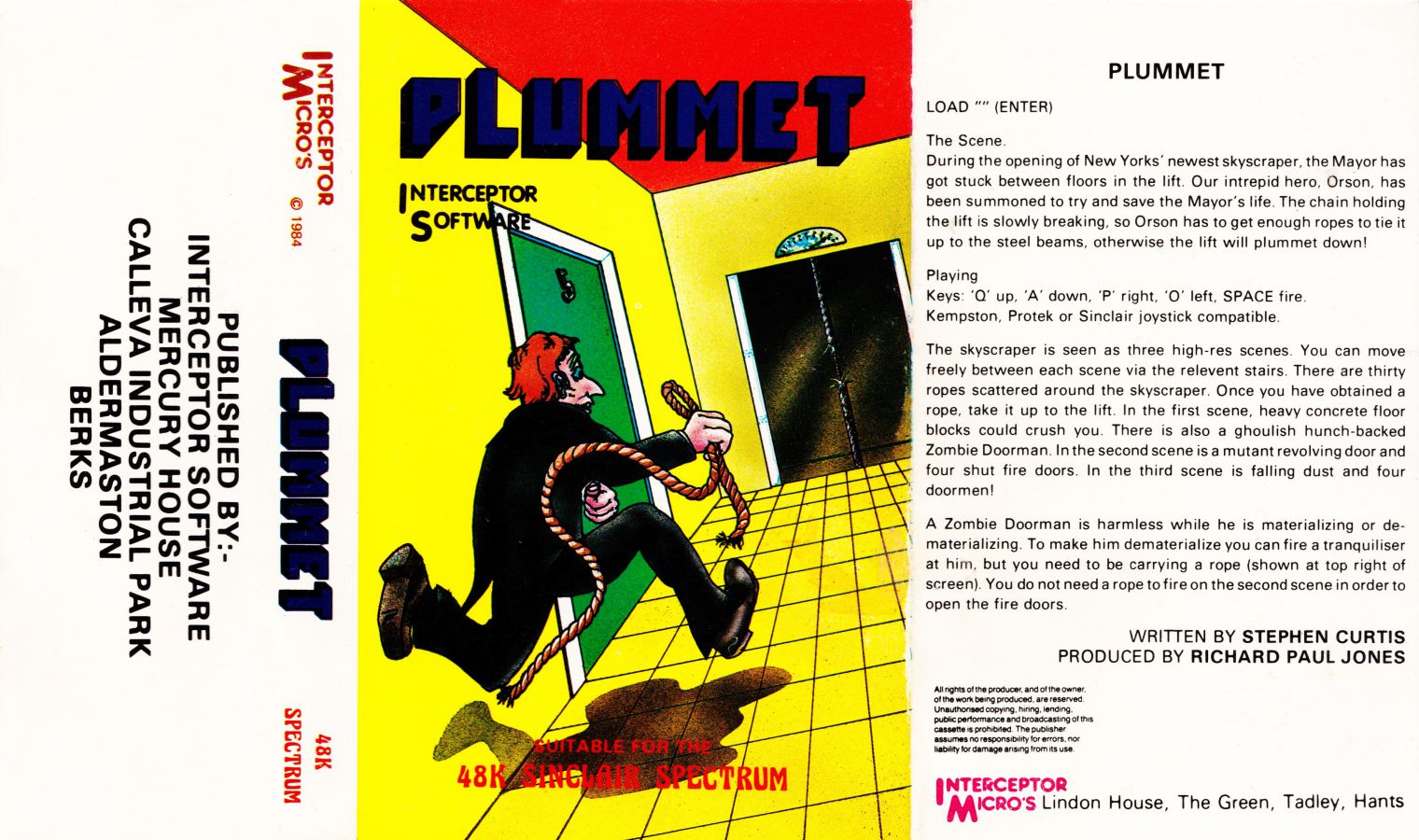
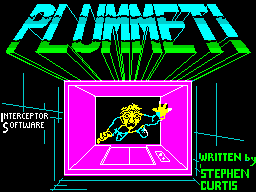
Discussion
Nobody has started a thread about this yet.
- Control Option
- Cursor, Interface 2 (right), Kempston Joystick
Releases
- 1984Interceptor Software Sold as Plummet!Pound sterling 7.00
- 1985ABC Soft
Play
- plummet.rzxRZX playback file
- Plummet.tzx.zipTape image English19 KB
- Plummet.tap.zipTape image English21 KB
- Plummet(ABCSoft).tzx.zipTape image English18 KB
Documents
- Plummet.txtInstructions English1 KB
- Plummet(ABCSoft).pdfInstructions Spanish7 KB
Other files
- Plummet (1984)(Interceptor Software).pokPOK pokes file 0 KB
Files and rights
No permission is on record either way. Screens and pictures are copied here on a take-down basis: if you hold the rights and want something removed, say so and it goes.
Credits
- Stephen N. Curtiscredited
- Terry GreerInlay/Poster Art
Sign in to credit somebody, or say what these people did.
Scores
In the magazines
- Personal Computer News #901984 · Overall4/10
- Sinclair Programs #301985 · Rating40%
- Crash #121985 · Overall61%
- Personal Computer Games #151985 · Overall6/10
Elsewhere on the web
- WorldOfSpectrum 16 votes7.31
In the magazines 11
Sinclair Programs #30Apr 1985 · p.1740%40%
Rating 40%
Colette McDermott 40%
PRICE: £5.50 GAME TYPE: Arcade What is Orson doing? "What are you doing, Orson?" "Can't stop, must save the mayor from an awful fate." "Eh?" "I said, can't stop, must save,..," and he is gone, rushing into the distance, trailing a long rope behind him. He soon returns. "Forgotten something, old chap?" He shakes his head, "Hit by a mutant revolving door," "?" Off he goes again, trailing his rope. Next time round, "Mutant revolving door again?" "Ghoulish hunch-backed Zombie doorman." Right, fine, not much to say to that, is there?" Some time later, Orson returns in the search of another rope. As he emerges in the lobby there is a screeching sound, cries for help and then a sickening thud. Orson collapses into a chair. "Just tell me all about it, old son." Tuens out that the Mayor was stuck in a lift which was giving way. Orson, instead of calling the lift maintenance operatives, had decided to secure it by rushing around this doom-laden hotel in search of ropes and then tying them to the lift. Up and down, through three screens he ran, but the slightest mistake sent him back to reception and, with the Mayor's life at stake, the slightest mistake could not be tolerated. Plummet is produced for the 48K Spectrum by Interceptor Micros, [redacted].
Personal Computer Games #15Feb 1985 · p.326/103/103/106/106/106/10
Graphics 6/10
Sound 3/10
Originality 3/10
Lasting Interest 6/10
Overall 6/10
Bob Wade 6/10
Steve Perkins
Steve Spittle
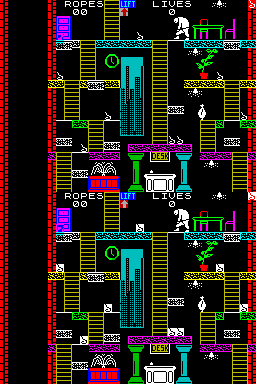
MACHINE: Spectrum 48K CONTROL: Keys, Kemp, Curs, Sinc FROM: Interceptor Micros, £7.00 Fortunately it's not you that plummets in this game, it's the mayor - three floors in a lift while you stand by having a good laugh. You're supposed to be trying to help the poor trapped man by collecting ropes to hold up the lift. Thirty ropes will save him but you can only collect them one at a time and, as you would expect, there are lots of nasty things trying to stop you. The hotel you are in is represented on three screens starting with the lobby, while the lift is stuck on the third screen up. You have to pick up one of the coiled, flashing ropes and climb a series of stairs through the three screens to the lift. In your path there are, of course, a variety of hazards. The first floor features concrete floor blocks which move up and down trying to crush you, as well as a zombie doorman who shuffles up and down, his back permanently hunched. The second floor has a mutant revolving door and four fire doors, while the third has four doormen and falling dust, all of which prove fatal to your rotund character. The doormen can be dealt with by dematerialising them with a tranquiliser, but you can only shoot this while you are carrying a rope. The fire doors are also opened by shouting at them, though why tranquilisers should open doors I'm not sure. If you lose all your lives the chain which is holding the lift snaps and the mayor plummets three floors while shouting for help. Unfortunately you don't get to see him hit the basement in a crumpled heap, but you can't have everything can you? High scores for this game aren't going to look very impressive since you only score one point for each rope attached. If you can get more than 10 you're doing well.
Crash #12Jan 1985 · p.9169%68%70%66%49%45%61%
Use of Computer 69%
Graphics 68%
Playability 70%
Getting Started 66%
Addictive Qualities 49%
Value For Money 45%
Overall 61%
Unknown
Unknown
Unknown
Producer: Interceptor Software Memory Required: 48K Retail Price: £7.00 Language: Machine code Author: Stephen Curtis Maiden voyages of almost anything seem to attract drama. There was the sinking of the Titanic, Paul Newman's beautiful glass tower burnt down in Towering Inferno, and now, during the opening of New York's newest skyscraper, the Mayor has got stuck between floors in the lift and the chain holding the lift is slowly breaking. The hero of the piece is not Robert Redford but Orson who has been summoned to rescue the Mayor before death sets in. Orson must get enough ropes from the building to tie the lift to the steel beams to prevent its plummet. The skyscraper is seen as three screens (this isn't exactly a TOWERING inferno) or floors, and you can move between them by using the many relevant staircases, whilst avoiding being crushed by concrete blocks, grabbed by a zombie doorman or mutant revolving door or falling dust (they did say this was a NEW skyscraper?) and collecting the ropes necessary for the task. Fire doors on the second screen are shut and can't be opened unless you fire at them. COMMENTS Control keys: Q/A up/down, O/P left/right, SPACE to fire Joystick: Kempston, Protek, AGF, Sinclair 2 Keyboard play: sensible positions and responsive Use of colour: good Graphics: smooth, with some nice animation, generally simple looking Sound: poor Skill levels: 1 Screens: 3 Special features:
Personal Computer News #90Dec 1984 · p.484/104/10
Overall 4/10
Mike Gerrard 4/10
PRICE: £7.00 PUBLISHER: Interceptor Micro's, [redacted] Ah, I do like a game that has a believable scenario. In Plummet you are present at the opening of New York's newest skyscraper when the Mayor gets stuck in the lift between floors. You have to take the 30 pieces of rope scattered about the building up to the lift, secure it to the steel beams before the chain breaks, while simultaneously avoiding the falling concrete blocks, dust, mutant revolving doors and the ghoulish hunch-backed Zombie Doormen. This nonsense might have made a nice enough game, but unfortunately it doesn't, being badly let down by the poor graphics and even poorer sound. Your hero is Mr and Mrs Cart's little boy, Orsen, and he starts at the foot of the building, which is made up of three vertical screens. Down the left of all the three is the lift shaft, where the Mayor does his plummet once you've lost your third life, and all three screens have the usual ladders and platforms and the flashing pieces of rope. Apart from the fact that the game soon gets tedious, the main drawback is the poor quality of the graphics. Not only that, but, the falling dust is inaccurate: sometimes it kills you without actually touching you, and at other times it will pass right through you. The same might be said of the game... it passed along the conveyor belt of new Spectrum software with no discernible impact.
Sinclair User #11Feb 1983 · p.62
John Gilbert
SINCLAIR BRINGS THE THRILL OF THE ARCADE INTO YOUR HOME With the Spectrum, program writers have been able to write more complex games. John Gilbert investigates this new move. Almost every major type of arcade game has been simulated on Sinclair computers. There are also new games which have an arcade format but have evolved on a microcomputer. The Spectrum is an ideal machine on which to play arcade games. The quality of them has improved substantially since the launch of the machine. Some of the first arcade games to be produced for the Spectrum were versions of Space Invaders, the game which started the arcade craze. Spectral Invaders was the first to be announced by Bug-Byte, which was already renowned for its arcade and adventure games on the ZX-81. So far it is the game which most closely resembles the original arcade version. Although it is slow it is difficult to score points, as you can fire only one laser blast at a time. By the time the laser bolt has reached the place where you wanted it to go, the target invader has moved on. That means that a great deal of anticipation and skill is required. Graphically, the Bug Byte Invaders is the best, with rows of different-colour aliens crossing the screen and large motherships moving from one side of the screen to the other at random intervals. Spectral Invaders is well-presented and costs £5.95. Another invaders game, Space Intruders, was launched at about the same time as Spectral Invaders. The game is much faster and is recommended for those who like to keep their fingers on the fire button and amass a big score. The only criticism is that the aliens and mothercraft are very small and the mothership is blue on a black background and so is very difficult to hit. Apart from that Space Intruders from Quicksilva is good value at £5.95. Namtir Raiders, for the ZX-81, is a space invaders game from Artic Computing with a difference. The player still has to face the hordes of aliens which come down the screen but the laser base can be moved up and down as well as left and right. The greater movement permitted to the player is compensated by the hail of bombs dropped by the aliens and the size and power of alien ships. There are four waves of aliens and as the game progresses the ships get bigger until the giant mothership arrives. The player has five laser bases during the game and they can take only five hits from alien bombs. There are three levels of difficulty - easy to impossible. The game, costing £3.95, is addictive and the graphics are neither awkward in design nor jerky in movement. The game which is gaining popularity with 48K Spectrum owners is Time Gate, from Quicksilva. The authors claim that it is the ultimate in 3D arcade space action. The game is loaded in two parts, the first being a lengthy instruction manual. After the manual has finished you can load the game. The object is to destroy a race of aliens called the Squarm who are trying to colonise Earth. To do that the player must fight the enemy in space and go through time by locating a series of Time Gates to find the Squarm's base. The pleasant thing about the game is its graphics. The player is at the controls of a space fighter and look out into a 3D representation of space. The enemy fighters are also seen in 3D and so are the planets on which the player can land to refuel and repair the ship. It is by far the best arcade action game so far for the Spectrum and costs only £6.95. Asteroids is also becoming popular on Sinclair machines. One of the first companies to launch a version for the ZX-81 was Quicksilva. It was a good version on such a small machine and is still proving popular. Quicksilva has also introduced a Spectrum version called Meteor Storm. It has the added attraction of speech before play. It is difficult to hear the words but we are informed by the authors that it says "Meteor Alert... Meteor Alert...". Meteor Storm is a novel version of Asteroids and costs £5.95. Sinclair Research has a good game of asteroids, called Planetoids, in its new Spectrum Software library. The asteroids are in 3D and much careful design work on both the asteroids and the player's ship seems to have gone into the game. Planetoids costs £5.95. Artic Computing seems to be the only company to have produced a version of Galaxians for the ZX-81. ZX-Galaxians looks like Space Invaders but the invaders are 'V'-shaped and are supposed to be inter-galactic birds. The birds swoop from formation and bomb the player's laser base. ZX-Galaxian is slow in action but can still be a very addictive game. It costs £4.95. Defender is still a much-sought-after game in the arcades and Artic Computing took advantage of that early by producing a version for the ZX-81. The graphics are not particularly interesting and the spaceship which the player flies across the landscape is made up of a series of blocks which look only slightly like a ship. Despite those criticisms, the original idea behind the game is still there and the Artic version can be exciting, as you see the enemy ships rushing at you from the other side of the screen. Now that the Spectrum has arrived, many manufacturers have found an interest in the arcade game Scramble. The best and fastest version so far is from Mikro-Gen. In the game you have to go through caves which become smaller and smaller as it progresses. There are four sectors to the game, including Missiles, UFOs and Meteors. The player has to destroy the missiles which are fired from the ground at the players' ship, destroy UFOs with a laser blaster, and dodge the meteors. The game becomes progressively more difficult and can be run in slow, normal and fast modes. It costs £3.95. Silversoft has a Scramble-type game called Ground Attack. It works on the same principles as the Mikro-Gen game but is much slower. There is a good deal of blank screen between game rounds and the average waiting time between rounds is 15 seconds. Ground Attack costs £5.95. The range of arcade-type games on Sinclair machines is always increasing. Manufacturers seem to feel safe in producing standard arcade games such as Space Invaders and Scramble. Those games, especially for the Spectrum, are becoming more imaginative and the graphics and sound more impressive. Manufacturers have to be careful about copying ideas from other games but with the imagination of some of the firms in the Sinclair market, children and many adults will be kept happy with arcade-type games on the ZX-81 and Spectrum for a long time. Space Invaders games have now been overtaken by Pacman in popularity. A number of them have been produced for the ZX-81 and several companies are producing them for the Spectrum. It looks as if Pacman may provide the next boom in Sinclair software - but that is another story. Bug-Byte, [redacted]. Quicksilva, [redacted]. Artic Computing, [redacted]. Sinclair Research, [redacted]. Mikro-Gen, [redacted]. Silversoft, [redacted].
'With the imagination of some of the firms in the market, users will be kept happy with arcade games for a long time'
Advert5
- Big K #11Feb 1985 · p.68
- Big K #10Jan 1985 · p.80
- Personal Computer Games #14Jan 1985 · p.172
- Popular Computing Weekly #49Dec 1984 · p.30
- Popular Computing Weekly #45Nov 1984 · p.32
Review1
- Popular Computing Weekly #45Nov 1984 · p.76
Related
Reviews from people here
Sign in to write about this, or make an account. It takes a minute and lets you correct the catalogue too.
No description recorded.
Sign in to correct or add to this.
Hold the rights to this and want it taken down?