
Plunder
Strategy Game: War · ZX-Spectrum 48K · 1 players · English
CCS · 1983 · Pound sterling 6.00


Discussion
Nobody has started a thread about this yet.
Play
- Plunder.tzx.zipTape image English14 KB
- Plunder.tap.zipTape image English14 KB
Documents
- Plunder.txtInstructions English5 KB
Files and rights
Distribution permission is on record, granted to another archive rather than to this one. Screens and pictures are copied here; everything else links to the archive that holds it.
- AllowedCCS → WorldOfSpectrum
Credits
- D.G. Evanscredited
Sign in to credit somebody, or say what these people did.
Scores
In the magazines
- Sinclair User #231984 · Gilbert Factor8/10
Elsewhere on the web
- WorldOfSpectrum 6 votes6.50
In the magazines 35
Crash #4May 1984 · p.70
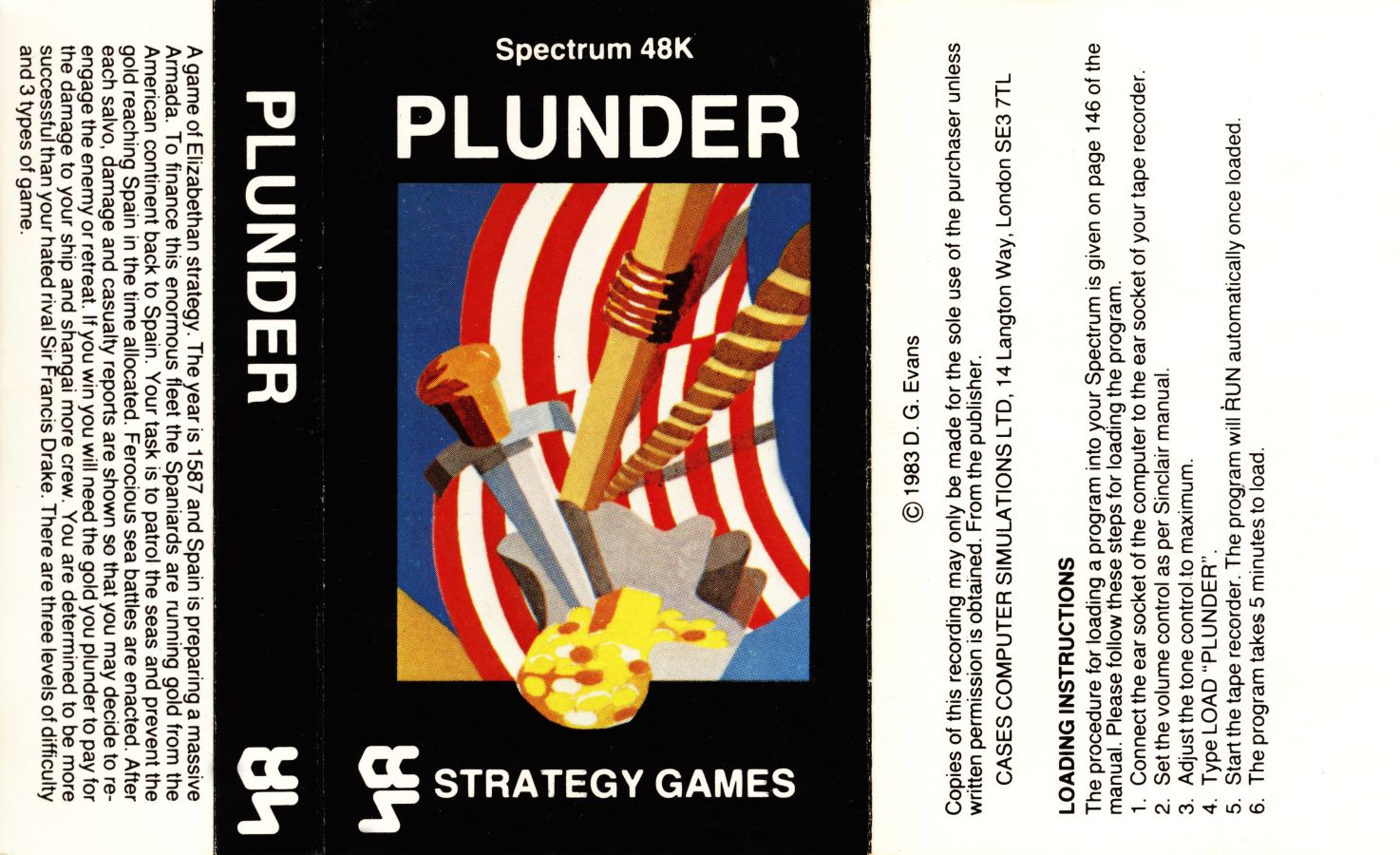
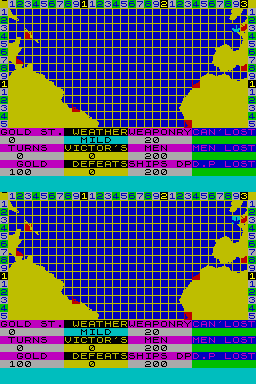
Producer: CCS, 48K £6.00 Author: D G Evans Plunder is a pretty massive strategy game where you find yourself in command of a British Galleon with the object of stopping the Spaniards from running gold from the New Lands to Spain. There is a short, medium and long game option with 3 skill levels for each. The screen gives you a high resolution map of the North Atlantic, divided into squares by a grid. You move your ship about with the cursors, seeking enemy galleons, troopships and battleships. If one is encountered you may attack or retreat. Attacking gives the option of firing or boarding or both. Firing on a galleon may be a mistake - if it sinks then you lose its gold. Depending on your battle success the morale factor of your crew goes up or down. There are several ports open to you which must be entered via an arcade style sequence for docking. In port you may take on extra crew or weaponry, have repairs made, buy food, jewels or opium, or sell if you already have any. The display informs you at all times of the gold stopped, gold acquired and spent, weather conditions (which affect finding enemy shippping), number of victories, men lost, ships sunk and so on. The length of the game is determined by the number of moves you make, and these are also displayed. All in all, an entertaining game, but one that can become repetitive with playing.
Crash #2Mar 1984 · p.64
Producer: CCS, 48K £6.00 Author: D G Evans Plunder is a pretty massive strategy game where you find yourself in command of a British Galleon with the object of stopping the Spaniards from running gold from the New Lands to Spain. There is a short, medium and long game option with 3 skill levels for each. The screen gives you a high resolution map of the North Atlantic, divided into squares by a grid. You move your ship about with the cursors, seeking enemy galleons, troopships and battleships. If one is encountered you may attack or retreat. Attacking gives the option of firing or boarding or both. Firing on a galleon may be a mistake - if it sinks then you lose its gold. Depending on your battle success the morale factor of your crew goes up or down. There are several ports open to you which must be entered via an arcade style sequence for docking. In port you may take on extra crew or weaponry, have repairs made, buy food, jewels or opium, or sell if you already have any. The display informs you at all times of the gold stopped, gold acquired and spent, weather conditions (which affect finding enemy shippping), number of victories, men lost, ships sunk and so on. The length of the game is determined by the number of moves you make, and these are also displayed. All in all, an entertaining game, but one that can become repetitive with playing.
Sinclair User #23Feb 1984 · p.508/10
Gilbert Factor 8/10
LEAVE THE SPANISH ALL AT SEA In Plunder, for the 48K Spectrum, the scene is set in the 16th century, which makes a welcome change from space travel and aliens. As captain of a British galleon, your task is to patrol the seas and prevent the Spanish bringing back gold across the Atlantic with which to finance their Armada. Your eventual object is to earn a knighthood for services to your country and also to make sure you outdo vow hated rival Sir Francis Drake, who will "fall about laughing" every time you run the ship aground or similarly disgrace yourself. Plunder also allows you to manoeuvre your ship into port, trade in bazaars to increase your assets, and investigate uncharted islands. In spite of the scope for variety the game provides, it is easy to engage in a repetitive series of sea battles and the slow graphics detract from any advantage it might have over a board game. It is also a pity that each time you lose a round you have to return to the title page before you can start again. A Little seafaring practice should enable you to avoid the pitfalls and derive some entertainment from an interesting concept - Plunder is produced by Cases Computer Simulations, [redacted], and costs £6.00.
Personal Computer Games #2Dec 1983 · p.53
Steve Mann
MACHINE: Spectrum 48K JOYSTICK: Kempston, Optional FROM: Cases Computer Simulations PRICE: £6.00 Now this one really is fun... The year is 1587, and Spain is financing her Armada by running gold from the Americas back to Europe. You are, in fact, a licensed pirate. Your job is to patrol the seas and grab as much of the Spanish gold as you can. If you can't actually get your hands on it, you can at least sink the ship carrying it and prevent Spain getting the benefit. A game may consist of 60, 10, or 140 turns, and there are three levels of difficulty for each number of turns. The game is won once you have stopped a certain amount of gold from reaching Spain (35,000 gold pieces at the easiest level, 145,000 at the hardest). If successful, you are knighted, and your hated rival Francis Drake becomes your cook. Fail, and you are humiliated while Drake goes on to write his name in the history books. To aid you in your task, the Spectrum displays a detailed map of the Atlantic, together with copious information on the weather, armament, cash, cargo, men, damage to the ship, number of victories and defeats, number of turns, and so on. When your lookout spots a ship, you are told its type (merchant, galleon, troopship, warship), and you then make the decision to attack or retreat, based on the relative strengths of the enemy and your ship. If you attack, you are given the option of firing or boarding. In either case, the battle is enacted graphically, with the two ships closing together, and somewhat stylised plumes of water as cannonballs splash into the sea. If the battle looks to be going badly, you can choose discretion and head for the nearest port for repairs or more men. Hitting another ship results in your craft sinking, whereupon you are ignominiously drummed out of the service. There are also uncharted islands, abandoned ships, and strange mists to investigate. These can bring rewards, or disaster. This is the sort of game for which a computer is ideal, and this particular simulation gave me hours of enjoyment. It's sufficiently difficult to hold one's interest for a long time, and the concept behind it is novel, and well thought out. Great fun.
Your Computer #11Nov 1983 · p.82
Peter Connor
NO OTHER MICRO HAS THE SOFTWARE BACK-UP OF SINCLAIR'S SPECTRUM. PETE CONNORS PLOUGHS HIS WAY THROUGH SOME OF IT FROM GRAPPLING WITH EVIL MAZIACS TO HELPING CHARLIE THE CHEF. Every software house, from the giants to the leprechauns, seems to have programmers chained to terminals, frantically churning out products for the massive Spectrum market. For Spectrum owners the pot of gold under the rainbow is the now huge variety of software available: their only problem is distinguishing the genuine article from the fake. One game you certainly will not need to bite into is Zzoom from Imagine. This is the Real McCoy, a quality arcade-style game of skill and destruction in the comfort of your own armchair. The game starts with the Dambusters theme tune, enough on its own to make you start twirling imaginary handlebar moustaches and warn Ginger about the bandits at 4 o'clock. You find yourself in command of an aeroplane whose gunsights appear on the screen; also displayed are a dibar to show your relation to the ground and a long-range scanner. Before you have time to think, hostile aircraft are approaching from the east; they speed in and suddenly, unexpectedly, wheel 90° towards you, presenting the slightest of targets for your cannon. Those earthbound refuges you are trying to protect do not have much of a chance. Poor blighters, I wish I could have done more to help. After the waves of planes, the landscape changes. Now its the desert, complete with palm trees. Over the horizon come battalions of tanks. More skill is now required, as you have to dive low enough to shoot your earthbound adversaries without crashing to your doom. After the desert - the sea, with enemy destroyers trying to blast the refugees' lifeboats. The standard of graphic display and excitement combine to make Zzoom a most exciting game, one that has deservedly become a micro-classic. DK'tronics, though, has produced a game which could rival Zzoom's popularity. Maziacs may seem, initially, to be just another maze-game. In fact, it has subtle qualities which make it one of the best available in this genre. The scenario is familiar: you must get through the maze, collect the treasure and get out. You can ask the way from prisoners, and pick up swords to combat the maziacs. What lifts Maniacs above the common land is its graphic sophistication. The monsters are the most grotesque I have ever seen on a micro; nightmarish squatting creatures, all legs and jaws who enjoy nothing more than gobbling you up. The prisoners are sad creatures, writhing in their shackles inside blue circles. One feels great pity for them but, sadly, one can do nothing to help. And you, the brave treasure-hunter, are a perky little fellow with a jaunty rhythmic step. You are never downhearted and your jubilation when you have destroyed a marine is quite heart-warming. These qualities give Maniacs that something extra, and make it a very compulsive game. Best of the other offerings from DK is Hard Cheese, in which you have to eat your way round the board, creating your own maze, in order to get at the cheese in the middle. Naturally, you are pursued by monsters. Naturally you can shoot these monsters, but this is not so easy as they move very quickly and you must replenish your energy. Again the graphics are of a high standard, and Hard Cheese is almost, but not quite, as compulsive as Maziacs. In comparison, DK's Road Toad and Jawz are rather dull. The first needs no introduction and is as expected; though the graphics are, perhaps, a little clearer than usual, and the tankers are truly fearsome. Jawz is a disappointment; here you are underwater, firing at Sharks and Jellyfish. It is quite tricky to hit them as you have two cannons converging from either side of your control. Otherwise the game is low on interest. Ultimate Play the Game has a reputation for quality software, and it does not besmirch it with Cookie and Tranzam. Cookie has one of the wackiest situations for a long time; Charlie Chef's ingredients have escaped from the pantry-yard and he must recapture them by dazing them with flour bombs and knocking them into his mixing bowl. As well as the runaways Crafty Cheese and Colonel Custard there are nasties such as Wally Washer and Terry Tack. Crazy, but true. The graphics are very good and Charlie is a sympathetic little figure in his white chef's hat. It is very difficult to avoid the nasties; if they get you, you end up in a dustbin. Cookie is a witty and enjoyable game, but one which you might do well to use a joystick for. Tranzam is set in the year 3474; it is your Red Racer versus the Deadly Black Turbos in the search for the Eight Great Cups of Ultimate. The screen displays a barren landscape where the only land-marks are cacti and petrol stations. You guide your car around looking for the cups, while trying to avoid your enemies and the obstacles. This is a tricky business if you are doing 400 mph and steering on the keyboard; again, a joystick would be useful. Tranzam is an exciting game which gives a taste of the Mad Max experience. GAME OR BLURB? And so to Quicksilva. Do people buy their programs for the game or the blurb? Aquaplane's scenario begins "The contrasting blues of sea and sky provide a perfect backdrop as I relax with a Pernod and lemonade..." and goes on in the same vein for two sides of packaging. Indeed, Aquaplane's sea and sky are very blue, suggestive of hot Mediterranean summers. And, the game is very good. There you are, out for a bit of water-skiing, when the speedboat goes bananas. You are being pulled away to almost certain death. Rocks, driftwood, tacking yachts, cruisers piloted by drunken play-boys, snapping sharks; get through all those and you have mastered the game. Aquaplane is made more intriguing because, as the boat accelerates, you are pulled to one side or another, thus increasing the risk of meeting a sticky end on a piece of driftwood. The graphics, too, are very colourful and realistic. Aquaplane is a highly entertaining game - almost as good as the blurb. On the subject of watery graves, Bug-Byte has Aquarius "an underwater espionage game". As commander of a frogman team you must destroy the bombs planted by an enemy nation. Problems you will encounter are sharks and electrifying jellyfish. Your oxygen will run out and must be replenished by collecting fresh tanks from the sea-floor. While the undersea world is fairly convincing and the sound effects are genuinely squelchy, Aquarius is not a very exciting game, lacking the speed and variety top-class programmes. ENCOUNTER WITH THE DARK ONE In Styx, also from Bug-Byte, you are supposed to be battling your way across the mythological river to Hades "towards an encounter with the Dark One himself". In fact, it is a rather boring maze game, where the "deadly spiders" look like bits of dried grass and the Piranhas - did you know there were Piranhas in the Styx? - are most unconvincing. If they have micros in Hades as well they may well be playing Pool, another Bug-Byte game. The graphics are much better than Styx; a bright green for the baize and red for the bolls. Curiously, the object balls are all the same colour. Control is straightforward, using the cursor keys. But perhaps these denizens of Hades might prefer CDS Micro Systems' Pool. I know I do, if only because the object balls are divided into blue and red. Otherwise, it is much the same as Bug-Byte's version, easy to control and pleasant to look at. Both programs are for one or two players. Purer pleasures of the mind are entered for by Artic's Chess Tutor. The novelty of this program is that it not only plays chess - at three levels - but takes the beginner through three different opening variations; King's Indian, Ruy Lopez and Sicilian Dragon. There is also a section which demonstrates the moves of each piece. This is indeed very useful and would be suitable for the absolute beginner. Unfortunately the board is none too clear, as the white pieces do not show up well on the light squares. As a game chess is not in much danger of being overtaken by any of three new programs consisting of logical board games: Hanoi King from Contrast Software, Lojix from Virgin and 3-D Strategy from Quicksilva. In the first of them you have three pillars on which are a series of rings. You have to transfer them to the third so that they are in the same order, moving only one ring at a time ind without placing a larger on top of a smaller ring. It sounds easy, and with only three or four rings, it is. More than that and it can become fiendishly difficult. Lojix is a game in which you have to fit 18 irregularly shaped pieces onto a board. A sort if fiendish jigsaw puzzle, it is difficult and interesting. Virgin is offering a cash prize for the first correct solution. 3-D Strategy is billed as "a multi-dimensional mind game". It is 3-D noughts and crosses on a 4 by 4 by 4 cube. After 3-D chess Mr Spock might not have much trouble with his, but ordinary earthlings will find it very hard to beat. Despite being essentially simple ideas, all three of these games are well produced and will provide hours of entertainment for the puzzle happy. Perhaps the most interesting new program for the Spectrum is The Forest, from Phipps Associates. This is a complex simulation of orienteering, the sport in which you have to follow a course over difficult terrain using only map and compass. The program comes with a beautifully printed orienteering map ind a long, but clear, explanatory booklet. The screen displays various topographical features and, using the map, you have to negotiate the course. Thus, The Forest is not merely a game, but an help introduce people to map-making and the relation between maps and the physical features they represent. As the program notes say, this program will be of particular interest to students and teachers of geography as well as armchair orienteerers. Plunder is a strategy game from Cases Computer Simulations. Set in 1587, the year before the Spanish Armada set sail, the game gives you the opportunity to be an English privateer whose task is to prevent gold from the New World getting back to Spain. You must also be more successful than your deadly rival Sir Francis Drake. There is more to this than mere yo-ho-ho and a bottle of rum; you must weigh up the chances of success in taking on merchant, troop and warships. Too much damage or too many lost crew and the game is up; it's Davy Jones' locker for you. Camelot, an adventure-game from the same company, is not quite so good. As Arthur Pendragon you have been banished from Camelot by the Black Knight. Understandably you want to get back; who knows what Lancelot and Guinevere are up to round the Round Table? You have some warriors and money to help you find the necessary seven items. There are graphic displays of landscapes and obstacles, unfortunately rather crude. The "evil magician" looks rather like a conjurer at a children's party. Those Spectrum owners keen to develop the machine's graphics potential should look at Melbourne House's 48K Melbourne Draw. This program will take you on a tour of the Spectrum's graphics, allowing you to choose colours, draw, and store graphic displays. Once you have drawn your picture, you might want to make it say something, in which case you are referred to Abbex's Supertalk which, with no extra hardware, will enable your Spectrum to speak. The demo facility lets you hear Supertalk's Dalek-style voice exercising its small vocabulary. To enter your own vocabulary you record the words on tape and then feed them in, afterwards adjusting them to make sentences. First "Jolson Sings!" now "Spectrum Talks". Program: Aquarius Company: Bug-Byte Memory: 16/48K Price: £5.95 Program: Styx Company: Bug-Byte Memory: 16/48K Price: £5.95 Program: Pool Company: Bug-Byte Memory: 16/48K Price: £5.95 Program: Pool Company: CDS Microsystems Memory: 16/48K Price: £5.95 Program: Jawz Company: DK'Tronics Memory: 16/48K Price: £4.95 Program: Hard Cheese Company: DK'Tronics Memory: 16/48K Price: £4.95 Program: Road Toad Company: DK'Tronics Memory: 16/48K Price: £4.95 Program: Maziacs Company: DK'Tronics Memory: 48K Price: £4.95 Program: 3-D Strategy Company: Quicksilva Memory: 16/48K Price: £6.95 Program: Aquaplane Company: Quicksilva Memory: 16/48K Price: £6.95 Program: The Forest Company: Phipps Associates Memory: 48K Price: £9.95 Program: Lojix Company: Virgin Games Memory: 48K Price: £7.95 Program: Plunder Company: Cases Computer Simulations Memory: 48K Price: £6.00 Program: Camelot Company: Cases Computer Simulations Memory: 48K Price: £5.00 Program: Hanoi King Company: Contrast Software Memory: 16/48K Price: £4.95 Program: Melbourne Draw Company: Melbourne House Memory: 48K Price: £8.95 Program: Supertalk Company: Abbex Memory: 48K Price: £5.95 Program: Chess Tutor Company: Artic Computing Ltd Memory: 16/48K Price: £6.95 Program: Zzoom Company: Imagine Software Memory: 48K Price: £5.50 Program: Tranzam Company: Ultimate Play the Game Memory: 16/48K Price: £5.50 Program: Cookie Company: Ultimate Play the Game Memory: 16/48K Price: £5.50
Personal Computer News #36Nov 1983 · p.52
John Lettice
SPECTRUM SPECIAL John Lettice takes his Spectrum from the Spanish Main to the familiar monster mazes. Plunder (£6), Cases Computer Simulations, [redacted] Baron (£5.95), Temptation Software, [redacted] Escape (£4.95), New Generation Software, [redacted] The Detective (£5.50), Arcade Software, [redacted] Home Runner (£4.95), Britannia Software, [redacted] The Spectrum has now passed its first anniversary, and the current batch of games being released shows that age cannot wither it nor custom stale its infinite variety - in some cases at least. PLUNDER First off the slipway is an everyday story of seafaring folk. In Plunder, your objective is to stop the Spanish Armada sailing by pillaging the convoys of gold Spain is shipping to finance it. You sail your ship - a nice little user-defined graphic - around a very impressive high-resolution map of the Atlantic Ocean, seeking out galleons (can be nasty), troopships (you can deal with these, but boarding might not be such a smart idea), merchant vessels (sitting ducks) and finally the warships (run for your life). While you're doing this, the sea takes its toll of crew and hull, and naturally the odd cannonball can make mischief. So you use some of your winnings - they're probably tainted with the curse of Montezuma anyway - to hire new crew, make repairs, and perhaps do a little trading and/or drug running. Yes, that's right, you can buy one of Central America's less savoury products in Haiti and sell it at a profit at Marseilles. I didn't run into Gene Hackman, but he and other cops might still prefer it if you stuck to grain and diamonds. One nice point about Plunder is that it's actually fairly realistic. Broadly speaking, you can take on the ships a thieving buccaneer/national hero of the time would be able to, with approximately the logical consequences (although merchant seamen seem to be a lot less ready to run up the white flag than I'd expect). And I won't swear to it, but the warships really do seem to follow you around, hunt the Graf Spee style. All in all, it's a particularly neat and inventive execution of what is becoming a fairly common idea. BARON Baron is another offering in the honourable tradition of Candyfloss. Here your goal is to manage a small fiefdom, fighting off the villains and beating up the villeins. You can play it solo, but the game is really geared to several - up to four - players. All players start off with the same amount of land, peasants and cash, and your goal is to manage these resources. You can play the game the peaceful way, tending your crops and amassing land legitimately by purchase, or you can hire mercenaries and pillage your neighbours. It's certainly refreshing to see a computer game that'll take more than one player, but there are problems with this one. The instructions are a little ropey for example, you can increase your supply of peasants by feeding more than you've got, but you aren't told this. There was one annoying bug on the review copy. At one point the program asked if you wanted to hire mercenaries. You answer 'y' or 'n'... and then it asks you if you want to hire mercenaries, up to a dozen times. It defies belief that a manufacturer could send out a game with a louse-up like this in it, but there it is. If it wasn't for this boredom-inducing bug, the game would be relatively entertaining for several players. The one-player version is a fairly pointless exercise. ESCAPE I could forgive this one a lot. It's a new twist on maze games, where you're stuck in a Hampton Court style environment, being pursued by various prehistoric monsters. Your aim is to find an axe, then use it to break down a door and get out of the maze. But the real killer is the way the dinosaur comes after you, using the Spectrum's excessively quiet speaker to produce a 'pad pad pad' noise as it runs. I never did get out of the maze, but I plead that I was too busy laughing at the dinosaur. If you can control yourself, it has potential to be a fast and entertaining maze game. THE DETECTIVE More humour here. Load up the Detective and you're presented with a natty title page, across which you see a row of bullet holes creep. Start on the game and you see a small figure in the centre of the screen; cursor left or right and the figure saunters, slowly but purposefully, in the relevant direction. If you press the fire button the figure stops, whips out two guns and blazes away at the sky, the reason for this being that there are things falling out of the sky at you. Yes, you've guessed it, someone's thought of yet another twist on Space Invaders. According to the instructions, you've got to get through Dagger Alley (all 25 screens of it), then crack a safe. The mob's 'out to get ya' (according to this 'broad' you met), and they're trying it in all sorts of weird ways. The first screen seems to have them dropping giant-sized ring-pulls on you, while in the second they seem to be lampshades. In addition to this, rows of car tyres form up above your head and then fall on you, and if the dog comes by you lose all your points. It's not particularly fast to start with, but it's tricky, and highly entertaining. HOME RUNNER Put together an Olympic runner, a set of monsters and some scaffolding, and Home Runner is what you come up with. You hop, skip and jump your way up a number of levels, avoiding monsters and the holes that appear in the floor every now and then, until you get to home, at the top level. I didn't find the monsters made my pulse race.
Advert27
- Sinclair User #28Jul 1984 · p.50
- Crash #6Jul 1984 · p.70
- Personal Computer Games #7Jun 1984 · p.44
- Sinclair User #27Jun 1984 · p.50
- Crash #5Jun 1984 · p.6
- Personal Computer Games #6May 1984 · p.52
- Sinclair User #26May 1984 · p.58
- Crash #4May 1984 · p.6
- Personal Computer Games #5Apr 1984 · p.52
- Sinclair User #25Apr 1984 · p.66
- Games ComputingApr 1984 · p.87
- Crash #3Apr 1984 · p.6
- Personal Computer Games #4Mar 1984 · p.60
- Games ComputingMar 1984 · p.80
- Crash #2Mar 1984 · p.91
- Sinclair User #24Mar 1984 · p.8
- Crash #1Feb 1984 · p.78
- Sinclair Programs #16Feb 1984 · p.43
- Games ComputingFeb 1984 · p.10
- ZX Computing #11Feb 1984 · p.115
- Sinclair User #23Feb 1984 · p.129
- Sinclair Programs #15Jan 1984 · p.26
- Sinclair User #22Jan 1984 · p.24
- Sinclair User1984 · p.94
- Sinclair User #21Dec 1983 · p.142
Feature2
- Computer ChoiceMar 1984 · p.48
- Your Computer #11Nov 1983 · p.85
Related
- Ports
- (BBC Micro)
- Elsewhere
- Centre for Computing HistoryUVL
- Same entry at
- Spectrum ComputingZXInfo
Reviews from people here
Sign in to write about this, or make an account. It takes a minute and lets you correct the catalogue too.
No description, tag recorded.
Sign in to correct or add to this.
Hold the rights to this and want it taken down?