
Pool
Sport Game: Action · ZX-Spectrum 16K · 2 players · English
CDS Microsystems · 1983 · Pound sterling 5.95
Also known as Spectrum Pool (English)
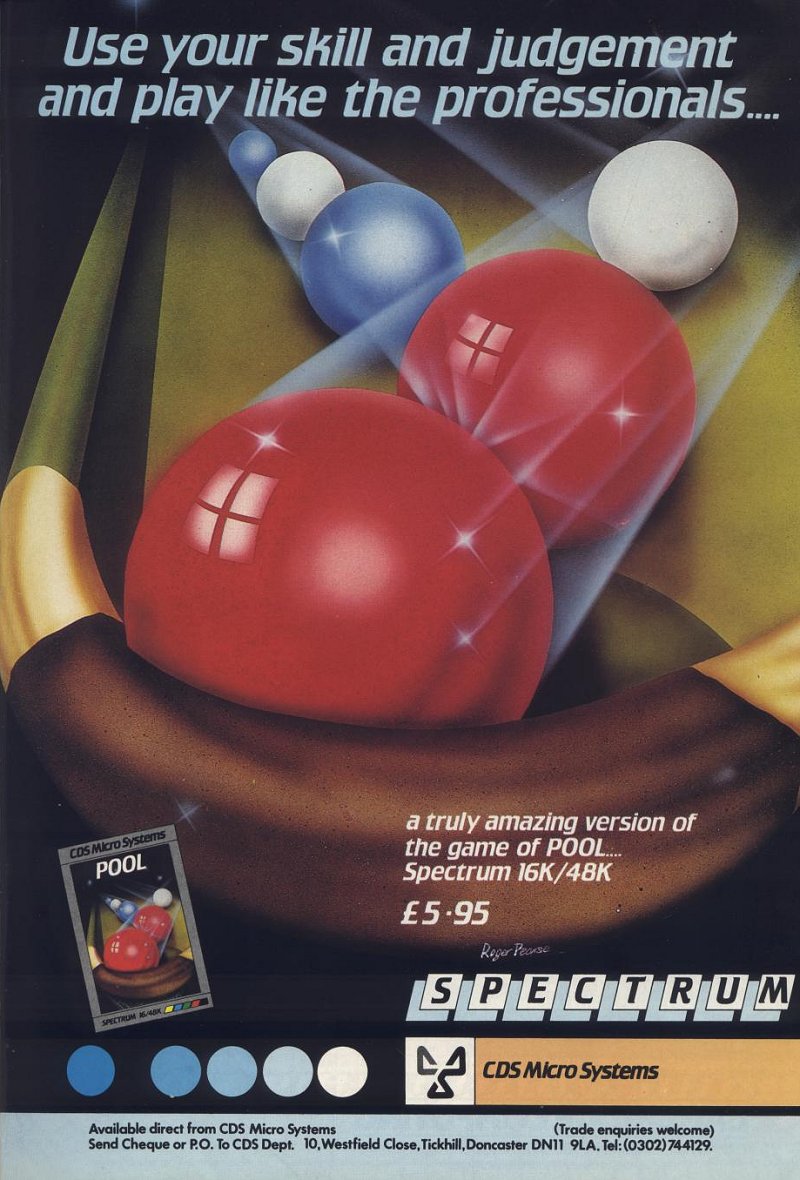
_Back.jpg)
_Back.jpg)
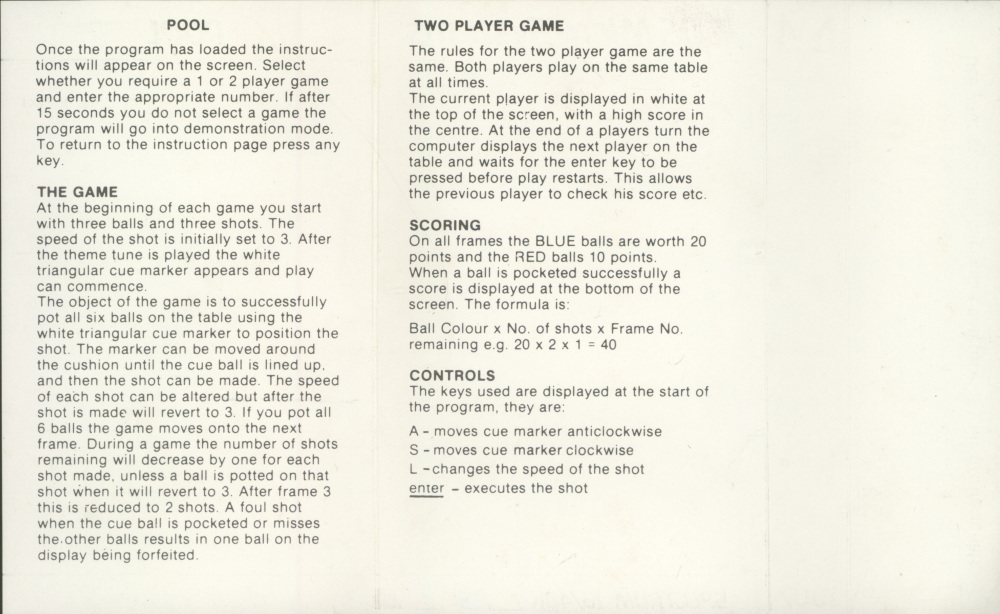
.jpg)
_3.jpg)
.jpg)
.jpg)
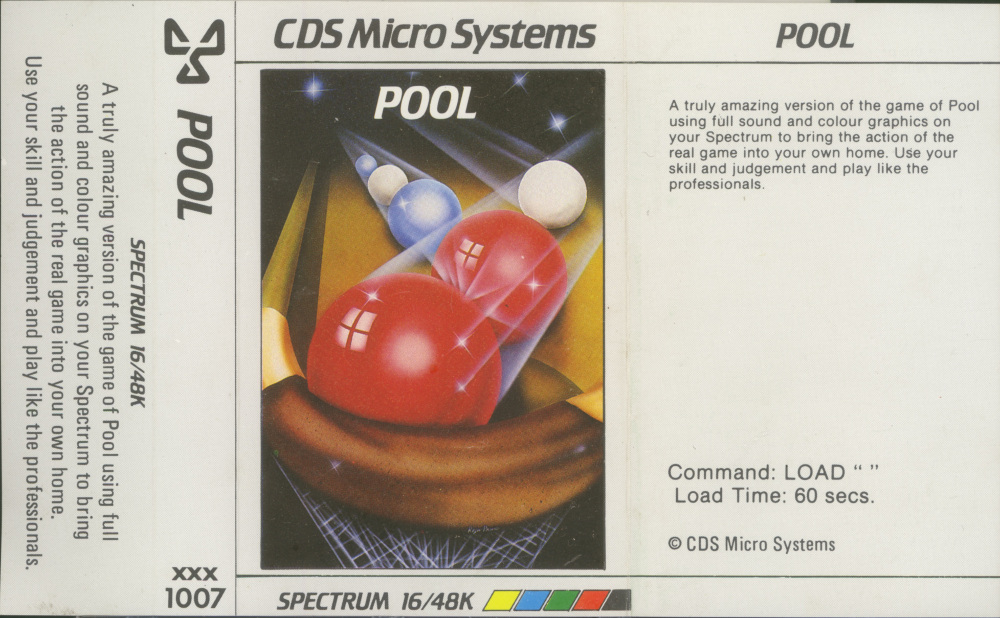
_Front.jpg)
.png)
_Tape.jpg)
_Media.jpg)
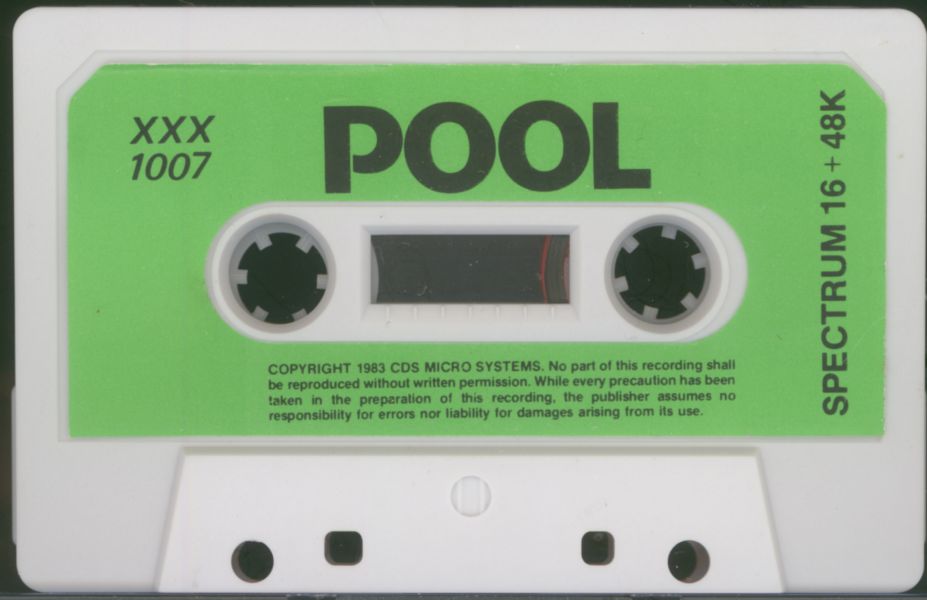
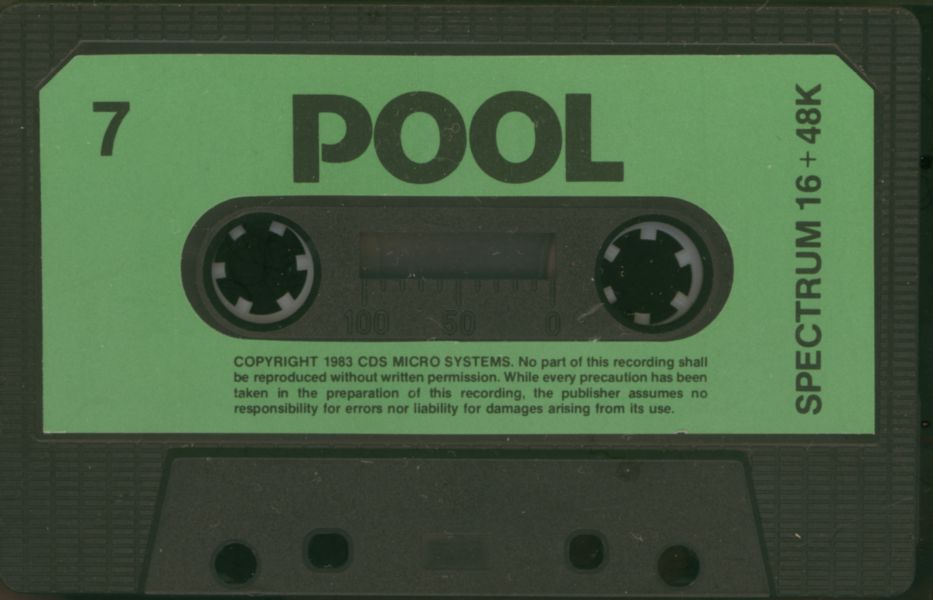
Discussion
Nobody has started a thread about this yet.
Music References
Includes the following music: Scott Joplin, "The Entertainer"
Releases
- 1983CDS Microsystems Sold as Spectrum PoolPound sterling 5.95
- 1983Blue Ribbon SoftwarePound sterling 2.99
- 1 Sep 19862.99 Classics
- UnknownEDOS
Play
- poolcds.zipRZX playback file
- Pool_3.tzx.zipTape image English5 KB
- Pool_3.tap.zipTape image English5 KB
- Pool(2.99Classics).tzx.zipTape image English5 KB
- Pool(BlueRibbonSoftware).tzx.zipTape image English8 KB
- Pool(BlueRibbonSoftware).tap.zipTape image English8 KB
Documents
- Pool.txtInstructions English3 KB
Other files
- Pool (1983)(CDS Microsystems).pokPOK pokes file 0 KB
Files and rights
No permission is on record either way. Screens and pictures are copied here on a take-down basis: if you hold the rights and want something removed, say so and it goes.
Credits
- Mike Lambcredited
- Roger PearseInlay/Poster Art
Sign in to credit somebody, or say what these people did.
Scores
In the magazines
- Personal Computer News #341983 · Overall Value4/5
- Crash #61984 · Overall77%
- Personal Computer Games #31984 · Overall8/10
- Personal Computer Games #61984 · Overall Rating6/10
- Your Sinclair #101986 · Overall6/10
Elsewhere on the web
- WorldOfSpectrum 26 votes7.88
In the magazines 39
Your Sinclair #10Oct 1986 · p.845/107/106/107/106/106/10
Graphics 5/10
Playability 7/10
Value For Money 6/10
Addictiveness 7/10
Overall 6/10
Rick Robson 6/10
2.99 Classics £2.99 Reviewer: Rick Robson Ever fancied yourself as a Maltese Joe? Well, now's your chance with the latest 2.99 Classic, Pool. It's just that, a simulation of the old ball clattering sport. It's not the most imaginative of realisations - any similarity to the real McCoy is purely coincidental. Well most of the time it is. Still, that doesn't invalidate it as a Speccy game in its own right. Not only that, it's a pleasure to find a game where Euclid is of more use than blood-lust and whizzo reflexes. The aim of the game is to pot balls - there are six altogether. Blue balls are worth 20 points and red only ten though I'm not quite sure why. Anyway you're given three chances to pot a ball so if you're as uncoordinated as a lemming on Beachy Head there's still hope for you. The only snag is, it reduces as you move on through further frames. You never actually see the cue itself but at least you can move a marker round the table to the position you want to shoot from. You'll have to clear all your balls to move onto the next frame, though points decide the winner if you haven't the nous to clear the table before you run out of shots. One for the Steve "Interesting" Davises of the world to cut their cues on. Younger ones might get more enthusiastic about chalking their tips over this one!
Crash #6Jul 1984 · p.4079%75%76%80%78%65%87%77%
Use of Computer 79%
Graphics 75%
Playability 76%
Getting Started 80%
Addictive Qualities 78%
Originality 65%
Value For Money 87%
Overall 77%
Unknown
Unknown
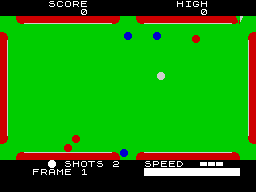
Producer: C.D.S. Microsystems Memory Required: 48K Retail Price: £5.95 Language: Machine code Author: Mike Lamb Pool by CDS is hardly a brand new game, having emerged in the middle of last year. But most such games were released before CRASH started life, and it's no bad thing to catch up on a few of them, especially if they have been popular, and CDS Pool certainly has, remaining in the charts all year. To celebrate its continuing popularity, CDS have now repackaged the game in a new cassette cover which matches the style of their recent releases. The game, however, remains as it was. Each version has its own peculiarities. In the CDS Pool you start each game with three balls and three shots. The object is to pot all six balls on the table, three red and three blue. Aiming the cue ball is done by moving a small triangular marker around the edge of the table, the ball being shot towards the marker (not in the opposed direction as happens in some versions). The marker is moved clockwise or anticlockwise using the S or A keys. Speed of shot is controlled by a five block bar below the display area. After a shot has been taken, the speed setting returns automatically to a value of three. During a game the number of shots remaining will decrease by one for each shot made, unless a ball is potted on that shot when it will revert to three. After frame three, this is reduced to two shots. Any foul shot results in one of the players three start balls being removed. Scoring is done by giving the blue balls 20 points and the red 10 points. Pool can be played by one or two players, each score being continuously displayed. COMMENTS Control keys: A/S moves cursor anticlockwise, L = speed, ENTER to shoot Keyboard play: simple and responsive Use of colour: well used but naturally limited Graphics: good movement of characters, well laid out text and scores Sound: well used with rebound sounds and a strident tone for the cue cursor Skill levels: 2 Lives: 3 balls Features: 1 or 2-player games
A battle on the cool green baize in the newly repackaged CDS Pool.
Personal Computer Games #6May 1984 · p.406/10
Overall Rating 6/10
Peter Connor
Steve Cooke
THE VIDEO SPORTSMAN Want to be a demon driver? Or a golfing wizard? Or a master of the big break? We load up the motor race, golf and pool simulations. MOTOR RACING The family will gasp in awe as you hurtle round the track, defying death at every bend and only occasionally have to be scraped off a billboard. Peter Connor enjoys the best of micro motor racing. The trouble with motor racing is that it's far too dangerous, it's all very well driving round Silverstone at 200 mph looking forward to a bottle of champagne and a kiss from a beautiful blonde, but what happens if you crash? Most likely third-degree burns and three months in traction. And that's if you're lucky. Such risks can be avoided, without losing too much of the excitement, by the simple trick of putting a racing simulation on your home computer. And there's no need to buy expensive cars or get oil all over your hands. But which team do you want to drive for? On the Spectrum, racing correspondents think that Psion's Chequered Flag is the one to watch. POWERFUL This is a powerful program for the 48K model with many excellent features. You're given a choice of ten tracks, some real and some imaginary. Three cars are available, two with manual gears and one, the McFaster Special, automatic. It is advisable for the novice to use the McFaster, since one of the difficulties with this program is the number of keys you have to manipulate. Chequered Flag's graphics are quite superb. The screen displays the dashboard and bonnet of the car. Ahead of you stretches the road, jet black against the rich green of the fields. Steering around the dog-legs of Brands Hatch or the tight bends of Monaco takes time to master, especially if the road is covered with oil, water, glass or even rocks. Once you get up some speed you must keep a close eye on the instruments or you could be forced to pull into the pits because of over-heating. Even the sound is almost convincing in this enthralling Spectrum game. ENTERTAINING In Chequered Flag it's just you and the car against the track and the clock. Road Racer, from Thom-EMI, is the other kind of motor racing program, in which you have to overtake other cars. This is only a 16K program, so it's not surprising that it isn't quite as impressive as Psion's. But it's still good value and an entertaining game. The graphics are good with a blue mountain range forming a backdrop to the black track. The cars themselves come in a variety of primary colours. The object is simply to pass as many cars as possible. Here too you must watch the instruments [or imminent over-heating. Although the game is fun, there is not really enough variety in the track to hold the players attention for very long. Salamander's Grand Prix for the Dragon is unlikely to have you trembling with excitement. In fact. there's a good chance you'll fall asleep at the wheel. In this game for one or two players the 'cars' are merely minute black dots. It's more like racing fleas than motor-cars. There's a choice of tracks, but it doesn't do any good. The two-player game is only marginally less tedious. Microdeal's Morocco Grand Prix is a better bet for the car crazy Dragon owner. Here you view the track from above. You bring you own car on to it from the side and try to overtake as many rival cars as possible. The screen scrolls down, unfortunately giving you the impression that all the other cars are going backwards. But the graphics are otherwise quite good and the sound gives a tolerable imitation of a crashing noise. It's by no means a great program, but when you compare it with the opposition... EXCITING Le Mans, on the Commodore 64, takes its name from the famous 24-hour race in France. On the computer game you also have to drive by night as well as by day. The track is seen from above and, as usual, you must pass as many cars as possible. Although there are no bends on this track there are plenty of chicanes and obstacles. Night driving is exciting; the screen goes dark and you see only the tail lights of cars in front. Le Mans' graphics are strong and the sound features excellent acceleration and overtaking noises. UNRIVALLED Pole Position, for Atari computers, is unrivaled in micro motor racing, both in quality and price. It has essentially the same graphics as the arcade game, which means that they are superb: blue skies, snow-capped mountains and excellent cars with spinning wheels. The sound is a deafening roar of engines as you hurtle around your choice of the four tracks. In almost every respect Pole Position is superior to other micro racing games. But when you pause to consider the price - £29.95 you realise that it ought to be the best. If it weren't, you might justifiably ask for your money back. Of the other programs considered both Chequered Flag and Le Mans stand out for the quality of their graphics and their lasting interest. Game: Road Racer (Thorn-EMI) Machine: Spectrum 16/48K Joystick: Optional Price: £6.95 Overall Rating: 5/10 Game: Grand Prix (Salamander) Machine: Dragon Joystick: Necessary Price: £7.95 Overall Rating: 2/10 Game: Morocco Grand Prix Machine: Dragon 32 (Microdeal) Joystick: Necessary Price: £8.00 Overall Rating: 5/10 Game: Le Mans (Commodore) Machine: Commodore 64 Joystick: Paddle Only Price: £9.99 Overall Rating: 7/10 Game: Chequered Flag (Psion) Machine: Spectrum 48K Joystick: No Price: £6.95 Overall Rating: 8/10 Game: Pole Position (Atari) Machine: Atari 400, 600, XL Joystick: Necessary Price: £29.95 Overall Rating: 9/10 GOLF Drive, chip and putt - without so much as a practice swing. Steve Cooke says which golf games are up to par. Golf isn't exactly the most strenuous of sports, but if you're too lazy to venture out into the great outdoors, you can now play a brisk 18 holes from the comfort of your armchair as you gaze into your micro's monitor. In a recent series of tournaments, held in the PCG offices, the results were as follows. First, the Spectrum Open, played in fine weather with challenging performances from six contenders. First prize in this competition went to Abrasco for their well-presented game Golf played in gusting winds over nine holes. They even managed to cram their performance into 16K, giving them an edge over CRL, who were narrowly beaten into second place. Abrasco's Golf has bold, clear graphics and a good choice of clubs. Information concerning your score and par is clearly displayed on the screen at all times. This program is also available on the Commodore 64. LEISURELY CRL's Handicap Golf boasted animated 3D graphics, which do add some interest to the presentation of the game, but not to the actual playing. A nice choice of clubs were available to sec you through 18 holes, but the action was perhaps slightly too leisurely, and the ball occasionally difficult to see. DK'tronics struggled into third place with acceptable graphics, a reasonable choice of clubs, and up to 18 holes. Honourable mention must also be given to R&R for a very simple 16K game that changes hands for only £3.75. However this program doesn't offer you a choice of clubs. Other contenders in the Spectrum Open included Virgin and Lyversoft. Virgin do versions for both 16K and 48K machines, but the graphics are poor and the presentation unimpressive. Lyversoft's was much more credible, though it was impossible to see the ball in flight - it just appeared somewhere as if by magic. This would be the equivalent of a real golfer teeing off with eyes shut, and trying to spot the ball after it had come to rest! Oric owners can also potter round either a nine- or 18-hole course with a version of R&R's game converted for their machine. Unfortunately they'll have to pay rather more for it. No choice of clubs severely limits the interest of this game. Teams competing in the BBC Masters included Birdie Barrage from Computasolve and Supergolf from Squirrel Software. Supergolf departs from the usual format by displaying the course from a different angle (see screen shot). Instead of choosing the direction of your shot, you have to choose your clubs carefully to put the ball on the right trajectory. The graphics on Supergolf were simple but very well done. Getting out of the bunker involves chucking a lot of sand about, and there are some nice splashes in the water hazards. The game is also available on the Electron. CHUNKY Birdie Barrage took second place with the usual display format, rather chunky graphics, and garish colours. It doesn't tell you how many shots you've had on a particular hole until you've finished but putting is given an added twist by varying conditions of the green. If you're a Dragon owner, then Tee-Off from Dragon Data tries to capture the realism of the game with a small animated figure. He walks slowly and jerkily about the screen, poking his (unidentifiable) club at the ball. You need a joystick to play, and pressing the button makes the player swing his club and, you hope, hit the ball in the right direction. Tee-Off is a brave attempt but you can't choose clubs, and after the novelty has worn off the limitations of the game cause one to lose interest. For a more conventional (and more interesting) game on the Dragon try Salamander's Golf, which uses the Stableford scoring system and accepts 2-4 players. HOW GOLF GAMES WORK Most golf games give the player an aerial view of each hole, with a close-up shot of the green to help accurate putting. First you select your club and then you input the direction of your shot using either a clock-face (or in some programs the points of the compass) as a reference. You then choose how hard you want to hit the ball. Choice of clubs usually includes one or two woods, up to nine irons, and in some games a wedge or sand-iron. The distance the ball travels depends on the strength (usually input on a scale 0-100) and of course your choice of club. Supergolf from Squirrel Software, has a different angle of view (see screen shot). You don't input a direction (which is chosen automatically) but you have to be very careful in your choice of clubs if you are going to clear the obstacles. Game: Oric Golf (R&R) Machine: Oric 48K Price: £5.95 Overall Rating: 4/10 Game: Golf (Salamander) Machine: Dragon Price: £7.95 Overall Rating: 5/10 Game: Golf (Lyversoft) Machine: Spectrum 48K Price: £5.95 Overall Rating: 5/10 Game: Birdie Barrage Machine: BBC (Computasolve) Price: £7.95 Overall Rating: 4/10 Game: SuperGolf (Squirrel) Machine: BBC or Electron Price: £7.50 Overall Rating: 6/10 Game: Golf (R&R) Machine: Spectrum 16/48K Price: £3.75 Overall Rating: 4/10 Game: Golf (DK'Tronics) Machine: Spectrum 48K Price: £4.95 Overall Rating: 5/10 Game: Tee-Off (Dragon Data) Machine: Dragon Price: £7.95 Overall Rating: 4/10 Game: Golf (Virgin) Machine: Spectrum 48K Price: £7.95 Overall Rating: 4/10 Game: Handicap Golf (CRL) Machine: Spectrum 48K Price: £5.95 Overall Rating: 6/10 Game: Golf (Abrasco) Machine: Spectrum 16/48K Price: £6.95 Overall Rating: 7/10 POOL Move over Steve Davis. Peter 'Hurricane' Connor gives a break-down of the green baize micro games. If you sincerely want to misspend your youth, snooker is still the best way to do it. But you no longer need to spend endless days in smoke-filled halls where the only sounds are of cues being chalked and criminal acts being planned. The miracle of modern technology means that now you can break the pack, sink a red, screw back for a colour, come off the cushion for another red and go on to make a 147 break - all in the comfort of that well-used armchair in front of your computer. Visions produce Snooker for five different micros: BBC, Electron, Spectrum, Commodore 64 and Vic 20. On the BBC the game is one of the best versions available. The graphics are superb, with a brilliant green table and blue cushions. All the colours are clearly distinguishable, from yellow through to pink - the only version I've seen where this is so. REALISTIC Your shot is controlled by moving a cross to the point on the object ball you want to hit, thus giving a high degree of accuracy. Strength of shot is easy to change and it's also possible to put spin on the ball. The behaviour of the balls is most realistic and the sound nicely mimics the familiar click of ivory on ivory. You can't expect the same quality on the Vic 20, which is a good thing, because you don't get it. Visions' Snooker, for 3K expansion, bears little resemblance to the BBC version. It has nearly all the same features, but is not as sophisticated. Rather than a cross you have a tiny black dot to position the cue. This is sometimes lost either against the table or one of the balls. The graphics are slightly unclear and the green of the baize is too vibrant. Not everyone, though, wants to play snooker. Some people find the large table intimidating. Those with poor eyesight can't see the balls, let alone hit them. Pool, played on a smaller table with fewer balls, is a more suitable game. Since pool, like snooker, is played on a table covered with green baize it seems to be exactly the right kind of game for the Dragon, whose screen display is greener than the grass on the proverbial other side. CLEAR Microdeal's Eight Ball, for the Dragon, is one of the better pool games around. The Dragon's green is just the job here, The display is very clear, with red striped balls and blue solids. Sighting before you make your shot is particularly good in this version: a solid line from the ball indicates your cue position while a flashing line shows the path the cue-ball will take. This makes it easier to hit the object than in the real thing. Another excellent feature is that the player can put spin on the cue-ball. This is done by positioning a spot on a ball displayed above the table, The computer then simulates the cue-ball striking the target ball with whatever spin - top, back or side - you've selected. This means that you have a high degree of control over your game. The balls move very realistically when struck and the sound is almost the same as the real thing. Abrasco's Pool, for the 48K Spectrum, is not really in the same class. Although the graphics are reasonable the balls have a jerky, creeping motion reminiscent of ants on the move. Aiming, too, is strange. You move a circle round the cushion using the cursor keys but must place it 'in the direction from which you want to hit the ball'. Admittedly, this is the way you do it in the real game, but on the screen it can make things very awkward. The program doesn't allow you to apply spin, but it does register fouls. Also included is a facility for up to eight people to play in a league. The ragtime theme music from the film 'The Sting' introduces CDS's Pool for the 16 or 48K Spectrum. In this version there are only seven balls on the table, the cue-ball, three red and three blue. The graphics are clear and colourful and again your shot is aimed by moving the cursor round the cushion. Unfortunately there is no spin facility and the program does not register fouls. But for those with only 16K machines it's not a bad buy. ZANY Billiards is traditionally thought of as a more gentlemanly game than snooker or pool. You play it after a superb dinner to the accompaniment of brandy and cigars. Dinner jackets are worn. Romik's Pottit, for the Commodore 64, is a zany and aggressive version, for two players, of this formerly peaceful game. If you can imagine two people trying to play billiards at the same time you will get something of the flavour of the game. On the table there are three balls: black, white and red. Using joysticks the players control a ball each and try to pot the white. It's great fun as the players jockey for position and frantically try to manoeuvre their balls. Romik wisely advise players that 'bending the joysticks will not make the balls go any faster,' INNOVATIONS So whither snooker simulations? How will this game develop in future micro incarnations? A way forward is pointed out by a feature of Microdeal's Eight Ball. The ball is sometimes struck before you've released the fire-button on your stick. 'This', says the blurb, 'is a random selection designed to simulate the player mis-hitting the cue-ball.' There's clearly great potential here: beer spilled on the table, fights over whose turn it is or even 'game over due to cue ripping the cloth.' Fortunately we'll have to wait some time for these innovations to be programmed into commercially available software! Game: Eight Ball (Microdeal) Price: £8.00 Machine: Dragon 32 Joystick: Necessary Overall Rating: 8/10 Game: Pool (Abrasco) Price: £6.95 Machine: Spectrum 48K Joystick: No Overall Rating: 4/10 Game: Pool (CDS) Price: £5.95 Machine: Spectrum 16/48K Joystick: No Overall Rating: 6/10 Game: Pottit (Romik) Price: £6.99 Machine: Commodore 64 Joystick: Necessary Overall Rating: 6/10 Game: Snooker (Visions) Price: £8.95 Machine: BBC Joystick: Optional Overall Rating: 7/10 Game: Snooker (Visions) Price: £8.95 Machine: Vic 20 + 3K Joystick: Optional Overall Rating: 5/10
Clockwise: Psion's Chequered Flag, Commodore's Le Mans and Atari's Pole Position
Top to bottom: Microdeal's Eight Ball, CDS's Pool, Romik's Pottit and Vision's BBC Snooker.
Top to bottom: Squirrel's Supergolf, CRL's Handicap Golf and Abrasco's Golf
Crash #4May 1984 · p.65
Producer: CDS, 16K £5.95 Author: Mike Lamb CDS have done very well with this version. It isn't a classic stripe or spot game. There are six balls, three red, three blue. The cursor moves round the edge of the table with key S, picking up speed as it goes. A 4-block bar indicator is used for strength of shot, a sensible arrangement where each key stroke adds a block. The graphics are very good, with neat movement and perhaps the best stopping effect of any of the pool/snooker games available. One or two player games, scoring and hi-score. Good value. Machine code.
Crash #2Mar 1984 · p.62
Producer: CDS, 16K £5.95 Author: Mike Lamb CDS have done very well with this version. It isn't a classic stripe or spot game. There are six balls, three red, three blue. The cursor moves round the edge of the table with key S, picking up speed as it goes. A 4-block bar indicator is used for strength of shot, a sensible arrangement where each key stroke adds a block. The graphics are very good, with neat movement and perhaps the best stopping effect of any of the pool/snooker games available. One or two player games, scoring and hi-score. Good value. Machine code.
Crash #1Feb 1984 · p.61
Producer: CDS, 16K £5.95 Author: Mike Lamb CDS have done very well with this version. It isn't a classic stripe or spot game. There are six balls, three red, three blue. The cursor moves round the edge of the table with key S, picking up speed as it goes. A 4-block bar indicator is used for strength of shot, a sensible arrangement where each key stroke adds a block. The graphics are very good, with neat movement and perhaps the best stopping effect of any of the pool/snooker games available. One or two player games, scoring and hi-score. Good value. Machine code.
Personal Computer Games #3Feb 1984 · p.498/106/108/107/109/108/108/10
Graphics 8/10
Sound 6/10
Ease Of Use 8/10
Originality 7/10
Lasting Interest 9/10
Overall 8/10
Steve Mann 8/10
MACHINE: Spectrum 16/48K JOYSTICK: No CATEGORY: Simulation SUPPLIER: CDS Micro Systems PRICE: £5.95 At first glance, Pool may not be the most likely candidate for a Spectrum implementation, but this package survives the transition from smoke-filled bar-room to home computer in fine style. Sensibly, CDS has not attempted a full duplication of the game's rules. In this version there are but three red, and three blue, balls to be potted - but then, picking out all those stripes and spots on the Spectrum screen would hardly have been an easy task. In fact, the rules are considerably simplified. The object of the exercise is simply to pot each of the six balls in as few shots as possible. At each 'visit to the table' the display shows the number of shots remaining to you. This starts at three, and decreases by one, each time you fail to pot a ball. If the 'shots remaining' indicator reaches zero, or if you sink the cue ball, or if you miss one of the object balls entirely, a foul shot is called, and you lose one of your four lives. Pocket all six balls, and you move on to the next frame - but from the third frame onwards you get only two shots per ball. You may vary the speed of each shot from a gentle nudge to a full-blooded whack, which will send the ball cannoning off all the cushions. I was extremely impressed with CDS Pool. It is obvious that a lot of thought went into the planning of the game, the graphics are very realistic, and, most important of all, it's totally compelling to play.
Your Computer #11Nov 1983 · p.82
Peter Connor
NO OTHER MICRO HAS THE SOFTWARE BACK-UP OF SINCLAIR'S SPECTRUM. PETE CONNORS PLOUGHS HIS WAY THROUGH SOME OF IT FROM GRAPPLING WITH EVIL MAZIACS TO HELPING CHARLIE THE CHEF. Every software house, from the giants to the leprechauns, seems to have programmers chained to terminals, frantically churning out products for the massive Spectrum market. For Spectrum owners the pot of gold under the rainbow is the now huge variety of software available: their only problem is distinguishing the genuine article from the fake. One game you certainly will not need to bite into is Zzoom from Imagine. This is the Real McCoy, a quality arcade-style game of skill and destruction in the comfort of your own armchair. The game starts with the Dambusters theme tune, enough on its own to make you start twirling imaginary handlebar moustaches and warn Ginger about the bandits at 4 o'clock. You find yourself in command of an aeroplane whose gunsights appear on the screen; also displayed are a dibar to show your relation to the ground and a long-range scanner. Before you have time to think, hostile aircraft are approaching from the east; they speed in and suddenly, unexpectedly, wheel 90° towards you, presenting the slightest of targets for your cannon. Those earthbound refuges you are trying to protect do not have much of a chance. Poor blighters, I wish I could have done more to help. After the waves of planes, the landscape changes. Now its the desert, complete with palm trees. Over the horizon come battalions of tanks. More skill is now required, as you have to dive low enough to shoot your earthbound adversaries without crashing to your doom. After the desert - the sea, with enemy destroyers trying to blast the refugees' lifeboats. The standard of graphic display and excitement combine to make Zzoom a most exciting game, one that has deservedly become a micro-classic. DK'tronics, though, has produced a game which could rival Zzoom's popularity. Maziacs may seem, initially, to be just another maze-game. In fact, it has subtle qualities which make it one of the best available in this genre. The scenario is familiar: you must get through the maze, collect the treasure and get out. You can ask the way from prisoners, and pick up swords to combat the maziacs. What lifts Maniacs above the common land is its graphic sophistication. The monsters are the most grotesque I have ever seen on a micro; nightmarish squatting creatures, all legs and jaws who enjoy nothing more than gobbling you up. The prisoners are sad creatures, writhing in their shackles inside blue circles. One feels great pity for them but, sadly, one can do nothing to help. And you, the brave treasure-hunter, are a perky little fellow with a jaunty rhythmic step. You are never downhearted and your jubilation when you have destroyed a marine is quite heart-warming. These qualities give Maniacs that something extra, and make it a very compulsive game. Best of the other offerings from DK is Hard Cheese, in which you have to eat your way round the board, creating your own maze, in order to get at the cheese in the middle. Naturally, you are pursued by monsters. Naturally you can shoot these monsters, but this is not so easy as they move very quickly and you must replenish your energy. Again the graphics are of a high standard, and Hard Cheese is almost, but not quite, as compulsive as Maziacs. In comparison, DK's Road Toad and Jawz are rather dull. The first needs no introduction and is as expected; though the graphics are, perhaps, a little clearer than usual, and the tankers are truly fearsome. Jawz is a disappointment; here you are underwater, firing at Sharks and Jellyfish. It is quite tricky to hit them as you have two cannons converging from either side of your control. Otherwise the game is low on interest. Ultimate Play the Game has a reputation for quality software, and it does not besmirch it with Cookie and Tranzam. Cookie has one of the wackiest situations for a long time; Charlie Chef's ingredients have escaped from the pantry-yard and he must recapture them by dazing them with flour bombs and knocking them into his mixing bowl. As well as the runaways Crafty Cheese and Colonel Custard there are nasties such as Wally Washer and Terry Tack. Crazy, but true. The graphics are very good and Charlie is a sympathetic little figure in his white chef's hat. It is very difficult to avoid the nasties; if they get you, you end up in a dustbin. Cookie is a witty and enjoyable game, but one which you might do well to use a joystick for. Tranzam is set in the year 3474; it is your Red Racer versus the Deadly Black Turbos in the search for the Eight Great Cups of Ultimate. The screen displays a barren landscape where the only land-marks are cacti and petrol stations. You guide your car around looking for the cups, while trying to avoid your enemies and the obstacles. This is a tricky business if you are doing 400 mph and steering on the keyboard; again, a joystick would be useful. Tranzam is an exciting game which gives a taste of the Mad Max experience. GAME OR BLURB? And so to Quicksilva. Do people buy their programs for the game or the blurb? Aquaplane's scenario begins "The contrasting blues of sea and sky provide a perfect backdrop as I relax with a Pernod and lemonade..." and goes on in the same vein for two sides of packaging. Indeed, Aquaplane's sea and sky are very blue, suggestive of hot Mediterranean summers. And, the game is very good. There you are, out for a bit of water-skiing, when the speedboat goes bananas. You are being pulled away to almost certain death. Rocks, driftwood, tacking yachts, cruisers piloted by drunken play-boys, snapping sharks; get through all those and you have mastered the game. Aquaplane is made more intriguing because, as the boat accelerates, you are pulled to one side or another, thus increasing the risk of meeting a sticky end on a piece of driftwood. The graphics, too, are very colourful and realistic. Aquaplane is a highly entertaining game - almost as good as the blurb. On the subject of watery graves, Bug-Byte has Aquarius "an underwater espionage game". As commander of a frogman team you must destroy the bombs planted by an enemy nation. Problems you will encounter are sharks and electrifying jellyfish. Your oxygen will run out and must be replenished by collecting fresh tanks from the sea-floor. While the undersea world is fairly convincing and the sound effects are genuinely squelchy, Aquarius is not a very exciting game, lacking the speed and variety top-class programmes. ENCOUNTER WITH THE DARK ONE In Styx, also from Bug-Byte, you are supposed to be battling your way across the mythological river to Hades "towards an encounter with the Dark One himself". In fact, it is a rather boring maze game, where the "deadly spiders" look like bits of dried grass and the Piranhas - did you know there were Piranhas in the Styx? - are most unconvincing. If they have micros in Hades as well they may well be playing Pool, another Bug-Byte game. The graphics are much better than Styx; a bright green for the baize and red for the bolls. Curiously, the object balls are all the same colour. Control is straightforward, using the cursor keys. But perhaps these denizens of Hades might prefer CDS Micro Systems' Pool. I know I do, if only because the object balls are divided into blue and red. Otherwise, it is much the same as Bug-Byte's version, easy to control and pleasant to look at. Both programs are for one or two players. Purer pleasures of the mind are entered for by Artic's Chess Tutor. The novelty of this program is that it not only plays chess - at three levels - but takes the beginner through three different opening variations; King's Indian, Ruy Lopez and Sicilian Dragon. There is also a section which demonstrates the moves of each piece. This is indeed very useful and would be suitable for the absolute beginner. Unfortunately the board is none too clear, as the white pieces do not show up well on the light squares. As a game chess is not in much danger of being overtaken by any of three new programs consisting of logical board games: Hanoi King from Contrast Software, Lojix from Virgin and 3-D Strategy from Quicksilva. In the first of them you have three pillars on which are a series of rings. You have to transfer them to the third so that they are in the same order, moving only one ring at a time ind without placing a larger on top of a smaller ring. It sounds easy, and with only three or four rings, it is. More than that and it can become fiendishly difficult. Lojix is a game in which you have to fit 18 irregularly shaped pieces onto a board. A sort if fiendish jigsaw puzzle, it is difficult and interesting. Virgin is offering a cash prize for the first correct solution. 3-D Strategy is billed as "a multi-dimensional mind game". It is 3-D noughts and crosses on a 4 by 4 by 4 cube. After 3-D chess Mr Spock might not have much trouble with his, but ordinary earthlings will find it very hard to beat. Despite being essentially simple ideas, all three of these games are well produced and will provide hours of entertainment for the puzzle happy. Perhaps the most interesting new program for the Spectrum is The Forest, from Phipps Associates. This is a complex simulation of orienteering, the sport in which you have to follow a course over difficult terrain using only map and compass. The program comes with a beautifully printed orienteering map ind a long, but clear, explanatory booklet. The screen displays various topographical features and, using the map, you have to negotiate the course. Thus, The Forest is not merely a game, but an help introduce people to map-making and the relation between maps and the physical features they represent. As the program notes say, this program will be of particular interest to students and teachers of geography as well as armchair orienteerers. Plunder is a strategy game from Cases Computer Simulations. Set in 1587, the year before the Spanish Armada set sail, the game gives you the opportunity to be an English privateer whose task is to prevent gold from the New World getting back to Spain. You must also be more successful than your deadly rival Sir Francis Drake. There is more to this than mere yo-ho-ho and a bottle of rum; you must weigh up the chances of success in taking on merchant, troop and warships. Too much damage or too many lost crew and the game is up; it's Davy Jones' locker for you. Camelot, an adventure-game from the same company, is not quite so good. As Arthur Pendragon you have been banished from Camelot by the Black Knight. Understandably you want to get back; who knows what Lancelot and Guinevere are up to round the Round Table? You have some warriors and money to help you find the necessary seven items. There are graphic displays of landscapes and obstacles, unfortunately rather crude. The "evil magician" looks rather like a conjurer at a children's party. Those Spectrum owners keen to develop the machine's graphics potential should look at Melbourne House's 48K Melbourne Draw. This program will take you on a tour of the Spectrum's graphics, allowing you to choose colours, draw, and store graphic displays. Once you have drawn your picture, you might want to make it say something, in which case you are referred to Abbex's Supertalk which, with no extra hardware, will enable your Spectrum to speak. The demo facility lets you hear Supertalk's Dalek-style voice exercising its small vocabulary. To enter your own vocabulary you record the words on tape and then feed them in, afterwards adjusting them to make sentences. First "Jolson Sings!" now "Spectrum Talks". Program: Aquarius Company: Bug-Byte Memory: 16/48K Price: £5.95 Program: Styx Company: Bug-Byte Memory: 16/48K Price: £5.95 Program: Pool Company: Bug-Byte Memory: 16/48K Price: £5.95 Program: Pool Company: CDS Microsystems Memory: 16/48K Price: £5.95 Program: Jawz Company: DK'Tronics Memory: 16/48K Price: £4.95 Program: Hard Cheese Company: DK'Tronics Memory: 16/48K Price: £4.95 Program: Road Toad Company: DK'Tronics Memory: 16/48K Price: £4.95 Program: Maziacs Company: DK'Tronics Memory: 48K Price: £4.95 Program: 3-D Strategy Company: Quicksilva Memory: 16/48K Price: £6.95 Program: Aquaplane Company: Quicksilva Memory: 16/48K Price: £6.95 Program: The Forest Company: Phipps Associates Memory: 48K Price: £9.95 Program: Lojix Company: Virgin Games Memory: 48K Price: £7.95 Program: Plunder Company: Cases Computer Simulations Memory: 48K Price: £6.00 Program: Camelot Company: Cases Computer Simulations Memory: 48K Price: £5.00 Program: Hanoi King Company: Contrast Software Memory: 16/48K Price: £4.95 Program: Melbourne Draw Company: Melbourne House Memory: 48K Price: £8.95 Program: Supertalk Company: Abbex Memory: 48K Price: £5.95 Program: Chess Tutor Company: Artic Computing Ltd Memory: 16/48K Price: £6.95 Program: Zzoom Company: Imagine Software Memory: 48K Price: £5.50 Program: Tranzam Company: Ultimate Play the Game Memory: 16/48K Price: £5.50 Program: Cookie Company: Ultimate Play the Game Memory: 16/48K Price: £5.50
Personal Computer News #34Nov 1983 · p.533/55/54/54/54/5
Lasting Appeal 3/5
Playability 5/5
Use Of Machine 4/5
Overall Value 4/5
Mike Gerrard 4/5
NAME: Pool SYSTEM: 16/48K Spectrum PRICE: £5.95 PUBLISHER: CDS Microsystems, [redacted] FORMAT: Cassette LANGUAGE: Basic OTHER VERSIONS: None OUTLETS: Mail order, Smiths, Boots, Menzies, other dealers. POOL HUSTLER Some companies make the mistake of trying to put an exact replica of a sport or a game onto a micro, which often can't be done. The more successful ones I've seen are programs which accept the micro's limits and produce scaled-down versions. These frequently turn out to be great fun to play, and Pool is in this class. OBJECTIVES The name of the game is aiming, of course, and sinking the pool balls into the pockets. The game offers one-player and two-player options. IN PLAY The scaling down means that you have just six coloured balls on the table at the start of each frame, three red at 10 points and three blue at 20 points. After a few bars from The Sting you're ready to play. You aim by moving a small white triangular marker round the edges of the table, this being your sight and the direction in which the cue ball will travel. The marker is moved clockwise with the 'S' key and anticlockwise with the 'A' key. Once you're happy with the sighting you can then set the strength of the shot from one to five using the 'L' key. With everything ready you make the shot using ENTER, and of course you miss the pot and the balls click and bounce. The format of the game is simple in that you have three cue balls and three shots per ball - unless you sink a colour, when you have three more shots. Pot all six colours and you move on to the next frame. Each ball potted scores the value of the ball multiplied by the frame number multiplied by the shots remaining. Most important, though, is the accuracy and entertainment value of the game, and these seem to be first class. Apart from the odd loss of colour while the balls are moving or passing close to one another, the result of each shot is just what you might expect from the real thing, ie in my case disastrous. They bounce off each other or off the cushions at realistic angles, each time' accompanied by the appropriate click or bump, and the whole game has a satisfying authentic feel about it. Each ball potted is stored in a box at the foot of the screen, and there's a high-score record at the top along with the current score. VERDICT It may not turn you into a Paul Newman or Steve Davis, but although it's simple Pool is well done and good fun, the kind of game I wanted to continue playing.
Game, Set and Match carries this game and has 39 references of its own.
Take 3 Sports carries this game and has 2 references of its own.
Advert17
- Crash #33Oct 1986 · p.106
- Your Sinclair #9Sep 1986
- Crash #32Sep 1986 · p.99
- C&VG (Computer & Video Games) #59Sep 1986 · p.11
- Personal Computer Games #2Dec 1983 · p.38
- Home Computing Weekly #38Nov 1983 · p.1
- Your Computer #11Nov 1983 · p.147
- Home Computing Weekly #34Oct 1983 · p.1
- Personal Computer News #32Oct 1983 · p.10
- Personal Computer News #30Oct 1983 · p.49
- Your Computer #10Oct 1983 · p.144
- Home Computing Weekly #30Sep 1983 · p.30
- Home Computing Weekly #29Sep 1983 · p.1
- Popular Computing Weekly #37Sep 1983 · p.39
- Popular Computing Weekly #38Sep 1983 · p.44
- Popular Computing Weekly #39Sep 1983 · p.19
- Home Computing Weekly #25Aug 1983 · p.1
Full-page ad4
- Crash #7Aug 1984 · p.49
- Crash #6Jul 1984 · p.41
- Home Computing Weekly #63May 1984 · p.32
- Home Computing Weekly #64May 1984 · p.41
Feature3
- Crash #16May 1985 · p.43
- Personal Computer Games #6May 1984 · p.42
- Your Computer #11Nov 1983 · p.83
Review2
- Computer ChoiceJan 1984 · p.14
- Home Computing Weekly #32Oct 1983 · p.32
CoverGame1
- Your Sinclair #59Nov 1990 · p.6
Offer1
- Crash #32Sep 1986 · p.71
Related
- Compilations
- The Complete Home Entertainment Centre, Game, Set and Match, Take 3 Sports, Your Sinclair issue 59: Four Pack 2, 48K issue 10, The Complete Home Entertainment Centre - 10 Great Games, The Complete Games Centre, Open Game #4, Load 'n' Run issue 54
- Tags
- Snooker/Pool, Turn based
- Elsewhere
- MobyGamesRZX ArchiveThe Tipshop
- Same entry at
- Spectrum ComputingZXInfo
Reviews from people here
Sign in to write about this, or make an account. It takes a minute and lets you correct the catalogue too.
Everything ZXDB can hold about this is here.
Sign in to correct or add to this.
Hold the rights to this and want it taken down?