
Power Pyramids
Arcade Game: Action · ZX-Spectrum 48K · 1 players · English
Grandslam Entertainments Ltd · 1988 · Pound sterling 8.95
Also known as Power Pyramid (English)
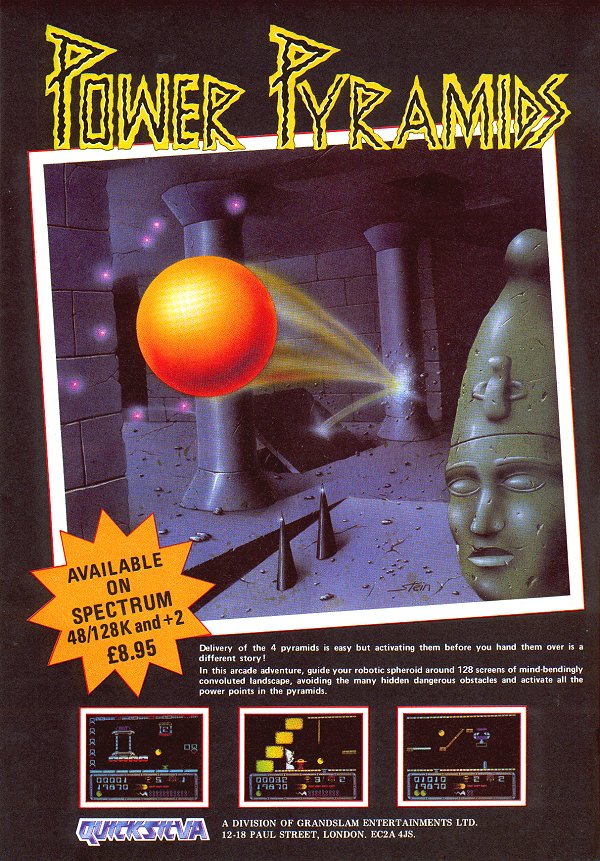
_Back.jpg)
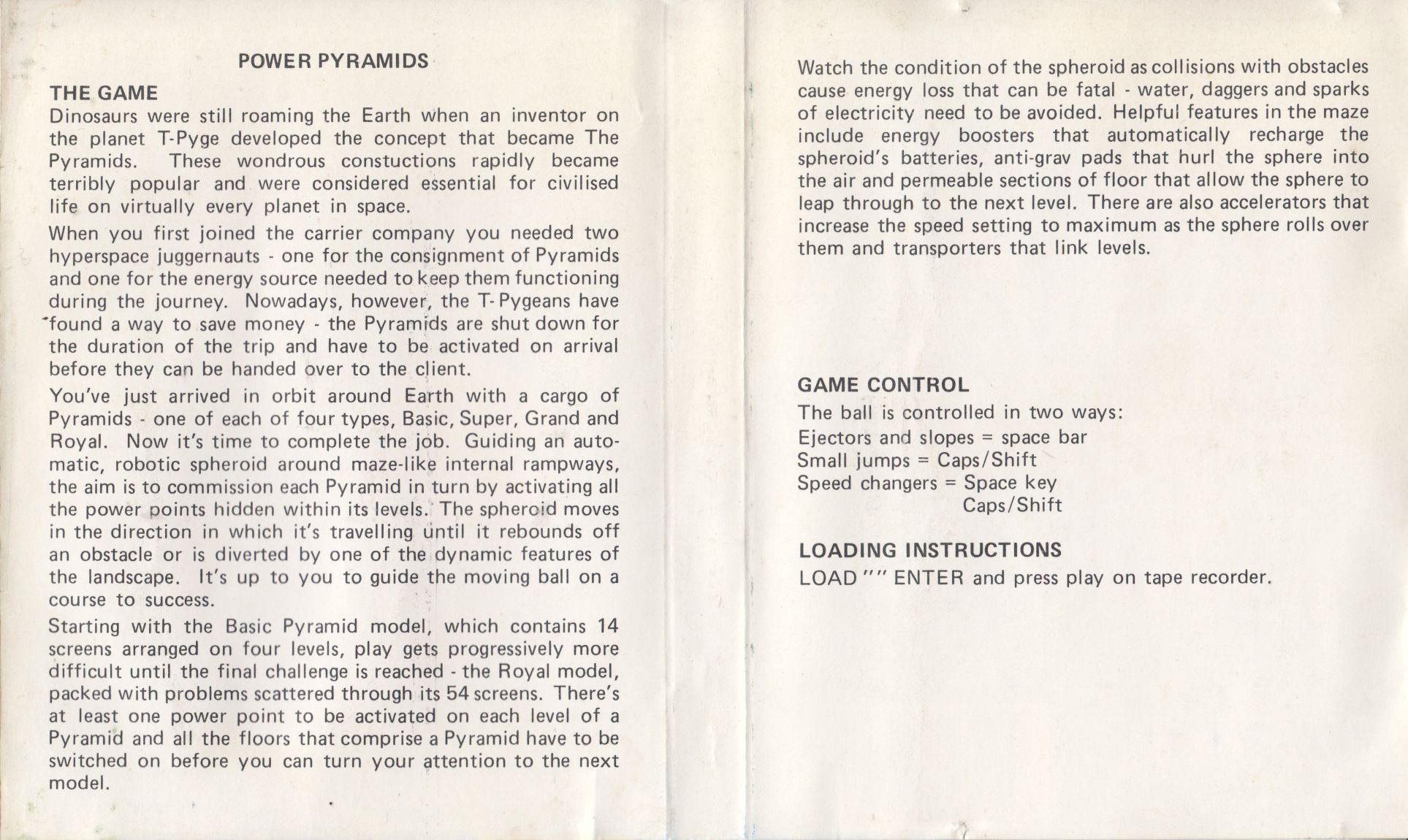
.jpg)
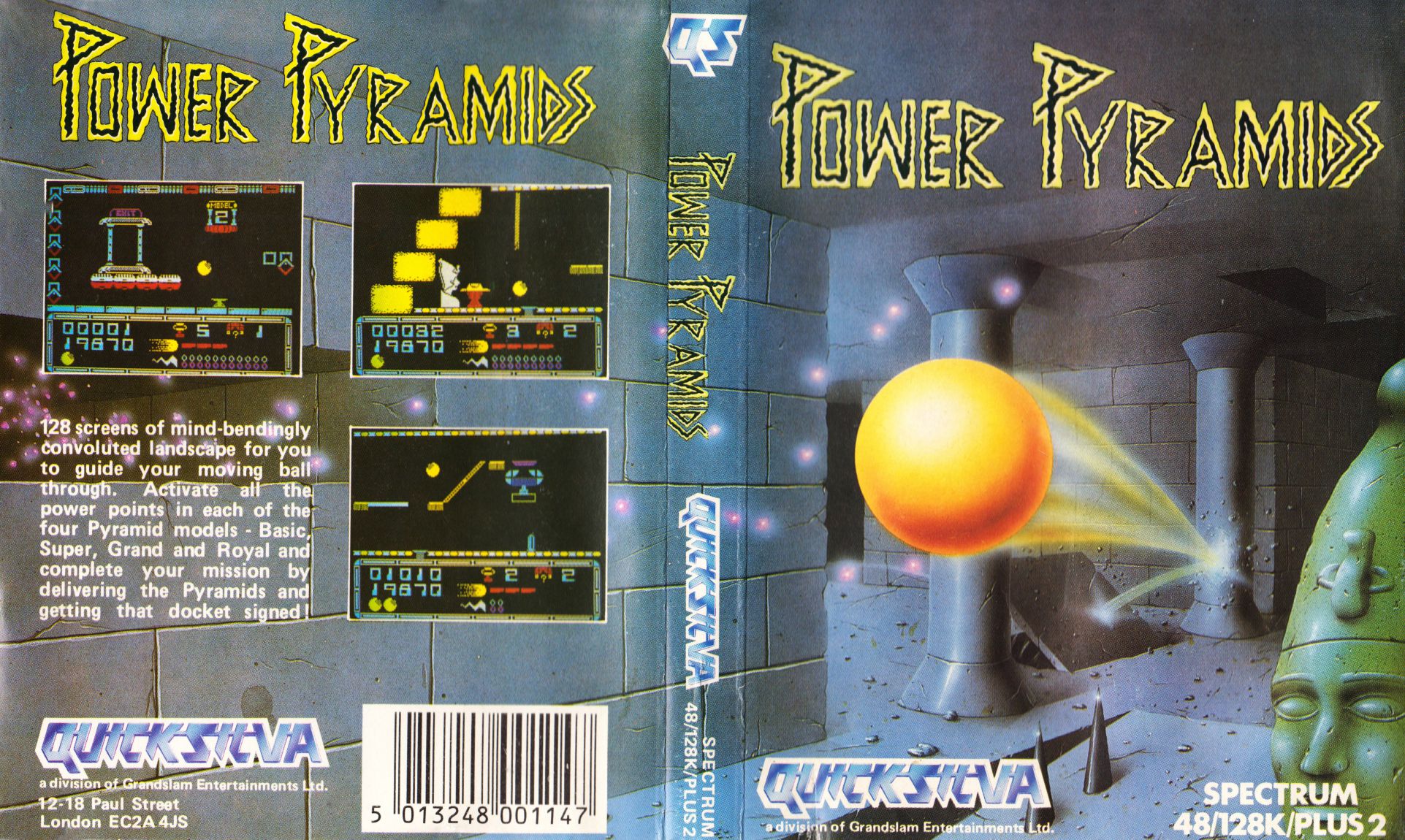
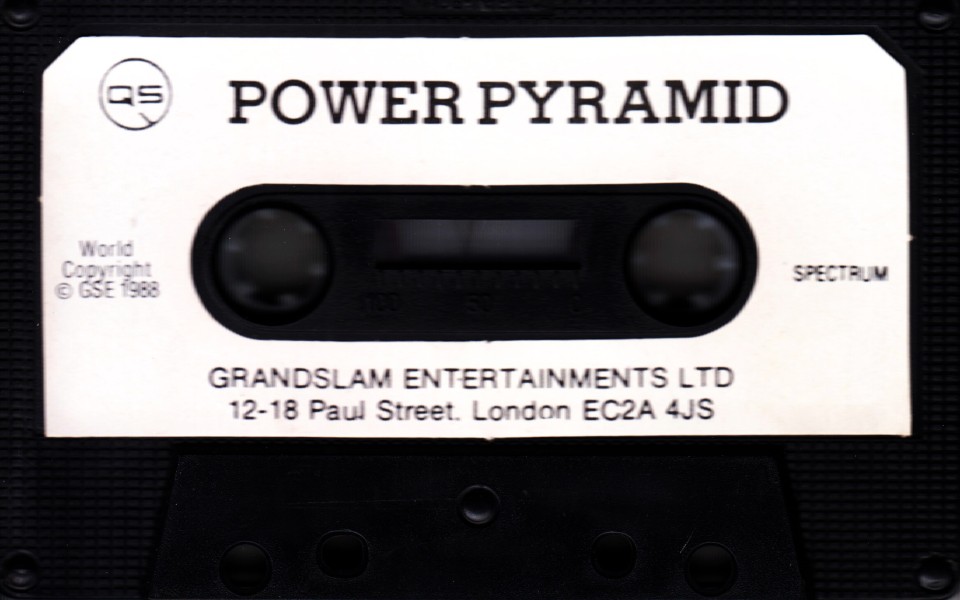
_Tape.jpg)
Discussion
Nobody has started a thread about this yet.
Releases
- 1988Grandslam Entertainments Ltd Sold as Power PyramidPound sterling 8.95
- 1988Bug-Byte Premier
Play
- PowerPyramids.tzx.zipTape image English24 KB
- PowerPyramids.tap.zipTape image English23 KB
- PowerPyramids(Bug-BytePremier).tzx.zipTape image English24 KB
Documents
- PowerPyramids.txtInstructions English3 KB
Other files
- Power Pyramids (1988)(Grandslam Entertainments).pokPOK pokes file 0 KB
Files and rights
No permission is on record either way. Screens and pictures are copied here on a take-down basis: if you hold the rights and want something removed, say so and it goes.
Credits
- Julian SkellyCode
- S.A.V.E.Load Screen
- Andy BrownMusic
- Steinar LundInlay/Poster Art
Sign in to credit somebody, or say what these people did.
Scores
In the magazines
- Sinclair User #811988 · Overall42%
- Your Sinclair #371989 · Overall7/10
Elsewhere on the web
- WorldOfSpectrum 12 votes6.92
In the magazines 24
Your Sinclair #37Jan 1989 · p.1147/108/107/108/107/107/10
Graphics 7/10
Playability 8/10
Value For Money 7/10
Addictiveness 8/10
Overall 7/10
Marcus Berkmann 7/10
Grandslam £7.95 Reviewer: Marcus Berkmann Sadly, this game has nothing to do with Egypt at all, which was something of a disappointment to me as I had to cross out about 8 billion hilarious Egyptian jokes. Like the one about (Get on with it. Ed). Power Pyramids is in fact set deep in the mists of time and space on the planet T-Pyge, where some geezer came up with the idea of Pyramids. Neat notion, I hear you cry, and although no-one came up with an actual use for the things they soon became terribly popular and much sought after across the galaxy. You, you poor sap, are a sort of hyperspace equivalent of a long-distance lorry driver, carrying these pyramid things around the universe in between bites of your intergalactic Yorkie bar. When you deliver four pyramids on Earth, all of different sizes, they all have to be reactivated, as the T-Pygeans, to save on the spondies, switched them off before you left. But unfortunately, you are a bit of a clot, for instead of doing it yourself, you have to guide a remote control spheroid (bouncy ball to you and me) around the ramps and walkways. It'd take about a femtosecond to do it all yourself, but no ball, no game, so instead you launch into what Grandslam would have you believe is a complex maze of ramps and levels. You and I, on the other hand, would call it a spanking great platform game. Now, regular readers will know that I am an absolute sucker for a good platty game, even though they are dangerously unfriendly (unlike me, hem hem). This one's in the Cauldron II mode, but less bouncy (the ball does a lot of rolling around in this one) and with greater emphasis on problem solving. Each of the four pyramids has a series of levels which you get to and from using teleporters. On each level there is at least one power point, and you have to activate the lot. Simple stuff, eh? Not on your nelly. For the problems come when your try to get to the things. Other than rolling along, you have only two ways of influencing the ball's direction yourself. Pressing the space key activates certain springs, which boing you high in the air and, with careful steering, onto the next platform. And with the Caps/Shift key, you can engineer small jumps over hazards. And that's all you can do. Part of the games challenge lies in working out what you really can do with these keys, and how to get your ball to go (fnar). Things also perk up when you actually get to activate a power point, for then once harmless hazards suddenly become less harmless and more hazardous. Other more helpful features in the labyrinth include energy boosters, which automatically recharge your batteries, anti-grav pads which bung you into the air and, my personal fave, permeable bits of flooring that let you jump up to the next level. More dodgy are accelerators which increase your speed setting to maximum, making manoeuvring around the place deeply tricky. It's all cracking good fun, and although I'm sure I have seen about 200 games over the years that look more or less like it, it has a carefully constructed atmosphere of its own. And like all the best games, it's easy to start, hard to complete. Perhaps the most impressive feature of Power Pyramids is its control system, which is easily learnt and used. We've had many bouncy ball games in the past which have been all but crippled by impossible control systems - Cauldron II is one that springs to mind - so it's good to see one that works so simply. I wouldn't recommend it to everyone - specifically those dullards who aren't happy unless they have destroyed about half the universe's population before level two - but if, like me, you have a sneaking regard for these platformy things, I have a sneaking suspish that you might go for this in a big way. Now, there was these geezer from Cairo who (Shut up. Ed).
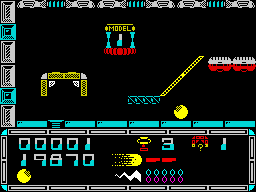
Here the space bar helps you flick around the ramp, helping you get up to the spring, which can them help you get... where? Not those yellow things on the left, for sure. Don't they look just like the cross-section of a Crunchie bar? (is it time for lunch yet?)
The first screen you'll see. The space bar gets you out of that little cage thingy in the middle, but how to get up to the transporter thingy on the right? I'll leave you to find that out (chortle).
Sinclair User #81Dec 1988 · p.6241%32%45%43%42%42%
Graphics 41%
Sound 32%
Playability 45%
Lastability 43%
Overall 42%
Chris Jenkins 42%
Label: Grandslam Author: Julian Skelly Price: £7.95 Memory: 48K/128K Joystick: various Reviewer: Chris Jenkins There was a time when a game like Power Pyramids would have been a nice little thrill. On paper it sounds good; 128 screens of arcade-adventure action, as you guide a bouncing ball around the convoluted interiors of a series of space pyramids. Unfortunately, this is 1988, guys, and this sort of thing doesn't quite cut it in a market where you're competing with technical marvels like Carrier Command and Dark Side. In fact, not even the plot makes much sense. The alien T-Pyge have developed the concept of the Pyramids. Suddenly, everyone wants Pyramids, and the T-Pyge are shipping them all over the universe. But WHY? No idea. Anyway, the pyramids are shipped in a dormant state, and have to be activated on installation. You've just arrived in Earth orbit with four types of Pyramid; Basic, Super, Grand and Royal. To complete the job you have to guide an automated spheroid robot around the ramps and mazes inside the pyramids, activating all the hidden power points. Each pyramid features more screens and more hazards than the last, and there's at least one power point on each level. The spheroid is in constant motion, and collisions with obstacles such as water, daggers, sparks and spikes cause it to lose energy. However, there are boosters which will recharge your energy when you dock with them, anti-grav pads which fling you high into the air when you activate them, and transporter spondules which whizz you to new locations. Strangely enough, there's no joystick control, or anyway, I couldn't make the joystick work, and there's no mention of joysticks in the instructions, so I think it's safe to assume that there's no joystick control. Instead, you make the ball jump by pressing the CAPS SHIFT. Direction is completely dependent on what you bounce off; you can't change it in any other way. The only other option open to you is to use the space bar to activate the springy anti-grav pads, or to change the angle of the ramps, some stages you have to pick up a speed changer to allow you to negotiate the tighter angles; also activated by pressing the bar. While some of the little tricky bits are quite fun to work out, Power Pyramids has absolutely nothing to make you go "WHOOOO! Look at THAT!" The backgrounds are primitively drawn, with large amounts of black space. Because there aren't any moving objects except your flickering ball (on the early levels, anyway), there isn't much in the way of heart-stopping excitement; just the repetitive task of trying to bounce your way through the screens one after another. Not so much Power Pyramids, more Tacky Tetrahedrons.
Preview6
- MicroHobby #184Jan 1989 · p.15
- The Games Machine #10Sep 1988 · p.18
- Crash #56Sep 1988 · p.119
- Your Sinclair #33Sep 1988 · p.9
- Crash #53Jun 1988 · p.110
- Sinclair User #73Apr 1988 · p.101
Advert4
- C&VG (Computer & Video Games) #84Oct 1988 · p.52
- Your Sinclair #33Sep 1988 · p.85
- C&VG (Computer & Video Games) #83Sep 1988 · p.68
- Sinclair User #78Sep 1988 · p.41
Full-page ad4
- Crash #56Sep 1988 · p.66
- The Games Machine #5Apr 1988 · p.33
- C&VG (Computer & Video Games) #78Apr 1988 · p.41
- Your Sinclair #28Apr 1988 · p.47
CompoEntry3
- Sinclair User #81Dec 1988 · p.37
- The Games Machine #10Sep 1988 · p.116
- Crash #56Sep 1988 · p.51
News/Note2
- C&VG (Computer & Video Games) #81Jul 1988 · p.14
- ACE (Advanced Computer Entertainment) #3Dec 1987 · p.9
Review1
- MicroHobby #185Feb 1989 · p.30
Hack/Poke1
- Your Sinclair #38Feb 1989 · p.25
CompoResult1
- Crash #58Nov 1988 · p.68
Related
- Compilations
- Load 'n' Run issue 63
- Ports
- (Commodore 64)
- Same entry at
- Spectrum ComputingZXInfo
Reviews from people here
Sign in to write about this, or make an account. It takes a minute and lets you correct the catalogue too.
No description, tag recorded.
Sign in to correct or add to this.
Hold the rights to this and want it taken down?