
The Prince
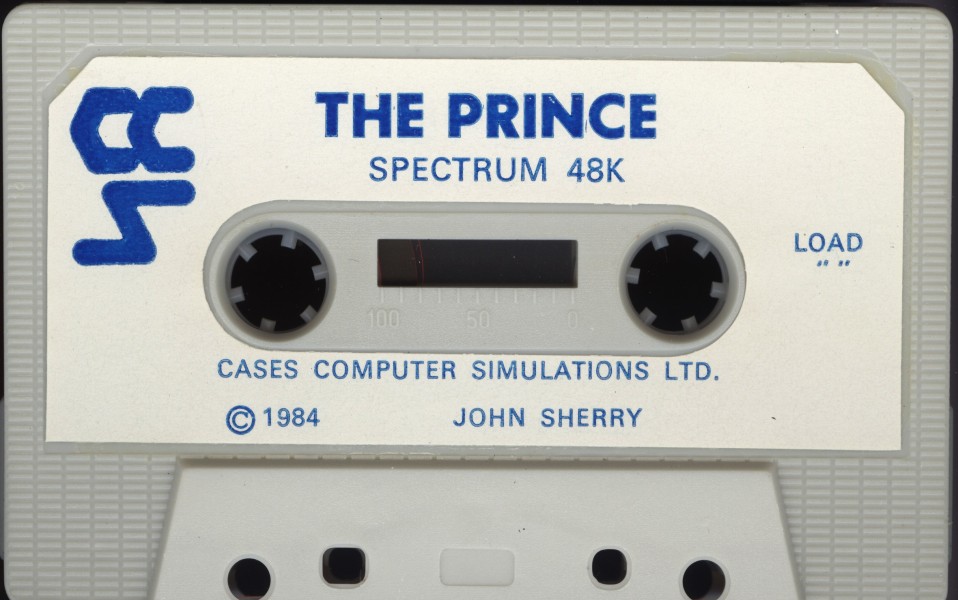
Strategy Game: Management · ZX-Spectrum 48K · 4 players · English
CCS · 1984 · Pound sterling 7.95
Discussion
Nobody has started a thread about this yet.
Play
- PrinceThe.tzx.zipTape image English23 KB
- PrinceThe.tap.zipTape image English25 KB
- PrinceThe.tzx.zipTape image English22 KB
Documents
- PrinceThe.rtfInstructions English38 KB
Files and rights
Distribution permission is on record, granted to another archive rather than to this one. Screens and pictures are copied here; everything else links to the archive that holds it.
- AllowedCCS → WorldOfSpectrum
Credits
- John Sherrycredited
Sign in to credit somebody, or say what these people did.
Scores
In the magazines
- Sinclair Programs #261984 · Rating80%
- Personal Computer Games #131984 · Overall7/10
- Sinclair User #341985 · Gilbert Factor8/10
- Big K #101985 · Overall3/3
Elsewhere on the web
- WorldOfSpectrum 5 votes7.00
Awards and competitions
Cambridge Awards 1984
- 1placed
In the magazines 32
Sinclair User #44Nov 1985 · p.30
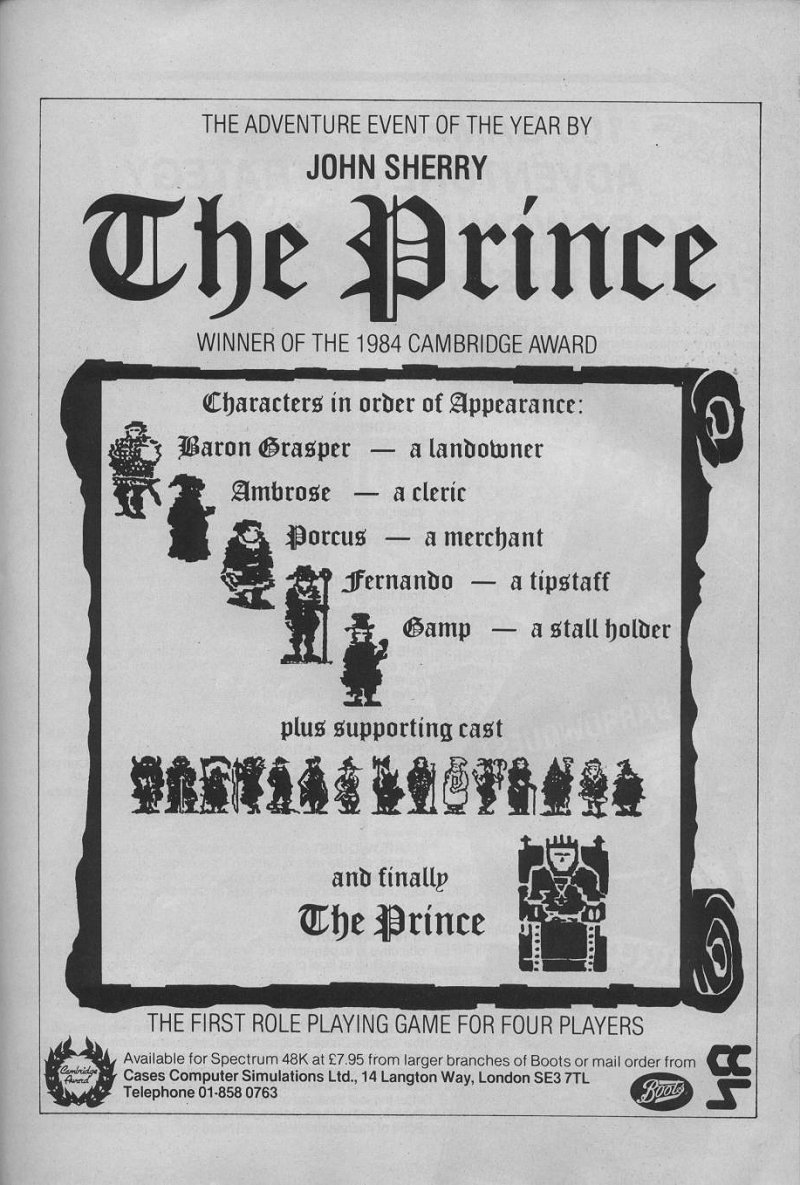
Multi-player computer games are frequently little more than glorified board games. The Prince, winner of the 1984 Cambridge Award, was the first to use the Spectrum's potential for hiding information from the human protagonists, creating a mood of mistrust and deceit. All four players explore the gloomy and rambling castle seeking an audience with the shadowy Prince. Unreliable henchmen may be bribed to hinder or spy on your opponents, information and useful goods can be bought and sold, while off-screen devious alliances can be forged. Compulsive and evil entertainment, nothing quite like it has been released before or since.
C&VG (Computer & Video Games) #40Feb 1985 · p.68
Keith Campbell
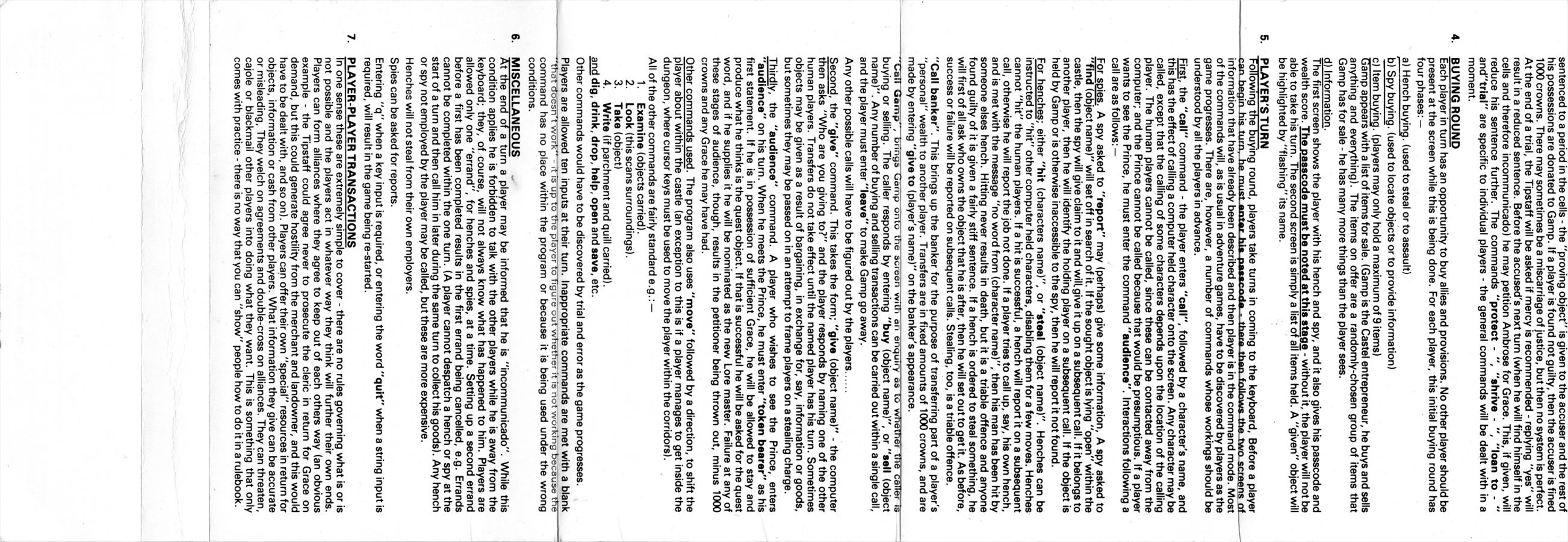
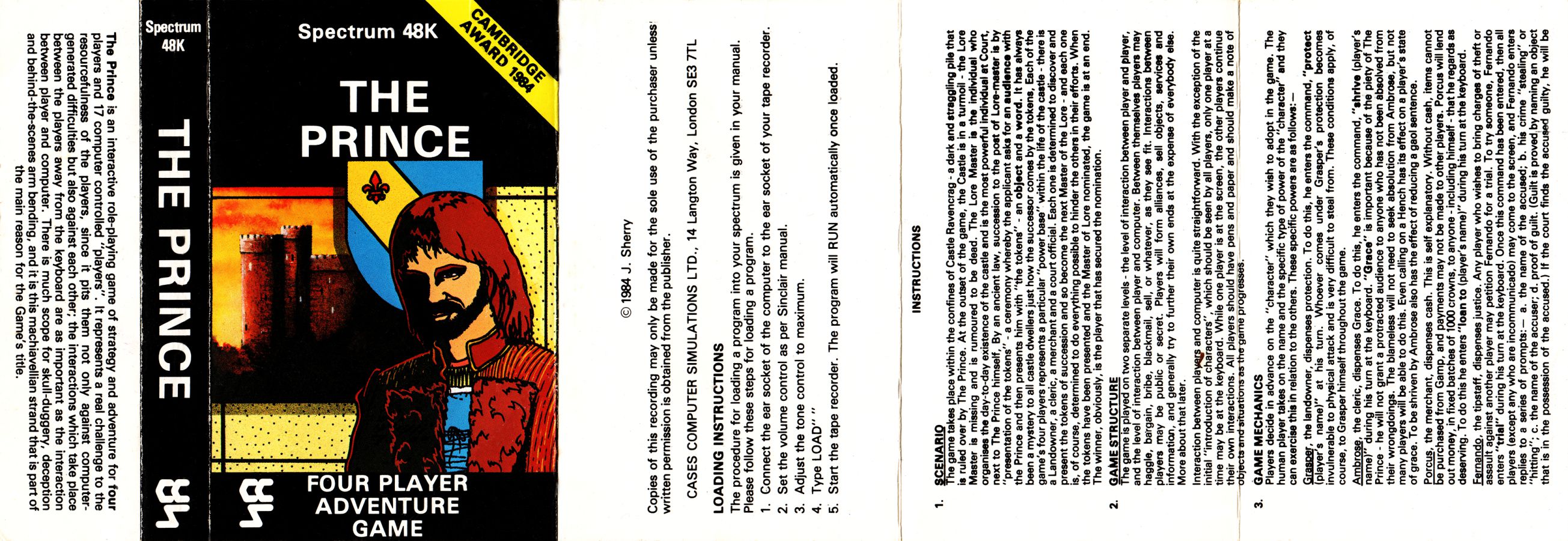
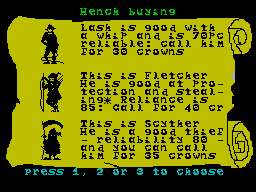
A PRICE FOR THE SPECTRUM! Adventurers often gather together to pit their wits against a common enemy - the programmer! However, in The Prince, you will find a game in which such a group are mutual enemies. This is a four-player game with a very original approach. The objective of each player is to get hold of four tokens, then gain an audience with the Prince to claim the title of Lore Master. In order to do this, he may call upon the help of a personal Hench and Spy. A Hench, in case you didn't know, is a thieving mugger! The adventure window takes the form of a sheet of parchment, upon which words are displayed using a medieval character set. The game opens offering each player in turn, a choice of three different characters in each trade. These are displayed graphically and their ability is described in some detail. Right nasty looking characters some are, too! Next, each player may spend money on a selection of objects, then play commences. Input is in plain English, as in a normal Adventure, but there are some very unusual commands. You may call upon the services of your Spy and Hench to do your dirty work. Thus, you can steal objects carried by your opponents and do all sorts of other nasty things to hinder your opponents. In addition to all this, you may confer with any or all of your fellow players to decide a strategy. You can swap objects or perhaps gang up to plot the downfall of another! Each player is given his own pass code, so no player is allowed to watch the others during their turn at the keyboard. I have only two points to criticise. First, you must have four players for there is no option for less. Second, the instructions and rules, which are necessarily quite complex, are printed on an elongated extension of the inlay. These really warrant a small booklet in which they could be laid out in a more easily referenced form. The Prince is for 48k Spectrum from Cases Computer Simulations Ltd.
Micro Adventurer #16Feb 1985 · p.27
Cath Bilgora
BACK STABS MICRO: Spectrum 48K PRICE: £7.95 FORMAT: Cassette SUPPLIER: Cases Computer Simulations, [redacted] This should be what all groups of computer adventure game players have been waiting for; but hang on to your cheque books, it's far from perfect. Given that 90 per cent of the fun in multi-player games is interaction and the remaining 10 per cent is a neat game system that's challenging and interesting, I'm afraid The Prince falls rather short. The action takes place in Castle Ravenscrag; the Lore Master is missing, presumed dead. Succession to the exalted post, second only to that of the Prince, is decided by tradition with the "presentation of the tokens". Each of the players must vie to create a power base at court and thus guarantee their ascension to the post. The players may chose to be a Landowner, cleric, merchant or court official. The winner is the player to secure the most tokens and thus the post. The nature of the game is almost identical to a solo adventure game, with some 17 non-player characters to interact with, manipulate and worry about on top of the three other player characters. Options are there for blackmail, buying, selling, haggling, in addition to examine, look, take and so on, that we are all used to. The individual player characters are distinctly different, each having abilities and weaknesses. Having decided which of the characters each of the four will play (I should point out only four, no less) and a pass code given to each player, the competitors will privately hire henchmen, and spies and make purchases from Gamp the purveyor of the almost useless! When each has been through this the game will start. Play is as I have said not dissimilar to a standard adventure game, only you know that there are other players moving about in the scenes thwarting you. All the other player characters are inactive during the game turn of another player. Deals may be made off screen, but the instructions given by each player are secret. The effects will be made clear in the fullness of time when something terrible or sneaky happens. The main criticism is that the player contact is minimal. Obviously in the presentation and limitation of the four player-one keyboard set up, only one player can be active at one time. This game would have been better suited to be saved until Spectrum networking is sorted out and accepted as the medium of multi-player games. I won't give anything away about the plot any further but suffice to say there are some characteristically mind boggling head benders of problems in it, as with a lot of games. Ploys only work if the computer understands you, so subtlety may not be the best approach - that's up to the players. If you want to see what network adventure games will look like in the near future try it. In the present form, accept lots of thumb twiddling while you're waiting to play, and put aside quite a few hours - and for heavens sake write down your pass code.
Big K #10Jan 1985 · p.20N/A3/33/33/33/3
Graphics N/A
Playability 3/3
Addictiveness 3/3
Overall 3/3
John Conquest 3/3
THE SMYLER WITH THE KNIFE MAKER: CCS FORMAT: cassette PRICE: £7.95 Any game that takes Machiavelli's famous treatise on gaining and keeping power is going to have to be pretty cunning and underhand, but this very well presented four-player adventure certainly does justice to old Niccolo. Each player runs a specific character, each with different attributes; the landowner can provide protection, the cleric grace, the merchant cash and the tipstaff justice. All four are looking to locate an object and a work that constitute the 'tokens' needed to gain the vacant post of Lore master. The game takes place inside a castle, clearly as large, if not larger, than Gormenghast, which house 17 non-player characters, the Prince himself, a banker to handle cash transactions, a dealer in all kinds of useful odds and ends and an assortment of henchmen, who can assault and steal from other players, and spies. Each player can recruit a henchman and a spy. Players are given codes which are need to access their characters and have 10 input at a time. However, apart from grappling with the computer, finding out what you can do, where things are, what use they are and all the usual adventure problems, there's a whole other side to the game, the interaction between the players, away from the terminal. Here, as in Diplomacy, there are no rules at all - lies, deception, betrayal, threats, blackmail, bribery and the double-cross, anything goes. Oh, it's all good, clean fun in Castle Ravenscrag. The big problem of course is getting four people together for long enough, but this could be just the thing for those long winter evenings and miserable weekends. The owner of the game does have a hideous advantage in that playing solo will let you build up a map very quickly. Which is entirely within the spirit of the game.
Crash #12Jan 1985 · p.158
Angus Ryall
FRONTLINES From our correspondent at the front Angus Ryall. Direct response! I've finally done it! Two issues ago I bemoaned the fact that the software industry was so complacent - it seemed that no matter what I wrote or said, I couldn't get through the thick skins of the people who need to buck their ideas up. But - over the last month it seems to have worked. First of all John Merry (of Reichswald fame -now of Scorpio Gamesworld) rang up to say that not only was Reichsweld a brilliant game (a point which I obviously missed when reviewing it) but that my remarks about his girth were totally unfounded and libellous. Quoth he: 'This kind of petty slander makes my blood BOIL!' Me: 'Sorry John, I was only trying to liven up a really tedious subject.' I was hoping that John would send in a couple of 'before and after' pics as irrefutable proof, but instead he burbled on about withdrawing all Scorpio's advertising from Crash (ho-hum, here we go again) which is probably why Roger is refusing to pay me. My apologies also go out to Argus Specialist Press, whose representatives threatened me with legal action and/or severe bodily dismemberment - I didn't really mean to say anything horrible about your wonderful magazines chaps, I was of course talking about EMAP (at this point the editor grasps me firmly round the windpipe. As I feel the life-force draining from my limbs I manage to scrawl ONLY JOKING PEOPLE, I LOVE YOU ALL)! THE CRASH SANDINISTAS STRIKE A BLOW IN THE CITADEL OF CAPTILISM Or, to put it another way, this month's report comes to you direct from the Ritz Hotel in Picadilly, London. Unfortunately this does not mean that Crash has seen the light and started treating its reviewers with the respect they deserve - we'd be lucky to get a room in the Red Cow in Ludlow. It means that I went along to the 'most prestigious award for amateur programmers' ceremony, the Cambridge Award. Funnily enough, I've only recently reviewed last year's winner and runner-up, Battle 1917 and War 70, so I thought I had an idea of what to expect: but in the event I was pleasantly surprised. There were four 'finalist' games, which I've reviewed below. They can all be loosely described as 'strategy games. But first I must tell you a little about the actual event itself, since I feel morally obliged under the freeloaders' code of honour. As I entered the Ritz in my rainbow-striped jumper and my hardware jeans, I sensed that something was not quite right - why wasn't I being thrown out on my ear for not wearing a tie? Well, apparently if you are going to a private function then you don't have to. Great, I thought; let's just head straight for the bar in my usual manner. Having located the 'Marie Antoinette' suite, I made the mistake of asking the barman for a drink. I say mistake because the man was fairly well blasted by the time I arrived and he could only understand the kind of 'tourist' French that the waiters oil heff to spik, (Was he on a percentage from Beefeater?) Anyway, I got a gin big enough to farm salmon in, topped up with about two millimetres of tonic water. Now I'm not actually that keen on neat gin, so I asked one of the floating French penguins to fetch mea bitter lemon so that I could mix it with the half-pint of gin. A minute later he returned with a slice of lemon on a stick: 'Your beet urv limon monsieur,' he said! Things went from bad to worse. RUSSELL AND Carol from White Dwarf arrived, already half cut, and pounced on a QL chap, hoping to have a meaningful discussion about artificial intelligence. The man was so scared he ran away. The waiters wrested our half-empty glasses from our hands and topped them up with yet more neat gin. By now I had started to acquire a taste for neat gin, and when I was accosted by the Argus heavies I was able to fend them off with a bottle of (yes, you guessed it) gin. Julian Fuller from Micronet got very earnest with a man from Telecom about Multi-User Dungeon. I think that if ever a nuclear war is imminent I shall book myself into the Ritz, because it's the only place I know where you can get drunk in under eight minutes without even trying! Then the buffet lunch arrived, consisting of a load of raw, minced meat on what looked like pieces of Ryvita (I have since learned that this is in fact a great delicacy known as 'Steak Diane') and some kind of Scampi - or was it Pork Balls? (The kind you get at a Chinese take-away, I mean!) Then the speeches began, greeted with thunderous applause. The sponsors of the awards were C.C.S., Sinclair User magazine and Sinclair Research Ltd. I think that most of us who'd managed to stay sober were hoping to have a word with Sir Clive about his plans for world domination and whether we'd be able to buy shares in Sinclair in 1985 (ha-ha). But alas, it was not to be because he didn't show up. Instead we had to make do with Nigel Searle who is (only) the Managing Director. He spoke about how Sinclair had been responsible for getting computing off the ground in the U.K., and how pleased they all were to be British and all that sort of thing. My associates Russell and Carol kept making distinctly negative comments at particularly high volume, which made one feel slightly conspicuous. The Chairman of C. C. S, made a rather rambling speech and seemed a little overwhelmed by the whole situation; but then, if he had drunk as much as I had then I wouldn't be at all surprised. John Gilbert of Sinclair User made a punchy but totally vaccuous speech about what a brilliant magazine he works for. John Sherry from Keele received the award from Nigel Searle for his program The Prince, and looked understandably pleased with himself since he'd just won £2,000. THE PRINCE Author: John Sherry Producer: C.C.S. Retail Price: £7.95 The 1984 Cambridge Award Winner: This is a very complex program for four players which actually demands quite a lot of thought from the participants. It is reminiscent of the board game Diplomacy' in that it provides a vast amount of scope for inter-player negotiations. The game is based on Machiavelli's classic chronicle of Renaissance intrigue ('The Prince') and the task is to retrieve a secret object and word and present them to the Prince in order to become his thief adviser. Each of the players has a character on the screen who holds a certain measure of power; for example, Porcus the Merchant can lend money to other characters, while Brother Ambrose can dispense grace. The Prince will refuse to see anyone who has too many sins outstanding, and it's well nigh impossible to avoid committing the occasional sin along the way, such as sending out your henchman to 'hit' another player, or even stealing the objects themselves. Each player has a spy and a thug to help him collect information and hamper his rivals' efforts, but as there is only an initial selection of six of each two, the chances of your men being double agents is very high. The other players are required to leave the room while you take your turn on the keyboard, and you can leave phony messages around the castle for them, steal their ladders as well as all sorts of other devious tricks. Also, the opportunities for off-screen disinformation are enormous. But one of the problems with the game is that I feel it's unreasonable to expect the players to maintain the pretence and secrecy for the amount of time it takes to play. One feature of the game, for instance, is being rendered 'incommunicado' at certain points, which means that you can't talk to the other players off-screen. I have my doubts as to whether this is particularly practical. Also, the command structure is only likely to be understood by hardened adventure freaks. But these are only minor quibbles. The graphics and character set are very neat and very fast, and the basic strength of the game as a multi-player experience should not be missed. I haven't really had time to get to grips with The Prince as yet because of its great complexity, not to mention the difficulty of getting four players together at the same time. But saying that, I think this one should see me through most of the winter.
Sinclair User #34Jan 1985 · p.448/108/10
Gilbert Factor 8/10
Richard Price 8/10
AN AUDIENCE WITH MACHIAVELLI'S PRINCE Memory: 48K Price: £7.95 Duplicity, cunning and self-interest are the keynotes of the 1984 Cambridge Award winner, The Prince, written by John Sherry and published by CCS. The title is consciously derived from Machiavelli's handbook of politics and is designed for four players. Set in a gloomy renaissance fortress the game is a combination of strategy and adventure formats. The aim is to become Loremaster and chief counsellor to the Prince, ruler of this land, and each character must get to the top by any means possible - whether it be theft, kidnap or mayhem. After engaging the services of henchmen - who can 'hit' other castle servants and characters - and spies who can report on the actions of other people, each player moves around the fortress giving instructions to his staff and trying to secure the tokens which will ensure advancement. Goods can be bought and sold from the castle trader and a banker will arrange transfers of cash. Each player has a passcode which will allow him to take his turn - other players are not supposed to observe this but are sure to try. Life is not simple since any of the spies and henches recruited may well be working for other player-characters and information may be bought and sold. The computer keeps track of your money and possessions and informs you of your current position at the beginning of each turn. Input is in standard verb/noun combinations and there is a hidden vocabulary besides the predefined commands for controlling your gang. The Prince will involve you in much bargaining and chicanery with the three other human players. Alliances may be formed and broken, lying and deceit will be the most normal interactions. An audience with the Prince himself is possible but he is temperamental and will brook no impertinence. Ten inputs are allowed for each turn so you must plan your strategy carefully. Pictures of the people you are talking to are shown on- screen and the character set is a mock-gothic script. The game is well-constructed and, since you only ever have a partial view of the goings on, is full of the unexpected. Diplomacy addicts will feel quite at home here as the web of treachery spreads through the palace and it is easy to become utterly absorbed in your character.
Personal Computer Games #13Dec 1984 · p.1108/107/105/107/107/10
Atmosphere 8/10
Complexity 7/10
Interaction 5/10
Overall 7/10
Steve Cooke 7/10
SPOILT FOR CHOICE The White Wizard investiagtes the latest releases. GAME: Return To Eden PRICE: £9.95 MACHINE: Amstrad, Atari, BBC, CBM64, Nascom, Memotech, Spectrum GAME: Sorceror of Claymorgue Castle PRICE: N/A MACHINE: Apple, Atari, BBC, CBM64, Dragon, Electron, Tandy, Spectrum GAME: Fire on the Water PRICE: £6.95 MACHINE: Spectrum GAME: The Prince PRICE: N/A MACHINE: Spectrum GAME: Macbeth PRICE: £14.95 MACHINE: CBM 64 Anyone know of a secluded retreat, with ample supplies of tinned owls livers and lettuce opium? So much software has flooded into the White Wizard's cave this month that he is at his wits' end and badly in need of a very long holiday. However, the good news is that there are some hot new releases out this month. Level 9's Return to Eden hits the streets and, of course, there's the Sorceror of Claymorgue Castle from Scott Adams. Not only that, but there are also one or two new games that offer the adventurer something quite different from any programs that have come before. First, however, let's Return to Eden with Level 9. This is the eagerly-awaited sequel to Snowball and will be available on the usual extensive Level 9 range of machines, from the Memotech right through to the Amstrad. You don't, by the way, need to have played Snowball to enjoy Return To Eden. This game marks a radical departure from Level 9 tradition by including gasp - GRAPHICS. Have the die-hard, text-only gents from L9 taken leave of their senses?? No, mein wizardlings, zay haf zimply produced a better game, ja! (Yes, the White Wizard is proficient in all languages including Numenorean Provincial). Frankly, the White Wizard found Snowball a very trying game and wore out at least a dozen wands exploring its secrets. Return to Eden is rather easier in my opinion and certainly as enjoyable as its predecessor. The only thing about the graphics, is that some of them are rather poor... Sacrilege, I know, to speak ill of a Level 9 game but really they aren't that hot with the pastels. Even the old Mysterious Adventure range comes out on top here. However, this game oozes with atmosphere as you explore a distant planet populated by some very strange creatures, including the invaluable See Bee, the very necessary Ouija bird, and the undesirable leviathan. You can jump off cliffs, fight squirrels (well, be attacked by squirrels), and die of radiation. This is the sort of thing Wizards enjoy and that's only the beginning. From the exotic forest you move on to the daunting task of penetrating the different zones surrounding a robot constructed city. Very hazardous this, and I guarantee you'll need to spend at least a week driving yourself round the bend before you reach the city - by which time you'll be only about halfway through the game! 200 locations, the usual extensive vocabulary, and a great scenario make this every bit as good as previous Level 9 games. Don't expect the locations to be quite so fully described as other Level 9 games - after all you do get the graphics which take up a lot of memory. There's a strong 'conservationist' slant to the story, centring on the moral questions surrounding the destruction of alien life forms. No, I'm not kidding, and the White Wizard very much approves of this sort of thing. The more adventures we have that reflect real-life problems like this the better in my view. The only slight reservation I have about Return to Eden (and all other Level 9 games) is that it doesn't tell you which words it fails to understand. It simply replies with the famous 'Arfle Barfle Gloop?' which isn't much help when you are trying to unravel vocabulary problems. It has to be said, however, that one doesn't often have vocabulary problems in a Level 9 game. Another important recent release is Scott Adams' Sorceror of Claymorgue Castle. This is available for the Commodore, Spectrum, Apple, Atari, BBC, Dragon, Electron, and Tandy... phew! Quite a list. The White Wizard has dabbled enjoyably in the Spectrum version, which features some very pretty graphics indeed. It's worth noting that the Spectrum conversion was done by Brian Howarth who writes the Mysterious Adventures, to which this program bears some superficial resemblance. Well, what can one say about Scott Adams' adventures? They've been around for a very long time now in one form or another, but the fact is that whenever a new one comes out it is always a good buy. Sorceror of Claymorgue Castle is no exception. As in most Scott Adams' games, the object of the game is simple - you must collect a certain number of readily identifiable treasures and store them in a particular location. The challenge of the games is in overcoming the different puzzles, most of which are encountered when you try to move from location to location. None of Scott's games have that many places to visit, but that doesn't mean they're a doddle by any means. Sorceror is definitely a case in point here. You start off behind a castle and I guarantee that you won't enter it inside ten minutes of cursing, howling, and (as it happens) holding your breath. Once you get inside, you'll still have to try every trick in the book to explore more than about six locations. Just to tantalise you, one of the treasures is plonked almost right in front of your nose at the beginning - but try picking it up and you'll see that all is not as easy as it seems. So that's two new games for your shelves - and both available on a wide range of machines. Now let's take a look at something quite different - three releases each of which offers something rather unusual. LONE WOLF The first is the Lone Wolf series for the Spectrum, though I imagine that there will soon be similar offerings for other machines. There are two games in the series so far - Escape from the Dark and Fire on the Water. Both titles offer excellent animated graphics and a very unusual format. The cassettes come either on then own or with an accompanying book that gives some idea of what to expect from the games themselves. The books are split up into numbered sections each of which contains a stage in the development of the plots. I say plots rather than plot, because the story changes as you read. This is because whenever you come to a crucial point in the story, you have to make a decision. Depending on the decision you make you are then directed to another numbered section where you continue reading. This, of course, is very much like playing an adventure game on a computer, so it's only natural that Arrow, the publishers, have decided to offer a game as well. The format is as follows - there's a graphics screen surrounded by an attractive border and a scrolling text window below. You place a keyboard overlay on top of your Spectrum. The storyline scrolls on the screen, and whenever you have to make a decision you press the appropriate key and the program jumps to the next stage in the story. There are also extensive fight routines, requiring diligent pressing of Parry, Thrust, Chop, and Swipe keys. Your fighting skill and energy are monitored on the screen, and when you run out of energy Lone Wolf (that's you) bites the dust. The fight sequences are well-animated, and after a couple of hours playing I decided that there really was a tactical element which made them much more satisfying than the usual 'You-stab-the-Dire-Wolf' routines that other games tend to offer. Escape from the Dark and Fire on the Water are consecutive games, and a character developed in the first can be loaded into the second ready for action. So what's different about these games? The first thing to notice is that the program itself dictates your movements. For instance, you can't type in 'Go West' unless that is presented to you as an option to be selected. In this respect the game is more limited than a traditional adventure. However, all the space saved by the absence of complex 'parsing' routines (the bits of the program in a normal adventure that scan your inputs and generate appropriate responses) means more room for graphics and animation. There is still a good deal of scope for the player to shape the game - you can sometimes run away rather than fight. You can choose your own routes to your destination, and investigate a number of dead-ends, some of which are more rewarding than others. The White Wizard gives these games the thumbs-up and looks forward to more along the same lines. They are very different in feel to the traditional text/graphics games, but I think they have at value all of their own. It is, incidentally, worth getting the books as well as the games - you can then use them as crib-sheets if you find the going too tough! THE PRINCE If you think Lone Wolf sounds different, wait 'till you get a LOAD of the next game an interactive program for four players from CCS called The Prince. This game apparently won the Cambridge Award 1984, though I'm a hit hazy as to what exactly that means. However, it is a very interesting piece of software that should be carefully examined by adventurers and particularly those with a D&D background. The scenario is as follows: in Castle Ravencrag the Lore-Master has disappeared and is believed dead. By law, succession to this desirable post is by 'presentation of the tokens' - a ritual ceremony in which the applicant begs an audience with the Prince of Ravencrag and hands over the tokens. Your task, and that of your three human opponents, is to find out what the 'tokens' are, get hold of them, and present them to the Prince. You then become Lore Master and win the game. Each player takes on one of four characters - Grasper, a landlord; Ambrose, a cleric; Porcus, the merchant; and Fernandon, the tipstaff (magistrate to you and me). Each player has certain advantages related to his profession - money, for example, in the case of Porcus. Having chosen characters the players then take it in turns to recruit help from the Castle retinue and purchase items from Gump, the Castle trader. During this phase only one player at a time looks at the screen, so other players will not know who is working for you or what you possess. Occasionally, for example, a servant may serve two masters and knowledge of his double-dealings could benefit either player. Each player has a passcode which he must enter during the game in order to play. This stops other players from cheating when you pop out for a slice of toast and honey - or whatever you fancy. During your turn you find yourself inside the castle as in a traditional text adventure. You have only 10 inputs in each turn and must find out as much as possible. You can call your spies and ask them to report, or get your less desirable -helpers ('henches') to attack your opponents servants. During this phase you will find that the vocabulary of the game is rather limited but, of course, it's the same for all four players. What's special about The Prince, however, is that it is one of the first computer games I've come across that permits intelligent and enjoyable collaboration between the human players. As in D &D you will find yourself involved in complex negotiations with your opponents (or allies, depending on how you deal with them). Nothing is too fair or too foul to be considered - you could, for example, ally yourself with Fernando, find out who his spies are under pretence of helping him, then have your spies knock them all out! You unscrupulous devil you, of course you wouldn't do a thing like that, would you? Oh yes you would... Like the Lone Wolf games The Prince is very far from being a trad adventure. It is, however, a game that will appeal to adventurers who enjoy a get together and the chance to outwit each other. Again, the White Wizard, while granting this game a place on his now crowded shelf, would be pleased to hear from other adventurers as to what they think of this new breed. MACBETH Finally - in the 'New Trends' department - we have Macbeth from Creative Sparks for the Commodore 64. This is quite a handful, this one. Two tapes, four games, plus a copy of the Shakespeare play. Each of the four games is related to part of the play, and each is in a different style. All four games feature graphics to a greater or lesser extent and the standard of these is extremely high. In each game you must achieve certain objectives that will allow you to achieve the goals of the character you are playing. In the first and last games you play Macbeth, in the second game you are Lady Macbeth, and in the third you are one of the Three Witches' assistants. With the exception of game number 3, these are all text-games with graphics added in places. Unfortunately, they rely very heavily on your ability to phrase your inputs correctly. Although they will tell you which words are not understood (by highlighting them in red) they are not very hot on understanding the traditional vocabulary. This is particularly true in game 3, which is almost entirely graphics based and doesn't understand words like 'North' or 'South', The display plays a very important role here and you must pick out items in the picture and use them as appropriate, although you may not have been told explicitly that they are there. I'm not sure that Macbeth will appeal to many adventurers unless you have a particular interest in Shakespeare or Scottish history. Some of the sequences are very good, but of 14.95 seems a lot to pay for them. The other drawback with the game - and this applies to one or two other book-based adventures - is that you can't succeed without reading the play, and having read the play, you know what's going to happen. The whole program is rather lacking in the excitement of discovery that makes a good adventure. However, there is one very interesting innovation that is worth a mention. At the end of each game the program gives you the opportunity to load a program called 'Psycho'. This is a very novel routine in which the computer poses as a psychiatrist and questions you in your role as the character you have just been playing. 'Remember that session we had years ago when we got rid of your meat phobia?' enquires the computer of Lady Macbeth (i.e. you) and then goes on to find out just why you behaved as you did in the play - or the program. Computer buffs will no doubt realise a similarity here between Psycho and Eliza - a program that simulated a psychiatrist and gave apparently intelligent replies to the questions put to it. Psycho isn't nearly as complex, but it's still good fun. But why does the White Wizard mention this curiosity, I hear you cry. Well, I reckon it's only a matter of time before we see more variations on the traditional adventure theme. Using a routine like 'Psycho', for example, you could carry on an enjoyable - even if perfectly meaningless - conversation with Thorin in The Hobbit, for example... and just look at Sherlock, where you can 'Tell...' a character things you think they ought to know. Well, that's all for this month my friends. Next month's issue will be absolutely packed to the brim, and will include a couple of goodies that I've had to leave out in this issue because of lack of space. In the meantime, I have a special favour to ask of you all, in recent months we've had a number of new games that one can't really call adventures, but still seem to have some sort of claim to a mention on these pages. I'm thinking particularly of so-called 'arcade adventures' like Gisburne's Castle, or novelties like the Lone Wolf games I've mentioned above. Well, what do YOU think? Are these games worthy of our attention? What do you think is the definition of an 'adventure game'? Shall we stick to the straight and narrow path of the traditional adventure, my fellow explorers of the unknown lands, or shall we allow ourselves to sally forth into new realms? The White Wizard humbly awaits your reply, and will how to your judgement.
D&D-style interaction for four players in The Prince from CCS.
Superbly animated fight sequences make Fire on the Water a cut (and thrust!) above the ordinary.
Sinclair Programs #26Dec 1984 · p.1780%80%
Rating 80%
June Mortimer 80%
PRICE: £7.95 GAME TYPE: Strategy Winner of the 1984 Cambridge Awards, sponsored by CCS an Sinclair User magazine, was The Prince, a four player game of strategy and tactics. The game is based on Machiavelli's book of the same name, which details unscrupulous practices for political survival in the court of a powerful prince. These practices must be carried out carefully by you as you try to collect the secret word and secret object which are necessary to persuade the prince to appoint you as his lore master. The game necessitates interrelation with the other players, as well as with the spies and henchmen controlled by the computer. Without the help of the computerised characters you are unable to obtain the information you need or the things you want while, without the help of the other players you are unlikely to survive the machinations of life in court. Of course, none of the computer's characters are 100% reliable, so it is not advisable to take their word in every situation. The other players, on the other hand, are your rivals for the prince's favour, so are likely to double-cross you whenever they feel they can do so safely. The Prince is produced for the 48K Spectrum by CCS Ltd, [redacted].
Full-page ad9
- Sinclair User #35Feb 1985 · p.54
- Crash #13Feb 1985 · p.71
- Sinclair User #34Jan 1985 · p.13
- Crash #12Jan 1985 · p.77
- Micro Adventurer #15Jan 1985 · p.14
- Sinclair User #33Dec 1984 · p.32
- Crash #11Dec 1984 · p.117
- Micro Adventurer #14Dec 1984 · p.25
- Your Computer #11Nov 1984 · p.96
News/Note9
- ZX Computing #17Feb 1985 · p.83
- Your Spectrum #10Dec 1984 · p.4
- Sinclair User #33Dec 1984 · p.13
- C&VG (Computer & Video Games) #38Dec 1984 · p.22
- Micro Adventurer #14Dec 1984 · p.6
- Crash #11Dec 1984 · p.40
- Sinclair Programs #26Dec 1984 · p.10
- Big K #8Nov 1984 · p.4
- Crash #10Nov 1984 · p.135
Advert3
- Crash #14Mar 1985 · p.123
- Sinclair User #36Mar 1985 · p.56
- Micro Adventurer #16Feb 1985 · p.41
Review2
- Home Computing Weekly #106Apr 1985 · p.10
- Home Computing Weekly #91Dec 1984 · p.30
Feature1
- Sinclair User #32Nov 1984 · p.93
Related
- Tags
- Turn based
- Elsewhere
- UVL
- Same entry at
- Spectrum ComputingZXInfo
Reviews from people here
Sign in to write about this, or make an account. It takes a minute and lets you correct the catalogue too.
No description recorded.
Sign in to correct or add to this.
Hold the rights to this and want it taken down?