
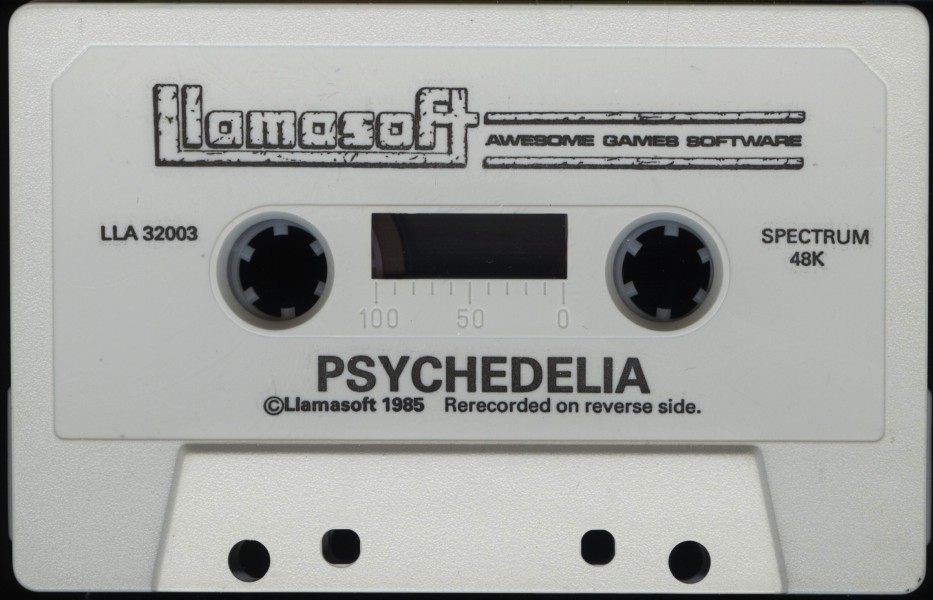
Psychedelia
Utility: Visual/Screen · ZX-Spectrum 48K · 1 players · English
Llamasoft · 1984 · Pound sterling 6.00
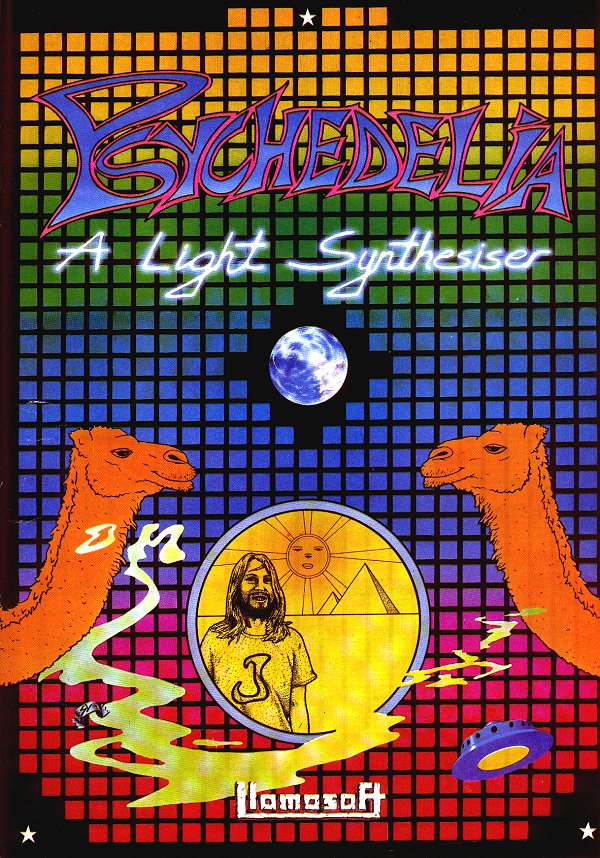
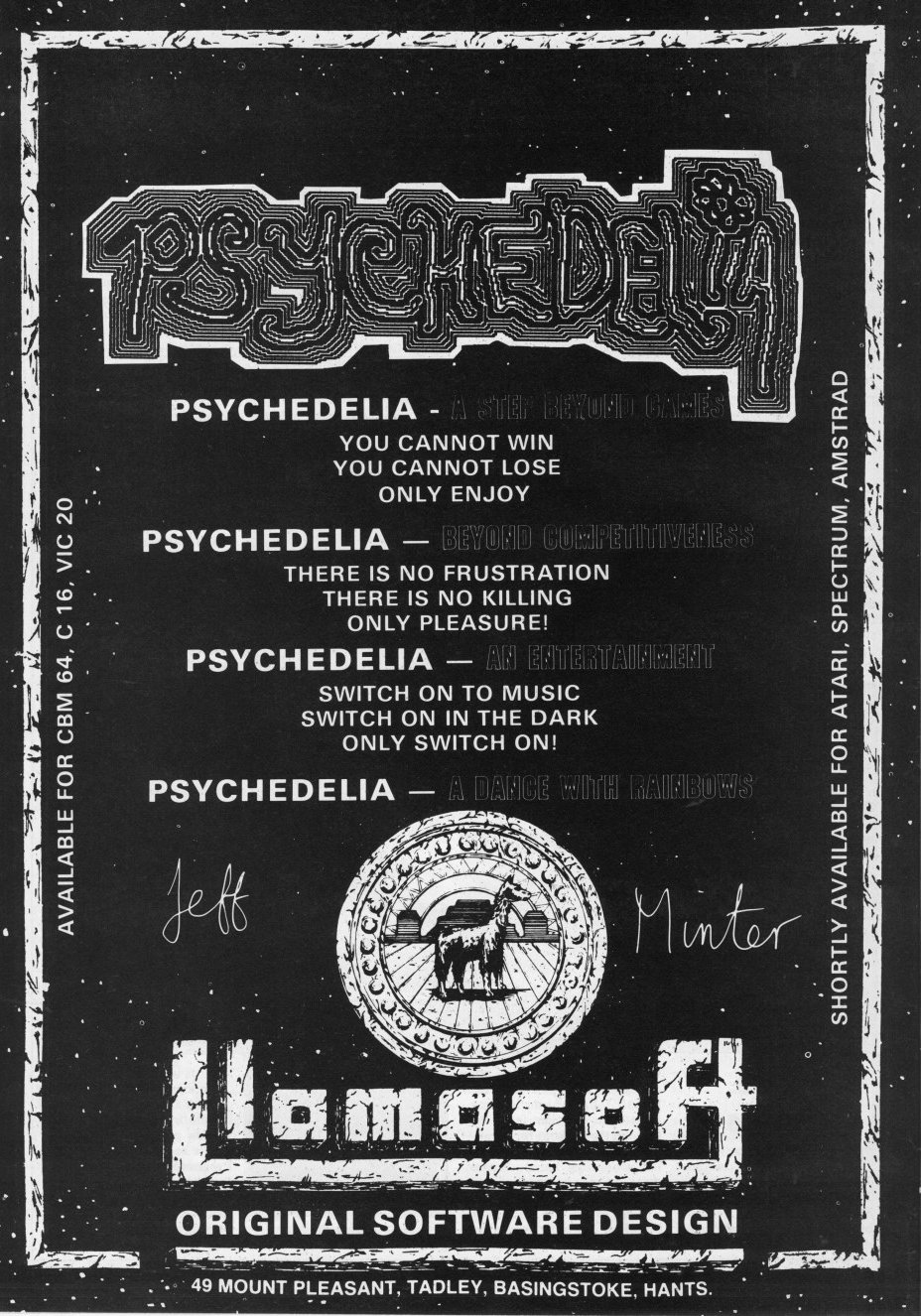
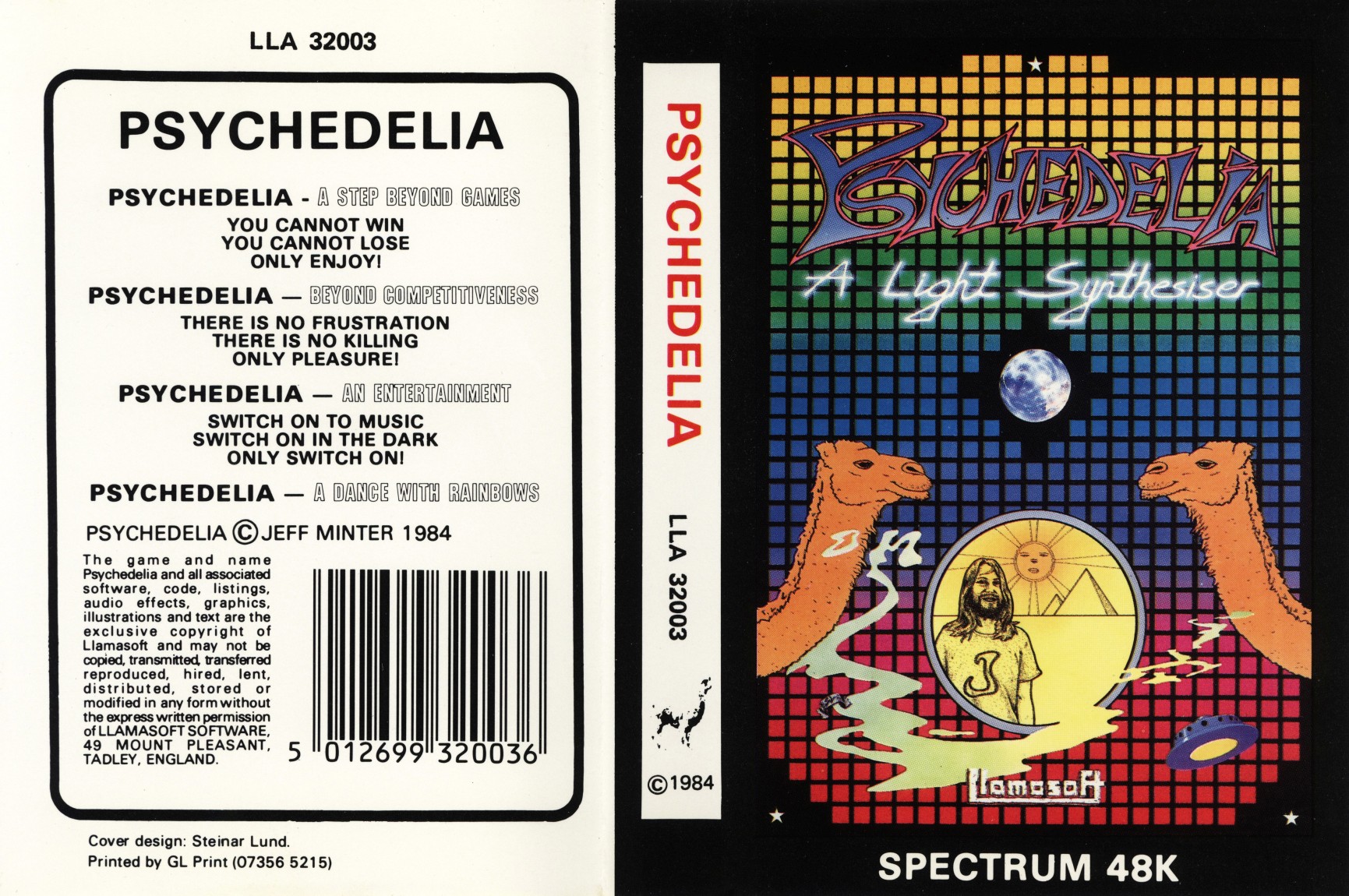
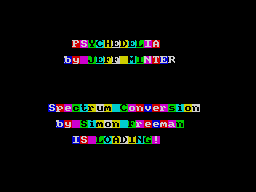
.jpg)
Discussion
Nobody has started a thread about this yet.
Remarks
pattern generator
Releases
Play
- Psychedelia.tzx.zipTape image English5 KB
- Psychedelia.tap.zipTape image English5 KB
Documents
- Psychedelia(EN).pdfInstructions English189 KB
Files and rights
Distribution permission is on record, granted to another archive rather than to this one. Screens and pictures are copied here; everything else links to the archive that holds it.
- AllowedLlamasoft → WorldOfSpectrum
Credits
- Simon Freemancredited
- Jeff Mintercredited
- Steinar LundInlay/Poster Art
Sign in to credit somebody, or say what these people did.
Scores
In the magazines
- Sinclair User #411985 · Overall2/5
Elsewhere on the web
- WorldOfSpectrum 3 votes8.00
In the magazines 18
Sinclair User #41Aug 1985 · p.262/52/5
Overall 2/5
John Gilbert 2/5
Publisher: Llamasoft Price: £7.50 Memory: 48K Joystick: Kempston, Sinclair Hey man, this is really far out. It's so far out I can't see the point of it. The latest craze from Llamasoft is called Psychedelia. The author describes it as a computer toy. You could hardly call Psychedelia a game. All it does is create random, pretty, patterns which you can program and save onto tape. Pressing keys on the keyboard will have one of three effects. You can either change the characters which make up the patterns, change their colours or the overall flow of the patterns. If you want to produce your own patterns the program presents you with one cursor block on the screen. You can change the block into one of the pre-defined character shapes, set the visual synthesiser to record mode and press the keys to control the direction of the whirls, lines, circles and diamonds. Llamasoft has launched the product into the wrong market. Instead of being on the shelves of high street shops it should be running advertising matter in their windows. The program does allow text to be run with the graphics, so the product would be ideal for visual advertising. The light synthesiser is an interesting idea, probably generated because Jeff Minter of Llamasoft had run out of things to do with camels, goats and llamas. It is the sort of activity which could make you go blind - or mad. You would certainly be mad to buy it.
Your Spectrum #14May 1985 · p.431/5 MISS2/5 MISS2/5 MISS
Dave Nicholls 1/5 MISS
Roger Willis 2/5 MISS
Ross Holman 2/5 MISS
JOYSTICK JURY Up before the beaks - Dave Nicholls, Roger Willis and Ross Holman - comes all the new games software, from the greatest to the grottiest. Back on the bench again, our joystick jurors are here to pass judgement on all the latest software. Read their sentences before you commit your cash. WARNING! Just in case you find our scoring system too confusing, here's what it's all about. The score out of five at the end of each person's review is based on their own experience of the game. But that's pretty subjective... so they also use the HIT and MISS system to indicate its potential as a commercial success. PSYCHEDELIA Llamasoft £6.00 Dave: Have you ever had the urge to fly aerobatics with the Red Arrows? You have? - then rush out and buy Psychedelia. It's not a flight simulator but the feeling of nausea that came over me while waggling the joystick with it, was like nothing on earth! What's more. Psychedelia isn't a game: it's really a sort of light synthesiser where you use the joystick (or keyboard) to produce patterns on screen. It offers the facility for presenting patterns so you can play them back with a single keypress, and your efforts can be recorded into memory or onto tape for later playback. Think of it - now you and your friends can bring on an attack of nausea and dizzyness at parties without so much as a drop of pop passing your lips. It may be true that you are limited only by your imagination (or so it says here), but boredom (and an unwell feeling) set in long before I'd even got my imagination into gear. It's worth a look - otherwise a ride on a Waltzer at the fun fair is cheaper and has much the same effect.
Crash #15Apr 1985 · p.20
Unknown
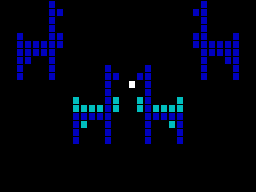
Producer: Llamasoft Memory Required: 48K Retail Price: £6.00 Language: Machine code Author: The Hairy One This program is certainly very different not only because of the instruction manual which contains such passages as 'Psychedelia was the realisation of that dream ... many evenings were spent freaking out to music and just DOING it' or 'Demos were given, minds were blown and a good time had by all'. Of course to the modern computer generation, the drugged dreams of the flower power, drop out hippy era probably seem as archaic as the Second World War. 'Psychedelia is a completely new way of enjoying your micro. If you love music, if you love graphics, if you are creative....' he even goes on to admit that Psychedelia is the high point of my designing career'. The hairy one certainly seems to have given it his all! The results can be spectacular, the opening screen gives a demonstration of what you might produce. Imagine, if you can, hundreds of tiny coloured squares dashing all over the screen, some run together, others collide, some move up while others move down or across this way and the other. Each square is one of a seven different colours, but it can change from one colour to the next while hurtling across the screen. Of course the you don't have to have coloured squares you can design shapes of your own by altering the pixels that make up a shape. Some of the easiest patterns to create would be star bursts or multi coloured spirals. The nearest visual analogy would be a highly coloured firework display, but of course Psychedelia is on a much smaller scale. The purpose of the program is for you to design your own light displays and it provides some quite powerful routines to help you do just that. Initially the program is set up with some basic parameters for creating built in effects, these are activated via the cursor keys and keys Q-R - press different combinations of these keys and that should show you enough to make you curious. The more advanced commands are divided into two parts, VARIABLES and OTHERS. In all there are nine variable commands. CURSOR SPEED simply alters the speed at which the squares move about the screen. PULSE WIDTH alters the speed with which burst of squares are sent across the screen. LINE WIDTH sets the width of pulse lines. The other commands perform much more complex tasks, far too complicated to describe here. When the user selects a variable to alter a little graduated bar appears at the bottom of the screen showing the value of the relevant variable. These values can be changed to suit your requirements, essentially finding the desired effects requires a great deal of trial and error but this is by far the most enjoyable method because one of the clever features of the package is the ability to alter the variable while the display is in full swing; better still by using the OTHER commands you are able to 'record' the patterns to memory as you alter the various parameters and eventually save the whole show to tape. About half an hour's worth of display can be saved for playback later, and that should be enough to blow anyone's mind! Finally the writer offers some good advice, he admits that the package sounds complicated to use but suggests that '...the best way to learn is by experimentation, play with the values to see what happens just like you would tinker with a synthesiser... freak out with it... Blow minds with it, freak out your granny. Be creative.' Uhm! COMMENTS Control keys: various inputs required - see manual Joystick: cursor type and most makes
Full-page ad9
- C&VG (Computer & Video Games) #41Mar 1985 · p.20
- Your Computer #3Mar 1985 · p.95
- C&VG (Computer & Video Games) #40Feb 1985 · p.38
- Popular Computing Weekly #6Feb 1985 · p.21
- Your Computer #2Feb 1985 · p.94
- Home Computing Weekly #94Jan 1985 · p.47
- Home Computing Weekly #92Dec 1984 · p.47
- Home Computing Weekly #93Dec 1984 · p.57
- Popular Computing Weekly #49Dec 1984 · p.50
News/Note3
- C&VG (Computer & Video Games) #41Mar 1985 · p.16
- Personal Computer Games #15Feb 1985 · p.10
- Popular Computing Weekly #49Dec 1984 · p.1
CoverGame1
- Crash #93Oct 1991 · p.9
Advert1
- Popular Computing Weekly #43Oct 1986 · p.18
Review1
- Popular Computing Weekly #8Feb 1985 · p.49
Related
- Compilations
- Crash issue 93: Presents 29
- Ports
- (MSX), (Commodore 64), (Amstrad CPC), (Commodore Plus/4)
- Same entry at
- Spectrum ComputingZXInfo
Reviews from people here
Sign in to write about this, or make an account. It takes a minute and lets you correct the catalogue too.
No tag recorded.
Sign in to correct or add to this.
Hold the rights to this and want it taken down?