
Psytraxx
Arcade Game: Action · ZX-Spectrum 48K · 1 players · English
The Edge · 1984 · Pound sterling 7.95
Discussion
Nobody has started a thread about this yet.
- Control Option
- Cursor, Interface 2 (right), Kempston Joystick
Play
- Psytraxx.z80.zipSnapshot image English26 KB
- Psytraxx.tzx.zipTape image English22 KB
Documents
- Psytraxx.txtInstructions English3 KB
- Psytraxx(EN).pdfInstructions English113 KB
Other files
- Psytraxx (1984)(The Edge).pokPOK pokes file 0 KB
Files and rights
No permission is on record either way. Screens and pictures are copied here on a take-down basis: if you hold the rights and want something removed, say so and it goes.
Credits
- Andrew Bealecredited
- Jack Wilkescredited
- David John RoweInlay/Poster Art
Sign in to credit somebody, or say what these people did.
Awards
Scores
In the magazines
- Crash #101984 · Overall69%
- Personal Computer Games #121984 · Overall8/10
- Personal Computer News #851984 · Overall8/10
- Your Sinclair #231987 · Psytraxx3/10
Elsewhere on the web
- WorldOfSpectrum 9 votes5.11
In the magazines 20
Your Spectrum #10Dec 1984 · p.632/5 MISS1/5 MISS3/5 MISS
Dave Nicholls 2/5 MISS
Roger Willis 1/5 MISS
Ross Holman 3/5 MISS
JOYSTICK JURY What's on your software shopping list for Christmas? Let Ross Holman, Dave Nicholls and Roger Willis help you make your mind up! This month, our motley crew of Joystick Jurors include Dave Nicholls, a self-confessed adventure fanatic and seasoned hacker; Ross Holman, ace games player and winner of the Jet Set Willy prize; and, last but by no means least, Roger Willis, a relative newcomer to the Spectrum scene. Dave and Ross you'll already know from our monthly major games reviews. Roger Willis, on the other hand, is probably more at home in the saddle of a massive motorbike... but that was before he discovered the thrills and spills of the Spectrum. Check out what they thought of the latest in games software... PSYTRAXX The Edge £7.95 Roger: A sample tape with hardly any instructions didn't increase the likelihood of my establishing instant rapport with this game. I'm still not completely sure what you're supposed to achieve and/or whether there arc hidden programming secrets that incompetence and general lack of Willis-interest failed to unlock. If my eyes haven't decieved me - which is always possible - the on-screen action occurs on a circuit board and involves the usual four-key control of movement plus the ability to zap any oppostion with what one can only assume are graphic attempts to represent electro-magnetic energy. I would call it a one-screen stand even though it's claimed to have over 1000! It's not that other screens didn't exist, they're just not that different. The graphics are abysmal - unclear and unoriginal. The screens seemed to suggest the programmer had defined a few characters at the most, and then used them around the edge. If your vocabulary in Basic is even smaller than your basic vocabulary, then it might just hold your interest for longer than it did mine, but I doubt it. I'm afraid 1 have to report that this is one of the most boring and overrated games I've had the misfortune to play since an old schoolfriend brought out his conkers!
Personal Computer News #85Nov 1984 · p.498/108/10
Overall 8/10
Bob Chappell 8/10
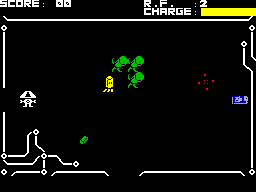
PRICE: £7.95 PUBLISHER: The Edge [redacted] Described as a mega game, Psytraxx boasts 1,000 screens of playing area, something unknown to the Spectrum. The hero is a small, dome-headed, pincer-handed robot who has been let loose inside a gigantic network of rooms - the 1000 screens. The entire network is supposed to be the internal circuitry of a tyrannical Emperor Robot who created and placed the microdroid there. Now the microdroid has decided to avenge his fellow oppressed druids. To complete his mission he must seek out the key program cards to deactivate forcefields, gain access to the CPU and pull the Emperor's plug. The game has a basic similarity to Berzerk - you have to move from chamber to chamber, dodging or firing at the inhabitants. Although the microdroid can move in any direction, he can only fire his tiny bolts to the left or right. The opposition turn out to be animated chips, transistors and sundry other computer components. Each of these appear first as dispersed molecules before forming into a more solid and mobile state. Contact with the enemy spells immediate loss of one of three lives. Each room has several obstructions and at least one exit. This may be blocked by a force field which can be deactivated by collecting program cards. Once an exit is used, the screen changes instantly to the next room. The microdroid can recharge his ever-draining batteries by passing over little green fuel cells. The graphics are colourful. If fairly simple, and the animation of the various enemies is neatly and humourously done (chips with moving legs!). The game theme can hardly be said to be original, but it has been implemented with style.
C&VG (Computer & Video Games) #37Nov 1984 · p.30
SOFTEK HAS THE EDGE Softek, the producers of the highly successful Quo Vadis? and Star Bike games, have changed their name. Following a large reshuffle in the company's employees and a change of direction in the company's approach to games production, the company has decided to rename its newly enlarged software development team, The Edge. Psytrazz is the first game published under the new label. It uses the software house's newly developed programming technique - "Synergy" which allows the programmer to incorporate over 100 different screens into a single Spectrum game. The original company, Softek International, has been split in to several different arms because of the increasing diversity of the firm's business. Psytrazz will be available at the beginning of October. It runs on the 48K Spectrum and costs £7.95.
Personal Computer Games #12Nov 1984 · p.72PCG Hit6/106/105/108/108/108/10
Personal Computer GamesPCG Hit
Graphics 6/10
Sound 6/10
Originality 5/10
Lasting Interest 8/10
Overall 8/10
Bob Wade 8/10
Chris Anderson
Martyn Smith
Peter Walker
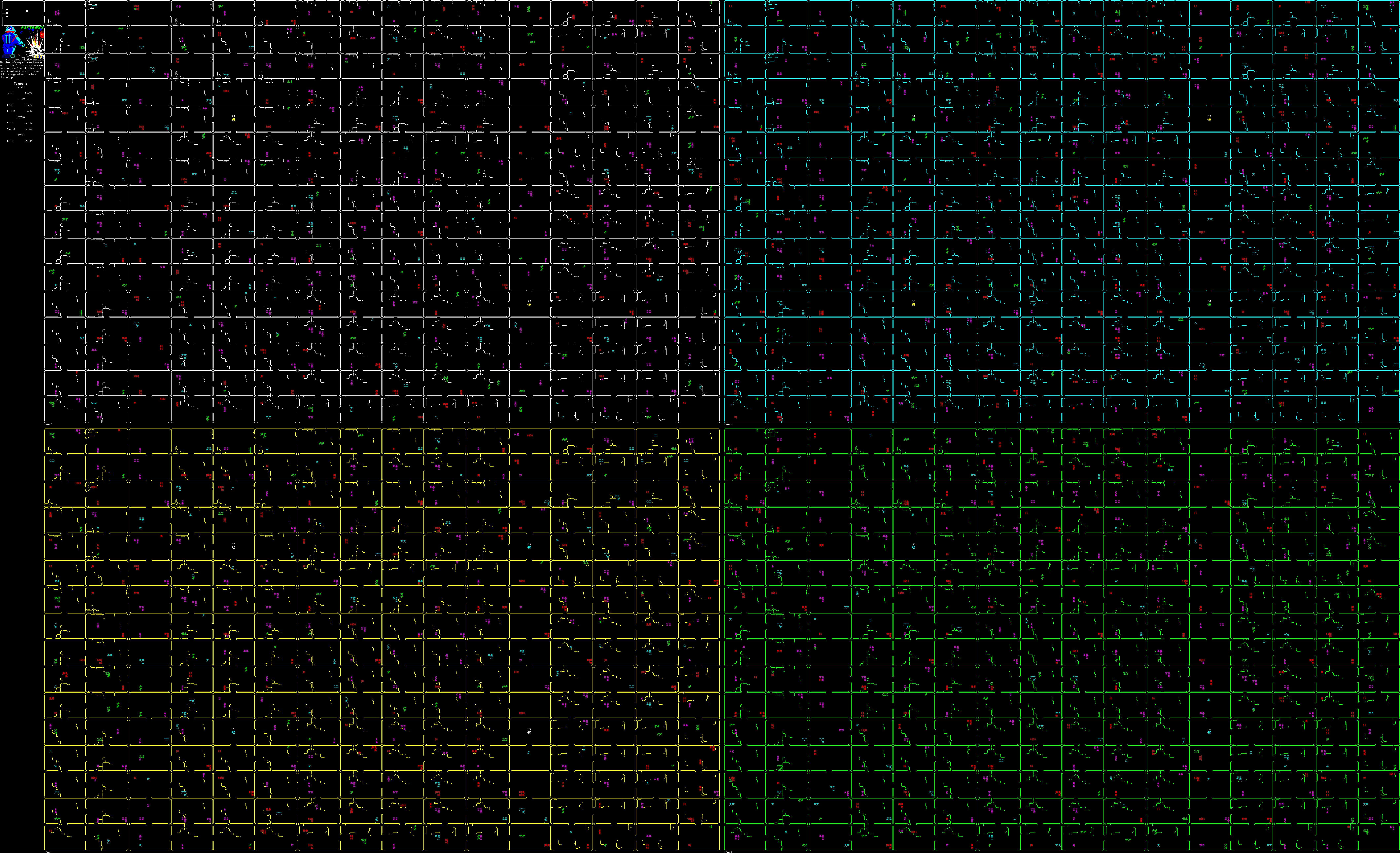
MACHINE: Spectrum 48K CONTROL: Keys, Kemp, Sinc FROM: The Edge, £7.95 BRAIN DRAIN CHALLENGE From the same stable as Quo Vadis comes another 1,000-screen arcade-adventure starring a microdroid called Psytraxx. Trapped in the confines of the Emperor robot's brain circuitry this rebel droid is trying to deactivate his master and free all the other enslaved components. You start your quest at the edge connector and have to find your way to the CPU and turn it off. Many problems and hundreds of rooms bar your way and a map will be essential in the long run. Each room is ringed by circuitry and contains components, some stationary and others which can move around. Contact with the circuits and electronics will deplete your energy in the form of your regeneration factor (RF). If you hit a bit of moving micro hardware you lose a life although to start with they are fairly easy to avoid. You can also shoot these with your electric sparks which only zap to your left and right and use up your RF as well. As you explore the rooms force field doors are encountered which can only be opened by the appropriate identity cards. These and several other objects can be found lying around for you to pick up. The doorways between rooms appear a tight fit for your droid at first, but they allow you to get through even if you don't hit them spot on. Some are partially blocked by other circuitry and a steady hand is needed to avoid RF losses. In nearly all the rooms there are green pills which replenish your RF, though they should be used as sparingly as possible. A keen eye is needed on this or you may find yourself with no energy and surrounded by hostile capacitors, resistors and diodes. There are four circuit boards and hence four different levels to explore. You can move between levels by way of 'OR' gates which are colour-coded appropriately. The main asset of the game is again size and hence the screens and characters are not that great to look at and there is no music or stunning sound effects. It is compulsive though as you explore and familiarize yourself with the layout, especially since the game gets tougher for every bit you solve. There is actually a real arcade feel to this game as you blast your way about and it's large enough and complicated enough to keep the old grey matter moving as well.
Psytraxx was programmed by 17-year-old Andrew Beale from Tolworth in Surrey. He wrote the game over a five-month period in between study for A-levels. Previous games for Softek include Microbot and Megapede.
Zany action with Psytraxx inside the Emperor's brain.
Crash #10Nov 1984 · p.1975%71%73%70%59%64%69%
Use of Computer 75%
Graphics 71%
Playability 73%
Getting Started 70%
Addictive Qualities 59%
Value For Money 64%
Overall 69%
Unknown
Unknown
Unknown
Producer: The Edge Memory Required: 48K Retail Price: £6.95 Language: Machine code Author: Andrew Beale Psytraxx is said by its producers to be the second true mega-game, the first having been their 64 game Quo Vadis? "Now Spectrum owners can experience the fruits of our unbelievable synergy programming techniques," says the PR. No one at CRASH is entirely sure just what 'synergy' is when it's at home, or how it makes Psytraxx different from any other similar game type; and in as much Starbike looks uncannily like Lunar Jetman, Psytraxx looks uncannily like Atic Atac. You have a very large number of rooms, a wandering and questing hero and numerous manifestations of monsters, plus useful items to pick up on the way. As in Atic Atac, it it up to the player to discover how to do what, and what to do with it when you've got it. Psytraxx takes place inside that ever popular location, a computer. You are in control of a Microdroid and the object is to do battle with the nuts and bolls of its innards (diodes, chips and the like) while trying to gain access to a CPU by collecting the Key Cards. To keep your spirits up there are little green blocks in each room visited that charge you up so you can fire at and destroy the nasties, although in each life, once eaten the cake is gone. There are only five rooms (all framed in printed circuitry) at the start that you can visit without problem since the last is blocked off by a purple and a blue force field over two exit doors. Collecting the key card a few rooms before, however, will gain you access to the next area which is much larger. The Edge claim that there are over 1060 screens to play through, and as our reviewers discovered, the game isn't as straightforward as it first seems. COMMENTS Control keys: A/Z up/down, O/P left/right, Q-T pick up and drop Joystick: Kempston, Sinclair, AGF, Protek Keyboard play: responsive 8-directional movement Use of colour: above average Graphics: reasonable size and detail, fast and fairly smooth Sound: useful beeps and some effects, otherwise not much Skill levels: 1 Lives: 3 Screens: over a 1000
A thousand plus rooms of connections and materialisations in PSYTRAXX.
All-Stars carries this game and has 4 references of its own.
Classix 1 carries this game and has 4 references of its own.
Review4
- Your Sinclair #23Nov 1987 · p.64
- MicroHobby #57Dec 1985 · p.14
- Home Computing Weekly #86Oct 1984 · p.14
- Popular Computing Weekly #40Oct 1984 · p.68
News/Note4
- Crash #12Jan 1985 · p.8
- C&VG (Computer & Video Games) #37Nov 1984 · p.30
- TV GamerOct 1984 · p.7
- Your Spectrum #8Oct 1984 · p.6
Tips3
- Crash #13Feb 1985 · p.68
- Popular Computing Weekly #3Jan 1985 · p.35
- Popular Computing Weekly #51Dec 1984 · p.48
Full-page ad3
- Personal Computer Games #13Dec 1984 · p.37
- Sinclair User #32Nov 1984 · p.87
- Personal Computer Games #12Nov 1984 · p.32
Map1
- Crash #13Feb 1985 · p.63
Related
- Tags
- Robots, Teleportation
- Elsewhere
- Speccy Screenshot MapsThe TipshopUVL
- Same entry at
- Spectrum ComputingZXInfo
Reviews from people here
Sign in to write about this, or make an account. It takes a minute and lets you correct the catalogue too.
No description recorded.
Sign in to correct or add to this.
Hold the rights to this and want it taken down?