
Quazatron
Arcade Game: Action · ZX-Spectrum 48K · 1 players · English
Hewson Consultants Ltd · Apr 1986 · Pound sterling 8.95
Also known as Ziggurat (English)
Quazatron, 1 of 2
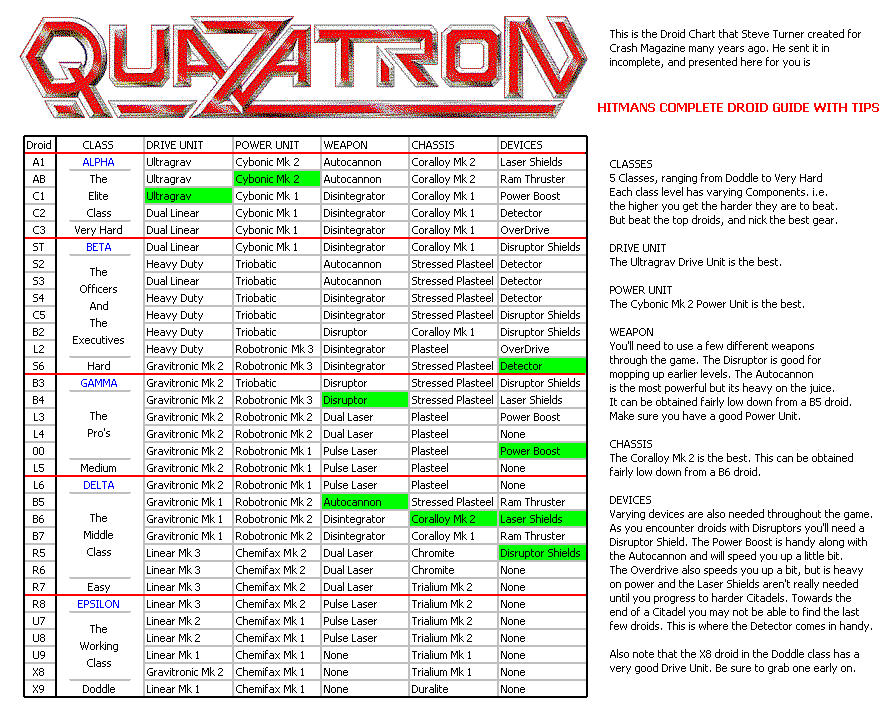
.jpg)
.jpg)
Discussion
Nobody has started a thread about this yet.
Remarks
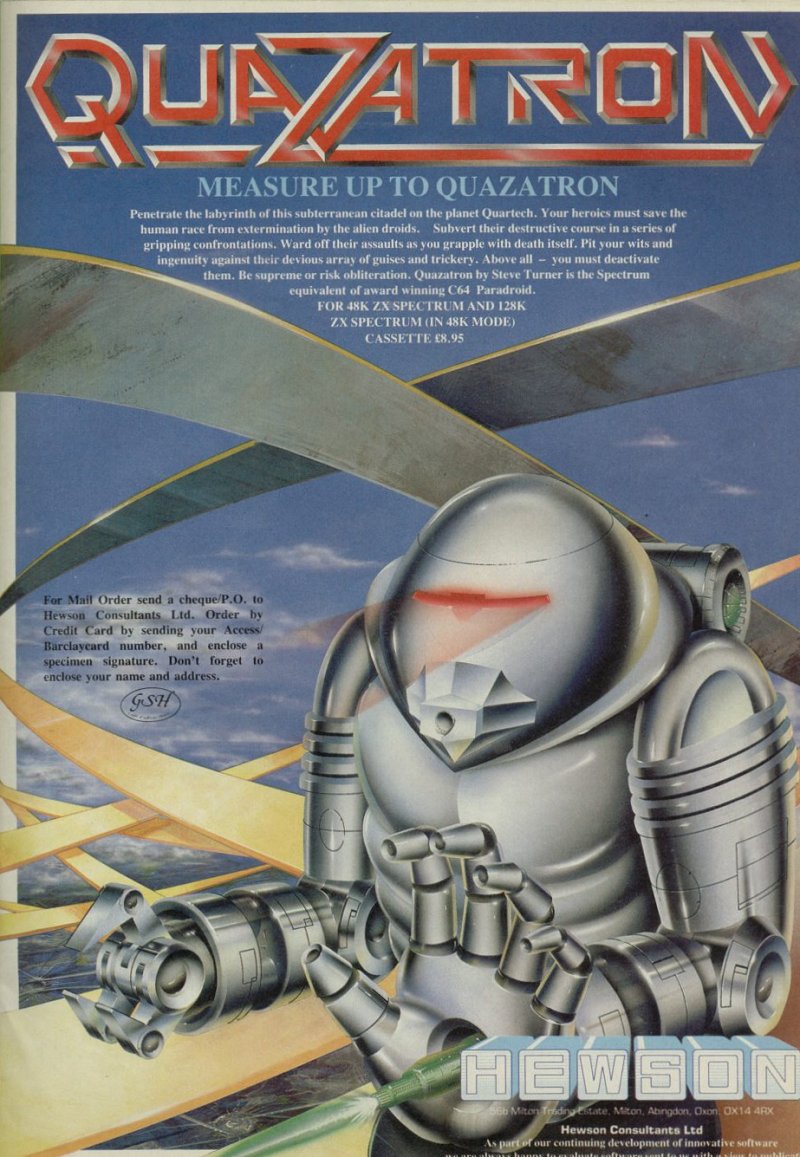
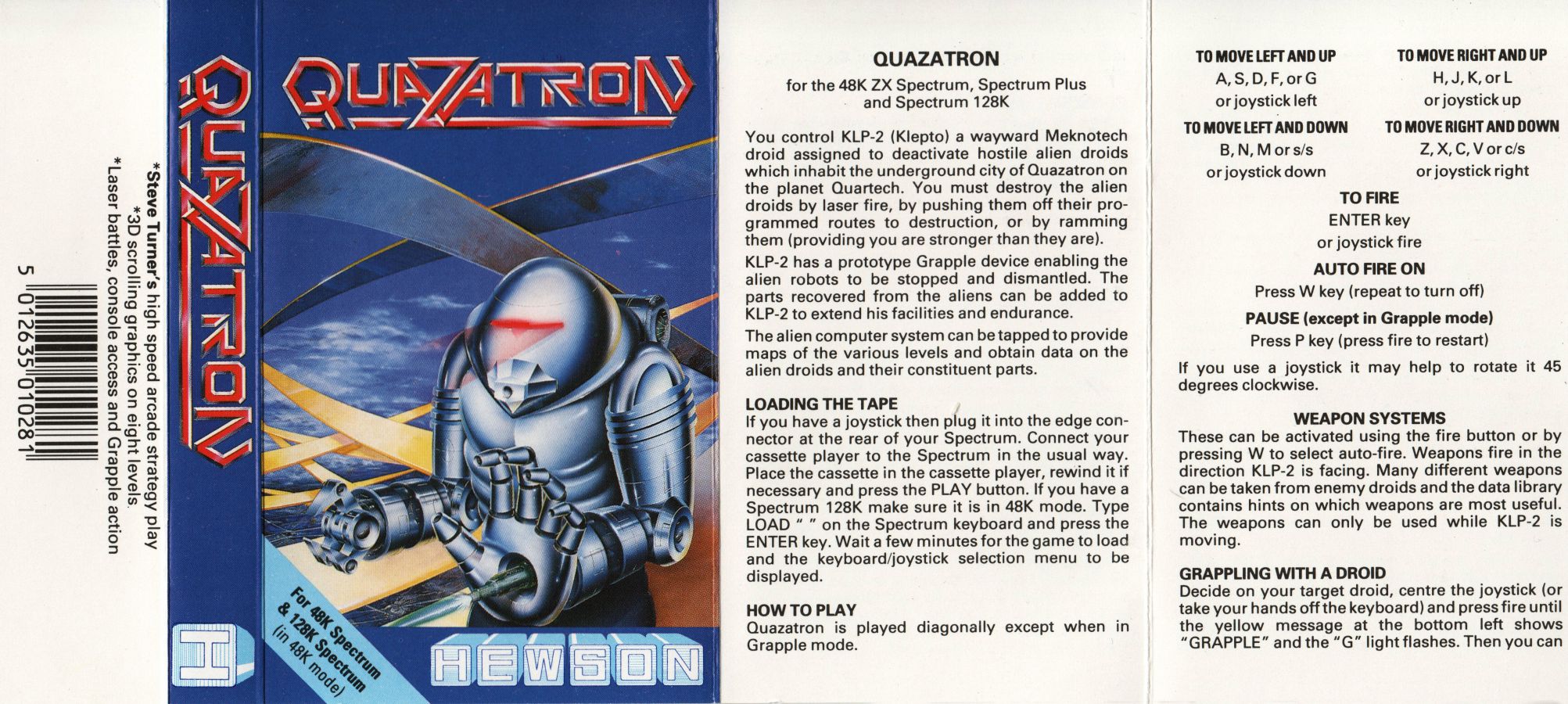
"Quazatron by Steve Turner is the Spectrum equivalent of award winning C64 Paradroid."
- Control Option
- Cursor, Interface 2 (right), Kempston Joystick
Releases
- 28 Apr 1986Hewson Consultants Ltd Sold as ZigguratPound sterling 8.95
- 1986Erbe Software S.A.
Play
- quaz.rzxRZX playback file
- Quazatron.tzx.zipTape image English20 KB
- Quazatron.tap.zipTape image English24 KB
- Quazatron(ErbeSoftwareS.A.).tzx.zipTape image English20 KB
Documents
- Quazatron.txtInstructions English11 KB
- Quazatron(ErbeSoftwareS.A.).pdfInstructions Spanish12 KB
Music
- Quazatron.ay.zipRipped in-game/theme music in AY format 2 KB
Other files
- Quazatron.zipGame map 136 KB
- Quazatron (1986)(Hewson Consultants).pokPOK pokes file 0 KB
Files and rights
Distribution permission is on record, granted to another archive rather than to this one. Screens and pictures are copied here; everything else links to the archive that holds it.
- AllowedHewson Consultants Ltd → WorldOfSpectrum
Credits
- Andrew BraybrookGame Design/Concept
- Steve Turnercredited
Sign in to credit somebody, or say what these people did.
Awards
Scores
In the magazines
- Sinclair User #501986 · Overall5/5
- Your Computer #51986 · Overall Rating5/5
- Your Sinclair #61986 · Overall9/10
- Crash #291986 · Overall94%
- Your Sinclair #191987 · Quazatron9/10
- Crash #511988 · Overall81%
Elsewhere on the web
- WorldOfSpectrum 384 votes8.50
Awards and competitions
Crash Readers Awards 1986
- 4Best Game Overall
- 5Best Sound FX
In the magazines 56
Crash2018 · p.57
Chris Wilkins
Ryan Coleman
As the Crash annuals are still for sale ZXSR has taken the decision to remove all review text, apart from reviewer names and scores from the database. A backup has been taken of the review text which is stored offsite. The review text will not be included without the express permission of the Annuals editorial team/owners.
Crash #51Apr 1988 · p.8581%81%
Overall 81%
Will Brooker 81%
LOOKING FOR AN OLD ANGLE From Ultimate's classics to the cute and quirky Head Over Heels, we've had our arcade adventures in the strange 3-D of isometric perspective. But, says WILL BROOKER, some of those first tentative steps in the new dimension work better than today's glossy games. Way, way back when Hungry Horace was still a national hero, 3D Ant Attack sneaked out under the Quicksilva label. Its Softsolid graphics of the walled desert city Antescher were hailed as astounding, and 3D Ant Attack wedged itself firmly into Spectrum history as the first game with truly three-dimensional views. The next isometric blockbuster was Vortex's Android 2, released in the spring of 1984. In gameplay it's just a 3-D version of the old arcade game Berserk, but the graphics (which CRASH gave 96%) brought it up to this magazine's Game Of The Month standard. Programmer Costa Panayi followed this up with the impressive TLL - a fighter-plane simulation with a carefully worked-out dynamic playing area. There's not a lot of game behind it, but the flying is enough. The Softsolid technique was soon followed by the first 3-D 'adventure movie' - Hewson Consultants' The Legend Of Avalon. Its adventure element is a bit dubious, and the term 'arcade adventure' would be disputed for years after its release, but the game was a great success with its colourful, pseudoisometric graphics. In 1985 the spate of high-quality isometric games continued: Ultimate's classic Knight Lore was followed by another Vortex game, Highway Encounter, and the next technical advance was Filmation 2. An Ultimate invention, this allows graphics of Knight Lore's quality to be scrolled smoothly over a large playing area. Filmation 2 was used for Ultimate's Nightshade, but was soon knocked into a cocked hat by The Edge's Fairlight. Even back in the golden year of 1986 there were unimaginative clones which sometimes threatened to swamp all the review pages with their identical, and by then extremely boring, isometric screens. But some games brought a breath of fresh air to the already tired genre: the humorous Sweevo's World from Gargoyle Games, Ocean's surprise hit M.O.V.I.E, and Hewson's Quazatron. A Spectrum version of the Commodore 64 hit Paradroid, Quazatron amazed everyone by being superior to the original. Not so original but also well-implemented was Ocean's Batman, and Quicksilva's Glider Rider deserves a mention along with Design Design's Rogue Trooper for taking a gamble and nearly succeeding. Last year Ocean had a megahit with Head Over Heels, M.A.D. had a budget Smash with Amaurote, and Gargoyle brought out the first (and probably last) Hydromation game, Hydrofool - the sequel to Sweevo's World. CRL's 3D Gamemaker utility now enables everyone to rewrite Knight Lore, and last November saw the first real isometric adventure, Incentive's Karyssia. Of course, whether isometric perspective presents a 'true' 3-D view is arguable - the player in these games is 'positioned'somewhere up in the air, outside the playing area, so any game using the technique looks forced, like a technical drawing. Though its representation of object and rooms may be highly effective, if we're going to nit-pick we can't say isometric perspective gives a realistic view. But the technique has proved perfectly satisfactory for countless games, and it's pointless to damn them all for lack of realism. More significantly, it will be interesting to see if the market for isometric graphics ever dries up, and if the public will one day reject the genre as outdated and overused, just as it once refused to accept any more Pacman clones. 3D ANT ATTACK Quicksilva 87% Issue 1 'One day, one year, one hour,'says the introduction. He and She arrived in the walled city of Antescher, 'the signature of a long dead race, the city lost from the world of men for days without number'. But the Ants of Antescher now have your partner (either He or She - unfortunately, this admirably nonsexist feature is undermined by the program's always calling you a 'hero'), and your job is to rescue him or her with the help of some heavy-duty grenades. Complete one level and the foolish girl (or boy) goes and gets herself (or himself) captured again, but this time further away from the starting position. Well, that's life... Back in late 1983 when nobody worried about glaring white backgrounds, UDG-sized graphics and poor sound, 3D Ant Attack was a wonder to behold. But even if you overlook these faults the fact remains that there isn't much gameplay, and what there is soon grows repetitive. Next to modern software, 3D Ant Attack looks rather dismal. TLL Vortex 81% Issue 7 TLL involves navigating a landscape sprinkled with houses, pylons, cliffs and bridges in order to eliminate 'enemy dots'. This top-priority procedure (you don't know how dangerous enemy dots can be if you let them get out of hand) is carried out by swooping low over the ground (hence the title - Tornado Low Level). You always run the risk of crumping your fighter against an obstacle, and once five of the dastardly dots have been wiped out a new mission begins - it's on the same landscape, but this time those devils are hiding below bridges and in the water and all sorts of underhand places. TLL was seen as a masterpiece when it first appeared, and its appeal has hardly diminished since. The landscape is described in effective, clean washes of colour and the fighter is well-drawn, rotating smoothly. The whole thing handles really well and though destroying evil dots is a bit of an artificial exercise the dynamics of the game come together perfectly. Perhaps more a simulation than an arcade game, TLL would, I'm sure, still do well at a budget price. HEAD OVER HEELS Ocean 97% Issue 39 'The best Ritman/Drummond game yet - it's even better than Batman!' said Crash. We read on: 'cuddly',' cute'. I agree; and that's probably what puts me off Head Over Heels. I can do without poisonous Marmite jars, stuffed rabbits, reincarnation fish and doughnuts, especially when their purpose in the game bears no relation to their appearance (why should stuffed rabbits give you extra abilities?). The scenario is unoriginal (two spies from the planet Freedom are out to destroy the Evil Empire), and the graphics look like something you see on early-teatime children's ITV (not that I watch it). Yes, they're detailed and well-animated; yes, they're cute if you like that sort of thing; but there's nothing to link them all together. As isometric arcade adventures go this is probably the best of its kind - there are lots of features, and the graphics are technically the best yet - but no way is it 'the ultimate game'. I like mine a little less silly and with a lot more logic behind them. KNIGHTLORE Ultimate 94% Issue 12 'Sheer perfection,' enthused the anonymous CRASH reviewers of way back at the sight of Knight Lore's Filmation graphics. The Filmation technique allows your sprite to physically interact with onscreen objects in almost any way, and with Knight Lore, the tenuously-related sequel to Underwurlde and Sabre Wulf, Ultimate's programmers surpassed themselves. In this thrilling instalment Sabreman (the player) must brave the castle of the wizard Melkhior to find the ingredients of the potion that will cure his sudden lycanthropy (Ultimate's instructions take the form of an epic poem, but manage to say nearly the same thing). Fail, and you must remain the werewolf forever - but so what? He's a dam sight cuter than Sabreman. Melkhior's castle is divided into rooms full of traps, structures and useful objects, all of which can be manoeuvred using Filmation. The avalanche of isometric games in this style has lessened the impact of Knight Lore's graphics. Today they seem rather plain and simple, though the old Ultimate touches still stand out (the sprite looking warily over his shoulder, for example). The game itself is a little unsophisticated for our times, too: essentially it's just a set of Manic Miner-type problems of timing, jumping and avoiding, and Filmation only comes in useful for making higher leaps. Still, Knight Lore deserves some recognition for having started off the isometric-arcade-adventure genre proper - it's just a pay the subsequent deluge was so heavy. BATMAN Ocean 93% Issue 28 Crash's Overall comment described this as 'a neatly finished game which does Batman proud'. But Ocean took all the Batman mythos and promptly forgot about it in an (admittedly commercially successful) attempt to cash in on Alien 8 etc - this game has nothing to do with Batman. Even the main character graphic shows a squat little figure who looks more like a Smurf than the Caped Crusader. And the Batcave has become some sort of architectural monstrosity furnished with conveyor belts and spiked floors and populated by creatures ranging from puppy dogs to lion-headed mutants. Maybe he's had it redone, but it never looked that way in the comics, the TV series, the films and the graphic novels. All that aside, Batman is quite a good game. The graphics and animation are superior to Ultimate's, and the Bat Devices and Batpills which give Fatman extra abilities add interest to the gameplay. In fact, leave out the pseudoBatman scenario and title and I'm quite content with this. NIGHTSHADE Ultimate 91% Issue 21 Nightshade just scraped into the Smash bracket, and the autumn 1985 release is now generally considered to have marked the beginning of the end for the former masters of Spectrum software at Ultimate. The gameplay is similar to Atic Atac's: wandering around the playing area (in this case a medieval town) destroying materialising nasties and collecting 'super antibodies' to kill off the four major villains. But the real star of Nightshade is the Filmation 2 technique, which scrolls the highly - detailed buildings about and lets you effectively see through the walls in a cut-away view whenever you pass behind them. It's become a cliche that 'the trouble with Ultimate's games is that they have great graphics but no game bolted on', but in this case it's undeniably true. Though the pseudomedieval atmosphere is strong and the characters are well-animated, Nightshade is extremely boring. It eventually bolls down to searching in vain for the major villains, just for the dubious thrill of getting killed by them instead of by lesser monsters for a change. HIGHWAY ENCOUNTER Vortex 95% Issue 20 You're a lone Vorton droid, pushing a highly brainfrying explosive device to the far end of an alien highway to blow up an enemy base. The road is populated by various aliens resembling anglepoise lamps and other dangerous household items (I gave them all names once but that was ages ago), and floating mines weave across the tarmac in dances of death. Your only strategy is to block up or kill off the nasties on your first run, and then go back to get your slave droids and the bomb. Highway Encounter's graphics are still impressive today; as in TLL, the combination of flat background colour and detailed monochrome overlays works very effectively. All the roadside scenery is beautifully drawn, from the crops in the fields to the golden sands of the beach. The only trouble with the game is its difficulty. I still wonder at Crash's comment of the time 'it will be easy to complete and I will probably get bored with it' - after 2.5 years I still can't clear the 30 zones and get the bomb to its destination within the time limit. But Highway Encounter looks great (better, in fact, than it s sequel - Vortex's Alien Highway, 88%/Issue 29) and would probably still sell as a budget game. QUAZATRON Hewson 94% Issue 29 As Klepto, a psychotic young droid with a penchant for taking things apart, you have been volunteered to get the mutant droids out of Quazatron, a multilevelled underground citadel of ramps and lifts. Klepto starts with a measly pulse laser but can collect extra weaponry by ramming other droids and entering a grapple sequence - really a subgame. A test of strategy and reflexes decides who wins the grappling duel. If you successfully grapple another droid you can take any available weapons; if you lose, the consequences are usually fatal. As you upgrade your weapons you can take on ever more powerful opponents, till you become the top dog -and then it's time to move on to the next citadel. 'Quazatron is a true masterpiece,' said Crash at the time, and the comment is still valid. Apart from the rather jerky scrolling everything is faultless: the graphics, the music, the FX and the gameplay. Quazatron is a successful fusion of strategy and arcade and deserves all the recognition it's had. ROGUE TROOPER Piranha 79% Issue 36 This licence is based on the early Rogue trooper stories from the comic 2000AD. Rogue is, as usual, trudging around Nu Earth, this time looking for the eight vid-tapes which show how the Traitor organised the destruction of the rest of the GIs (you have to know the strip to follow the scenario, really). Nu Earth, which seems to have shrunk a little in conversion from comic to computer, is patrolled by Norts and littered with ammo, med-packs - and, of course, the tapes. And Rogue's biochipped buddies Gunnar, Helm and Bagman give onscreen advice which isn't always particularly useful (Gunnar rarely says anything more inspiring than 'Let's grease some more Nort scum'). When all the evidence has been collected Rogue can return to the shuttle and wait for Cam Kennedy to draw him some more identical stories (oops! that just slipped out). Despite the extremely tacky presentation, this is an enjoyable game. It's not hard to win, which may put some off, but it provides relaxing therapy when you need your confidence boosted a little. The graphics are detailed, varied and recognisable, and though the colour washes are used simply they add interest. Perhaps Rogue Trooper's strongest point is the atmosphere generated by the graphics and the comments; it is, surprisingly, the most faithful 2000A0 conversion yet.
Successful fusion: there are strategy and arcade elements to grapple with in Quazatron.
C&VG (Computer & Video Games) #56Jun 1986 · p.14C+VG Hit8/108/109/1010/10
C&VG (Computer & Video Games)C+VG Hit
Graphics 8/10
Sound 8/10
Value 9/10
Playability 10/10
MACHINE: Spectrum 48/128 SUPPLIER: Hewson PRICE: £8.95 Well, it looks like Hewsons have done it again. Got a number one on their hands, that is! After Uridium comes Quazatron from Steve Turner, the Dragontorc man. Quazatron is quite a departure from Steve's previous games - it's more arcade oriented than his earlier offerings for a start and it's guaranteed free of wizards! If you've played Paradroid on the 64 by Steve's mate Andrew Braybrook, you'll recognise the basic idea of the game. In fact Steve set out to create Paradroid on the Spectrum. But don't think this is just a copy - far from it. Quazatron features some neat 3D Marble Madness/Gyroscope style pyramids for a start. BUt let's take a look at the scenario. You find yourself in the subterranean city of Quazatron the planet Quartech, home of the Daglath, a droid culture dedicated to the domination and elimination of us humans. The smooth-running of the city is in the mechanised hands of a number of battalions of Battle Droids, Service, Robots and Repair Mobiles who trundle around the ramps and pyramids of the many levels of the city in execution of their mysterious duties. Unknown to the Logic Robots, who control Quazatron, the city has been targeted for subversive attack by a human controlled Meknotech droid. You control KLP-2 (Klepto) the wayward Meknotech droid assigned to deactivate hostile alien droids which inhabit the underground city of Quazatron. KLP-2 is a prototype grapple device enabling the alien robots to be stopped and dismantled. Klepto can add the parts recovered from the aliens himself - his facilities and endurance. Each alien Droid has a range of equipment at its disposal - lasers, disruptors, shields and ram thrusters. Klepto must destroy these Droids in a laser battle or by dismantling his opponent piece by piece. Anti-tamper and other security devices make grappling at close quarters a difficult procedure. BUt the reward for success if the pick of the hardware removed from the vanquished Droid. Intelligence reports on the strength and disposition of the enemy can be obtained from control consoles of the Logic Robots also dotted around the complex. Travel around the city is by means of elevated ramps with lifts to links the various levels. Both of these units can be activated using the fire button. Many different weapons can be taken from enemy droids and the data library contains hints on which weapons are most useful. Weapons can only be used while KLP-2 is moving. To successfully grapple with a droid you must engage its security circuit. This is the sub game first seen in Paradroid. To change levels within the city complex you must find a lift square. Press your fire button and a side view of the city is displayed. Move up/down to the required level and left to right exit the lift. Enemy logic robot control consoles are useful tools. They are easy to locate as they look just like blank TV screens dotted around the map. Your energy is shown by the rotation of the head of the KLP-2. His expression changes from happy to upset as he runs out energy. Quazatron is one of those games you start playing at lunchtime and still be at it at midnight! Addictive isn't the word. The combination of strategy and arcade action will have you hooked instantly.
Crash #29Jun 1986 · p.136Crash Smash94%93%93%89%93%93%94%
Use of Computer 94%
Graphics 93%
Playability 93%
Getting Started 89%
Addictive Qualities 93%
Value For Money 93%
Overall 94%
Unknown
Unknown
Unknown
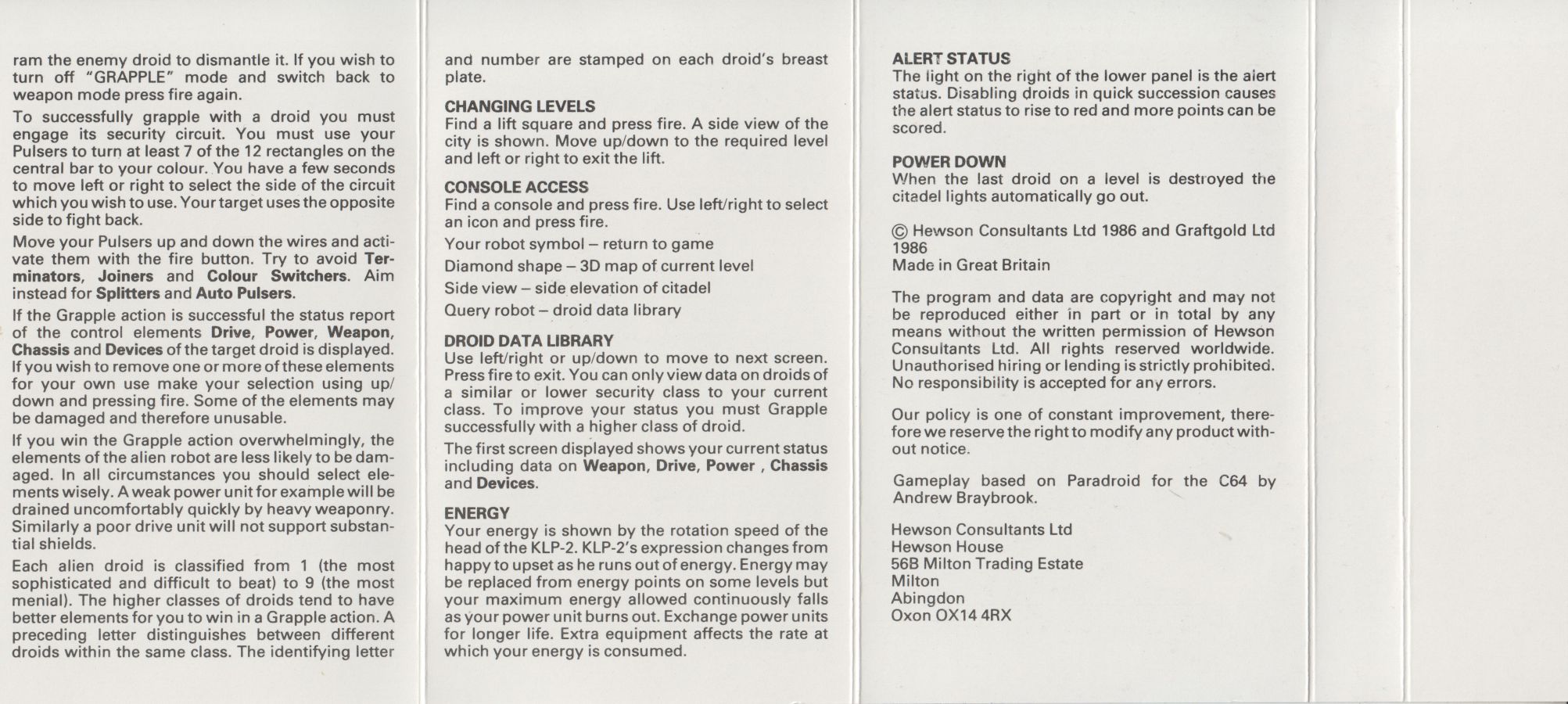
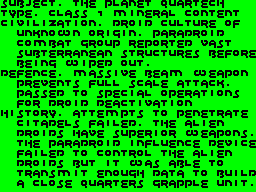
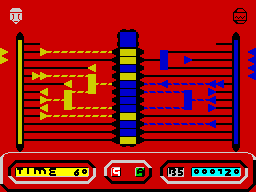
Producer: Hewsons Retail Price: £8.95 Author: Steve Turner The underground citadel of Quazatron is run by an evil cult of mutant droids, hell-bent on destroying the human race. Sob, whimper. But... do not despair, help is at hand in the form of KLP2, a psychotic Meknotech droid. Klepto, as he is known, is a droid with A Past. In his youth he was exposed to a rare form of radiation which induced a type of droid madness. His persistent habit of dismantling everything mechanical in sight has landed him in serious trouble - he was expelled from droid school for demolishing his teacher. Despite painstaking re-programming, he remains a liability, but now he has a chance to prove his worth by eliminating the alien droids from the planet Quartech. The droids patrolling the levels of Quazatron are pretty tough cookies, graded in security classes from one (very tough) to nine. They have some deadly weapons systems, and are virtually invincible - all previous attacks on the citadel failed. Now a new grappling system has been developed for droid-to-droid combat, and on account of his anti-social disposition Klepto has been chosen to test the prototype in a combat situation. He is expendable, after all! At the start of the game Klepto is transported to the underground citadel of Quazatron. He must trundle about locating the enemy droids, dismantling them, pushing them off their programmed courses or blasting them to smithereens with his laser. Quazatron can be approached in two ways: on one level it is a shoot em up - destroy all the enemy droids and you win; but a wealth of strategical gameplay lurks below the surface. Whenever Klepto uses the prototype grappling system successfully, and overcomes an alien droid, his penchant for taking things to bits allows him to scavenge droid parts and upgrade himself. Klepto toddles up and down ramps looking for droids to scrap with. Ramming into a patrolling droid allows Klepto to use the grappling system, which breaks into the enemy droid's circuits: the fight is on. The grapple system in the game has been adapted from Hewson's Commodore game, Paradroid, and the aim is to win control of as many of the central bars on the grapple screen as you can. Using pulsers which are fired into the circuits, you must turn at least seven of the twelve central bars on the screen to your colour to win - the more bars you control at the end of the time limit, the more resounding the victory and the less damage done to the alien droid's systems. If the grapple is won, Klepto can help himself to his victim's undamaged components - including the drive unit, weapon system, power unit, chassis and any other special devices that may be present. He's a regular robotic carrion collector is Klepto. The lowest class of alien droid, Class 9, is relatively easy to outgrapple, but the goodies that can be scavenged from its hulk are not as attractive as those found on higher class droids. Care should be taken when choosing which parts to take from a vanquished opponent - it's all very well pinching a super dooper weapon system for instance, but if Klepto has a wimpy power unit then it'll rapidly be drained by the demands made on it by the new equipment. Computer consoles scattered around the cityscape can be used to pick up information that comes in very handy when taking a strategic approach to the game. Trundling up to a terminal and pressing fire logs Klepto on to the system and calls up an icon menu from which a map of the current level of the city, a plan of the entire city and the droid data library can be called up. The data library displays Klepto's current status, and lists the weapon, drive, power unit, chassis and devices currently installed. Details of the equipment to be found on enemy droids in the same or lower security classes as Klepto may be called up - vital for planning a rational upgrade path. Travel between city levels is effected by moving Klepto onto a lift square set in the rampway and pressing fire - a plan view of the city comes onto the screen and Klepto can whizz up or down the lift shaft he is in. All this grappling and zooming round drains Klepto's energy - and if his power unit is low-grade compared to the weapon systems or chassis that hs been gained by grappling, then the power drain is all the more rapid. Klepto's power unit can be recharged by moving onto power squares found on some levels, but points are lost for each recharge. As a power unit runs down, the amount of charge it can hold reduces. Eventually a new unit will have to be grappled from an alien if Klepto is to survive. The city's rampways are displayed in a scrolling window on the screen in 3D perspective. Klepto moves around the diagonals of the playing area, and can only fire his weapon system while he's on the move and in weapon mode as opposed to grapple mode. Klepto's energy status is revealed by the speed at which his head rotates - when he's fully charged it whizzes round and a smile covers his countenance. As his power reserves dwindle, Klepto begins to look glum. Only one life is supplied in the game, so the aim is to keep Klepto smiling. Get grappling! COMMENTS Control keys: A,S,D,F,G left and up, H,J,K,L right and up, B,N,M,SYM SHIFT left and down, Z,X,C,V,CAPS SHIFT right and down, ENTER to fire, W to toggle autofire, P to pause Joystick: Kempston, Cursor, Interface Keyboard play: straightforward and responsive Use of colour: attractive Graphics: detailed, with cunning 3D but a little slow to scroll Sound: first rate Skill levels: one Screens: multilevel scrolling city
CONSOLES Log onto one and call up vital information on the city, its droids and, of course, yourself...
Interfacing with a comsole allows Klepto to call up a plan view of the current city level.
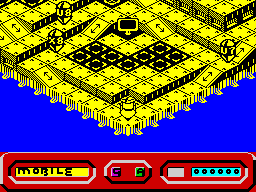
Klepto gets close to U8 droid on a yellow city level.
POWER POINTS Klepto can recharge his flagging batteries and put the smile back on his face by trundling over one of these.
The edges of the city known as Quazatron hang out into space - mind you don't fall off!
The grapple screen. The aim of the sub-game is win as many of the central colours over to your side as you can in the few seconds available.
The plan view of the city levels that pops onto the display when Klepto uses a lift.
ZX Computing #26Jun 1986 · p.50ZX Computing Monster Hit
ZX ComputingZX Computing Monster Hit
HEWSON'S NEW DROIDATHON SPARKS OFF THE SUPERLATIVES Hewson £8.95 One surefire test of a compulsive game is whether you are tempted to go back and play it while you are writing the review and I can assure you that I'm fighting like mad to resist it. Quazatron is set in the multi-levelled city of the same name on the planet Quartech. You are in control of a Meknotech droid who must eliminate a whole horde of enemy droids who inhabit the underground complex. There's nothing startling about the basic idea but the way it is developed and the number of additional features built into it make Quazatron a real joy to play. There are eight levels to the city and almost as many levels of enjoyment. You can choose to treat the game as a straight shoot 'em up or try it as an exercise in strategy. You can of course opt to laser every droid in sight but there is more than one way to skin a robot. Different classes of robot have varying strength levels and component parts - you can ram them, push them off ramps or engage in "grapple mode". When grapple mode is engaged by putting the joystick into the central position and pressing fire you can move in on a vulnerable droid and dismantle him, saving for yourself weaponry, chassis and other elements you want to incorporate into your robot. Each enemy droid has a defensive security circuit so that each time you go for grapple mode you are transferred to a sub-game. You are given a limited number of "pulsers" to fire at a central bar to turn it to your chosen colour. Not as simple as it sounds as you have a few seconds to decide which side of the bar you want to fire from. Once you've chosen, your target droid will be firing from the other side. The game is complicated by junction boxes and obstacles that prevent you having a free shot at the bar. If you succeed in hitting at least seven of the 12 sections of the bar you are presented with a status report on your victim. A careful choice is needed here as different elements are required to tackle the more sophisticated droids later in the game. If the grapple mode sub-game has been deadlocked requiring one or more rematches the target droid may be severely damaged and have no elements that you can incorporate, so a swift first time victory is essential. The droids are numbered from one to nine, the higher the number the easier it is to grapple successfully. The letters which are stamped on the droids refer to their function. You can recharge your droid (KLP-2) from power points on the various levels. Your energy can be measured from the speed of rotation of the droid's cap. Every now and then a face emerges from under the cap to give you a smile or a frown depending on the state of the game. If you have a energy crisis the word 'power' will appear on the display at the bottom of the screen. If that happens it's time for a high speed visit to the nearest power point or, if possible, grapple a droid to steal a new power unit. Although you start with a single life grappling successfully will gain you an extra life so it is advisable to come to grips with grappling early on. Scattered around the city are consoles which will give you valuable information. Once accessed you are presented with four icons giving a 3D map of the city, a side on view of the levels, information from the Droid Data Library and a return to game option. The facts from the library will give you the lowdown on droids which have a similar or lesser status to your own but it is useful to find out which have the vital elements to build your best droid. Success in this game is all down to skilfull grappling, knowing which droid is beatable and what they have that can be cannibalised for your own robot. The best strategy is to go for droids which are close to your current class number. As most of the droids movements are diagonal it can be tricky to master the steering at first but unlike a lot of games with a joystick option, keyboard control can be as easy and effective. The scenario of the game, with its various ramps, ledges and levels is sufficiently complex to entice you back again and again, the gameplay is truly addictive and the graphics are excellent. Without reservations a Monster Hit and a game that will give the term "grappling fan" an entirely new meaning.
Looking over the potential prey: Facts from the Droid Data Library on an R6 Repair Robot.
Steve Turner
Your droid KLP-2 advancing through the multi-level terrain.
After six months grappling with the code, programmer Steve Turner, author of Avalon, Dragontorc and Astroclone is finally getting hooked on his latest creation Quazatron. "After finishing a game you just don't want to see the code again but after a while it seems fresh and now I'm trying to crack the game. The way I program the game only materialises in the last month and up until the last few weeks before the game was complete I was still working with test graphics. It's always good to see the way it all comes together at the end. I've heard a lot of people say that it takes about two months to produce a top notch game. For me because I do everything myself, from the graphics to the sound, it takes me six months to get a game just right" Steve works in the same room as another Hewson programmer, Andrew Braybrook, whose game Paradroid for the C64 provided the inspiration for the gameplay in Quazatron. "Obviously there is a good crossover of ideas and designing of games is largely a joint effort. With Quazatron I wanted to break away from the usual arcade or arcade/adventure type game. Paradroid is a clear influence but the graphics are inspired partly by Marble Madness and partly by Alien 8 with the use of multilayered graphics. I wanted to build up a 3D scenario with different levels and create a huge tower but give if an unusual look by viewing it from a diagonal angle." The music which features at the beginning of the game is surprisingly complex for the Spectrum considering its one channel limitation. "Everyone knows that the sound on the Spectrum is woefully inadequate but I managed to develop some interrupt and sound routines which mean that you can get some variations in phase and frequency." Steve has only a single quibble about Quazatron. "There's just one thing about it I don't like and that's the lack of a scrolling capability but it's turned out okay in the end."
Your Sinclair #6Jun 1986 · p.61Your Sinclair Hot Shot9/109/109/1010/109/109/10
Your SinclairYour Sinclair Hot Shot
Graphics 9/10
Playability 9/10
Value For Money 9/10
Addictiveness 10/10
Overall 9/10
Phil South 9/10
Hewson £8.95 Reviewer: Phil South You might as well ignore the fact that this game is supposed to be the Spectrum version of a 64 game called Paradroid. I mean, it's a whole different bailgame. Er, that's just a figure of speech, it's not a ball game... The plot, for those of you wise enough not to have played the 64 version, revolves around a certain little droid called KLP-2, aka Klepto, assigned to deactivate the armies of hostile alien droids that inhabit the underground city of Quazatron. Klepto disables the droids either by blasting them to their component atoms (crude but effective), pushing them off thew programmed routes, ramming them if he's strong enough, or by 'grappling'. This is a process by which you take over the grappled droid's mind at circuit level, switching gates in his circuits until he relinquishes control. It's totally brilliant! By far the most original scenario to pass before my eyes, and certainly the greatest all-round challenge. Don't get me wrong, I like games that involve blasting things to bits, but as well as the thrill of destruction I like a bit at strategy thrown in. Partly to justify my interest in wanton havoc, but also because it's nice to play a game that stretches more than your joystick. I like to be stretched all over... but then I'm a bit pervy.
Your Computer #5May 1986 · p.185/53/54/54/55/5
Graphics 5/5
Sound 3/5
Playability 4/5
Value For Money 4/5
Overall Rating 5/5
Spectrum Hewson Consultants Shoot-'em-up £8.95 Remember Paradroid? The stunning original arcade game that made Andrew Braybrook a name spoken in hushed tones at every computer club. Well this is better! Steve Turner, author of Avalon, Dragontorc and Astro-Clone, has taken Andrew's idea, added some nice graphics, tweaked the plot and produced a game which will have arcade and strategy fans alike beating a path to Hewson's door. You start off a humble, menial robot in the city of Quazatron, which is swarming with enemy robots of varying degrees of lethality. Your job is to wipe them out. This is no simple arcade game. You can have reflexes so sharp they hurt, and you still won't win. The idea is not only to blast away, but to get in close and "grapple" with the enemy. You then move on to a takeover screen, which is a battle to outwit the enemy robot by invading his logic circuits. Once again, Hewson have set the standard that others must follow.
Sinclair User #50May 1986 · p.24Sinclair User Classic5/55/5
Sinclair UserSinclair User Classic
Overall 5/5
Chris Bourne 5/5
Publisher: Hewson Programmer: Steve Turner Price: £8.95 Memory: 48K Joystick: Kempston, Sinclair, Cursor Here come the Droids! Scores of them, deadly in combat, of every rank and class - medic droids, logic droids, security droids, command droids, repair droids. From the lowly menials to the deadly battle cyborg, they inhabit Quazatron - underground technopolis of Quartech. Then there's you, KLP-2, the most famous bot in the galaxy. Accidentally, while training as a droid mechanic, you dismantled your teacher. After that things went from bad to worse. A highly developed ability to take things to pieces led you to a posting at the end of Empire, where you redeemed yourself by dismantling the left leg of Mandroid, the space pirate. Now you're a public hero. And now, because of your fame, you've been sent to Quartech to dismantle, destroy, or otherwise demoralise the alien droids of Quazatron. This latest game from the gifted mind of Steve Turner, programmer of Dragontorc and Avalon, is a magnificent blend of arcade action and strategy. It owes much to Andrew Braeburn's Commodore 64 game Paradroid, also published by Hewson, but for my money Quazatron has a wonderful quirkiness that lifts it well above the earlier game. The city is built on seven levels connected asymmetrically by lift shafts. Each level has a completely different layout of ramps and shafts. The impression is a little like a Marble Madness scene, but the similarity ends there. You can climb up and down ramps and, of course, move along the level, but you cannot climb up a straight edge. Falling off an edge drains your energy, and some of the great cliffs that split a few of the levels into two halves represent instant suicide if you take the plunge. The alien bots may well try to push you over - especially if they are more powerful than you. You can shoot down droids and, if you are superior in strength, destroy them by ramming. But even if you're the greatest zapper that ever held a joystick, you would still run out of power long before you finished the game. To get more power you might try to juice up from the power points scattered around each level. Better by far to rely more on your famed ability at taking the opposition to bits - literally. Here's how. When you move you can either be in mobile mode or grapple mode. In the former you can fire your rockets at the enemy. In the latter you can close for a form of robotic wrestling that scores full marks for novelty and addictive pleasure. When you make contact in grapple mode, the screen switches to display a diagram of the two droids' security circuits. Well, that's what the instructions say they are. A series of lines, one side blue and the other yellow, meet in the centre of the screen where a barrier separates them. The barrier is coloured alternately yellow and blue where the lines strike. Each side has a number of pulses to send down the lines and a time limit in which to despatch them. Some of the lines are dead ends, others split into two, some converge on a single part of the barrier. You get a short time to decide which side of the circuit to play and then try to turn as much of the barrier your colour as you can. The opposing droids play more or less efficiently depending on their power. Once you win a victory - by converting more than half of the barrier to your colour - you can take your pick from the various components of the enemy droids. The closer the battle the more likely some of these are to be damaged. An overwhelming victory will give you a free choice - but beware, a powerful drive unit may require more power to fuel it than you can afford. Sophisticated weapons and shields may put too much of a strain on your drive unit, and so on. Details of the characteristics of various units are available through the monitor terminals dotted about the levels. However, you will receive information on the parts carried by droids of similar or lower rank to your own current configuration. To improve you must take on a more powerful droid - blind. The droids are graded from one to nine - one being the most powerful. However, you must still be careful over what equipment you pick, as even the most mighty droids may not be superior to you in every part. And if you overload yourself with heavy, fuel-hungry gear you'll be risking everything when power runs low. The graphics, even on the pre-production version I have been playing, are superb. The playing area of each level is large, and although the scrolling was not as smooth as I would have liked, Hewson assures me that problem will be solved in the finished version. The game plays fast - again, that is to be slowed down a fraction, although I don't see any particular need for it. Keeping the balance between grappling and shooting enemy droids is a nice exercise in strategy, and the whole idea of cannibalising the enemy for spare parts appeals equally to my sense of humour and love of variety in games. Another feature I enjoy is an almost complete lack of status tables, energy and so on. Your power level is indicated by the rate at which your droid's head revolves. When it gets really low, KLP-2's face assumes a gloomy expression, and at rock-bottom the movement mode indicator flashes a warning. Apart from that, the only indication of your status is when the lighting on a level goes dark because you have killed all the droids, and when you win a grapple contest - you are reminded then of the components currently installed on your droid. That vagueness about how well you are doing until you start doing really badly makes the game a major challenge. In fact, it's quite easy to run around having fun, killing droids and ripping off their usable parts. But you must plan carefully if you want to survive for long, husbanding your power supply until you can be sure of obtaining better. Different levels have higher concentrations of powerful bots too. If you knock out too many of the really powerful ones in one visit, you may find you have wiped out and wasted a major source of good equipment and cannot clean up the rest of the city in time. The potential for complex planning is great. Compared to Steve Turner's previous games, Quazatron seems much more light-hearted in concept. But it's certainly not a quick throw-away between major games. I found it one of the most refreshing games I've seen in months, and I'm sure I'll be returning to it many times. In spite of the fact that the copy I've been using still has a few rough edges to it, I'm in no doubt at all about awarding Quazatron a Classic. It's a magnificent program as it is, and the slight improvements promised can only make it better. Quazatron had me hooked from the start.
A full plan of the current level can be obtained from the information terminals.
A plan of the levels and lift shafts. The current level is illuminated.
KLP-2 is about to enter a lift. Above looms a higher part of the level, only accessible from another shaft.
KLP-2 moves towards a power point - the dark square with a circle and cross.
Two powerful security droids have KLP-2 trapped at the top - dare you make the switchback run down the right-hand side?
Five Star Games 2 carries this game and has 8 references of its own.
Tips13
- Die Speccy CDJan 1996
- Your Sinclair #63Mar 1991 · p.41
- Your Sinclair #16Apr 1987 · p.23
- Your Sinclair #15Mar 1987 · p.40
- Your Sinclair #14Feb 1987 · p.26
- MicroHobby #110Jan 1987 · p.31
- C&VG (Computer & Video Games) #62Dec 1986 · p.102
- Your Sinclair #12Dec 1986 · p.26
- Sinclair User #55Oct 1986 · p.20
- Sinclair User #54Sep 1986 · p.20
- Sinclair User #53Aug 1986 · p.20
- Your Sinclair #8Aug 1986 · p.37
- Crash #30Jul 1986 · p.64
News/Note8
- ACE (Advanced Computer Entertainment) #18Mar 1989 · p.82
- Your Sinclair #5May 1986 · p.13
- Sinclair User #49Apr 1986 · p.9
- Popular Computing Weekly #16Apr 1986 · p.5
- Popular Computing Weekly #16Apr 1986 · p.49
- ZX Computing #24Apr 1986 · p.5
- Computer Gamer #13Apr 1986 · p.6
- C&VG (Computer & Video Games) #53Mar 1986 · p.8
Full-page ad7
- Your Sinclair #6Jun 1986 · p.7
- Computer Gamer #15Jun 1986 · p.18
- Crash #29Jun 1986 · p.27
- Sinclair User #51Jun 1986 · p.11
- Crash #28May 1986 · p.33
- Your Sinclair #5May 1986
- Sinclair User #50May 1986 · p.35
Review5
- ZX MagazínJan 1993 · p.4
- Your Sinclair #19Jul 1987 · p.60
- MicroHobby #82Jun 1986 · p.14
- Computer Gamer #15Jun 1986 · p.18
- Popular Computing Weekly #16Apr 1986 · p.12
Hack/Poke3
- Your Sinclair #36Dec 1988 · p.34
- Crash #32Sep 1986 · p.44
- Popular Computing Weekly #34Aug 1986 · p.19
Feature3
- Crash #51Apr 1988 · p.83
- Computer Gamer #17Aug 1986 · p.14
- ZX Computing #26Jun 1986 · p.52
CompoResult2
- Your Sinclair #11Nov 1986 · p.88
- Sinclair User #52Jul 1986 · p.17
CompoEntry2
- Your Sinclair #8Aug 1986 · p.38
- Sinclair User #50May 1986 · p.26
Preview2
- C&VG (Computer & Video Games) #55May 1986 · p.9
- Crash #27Apr 1986 · p.110
Information1
- SSD-IISep 1999
CoverGame1
- Your Sinclair #61Jan 1991 · p.6
Solution1
- C&VG (Computer & Video Games) #57Jul 1986 · p.6
Remakes
- Quazatron PC2001PC/DOS
Rebelstar (Cozza)
- Quazatron2003Flash
Bitshifter
Related
- Compilations
- Five Star Games 2, Your Sinclair issue 61: Christmas Collection 1, Arcadia, Load 'n' Run issue 34, The Spectrum
- Ports
- Paradroid (Commodore 64)
- Elsewhere
- Speccy Screenshot MapsWikipediaCentre for Computing HistoryMobyGamesRZX ArchiveThe TipshopUVLRZX Archive - YouTubeModern ZX-Retro GamingSpectrum Computing RZX - YouTubeModern ZX-Retro Gaming
- Same entry at
- Spectrum ComputingZXInfo
Reviews from people here
Sign in to write about this, or make an account. It takes a minute and lets you correct the catalogue too.
Everything ZXDB can hold about this is here.
Sign in to correct or add to this.
Hold the rights to this and want it taken down?