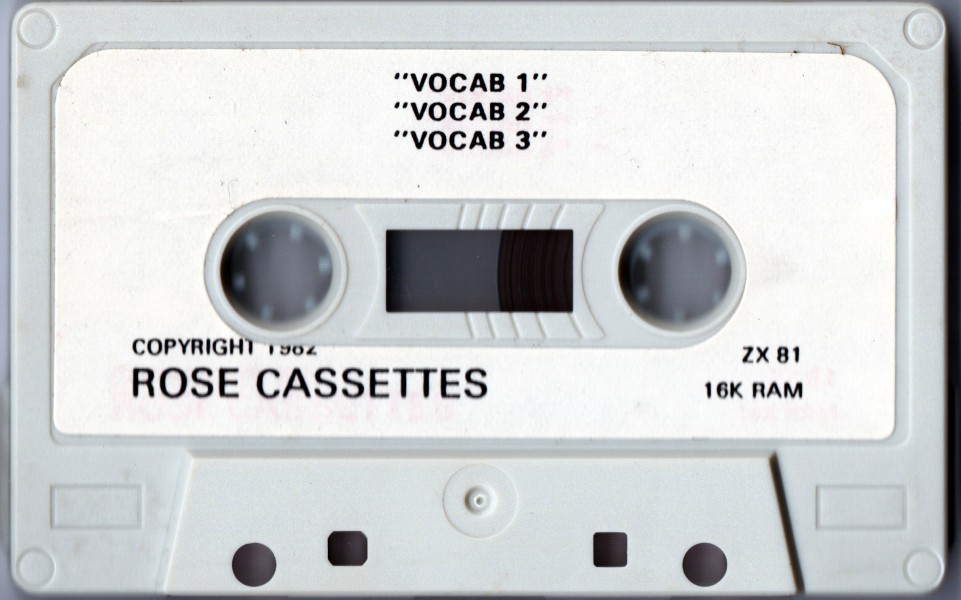
G.C.E. "O" Level French Revision
· ZX81 16K · 1 players
Rose Cassettes · 1982 · Pound sterling 4.50
Discussion
Nobody has started a thread about this yet.
Play
- GCEOLevelFrenchRevision(SideA).tzx.zipTape image English14 KB
- GCEOLevelFrenchRevision(SideB).tzx.zipTape image English14 KB
Files and rights
No permission is on record either way. Screens and pictures are copied here on a take-down basis: if you hold the rights and want something removed, say so and it goes.
Credits
- Rose Cassettescredited
Sign in to credit somebody, or say what these people did.
In the magazines 7
Sinclair User #10Jan 1983 · p.49
Dave Sayers
SINCLAIR ROUTE TO BETTER O LEVELS Dave Sayers reviews some of the growing number of cassettes for older pupils. As more and more people get to know the ZX-81 and its possibilities an increasing number of software suppliers are producing cassettes on subjects other than games. One major growth area has been education. In September we published a round-up of most of the programs which were then available. The market has continued to grow and we have decided to look again at what is an offer. Cassettes are available for children of all ages, from nursery school to GCE O level. In the upper age range we looked at programs from Scisoft, Calpac and Rose Cassettes. Scisoft of [redacted], produces cassettes for O level chemistry, biology and physics. The subjects covered in chemistry are titrations, masses, molarity, mystery metal, electrolysis, the gas equation and mystery gas; in biology are enzymes, hormones, botanical terms, alimentary canal, bodily organs; and in physics, gas laws, linear expansion, moments, electricity equations and Snell's Law. Each cassette is accompanied by a comprehensive booklet of revision notes. packed with drawings and information. They were a big plus in favour of the programs and would certainly be most useful. The programs are recorded on high-quality cassette and all loaded first time. The 'unknown' section of the biology tape contains some bugs, bad enough to stop the program and too numerous to alter, not that it should be necessary. The rest of the programs ran so well, though, that it was clear the bugs were the exception rather than the rule. The material covered was good, with useful instructions and tips. Some of the graphics in the chemistry program enlivened what can often be a dull slog of repetitious learning and the randomised questions in the programs required a sound knowledge of the subject. Suggestions of the degree of success are given at the end of each tape. Overall, the programs represent some of the best educational software so far seen and are recommended for use, either at home or in the school, and are good value at £7.50 each. The Calpac O level chemistry sent for review is a single cassette with no accompanying literature. There are four programs on the cassette, dealing with elements, compounds, mixtures, activity series, acids, bases and salts. Each program has only 10 questions and there is no random element. Well-presented and easy to load and use, they were, however, more limited than the Scisoft versions but they could still be useful for drilling. The cassette costs £5.50 and is available from [redacted]. Rose Cassettes [redacted] sent O level maths revision and O level French. The French cassette has six programs, three dealing with grammar and three with vocabulary. The maths cassette has one revision program and two test programs using questions from the O level syllabus. In classroom use children have been using other Rose programs consistently with no problems at all and so it is safe to recommend these two as useful classroom aids. The cassettes cost £4.50 each and there are no accompanying booklets.
'Overall, the Scisoft programs represent some of the best educational software so far seen and are recommended for use'
ZX Computing #4Dec 1982 · p.61
James Walsh
JAMES WALSH, OUR PINT-SIZED EDUCATION REVIEWER, THE TERROR OF HIS SCHOOL IN LOUGHTON, TAKES A LOOK IN THIS iSSUE AT THREE EDUCATIONAL PACKAGES, FOR THE ZX81 AND SPECTRUM. In this edition I have been asked to look at three educational packages for the ZX81 and the Spectrum, The first one that I'll look at is CALPACs new Spectrum "JUNIOR EDUCATION" cassette which (I quote) "contains eight attractive, easy-to-use programs for the 7 to 11 age group, including Maths, English, Junior Science and History. Colour graphics and sounds are used extensively". The other two packages are both for the ZX81 and are produced by ROSE CASSETTES. I use the word package intentionally, as both cassettes contain no less than 6 full length programs. The two packages that I will look at shortly are: JUNIOR ENGLISH 1 and G.C.E. "O" level FRENCH. As I said earlier (if you were listening), I would first like to look at CALPAC's JUNIOR EDUCATIONAL cassette or the ZX Spectrum, so here goes:... The cassette itself comes well packaged with a specially prepared leaflet of teachers notes. Though they are brief, they do give the teacher, parent or pupil for that matter, a reasonably good idea of what each program aims to do and hence whether they fit their requirements. My only suggestion is that some hints on loading could be included for the uninitiated user. DRAWING PICTURES The first program is called DRAW. The idea is simply that you can guide a dot around the screen and draw pretty pictures with it. It is reasonably advanced as it allows you to control a number of functions listed below: iNK, PAPER, FLASH, BRIGHT, OVER, INVERSE, INVISIBLE, ON, OFF, SLOW, FAST, COPY and ENOUGH. Though this program holds very little educational value as such, it is a very good way for a newcomer to find his or her way around the keyboard, and generally feel that they are in control. The second program is called "HOMEOPHONES", or in other words, words that sound the same but mean different things. You are given a sentence with a blank space and two or three alternative answers. You then type in the answer that you think is right. If you are correct then a graphically represented plant will grow and if you get to the end it will flower. If however you are wrong it makes a raspberry noise and goes onto the next question. Though the idea and application is good there is no variety, and I feel that most kids of the prospective age-group would get bored with the same questions and only one special drawing at the end. Next on the tape is "SUB", which is a basic subtraction program. It deals with the subtraction of larger numbers from smaller numbers in a very understandable way. If you get a question right then you get a pleasant tone and the bridge gets a little longer. If you get it wrong then the program will carefully take you through the right way of doing it. At the end a tank will drive across the bridge and stop if it cannot get to the other side. A very thoughtful addition is the facility to choose how the answer should be explained, depending upon the way in which the pupil has been taught so far. This is a reasonably good program, but it gets rather boring after a while. NATURE STUDIES "FLOWER" is by far the best program on the cassette so far. It first draws an accurate diagram of a typical flower and all its parts. It then goes on to tell you what they all do and how. It also tells you where they all are and test you on their location. This program is ideal for 2nd year science/biology pre-'O' Level course candidates, as this is a major subject. We now flip the cassette over and start looking at the second four programs. TABLES The first program on side two is called, quite aptly, TABLES. You are allowed to specify a particular table from 2 to 12, or if you prefer then a variety up to a specified table, (3 to 12). It will then ask you 20 questions. If you get a question right then a bit more of your graphic train is drawn. If you get one wrong you hear another raspberry tone and the offending table is displayed. When you have finished your score is displayed and your train is shown driving through the countryside. This program is very good, ideal for Junior school and lower secondary school pupils. Next we come to "COMP" - an English comprehension program. A sentence is given with a blank and you have to choose one of four words to fit m that space. The special value of this program is that it allows you to enter your own words and phrases. Again, if you get the answer right a bit more of the plant is drawn, and if you get it wrong it... you guessed it, makes a raspberry noise. CHARIOTS "ROMANS" is a simple question and answer program on Roman history. If you get enough questions right the horse will gallop away with its chariot. Personally I found that this was reasonably advanced for a Junior school and so would be useful in Secondary school as well. The final program on this cassette is called "SPELL", which is quite naturally a spelling program. The difference being that you type in the words and clues so that pupils can be tested. This way a large library of words can be built-up. In all this is a good cassette. There may be certain programs that you will decide not to use, but this is mainly due to the incredible variety on this one cassette. I agree with the maximum age of 11 for the programs, except for FLOWERS and ROMANS, which may be useful in secondary schools. This cassette can be obtained for £5.50 from the address below: CALPAC Computer Software, [redacted]. This is definitely a worthwhile cassette for any junior school teaching using a SPECTRUM in class. JUNIOR ENGLISH 1 Junior English is one of many educational packages from Rose Cassettes. These cassettes come quite well packaged, with loading hints on the inside of the cassette insert, but with very little information about the programs themselves. In computer circles it is not always necessary to include documentation, but for the product which is not only aimed at the computer owner but also at the school environment, I do feel that some introductory notes are helpful. CALPAC have done this simply by including an A4 size sheet folded into an A5 leaflet with a couple of sentences on each program. One small touch which I did like about the Rose Cassettes loading hints, was that they included approximate loading times for each program. This gives the user some idea of how many cups of coffee he or she has got time to drink before starting work! Junior English is made up of six full 7K to 12K programs all of which are recorded once on the cassette. It may seem a better bet to record them twice, but reliability is almost 100%. MEANINGS The first two programs are called MEANINGS 1 and 2 respectively. The idea is that a phrase or word is displayed at the top of the screen, and underneath are three possible meanings. Your job is to decide which is the correct meaning and then type 1, 2 or 3. The program holds a large stock of questions and answers so that you don't get the same questions on each RUN. The only difference between 1 and 2 is that 2 is slightly harder than 1. The next program is called PARTS OF SPEECH. The idea is that you fill in the blank with one of three words displayed. The first program on side two is called PROVERBS. It holds 35 well-known proverbs, such as: "A stitch in time saves nine". It displays one at a time but with a word missing so that you have to complete the proverb. I particularly liked this program because it gave a little variety in a subject which even with the best teacher in the World, most people find tedious after a while. LEARNING ENGLISH We now come to "SIMILES", an aspect of English which is more popular (if that is the right word) than most. This time the program holds 40 well known similes. The program itself follows a very similar format to the rest, in that you have to fill the blank with one of the three possible answers. The final program is called "ANAGRAMS". What you have to do is unscramble one of 50 six-letter words. If you cannot get the answer simply type 'Help' and the computer will display the first letter of the unscrambled word. One particularly nice part of each program is the 'Jackpot' game which is played every time you answer a question. Though they are very basic, there is a different one on each program. A very important point when using a program in class is its 'uncrashability', if you would pardon the expression. In other words, it is important that the computer checks every INPUT before it tries to digest it. This is very well done, as it is almost impossible to crash without hitting the 'BREAK' key. Overall, this is a very well thought out program and well worth the expenditure of £4.50 (for those studying English at Junior School). This and various other educational packages are available from: ROSE CASSETTES, [redacted]. ROSE CASSETTES: SUMMING IT UP Ian Marshall of Bramhope, Leeds, sent us this program, with the following comments: "Most of the teaching programs for simple maths seem to be of the type 13 + 14 = 27, where the calculation must be done mentally, (or with pencil and paper), and the answer entered in the sequence 'tens' followed by 'units'. "In general, this is not the way a child is taught to add, and the facility to add the 'units' and then the 'tens' and enter the answer in sequence would be desirable. "The following program is very simple, but it follows what I believe is the desirable format and offers more sophisticated possibilities."
Sinclair User #4Jul 1982 · p.45
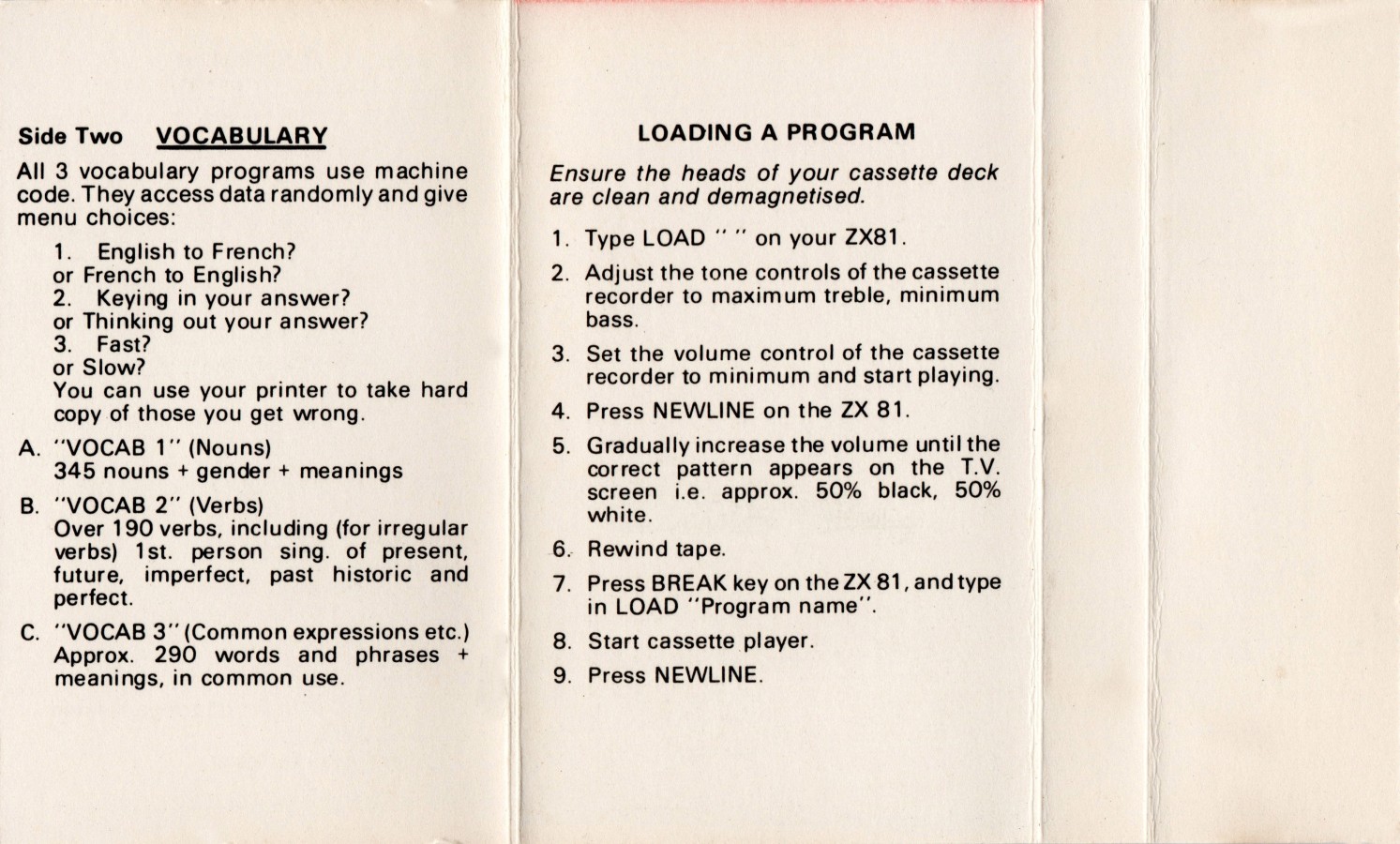
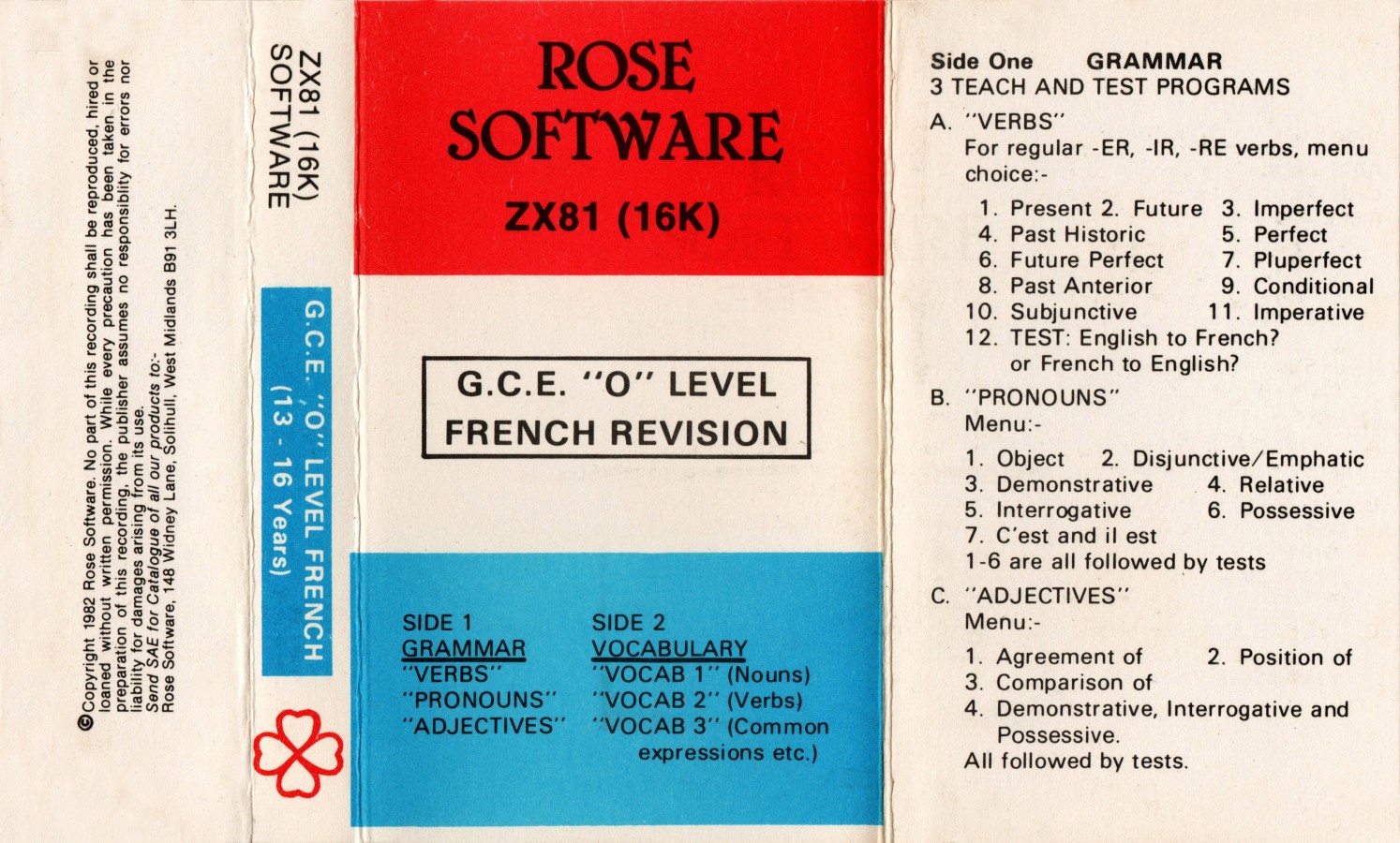
PARLEZ-VOUS LE BASIC? A cassette to help children with GCE O level French examinations has been produced by Rose Cassettes, which specialises in educational software for the ZX-81. For use with the 16K RAM pack, it covers grammar and vocabulary. On the first side, there are three sections dealing with verbs, pronouns and adjectives, with lessons followed by tests. The second side deals with vocabulary, with 345 nouns, more than 190 verbs and about 290 common expressions. The cassette is available from Rose Cassettes, [redacted] at a cost of £4.50 including postage.
Advert4
- Sinclair User #8Nov 1982 · p.31
- Sinclair User #6Sep 1982 · p.57
- Sinclair User #4Jul 1982 · p.66
- Sinclair User #3Jun 1982 · p.66
Related
- Elsewhere
- ZX81 Stuff
- Same entry at
- Spectrum ComputingZXInfo
Reviews from people here
Sign in to write about this, or make an account. It takes a minute and lets you correct the catalogue too.
No genre, language, description, tag recorded.
Sign in to correct or add to this.
Hold the rights to this and want it taken down?