
QS Scramble
· ZX81 16K · 1 players
Quicksilva Ltd · 1982 · Pound sterling 4.95
Discussion
Nobody has started a thread about this yet.
Play
- QSScramble.p.zipTape image English1 KB
- QSScramble(Main).p.zipTape image English2 KB
- QSScramble.tzx.zipTape image English3 KB
Files and rights
No permission is on record either way. Screens and pictures are copied here on a take-down basis: if you hold the rights and want something removed, say so and it goes.
Credits
- Quicksilva Ltdcredited
Sign in to credit somebody, or say what these people did.
In the magazines 4
Sinclair Programs #22Aug 1984 · p.32
June Mortimer
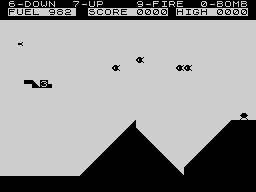
GOOD MICRO: SHAME ABOUT THE GAMES Manufacturers reproach ZX-81 owners for lack of interest in buying programs. We look at software for the ZX-81 and its value for money. ZX-81 owners have reason to be annoyed with the software industry. A cursory glance at computer magazines each month reveals ample signs of the 150 or so companies producing software for the Spectrum. Spectrum software supports entire magazines devoted to its reviews. So few ZX-81 games are produced that the entire computer press could be read for a month, without producing more than two pages of reviews, most of them of old products. Software Farm took high-resolution graphics to the ZX-81 earlier this year with its Forty Niner. Half the letters to Sinclair Programs from ZX-81 owners that month were written in praise of the new game. The success of Forty Niner has not led to production of high-resolution graphics programs by other software houses and the field has been left clear for Software Farm to follow its success with its new program, Rocket Man, to be reviewed in the next issue. Other companies are also producing good software for the ZX-81, although they are few and far between. Sinclair Programs has looked at some of the products on the market to see where the best programs are to be found. Bears in the Wood from Unicorn Micro Systems is a good example of an original game for the 16K ZX-81. The player begins with a mother bear and three cubs which head across the screen towards their cave, collecting honey as they go. Of course, the little bean have a tendency to lose their mother and, as soon as they do so, they become prey to the evil hunters in the forest. Hunters must be charged, bears guarded, and the time limit watched. Once inside the cave, honeypots must be filled and there is a chance to gain an extra cub. Then the player returns to the forest. Bear in the Wood is a difficult game at which to succeed and consequently holds the attention. The opportunity to return to the forest more than once can be attained only with a sound knowledge of the scoring system and a variety of tactics which keep mother and cubs united with plenty to cat. One small bug is that the mother bear can become blocked in a corner by the cubs, unable to move until one of them is shot by a hunter. Climber, also produced by Unicorn, is much less enjoyable. It is a version of Kong in which the player must climb from level to level on one screen, jumping the monsters and picking-up points on the way, and finally moving to the next screen by reaching the appropriate point on the top level. DOES NOT ADAPT WELL Kong is not a game which adapts from arcade to ZX-81 particularly well, as much of its interest relics on speed and good graphics. This version is not particularly difficult, once the movement of the various obstacles has been understood, but it is very repetitive. A style of game more suited to the ZX-81 is represented by Ocean Trader from Quicksilva. It is a form of simulation in which the player takes the part of a ship's commander, sailing from port to port round the coast of England. Prices of commodities in the ports change from day to day and from place to place and the aim is to profit by buying goods in one port and selling them for a profit at the next. The game is rather slow-moving, taking some time to display option or to print details of prices. This type of game, though, is well-suited to the ZX-81 and this is a well-thought-out a.ample. Black Star from Quicksilva has an impressive storyline printed on its cover. The story tells of the Cosmic Guerillas and of your plan to bomb their Black Star base in your Svlegian Raider. Enemy ships must be dodged and the energy ducts in the tunnel leading to the Black Star must be destroyed. All very impressive. On RUNning the program, however, the tunnel proves to be a black rectangle, or sometimes a rectangle of asterisks. Immediate acceleration means that no enemy ships appear and, when your ship travels slowly enough to sec them, they appear as small Vs at the bottom of the screen. Similarly uninteresting is Croaka Crawla from Quicksilva, a version of the arcade oldie Frogger. According to this version Frogger has gained nothing in its old age and has lost much. There is a huge variety of skill levels, ranging from the very low to the ultra-fast but, other than that, the program has little to commend it. QS Scramble from Quicksilva is yet another arcade adaptation. The player flies above the surface of a planet, firing at approaching aircraft and bombing those still on the ground. The game loses less than others from its adaptation to the ZX-81, perhaps because its interest is almost totally in controlling your craft. As the screen display changes continually the square graphics are less glaringly apparent than in games where the screen display remains constant. Arcade games can do little on the ZX-81 other than to demonstrate its weaknesses. The ZX-81 also has advantages which Psion has put to excellent use in its program Vu-File. Vu-File allows the user to store information on record cards, to re-arrange, sort, store and print that information. Unlike other filing systems it does not pre-define the index card but allows the user to design one. Information can then be entered into the computer and can be rearranged according to any one of the headings on the record card. A demonstration program on the B side of the cassette demonstrates one use to which the program can be put. A gazetteer has been recorded, including basic details about a number of countries. The program can be used for reference or taken as an example by those who want to test the efficacy of Vu-File before entrusting their records to it. INEXPENSIVE PROGRAMS Also reviewed by Sinclair Programs were programs from two small companies which produce inexpensive programs on a mail order basis. They give some idea of the quality of programs sold through magazine small advertisements, rather than those produced by large companies. Swag is produced by Howard Software, [redacted] and costs £3.45. In it the player takes the part of a burglar who wishes to rob a bank. The first section is a street chase, in which the player navigates a car through a maze, pursued by two police cars which move more slowly. Speed is slow and it is easy to avoid the police. Section two takes place inside a building. The aim is to walk into each of three rooms, pick up treasure and return it to your lorry outside the building. The problem here is to avoid the forcefields on the doors. As they appear to flash in a completely arbitrary fashion it is difficult to use any skill in that section. Section three is combined with section two. The treasure in room two is inside a safe with a combination lock and the combination must be cracked quickly before the alarms ring. Overall the pace of Swag is slow and the game unexciting. It would keep few players interested for as long as half an hour; most would lose interest more quickly. Bank Raid is from Senior Software, [redacted]. Again the theme is bank robbery, this time with an emphasis on shoot-outs. A maze is printed on-screen and the player must escape the two gunmen who are out to kill. On the next screen the tables are turned and this time it is the player who must shoot the gunmen before they escape. The next screen returns the player to the beginning to escape again, and so it continues. Again, the game is deadly slow and lacks the excitement necessary to a maze game. Also from Senior Software is Allotment, a utility program for gardeners planning how to allocate space in their vegetable gardens or allotments. The program works on a three- or four-year crop rotation system and divides the vegetables which it has stored in it accordingly. On a diagram of the allotment vegetables chosen by the gardener will be placed automatically at the correct distance from each other, so that the number to be planted is readily apparent. ESSENTIAL ADD-ONS Allotment is an easy way of planning a garden to advantage, of recording where vegetables are planted and when they are likely to appear. A large number of vegetables and information about them is stored in the data section and gardeners who prefer to plant exotic plants can include their own data. Available by mail order also are essential add-ons for the user on a limited budget. Glaston Computers, [redacted] produces clear, self-adhesive plastic pads which can be stuck on to the keys of a ZX-81, or only on to those keys used for games playing. Forty pads cost £2.99 and they make the ZX-81 keyboard usable for games or for typing.
C&VG (Computer & Video Games) #11Sep 1982 · p.827/105/108/10
Getting Started 7/10
Value 5/10
Playability 8/10
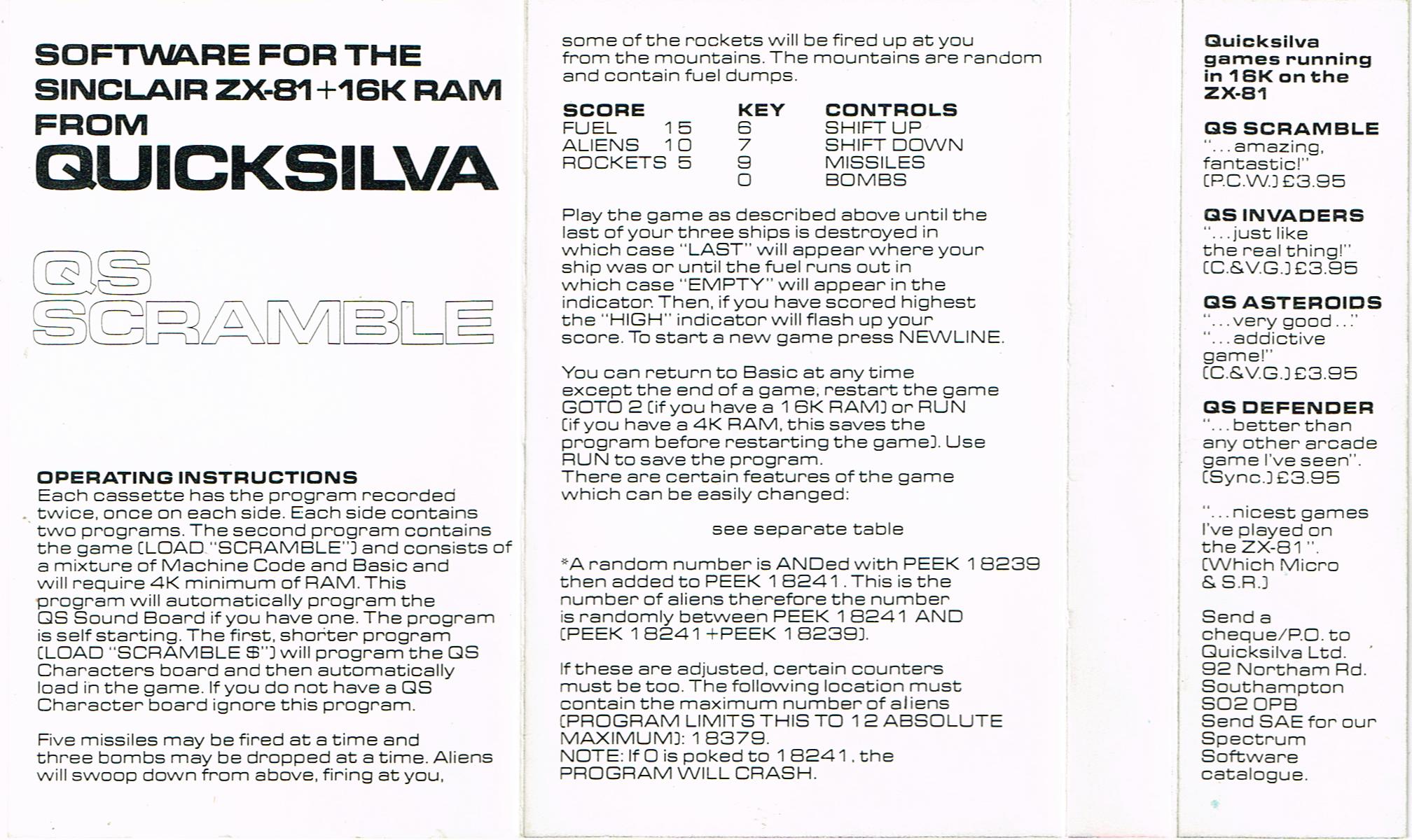
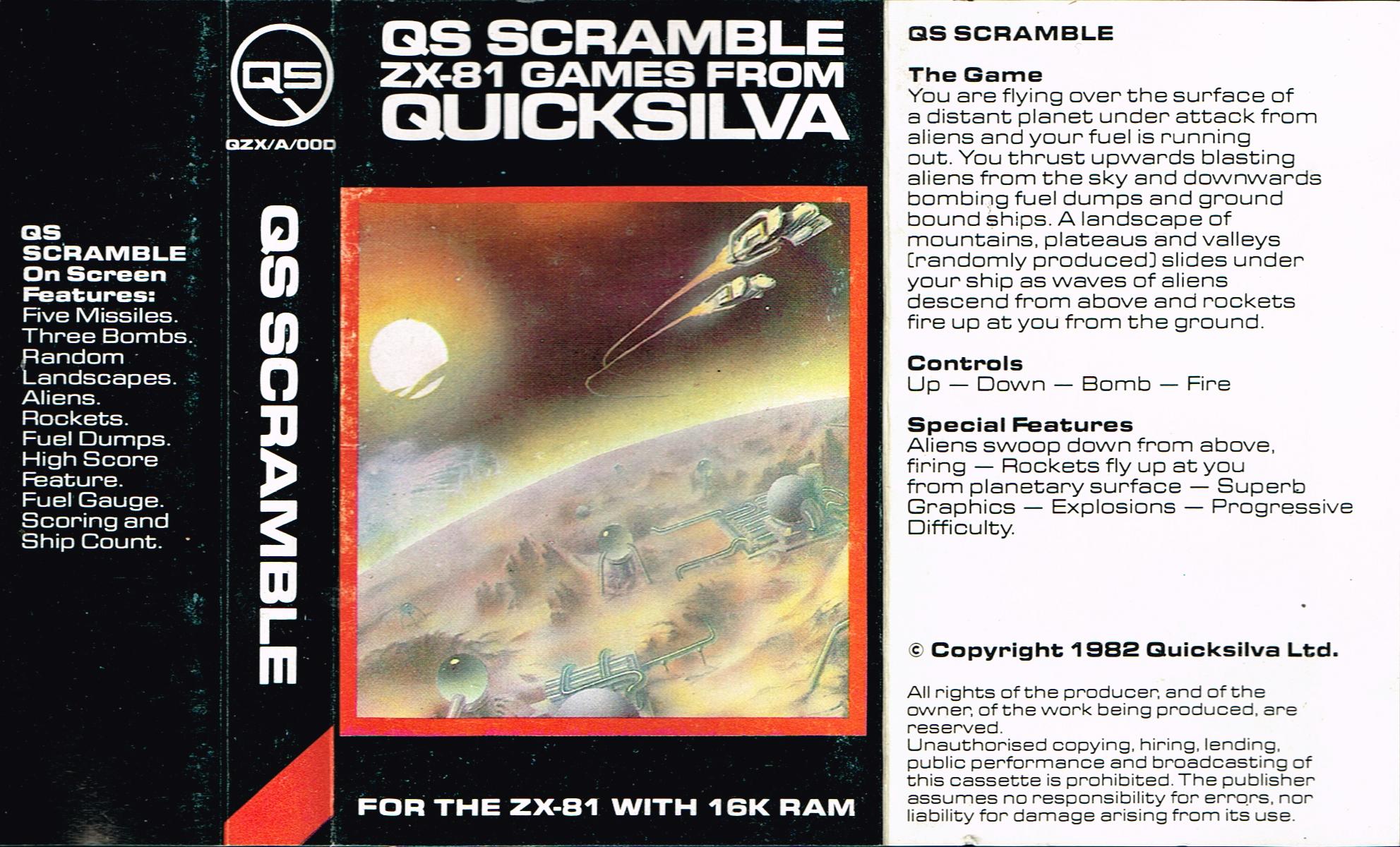
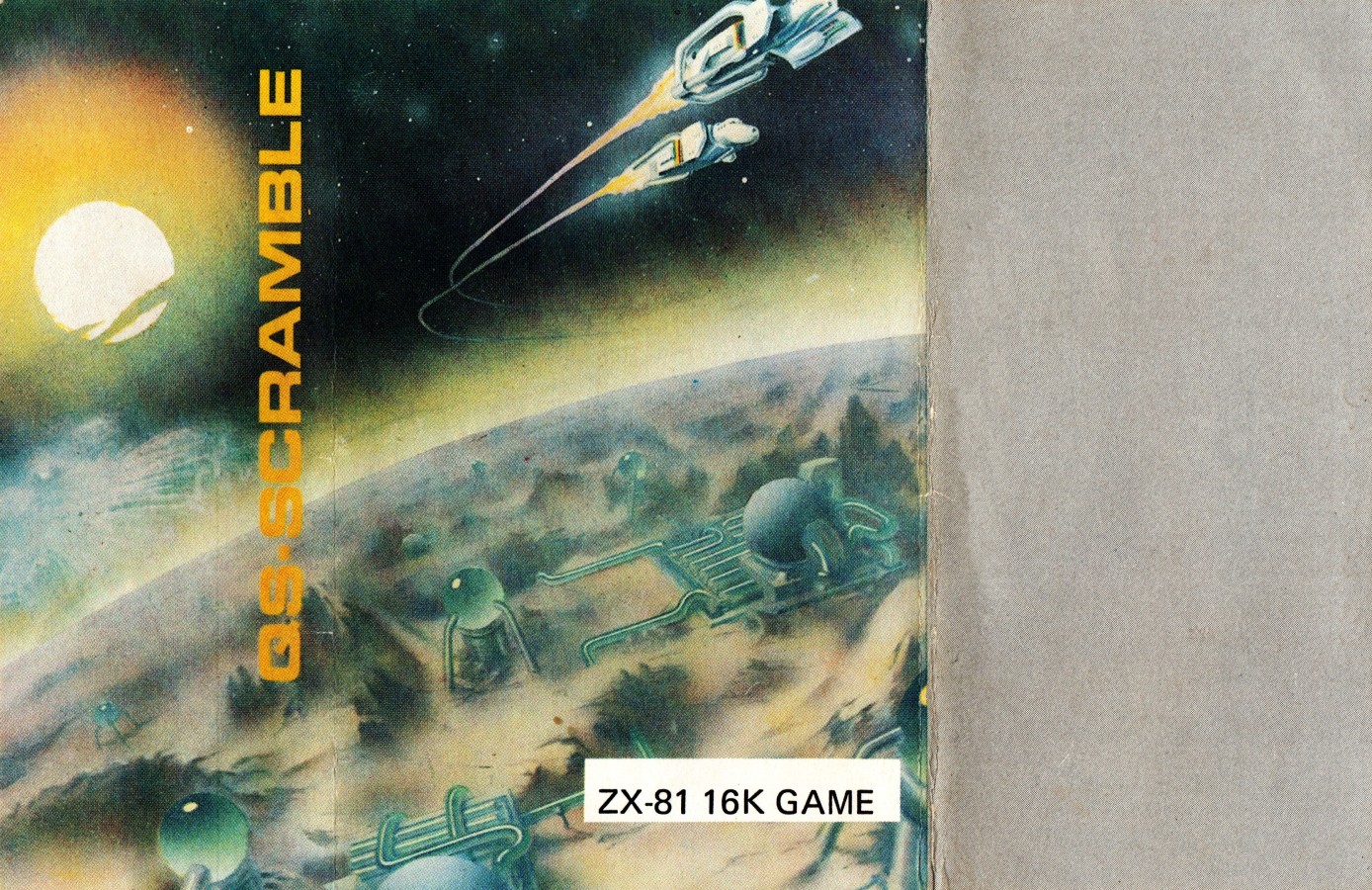
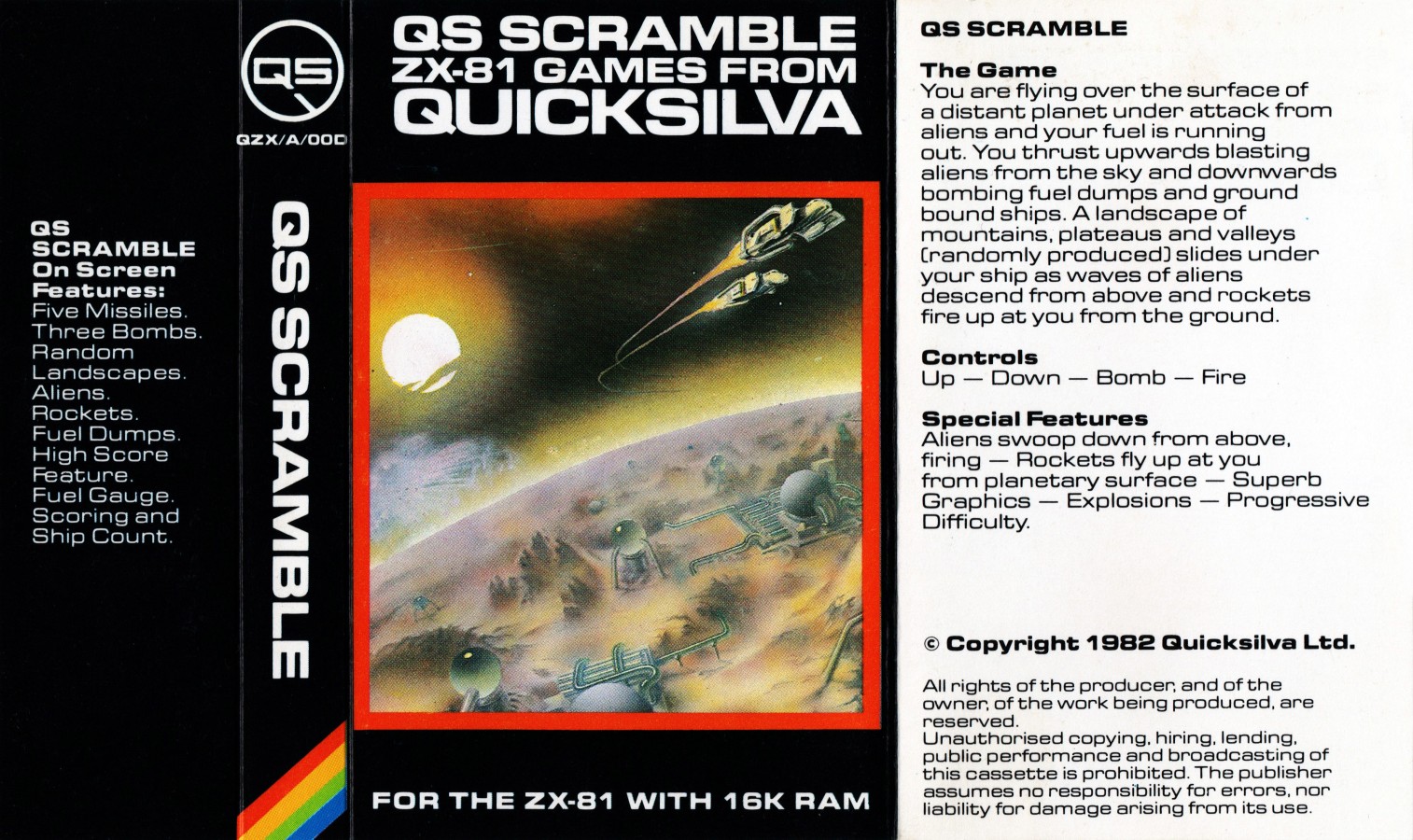
WHO NEEDS GRAPHICS? This version of Scramble proves that you don't need sophisticated graphics to produce an enjoyable arcade game replica. The missiles here are capital "A"s fired up in a looping flight from the hillsides and valleys. The alien planes are made up of "less than" signs arrowing their way through the skies and the fuel tanks are grey smudges dotted along the landscape. But for sheer compulsion it is going to be hard to beat this game. You play the part of a aircraft armed with bombs and guns, on a mission over enemy territory. The screen scrolls from left to right, forcing you forwards but allowing you to alter altitude above the crags and chasms of the landscape. Fuel tanks and missiles can be blown up to score points, either by dropping to their level and firing out ahead of you, or by sending looping bombs over the hills to drop down on them. The missiles periodically takeoff and it is advisable to try and destroy them before you have to pass over them or retreat to the top of the screen where they are less likely to surprise you. But the greatest danger is posed by the enemy airborne fleet which descends from the heavens in groups of up to four, spitting fire and rising and falling in flight as they search for you. The tactics are pretty obvious but the race to beat a friend's high score is thrilling. It has all the addictive ingredients of being a game simple enough to make you believe you can always do better, so you never finish satisfied with your performance. Quicksilva have already won themselves a good reputation for producing good arcade replicas within the limitations of the ZX81, this cassette will further that reputation. It costs £4.95 from Southampton-based QS and runs on a ZX81 with 16K Rampack.
C&VG (Computer & Video Games) #10Aug 1982 · p.15
ARMED, FUELLED AND ON THE MOVE Scramble aptly describes the player's desperate antics as he attempts to score points above a world on which he is barely equipped to exist! Already a big arcade success, the game puts you in charge of a plane, armed, fuelled and on the move across a mountainous landscape. Quicksilva is the company responsible and it is quickly making a name for itself for adapting arcade games onto the limited graphics facilities of the ZX81. This version costs £4.95 (including post and packaging) and allows up to five ships to appear on the screen at any time and has the fuel dumps, ground defences and changing terrain of its video predecessor.
News/Note1
- Sinclair User #7Oct 1982 · p.11
Licensed from
- ScrambleArcade coin-opunofficialKonami Ltd
Related
- Same entry at
- Spectrum ComputingZXInfo
Reviews from people here
Sign in to write about this, or make an account. It takes a minute and lets you correct the catalogue too.
No genre, language, description recorded.
Sign in to correct or add to this.
Hold the rights to this and want it taken down?