
Space Raiders also BOMBER
· ZX81 16K · 1 players
Sinclair Research Ltd · 1982 · Pound sterling 3.95
_Scan.jpg)
Discussion
Nobody has started a thread about this yet.
Play
- SpaceRaidersAlsoBOMBER.p.zipTape image English2 KB
- SpaceRaidersAlsoBOMBER_2.p.zipTape image English1 KB
Files and rights
Distribution permission is on record, granted to another archive rather than to this one. Screens and pictures are copied here; everything else links to the archive that holds it.
- AllowedSinclair Research Ltd → WorldOfSpectrum
Credits
- Psion Software Ltdcredited
- Mikro-Gen Ltdcredited
Sign in to credit somebody, or say what these people did.
In the magazines 6
ZX Computing #3Oct 1982 · p.74
Nick Pearce
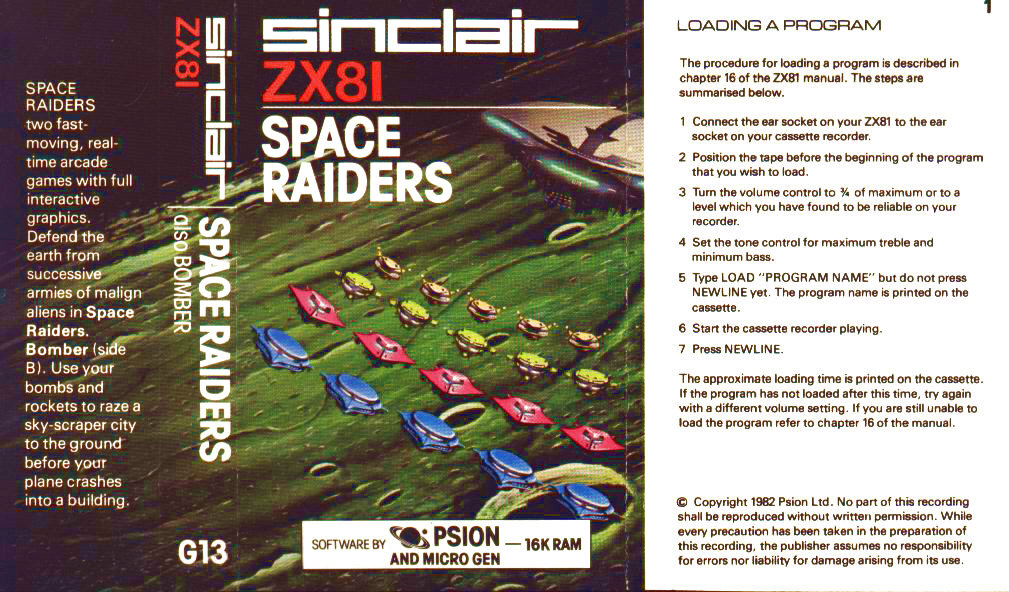
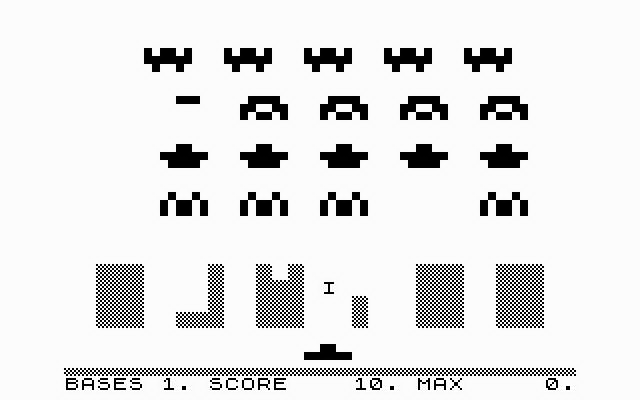
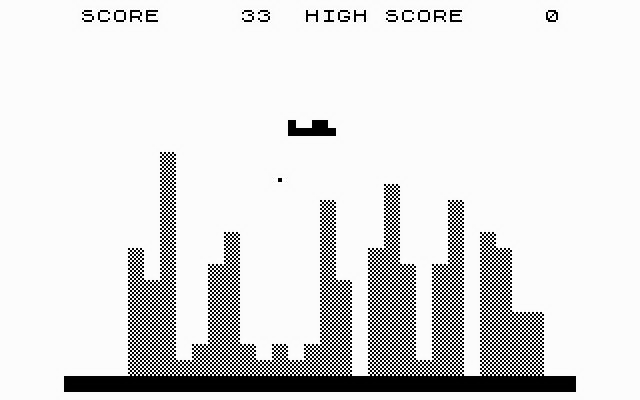
ZAP! POW! BOOM! The Psion software company got the big deal that everyone wanted - to become the 'official' Sinclair software supplier, HOW good is their material? Did they deserve the prize? Nick Pearce takes a look. Avid readers of the computer press, and visitors to the ZX81 counters of W H Smith, could hardly have failed to notice the extensive range of software recently released by Sinclair. I decided to look at six of the Psion cassettes. The best of the six is, in my opinion, FLIGHT SIMULATION. This is a superb program which makes very good use of the power and the graphics of the ZX81. You are the pilot of a small, high-performance aeroplane, which must be safely landed. You have a choice of three screen displays. The cockpit display shows the outside world (horizon) in the upper half of the screen, and cockpit instruments in the lower half, including power indicator, altimeter, fuel gauge, rate of climb indicator, air speed indicator and radio direction finding equipment. The map shows the position of the runway, various radio beacons, the aeroplane, and an escarpment of hills to hinder your landing. The third display is the visual approach which shows a full perspective view of the runway lights, together with some essential landing indicators. This display is particularly effective and gives a convincing "pilot eye" view of the runway lights which cope admirably with banking and changes in speed or altitude. The program's instructions are clear and concise. It is well worth getting acquainted with them before flying. I didn't, and consequently landed with the undercarriage up, and then made repeated attempts to land without using flaps, and therefore stalling, on my next few flights. After a little practice, flying becomes easier, and full use can be made of the controls and facilities that were ignored during the panic of the first few flights. An option at the start of the program allows the aspiring aviator to practice and perfect just the final runway approach and landing. If you find flying becomes too easy - which is most unlikely - you can introduce additional complexity by adding wind effects. I have just two criticisms of FLIGHT SIMULATION. I would have liked to try my hand at taking-off, which is not possible with this program; the program permits the pilot to 'cheat' and 'fly' at ground level (zero altimeter reading) on the runway approach. Apart from these points, I could not fault this software. At £5.95 it represents very good value for money. Incidentally, a friend kindly lent me a 12.5K flight simulation on his Tandy computer. In many respects I found the Psion simulation superior; both its visual effects and navigational facilities were more convincing, and it was more user-friendly. The Tandy version does have some additional features, however, including take-off and taxiing, and a wargame facility. SPACE RAIDERS is a ZX81 version of the 'traditional' arcade game SPACE INVADERS in which you defend the earth from successive armies of invaders. You have three lives (bases), and points are awarded for each raider ship hit. RAIDERS may be played at one of three speeds, normal, fast and super-fast, and I was told by an experienced player who had a go that it bears the most similarity to the arcade game when it is played in the superfast mode, which was too fast for me. This program is similar to the many other invaders programs on the market, but has the bonus of a second game, BOMBER, on the B side. In this 'blitz'-type game, you use bombs and rockets in an attempt to raze a skyscraper city to the ground before your plane either crashes, or is knocked out by the blast from one of your own rockets. It is probably impossible to completely obliterate the city. I tried in vain several times at the slowest speed (and there are nine speeds altogether). Not a particularly inspired game, I thought, but one which makes a welcome change from invaders. A nice finishing touch to RAIDERS and BOMBER is the display at the end of each game which gives the score for that game and the highest score so far. In common with the rest of the software in this review, these programs are pretty well idiot proof, and I (even I) could not get either of them to crash. Both these games perform well, and at £3.95 for the two, this cassette is a reasonable buy. Moving on to programs for the more serious user, the Sinclair range includes VU FILE and VU CALC; programs intended for business or household management use. VU FILE is a general purpose filing program. It is the sort of program you could use to catalogue your coin or stamp collection, keep a name and address list of friends, or for business, maintain a membership record for your club or society, or even keep a file record of all your ZX81 software! The program is logically displayed, and easy to use. You start by 'laying out' the record, using headings, titles and graphics symbols. Anything entered during this record layout mode will be shown on each record on the file. You then move to another file, datafields, in which you define the positions on the record where you wish to set the information. Data is entered into the file from the main command mode. As well as ENTER, the other main commands are ALTER, INFORM, FORWARD, BACK, RESET, ORDER, PRINT, COPY, SELECT, QUIT, LIST and DELETE. These provide a comprehensive file handling capability and can be implemented simply by keying m just the first letter of each command. The commands are pretty much self-explanatory, but where there is any difficulty in comprehension, the instructions give a fuller explanation. The top of the screen gives continuous prompts to guide the user through the system. Recorded on the B side of this cassette is an example of an application of VU FILE. It is called GAZETTEER, and is a file of records for every country in the world, giving the name of the country, its capital city, main languages and the like. I made use of GAZETTEER to get a feel for the manipulative and interrogative power of the main program. I was able to select and view any country in the file almost instantaneously; in well under a second. The record to be selected must be correctly defined. For example, the USA is filed as UNITED STATES OF AMERICA, and Russia as USSR. On the command LIST, each record in the file is displayed for about one and a half seconds. By using the commands FORWARD and BACKWARD you can step through the file. RESET sends you to the first record, ORDER defines the particular sequence required, ordering being defined by the leading alphanumeric characters of any of the data fields. INFORM gives information on the status of the file. As an indication of the capacity of VU FILE, the GAZETTEER holds records on 152 countries, and uses 96% of the space available in the program. I think this software might be let down, not by the quality of the program itself (which I thought very high indeed), but by the inconvenience of loading the files from cassette. Few people would be prepared to wait for five minutes or more to load a file to obtain the address of a friend, or colleague. The ZX81 really needs a disc operating system to be used effectively for this sort of work. For business, or perhaps school or hobby use where a cassette can be loaded at the beginning of the day or session, and the ZX81 can remain dedicated for some time, VU FILE on a cassette might be viable, although file space may quickly become a limitation. Although the GAZETTEER effectively demonstrates the power and capacity of VU FILE, and white it clearly has initial novelty value, I think I would prefer to browse through a good atlas to get the kind of information the program contains. VU FILE is, however, a good program, and does all that is claimed for it. The real question, however, is whether it would actually ever be used for all those filing jobs you've always meant to do. The program certainly gave me a better understanding of how computers can be used for organising data, and the power a computer system can offer. The discipline of attempting to catalogue on VU FILE that coin or stamp collection can itself be a worthwhile exercise, whether or not the computer eventually replaces your manual records. VU CALC - a ZX81 version of VISICALC - is a program for calculating and displaying tables of numbers and names. You start with an empty table of 'boxes' in a grid of 26 rows by 36 columns. Only a small part of the table can be displayed at one time, but you can quickly move around the table using the arrow keys. Using simple commands, you can enter data into the boxes, and use formulae to link boxes, rows or columns, so that the computer can quickly calculate a complete table. The power of the program lies in the ease and speed with which the table can be recalculated with altered data or different formulae. There is a facility for saving the program on cassette, together with the completed or partially completed table, and it could easily be used for something like monthly accounting. As an engineer, I was rather disappointed that this program only permits the four basic arIthmetic operations (+ - / *) to be carried out. Many engineering applications would require logarithmic and/or trigonometric functions as well. For this reason, I think VU CALC is more likely to be used as a tool for financial analysis, rather than engineering, scientific or statistical applications. I had some difficulty assimilating the operating techniques required by this program, and I had to persevere to make it work. However, after rereading the instructions and some practice, I found I was able to operate the program quite efficiently. Once the formulae and titles for a particular chart had been developed and entered, it is quite easy to enter the data into the chart from which the complete table can be calculated. Some care needs to be taken in setting up the formulae, and entering data. For example, you must ensure that when operations are carried out, the resulting figures can be displayed without problems in the eight digit boxes. VU CALC could be a useful tool for managing household accounts, although I am not sure it could compete with some of the dedicated financial control programs on the market which are designed for more sophisticated applications. A lot of effort has gone into producing VU CALC, and it works well, again with considerable emphasis on user-friendly aspects. However, I feel its field of application is likely to be limited since it rather lies between two camps. It is neither a proper financial analysis program, nor is it ideally suited for serious use by the engineer or statistician. For some household applications, VU CALC (like VU FILE), could prove a boom. You do need a certain amount of dedication to set up and maintain a computerised system, but the result is likely to be well worth the effort. HAD ANY GOOD FANTASIES LATELY? Finally, on a lighter side, is FANTASY GAMES, which contains two 'adventure' programs. On the A side of the cassette is PERILOUS SWAMP, which Psion recommend you tackle before you take on the more difficult SORCERER'S ISLAND on the B side. When you enter the Perilous Swamp you must rescue a princess who has been captured by an evil wizard, and then return safely. The game starts with a map showing your position, along with that of the princess, and the locations of several swamps in the rescue area. The map, which can be called up at any stage, is different for each game. As you move, prompted by requests for compass directions, monsters and treasures are encountered, and you gain or lose points as you fight or bribe your way onwards. This program has been well written and is quite entertaining. However, it is more of a guessing game than a true adventure program. SORCERER'S ISLAND is a cross between a guessing game like Swamp, and more traditional adventures. You have been marooned on the island from which you must escape. A detailed map can be called up at will, although the screen goes blank for nearly a minute each time you do so. You have a vocabulary of some ten words with which you tell the computer what you want to do. At each turn, your immediate surroundings are shown. Again, these take rather a long time to display. As the game progresses, you are assailed by monsters, tempted by treasures, and have to deal with the other hazards that abound on the island. There is supposed to be a grand sorcerer who can help you escape, but I have to admit I never managed to meet him. Again, an entertaining game, although I did think it was spoilt to some extent by the length of time it took to create the screen displays. FANTASY GAMES costs £4.75. SUMMARY Of the six cassettes I reviewed, I was particularly impressed by FLIGHT SIMULATION. It is a novel and apparently authentic simulation which must have taken considerable effort to compile, and of which Psion should feel proud. All the programs maintained a high standard, and together must represent some of the better software available for the ZX81. The price of each is more than reasonable, with FLIGHT SIMULATION being particularly good value. Each cassette is attractively boxed, and well presented, with clear and concise instructions on the cassette insert card. All the programs loaded first time, an indication of the excellent quality of the recordings. I was interested to see that CRC (cyclic redundancy check) to which each program is subjected on loading. This checks that the program has not corrupted and should give the user some confidence that the program will not crash. It is also used by the manufacturer as a check on recording quality. All the cassettes are for the ZX81 and can be obtained from W H Smith branches, or from Sinclair Research, [redacted].
Cockpit display from FLIGHT SIMULATION
Printout from VU CALC
The cassettes
VU-FILE Gazetteer output
C&VG (Computer & Video Games) #10Aug 1982 · p.15
FROM THE COCKPIT Bank, dive and climb as the Earth travels past beneath your feet - or actually it's on your TV screen which has been transformed into a cockpit window. Flight Simulation is the name of the game which is one of a series of five being produced for Sinclair b y software house, Psion. The simulation places you in a cockpit of an aircraft. The sky and the ground move through this window, and although it hardly bears comparison with the multi-million pound flight simulators which real pilots train on, it does offer some of the excitement and a very real challenge. The tapes are marketed under the Sinclair label and will be available from the company or your local W. H. Smith for ZX81s with a 16K Rampack. Flight Simulation costs £5.95 and the other programs are: Fantasy Games which retails at £4.35 and offers two adventures in a Perilous Swamp and on the Sorceror's Island. Chess costs £6.95 and has six levels of play with a chess clock on which to time yourself. Backgammon, the gamblers' favourite dice game has a graphics board, rolling dice, and doubling dice for £5.95. The Space Invaders look-alike, Space Raiders shares a cassette with the familiar City Bomb type game, Bomber and retails at £3.95.
Advert3
- Sinclair User #6Sep 1982 · p.54
- Sinclair User #5Aug 1982 · p.52
- Sinclair User #4Jul 1982 · p.54
Review1
- Personal Computer World (PCW)Sep 1982 · p.154
Related
- Elsewhere
- ZX81 Stuff
- Same entry at
- Spectrum ComputingZXInfo
Reviews from people here
Sign in to write about this, or make an account. It takes a minute and lets you correct the catalogue too.
No genre, language, description, tag recorded.
Sign in to correct or add to this.
Hold the rights to this and want it taken down?