ZX Forth
· ZX81 16K · 1 players
Artic Computing Ltd · 1982 · Pound sterling 35.00
Discussion
Nobody has started a thread about this yet.
Releases
- 1982Artic Computing LtdPound sterling 35.00
- 1982International Publishing & Software Inc
Play
- ZXForth.p.zipTape image English5 KB
Files and rights
No permission is on record either way. Screens and pictures are copied here on a take-down basis: if you hold the rights and want something removed, say so and it goes.
Credits
- Artic Computing Ltdcredited
Sign in to credit somebody, or say what these people did.
In the magazines 8
ZX Computing #11Feb 1984 · p.99
Lindsay Godfrey
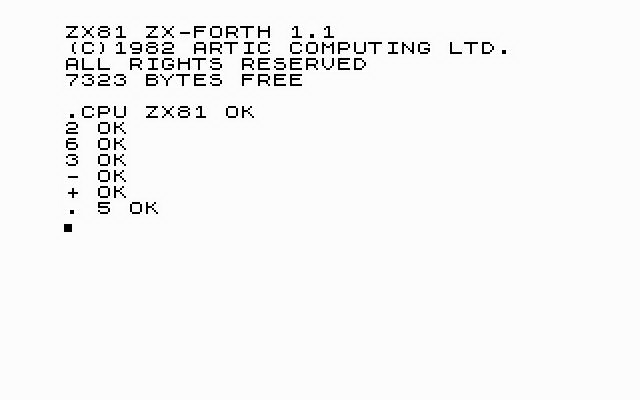
READERS REVIEWS Next time anyone claims that we are a nation of illiterates I'll just let them read your letters! I have never read so much well thought out, individualistic, critical literature. The old saying, 'spoilt for choice' was never so appropriate - perhaps we'll run a special supplement later in the year. For new readers, this feature provides space to air your views on any software, be it for the ZX80, ZX81 or ZX Spectrum. If you've had a good or bad experience of any of the commercial software packages available for your micro, why not write and tell us. Your reviews should contain your critical thoughts about the software and the relevant details concerning the availability of the package, its price, etc. If you can provide any screen dumps to illustrate the review, so much the better. Any reviews published in this section of the magazine will be rewarded with the price of the tape you review. So, if you buy a cassette and send in a review that gets published, you'll get your software for free! FORTH Artic Lindsay Godfrey Among the latest software to receive Sinclair's stamp of approval is Artic's FORTH, for the 16K ZX81 or the 48K Spectrum, of which I have the ZX81 version. FORTH is another computer language, which is ten times faster than BASIC and four times more compact. What makes it really powerful is the ability to make up your own functions called 'words'. Each word has a name (by which you refer to it) and a definition (what it does). Each new word is entered into the FORTH dictionary. Once a word has been entered, every time you type in the name of the word, its definition is carried out. You could now define another word which contains the previous word you have just entered into the FORTH dictionary or/and any other word in the dictionary; so, after hours of programming, your brilliant program will be the definition of just one word. The whole FORTH package is nicely presented and comes in a double sized cassette case along with a FORTH Users Manual, a FORTH Editors' Manual and a keyboard overlay. When the main program has LOADed it autoRUNs and greets you with: 'ZX81 FORTH, ARTIC COMPUTING, 7294 BYTES FREE.' and waits for your input. The program does not use single key entry like the ZX81's BASIC, and as far as numbers go you can use any base from 2 to 36. Inside the FORTH dictionary there are already over 100 word definition;. To enter a new word into the dictionary you use for example; ; used to begin a definition PRINT the example name of the new word ;'FORTH' the FORTH words defining what to do ; used to end a definition If the above were entered every time you enter the name of the word ie. PRINT, 'FORTH' would be printed at the top right of the screen. ',' is the FORTH word for PRINT. At any time the contents of the dictionary can be listed using VLIST, and any words you no longer want can be erased using; FORGET (name of word) and to clear all the words you have written from the dictionary you can enter; COLD If the worst comes to the worst and you get fed up with FORTH you can enter; BYE and say bye, bye to FORTH as it returns you to BASIC. The unusual thing about FORTH is that in BASIC to add two numbers together and display them you would type; PRINT 4 + 2 but in FORTH you would type; 4 2 + . which means place 4 on the stack, place 2 on the stack, add them together placing the result on the stack, and finally, print the result. You can not do any real programming until you LOAD the EDITOR. The Editor comes after the main program in four separate parts or 'screens'. Each screen is 1K long and has a number from 0 to 327688 but only one screen can be in memory at any one time. This may seem a problem but FORTH comes complete with a fast tape routine and it only takes 30 seconds to LOAD or SAVE a screen, or rather FLUSH, which is the FORTH word for SAVE. As a screen is LOADed all the word definitions from that screen are put into the FORTH dictionary, and then the next screen can be LOADed. Each screen is organised as 16 lines, numbered from 0 to 15, of 64 characters. This is a method of storing memory and does not affect how you see the T.V. screen. The Editor gives you various commands to manipulate the screens using the line numbers, a few of these commands are; (n stands for a number) Clear screen n Put the following text into line n Delete line n Insert the following text into line n List the current screen To get the characters shown on the keyboard overlay and in the manuals you need a Q.S. character board, this can be confusing at times, when you are looking for a character that is not there, but is no real problem. However, the fact that FORTH is so easy to crash is a problem. You only have to type in any graphics character or the wrong word and it crashes, 'bye bye FORTH!' Another small fault is that the keyboard overlay is not all that good! Apart from the above, the FORTH package is very good, and anybody who wants to learn another language should get it. FORTH costs £14.95 and is available direct from Sinclair.
ZX Computing #10Dec 1983 · p.151
Nick Pearce
THE BEST THREE OF '83 Nick Pearce and James Walsh take a fond look back at the three best software packages they've seen during 1983. THE ZX81 OVERVIEW With 1983 fast drawing to a close, this is the time of year when it is traditional to look back over the past twelve months and take stock. I have seen a considerable number of cassettes during 1983, Some have been pretty mundane, many were very good and a few were outstanding, either in terms of their originality or because they broke new ground in the software market. It must be said that many of the major advances in ZX81 software were made in 1982 - I'm afraid 1983 is unlikely to be remembered as a vintage year for software. But, then again this is hardly surprising as the ZX Spectrum and a host of other cheap computers have been primary attractions, and the ZX81, introduced nearly three years ago and still extremely popular, is beginning to feel its age in computing terms. SPOILT FOR CHOICE I have chosen my three best packages using the following criteria: longevity, a program which survives constant use and remains as interesting as it first did; technical innovation, as to how well the programmer has used the capabilities of ZX BASIC and the limitations of the ZX81's memory; and originality. The kind of program that any ZX81 user would be happy to find in their Christmas stocking. I have not interpreted my brief too literally, in that some of the chosen three were in fact produced late in 1982 although their impact on the software market was only felt in 1983. Also, I have been unable to resist mentioning more than the stipulated three (perhaps I will be permitted to look back at four packages in '84 and five in '85!). Equally, for fear lest this short summary become a little more than a catalogue of ZX81 software, I have not made too many references to many other great cassettes which I'm sure you will have come across this year. My selection is very much a personal one, and for the benefit of users of both the unexpanded and the expanded ZX81, I have chosen a cassette of 1K games, a 16K game and for the more experienced programmer, Artic's FORTH implementation. THE NAME OF THE GAME Taking the game for the 16K ZX81 first, Odyssey's 'Invaders' package continues to provide enjoyment and I also use this game to demonstrate to sceptics that high resolution games really are feasible on the ZX81. As well as the impressive display, the action is fast and responsive, and as a game is great fun. Only Artic's 'Namtir Raiders' comes to mind as being as exciting to play, but this version does not have the same Hi-res display. Some users of Odyssey's game seem to have had some problems with the Hi-res display - it appears that access to the horizontal hold on the TV is sometimes necessary to correct the distortion. Persevere - you'll find it's worth it! You could also check out some of Odyssey's other Hi-res games, which I have heard rumoured are equally good. Someone with just 1K of RAM might appreciate a cassette such as Selec's 'Maze Guzzler' in their Christmas stocking. (They might prefer a RAM pack, but Selec's offering comes a lot cheaper.) 'Maze Guzzler' is a game after the 'Pacman' style, and all the usual facilities found on the 16K games available. The restricted memory has dictated a small screen display, but it is nevertheless a very good game. On the B-side of Selec's cassette is a game called 'Super-breakout'. This is a good 1K version, again with a less than full-size screen display. All Selec's 1K games cassettes are of a very high standard, although they have perhaps arrived a little late on the software market to achieve much penetration... which is a shame. Another excellent version of Breakout is New Generation Software's Gamestape 6 (formerly JK Greye's Gamestape 6). This uses a full screen display and is a first class game, and good value for money too! However, since it was produced well before 1983, it doesn't really qualify for too much of a mention here. GO FORTH So much for games. For the ZX81 programmer who feels like a change from BASIC, how about taking a closer look at Artic's FORTH package. Originally selling for around £30, this implementation now sells for £14.95 and should keep you more than busy over the Christmas holiday. The manual which comes with the cassette is not really intended for the complete novice, so if you're new to FORTH you will probably need a book on the subject to help you through the teething stages. I did not find this FORTH package particularly easy to use - not, I hasten to add, a fault of Artic's - because of the slow ZX81 cassette system. The FORTH compiler takes about six minutes to load, and the four screen editors take a further 20 or so seconds each. Apart from the initial wait to get the FORTH loaded, if you should crash the system half-way through a programming session, you will have a frustrating wait while you reload the compiler/editor and start all over again. Various versions of FORTH have been developed, but this version is an implementation of Fig FORTH. Artic supply a 'peel-off' keyboard overlay which is intended to be stuck on the ZX81 keyboard. The keys are similar to those normally found on the keyboard with a few exceptions such as the FORTH words and '!' on the 'W' and 'Q' keys. It doesn't have to be used - I didn't use it as I have a File-Sixty keyboard with moving keys - but it does help you get used to the package. FORTH is considerably faster to run than BASIC, and its power lies in the ability to allow you to define your own words (or functions). FORTH already has an extensive range of words and the programmer can use these to create additional words to do whatever is required. Once a new word has been defined, it becomes part of FORTH's vocabulary. The compiler takes up something like 9K of RAM, and what with the screen editors this only leaves about 2K left for the user to work within. However, as I mentioned before FORTH is a very economical language and you can achieve a lot within this confine. ZX FORTH is a first class implementation of this language and provides a good insight into its peculiarities. If it bites you, it should be easy to progress onto a dedicated FORTH machine or another FORTH system as Artic have kept very closely to the standard language. XMAS ADVENTURES Apart from the software mentioned here, I've got plenty to keep me out of mischief over Christmas. I have still yet to complete all of Artic's adventures - Espionage Island alone should keep me from overdoing the food and drink - and I shall need a clear head to brush up on my flying using Psion's 'Flight Simulation'. On a last not, happy Christmas to all ZX Computing readers, and good computing! Nick Pearce.
Sinclair User #2May 1982 · p.8
ARTIC COMES IN WITH FORTH Forth, the language in which you can build a vocabulary of your own commands, can now replace Basic on your ZX-81. This version of Forth resides in EPROM like the Sinclair Basic and is therefore available when switching-on the power, with no LOADing problems. Forth programmers write the commands in the form of subroutines, which are then COMPILED into machine code, so that they run faster than their Basic equivalent. Forth is available from Artic Computing, [redacted].
Advert5
- Sinclair User #8Nov 1982 · p.40
- Sinclair User #7Oct 1982 · p.48
- Sinclair User #6Sep 1982 · p.18
- Sinclair User #5Aug 1982 · p.42
- Sinclair User #4Jul 1982 · p.44
Related
- Elsewhere
- ZX81 StuffZX81 StuffZX81 Stuff
- Same entry at
- Spectrum ComputingZXInfo
Reviews from people here
Sign in to write about this, or make an account. It takes a minute and lets you correct the catalogue too.
No genre, language, description, tag recorded.
Sign in to correct or add to this.
Hold the rights to this and want it taken down?