
Reversi
Game: Board · ZX-Spectrum 16K · 2 players · English
Sinclair Research Ltd · 1982 · Pound sterling 7.95
Also known as Othello (English)
Discussion
Nobody has started a thread about this yet.
Play
- Reversi_3.tzx.zipTape image English5 KB
- Reversi(different).tzx.zipTape image English5 KB
- Reversi_7.tap.zipTape image English6 KB
Documents
- Reversi.txtInstructions English9 KB
- Reversi_French.txtInstructions French10 KB
- Reversi_German.txtInstructions German10 KB
Files and rights
Distribution permission is on record, granted to another archive rather than to this one. Screens and pictures are copied here; everything else links to the archive that holds it.
- AllowedSinclair Research Ltd → WorldOfSpectrum
Credits
- Mine of Information Ltdcredited
- Games of Skill Ltdcredited
Sign in to credit somebody, or say what these people did.
Scores
In the magazines
- Sinclair User #121983 · Gilbert Factor8/10
Elsewhere on the web
- WorldOfSpectrum 11 votes7.18
In the magazines 8
Micro Adventurer #17Mar 1985 · p.10
Sally Glover
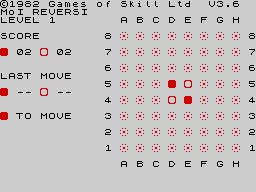
CLASSIC GAMES FOR YOUR MICRO The silicon chip squares off against the traditional board game - Sally Glover reports. This month I've been given a good selection of 'classic' boardgames, available for several home micros. To begin with we'll look at the three versions of chess that I have played. CHESS First, from Psion Chess for the 48K Spectrum. The game loads to display a 2D board and a menu of options which allows a player to set up the board for problem solving or to load a saved game if you desire. Opting to 'play' then allows you to choose a level of play (0-9) and a choice of black or white pieces. The game is played by using the standard algebraic notation to enter moves. The display is rather small and I found it a little tricky to differentiate between the King and Queen particularly. As a comparison for all three chess programs I used the Fidelity Sensory 9 chess computer with a proven ELO rating of about 1500 as a standard. I played three games, Fidelity versus Psion's Chess with the chess machine on level one (instant response) and the program on level five (response two to five minutes). The chess machine won every time although one session produced an entertaining end game. The result was not surprising though, and indicates that Chess is a sound basic program which is a good introduction for the beginner but rather too limited to appeal to the more experienced player. Beyond's MyChess II for the Commodore 64 is a better product altogether and boasts many features not seen in the program above. The first of these is a very good manual, rather than the brief information sheet of the previous game. Perhaps the most attractive feature is the option to produce a 3D view of the game. This involves loading the reverse of the cassette. This program also uses algebraic notation, which is clearly explained with examples to help the newcomer. The function key toggles between a view of the board and a list of the moves that have been made. Disc drive owners also have the option to toggle between 2D and 3D views of the board. The variety of options for 'set up' is impressive. The regular mode is computer versus human. Other modes include Demo, Players (human versus human), Solvemate (search for mate in a given number of moves) and Automatic where the program plays itself. There are too many other features, including hint, take back and so on, to cover fully in this brief review but it is clear that disc drive owners have many options not open to cassette users, particularly the 128 historic games which can be loaded and replayed from the B side of the disc. The nine level game program itself is much stronger than the Psion Chess game for the Spectrum and was able to force the Fidelity to a draw on two occasions. Personally, I found the 2D option easiest for play since the pieces in 3D are very difficult to tell apart, even if you use the 'turn board' facility and view from the side. Overall, though, MyChess iI is a good, solid program with many features (also found on the more expensive dedicated chess computers) that will be a boon to the developing player and quite challenging to the more experienced. The package is very good value for money - especially for disc drive owners! Finally, Psions QL-Chess which shows most of the features of MyChess II but has a brief 'handbook' similar to the Spectrum version. This time, though, this is not a disadvantage as everything is laid out clearly and in logical order. The game has an 'easy' mode where the computer cannot 'think' while you are considering your move. There is also the facility to have the program dump a hard copy of the game to printer. The game itself has both 2D and 3D options but, unlike the MyChess program, the 3D version is very, very smooth, a real joy to behold as the pieces, clearly shown, seem to glide around the board. The real strength of QL-Chess is in the program itself, the winner of the World Microcomputer Championship. It boasts no less than 14 levels of play ranging from novice, where the program plays more weakly if it is winning, to Championship with infinite response time. Playing the game at Tournament level (equivalent to level 10 of QL-Chess) resulted in five games against the Fidelity being drawn. QL-Chess then, is an excellent program that should suit all players from the novice upwards. The serious chess player might even consider buying the QL rather than a dedicated chess computer. OTHELLO Now a classic from more recent times, Reversi - or Othello. Two players use an eight by eight grid (like a chess board) and twin sided counters one side black, one side white. The object is to dominate as many squares as possible with your own colour by 'capturing' your opponent's pieces, causing them to be turned over to show your colour. The game continues until neither player can make a move. If it sounds a little complicated when written down, just watch the sample game in the pack before you buy to help you make up your mind. The graphics with the game are rather poor consisting of red circles depicting white counters and red discs for black, but the game it plays is very strong - I was totally unable to beat it even after reading the note on hints and strategy in the instruction leaflet. Othello is one of those games it takes a few minutes to learn and a lifetime to master. To help in this, though, the program has the facility to set up games at any stage like the problem solving modes in chess. Reversi is a very strong program badly let down by poor graphics that would probably soon lose your interest. The next classic of this month is Backgammon, another program from Psion for the Spectrum. BACKGAMMON The game is about 3000 years old and involves men (rather like draught pieces) on a board consisting of 24 'points' arranged in four 'tables' of six each. The number of spaces moved each turn is decided by a dice throw. The first player to move all his pieces off the board is the winner. This sounds pretty simple with a high chance element but there is one snag... Two dice are thrown and you can use the throw to move two pieces or the same piece twice - throwing a double gives you four moves. You cannot move a piece onto a point occupied by two or more enemy pieces (a block). If you land on a single enemy this piece is 'hit' and removed from the board. Your opponent must use his next throw to bring the piece back into play on your home table. If he cannot do this because he is blocked, the move is forfeit. So you can see the game has very strong tactical elements too. The Spectrum version of the game offers four levels of play and the option to throw your own dice if you think the machine is cheating - perhaps it was coincidence but it always seemed to throw a double when it was in trouble! The display is very clear and, as the program is written in machine code, the responses are almost instant. Backgammon, or at least this version, is very addictive and I was soon carried away, building blocks and cursing the machine's good fortune. Most enjoyable and available on both cassette and ROM cartridge. SCRABBLE I'm sure that Scrabble is a game that doesn't need much introduction from me as it is seen in toyshops worldwide and has spawned countless TV quizzes. For any that haven't played though, the object is to use the seven letter tiles at your disposal each turn to join with the letter tiles already laid to form a new word for which points are scored. The words laid down must appear in the chosen reference dictionary. Play continues until all times have been laid or the players decide to call a halt - usually when they are left with a handful of unusable letters. Certain squares improve the value of various words and letters. When play stops, the value of a player's unplayed tiles is subtracted from the total they have accumulated throughout the game. The player with the most points is the winner. Up to four players can try Sinclair's Scrabble on any of its four levels and games can be saved for later reloading. As far as I can see there are no options denied the computer Scrabbler that the conventional player might use. You can shuffle the tiles about on your rack, change them all or note the value and distribution of the pieces. The 11,000 word plus 'dictionary' in the program allows many words to be checked and accepted by the computer but the more outlandish suggestions will be challenged. The machine is quite happy to believe you if you tell it the word is valid don't be tempted to cheat though! Playing the game is very easy. Just use the cursor keys to choose the position for the first letter of your word, and type A or D depending on whether the word is to run across or down the board. Then just type it in. The computer won't let you use letters you don't have or position words incorrectly. The only difficulty I experienced was in making out the premium letter and word squares - they seem tiny even by Spectrum standards. In summary, I had a lot of fun with Scrabble and, if you're keen on this sort of game, it is good value for money. A nice, well programmed game. Next month I shall be looking at the ancient games of Go and Kalah and computer versions of Monopoly, Cluedo, Kensington and Bridge (not Tony, although he's a classic too).
Crash #4May 1984 · p.64
Producer: Sinclair, 16K £7.95 Excellent graphics, nine skill levels to choose from and you can watch the computer play or play against the machine. Hi-res graphics and machine code. One of the best versions, but so it should be for the price.
Crash #1Feb 1984 · p.60
Producer: Sinclair, 16K £7.95 Excellent graphics, nine skill levels to choose from and you can watch the computer play or play against the machine. Hi-res graphics and machine code. One of the best versions, but so it should be for the price.
C&VG (Computer & Video Games) #17Mar 1983 · p.29/108/108/10
Getting Started 9/10
Value 8/10
Playability 8/10
Terry Pratt
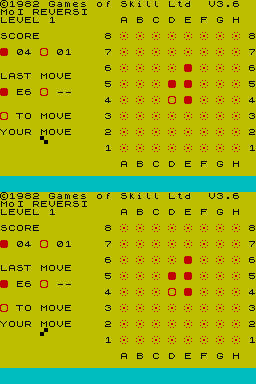
Reversi, or Othello as it is often called, is a nineteenth century game of territorial acquisition. Strategy and skill are needed to win. Two versions of the game are currently available for the Sinclair Spectrum, and both run on the unexpanded machine. One is by Mine of Information, for Sinclair Research, and the other has been written by Microx, based at Worthing, Sussex. The Sinclair version comes in a very pleasant package. the cassette insert is colourful and packed with information. Beginners should soon become well-versed in the game by simply reading it. The program loaded without any problems and ran immediately. The game is fairly standard, but with many interesting features. To begin with. there are nine skill levels, with a three-second response time at level 1. You can challenge the computer, with either the Spectrum or yourself starting, or you may play against a friend with the computer acting as umpire. If you are a beginner. you may review a sample game at your leisure. Half-way through a game you may change sides, and at the end of one, you may review all the moves of the game. The graphics are fair, and there is even a facility to change border, paper and ink colours to your requirements. All in all, this is a most magnificent game. I wish I could say the same for the Microx version. The purchaser is greeted by a most unappealing package bearing the company's name and the program title. After sorting out the loading problems, which I have never had with any other cassettes, I was confronted with a page of confusing text which would leave the beginner completely bemused. The game itself has a rather uninteresting screen display, and makes average use of colour. When I tried the program on a monochrome television set, the players' pieces were almost indistinguishable. The program is written in Basic. and there is only one skill level. The computer's moves are average, about equal to the moves of level one on the Sinclair cassette. The computer does not check if an opponent has had to pass. and if "enter" is pressed without a move being keyed in, your turn is overlooked. For my money, the Sinclair cassette has to be my choice. Microx Othello is no comparison to Sinclair Reversi, and I would not even consider purchasing it. Sinclair Reversi is available at £7.95 and Microx Othello at £3.50.
GAMES GLOSSARY If you can tell a Pacman from a Defender and a Galaxian from a Space Invader you probably know your way around computer games. But if some of the game terms we have used in this supplement, or in the issue itself, are new to you, then this page should supply the answers. In it we take some of the best known types of computer game and describe how they are played and what features these games normally incorporate. So, if we claim that Penetrator is a "Scramble-type game" and that leaves you just as much in the dark about what to expect, then below there is a full description of Scramble to put you in the picture. ASTEROIDS The Asteroids came into the arcades courtesy of Atari. It features a small dart-shaped craft controlled by the player which can rotate left or right and thrust or fire in the direction it is facing. There is one further control, the panic button (hyperspace) which lets you travel to another part of the screen chosen by the computer. The enemy is mainly made up of large asteroids which sweep across the screen in large deadly groups of rock. When blown up these break into smaller fragments worth extra points. There is extra danger supplied by two UFOs. The first larger creature you'll meet fairly early on. It tends to spray shots in all directions and often crashes into an asteroid. The smaller variety is far more deadly in its own shooting and also more difficult to hit. Each cleared screen means you start again with extra asteroids. DEFENDER You can't expect to keep a finger on every control button in Defender or you'd end up in knots. The action, which takes place above an alien landscape, involves some seven control buttons and takes patience to gain proper mastery of your lone craft. That patience can be rewarded though, as Defender is challenging from the word "Go". The Defender craft can go: up, down, thrust forward, reverse direction, fire, smart bomb and hyperspace. Ten humanoids wander on the landscape and these may fall prey to raiding alien creatures known as Landers. Landers pick up the humanoids and take them to the top of the screen. If they succeed in getting there the Landers turn into fearsome mutants hellbent on your destruction. In all there are six alien opponents. On top of Landers and Mutants, these are: Pods are quite harmless but contain the small and persistent Swarmers; Bombers seed space with white bombs and Baiters only appear if you take too long clearing a screen of the rest of the aliens. If all 10 humanoids are captured, the planet explodes and all remaining alien life attacks your craft at once. Defender games usually feature a small radar screen which shows what is going on at all parts of the planet surface. FROGGER Frogger has spawned a whole host of computer games with a similar theme. This game features a frog hero who must jump across a road and make his way across a river torrent to five frog-holes in the bank. The busy road usually features live streams of traffic travelling in both directions at varying speeds, between which the player must hop his frog without wrapping it around any fenders. Once across the road, the river can be crossed by leaping onto floating logs and onto the back of swimming turtles, until our frog can enter a vacant spot in the far bank. Turtles have a habit of diving though so don't let a frog dally too long on one. Being carried off the edge of the screen (by log or turtle) also results in a note in the funeral column of Amphibians' Weekly. When all five frog-holes have been filled, the game becomes more difficult with extra traffic being added to the road, snakes traversing the bank between road and river and alligators appearing instead of logs in the river. A timer running down on each frog also adds to the difficulties. The arcade original also featured a small lady frog who could be "picked up" on the logs and offered a lift home for a bonus. Other bonuses can be scored by entering a frog-hole in which a tasty fly meal has come to rest. DONKEY KONG Donkey Kong is the strange name for a climbing and jumping game which features a starlet-grabbing monster gorilla. Often referred to as Crazy Kong or Crazy Climber in the computer circles, it has only just found its way onto the home screen. The game features a gorilla holding a girl captive at the top of the screen and an intrepid hero (Mario the carpenter), who starts at the bottom of the screen. Between the two is a connecting network of platforms and ladders up which Mario must run to achieve his rescue. Kong hurls barrels down the screen and Mario makes use of his "jump" button to leap over them. He can also grab a hammer and smash the barrels as they approach him. Once at the top of the screen a new complex is built with Mario, again starting from the bottom with a view to rescue. This time the screen features a series of conveyor belts and deadly fires which travel around on the ladders and belts. GALAXIANS The Galaxians were the sons of Space Invaders. Instead of proceeding down the screen at a leisurely pace, they wavered at the top of the screen before swooping down in batches of two or three (or more often on a solo mission) firing bombs. The player has the usual left, right and fire controls on his laser base and must take care not to get trapped in a corner. He scores double points for a galaxian hit in mid-swoop and there are bonus points for taking out the red fleet commanders, who usually descend flanked by their generals, dispersing bombs at such a rate that the first instinct is to flee for cover. That is the essence of Galaxians but with each destroyed platoon, new waves appear at screen top and their attacks become more frequent, more accurate and, all too often, more deadly! PACMAN The ghostly world of Pacman is made up of a dot-filled maze, a hungry dot-eater and four pursuing spectres. Pacman variations can be found under a whole range of titles from Vic-men to Gobbleman, Snapper to Super Glooper and many others. Most dot-eating games are related to it. The main character is the dot-eater, which travels around the maze, eating every dot he touches. His objective is to clear the screen of dots. He is hampered in this by the four chasing ghosts whose touch is lethal. The Pacman's main defence against the ghosts, who usually number four, are energiser dots. These pulse in the four corners of the maze and, upon being eaten, reverse the roles for a short while. This means that Pacman can turn the tables on the ghosts and eat them for bonus points. He is allowed only a few seconds of dominance before the usual hunter and hunted rules come back into operation. It is also usual for fruits to appear on the screen occasionally and these too can be consumed by Pacman for bonus points. When Pacman has cleared the screen, it refills with dots and the game restarts except that this time the ghosts are a little livelier and a new fruit, worth extra points, appears at this level. SCRAMBLE Scramble should have a big one-way sign on its cabinet. The screen rolls from right to left, taking the player's craft along it into ever-increasing danger. Scramble variations often contain the word "Mission" or "Attack" but there are some weird and wonderful titles about. The player controls a craft heading right across the screen over hilly terrain His craft can never turn around and opt out of its mission but he does have some control over his destiny. His controls are up and down, fast and slow and he can both bomb and fire at his enemies. The Scrambler is not usually equipped with enough fuel to complete his task, but it is normal to obtain more fuel by bombing fuel tanks on the ground and so (mysteriously) replenish his own stocks. The enemies come in all shapes and sizes. Most common are missiles which fire up from the ground as your craft passes overhead and alien invader creatures which frequently inhabit caves and fly at the player's craft. The original Scramble game sent the player through a series of different terrains with new challenges in each section. And most computer Scrambles attempt to duplicate this with a number of different stages. Scramble requires a cool head which can find the right control in a crisis, but it makes an ideal computer game as success naturally leads to new and more difficult stages. INVADERS Space Invaders started the whole computer game craze back in 1977 and most gamers know the format backwards. Still, just a brief resume... The invaders come in waves above the ground and move in rows across the screen one step at a time, firing missiles earthwards. When one row of the aliens reach an edge of the screen, the whole platoon jump down a line and return back the way they came. When they achieve their slow progression to the bottom of the screen, the game ends. The player controls a laser base which moves left to right and fires directly up from its position. His aim is to blow up the entire fleet before it reaches the bottom of the screen. Flying saucers move across the top of the screen in both directions and can be hit for a mystery bonus score. In the arcade original, top saucer scores of 300 were achieved by firing 22 shots before shooting at the first saucer, then firing 14 shots in between each subsequent saucer. Some computer versions have copied this technique.
TIME AND MOTION The classic board games transfer well to computers who make better than average opponents on all the games dealt with here. But there is more to choosing a chess, backgammon, draughts or reversi program, than picking one which will beat you every time. Most important in these programs are a display that is clear and easy on the eye, coupled with pieces which can be easily recognised. Programs which use disturbing colour clashes or badly shaped pieces will hardly help a player trying to give caretul study to a critical position. The program should also draw a player's attention to its move. Both an audio and visual signal should be included to let the player know it's moving and which place it is changing. A good response time is crucial. If left to its own devices for long enough most computers can come up with a good move. But long study should be the human player's prerogative - computers are used for their speed. Finally an easy-to-understand, and implement, move input system will ensure that the program does not start gathering dust after the first few tries. In chess it is difficult to come up with anything better than E2-E4 but this can easily lead to a mistake which is still a valid move and completely ruin a player's chances. Few programs allow the player to take a move back, try and find one that does. Other key things to question with regard to chess: does the program always respond to P-Q4 openings the same way? If so you're in for a dull opening repertoire. Does it play forced moves quickly? Does it keep its head when things go wrong? Some programs just give up on bad positions. Terry Pratt
Sinclair User #12Mar 1983 · p.628/10
Gilbert Factor 8/10
John Gilbert
SINCLAIR ACTS TO IMPROVE THE STANDARD OF ITS NAMED SOFTWARE John Gilbert looks at the latest group of cassettes issued by Sinclair and finds that it is now setting the standards. A new batch of Sinclair Research software for the ZX-81 and Spectrum shows a marked improvement in the quality of programs and a continuation of fine artwork on the cassette inserts. The reason is that the company is selling programs from other independent companies, such as Melbourne House and Artic, instead of continuing to rely on Psion, Mikro-Gen and ICL. The Hobbit which takes first place in the new releases for quality and value for money. This adventure game, which the makers claim uses artificial intelligence, is discussed in Mind Games on page 93. VU-3D, for the 48K Spectrum, is another good offering from Psion. It allows the user to create a three-dimensional representation of an object on the television screen. The object can then be rotated and viewed from any angle. The objects can be displayed as wirework figures or can be shaded. They can also be magnified and reduced. It is possible to store the figure on tape in a data file and re-load it to view again. The program costs £9.95 but even though it has some good features it still seems over-priced. Games feature strongly in the new tapes. Sinclair is selling the Artic range of adventures, A, C and D. Adventure A works on the 16K or 48K Spectrum and 16K ZX-81 and is called Planet of Death. You are stranded on a planet and must return to your spaceship. There is no guide to the keywords but with a little thought you can discover the help command. At times the suggestions can be very unhelpful and it is a good idea to construct a map, as some of the help suggestions may make you retrace your footsteps. The next adventure so far released is C, called Ship of Doom. It can be run on the 48K Spectrum and 16K ZX-81. Your ship is captured by aliens who are searching for humanoids to replace their brains with microchips. The object of the game is to escape from the alien craft by breaking the gravitational field. To do so you must find the control room of the alien ship. The help command is a little more useful in this game and it is easier to get further when playing the game. Adventure D, called Espionage island, can be used on the 48K Spectrum or 16K ZX-81. You must escape from an aircraft which is about to crash into the Atlantic. You must the reach the island safely, avoid capture, and try to discover the secret of the island. The game is more difficult than the others and many people have not managed to get out of the aircraft, even though there is a parachute. All the adventures cost £6.95. Leaving adventure games, Reversi, or Othello as it is sometimes called, can be played on the 16K Spectrum or 16K ZX-81. The game has nine levels, from novice to expert, and the computer is difficult to beat. The makers claim that Reversi reflects the strict contemporary morality of Victorian society but we believe that it can traced to Arabic origins. Reversi costs £7.95. An interesting addition to the range of software is the Artic 1K Chess. It takes some technical wizardry to squeeze this kind of game into the unexpanded ZX-81. The game can be played using one of two opening moves. Because of the lack of memory, castling, pawn promotion and capturing en passant are not allowed. The game loads in approximately 40 seconds and that is ideal for someone who wants a quick game of chess without having to load from a tape which takes several minutes. The computer also makes its moves very fast for the amount of memory available to it. 1K Chess costs £4.95. Super Glooper is an amusing game of Pac-man on the 16K ZX-81. Glooper must paint the maze before the aliens kill him. Unfortunately it is difficult to evade those aliens using the standard ZX-81 keyboard but it is not impossible. Glooper can also pick up one of the shields at the corners of the maze to protect himself and chase the aliens. On the other side of the tape is Frogs, a game of Frogger. You must get the frogs over the river via the moving boats to the jetties on the other bank. If froggie falls into the river, it drowns. You score points for each frog you get across the river and you can have eight frogs to send to their deaths. Super Glooper and Frogs cost £4.95. Another game with a familiar-sounding theme is Through the Wall. It is based on Breakout and is available for the 16K ZX-81. On the other side of the cassette is Scramble, also a familiar theme. Both games on one cassette represent good value at £4.95. A package for the 1K ZX-81, called 1K Games, has also been released. The games include Jackpot, in which you must try to win the 25 pence jackpot from a one-armed bandit; Etch and Sketch, where you can draw pictures on the screen; and Maze Game, where you must find your way out of the conventional maze. The release of this cassette, costing £4.95, is a good idea at a time when so many people are buying ZX-81s. A basic Toolkit is available for the 16K ZX-81. It provides a series of machine code routines to make the job of programming easier. It includes a re-number routine, a search and replace routine, a merge routine to put together two separate Basic programs, and a routine to put a Basic program above RAMTOP and out of the way of the NEW command. The Toolkit costs £5.95. Two database programs are available in the range for the 48K Spectrum. They are called Collector's Pack and Club Record Controller. Collector's Pack can be used to store information about coins, stamps or even records. The Club Record Controller will store information about people such as addresses and telephone numbers. It would be useful to schools or even someone who runs a private club. Both packages are easy to use and cost £9.95. Adventure B, Inca Curse, for the 48K Spectrum is an upgrade of an adventure which Artic wrote for the 16K ZX-81. The adventurer is exploring in the jungle when he finds an Incan Temple. The aim is to go in and drag out all the treasure, or as much a you can carry. It all seems so easy until you enter the game and step into the temple. The authors have managed to cram a good deal into this adventure and the Artic top score of 3,200 points will take some beating. We must admit that it is not one of the adventures in which we have made much progress. Adventure B costs £6.95. The latest release of tapes is certainly better than the previous one. The games, utility, and business areas have been covered well but there is still a lack of good educational software. The only tapes available tend to be multi-choice and question-and-answer sessions. The Psion tapes seem to be the best for quality at the moment and the ones with the most interesting concepts. None of the cassettes reviewed was bad but The Hobbit, Vu-3D, 1K Chess, and Super Glooper seem best.
Review2
- ZX Collection1984 · p.110
- Popular Computing Weekly #9Mar 1983 · p.12
Feature1
- Micro Adventurer #17Mar 1985 · p.10
Licensed from
- Reversi/OthelloBoard/Tabletopunofficial
Related
- Versions
- Reversi (Another platform for)
- Compilations
- Open Game #5, Load 'n' Run issue 55
- Tags
- Turn based
- Same entry at
- Spectrum ComputingZXInfo
Reviews from people here
Sign in to write about this, or make an account. It takes a minute and lets you correct the catalogue too.
No description recorded.
Sign in to correct or add to this.
Hold the rights to this and want it taken down?