
Revolution
Puzzle Game: Problem-Solving · ZX-Spectrum 48K · 1 players · English
U.S. Gold Ltd · 1986
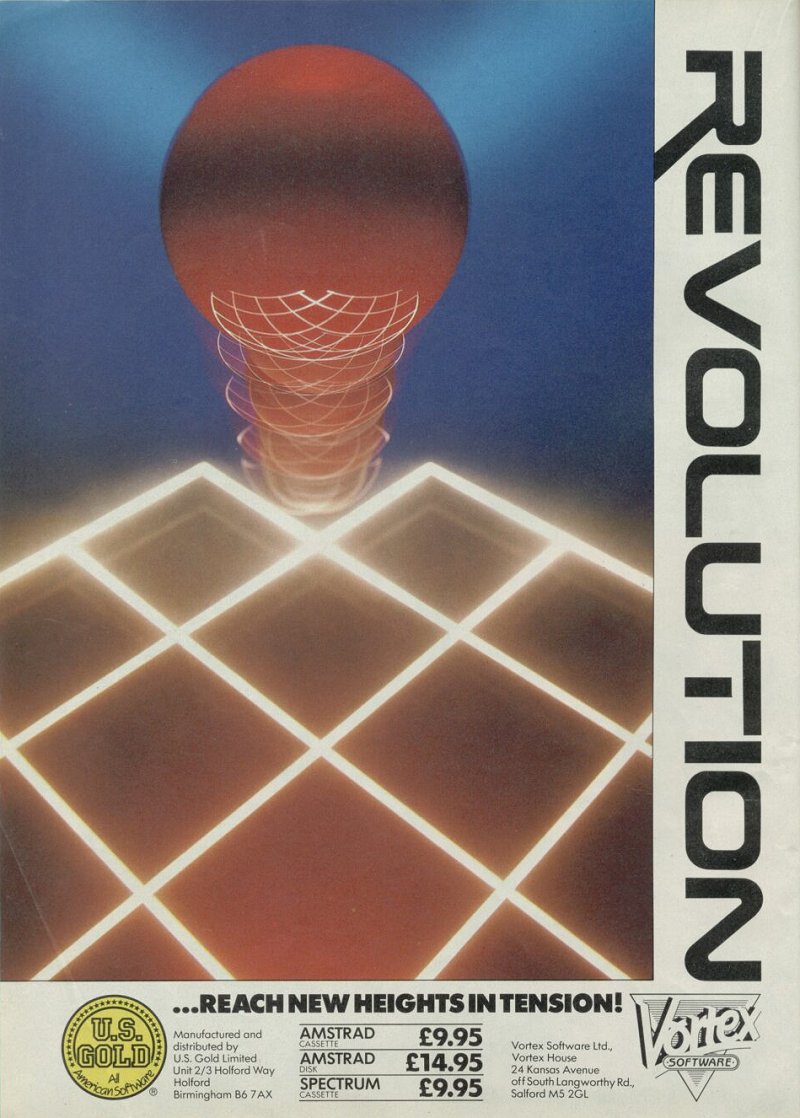
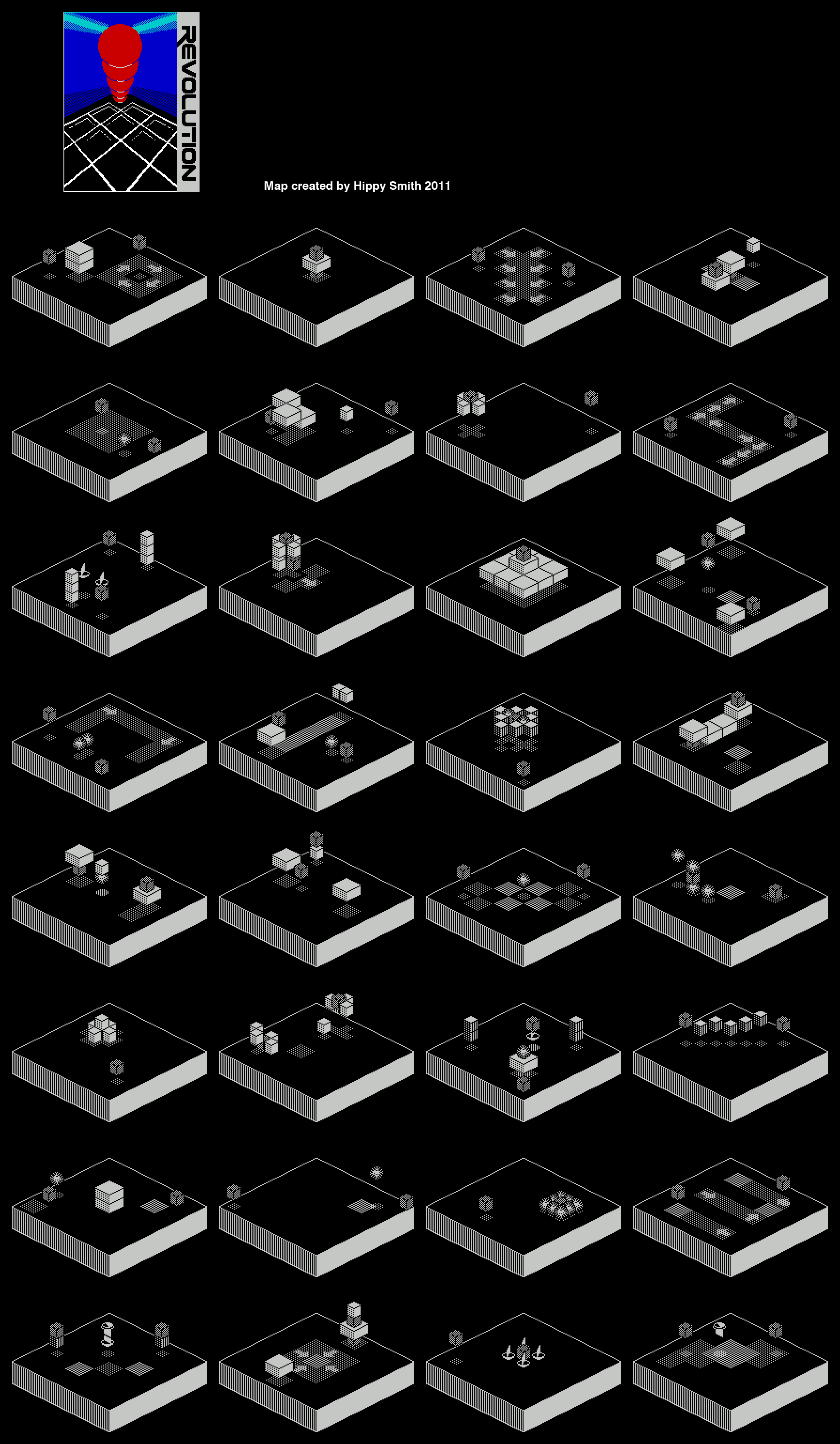
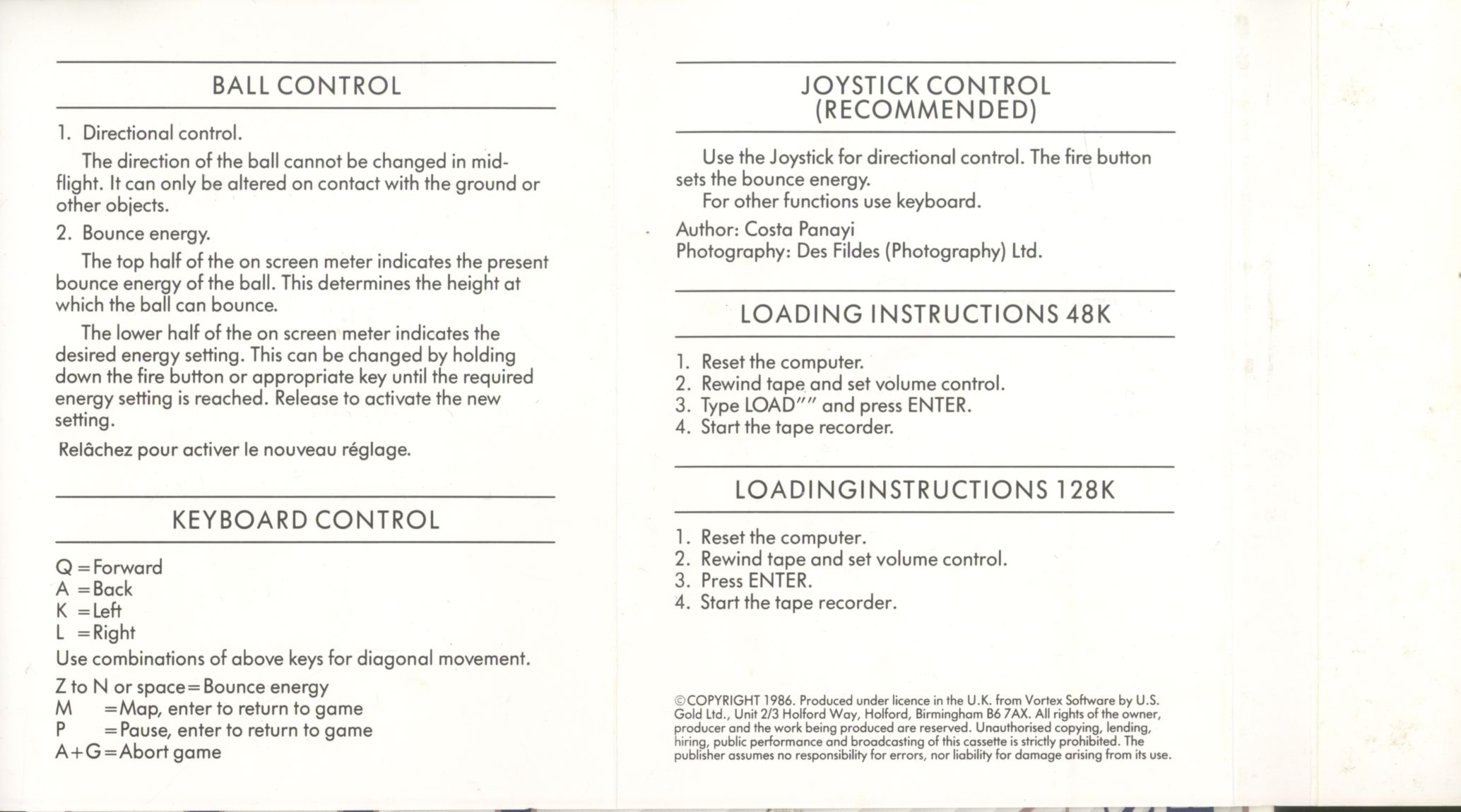
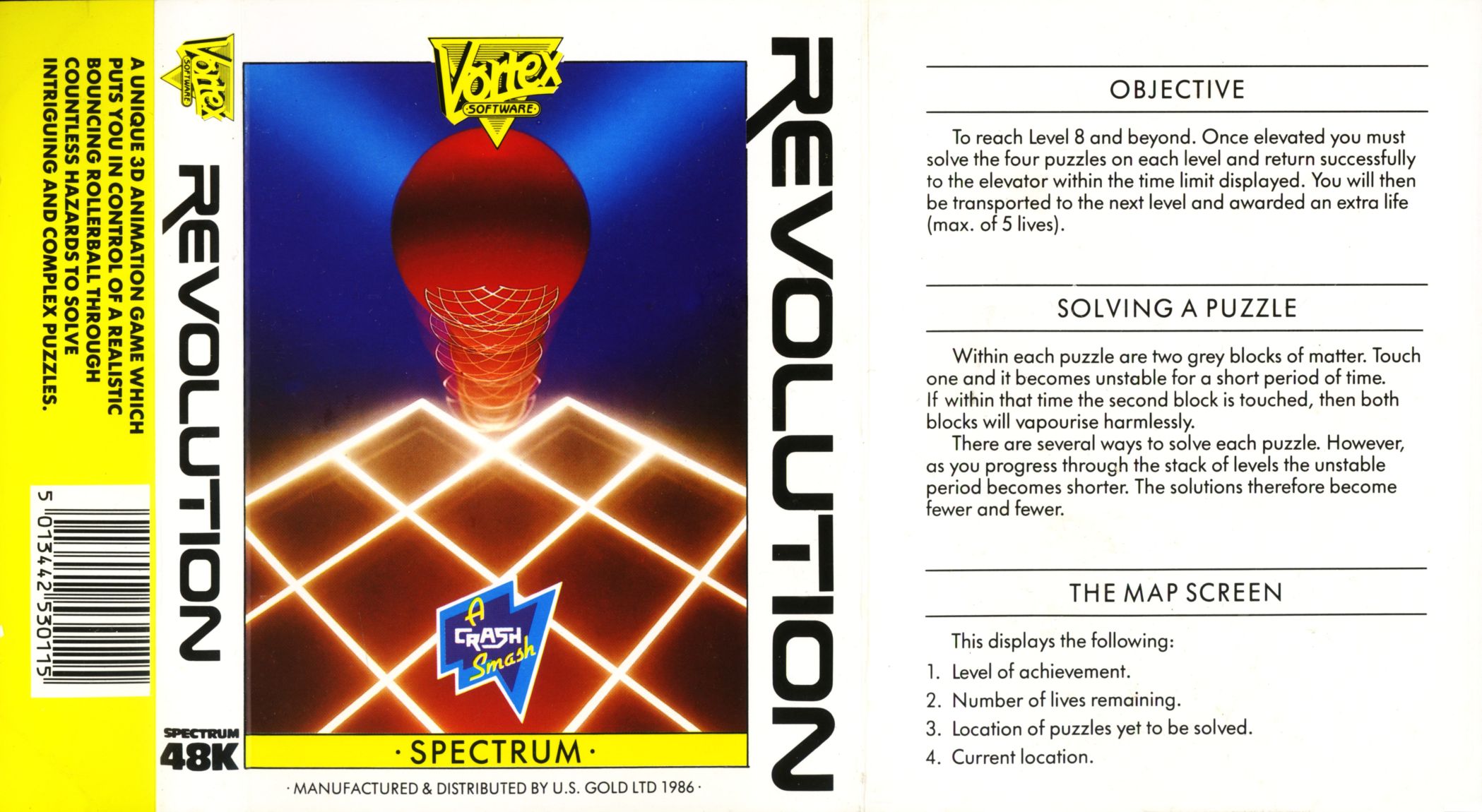
.jpg)
Discussion
Nobody has started a thread about this yet.
Known Errors
Bugfix provided by Mr. Anonymous: <UL><LI> The game cannot be completed due to this problem: <PRE>$8DAC LD A,R ;register 'A' is never greater than $7F in practice SLL A (undocumented) ;thus carry flag is never set JP NC,$8C53 ;following code (to restart game) is never reached!</PRE> This problem can be avoided replacing 'SLL A' with 'SRL A'. Fixed using POKE 36271,63</UL> Modified "BUGFIX" file provided by Einar Saukas.
- Control Option
- Cursor, Interface 2 (right), Kempston Joystick
Releases
- 1986U.S. Gold Ltd
- 1986Erbe Software S.A.
Play
- Revolution(BUGFIX).tzx.zipBUGFIX tape image English19 KB
- Revolution(BUGFIX).tap.zipBUGFIX tape image English19 KB
- revolution.rzxRZX playback file
- Revolution.tzx.zipTape image English20 KB
- Revolution.tap.zipTape image English19 KB
Documents
- Revolution.txtInstructions English3 KB
- Revolution(ErbeSoftwareS.A.).pdfInstructions Spanish9 KB
Other files
- Revolution (1986)(US Gold).pokPOK pokes file 0 KB
Files and rights
No permission is on record either way. Screens and pictures are copied here on a take-down basis: if you hold the rights and want something removed, say so and it goes.
Credits
- Costa Panayicredited
- Des FildesInlay/Poster Art
Sign in to credit somebody, or say what these people did.
Awards
Scores
In the magazines
- Sinclair User #551986 · Overall5/5
- Your Computer #111986 · Overall5/5
- Your Sinclair #111986 · Overall9/10
- Crash #331986 · Overall91%
- Your Sinclair #231987 · Revolution8/10
Elsewhere on the web
- WorldOfSpectrum 21 votes7.95
In the magazines 29
ACE (Advanced Computer Entertainment) #9Jun 1988 · p.85
ACE (Advanced Computer Entertainment)
Spectrum £8.95cs (On Best Of 3D compilation) Costa Panayi added bounce and his usual inventiveness to Marble Madness control problems, and here's what he came up with. A terrific looker on the Amstrad and very playable on both formats, the game features some of the oddest and most challenging 3D puzzles ever seen. Hitting two blocks in quick succession might not sound too difficult, but with a range of obstacles in the way and sheer drops close at hand if you overshoot, things can get very tough indeed. The time limits are nasty too, and get tougher as you move on through the levels, giving the game lasting interest to match its instant appeal.
ZX Computing #31Nov 1986 · p.31ZX Computing Monster Hit
ZX ComputingZX Computing Monster Hit
MASTERLY GRAPHICS, INFURIATING PUZZLES - ALL YOU EVER WANTED FROM A BOUNCING BALL GAME. Vortex/U.S. Gold £9.99 Costa Panayi, author of many of Vortex Software's previous hits, has made a change in direction after his recent games Allen Highway and Highway Encounter and come up with another winner. Revolution is one of those games which is quite simple to play (in principle anyway), but very difficult to master and absolutely infuriating when you get into the later levels of the game where you can see what you want to do but can't quite pull it off in time. The game is played on a multi-tiered structure consisting of eight levels, and your task is to start on the bottom level and work your way to the very top. Each level is made up of an assortment of platforms, all on the same level but separated by gaps which have to be avoided. These platforms are arranged in a roughly square arrangement (which changes in each game) with the occasional empty position which you might find yourself plummeting into if you look before you leap (each of these levels is a bit like one of those sliding square puzzles in which you can move the squares around to try and form a picture or sequence of numbers). You control a ball which can be bounced around the platforms and in order to complete a level and progress to the next you have to solve four puzzles. Scattered around each level you will find four platforms which carry various brick-like structures and shaded pathways. On each of these platforms there are two grey blocks which turn white when you bounce into them and deactivate them. Each brick will remain deactivated for just a few seconds before reactivating and turning grey again, but if you can get both bricks deactivated at the same time then they will both vanish - problem solved and you can move on to the next problem on that level. Unfortunately you've also got to contend with the shaded pathways on these platforms, and these can have different effects varying from just killing your bouncing or grabbing the ball and shooting it over the edge of the platform into oblivion. At the start of each level you are shown your position within the overall structure, as well as a map of the particular level that your are on. This map highlights both your own starting position and the position of the puzzles on that level so you've got a few tips to start off with. When you see this map it's also a good idea to make a mental note of the empty positions, as I found that I often went bouncing from one screen to the next only to find myself bouncing into nowhere. You only get five lives (though there are additional ones for completing levels) so you can't afford to do that too often. Controlling the ball is an art all in itself. It can move in any direction that a joystick handle can move in (a joystick is almost compulsory for this game I should think), and responds very smoothly to joystick control but judging the height and distance of your bouncing is a skill that will take a lot of refining, especially on some of the trickier puzzles where you've got to squeeze the ball through some quite tight spots. There are four different heights of bounce, controlled by using the fire button, or you can kill the bounce altogether and just roll along the surface of the platforms. There is also a variety of flying objects which patrol each level and though few of these are deadly you can find yourself accidentally colliding with one and bouncing off in a totally unexpected direction. The graphics are mostly in just two colours to avoid attribute clashes, but as with Vortex's Highway games the graphic style is quite distinctive, making good use of fine shading effects to create clear and detailed pictures. But where I found the Highway games to be a bit too fast and furious for my gin-addled reflexes, Revolution is the sort of game that each player can play at his or her own pace. If you want to go bouncing around the platforms like a loony you're quite free to do so, but if you're content to take things a little bit slower and just roll slowly around while you try and figure out which way is up you can do that too. At £9.99 Revolution is a bit pricey, but it's more likely to provide a long term challenge than most other arcade games around at the moment.
Vortex's Alien Highway: Scheduled for budget re-release on U.S. Gold's Americana label.
Vortex: Crete Panayi, Luke Andrews, Costa Panayi.
ZX TALKS TO SALFORD BASED SOFTWARE HOUSE VORTEX ABOUT THE INTRACACIES OF REVOLUTION. Revolution, a complex 3-D brainteaser is a real test for puzzle solvers as the game layout subtly changes with each new game. Luke Andrews of Vortex explained the evolution of Revolution. "Firstly it was essential to create the game in 3-D. It offers an attractive illusion and greater scope for complicated gameplay. The bouncing ball idea was really a progression from Highway Encounter but we wanted to do something completely different with it. "The idea had been around in Costa's head for over a year until he got the confidence to create such a game. What happens is that Costa comes up with an overall graphic treatment and we discuss ideas and ways of creating improved gameplay. ON THE LEVEL "The levels idea came at a later stage. We knew the bouncing ball was going to be the main character but we wanted an alternative to a long drawn out game on one level and something different from the usual map. With the idea of the levels we solved both problems. This way you could identify where you are and the overall layout very simply." One of the infuriating aspects of puzzle based games is laboriously working through the puzzles you've already solved to get back to the position you reached in your previous forays. In Revolution this problem doesn't arise. "There are eight layouts in the stack and the chances of meeting those layouts in the same order twice are 1 in 10,000. There's also a checkerboard layout that you encounter in the later levels. The random element is built-in in two ways. Firstly the puzzles are mixed up in the various levels and secondly you may find one puzzle on an early level and again later but you will have less time to come up with the solution. COMPLICATIONS "Programming games like this presents immense difficulties and although most of them are ironed out in the early stages. One problem was that when the ball was perched on an object it would just fall off rather than roll or pop up. It was solved, but getting the ball to look convincing and realistic was perhaps the hardest part. "The idea of touching the two blocks to solve the puzzle came about half way through the development. The three of us have been together for about four years now and when an idea comes up that we like we all get enthusiastic. If any of us hesitate then we ditch it. With the blocks we knew it was the vital ingredient we needed."
Your Sinclair #11Nov 1986 · p.27Your Sinclair Megagame9/109/109/109/109/109/10
Your SinclairYour Sinclair Megagame
Graphics 9/10
Playability 9/10
Value For Money 9/10
Addictiveness 9/10
Overall 9/10
Tommy Nash 9/10
Vortex £8.95 Reviewer: Tommy Nash If you're looking for a spot of Commie bashing, comrades, you can forget it. This Revolution hasn't even got anything to do with the ill-fated Al Pacino epic that bombed at the movies this year. But it sure is a game that's hot to Trotsky. Revolution is a 3D puzzle game. You have to work your way through eight levels stacked one on top of the other. On each level there are four puzzles to solve, with a limited amount of time to solve them in, before you're transported onto the next platform. As for the puzzles they'd have Rubik tearing his hair out! They all consist of two grey cubes arranged in different configurations. Touch one of the cubes and it turns white; now touch the other before the first goes grey again and the pair of them disappear and bingo, you've solved your first puzzle. So, what could be simpler? Taking a day trip to the moon. Making a million. Working for YS. 99 per cent of all human activity actually. The big problem is that you're controlling a bouncing ball - though come to think of it, control is not quite the right word for the way I played the game. And you can only alter the direction of the ball when it hits the ground. You can also regulate the bounce of the ball but remember to take into account the momentum that it's already got. It's one hell of a tricky task trying to judge the bounce of the ball and move it between the cubes in the couple of seconds that you're given to complete the puzzle. And you're not helped if one of the cubes is completely hidden - yes, it happens - or if you keep getting frazzled by the spiky nasties. But now the ball's in your court - you give it a go. Boing, boing, aaaargh! Oh, I forgot to mention that you can fall off the edge or between the cracks of the platforms into the inky void of oblivion. Still, four more lives to go. Boing, boing, aaaargh! And so it goes on. Addictive? I should say so! And you're not deterred if you can't get through the first platform on your first play and keep having to start back at square one again as you do in some games. The puzzles and platforms are re-arranged at random each time you start a new game. There are no Red Squares in this Revolution but the monochrome graphics are all up to Vortex's usual standard. Yet another cracker from Costa Panayi, the programmer, that'll appeal to the more interlekchall games player. If that's you - Russian and buy it!
Now what could be simpler. Just bounce up and touch one of the grey blocks and then reach the other one before the first turns grey again. Trouble is you may find you have to bounce up high for the first then roll along the ground for the second so timing and co-ordination are of the essence. Enough tips here to keep Hex Loader happy...
Okay, let's start at the bottom and work up. You can access the map of the level you're on at any time just by pressing the M key. It shows you the position of the four puzzles, the red dots, the square you're on and the holes you have to watch out foooo...
Your Computer #11Nov 1986 · p.455/54/54/54/55/55/5
Graphics 5/5
Sound 4/5
Playability 4/5
Value For Money 4/5
Overall 5/5
Francis Jago 5/5
Vortex Strategy £8.95 Vortex can scarcely be accused of trying to flood the market with its products. One thing to stand out from all its releases, however, is the quality of Costa Panayi as a programmer. His hits, which include TLL and Alien Highway, have always included fabulous three-dimensional graphics, and Revolution is no exception. At first glance, Revolution appears to be an uneasy combination of Bobby Bearing and Bounder but once you have been enthralled by the graphics and overwhelmed by the realistic feel of the ball control, the game soon becomes a challenge which cannot be ignored. The object is to bounce, or roll, round various levels of the game, solving puzzles as you go. Control is via the keyboard or, more realistically, a joystick. The puzzles consist of touching two blocks quickly before they have a chance to revert to their original colour. Essentially that sounds very simple but when you have to contend with all kinds of inanimate objects whose life revolves round making you fall off the edge of the playing plain, the game becomes much more difficult. What makes it so playable is the realism with which the ball moves. Gravity, elasticity and power are all well represented. although the height of the bounce can be determined by the player. Once you have played the game once you will be hooked. It requires more than dexterous finger-work and more than an auto-fire option to succeed. What you really need is patience and skill.
Crash #33Oct 1986 · p.16Crash Smash89%91%90%87%93%88%91%
Use of Computer 89%
Graphics 91%
Playability 90%
Getting Started 87%
Addictive Qualities 93%
Value For Money 88%
Overall 91%
Unknown
Unknown
Unknown
Producer: Vortex Retail Price: £9.95 Author: Vortex Software: Costa Panayi Vortex has an enviable reputation that spans virtually the entire history of Spectrum gaming, largely thanks to the programmer Costa Panayi (Android, Android II, TLL, Cyclone, Alien Highway and Highway Encounter) whose preoccupation with 3D representation has made each game outstanding and usually innovative. Now he's turned his talents to something completely different with Revolution. In this 3D game you control a versatile bouncing ball and the idea is to solve various puzzles on each game level. The action takes place on huge platforms suspended above bottomless ravines. Gaps of varying distance separate each platform, some are small and easily bounced over, while others are vast and take a lot of bouncing to get over. Being a bottomless ravine, going over the edge always ends in death for your ball. You move around by either bouncing or rolling. If for any reason the ball becomes stationary then you can get it bouncing again by using extra super bounce. A red bar indicator is provided to show the height of bounce being achieved, letting you estimate the amount of strength needed to reach an objective. But what about the puzzles? They're all identical in concept and consist of deactivating two grey boxes set a distance apart from each other. Touching a box with your ball turns it white and deactivates it for a short length of time. Next you must get your ball over to the other grey box and turn this white as well before the first block turns grey again in order to complete each puzzle. All fine and dandy. However, apart from the extremely short deactivation time limit, each puzzle contains various nasties, some animated some not. Like all nasties, they're convinced that what you're trying to do is wrong and are all out to stop you. The animated ones scoot around just above the ground at great speed and any contact has disastrous results - your ball may be given a swift nudge, knocking it off course or even be sent over the platform edge to its doom. Despite their savagery, the stationary perils are probably the hardest to negotiate. Arrows on the ground scoot your ball rapidly towards the direction in which they point. This either keeps you away from the block you're aiming for, or once again sends you to your death off the edge. Solid patches of grid act as super bouncing plates and might fling you off the side or sproing you in completely the wrong direction again. The furry nasties with their waving flagella-like protrusion are instantly lethal and if your ball touches any of these then a life is lost. Each level must be completed before an automatic lift transports your sphere to a higher grade. There are nine levels in total in the game, each with progressively more and harder puzzles. The position of puzzles on a level is indicated by red circles on a map, shown on at the start of a level. During play the map screen can be accessed by pressing the M key. Your starting position (which is rarely the same) is also shown on this map by a yellow rectangle. Five lives are provided for each game. When you lose one a new ball is shunted out of dock and automatically placed on the lift. This carries the ball up to the correct level and it's then up to you to control where it goes. On higher levels the deactivation time limit gets shorter and there is an overall time limit to each game shown by the descending green bar at the bottom of the screen. Beside it sits the score chart showing how many puzzles have been completed. A set amount of points is scored for each puzzle depending on its difficulty. Just because you've managed to complete the game once don't think playing it through is a doddle - each time a new game starts the puzzles and their positions are redistributed amongst the levels randomly! COMMENTS Control keys: Q/A forward/back; K/L left/nght; Z to N or SPACE for bounce energy Joystick: Kempston, Cursor, Interface 2 Keyboard play: combination key presses allow for diagonal movement, making control tough at first Use of colour: virtually monochrome but effective Graphics: great animation, generally excellent Sound: good spot effects, no title or game tunes Skill levels: progressive
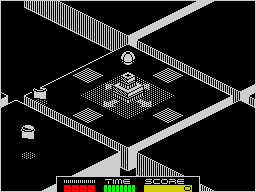
The REVOLUTION ball bounces with anticipation as another problem zone is approached. A mobile furry nasty, moving cube and bounce-distorting floorpads are amongst the hazards that must be negotiated.
The map screen. On the left is the stack of levels that must be worked through, while a plan of the current level is revealed on the right.
C&VG (Computer & Video Games) #60Oct 1986 · p.307/106/108/109/10
Graphics 7/10
Sound 6/10
Value 8/10
Playability 9/10
MACHINE: Amstrad/Spectrum SUPPLIER: Vortex PRICE: £9.95/£14.95 (Amstrad cassette/disk)/£9.95 Spectrum First impression: Revolution is a great game. Second impression: It's definitely a great game. Lasting impression: It looks good, it sounds good and, by golly, it is good. Revolution is very much in the tradition of past Vortex games with excellent graphics presented in exciting 3D. Both the Amstrad and Spectrum versions are very similar and for the purposes of this review, will be treated as one. The main differences are the Amstrad's better colur and sound. The Spectrum's monochrome graphics - due to the good old attribute problems - look a little drab in comparison. The idea is to control a bouncing ball - it has four levels of bounce - through eight levels of play, solving four puzzles per level. Simple maths tell you that there are 32 puzzles in all to be solved. The object of each puzzle is to make two blocks, one made of matter and the other anti-matter, disappear. Touch one with the bouncing ball to change its colour. You then have to touch the other block. It will also change colour and the two blocks will disappear. Solve the four puzzles and it's then on to the next level. But of course things are not that simple. The blocks change back to the original colour after a certain time, so you have to move quickly. There are also various hazards - blocks which kill your bounce; delicate dandelion shaped things which prove lethal; areas which slide you away from where you want to go. Of course, if you're clever these things could be put to use in solving the puzzles. But the really great thing about Revolution is that while it is very hard to progress through the levels you don't get bored trying to crack the same old puzzle each time. Each time you play a new game, the computer randomly conjours up a new grid for each level and randomly chooses the puzzles for each level. This means that it could be a long time before you play the same puzzle twice. It's also possible to pause the game and consult a map to show you where each puzzle is on the playing grid. Revolution has been around nine months in the making and the effort certainly shows.
AMSTRAD SCORES Graphics: 9/10 Sound: 8/10 Value: 8/10 Playability: 9/10
THE PROGRAMMERS Vortex Software has built up quite a reputation since it was launched back in 1982. Each of its releases has been progressively better - witness the success of the recent Highway Encounter and Alien Highway . Other releases include Android One, Cyclone and Tornado Low Level. The men behind Vortex - Luke Andrews and his brothers-n-law, Creete and Coast Panayi - have hardly blitzed the market. Quality has always been their aim. And with the release of Revolution on the Spectrum and Amstrad, Vortex has - if there is any justice in the world -a number one hit. And the recently announced link-up with US Gold will do the company no harm. US Gold will now manufacture, promote and market Vortex games but at the same time Vortex will retains its individuality and logo. Without the day to day headaches of running a software house, Vortex now plans to expand the programming side of its business and the hunt is now on for more programmers.
Sinclair User #55Oct 1986 · p.49Sinclair User Classic5/55/5
Sinclair UserSinclair User Classic
Overall 5/5
Clare Edgeley 5/5
Label: Vortex Author: Costa Panayi Price: £8.95 Joystick: various Memory: 48K/128K Reviewer: Clare Edgeley The days of the bouncing ball are not over yet. We've had a couple of games already on this theme - Gremlin's Bounder and Mirrorsoft's Action Reflex - but Revolution knocks the spots off the opposition. Very much in the Vortex style of clear, monochrome graphics and superb 3D effects, Revolution depends on a logical thought process and a lot of patience. It held me enthralled, and I didn't even get near the harder levels of the game. You control a ball which has four levels of graded bounce - it's essential to get the hang of the bounce if you're to complete the four infuriating puzzles to be found on each level. The puzzles are easy to spot, and if you're in difficulty they're well signposted on a map of the area which you can turn to at any time. They consist of two grey blocks which might or might not be hidden from view, protected by deadly fuzz balls or sliding blocks and you've got to bounce over, touch one and nip across to the other to make them disappear. If you're slow (and we're talking split seconds here) the blocks turn back to grey and you'll have start over again. And then there's the time limit to worry about. That ticks away steadily, heedless of your mistakes and failures. The ball's quite easy to control - it doesn't bounce off out of control at the first available opportunity, and if the joystick is held still the ball remains happily on one spot. That is unless it catches the edge of the slab (each level consists of a number of large slabs with gaps between) and then the ball tends to rebound at a wild angle into the distance. More likely you'll slip over the edge into a yawning gap and disappear into space. There are eight levels in the stack and each contains four puzzles. To move up a level you have to make all the grey blocks disappear within the time limit. Of the 32 puzzles some are simple, others are downright impossible and each level holds a good mix of both. On high levels - six, seven and eight - there is only one possible solution within the limited time. Revolution isn't just about bouncing a ball round slabs knocking out the grey blocks. Vortex has included spinning tops which can shove you out of the way and which, on occasion, you'll need to ride in order to get to outlying slabs. It's vital to get the hang of this as in later stages of the game, a number of slabs are missing from each level, separated from the main area by a huge chasm. The only way to cross to the isolated slab will be on top of the spinning top. Other spinning tops are inverted and tend to do more harm than good. Now a mention of the mysteries of fuzz balls, sliding blocks and double bounce blocks which tend to be located round the puzzles. Fuzz balls are deadly if touched and you'll lose a life. Unfortunate because they often surround a grey block, so a careful leap at the right bounce height is essential. Sliding blocks tend to kill the bound and whisk you off in the direction of the arrow. This can be good or bad. Occasionally, you must use the slides to get you from one block to another extra fast, other times they are merely red herrings put there to frustrate and waste time. Double-bounce blocks send you spinning at twice the height of your regulated bounce and again can be used to solve a puzzle in extra fast time. The graphics are sparse, small and incredibly detailed. Your ball even gives the impression of rotating as it bounces along. Because there's one colour there are no attribute problems, just as well because this precisely engineered game would be impossible with colour clash and fuzzy outlines. There's so much going on for such a deceptively simple game. And rest assured that if you like working things out and need more of a challenge then the 11th version of a thumb-numbing Rambo-esque copy, look no further. Revolution is fabulous.
Double bounce squares may help you here. Spinning tops are a hindrance.
The map and stack system shows where you and the puzzles are.
Touch the two square cubes. Note the sliding grid. Beware the fuzzballs - they're deadly.
HINTS AND TIPS Grade the bounce of your ball to at least match the height of the object you are attempting to bounce onto or touch. Remember that sliding grids kill your bounce. That can be quicker than doing it manually. If necessary use the pause button to study a particularly obnoxious puzzle in your own time. Look carefully, at the double bounce squares (white as opposed to grey) as they are often there for a purpose. A solution to a puzzle on a lower level isn't necessarily the right one to use on a higher level. Don't forget, sometimes parts of the puzzles are there to mislead - they don't help you solve it at all.
10 Computer Hits 4 carries this game and has 6 references of its own.
The Best of 3D carries this game and has 4 references of its own.
Full-page ad7
- Crash #34Nov 1986 · p.30
- Your Sinclair #11Nov 1986 · p.113
- Computer Gamer #19Oct 1986 · p.60
- Your Sinclair #10Oct 1986 · p.95
- Sinclair User #55Oct 1986 · p.26
- Crash #32Sep 1986 · p.9
- Sinclair User #54Sep 1986 · p.100
Review3
- Your Sinclair #23Nov 1987 · p.64
- MicroHobby #109Dec 1986 · p.16
- Popular Computing Weekly #38Sep 1986 · p.52
Advert3
- Sinclair User #57Dec 1986 · p.73
- Your Sinclair #12Dec 1986 · p.41
- Crash #35Dec 1986 · p.5
Hack/Poke2
- YS Smash TipsAug 1988 · p.39
- Your Sinclair #13Jan 1987 · p.90
Information1
- SSD-IISep 1999
CoverGame1
- Sinclair User #112Jun 1991 · p.6
Feature1
- ACE (Advanced Computer Entertainment) #9Jun 1988 · p.82
Tips1
- Your Sinclair #12Dec 1986 · p.27
Interview1
- ZX Computing #31Nov 1986 · p.33
Preview1
- Sinclair User #54Sep 1986 · p.90
News/Note1
- ZX Computing #29Sep 1986 · p.4
Related
- Compilations
- 10 Computer Hits 4, The Best of 3D, Sinclair User issue 112: Twelve Pack 1, Load 'n' Run issue 61
- Ports
- (Amstrad CPC)
- Elsewhere
- Speccy Screenshot MapsMobyGamesRZX ArchiveThe TipshopUVLSpectrum Computing RZX - YouTubeModern ZX-Retro GamingRZX Archive - YouTube
- Same entry at
- Spectrum ComputingZXInfo
Reviews from people here
Sign in to write about this, or make an account. It takes a minute and lets you correct the catalogue too.
Everything ZXDB can hold about this is here.
Sign in to correct or add to this.
Hold the rights to this and want it taken down?