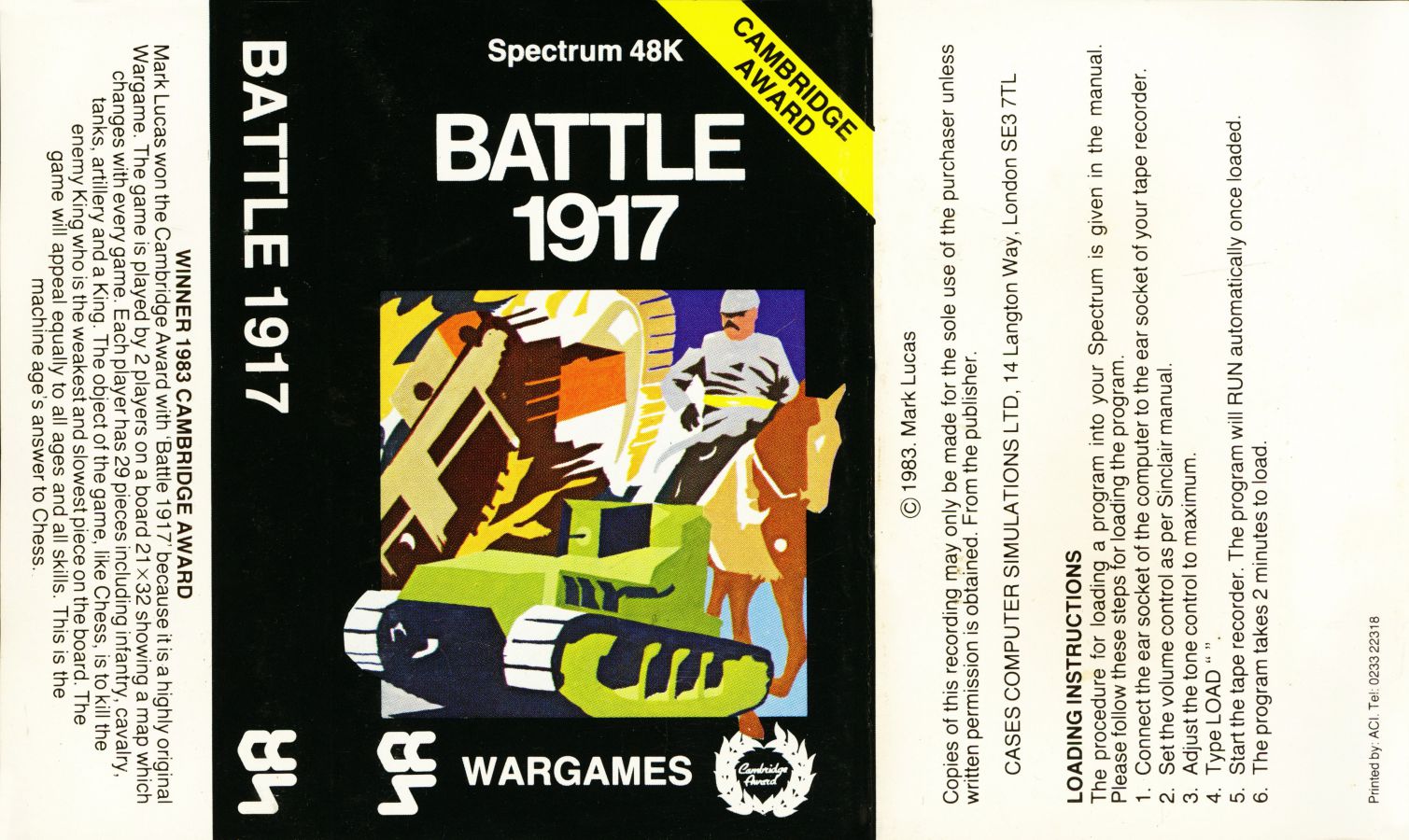
Battle 1917
Strategy Game: War · ZX-Spectrum 48K · 2 players · English
CCS · 1983 · Pound sterling 6.00
Discussion
Nobody has started a thread about this yet.
Remarks
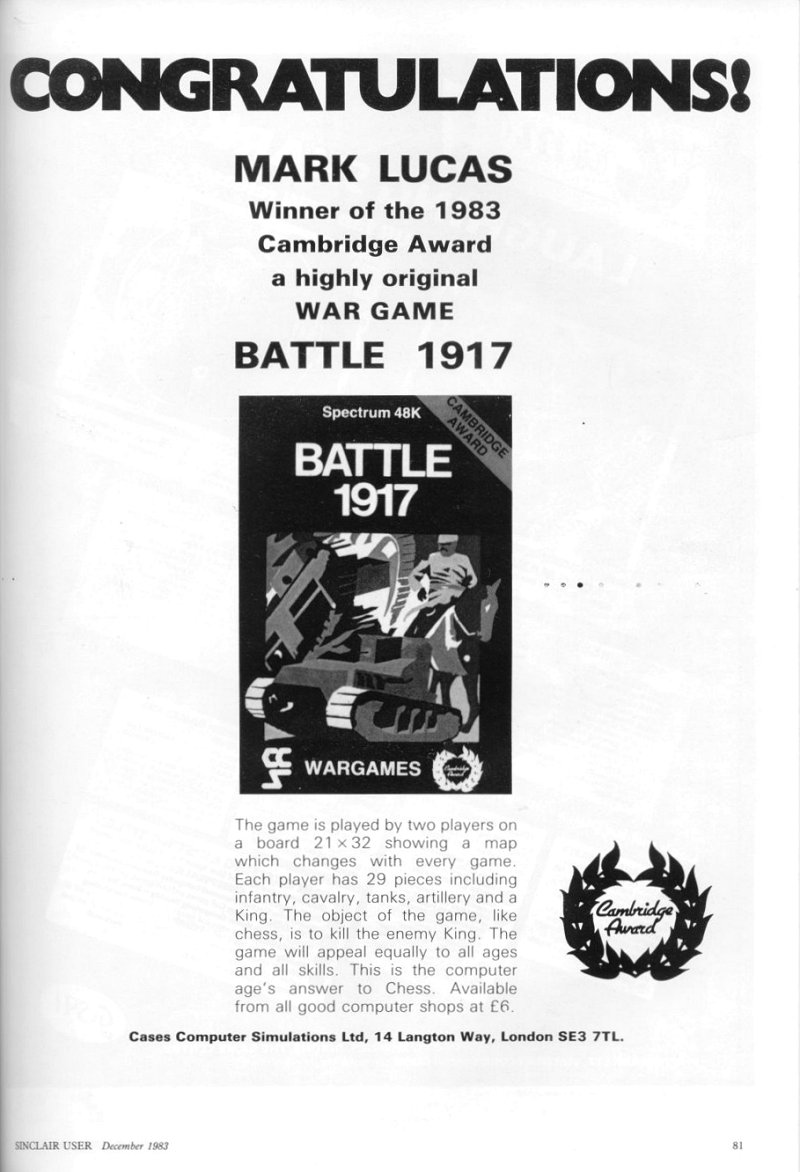
Mark Lucas won the Cambridge Award for writing this game. It was a competition run by CCS and Sinclair User. Winner won £1,000 and had the game published.
- Native Programming Language
- Sinclair BASIC
Play
- Battle1917.tzx.zipTape image English9 KB
- Battle1917.tap.zipTape image English6 KB
- Battle1917(SinclairUser).tap.zipTape image English6 KB
Documents
- Battle1917.zipInstructions English9 KB
Files and rights
Distribution permission is on record, granted to another archive rather than to this one. Screens and pictures are copied here; everything else links to the archive that holds it.
- AllowedCCS → WorldOfSpectrum
Credits
- Mark Lucascredited
Sign in to credit somebody, or say what these people did.
Scores
In the magazines
- Crash #21984 · Overall63%
- Crash #41984 · Overall63%
Elsewhere on the web
- WorldOfSpectrum 19 votes7.74
Awards and competitions
Cambridge Awards 1983
- 1ZX Spectrum Game
In the magazines 39
Crash #10Nov 1984 · p.134
Angus Ryall
FRONTLINES From our correspondent at the front Angus Ryall. Allo mes petits sossions! I was much disappointed by the lack of libel suits, threats against life and limb, etc, resulting from the last FRONTLINE, so this issue I'm going to be tightening up and telling the real truth about some more strategy turkeys. Actually, I must tell you that CRASH has been told that its review of a certain game, should have been upgraded and we have risked losing the advertising from the company that produces it (money we get from advertising pays a large proportion of running costs, so it keeps the cover price down). I'd just like to point out to these cowboys that this kind of petty blackmail produces, if anything, an even more negative approach from writers. It's about time some of these people realised that a reviewer is paid to write what he or she feels about a game, and not what the game producer feels about it. For the record, as I didn't write the review, I've reviewed this particular game again and found myself in agreement with the previous reviewers. You'll have to guess which one it is, but I expect that even those of you with really short memories will get it. And while I'm having a gripe, I spent a knackering couple of days at the PCW show recently, and were there any decent strategy games there? In a word, no. Good old Lothlorien were there, of course, and there was one other excellent strategy game which I can't tell you anything about (ahh, conflict of interest...) but I was very rapidly reduced to discussing the moribund state of the industry with a nubile you cocktailperson in leopardskin shorts. Actually, I can't stand exhibitions you know, but when duty calls... BATTLE 1917 Producer: CCS Retail Price: £5.95 Author: Mark Lucas Well what do you know... Right from the start of Battle 1917 you know you're dealing with a toy. When you ask for instructions, it gets all funny ha- ha with the tank symbols and suchlike. It makes whoopee cushion noises at you. In short, this program treats the user like a favoured, but moronic, grandchild (this does not bode well for the Cambridge Awards jury. Who are they? Are they utterly bold?) The game itself is just a straight battle between two players; each player starts off with a King and 28 units of various types. The problem is that the units are grouped together n fours, and orders can only be given to the group as a whole. This means that as the group gets broken up (as you move diagonally, for example, some units may pass the corner of a lake while others get stuck behind it) you can end up moving three units in the wrong direction just to get a fourth one out from behind a tree. Cannon, the only units that can fire, must all fire in the same direction and for the same range. Whilst the game is very fast moving, a little more thought and time could have produced something with individual or group movement, which would have been miles better. One excellent feature of the game is the directional compass on the map, which gives the key for the direction you need. The graphics are clear, but are pretty juvenile.
Crash #4May 1984 · p.6863%
Overall 63%
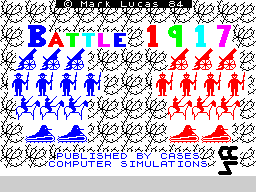
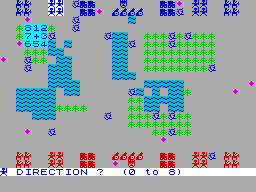
Producer: C.C.S., 48K £6.00 (2) The program won the 1983 Cambridge Award. It is a unique mix between a conventional wargame and chess, with the board, or war zone, laid out not unlike a chess board. The opposing armies face each other in formalised ranks with the battle area between them. This is full of obstacles like barbed wire, mines, water and forests. Each side has a King, artillery units, tanks, cavalry and infantry units. The object of the game is to capture the opponent's King. The units move as a group, but can be spit up into individuals by the terrain. Each unit has its own characteristics in how much it may move per turn, and what terrain type it may or may not cross. The moves are prompted on screen, so extremely complex wargame instructions are not necessary. If you like wargames, this is quite an original concept with reasonable graphics despite the BASIC. Amusing instructions in the 2-part load. Overall CRASH rating 63%.
Crash #2Mar 1984 · p.8875%54%58%65%55%68%63%
Use of Computer 75%
Graphics 54%
Playability 58%
Getting Started 65%
Addictive Qualities 55%
Value For Money 68%
Overall 63%
Unknown
Unknown
Unknown
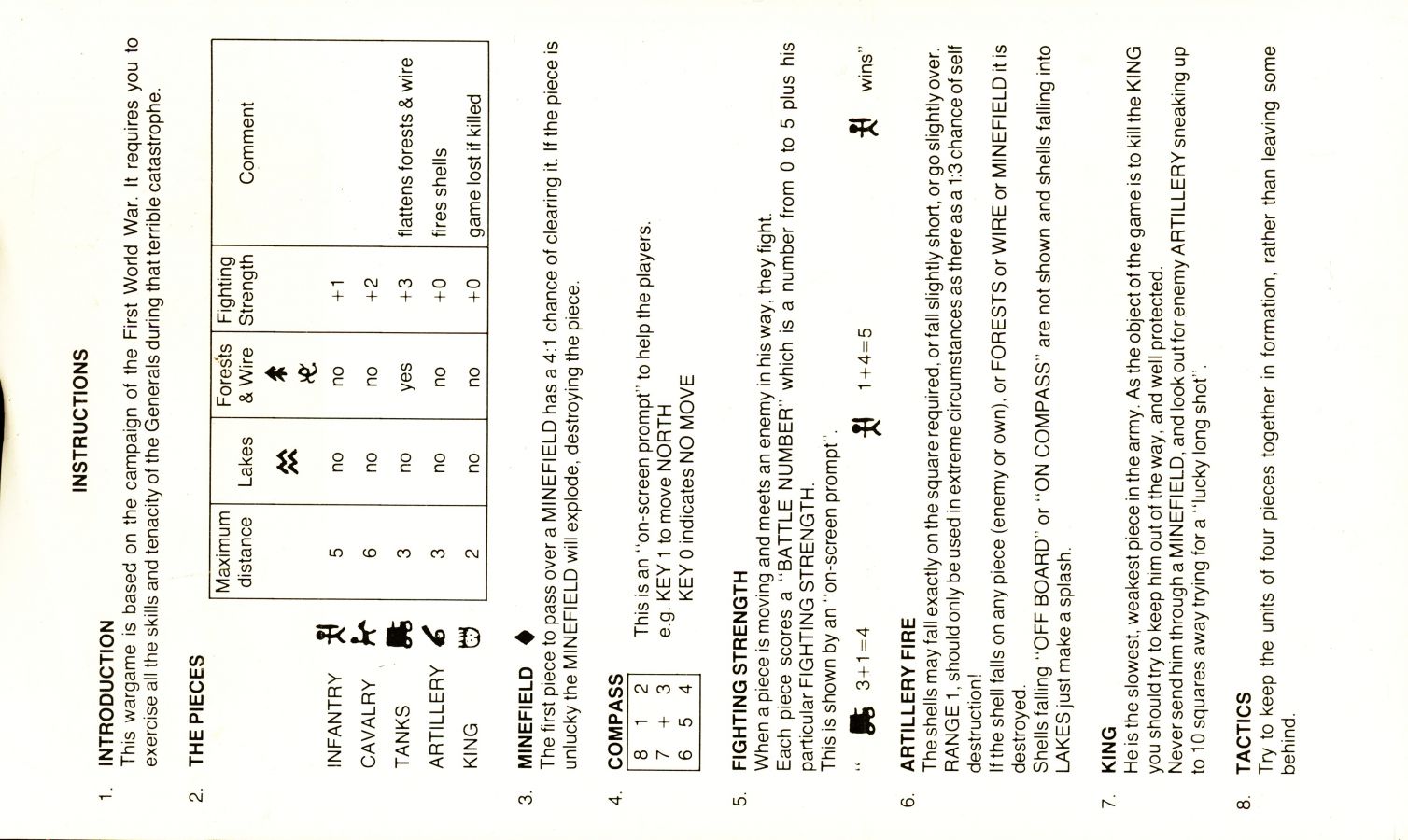
Producer: C.C.S. Memory Required: 48K Retail Price: £6.00 Language: Basic Author: Mark Lucas The author, Mark Lucas, won the Cambridge Award for writing this program. The competition is run by C.C.S. in conjunction with the magazine Sinclair User, and the Award plus £1000 goes to the winner, and of course the winner receives the satisfaction of seeing the program marketed. Battle 1917 is likely to prove popular with wargamers and perhaps with chess players too, as there is a resemblance in part. The board, or war zone, is laid out with the opposing forces at the top and bottom of the screen, each side has a King in the centre, protected by artillery and flanked by tanks, cavalry and Infantry. Each unit, except the King, is subdivided into four characters. The characters move as a group, but can easily get split up by the terrain. Each unit also has a fighting strength and a movement allowance. The battlefield, 21 by 32 squares large, is dotted with obstacles like rivers, forests, barbed wire and minefields. Tanks aren't bothered by wire or trees, but cannot go through water. The rest can't go across any obstacle. Minefields have a percentage chance of exploding when contacted. In addition to moving around, the artillery can fire in any of the 8 compass points desired, although extreme short range runs a risk of self destruction since shots may not land on the exact square they are supposed to. A prompt at the bottom of the screen tells each player which piece is to move next and reminds him or her how many squares it can travel and asks for the direction wanted. When one player has moved all his pieces, it is the second player's turn. When units of opposing forces meet, battle ensues and is won or lost by adding a random figure for each, from one to five, to the unit's official fighting strength. The higher figure wins. The aim of the game is to kill off the opponent's king. Directions are inputted using the numeric keys 1 to 8, 1 being North and 8 being North-West. There is an on-screen compass prompt as a quick visual aid. COMMENTS Control keys: 1-8 Colour quite good Graphics: fairly small but recognisable Sound: very little
Chess meets wargame in award-winning Battle 1917.
Advert19
- Sinclair User #31Oct 1984 · p.45
- Sinclair User #30Sep 1984 · p.64
- Micro Adventurer #11Sep 1984 · p.30
- Sinclair User #29Aug 1984 · p.62
- Crash #6Jul 1984 · p.70
- Sinclair User #27Jun 1984 · p.50
- Personal Computer Games #7Jun 1984 · p.44
- Crash #5Jun 1984 · p.6
- Sinclair User #26May 1984 · p.58
- Personal Computer Games #6May 1984 · p.52
- Crash #4May 1984 · p.6
- Crash #3Apr 1984 · p.6
- Games ComputingApr 1984 · p.87
- Personal Computer Games #5Apr 1984 · p.52
- Games ComputingMar 1984 · p.80
- Personal Computer Games #4Mar 1984 · p.60
- Crash #2Mar 1984 · p.91
- Games ComputingFeb 1984 · p.10
- Crash #1Feb 1984 · p.78
News/Note6
- Sinclair User #28Jul 1984 · p.13
- ZX Computing #12Apr 1984 · p.122
- Micro Adventurer #5Mar 1984 · p.8
- Crash #1Feb 1984 · p.26
- Sinclair User #22Jan 1984 · p.18
- Sinclair User #21Dec 1983 · p.77
Full-page ad4
- Personal Computer Games #3Feb 1984 · p.56
- Sinclair User #23Feb 1984 · p.20
- Sinclair User #22Jan 1984 · p.115
- Sinclair User #21Dec 1983 · p.81
Review3
- White Dwarf #54Jun 1984 · p.19
- Home Computing Weekly #47Jan 1984 · p.18
- Popular Computing Weekly #1Jan 1984 · p.60
Feature2
- Computer Answers #15Apr 1984 · p.23
- Your Computer #3Mar 1984 · p.70
Information1
- Die Speccy CDJan 1996
Type-in1
- Sinclair User #26May 1984 · p.73
Related
- Ports
- (BBC Micro)
- Same entry at
- Spectrum ComputingZXInfo
Reviews from people here
Sign in to write about this, or make an account. It takes a minute and lets you correct the catalogue too.
Everything ZXDB can hold about this is here.
Sign in to correct or add to this.
Hold the rights to this and want it taken down?