Battle of Britain
Strategy Game: War · ZX-Spectrum 48K · 1 players · English
PSS · 1985 · Pound sterling 9.95
Also known as La Bataille d'Angleterre (French)
_GameAddMat.jpg)
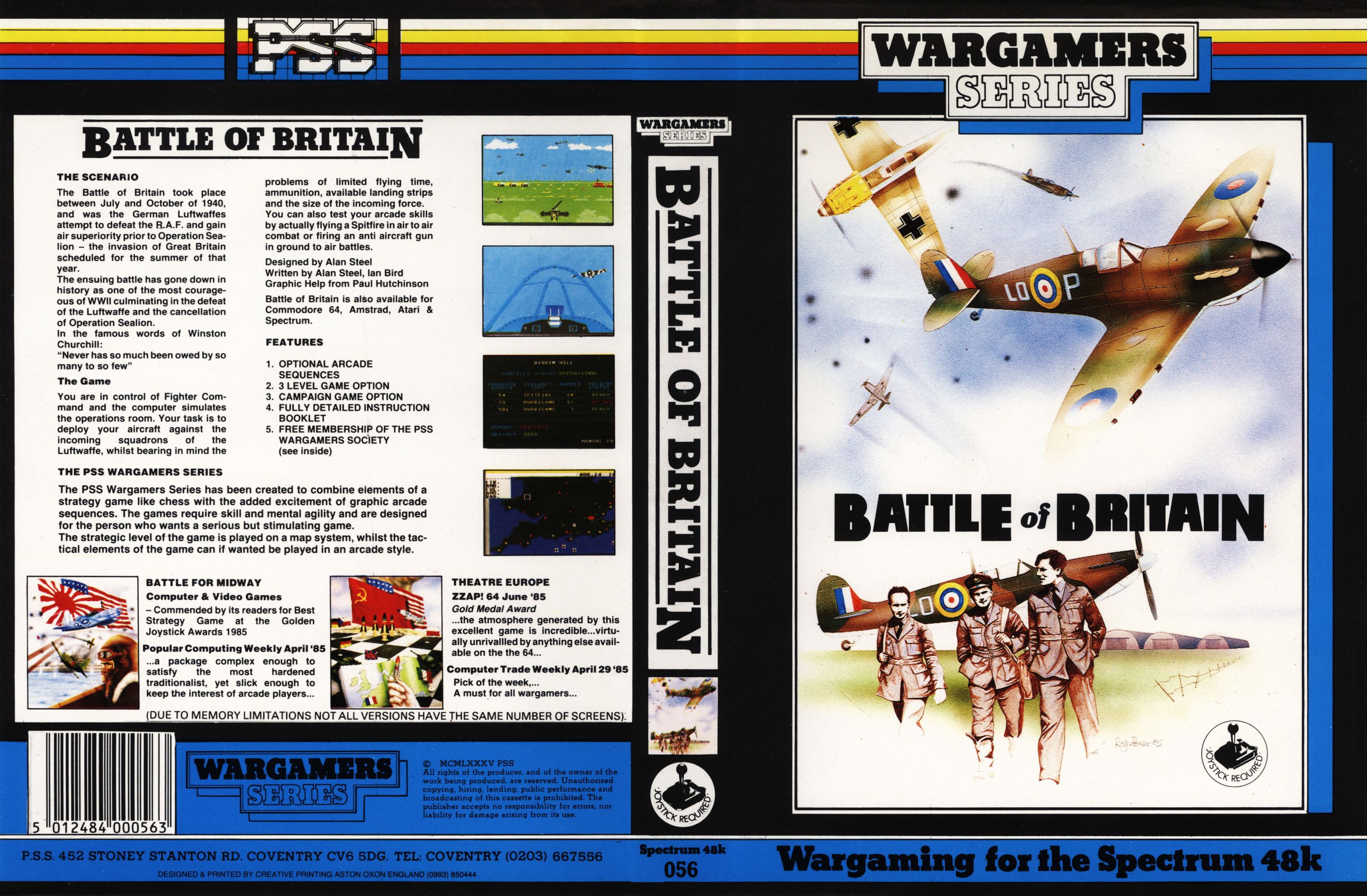
_Front.jpg)
_Front.jpg)
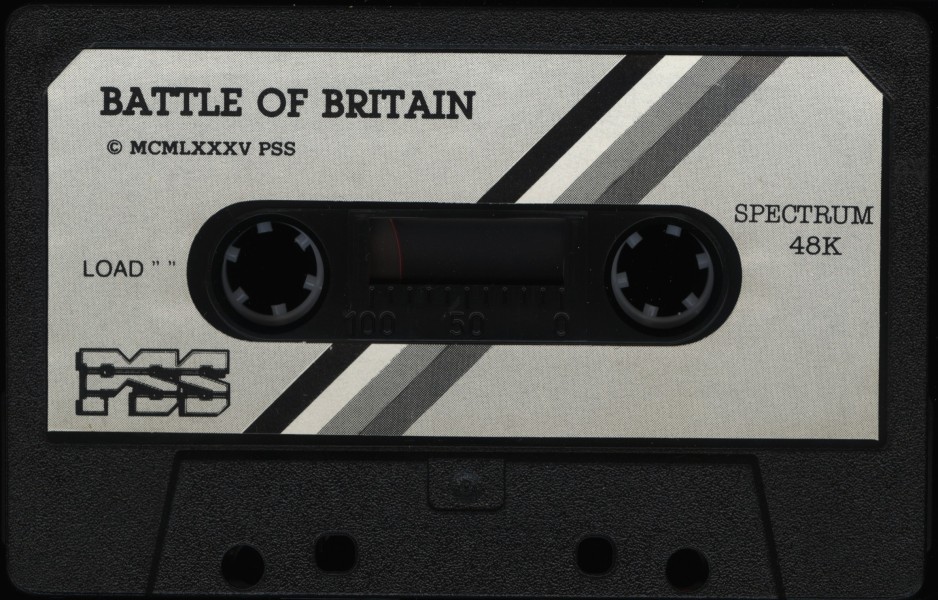
_Media.jpg)
Discussion
Nobody has started a thread about this yet.
Publication
Announced for ZX Spectrum by ERE Informatique, there is no evidence the Spectrum version was ever actually released. Inlays and manuals mention a Spectrum version alongside C64 and Amstrad, but tapes and documentation only cover other platforms.
- Control Option
- Cursor, Interface 2 (right), Kempston Joystick
Releases
- 1985PSS Sold as La Bataille d'AngleterrePound sterling 9.95
- 1987Classic Conflicts
- UnknownERE Informatique
Play
- BattleOfBritain_2.tzx.zipTape image English22 KB
- BattleOfBritain_2.tap.zipTape image English22 KB
- BattleOfBritain(ClassicConflicts).tzx.zipTape image English22 KB
- BattleOfBritain(ClassicConflicts).tap.zipTape image English22 KB
Documents
- BattleOfBritain(PSS).txtInstructions English18 KB
- BattleOfBritain(EN).pdfInstructions English886 KB
- BattleOfBritain(ClassicConflicts)(EN).pdfInstructions English509 KB
- BattleOfBritain(EREInformatique)(FR).pdfInstructions French161 KB
Files and rights
No permission is on record either way. Screens and pictures are copied here on a take-down basis: if you hold the rights and want something removed, say so and it goes.
Credits
- Roger PearseInlay/Poster Art
Sign in to credit somebody, or say what these people did.
Awards
Scores
In the magazines
- Sinclair User #601987 · Overall3/5
- Your Sinclair #151987 · Overall5/10
- ZX Computing #361987 · OverallGood
- Crash #371987 · Overall82%
- ACE (Advanced Computer Entertainment) #31987 · Ace Rating830/1000
- Your Sinclair #201987 · Battle of Britain7/10
Elsewhere on the web
- WorldOfSpectrum 12 votes6.83
Awards and competitions
Golden Joystick Awards 1985
- 2Strategy Game of the Year
In the magazines 18
ACE (Advanced Computer Entertainment) #3Dec 1987 · p.865/74/73/74/7830/1000830/1000
ACE (Advanced Computer Entertainment)
Opposition 5/7
Display 4/7
Ease Of Use 3/7
Game Depth 4/7
Ace Rating 830/1000
Andy Smith 830/1000
Spectrum, £9.95cs C64/128, £9.95cs, £14.95dk Amstrad, £9.95cs, £14.95dk Take control of Fighter Command during WW2 in this solo wargame featuring three separate scenarios. The computer assumes the role of the operations room as the player attempts to stop the invasion of Britain by the German Luftwaffe. You have to consider several factors when deciding upon which course of action you should follow, including airstrip availability, ammunition levels and flying times. Again PSS have included an optional arcade sequence which puts you into the cockpit of a Spitfire so you can dog-fight with Jerry over the Channel. While the game boasts three scenarios, the first is meant merely as an introduction to the game for the player to familiarise himself with the games' mechanics and the second is a simulation of an all-out attack by the Luftwaffe. But the third scenario covers 30 days of the actual battle and is as historically accurate as is possible within the constraints of game play. An enjoyable challenge that should be on your shopping list, especially as it's now available on the Classic Conflicts label for a fraction of the original price.
C&VG (Computer & Video Games) #70Aug 1987 · p.565/105/103/105/10
Graphics 5/10
Playability 5/10
Realism 3/10
Value 5/10
Steve Badsey
MACHINES: Spectrum/Amstrad/CBM 64 SUPPLIER: PSS PRICE: £9.95 (cass) VERSION TESTED: Spectrum PSS has now produced a Spectrum version of its Wargamers Series Battle of Britain game. It should be said at once that it isn't very good, and certainly not the best Battle of Britain game on the market. Many of the Wargamers Series work on the same basic program routine - the "enemy" forces approach from one corner of the map moving towards the other, the player (there is no two-player option) responds by cycling through options and moving forces rapidly with a joystick, and at the moment of contact the game goes into an arcade sequence. It works for some types of battle - it works very well for Bismarck - but it doesn't work at all for air combat over south-east England in 1940. The German forces attack anywhere from the Wash to Lands End, but the Fighter Command which opposes them has, unaccountably, lost 10 Group and so has no fighters stationed west of Portsmouth. Interceptions are far too easy to make, and so in order to make the game harder two very unrealistic features have been introduced. The first is that after one interception a squadron is considered "out of ammunition" and must land to replenish, the second is that airbases and sector stations are arbitrarily put out of action by being "fogbound" at all hours of the day, although this fog can clear again in an hour. The arcade sequence gives the view from a Spitfire cockpit in attacking enemy formations. This game is one more proof, I'm afraid, that you can't take a good computer program (and it is good, make no mistake) and turn it into every battle there ever was.
Battle of Britain.
THE WARRIOR RT Smith is generally held to be the best British computer wargames programmer around. He's the man responsible for Arnhem, Desert Rats and now Vulcan. But who is the mysterious RT Smith? C+VG's Man of War Steve Badsey yomped his way down to deepest, darkest Surrey to confront this unknown warrior. Advance and be recognised, he ordered. The rest, as they say, is history. Wherever serious wargamers gather and discuss computers, the name of R.T. Smith is mentioned with respect and admiration. The author of Arnhem, of Desert Rats, and now of his latest offering, Vulcan - covering the Tunisian campaign in the Second World War is perhaps the only British computer wargame designer whose work can be compared with the best American and Australian games. The "common sense" command and control system which is the distinctive feature of his work enables the player to concentrate on a winning strategy, rather than fussing over game mechanisms, and his judgement in modelling historical probabilities is second to none. All of this made me rather apprehensive when I asked to meet R. T. Smith. He clearly knew too much about history, and about wargaming, to be just one of the mathematically brilliant writers in their teens who provide the bulk of computer games. So who was I going to meet? Was he perhaps an elderly civil servant with a lifelong interest in military history who had taken to computers late in life? Or did those initials hide a beautiful young lady with a rare interest in warfare? Perhaps I would simply be confronted with the sort of person who knew everything about everything, and in his spare time wrote games like Vulcan for fun. As it happened, I needn't have worried. Bob Smith turned out to be a polite, impeccably mannered 23-year-old living quietly in a Surrey village. Bob learned about computers first at school, with the old mainframe language Fortran using punched cards to input the data. He taught himself BASIC while still at school, and his parents bought him a Spectrum for Christmas. Meanwhile, he got interested in wargaming in the Ancient period, using the almost universal Wargames Research Group rules. Yes - in answer to my question - he read campaign histories before writing his wargame programs, but more important was that early knowledge of conventional figure wargaming. Having grown up with wargames and computers, he knows if his program "feels right" in recreating history. Bob's first game was written while he was still at school, and vanished more or less without trace. Called Confrontation, it was a twentieth century, battalion tactical level game which allowed the player to design his own scenario before playing. He wrote it for the Spectrum only and approached Lothlorien, who published it in their Warmaster series. He wrote a conversion for the BBC while at Birmingham University reading physics, and decided to become a full-time programmer. So began an attempt to write a two-player expanded version of Confrontation which was intended to be an arcade-style game. But, between the wargaming and reading A Bridge Too Far something happened, and the result was the solo game Arnhem, finished in 1984. Bob wasn't happy with Lothlorien by now, and so offered the game first to PSS, and then to CCS who accepted it. Arnhem proved a major popular success, reaching number 10 in the W.H. Smith best sellers, and remains one of my own favourite games. The five-scenario Arnhem was one of the best games of its year, and Bob was given an Amstrad to write a conversion for it. He agreed with me that he was missing out a large number of people, but the conversion to 64K for the Commodore and the Atari would involve a great deal of re-writing, and I get the feeling he doesn't like writing conversions much. His next game was Desert Rats, which took more than six months to write and appeared at Christmas 1985 in Spectrum, 128K Spectrum and Amstrad versions. The appeal of Desert Rats is that the advice given to all armoured commanders - press on as rapidly as possible, a punch protects itself - really works, except for those infuriating moments when your master plan grinds to a halt on empty petrol tanks. Desert Rats, as Bob put it to me, got much better reviews than Arnhem but didn't actually sell as well. I thought that the only thing which stopped it being perfect was that lack of aircraft, and the ability of an opponent to see all the forces all the time. Vulcan, which has both air power and hidden movement, appeared before Christmas and is probably the outstanding British computer wargame of the year. His next work will probably be the lively arcade game that he always meant to write. Going back to the days of figure wargaming, when he commanded armies of Selucids and the Macedonians of Alexander the Great, there is also the idea in the back of his head of a game covering ancient warfare, which has been surprisingly neglected by computer game designers. Vulcan, I remembered as I left, is in ancient mythology the Smith of the Gods!
ZX Computing #36Apr 1987 · p.83ZX Computing GlobertGoodGood
ZX ComputingZX Computing Globert
Overall Good
Gordon Hamlett Good
GORDON HAMLETT REPORTS FROM THE FRONT... The number of wargames available for the home computer has escalated considerably over the last couple of years. There are several reasons why the micro version of a game is succeeding whereas its traditional 'boxed game' counterpart had only limited appeal. The obvious benefit that a micro offers is that you don't need a second person if you want to play a game. Then, there is no need to set up thousands of counters on a board or work out combat results from a set of complicated tables. The drudgery is all handled for you. On the debit side, computer wargames are not yet as sophisticated as their original counterparts although the balance is shifting and, as I will point out later, there are certain advantages in playability to be gained on the micro. Three games have appeared for the Spectrum in recent weeks and all three offer the budding strategist something different. The first of these games is Samurai from CRL (£9.95). This is a one player game with three different scenarios and three difficulty levels. You take the side of a small band of warriors, trying to wipe out an enemy force of assorted temple guards. The game is icon driven and starts with you selecting your initial forces. You have so many points to 'spend' and each type of warrior costs a varying amount. There are four types to choose from - Ashigari or lightly armoured troops, the traditional Japanese warrior the Samurai, a mounted Samurai and the deadly Ninja. The mechanics of the game are very simple and are basically move and fight, Ninjas must be carefully managed as they are the only troops who can attack from a distance and should be used very much in hit-and-run tactics. Samurai is by far the simplest of the three games and will appeal more to the novice. Beware though! To all intents and purposes, Samurai is the same game as Swords of Bane from CCS and it is probably not worth getting both. Moving forward a few hundred years brings us to 1940 and PSS's Battle of Britain (£8.95). Hitler had commanded Goering, his head of the Luftwaffe, to destroy the RAF prior to a planned invasion of Britain. Due to the RAF's meager resources, just about any tactic would have worked provided the Germans had maintained it. In practice, Goering decided that his methods weren't working and so switched his forces to night bombing major cities. Horrendous though the Blitz was, there was no way it was ever going to destroy the British planes for the simple reason that the Spitfires and Hurricanes never flew at night! There are three main scenarios for you to try. The training game gets you used to commanding the forces at your disposal by simulating a light raid. In Blitzkrieg, the Germans throw everything they have at you but only for a period of one day. Finally, there is the much longer campaign which is played over thirty days. There are also optional arcade sequences in which you can try shooting down Messerschmidts from the comfort of your own mess room. If you choose this option, how well you do in your own personal combat directly affects the outcome of a particular battle. This is fine for arcade fans but those of you only interested in the strategy elements should leave well alone. The gameplay depends on you making a lot of very fast decisions. As the German forces start to appear, you must scramble squadrons to intercept them. After combat or a prolonged patrol, a squadron must be landed in order that it can refuel and reload. Failure to monitor the status of your squadrons will result in them becoming dispersed and unavailable to you for a period of time. Airfields closing because of the weather add to your problems. Again, a fairly simple game to play but as any one who has ever tried to juggle will tell you, it is very easy to throw a lot of balls up into the air at once. It is a different matter to keep them there. The final game this month is Vulcan (£8.95) from CCS. This simulates the Tunisian campaign of 1942-43 and is by far the most detailed of the three games on offer. Control however remains straightforward and is all menu driven. There are five different scenarios designed to last anywhere from half an hour to sixteen hours. You can choose to play either the Axis or the Allied forces and the game can be played against either a computer or human opponent. The 128 version offers several other options including a debriefing mode, several historical 'what-if' variations and no need to reload any data after every game (necessary on the 48K Spectrum due to memory restrictions). One feature not available on board war games for obvious reasons is that of hidden movement by the enemy. Enemy units are only discovered literally when you bump into them. There are several ways of moving your troops. Normal movement, assault and travel. Assault means that a unit will go all out to gain its objective whereas travel is very defensive - you can move only along roads (at double speed) but are very vulnerable to attack. You can also choose to hold a position or fortify it. Terrain plays an important part in the game. Not only does it affect the rate of movement, but also how well a unit can attack from or defend a position. Combat is decided by many factors including the strength of a unit, how well it is supplied and the weather. Supplying your units is a vital element in your strategy and you should also make good use of any air power that you have, either to deliver an air strike or reconnoiter as you try to discover the enemy's positions. Vulcan is very well presented with an excellent instruction booklet giving players hints and the historical background to the campaign. Highly recommended to serious strategists.
Battle of Britain.
Sinclair User #60Mar 1987 · p.443/53/5
Overall 3/5
Gary Rook 3/5
Label: PSS Price: £12.95 Memory: 48K/128K Reviewer: Gary Rook The Battle of Britain was the heroic serial defence of Britain by the Few - the RAF - against the massed bombers and fighters of the German Luftwaffe in 1940. Now here's PSS's version of history, wrapped up as a full blown wargame. You kick off with a map of Southern England, with just a corner of France showing. Marked on the map are nine airfields, London, various other cities end industrial centres, and your radar stations. When the game begins everything is pretty quiet. It doesn't take long though for ominous black and white crosses to start appearing over the English Channel and the North Sea. These represent formations of German fighters and bombers. You have to scramble your aircraft, then move your squadrons to wherever you think you will be able to intercept the Germans. Once there, you have a battle. Then you do the whole thing in reverse because your planes will be out of ammunition and very possibly out of fuel is well. If it sounds simple, then it can be - so long as you're playing the introductory, training game. But before you dismiss the challenge the game offers, just try having a go at the Blitzkrieg game. The Germans come at you with everything they've got, and your squadrons start going down like ninepins. Your airfields get bombed to oblivion, your radar might as well be microwave ovens for all the good they do you, and Churchill is not pleased. What do you need to know? The map looks very much like a map - the land is green, the see is blue. When you scramble a squadron, it takes a turn (five minutes on the clock) before it appears by the airbase it launched from. You then move the on-screen cursor over it, hit the fire button, move the cursor to the destination you want the planes to go to, then hit the Fire button again. Simplicity itself. You can't have more then one squadron in the same square, so the objective is to guess where the Germans are going to be and then surround them. In this message space, you get bulletins charting your progress - or lack of it: such and such radar station bombed, Biggin Hill runway cratered, Coltishall airfield closed by fog. When you move the cursor over one of your units, you can get updated information on how strong it is, how much fuel it has, how much ammo it has, and so on. And at the and of each day you get a score screen. This tells you how well you did, and gives you a percentage rating. At this point, if you're playing the campaign game, you get a re-supply screen where you allocate new planes and pilots to your airfields. Battle of Britain la a very workmanlike simulation. All very neat but somehow it lacks a certain sparkle. Worth getting, nevertheless. Don't bother with the arcade sequences though - they're not much fun.
Your Sinclair #15Mar 1987 · p.667/107/106/106/105/105/10
Graphics 7/10
Playability 7/10
Value For Money 6/10
Addictiveness 6/10
Overall 5/10
Gwyn Hughes 5/10
PSS £9.95 Reviewer: Gwyn Hughes It's never-in-the-field-of-computer-wargames time again, as PSS tackles Jerry above the Home Counties. The Battle of Britain has endless romantic appeal, as well as an interest to wargamers. But does this version deserve its wings? PSS has steered an admirable course away from the grids of board wargames. Here are screens within screens, scrolling messages, cursor movement and even optional arcade sequences to sway the outcome of combat. Even if you don't choose the action sequences, there's not a moments rest, because commanding our brave boys against the Jerries is rather like juggling.. You have to get them up into the air, move them to the hotspots, guarding cities and radar installations, then guide them back to an empty airbase, preferably without too much runway damage, before they run out of fuel. And all the time the Luftwaffe is flying in from the south east. Battle Of Britain hardly gives you time to check whether a base operation, let alone draw up a plan. The result is that you throw as much as you dare at the incoming squadrons and hope! As for the arcade sequence, all I can say is that if you want a simulation of flying a WWII fighter, jump into Mirrorsoft's Spitfire 40. PSS has only been able to fit a rather dodgy shoot 'em up into the memory available, and has had to omit the ground gunning sequence, included in other computer versions. There's a training mode and a one day Blitzkrieg game, but hardened flyers could attempt the 30 day Campaign. This at least adds a supply element to the battle, which makes the strategy more sophisticated. Battle Of Britain falls between two stools for me, and while I can appreciate that a fast and furious game may seem more attractive to the punters, this will be too frenetic for most armchair air marshals!
Crash #37Feb 1987 · p.9689%79%86%87%77%83%78%82%82%
Presentation 89%
Rules 79%
Playability 86%
Authenticity 87%
Opponent 77%
Value For Money 83%
Graphics 78%
Overall 82%
Philippa Irving 82%
FRONTLINE With Philippa Irving THE NEW BROOM Having temporarily forsaken the spires of Oxford for the winding alleyways of Ludlow, it's time for me to introduce myself as the new frontline columnist. Although adventure games are now well-understood as a genre and catered for in most magazines in a specialised way, strategy software doesn't usually meet with the same depth of treatment. In a recent edition of another Spectrum magazine, a wargame review opened with an apology for the fact that it was one, and an assurance that despite everything it was quite a good game. It's difficult to imagine an adventure being treated like this, and yet what might be called pure strategy games are just as different from the 'arcade sector'. I believe that all kinds of games, 'minority' or not, should have specialised treatment, and so I'm happy to have the opportunity to follow in the footsteps of Sean Masterton. As everyone knows, the life of an Oxford student is hectically divided between punting on the Isis, going to college balls, being thrown into Christ Church fountain and smashing up restaurants. Despite these demands on my time I'm sure I'll manage to fit in editing FRONTLINE. Next month I'll be talking about the relationship between strategy and adventure software and the non-computer gaming hobby, so let's have your views on that. BATTLE OF BRITAIN Producer: PSS Retail Price: £9.95 Author: The PSS Team PSS seems to be trying to appeal to the mainstream market with its "all action" Wargamers Series, this game continues in this vein. This kind of wargame is exclusive to the computer. It relies on the facilities offered by a computer, and owes far less to board and miniature gaming than more traditional implementations. This is not instrinsically bad - just different - and of its type Battle of Britain is certainty not bad. But like ess's other releases, it is as much a game of reflex and quick thinking as strategy, and there is not much time for reflection and planning. Potential purchasers should be aware of this. Apparently we all know about the Battle of Britain, because the rulebook contains no historical background whatsoever. This is a major deficiency; the Battle of Britain may be one of the more familiar episodes in military history, but as a matter of principle, all wargames with any pretensions to authenticity ought to back themselves up with information which puts the action in context. There are three basic game-type options offered, the introductory level training game. the fast, furious and very short blitzkrieg game, and the full-scale 30 day campaign scenario. The training level is useful for the first few attempts, but it is ludicrously easy and becomes redundant after any proficiency is attained. The Blitzkrieg only lasts for one day, in this scenario the Luftwaffe go for an all-out attack on every target, and do it so quickly that keeping up with the action becomes close to impossible without an extra set of faculties. The campaign game is impressive by comparison, both in terms of content and length. It takes place over thirty days, implements a predictable strategy which is historically accurate, and has a choice of three speeds. In between days the player has the opportunity to make up the numbers of the squadrons from a pool of reserves. This gradually diminishes in quality as the days go by, representing the recruitment of inexperienced pilots. Playing the campaign game all the way through is a long-term project. At the slowest speed, with the arcade option, it could take well over five hours. Fortunately there is an option which allows the position to be saved at the end of a day. The fact that speed determines the level of play in the campaign says something important about the game. The most important skill which determines success or failure is the ability to dash the command box about the screen, scrambling squadrons efficiently and moving them to intercept the Luftwaffe. No specific orders can be given to the squadrons, and unless the arcade sequence is being played, the outcome of an armlet conflict seems to depend on relative numbers. Play takes place across a simplistic (but functional) map of the south of England. British radar stations, airfields and cities are represented, and can be identified by moving the joystick or movement-key operated command box. The date and time is permanently displayed underneath a scrolling message screen. This screen throws out a rapid variety of information about the weather conditions at airfields, squadrons which are short of fuel or lost, and cities and radar stations which are bombed by the Germans. Each type of message is accompanied by a distinctive audio signal, which isn't a bad idea as in the faster games there is scarcely enough time to keep up with them. Information about the strength and condition of each squadron when airbourne can also be obtained via the command box. There are eighteen squadrons available, stationed around the nine airfields, and all are either Spitfires or Hurricanes. The Luftwaffe squadrons are made up both of fighters and bombers. Many purists are dubious about the arcade element which PSS incorporate into their wargames. It is optional in Baffle of Britain: if selected, the player is given the chance to participate in any battle by selecting the squadron in combat and playing a brief snatch of unexciting simulation. This is cosmetically attractive, but very basic and slightly too easy, it is disassociated in feel from the rest of the game. Success in shooting down the German planes increases the number of Luftwaffe casualties, but playing through the sequence greatly lengthens the time it takes get through any of the scenarios, and missing it out doesn't appear to put the player at a disadvantage. It seems that an entire Luftwaffe squadron was faced by a single Spitfire or Hurricane, that the German pilots did not shoot back, and that they waited to be attacked one plane at a time. The gameplay is fast and smooth and it becomes absorbing after a while; it's the kind of addiction though, that comes from the satisfaction of quick thought and action rather than depth of thought, and it may not be what some people are looking for in a strategy game. On its own terms it has an atmosphere of authenticity, and creates a playable fast-moving environment which many will find enjoyable.
The arcade screen, at the cockpit of a Spitfire.
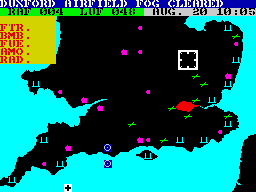
The map shows major towns, airfields and radar stations in the south of England. The command box is over a British squadron. In the box top left is given the squadron's status and the four arrows show where the squadron is off to - straight into the path of the German raiders.
Your Computer #11Nov 1986 · p.50
Tom Courtenay
GOING TO BATTLE War simulations are becoming ever more popular Tom Courtenay examines some of the best. War games have come a long way from the time H.G. Wells wrote Little Wars at the turn of the century. He wrote it as a result of trying to regulate the battles on the Kitchen table against his friends involving a handful of pained tin soldiers. These days, war-gamers revel in the complexity and realism of their simulations - ify ou call it playing soldiers they would be very upset. Any game worth its salt will involve tape measures, dice, sets of tables, vast numbers of troops, or even cardboard counters representing regiments or divisions. So it is scarcely surprising that the home computer was welcomed by the war-gaming lobby with open arms. Two approaches were taken: either the computer could be used to referee a traditional war game fought on a table-top in traditional manner, or the whole thing could be transferred to the computer. The pioneer of the latter approach was Lothlorien, which began to produce war games written in Basic on the Spectrum. Obviously they look primitive by today's standards but they attempted to be accurate representations of historical events. To the mainstream games enthusiast, they played slowly and you could not kill anything. The first truly modern game was Nato Commander from Microprose. It takes place in northern Europe and features that almost constant American obsession, the Reds pouring over the border and trying to take over Europe. The game covers the most critical period, between the initial invasion and the U.S. getting huge reinforcements to the front. Thus, the Nato commander is severely outnumbered and is fighting a delaying action, trying to hold on to as much ground as possible, and possibly inflicting significant losses on the Soviets. However distasteful you may find the scenario, it is a very good game. Success depends on falling back in stages, each rearguard action allowing time for the forces to the rear to dig in, then fall back, and so on. In that way, the steam is taken out of the Soviet advance. Any Soviet forces not in contact with friendly forces may disappear from the map, depending on how many aircraft are flying reconnaissance missions. Aircraft can also run air superiority or ground attack missions. It is important to keep open supply lines and make the best possible use of terrain. The computer opponent is fairly intelligent, although by following particularly outrageous tactics it might be very confused. Microprose recently followed this with Decision in the Desert and Crusade in Europe. They are a real tour de force. Covering two famous campaigns in WWII, they are about as near to a board game on a computer as you are likely to see. Almost everything is there, the different strengths and weaknesses of units, use of terrain, supply - in both strategic and tactical senses - fog of war, and a two-player option. Again, the computer could be a little lacking in the old grey matter, especially when called on to defend, but the two-player option is what the game was about. Both games feature several different scenarios which portray different battles within the campaign. Although the games can be long, the speed of play can be varied to slow things when things become difficult. Orders are made in real time - the battle does not stop while you input orders. Tactics are very subtle. All-out effort rarely works; you will just run out of supplies and exhaust your troops. It is all about probing for weaknesses and then exploiting them quickly. The games are on C64, Atari and Apple. Microprose recently capped even that success with its chart-topping Silent Service, in the same three formats, with ST, Amstrad and Spectrum versions promised. It is a superb simulation of submarine warfare in the Pacific. Almost without being aware of it, the player is subject to many rules about sighting, detection, firing and hidden movement. It knocks spots off all the board games devoted to the same subject - and you can shoot things. You command one submarine on patrol in the Pacific. After a convoy is detected, a quick squint through the periscope to see whether its worth the risk - how heavy is the escort? Then check the time. Should you wait until dusk? Check the speed and course of the convoy. What is the best attack course to evade detection? A little on the slow side for the shoot-'em-up fraternity but a superb and exciting simulation which will take some beating. That is not to say British programmers are not starting to get their acts together. Particularly Robert Smith, who has produced two fine simulations, Arnhem and Desert Rats, published by CCS on the Spectrum and Amstrad. Another company specialising in this field is PSS. It has attempted to popularise the genre by including an arcade element in most of its games. Unfortunately that tends to mean the realism of the game suffers - precious memory and development time is lavished on a rather tedious shoot-'em-up. Neither is the company a stranger to controversy. Its titles include Theatre Europe, all about the jolly little subject of a European war escalating into a thermonuclear holocaust. The scenario is much the same as Nato Commander but the addition of a complex air war, the arcade sequences and the thermonuclear option has left in its wake a rather dull land game. The game falls between four stools. Falklands '82 was another landmark of good taste. It features the Argentinians and the British locked in a struggle to save their respective governments from the wrath of the electorates. The game stayed mainly with the land campaign, and it aroused much anger as it demonstrated the possibility of the British losing - something fairly obvious to anyone of even a semi-rational disposition. Possibly the company's best game to date is Battle of Midway, about the decisive carrier battle in the central Pacific in the middle of 1942 which effectively ended Japanese chances of winning the war. The player controls the American task forces in an attempt to seek and destroy the Japanese aircraft carriers protecting an invasion of the American base at Midway island. Although the tactics employed would make most military historians turn pale, it is not a bad game. The player has to find, identify and then shadow the enemy task force as, his strike aircraft close in from his carriers. Naturally, the enemy is trying to do the same, or even get to grips with his surface units. The player must plan his raids, try to evade the enemy, and control the strikes, making sure they find their targets and have sufficient fuel to return to their carriers. The same system was developed further in the PSS Battle of Britain. It covers the Luftwaffe attempt to destroy the RAF in the summer of 1940. The main pre-occupation of the player is to preserve his fighters, taking on the Germans only if he can do so on favourable terms. There are problems; after each interception the fighters must land, re-fuel and re-arm. The nightmare is that a German raid will catch the fighters on the ground. The campaign is fought through several turns, with the British meeting raiders as their losses permit. It is a long game, of slightly dubious accuracy, but a fascinating struggle. On the same subject, Their Finest Hour from Hutchinson is a flawed attempt to be a real simulation of the battle. Although highly-detailed, some of the mistakes are almost laughable. First, defensive flak can zip from target to target as if on wheels; ME109s have huge fuel tanks, along with the Spitfires which also have inexhaustible ammunition. Time and again, a squadron can shoot down 200 aircraft and usually the Luftwaffe is defeated on the first day. It is a pity, because it had the makings of a fine game. The most recent PSS game returns to the Western Desert, Tobruk, on the Amstrad, features an exceptional network option where two Amstrads are connected using the joystick ports so that two players can battle with highly-realistic Fog of War. Neither can see each other's pieces. The game design is a little artificial, with the British having fixed supply dumps and the Germans being able to zip around at will but it is a fine game which is great fun to play. Most of the games have been set in WWII. If you crave for the age of the horse and the cannon, there is a grave shortage of quality material from that era. The Lothlorien Waterloo and Austerlitz are not bad. Although they lack detail, the games go some way to recreating the Napoleonic era, but if you are looking for dramatic cavalry charges, forget it. Possibly the best thing Lothlorian has done to date is Jonny Reb, a semi-abstract simulation of tactics in the American Civil War, seen in retrospect as the transition from the Napoleonic to the modern era. As firepower became more formidable, so the only way to stay alive was to take cover. The infantry charge became a rather rare commodity. That is dealt with very well in this game. The Confederate army's job is to try to take a bridge from a small force of troops before a large number of Union reinforcements can arrive. The tactic is to move up men with covering fire from artillery, then open fire with the infantry. If that does not work, send in the cavalry as a last resort - demoralised troops will tend to run rather than face a cavalry charge. Endless variations of troops and terrain can be tried with a kind of battlefield designer. The major criticism is that such a complex game has completely inadequate instructions. The terrain is placed there with little explanation of its effects. Despite that, and the usual monumentally thick computer opponent. It is a game which will reward plenty of experimentation. Computer war games have progressed a long way from their humble origins but they still have some way to go before they reach the level of accuracy and subtlety of most board war games. Perhaps the new generation of 68000-'based machines might just fulfil that potential.
Conflicts 1 carries this game and has 7 references of its own.
News/Note3
- Sinclair User #66Sep 1987 · p.94
- ZX Computing #34Feb 1987 · p.6
- Computer Gamer #4Jul 1985 · p.7
Review3
- Your Sinclair #20Aug 1987 · p.72
- Popular Computing Weekly #50Dec 1986 · p.53
- Popular Computing Weekly #47Nov 1985 · p.19
Feature2
- ACE (Advanced Computer Entertainment) #3Dec 1987 · p.85
- Computer Gamer #24Mar 1987 · p.84
Preview2
- Your Sinclair #14Feb 1987 · p.10
- Sinclair User #53Aug 1986 · p.98
Advert1
- Crash #26Mar 1986 · p.77
Related
- Compilations
- Conflicts 1
- Ports
- (Amstrad CPC), (Commodore 64)
- Same entry at
- Spectrum ComputingZXInfo
Reviews from people here
Sign in to write about this, or make an account. It takes a minute and lets you correct the catalogue too.
Everything ZXDB can hold about this is here.
Sign in to correct or add to this.
Hold the rights to this and want it taken down?