
Computer Scrabble
Game: Board · ZX-Spectrum 48K · 4 players
Sinclair Research Ltd · 1983 · Pound sterling 15.95
Also known as Micro Scrabble (French)
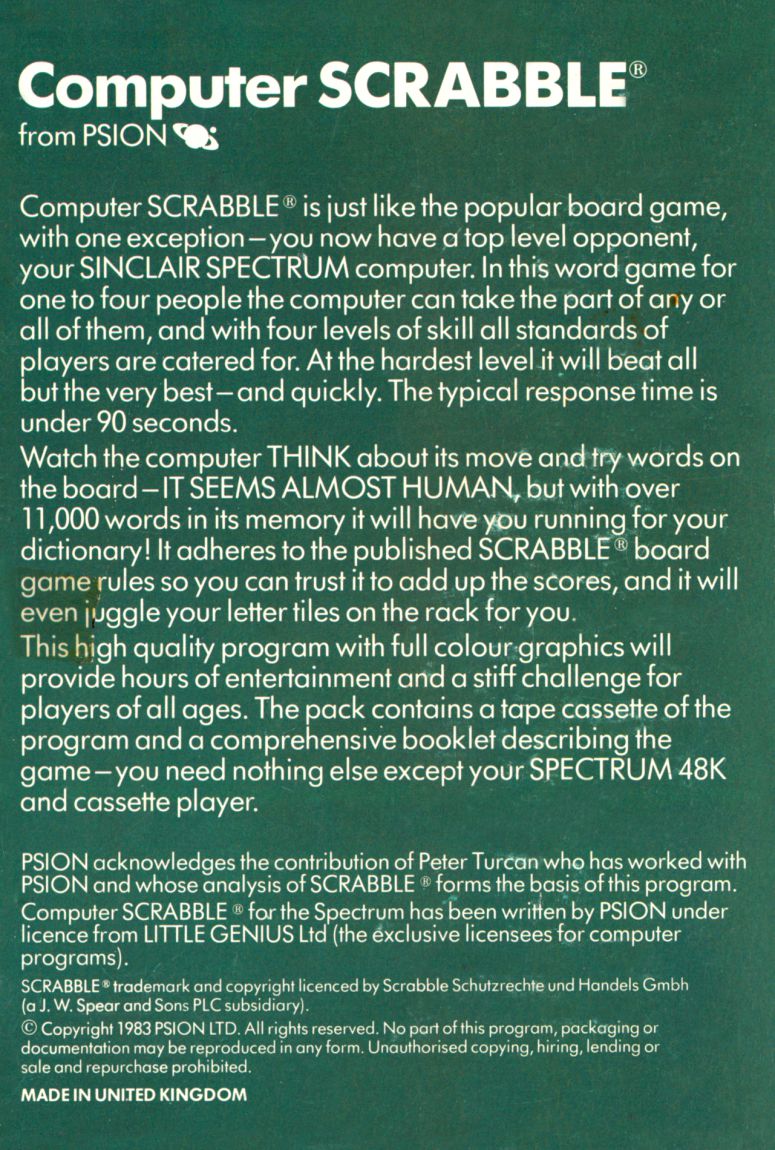
_Back.jpg)
(FR)_Back.jpg)
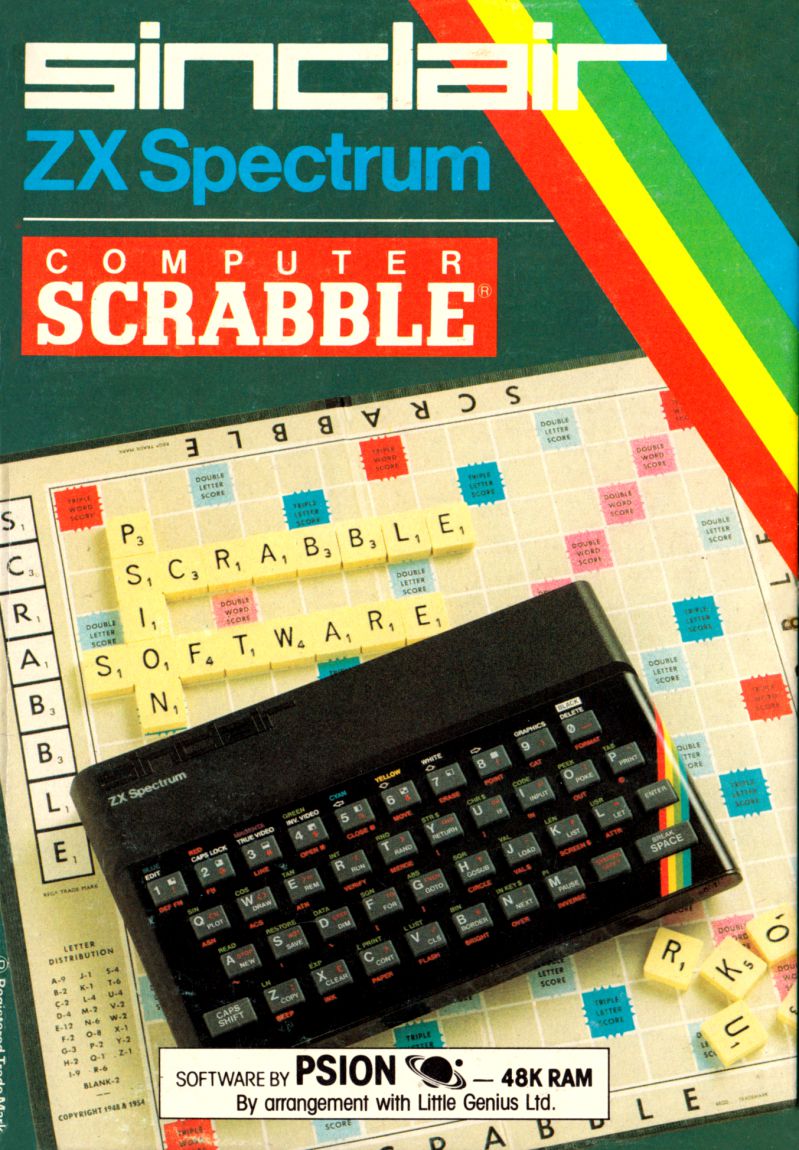
_Front.jpg)
(FR)_Front.jpg)
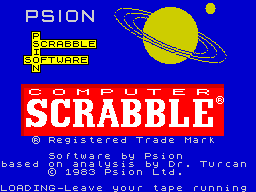
.png)
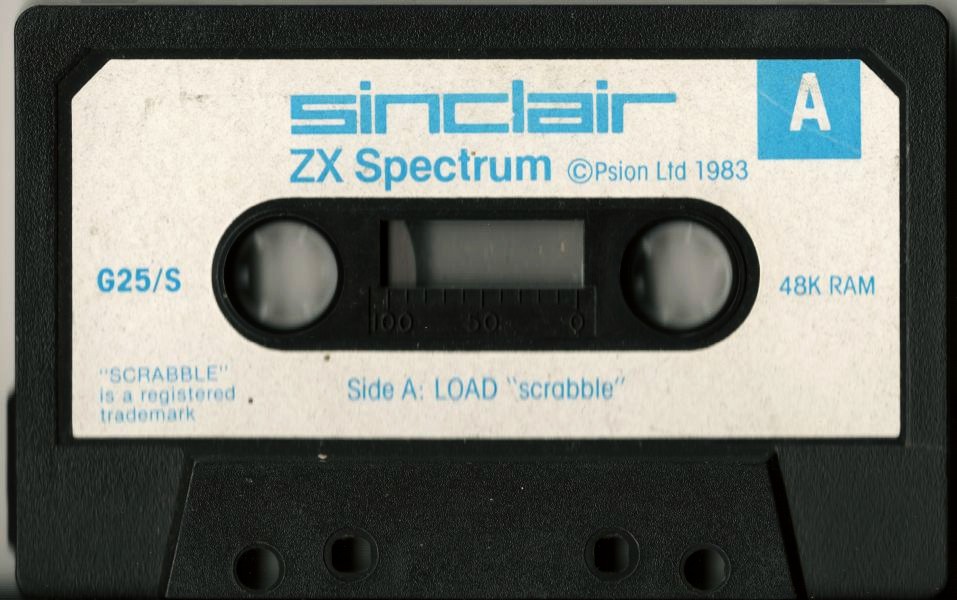
(FR)_Media.jpg)
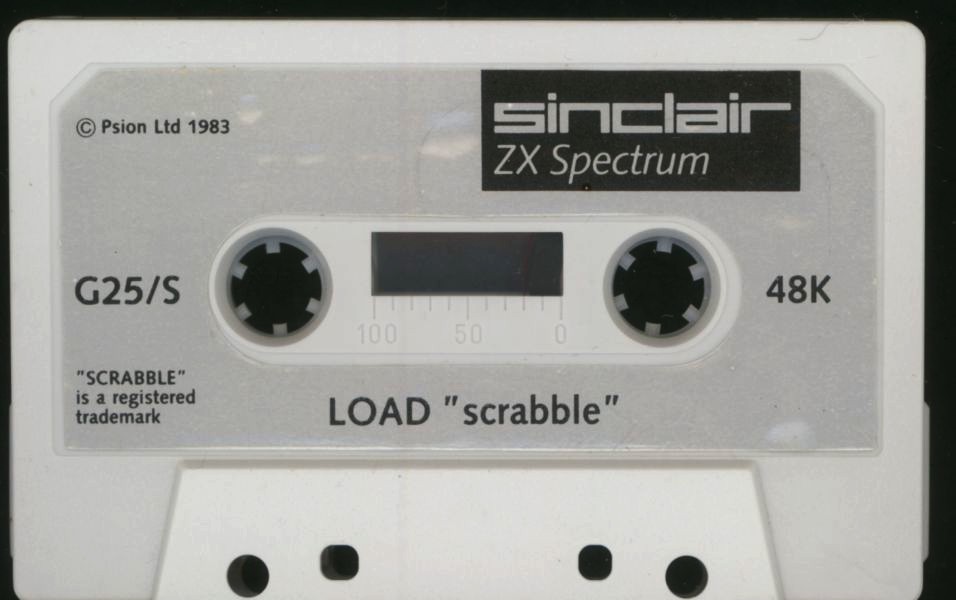
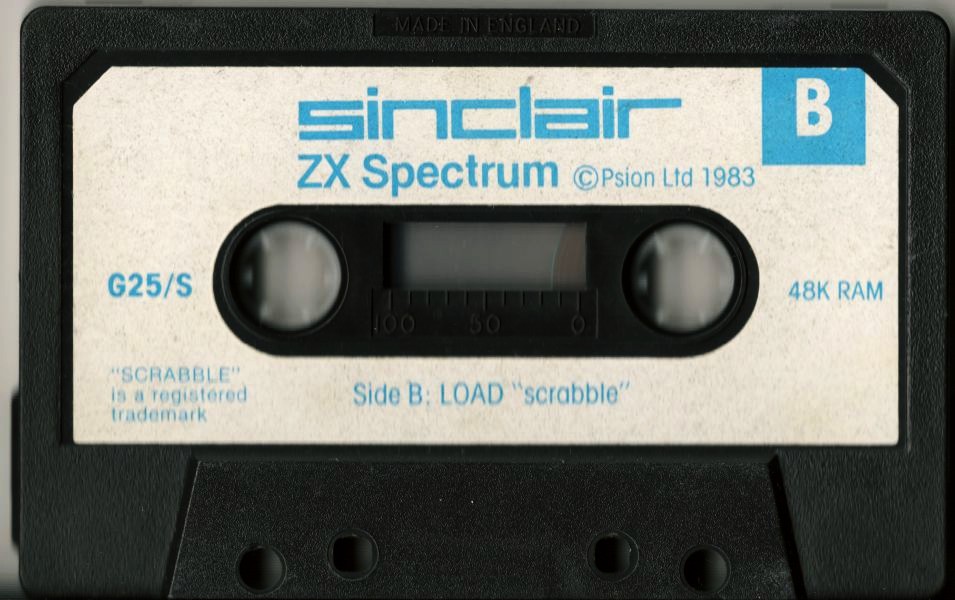
_Tape.jpg)
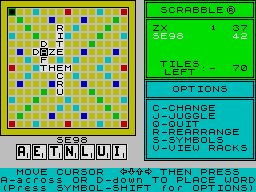
Discussion
Nobody has started a thread about this yet.
Awards
Rank #22 - 1984 Sinclair User Top 50 Spectrum Software Classics
Releases
- 1983Sinclair Research Ltd Sold as Micro ScrabblePound sterling 15.95
- 1987Leisure GeniusPound sterling 9.95
Play
- scrabble.rzxRZX playback file
- ComputerScrabble.tzx.zipTape image English26 KB
- ComputerScrabble_2.tzx.zipTape image English26 KB
- ComputerScrabble(French).tzx.zipTape image French22 KB
- ComputerScrabble.tap.zipTape image English32 KB
- ComputerScrabble(LeisureGenius).tzx.zipTape image English25 KB
Documents
- ComputerScrabble.txtInstructions English16 KB
- ComputerScrabble(LeisureGenius)(EN).pdfInstructions English357 KB
- ComputerScrabble(EN).pdfInstructions English388 KB
Other files
- Computer Scrabble (1983)(Sinclair Research).pokPOK pokes file 0 KB
Files and rights
Distribution permission is on record, granted to another archive rather than to this one. Screens and pictures are copied here; everything else links to the archive that holds it.
- AllowedSinclair Research Ltd → WorldOfSpectrum
Credits
- Steve Kellycredited
Sign in to credit somebody, or say what these people did.
Scores
In the magazines
- Sinclair User #201983 · Gilbert Factor8/10
- Sinclair User #321984 · Gilbert Factor8/10
Elsewhere on the web
- WorldOfSpectrum 63 votes8.12
Awards and competitions
C&VG Spectrum Top Ten 1983
In the magazines 47
ACE (Advanced Computer Entertainment) #6Mar 1988 · p.68
ACE (Advanced Computer Entertainment)
SCRABBLE Leisure Genius Spectrum, £9.95cs CPC, £9.95cs, £14.95dk C64/128, £12.95cs, £14.95dk MSX, £9.95cs Deluxe Version Spectrum 128K, £10.95cs, £15.95dk CPC 6128, £15.95dk C64/128, £12.95cs, £15.95dk IBM PC, £24.95 Psion caused quite a sensation with their first version of computer Scrabble for the Spectrum. It appeared just over three years ago and was remarkable for squeezing an 11,000 word dictionary into the 48K machine, together with a high degree of intelligence. As a result, many players discovered that Scrabble, like Chess, is a game that can be very satisfactorily played against a computer opponent. Fings ain't wot they used to be, of course, and now Scrabble is available from a different company - Leisure Genius (owned by Virgin) - and for additional machines. The original Psion version is still sold for the Spectrum, again by Leisure Genius, and there are also faithful conversions for most other formats. Notable exceptions are the ST and the Amiga, but we're promised an ST version for February this year. Playing Scrabble against a machine has certain advantages. To start with, you can be sure that the machine won't cheat. The words it chooses are in its vocabulary (which has been checked by an 'official Scrabble expert'), not in its imagination. If you cheat, entering a word that's not on the computer's list will cause it to challenge you - but simply reaffirming your decision will get it to back down. Cheating, therefore, is a matter for your own conscience and not the computer's adjudication. To complicate matters, Leisure Genius have also released Scrabble Deluxe. This offers a vocabulary ranging from just under 20,000 words on the Commodore to just over 23,000 on the PC. In addition, the number of skill levels has been increased from four to eight - a significant improvement since it enables you to match your own skills more accurately against your computer opponent. The Deluxe version also has a game-clock for timed play and an improved algorithm that speeds up the 'thinking time' for computer players at high skill levels. You should definitely pay the extra for this later version - in fact on the Commodore it's the same price, so no excuses. All versions allow up to four players, of whom any number can be computer controlled. Various game-play options include shuffling the letters on your rack (helps to spot possible words) and asking for hints. All normal play conventions are supported. One thing you will need, however, is a pencil and paper if playing with other humans - so you can jot down the letters on your rack before removing them from the screen display. You can choose to have all racks on permanent display, but this makes cheating rather easier and can be particularly serious at the end of a game when you're deciding whether to go out or hang on in the chance of getting that Q onto a triple-letter-score square. Along with chess, Scrabble is one game that converts excellently to computerised play. Fans of the game can at last play without having to seek out other addicts, and cheats can win every time.
Scrabble on the Spectrum - there's little difference between the formats, but this one remains on of the most impressive.
Micro Adventurer #17Mar 1985 · p.10
Sally Glover
CLASSIC GAMES FOR YOUR MICRO The silicon chip squares off against the traditional board game - Sally Glover reports. This month I've been given a good selection of 'classic' boardgames, available for several home micros. To begin with we'll look at the three versions of chess that I have played. CHESS First, from Psion Chess for the 48K Spectrum. The game loads to display a 2D board and a menu of options which allows a player to set up the board for problem solving or to load a saved game if you desire. Opting to 'play' then allows you to choose a level of play (0-9) and a choice of black or white pieces. The game is played by using the standard algebraic notation to enter moves. The display is rather small and I found it a little tricky to differentiate between the King and Queen particularly. As a comparison for all three chess programs I used the Fidelity Sensory 9 chess computer with a proven ELO rating of about 1500 as a standard. I played three games, Fidelity versus Psion's Chess with the chess machine on level one (instant response) and the program on level five (response two to five minutes). The chess machine won every time although one session produced an entertaining end game. The result was not surprising though, and indicates that Chess is a sound basic program which is a good introduction for the beginner but rather too limited to appeal to the more experienced player. Beyond's MyChess II for the Commodore 64 is a better product altogether and boasts many features not seen in the program above. The first of these is a very good manual, rather than the brief information sheet of the previous game. Perhaps the most attractive feature is the option to produce a 3D view of the game. This involves loading the reverse of the cassette. This program also uses algebraic notation, which is clearly explained with examples to help the newcomer. The function key toggles between a view of the board and a list of the moves that have been made. Disc drive owners also have the option to toggle between 2D and 3D views of the board. The variety of options for 'set up' is impressive. The regular mode is computer versus human. Other modes include Demo, Players (human versus human), Solvemate (search for mate in a given number of moves) and Automatic where the program plays itself. There are too many other features, including hint, take back and so on, to cover fully in this brief review but it is clear that disc drive owners have many options not open to cassette users, particularly the 128 historic games which can be loaded and replayed from the B side of the disc. The nine level game program itself is much stronger than the Psion Chess game for the Spectrum and was able to force the Fidelity to a draw on two occasions. Personally, I found the 2D option easiest for play since the pieces in 3D are very difficult to tell apart, even if you use the 'turn board' facility and view from the side. Overall, though, MyChess iI is a good, solid program with many features (also found on the more expensive dedicated chess computers) that will be a boon to the developing player and quite challenging to the more experienced. The package is very good value for money - especially for disc drive owners! Finally, Psions QL-Chess which shows most of the features of MyChess II but has a brief 'handbook' similar to the Spectrum version. This time, though, this is not a disadvantage as everything is laid out clearly and in logical order. The game has an 'easy' mode where the computer cannot 'think' while you are considering your move. There is also the facility to have the program dump a hard copy of the game to printer. The game itself has both 2D and 3D options but, unlike the MyChess program, the 3D version is very, very smooth, a real joy to behold as the pieces, clearly shown, seem to glide around the board. The real strength of QL-Chess is in the program itself, the winner of the World Microcomputer Championship. It boasts no less than 14 levels of play ranging from novice, where the program plays more weakly if it is winning, to Championship with infinite response time. Playing the game at Tournament level (equivalent to level 10 of QL-Chess) resulted in five games against the Fidelity being drawn. QL-Chess then, is an excellent program that should suit all players from the novice upwards. The serious chess player might even consider buying the QL rather than a dedicated chess computer. OTHELLO Now a classic from more recent times, Reversi - or Othello. Two players use an eight by eight grid (like a chess board) and twin sided counters one side black, one side white. The object is to dominate as many squares as possible with your own colour by 'capturing' your opponent's pieces, causing them to be turned over to show your colour. The game continues until neither player can make a move. If it sounds a little complicated when written down, just watch the sample game in the pack before you buy to help you make up your mind. The graphics with the game are rather poor consisting of red circles depicting white counters and red discs for black, but the game it plays is very strong - I was totally unable to beat it even after reading the note on hints and strategy in the instruction leaflet. Othello is one of those games it takes a few minutes to learn and a lifetime to master. To help in this, though, the program has the facility to set up games at any stage like the problem solving modes in chess. Reversi is a very strong program badly let down by poor graphics that would probably soon lose your interest. The next classic of this month is Backgammon, another program from Psion for the Spectrum. BACKGAMMON The game is about 3000 years old and involves men (rather like draught pieces) on a board consisting of 24 'points' arranged in four 'tables' of six each. The number of spaces moved each turn is decided by a dice throw. The first player to move all his pieces off the board is the winner. This sounds pretty simple with a high chance element but there is one snag... Two dice are thrown and you can use the throw to move two pieces or the same piece twice - throwing a double gives you four moves. You cannot move a piece onto a point occupied by two or more enemy pieces (a block). If you land on a single enemy this piece is 'hit' and removed from the board. Your opponent must use his next throw to bring the piece back into play on your home table. If he cannot do this because he is blocked, the move is forfeit. So you can see the game has very strong tactical elements too. The Spectrum version of the game offers four levels of play and the option to throw your own dice if you think the machine is cheating - perhaps it was coincidence but it always seemed to throw a double when it was in trouble! The display is very clear and, as the program is written in machine code, the responses are almost instant. Backgammon, or at least this version, is very addictive and I was soon carried away, building blocks and cursing the machine's good fortune. Most enjoyable and available on both cassette and ROM cartridge. SCRABBLE I'm sure that Scrabble is a game that doesn't need much introduction from me as it is seen in toyshops worldwide and has spawned countless TV quizzes. For any that haven't played though, the object is to use the seven letter tiles at your disposal each turn to join with the letter tiles already laid to form a new word for which points are scored. The words laid down must appear in the chosen reference dictionary. Play continues until all times have been laid or the players decide to call a halt - usually when they are left with a handful of unusable letters. Certain squares improve the value of various words and letters. When play stops, the value of a player's unplayed tiles is subtracted from the total they have accumulated throughout the game. The player with the most points is the winner. Up to four players can try Sinclair's Scrabble on any of its four levels and games can be saved for later reloading. As far as I can see there are no options denied the computer Scrabbler that the conventional player might use. You can shuffle the tiles about on your rack, change them all or note the value and distribution of the pieces. The 11,000 word plus 'dictionary' in the program allows many words to be checked and accepted by the computer but the more outlandish suggestions will be challenged. The machine is quite happy to believe you if you tell it the word is valid don't be tempted to cheat though! Playing the game is very easy. Just use the cursor keys to choose the position for the first letter of your word, and type A or D depending on whether the word is to run across or down the board. Then just type it in. The computer won't let you use letters you don't have or position words incorrectly. The only difficulty I experienced was in making out the premium letter and word squares - they seem tiny even by Spectrum standards. In summary, I had a lot of fun with Scrabble and, if you're keen on this sort of game, it is good value for money. A nice, well programmed game. Next month I shall be looking at the ancient games of Go and Kalah and computer versions of Monopoly, Cluedo, Kensington and Bridge (not Tony, although he's a classic too).
Sinclair User #32Nov 1984 · p.248/10
Gilbert Factor 8/10
The only version of the popular boardgame for the Spectrum and the best version on any microcomputer. The wordgame allows four people to play. If only one person plays the computer can take the part of the other three with ability levels set by the human contestant. The program contains a dictionary of 11,000 words and will respond within 90 seconds. It is possible to cheat by making the computer believe a word is correct but that is unsporting. Scrabble is the best boardgame simulation and certainly the most intelligent. Word-packing techniques leave room in memory for the excellent graphics and the computer capacity to play three parts. Position 22/50
Crash #4May 1984 · p.64
Producer: Psion, 48K £15.95 It may seem a lot of money to pay out, but if you enjoy playing Scrabble, you'll love the Spectrum version - even if you don't like Scrabble, you'll love the Spectrum version! There's no denying that this is a fabulous program. It allows you to do anything at all you would do in real Scrabble, and if you're playing against the computer it allows you to cheat - but you wouldn't do that, would you? Graphics display is crystal clear; your tile rack can be juggled to make up words, the computer tells you what your word will score and lets you take it back if you think you can do better. Up to four players, the computer may be one or all of them. You can select to see the computer 'thinking' if you wish. Only one failing, the Spectrum seems to get away with some rather odd two-letter words - and you can't challenge its 11,000 word vocabulary. Highly recommended.
Crash #1Feb 1984 · p.60
Producer: Psion, 48K £15.95 It may seem a lot of money to pay out, but if you enjoy playing Scrabble, you'll love the Spectrum version - even if you don't like Scrabble, you'll love the Spectrum version! There's no denying that this is a fabulous program. It allows you to do anything at all you would do in real Scrabble, and if you're playing against the computer it allows you to cheat - but you wouldn't do that, would you? Graphics display is crystal clear; your tile rack can be juggled to make up words, the computer tells you what your word will score and lets you take it back if you think you can do better. Up to four players, the computer may be one or all of them. You can select to see the computer 'thinking' if you wish. Only one failing, the Spectrum seems to get away with some rather odd two-letter words - and you can't challenge its 11,000 word vocabulary. Highly recommended.
ZX Computing #10Dec 1983 · p.165
David Rowley
READERS REVIEWS More of your thoughts on the commercial software packages you buy. This feature provides you space to air your views on any software, be it for the ZX80, ZX81 or Spectrum. If you've had a good or bad experience with any of the commercial software packages available for your micro, why not write in and tell us? Your reviews should contain your critical thoughts about the software and the relevant details concerning the availability of the package, its price, etc. You should aim to produce something like 250 to 500 words per package, depending, of course, on how enthusiastic you are about the software. Any reviews published in this section of the magazine will be rewarded with the price of the tape you review. So, if you buy a cassette and send in a review which gets published, you'll get your software for free! COMPUTER SCRABBLE Psion David Rowley About ten years ago I seriously considered writing a program to play Scrabble on PDP-8. However, I soon realized that the program's vocabulary would be so small that it would probably end up passing on half its turns. Now, Psion have produced a program with a vocabulary of over eleven thousand words (yes 11,000) for the Spectrum 48K. But having a large vocabulary is only part of what is needed to succeed at Scrabble, you need to see where the letters can be placed and decide on your strategy - is it really a good idea to open up the triple word square for your Opponent? So, on to a description of the 'product', as the marketing managers call it. The cassette comes in a miniature version of the box the original game comes in, so it is instantly recognizable. Inside the box is a professionally produced booklet describing the game for those who are unfamiliar with it, and details of how to operate the program. Although the program contains quite a lot of instructions, these are all straight-forward and easy to understand. The first trick, of course, is to load the program and after a couple of failures on side A, side B loaded first time, as it has done ever since. On successful loading of the program a number of questions appear: 1. Is your television colour or black and white; press C for colour or B for black and white. 2. Do you wish to reload a previously saved game; type Y for yes or N for no. 3. Number of players: press 1 to 4. 4. Name of player: type name (max. 8 letters) then ENTER. 5. Whether this player is the computer or not: type Y for yes or N for no. 6. If yes then at what level do you wish the computer to play for this player; press 1 to 4. where 4 is the hardest level. 7. Do you wish to see the computer's letter rack: press Y or N. 8. Do you want to see the computer trying its moves: press Y or N. The first option I wanted was to see the computer playing against itself, so I opted for level three against level four, with the options of seeing the computer's letter rack, and seeing it try its moves. Immediately on the screen was the Scrabble board, with different colours representing different square values. For the player currently taking a turn, the rack of letters is displayed, although not after they are placed on the board. On the right of the screen are the current totals of all players, the letter racks of all players, the number of tiles remaining, and a list of options. This game was marred a little because the letters which came up on the racks were very difficult to score well with, eg six vowels, or a 'Q' and an 'X' at the same time. However, level 4 ended up the winner, by 284 to 254. What was fascinating was to see the computer trying its moves. The flashing cursor square darted all over the board, trying out potential words, and printing things like "extra would score 32". Still, the real test of the program was to come. As a finalist at the British Scrabble Championships some years ago I felt quite confident. I set the program level 4, and asked the computer to keep its tiles hidden and not to visibly try out it moves. After scoring 32 on my first go I felt confident. But that confidence immediately disappeared, for the computer placed a full word and got on a triple word square to score a total of 86. The rest of the game was superb. The tiles came up well, a some good words were placed. The final scores were 358 to the computer and 332 to me. Although I caught up towards the end of the game, to be honest I never looked like winning. So, a victory first time out for the computer. I have beaten level four since, but it is not easy. I mentioned earlier that there are a number of options available. When it is a particular player's turn these options may be chosen: Symbol shift V displays the letter tiles of all players. Symbol shift S displays the values of various special value squares. Symbol shift R allows you to rearrange your tiles in any way you wish. Symbol shift C allows you to change any number of tiles you wish. Symbol shift J tells the computer to re-arrange the tiles in a random fashion. Symbol shift Q abandons the game and gives you the option of saving the game or starting a new one. It is also possible to pass if you cannot place any letters. All the options available in the original game are available here - even knocking the board over can be accomplished by 'accidentally' pulling out the power lead. Placing a word on the board is much easier than I though it would be. You simply move the cursor to where you want the word, type A if the word is to go across the board or D if it is to go down, and then type the word. The computer then places the word on the board, gives you your score, and the option of changing your mind if you wish to play somewhere else instead. When you finally enter the word the computer checks to see if the words formed are present in its vocabulary. If they are the game progresses, if they are not the computer asks you if you are sure about the word. If you answer yes, the computer accepts it. I mentioned the importance of strategy in Scrabble and here it is worth noting that the different levels appear to have different strategies. Level one seems to make little effort to score its maximum possible each turn, apparently placing tiles as soon as it finds somewhere they will go, and it has a very fast response time. By contrast level four always seems to attempt to get the maximum score possible, with one or two exceptions, eg if it has a blank it will not place it unless it gets quite a good score with it, but keeps it for a later turn. Dr. Peter Turcan, who Psion acknowledge as having played a large part in the development of the program, and Psion themselves, are to be congratulated on this program. For the beginner, levels one and two introduce you to the game, while level three provides a pleasant respite from the excellent lay of level four for the more experienced player. The program also appears to play an open rather than a defensive game, which is much more fun for its opponent. Are there any criticisms of the program? Only two, the first of which I am pretty sure can be solved only by using other hardware, like a pen and paper, or a Scrabble set. This problem arises if you wish to play against the computer and against human players at the same time. While the computer can keep its letters hidden, the other human opponent cannot. Still, more Scrabble enthusiasts believe that two person games are much more fun anyway. The second criticism is the price, £15.95. Maybe it reflects the box the program comes in, maybe not, but Psion are likely to lose sales to those potential customers who have only played Scrabble a few times and thus, not prepared to pay this much. Overall, a superb program, particularly if you are a Scrabble enthusiast without a regular opponent. But how about a price cut?
Sinclair User #20Nov 1983 · p.408/10
Gilbert Factor 8/10
SCRABBLE WILL SATISFY ADDICTS AND NOVICES The well-produced Sinclair computer version of Scrabble for the 48K Spectrum should please confirmed addicts of the game, as well as novices, with its easy-to-follow instructions and quick computer responses. One to four people can play and the computer can represent any number, including all four, thus turning Scrabble into a spectator sport. It has 11,000 words in its vocabulary and will challenge any player who tries to enter a word which is not in the store. Nevertheless, provided the other players permit, it is still possible to enter a non-existent word to register a high score, a slight weakness in this game although, in the long run, it is more fun not to cheat. As in real Scrabble, you can trade letters on your rack, juggle them about, miss your turn, and even save an unfinished game for later. Six levels of difficulty provide a challenge even for experienced Scrabble fans. Computer Scrabble is available from Sinclair Research, [redacted]. It costs £15.95.
C&VG (Computer & Video Games) #22Aug 1983 · p.1079/108/107/1010/10
Graphics 9/10
Getting Started 8/10
Value 7/10
Playability 10/10
PSION WIN THE WAR OF WORDS Psion's Scrabble program has jumped straight to a standard which chess machines haven't achieved in 20 years - it can test top human opponents. Charles Davies of Psion is worried about the 11,000 word vocabularly: "We could have had 20,000 but we went for a fast response time." He needn't be, the game seems to have words aplenty for its own moves and is certainly not guilty of over-challenging the human player's efforts. The presentation bears witness to the thought that went into it and the 16 page booklet which goes with the game is backed by on-screen prompts and reminders. On black and white TVs the coloured squares are changed into symbols so triple-word scores can still be spotted even if they remain elusive targets. In play the computer makes good use of the double and triple squares and is programmed to hold onto an "S" which doesn't give it a significant increase in the score. It also plays quickly and responds well within the two minute time limit demanded by Scrabble tournaments. It is hard to criticise this game except an price. Nicely packaged as it is, the £26.95 price tag means that it is only going to find its way into the dedicated Scrabbler's library. A pity because a lot of non-Scrabblers would enjoy it, if given the chance. For the playability mark we tested it out on two top Scrabblers.
EXPERT VIEW With 11,000 recognised words crammed into 48K, Spectrum Scrabble is a marvel of modern programming techniques but how close can it run the serious Lexicographer. Scrabble is a competitive game for over 700 members of Scrabble leagues and clubs and the national finals are keenly fought by wordsmiths capable of scoring 6-700 points in each game. We asked two regular entrants into the national finals, Heather Twidle and Jose Cope of Ware Scrabble Club to test out the Spectrum as an opponent and stood by to take notes. They were very impressed with the clarity of the board and the presentation of the screen, liked being able to see the Spectrum think through its moves and were pleased it totted up your score before asking you to commit a word. It also keeps score of the game and (important for the series Scrabbler) keeps a note of how many tablets are left in play. The program received top marks for its combinations of words and its game standard was generally rated as high. After a few practices, they took the machine on at the top level and after a mighty struggle which included three seven letter words, finally beat it by just four points - 397 to 393. The computer did not have to challenge often. It questioned Jos (Scottish sweethearts) but accepted Qua and it earned good marks for its vocabulary. While it was voted extremely user friendly it was a fierce competitor. And both would like to own the game to practice against. Which gave us the idea of running a competition to give Scrabblers the chance to win a Spectrum and this program. Read the September issue for your chance to enter our wordy competition for top Scrabblers.
Your Computer #7Jul 1983 · p.62
Meirion Jones
FROM DEEP-SPACE ADVENTURES TO WORLDLY BOARD-GAMES IN MEIRION JONES' SURVEY Less than a year ago the appearance of Scrabble on disc for the Apple caused consternation among micro owners. The program defeated three-quarters of the humans who challenged it to a dual of words. At least Scrabblers could comfort themselves with the knowledge that they had been beaten by a £750 disc-based system. Now Psion has taken even that consolation away by launching an improved version of the game with a bigger dictionary and better graphics which will run on a £150 system - the 48K Spectrum and a cassette recorder. This illustrates the rate at which Spectrum software is improving. The latest releases include clever implementations of board- games like monopoly and arcade favourites such as Scramble, long and complicated Adventures with names like Knight's Quest and combinations of arcade and Adventure like Pixel's Trader. While serious and educational material software is still thin on the ground, programs like Hewson's Countries of the World show how much useful information can be packed into the Spectrum. MORE ORIGINALITY Unfortunately the standard is not uniformly high. Sometimes imagination is lacking. Bridge software still insists on marketing what it calls "an exciting game for two to six players". Yes, you guessed, it is boring old Hangman. At other times graphics are weak. Micromega sells a version of Roulette which features a roulette wheel which looks more like a flying saucer on an off day. There is still too high a percentage of unloadable tapes and of tapes which you wished had been unloadable. Davic Games Tape 1, for instance, features a game which has Tooth Monsters instead of ghosts, which is probably the dullest-ever version of Pac-Man. The Tooth Monsters themselves are about as threatening as a pair of jelly babies. If you want real tooth monsters try Imagine's excellent Molar Maul. This is a real nerve-tingler from the moment that an enormous set of gleaming teeth appears on the screen like something out of jaws. Armed only with a toothbrush and toothpaste you have to defend these dentures from swarms of evil bacteria. These germs go by the name of Dentorium Kamikazium which allows Imagine to talk about "the DK Menace" - a triple pun partly at the expense of Imagine's Ipswich-based rivals DK'tronics. Imagine's punsters are at work again on the cover of Arcadia where we are told we are fighting against the "deadly menace of the Atarian empire". Perhaps this explains why Sinclair owners have shown such enthusiasm for Arcadia because the game itself is just a lacklustre version of Galaxians. Much better is Imagine's Schizoids. If, like me, you have always wanted to be a bulldozer, Schizoids is the game for you. You are a bulldozer in outer space and your job is to push tumbling cubes and pyramids into a nearby black hole without falling in yourself. Perhaps this nearby anomaly in the space-time continuum affects the wavelength of light. At any rate the game itself is only in black and white. Pixel is another company which cannot resist veiled messages. Trader is part space Adventure and part arcade game. The Adventure, trading commodities between different worlds, is more convincing than the crude skill tests such as finding the right orbit when approaching a planet. Trader may well be bought as much for its attractive packaging - which includes a survival guide for the would-be Trader - as for the game itself. After buying supplies for your first trip you set out for the planet Psi where the inhabitants - yes, Psions - who look like a cross between Clive Sinclair's beard and a muppet ask you tiresome questions such as "What is the formula for carbon monoxide?" or "What is your first name?". Entering "Clive" as an answer elicits the response "What a strange name". So, for that matter, does any other reply. If disaster should strike, a caption will appear saying "Is this the end...?" The answer is "No" because Trader is a trilogy so there are another two complete parts to load from the tape. There are many more traditional text Adventures of the "Go south, open door, take gold" variety but the narrowness of the replies they will accept is often irritating. DOWN THE MINES Mikrogen's Mines of Saturn starts with a cheery "Have fun" and then proceeds to ask questions like "Tunnels lead N, S, E and W - what will you do?" Attempts to answer "N" or "go N" or even "go n" will not wash. It must be "go North" or nothing. At least Phipps' Knight's Quest has a 120-word vocabulary to help you on your damsel-ridden way to a castle in the air. Everest by Richard Shepherd Software is more of a strategy game than a straight Adventure. You have to take enough food and rope to climb the mountain and cope with every hazard. I enjoyed the climb but I never reached the summit - partly because the Sherpas are not what they used to be. When Sir Edmund Hillary climbed Everest for the first time he managed to find a Sherpa called Tensing. The time when you visit a Nepalese hill village to recruit porters you are asked to choose between Sherpas with names like Keith, Brian, Ron, Tim and Paul. Presumably they are ex-hippies, lost on the road to Katmandu. Things obviously still are what they used to be down at Mikrogen. If Andy Capp sends you into fits of laughter Mad Martha might just raise a smile. It is the same old story, boy meets girl, well, hen-pecked husband meets axe-happy wife - all very predictable. Mikrogen also sells arcade games like Cosmic Raiders - a competent impersonation of Defender with a long-range screen and grabbers. Melbourne House's variation on the same theme is called Penetrator. The display looks more like the arcade version of Scramble. A training facility to help you build up specific game skills is a good idea. C-Tech's Rocket Raider is yet another competent variant on similar lines. Artic offers a suicidally fast asteroids game called Cosmic Debris. Still in the arcades, both Elfin Software and Quicksilva produce robot battles which are of the Pac-Man-meets-Tanks variety. Elfin's Tobor has the more exciting opening titles but loses on points to Quicksilva's QS Frenzy whose exotic science-fiction plot seems to offer a better justification for the game. Speaking of Tanks, DK'tronics 3D Tanx was one of my favourite programs in the whole batch. You can track you gun barrel from side to side and adjust the elevation as you lob your shells at four lines of moving tanks which can fire back at you. Although the opposing tanks at first appear to be crawling across a structure that looks more like Brighton's West Pier than a battleground, this is one of my four games you might catch me paying to play in an arcade. JOIN THE PROFESSIONALS Artic's Combat Zone is another ambitious attempt at a Tank game. Your target and the landscape - a few pyramids on an invisible plane - look like refugees from Psion's Vu-3D program. They are very simple three-dimensional shapes but they change position smoothly and realistically as if you were walking past them in some world inside your Spectrum. You and your opponents fire fragments of cubist paintings at each other but the abstraction is not so important as the fact that you are playing the first real Spectrum game in three dimensions - Vu-3D itself is a Psion program which allows you to build up three dimensional objects on the screen and then rotate them, or float them towards you and back again. In effect it is a crude version of the mainframe programs which create the effects for films like Tron. ET makes an appearance too in an Abbex Adventure with voices called ETX. Unfortunately after loading pages of instructions about how I should phone home ending with the advice that I should treat any MI5 man who appeared as an enemy, the tape self-destructed. This left me with an unnerving impression of "the strength of Britain's security services. The secret police are certainly important in DK'tronics strategy game called Dictator. The setting is a banana republic. The instructions ominously point out that "your rule is measured in months". You have to balance political factions, army, secret police, peasants, landowners, guerillas and superpowers if you are to survive. Breaking into embassies would doubtless be all in a day's work for a dictator. So for all prospective saviours of the nation, Sinclair's Embassy Assault will come in useful. It is very much like those maze games which present your view. standing in the maze. Instead of trying to avoid a minotaur, this time you are looking for secret codes and the like. All this is enough to send you back into the arcades but Jet Pac's creators have moved from the arcades into home computing. Ultimate Play the Game's Jet Pac puts you into the position of an astronaut who has to build a rocket from the pieces he can find sitting on clouds around the screen. The scenario is not entirely convincing but it makes for a good game. The same cannot be said of the simulations by CCS. CCS's representations of the oil business, Dallas, running a printers, Print Room, and of international aviation, Airline, may be realistic but they are not very exciting. Although these were originally designed as training for middle management, livelier presentation would not necessarily have made them less useful. Hewson's simulations of air-traffic control, Heathrow, and the Nightflite flight simulator are more convincing. Board-games seem to transfer particularly well to the Spectrum. Psion's Scrabble has already been recommended. With its four levels of play and 11,000-word dictionary it can offer almost as tough opposition as you could want. There are also two different approaches to that old favourite Monopoly. Automonopoli offers a continuous display of the part of the board around your current position. This display moves smoothly when the dice are thrown. Do Not Pass Go from Workforce has a less interesting display but at least shows the whole board all the time. Automonopoli allows you to personalise the program with the names of players and both programs give the option of being either a board for humans to play on or of letting the computer join in as a player. In each case the computer becomes a soft opponent once you have reached the stage of building houses and hotels. If you have ever wandered into a rundown dockland hotel or pub and been confronted by the sort of balding drunk who says he used to sail the seven seas and boasts that he can name the capital of any country you care to choose, I can reveal his secret. At home he has a Spectrum with Hewson's Countries of the World up and running on it. At the touch of a button it will remind you that N'djamena is the capital of Chad or that Yaounde is the capital of Cameroon. In the corner of the pub someone with probably be playing a video game not unlike Firebirds. Softek's Firebirds is a Galaxians-type game distinguished by good croaking noises from the birds. Still on the subject of sound effects Workforce's Jaws Revenge is very noisy and fun. The graphics are great. You are a shark and you are after the divers and- boats which are after you. Mined Out from Quicksilva is a very strange version of Mines. It is subtitled "Rescue Bill the worm from certain old age" and if you find a way through the first minefield you then have to rescue damsels in distress. Someone at Quicksilva has been playing too many Adventure games and it is beginning to show. The last words on the cassette packet read "the image fades to soft focus which is replaced by waves falling on a rocky shore, except in Bill's dream there are no waves or soft focus..." It is certainly time that software cassettes carried a government health warning. Company: Abbex Game: ETX Memory: 16/48K Price: £5.95 Company: Artic Game: 3D Combat Zone Memory: 48K Price: £5.95 Company: Artic Game: Cosmic Debris Memory: 48K Price: £4.95 Company: Automata Game: Automonopoli Memory: 16/48K Price: £6 Company: Bridge Game: Lynchmob Memory: 16K Price: £6.50 Company: CCS Software Game: Dallas Memory: 48K Price: £6 Company: C-Tech Game: Rocket Raider Memory: 16K Price: £6.50 Company: DK'Tronics Game: 3D Tanx Memory: 16/48K Price: £4.95 Company: DK'Tronics Game: Dictator Memory: 48K Price: £4.95 Company: Elfin Game: Tobor Memory: 48K Price: £7.95 Company: Hewson Game: Heathrow Memory: 16/48K Price: £7.95 Company: Hewson Game: Countries of the World Memory: 16/48K Price: £5.95 Company: Imagine Game: Molar Maul Memory: 16/48K Price: £5.50 Company: Imagine Game: Arcadia Memory: 16/48K Price: £5.50 Company: Imagine Game: Schizoids Memory: 16/48K Price: £5.50 Company: Melbourne House Game: Penetrator Memory: 48K Price: £6.95 Company: Micromega Game: Roulette Memory: 16/48K Price: £4.95 Company: Mikrogen Game: Cosmic Raiders Memory: 16/48K Price: £5.95 Company: Mikrogen Game: Mines of Saturn Memory: 48K Price: £5.95 Company: Mikrogen Game: Mad Martha Memory: 48K Price: £6.95 Company: Phipps Game: Knight's Quest Memory: 48K Price: £5.95 Company: Psion Game: Scrabble Memory: 48K Price: £15.95 Company: Psion Game: Vu-3D Memory: 48K Price: £9.95 Company: Quicksilva Game: Frenzy Memory: 16/48K Price: £4.95 Company: Quicksilva Game: Trader Memory: 16/48K Price: £9.95 Company: Quicksilva Game: Mined Out Memory: 48K Price: £4.95 Company: Richard Shepherd Game: Everest Ascent Memory: 48K Price: £6.50 Company: Sinclair Research Game: Embassy Assault Memory: 16/48K Price: £4.95 Company: Softek Game: Firebirds Memory: 16K Price: £5.95 Company: Ultimate Play The Game Game: Jet Pac Memory: 16/48K Price: £5.50 Company: Workforce Game: Do Not Pass Go Memory: 48K Price: £6.95 Company: Workforce Game: Jaws Revenge Memory: 16/48K Price: £5.95
Two down and one to go before the next wave of DK'Tronics Tanx hits you. Meanwhile Psion's Scrabble, main picture, can throw 12,000 words at you.
Personal Computer News #16Jun 1983 · p.484/54/54/53/5
Lasting Appeal 4/5
Playability 4/5
Use Of The Machine 4/5
Value For Money 3/5
Max Phillips
NAME: Computer Scrabble SYSTEM: 48K Spectrum PRICE: £15.95 PUBLISHER: Psion Software [redacted] FORMAT: Cassette LANGUAGE: Machine code OUTLETS: Mail Order from Sinclair Research [redacted] and dealers. NUMB'S THE WORD It's man versus machine. In one corner, the humble human, confidence shattered. In the other, the amazing 48K Spectrum, winning at Scrabble. This really is genuine Scrabble, played not just adequately but aggressively by a computer. It's an amazing program to watch and use, even if you can't stand the game. OBJECTIVES Just like the real thing, the idea is to score the most points by building up a crossword on the playing board. Up to four people can play, any one or all of which can be the computer. Besides four skill levels, the computer also acts as an automatic board, tile bag and scorer. FIRST IMPRESSIONS When you've got a program this good, you'd expect professional presentation. It is... complete with presentation box, labelled cassette, genuine Scrabble logos and a ten-page booklet. Instructions are divided neatly into two sections... Scrabble-the-game and Scrabble-the-program. They follow the box-lid tradition of presenting lots of info in a concise and clear manner. The program's not bad either. There's a faithful reproduction of the board and a simple, consistent, foolproof user interface. Little things, like the option to use a B&W TV, add to the impression of professionalism. Just a couple of barrel-scrapers. You can't fit either 'Spectrum' or 'Computer' in as the name of the Computer's player. And you've no way of interrupting an all-computer game. Believe me, you'd think twice about pulling the plug and reloading this one. Computer Scrabble caters for most of the real game. You can view your rack, reorder or change letters. A 'juggle' option even imitates the absentminded shuffling of your letters. There's access to information such as the symbols for premium squares, letter values and distribution, as well as running scores and a count of remaining tiles. When the computer is playing, you can optionally see it 'thinking'. You can see it shuffle its rack and make trial attempts at placing its words. If this isn't running as a demo in W H Smiths et all within weeks, I'll eat my Spectrum. IN PLAY Computer Scrabble plays a good game. Almost too good. We simple hacks take a pride in knowing the odd word or two. It isn't that rewarding to have the plastic nasty fighting back. Game two, level four, I start with 'Creel'. It plays 'Coze' with the Z on a triple letter square. 35 points. Response times are superb. Level one is around three seconds. Level four is around a minute. It sounds frustrating but it's a lot quicker than I can manage. There are a few differences from the human version. For starters, it's hard to fiddle with your rack in your head in between turns. And you're playing in full view of the opposition. There's a tendency for three human players to club together to beat the computer. Having the racks on view might be a problem. If you're such a good player that knowing what the other guy has got is an advantage, then be warned. And yes, you can't see what the Spectrum's got unless its 'thinking' option is on. The Spectrum checks your words when you place them. If it's not in its seemingly endless 11,000 word dictionary, it challenges. If you tell it the word is okay, it trusts you. If you've tried to cheat or simply mistyped the word, you lose your go. I know that's in the real rules. But most of the time, a long face can convince three human players to let you try again. But the most annoying feature is that you can't challenge it. I don't mind 'Id', 'En', 'Em', 'Re' and so on. But I'm not keen on its love of 'Ta' as a word. Oi, now hang on a mo. If we're going to play dirty, there's all sorts of colloquialisms, exclamations and so on I could come up with. Scrabble is an awful game for causing arguments and divorces among people. And here I am arguing with a computer. To place your word, you use the arrow keys to move a cursor to the square you want to start on. Then you press 'A' or 'D', depending on whether the word is run across or down. You can type the word, the Spectrum automatically filling in any letters you cross already on the board. The Spectrum displays the word and its score. You've then got the option to place it or not. This is great... you can try out words and have their scores calculated for you. It saves a fair amount of strain on your mental faculties. VERDICT Well, there goes another game. Prey to the microchip revolution. Scrabble on a computer, particularly a £130 computer, sounds impossible enough. But Dr Peter Turcan, Little Genius and Psion software have done it and I doubt if anyone else will bother with producing their own version. If you like Scrabble, then you shouldn't miss this one. Even if you can't stand computers, a dedicated and tireless opponent is worth the price of a Spectrum. If you don't like Scrabble, don't be taken in by the fancy graphics. Being thrashed by this thing is a lot less pleasant than losing to your little sister. Psion has a real winner. On a triple word square.
Mind-Stretchers carries this game and has 4 references of its own.
Spectrum Six Pack (ZX-Spectrum 48K version) carries this game and has 1 reference of its own.
Advert18
- Home Computing Weekly #40Dec 1983 · p.10
- C&VG (Computer & Video Games) #26Dec 1983 · p.172
- Sinclair User #21Dec 1983 · p.174
- Sinclair User #18Sep 1983 · p.117
- Personal Computer News #26Sep 1983 · p.61
- Your Computer #9Sep 1983 · p.117
- Your Computer #9Sep 1983 · p.122
- C&VG (Computer & Video Games) #23Sep 1983 · p.89
- Personal Computing Today #1Aug 1983 · p.63
- ZX Computing #8Aug 1983 · p.47
- Computing TodayAug 1983 · p.43
- C&VG (Computer & Video Games) #22Aug 1983 · p.57
- Your Computer #8Aug 1983 · p.25
- Home Computing Weekly #25Aug 1983 · p.41
- Sinclair User #17Aug 1983 · p.41
- Personal Computer News #23Aug 1983 · p.61
- Home Computing Weekly #20Jul 1983 · p.41
- Personal Computer News #18Jul 1983 · p.61
Letters4
- Your Computer #2Feb 1986 · p.17
- Popular Computing Weekly #35Sep 1983 · p.7
- Popular Computing Weekly #31Aug 1983 · p.39
- Popular Computing Weekly #19May 1983 · p.7
Feature4
- Computer Gamer #5Aug 1985 · p.22
- Micro Adventurer #17Mar 1985 · p.10
- C&VG (Computer & Video Games) #24Oct 1983 · p.126
- Your Computer #7Jul 1983 · p.62
Tips3
- Sinclair User #38May 1985 · p.18
- Popular Computing Weekly #51Dec 1983 · p.7
- Home Computing Weekly #28Sep 1983 · p.40
News/Note3
- Popular Computing Weekly #5Feb 1984 · p.5
- ZX Computing #8Aug 1983 · p.65
- Your Computer #6Jun 1983 · p.49
Review2
- Home Computing Weekly #17Jun 1983 · p.13
- Popular Computing Weekly #21May 1983 · p.53
Information1
- SSD-IISep 1999
CompoEntry1
- C&VG (Computer & Video Games) #24Oct 1983 · p.127
Hack/Poke1
- Popular Computing Weekly #37Sep 1983 · p.9
Licensed from
- ScrabbleSoftwareLittle Genius Ltd, Spear's Games
Related
- Compilations
- Mind-Stretchers, Spectrum Six Pack (ZX-Spectrum 48K version), Spectrum Six Pack (ZX-Spectrum+ version)
- Ports
- (Amstrad CPC), (BBC Micro), (Commodore 64), (MSX)
- Tags
- Turn based
- Elsewhere
- WikipediaCentre for Computing HistoryMobyGamesRZX ArchiveThe TipshopUVLSpectrum Computing RZX - YouTubeRZX Archive - YouTube
- Same entry at
- Spectrum ComputingZXInfo
Reviews from people here
Sign in to write about this, or make an account. It takes a minute and lets you correct the catalogue too.
No language recorded.
Sign in to correct or add to this.
Hold the rights to this and want it taken down?