
The Sentinel
Puzzle Game: Action · ZX-Spectrum 48K · 1 players · English
Firebird Software Ltd · 1987 · Pound sterling 9.95 · Pound sterling 12.95 disk



.jpg)
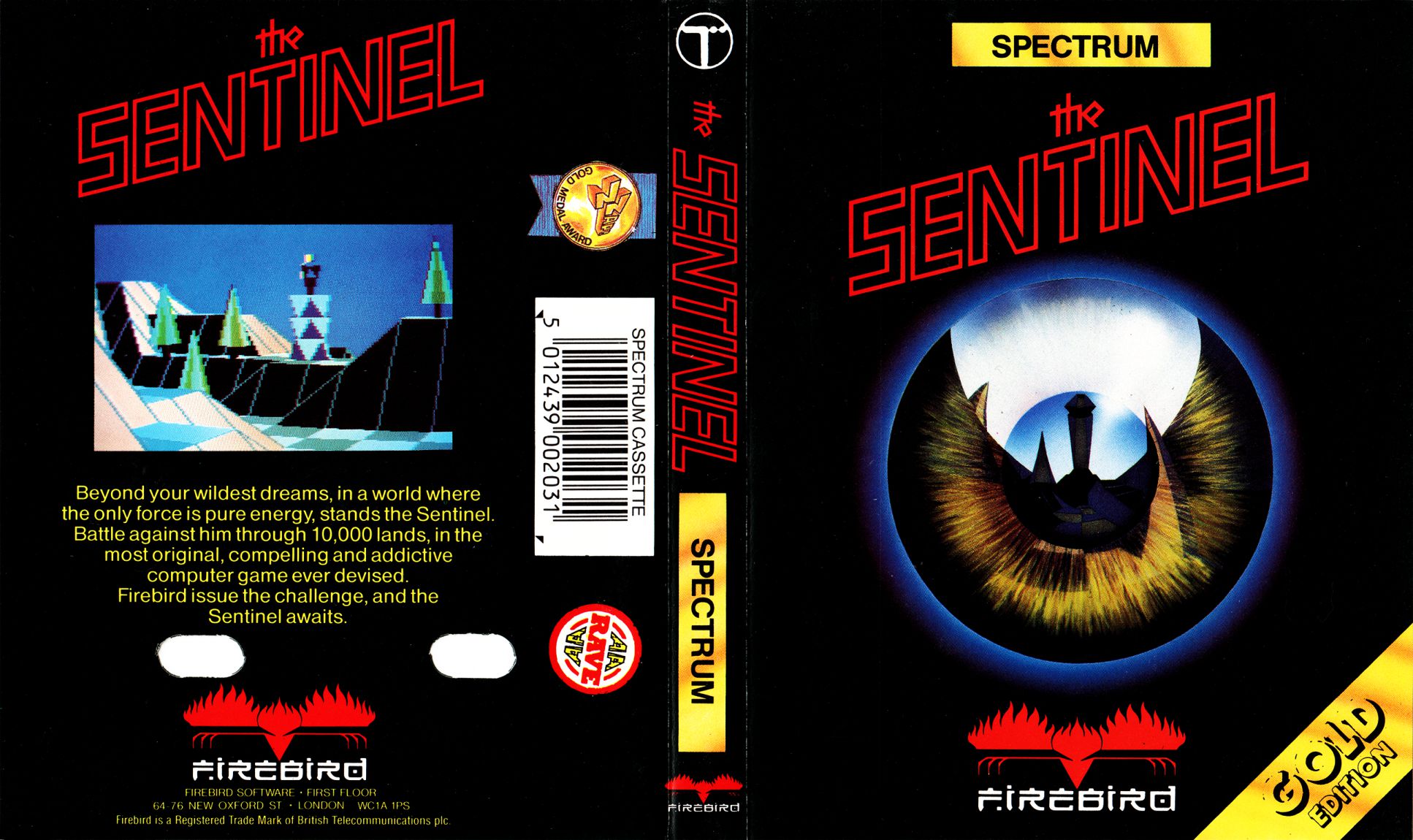

Discussion
Nobody has started a thread about this yet.
- Control Option
- Cursor, Interface 2 (right), Kempston Joystick
Releases
- 1987Firebird Software LtdPound sterling 9.95 · Pound sterling 12.95 disk
- 1987Dro SoftSpanish peseta 875.00
Play
- SentinelThe.dsk.zipDisk image English25 KB
- sentinel.zipRZX playback file
- SentinelThe.tzx.zipTape image English31 KB
- SentinelThe.tap.zipTape image English31 KB
- SentinelThe(DroSoft).tzx.zipTape image English31 KB
Documents
- SentinelThe(EN).pdfInstructions English543 KB
- SentinelThe(DroSoft).txtInstructions Spanish5 KB
- SentinelThe.txtInstructions English5 KB
Music
- SentinelThe.ay.zipRipped in-game/theme music in AY format 1 KB
Other files
- Sentinel, The (1987)(Firebird Software).pokPOK pokes file 0 KB
Files and rights
Distribution permission is on record, granted to another archive rather than to this one. Screens and pictures are copied here; everything else links to the archive that holds it.
- AllowedFirebird Software Ltd → WorldOfSpectrum
Credits
- Mike Follincredited
- Geoff Crammondcredited
- Tim FollinMusic
- David John RoweInlay/Poster Art
Sign in to credit somebody, or say what these people did.
Awards
Scores
In the magazines
- Sinclair User #621987 · Overall5/5
- Your Sinclair #181987 · Overall9/10
- Crash #401987 · Overall97%
- Your Sinclair #351988 · Sentinel9/10
- Your Sinclair #571990 · Overall79%
Elsewhere on the web
- WorldOfSpectrum 220 votes8.46
Awards and competitions
Crash Readers Awards 1987
- 2Most Challenging Game
- 2Most Imaginative Game
- 3Best Strategy Game
Golden Joystick Awards 1986
- 1Best Original Game of the Year
In the magazines 59
Crash2018 · p.62
Chris Wilkins
Ryan Coleman
As the Crash annuals are still for sale ZXSR has taken the decision to remove all review text, apart from reviewer names and scores from the database. A backup has been taken of the review text which is stored offsite. The review text will not be included without the express permission of the Annuals editorial team/owners.
Your Sinclair #57Sep 1990 · p.6690%60%30%78%79%79%
Fiendishness 90%
Lack Of Sleep Factor 60%
Pull Your Hair Out Factor 30%
Variation 78%
Overall 79%
Rich Pelley 79%
Cripes! You'd better look sharpish 'cos here comes... THE COMPLETE YS GUIDE TO PUZZLE GAMES Yep, readers, looks like it's time once again for another one of those Complete Guide thingies. This issue, for your delight and delectation, we thought we'd take a peek at the more puzzley sort of games. Y'know - puzzle games - those sort of weird ones where you have to use a bit of the ol' grey matter to solve, erm, puzzles and things. And who better to clasp you by the hand and drag you through the world of the mind-boggling than YS's resident 'heart-throb' RICH PELLEY. Hurrah! BUT FIRST... THE RATINGS As usual, the normal rating system seems a bit crap in these circumstances, so here's a different one instead. FIENDISHNESS How complex and difficult to finish are the puzzles? Are they a complete bummer to complete, or could you do it with your little finger stuck, er, wherever you want to stick it? LACK OF SLEEP FACTOR Will it have you coming back for more (and more) or will a few games be enough? (Who knows?) PULL YOUR HAIR OUT FACTOR Is the game easy to get into, or do you have to spend ages looking up various keys, and working out what's going on all the time? (The lower the mark the better the gameplay in this case.) VARIATION Are the puzzles varied, or are they all the same? (Er, obvious, really.) Okay, so I admit it - I'm crap at puzzle games. Come to think of it, I'm crap at most games really. And I'm not in a particularly good mood today either 'cos I've got a sneaky suspicion that this guide thingy is going to take absolutely ages to write. Even though Matt has reassured me "It won't take long" and Jonathan has informed me (much to my surprise) that "Honest, it'll really be a lot of fun to do" I'm a little dubious. Still, let's get on with it and see what happens, shall we? For a start, I can see one big problem staring me in the face almost immediately. I mean, what exactly makes a puzzle game a puzzle game, eh? One man's puzzle game may another one's arcade adventure be or, um, something really. We've had countless arguments here in the office over it already (and for some reason I always seem to lose). For instance, Matt thought Arkanoid, Batty and the like might almost count, while Jonathan firmly disagreed. (In fact, if Jonathan had had his way, Tetris would be 'the only true puzzler ever written' and this would be the shortest Complete Guide on record!) Seeing as this is my feature though, and I'm writing it, everybody's going to have to agree with me! And what is my definition? Well, it's fairly loose really. It's anything where you have to try to work out some sort of (perhaps totally abstract) mental problem against a time limit. Most great puzzle games are based on one very simple initial idea, which is then perhaps spiced up by slicking in lots of different ways that you can earn bonuses, die, get extra weapons or abilities (if it's a weapons sort of game) and so on. It's the simple initial idea that really counts though - if you haven't got that, you ain't got much really. So what sort of puzzle games have we got here, then? Well, lots of different ones really - there are games where you must arrange blocks, make pictures, blow up balls, collect keys, and do masses more equally weird and wonderful puzzley things. One good thing though is the scope - unlike in most areas of Speccy programming, with puzzle games you sometimes actually get a degree of originality. The games I've covered here are all good ones, and all still fairly easily available and - would you believe it? - no two of them are the same! (Well, no three of them at least.) And, erm, cripes, looks like I've run out of things to say. So, um, I'll stop waffling and get on with it, shall I? THE FIRST PUZZLE GAME IN SPECCY HISTORY Um, er, um. Now you re asking. Turning to the very first issue of Your Spectrum (ie Your Sinclair in disguise), I find one lurking in the first few pages. Traxx from Quicksilver is its name, and what seems to happen is that you move around this little grid thing collecting squares. Fun, eh? (Alright, I admit it. Of course there's no way that could be the first commercially available puzzle game, but it's the first I could come up with. Sorry and all that.) Anyway, on with the show. NB Erm, actually, before we start, I'd just like to clear something up. You may notice that all the marks for the following games are quite high - there don't seem to be any crap ones. Now this isn't 'cos I'm a great puzzles fan or anything (in truth I hate them all) - it's just that unfortunately all the ones I've picked have been quite original and good. And keeping up my reviewer's credibility, I have to be fair. Hence the high marks. The Sentinel Firebird Reviewer: Rich Pelley Er, um, so okay - it's not really that much of a puzzle game, but I'm desperately running out of the things. So just pretend it's not here or something. Anyway, The Sentinel, eh? I'm pretty sure (I wouldn't take my word for it, though) that it was the first solid 3D game on the Spec. And what happens is that you're this robot thingy, and there's this sentinal thingy way above you who turns around slowly. If he looks at you then you start dying, so you must climb up to his level by creating rocks and trees and things. and eventually absorb him. This may all sound very complicated, but once you've got into it, it really is lemon peasy and very enjoyable into the bargain, despite the large pauses during play which do tend to hinder things a bit. AND FINALLY... There we have it! As I predicted (and Matt and Jonathan got totally wrong) it took me absolutely blooming ages. And most of that time was spent arguing about what a puzzle game actually is and what qualifies and what doesn't (which is one reason why we don't have a giant list of all the ones ever made - we just couldn't agree what they were!). Next month - Flight Sims. (Something everyone can agree on.) Hurrah!
Spooky solid 3D vector graphics give this game a very different look to the others we've covered, but it's a puzzler nonetheless. (And quite a good one too.)
Your Sinclair #18Jun 1987 · p.84Your Sinclair Megagame9/109/109/109/109/109/10
Your SinclairYour Sinclair Megagame
Graphics 9/10
Playability 9/10
Value For Money 9/10
Addictiveness 9/10
Overall 9/10
Phil South 9/10
What's got 10,000 screens, hordes of vicious robots out for your blood, and a zillion complex puzzles for you to solve? We drop Phil South into Firebird's Sentinel to see if he's king of the castle! FAX BOX Game: The Sentinel Publisher: Firebird Price: £9.95 Reviewer: Phil South It's dark. All you con see is the wall of a high computer-generated cliff. As you rotate on the spot, you can see a small clump of trees, which you quickly absorb for their energy. You can't see any more without tilting your head... then as you look up you can see it, its slowly rotating body towering over you. All too soon its malevolent eye turns on you, and you start to feel the energy being sucked from your body. Finally, as your consciousness blinks out, you see the face of your destroyer... the evil Sentinel. Oh well, better luck next life. It's rare than an original game concept comes out, so when one appears it takes you completely by surprise. Sentinel is just such a game. It's a new kind of strategy/arcade idea, which draws from elements common in a range of traditional strategy formats. It takes place in stunning 3D renderings of 10,000 different landscapes through which the player moves, (or more precisely, teleports) in his quest to destroy the evil Sentinel. Yes, you must destroy him... but the catch is that if he sees you, he'll absorb your energy and you're dead! On each landscape there's a finite amount of energy to be had, in the form of trees which are dotted around the computer generated hills and valleys in a more or less random way. You have to absorb the trees to get any goodness out of them. Having gained a bit of energy, you can then project it out of your robot body, by creating something tangible, like another tree, a boulder or a fresh robot. Now, and here comes the clever bit, you can teleport yourself (accompanied by a digitised riff from a synthesiser, a sort of Whaaanggg!) into that new robot body and absorb the one you just left, and in this way you move across the landscape. The reason you absorb the robot you just left is because the amount of energy remains constant in the landscape - so if you expend energy to make a new robot, you must gain some of that energy back by absorbing your old robot. As to why you need as much energy as possible, we'll go into that in a minute. Your view of the computerised landscapes appears as if you're looking out of the head of the robot. You're able to pan round to look for the Sentinel and, using the crosshaired sight, orient on and absorb trees. This may all sound a bit easy-peasy to you, but there's one major point to the gameplay which prevents you from just scooting around, teleporting wherever you please and eating every tree you can see. You can't absorb anything unless you can look down on the square the object stands on, and that goes for boulders, trees, your robots and even the Sentinel itself. If you can't see it, you can't eat it! This can be very frustrating if you can see the top of a tree but can't see the square it's standing on. (The secret is to always go for extra height, but we'll get to that later!) Once you've managed to absorb the Sentinel and climbed up to where he was standing you can hyperspace to the next level. Here's another clever bit - depending on the number of points you have left when you've absorbed the Sentinel, you go on to a higher level. The more points, the higher the level. The entry code for the level you've achieved is displayed across the sccreen and you type this in when asked for it. And if you write it down on a bit of paper, you can go straight to that level next time you play and so save yourself the worry of going through from level one again. The graphics are totally brilliant, being by far the best 3D effect I've seen on the Speccy, and the digitised or sampled music is great. It sounds like that spooky synth music you used to get in Dr Who. (Daaann dannn dannnnnn! Ooooooo!) Soo-parb! If you find this all a bit hard to grasp, and who could blame you, don't worry. We've constructed a little Sentinel universe in microcosm, from which you should be able to draw all the conclusions you could possibly want. So sit back, and we'll take you forth into the dangerous realm of... (deep voice) The Sentinel!
And finally, when you've avoided the Big Lad's gaze and sneaked up on him, you can absorb him by focussing your crosshairs on the top surface of his pedestal and pressing 'A'. Once you've got him you can't absorb any more energy, so prepare yourself by absorbing as much stuff as you can before destroying old Big Nose.
Don't panic! Well, okay, go ahead. If you get in a very tight spot (like anywhere in the game, for example) you can escape by hitting the Hyperspace button. You should only use this very sparingly, because it uses a lot of energy, and you wouldn't want to blow yourself up by not having enough power, would you?
Don't waste time looking around every two seconds to see where the Sentinel (or indeed a Sentry) is looking. If you've memorised where he is in relation to your current position, you can work out a way which will take you around the landscape, just out of his line of sight. Always teleport to where he will be or has been looking.
Here he is, the king of the castle. And your job (you dirty rascal), is to topple him from his perch before he rotates your way and spots you. Trouble is, he's in a higher level than you, and you need a lot of energy before you can build yourself up to his level. The only way around the landscape is to keep out of sight.
If the Sentinel can't see your feet he can absorb you, but that won't stop him from turning the closest tree into a Meanie. Meanies rotate much faster than you and can Hyperspace you against your will unless you can absorb them first. So when you hear the low clicking... watch out! There's a Meanie about!
It's a good plan to get as much height as possible very early on. If you start by placing two blocks in plain sight (so you can retrieve the robot you started in) you can gain energy very quickly. The more energy you get, the more boulders you can put down and then you can get to the Sentinel!
Keep a weather eye out for the scanner window in the top right of your viewer window. If it goes fuzzy, you're being watched by a Sentinel or a Sentry. From then on you've got about ten seconds before your energy is sucked out through your ear! So when you hear the fuzzy sound and your scanner goes all snowy, get the hell out of there!
One some levels, from about 10 upwards, there are Sentries on guard too! This makes it very difficult to manoeuvre yourself into a position where you can't be seen, but it can be done. Just turn 360° before you begin moving, and memorise where the Sentinel an Sentries are so you can avoid their steely gaze (bzzzzt!)
To move around a Sentinel landscape, you have to place a robot on a square, and teleport to it. To make new robots for yourself, you have to eat three trees! (It's okay, I know they're a bit dry, but drink some water!) And don't forget to absorb the robots you leave behind, 'cos if you don't you're going to run out of energy.
ZX Computing #38Jun 1987 · p.40ZX Computing Monster Hit
ZX ComputingZX Computing Monster Hit
AN INTRIGUING AND ORIGINAL RELEASE FROM FIREBIRD Firebird £9.95 In a land far away where pure energy is the only source of power the Sentinel rules supreme. Now you aim to challenge this master in a battle that will rage over 10,000 landscapes that are amazingly crammed into 48K! Each landscape is a world of its own built out of plateaus, peaks and pits. On top of the highest peak stands the Sentinel. You begin at the bottom of the deepest pit. The sentinel from it's lofty throne slowly rotates and scans the landscape beneath it for anything with a surplus of energy, such as you. The Sentinel absorbs the energy of living things and recycles it into the lowest life form which is a curious conical tree that it scatters around the barren landscape. You can absorb these trees to collect the energy to defeat the Sentinel. You are in fact a robot that can't move but can duplicate robot shells from energy and transfer to them. You can then reabsorb the old robot shell thereby reclaiming the energy. Using this method you can move to any plateau you can see below you, and can rise up levels by building boulders on top of plateaus then the robot shell on top of that. You can stack boulders to any height (although you can only see the top of one boulder) and build up to the highest level. However, a boulder costs two units of energy and a robot three which tends to limit your excursions. If you think you're in desperate trouble you can hyper space (costs three units) but you'll end up at a equal height or even lower plateau. If the Sentinel traps you in its deadly gaze it will gradually absorb your stored energy until you either transfer to another robot, hyperspace or die. If it spots you but can't see the base of the plateau you're standing on it will try to flush you out by converting the nearest tree into a meanie. These snake like creatures also rotate and if it sees you before you can absorb it or get away then it'll force you to hyperspace. This will cost you three units and will probably land you in the gaze of the waiting Sentinel. By landscape thirteen things are getting a little trickier as the Sentinel has now recruited the help of a Sentry. This is a mini Sentinel that also stands on a tall peak and absorbs anything caught in it's gaze, creates Meanies to flush you out and of course guards the Sentinel. In later landscapes the Sentinel recruits more and more Sentries which must be destroyed before you can tackle the Sentinel. By now the landscape is also getting flatter with less cover in which you can hide from the energy draining gazes of the Sentinel and his Sentries. In one landscape you begin in the centre of a wide open circle surrounded by nine peaks containing the Sentinel and eight Sentries! The game is a mixture of tactics, energy collecting and reactions as you escape Meanies and the Sentinel. Your first task is to find the Sentinel (for Sentry) before they find you and gauge the direction and speed that it's rotating. You can then aim to stay on its blind side while you absorb enough trees for your assault. To absorb the Sentinel and complete the landscape you must get above it (by standing on boulders and absorb it by homing in on it's base. One landscape down only 9,999 to go! You don't actually have to complete every landscape as on completion of one you're given the eight digit code for your next one. The next code you're given depends on the amount of energy you have left once the Sentinel has been defeated. The more energy you have the more landscapes you skip. Soon you will have pages and pages of eight digit codes corresponding to the games landscapes. This means you can start any game at any landscape you like as long as you have the code. It's best to keep all the codes you find as you may get stuck on a particularly tough level that you could leap frog by redoing a previous level and aim to finish it with more energy. The Sentinel is an absorbing mix of gameplay demanding strategy and skill to solve it. Original, addictive and massive, what more could you possibly want?
Sinclair User #62May 1987 · p.24Sinclair User Classic5/55/5
Sinclair UserSinclair User Classic
Overall 5/5
Graham Taylor 5/5
Label: Firebird Author: Geoff Crammond Price: £9.95 Joystick: various Memory: 48K/128K Reviewer: Graham Taylor Sentinel is very, very strange. It has won trillions of awards on other formats just for being extraordinarily peculiar. The fact that it was technically brilliant and astonishingly addictive as well may have helped. Imagine a cross between chess, What's the Time Mr Wolf?, recent developments in quantum physics and fractal landscape techniques. Bet that helps a lot doesn't it? You're set down in this landscape. Actually it's one of around 16,000 possible landscapes! It's sort of craggy rocky affair not unlike the mountains of the moon or Herne Bay. Each craggy landscape consists of distinct levels - plateaux divided into a checkerboard of different squares at different levels. The only thing it reminded me of - and that not a lot - is Marble Madness, but with a worm's eye view. Somewhere on one of the higher peaks in this landscape stands the Sentinel - a giant statue-like figure which slowly turns through 360 degrees. If you should get in a position where the Sentinel can 'see' you your energy instantly begins to drain. On harder levels the Sentinel has a bunch of sentrys that are also standing around looking for you. The game is this. If they see you and your energy drains to zero you get absorbed. If you sneak up on the Sentinel - get on a level higher than it and absorb it, you've 'won' that landscape. The quantum physics comes in with the general principle that operates in the game that matter cannot be destroyed and there is a finite amount of energy in each universe. You use energy to move, you use energy to create. You can create trees, boulders or other selves. The opposite of creating energy is absorbing energy and this works in exactly the reverse way, ie. If you spot a tree or a boulder you can absorb it and gain energy. Movement is a matter of scanning around for a robot in that square and then transporting yourself to that square. Having transported yourself you can absorb your old body. All this cosmic stuff shouldn't hide the fact that what you are really playing is a sort of hide and seek. You carefully move around the landscape looking for trees or boulders to absorb but without moving to a square from which you can be seen by the Sentinel or its Guardians. The problem is where to move to that will both get you higher - nearer the Sentinel - yet not leave you exposed. The game looks extrodinary, a little like those fractal, landscape games with clever use of shading and lines to give the impression of some alien but 'real' looking landscape. The Sentinel, guardians, trees and boulders are equally well, if simply, realised. Whatever else, you've never seen another game that looks like this one. I managed to beat the first few levels relatively easily but the game soon becomes unbelievably difficult. Paranoia sets in as you start to wonder if there is a single place you can move to without being seen. Your tactics get more subtle (well more subtle than just pressing the Hyperspace 'run away' button anyway). If you get close to the Sentinel you can tell which way it is turning (it must turn before it sees you) and plan your movements accordingly. You can also create some objects in squares to 'test' whether they can be seen or not - Sentinels will always absorb energy from any object they can. Win through a landscape and you get a code for your next level. The more energy you have left means the higher the level you get the code for - so the better you did the faster you jump up the levels scale. So it goes on. And so you'll go on. Rather than becoming repetitive this is an astoundingly addictive game. Brilliant.
Crash #40May 1987 · p.20Crash Smash90%93%98%96%95%97%
Presentation 90%
Graphics 93%
Playability 98%
Addictive Qualities 96%
Value For Money 95%
Overall 97%
Ben Stone
Mike Dunn
Paul Sumner
Producer: Firebird Retail Price: £9.95 Author: Geoff Crammond Absorption, says the dictionary, is a process whereby one object disappears through incorporation in something else; a sucking in of fluid, light or nutriment. It also means a mental engrossment - and generally, that is the aim of any good game. In The Sentinel, FIREBIRD have pared absorption to its most elemental components, and produced a game which they hope is absorbing, and is about absorbing. Think of 10,000 planets, merely a fraction of the known universe, but almost infinite by man's reckoning. 9,999 of these worlds are under the sway of a supremely powerful malignant being - The Sentinel. What it is, or what its purpose might be, no one knows. What it does, however, is well understood. The Sentinel has slowly but inexorably travelled through the galaxy, absorbing the energies of all the worlds it touches upon, leaving on each one an image of itself and, on some levels, a host of attendant Sentries. Now it is Earth's turn. There is hope, though. The Sentinel can be attacked by reversing the process, and absorbing energy from it - world by world. The struggle is elemental - you against the Sentinel in a battle of wits played out on a 3D landscape where the chess pieces are your robots, boulders, trees, sentries and units of raw energy. Where to begin? Any of the worlds may be chosen, as long as you have attained its entry code, thus you are forced to play planet by planet, and you are hyperspaced down to its surface. An aerial view is displayed, showing the relative positions of the Sentinel and its Sentries, before you are placed on the surface. The Sentinel always occupies the highest point of the landscape, you are transported to the lowest. Look around for a while, get the feel of this world. Until you start absorbing or expending energy, your enemies will remain inactive. When you do, The Sentinel and its Sentries begin scanning the landscape, searching for squares containing more than one unit of energy - that's likely to be you. If they can clearly see the square on which you stand, then they reduce its energy level by one unit at a time, creating a tree somewhere else in the process. In turn you can absorb the energy units of objects on the landscape, such as trees or Sentries, or even The Sentinel itself, as long as you can centre on the square they stand on, and then use that energy to create new objects. The point of this is to make new robots for yourself, transfer to the waiting robot, and then absorb the energy of the robot you have just left. In this way movement around the landscape is possible. Boulders can be stacked up to create higher vantage points for observing and attacking the positions of Sentries and The Sentinel. A clear strategy is essential. You must hide from the absorption potential of the enemy, yet at the same time manoeuvre into positions of attack. Sometimes the action becomes frenzied. If a Sentry or The Sentinel can see the square you are standing on, a screen scanner warns, and there are five seconds to move before your energy is absorbed. Should the enemy see you, but find your square obscured by landscape, the scanner warns again, then a tree in a better vantage point for the job is transformed into a Meanie to flush you out of hiding. The Meanie rotates rapidly until it can see you, then forces you to hyperspace to a new random location, but probably one not to your liking. Hyperspacing costs energy units, because the Meanie creates a new robot, transfers you to it, but leaves the old one behind, wasting energy. You may be able to re-absorb it later, however, if it hasn't already been absorbed by The Sentinel. Gaining fluency with the control of your circumstances is vital for those moments when all hell breaks loose. The view may be panned up or down, left or right through 360°, or snap-turns can be made. A sight may be turned on so that absorption, creation or a transfer may take place. And there are separate controls for creating trees, robots or boulders. If you manage to defeat The Sentinel by absorbing all its energy, transfer to its position, the highest spot on that world, and hyperspace. You are given a new entry code for another world, another battle, another Sentinel. COMMENTS Control keys: S/D pan left/right, K/M pan up/down, A to Absorb, T, B and R to create Trees, Boulders and Robots respectively, H to Hyperspace, Q to Transfer Joystick: Kempston, Interface 2, Cursor Use of colour: monochrome effect, but background colour-change option Graphics: excellent line and cross-hatched shading creates solid 3D, the whole scrolling smoothly and fast Sound: some tunes and limited but effective spot FX Skill levels: effectively, you make your own Screens: 10,000 landscapes
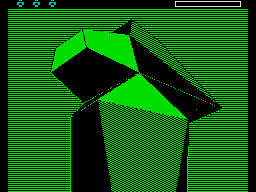
Big Guy in the distance - The Sentinel stands high on his rock outcrop, commanding the world below.
Having created, or transferred to, a boulder, your robot gets a better view of the landscape. But watch those trees - one of them may turn into a meanie at any moment.
Landscape 0000 - you don't need an entry code for this one, which probably explains why Cameron photographed it.
Supreme Challenge carries this game and has 16 references of its own.
Tips13
- MicroHobby #180Nov 1988 · p.47
- ACE (Advanced Computer Entertainment) #13Oct 1988 · p.61
- YS Smash TipsAug 1988 · p.42
- C&VG (Computer & Video Games) #80Jun 1988 · p.104
- MicroHobby #152Nov 1987 · p.24
- Sinclair User #66Sep 1987 · p.13
- Your Sinclair #21Sep 1987 · p.48
- Crash #43Aug 1987 · p.60
- Sinclair User #65Aug 1987 · p.47
- Sinclair User #65Aug 1987 · p.16
- Crash #42Jul 1987 · p.54
- C&VG (Computer & Video Games) #68Jun 1987 · p.82
- C&VG (Computer & Video Games) #67May 1987 · p.43
Review10
- Your Spectrum/CZ #11Nov 1999 · p.4
- FIFO #16Aug 1992 · p.17
- ZX MagazínMay 1991 · p.41
- New Computer Express #37Jul 1989 · p.41
- Your Sinclair #35Nov 1988 · p.83
- C&VG (Computer & Video Games) #82Aug 1988 · p.61
- MicroHobby #148Oct 1987 · p.18
- Computer Gamer #27Jun 1987 · p.12
- Popular Computing Weekly #18May 1987 · p.51
- Your Computer #2Feb 1987 · p.47
Feature8
- ACE (Advanced Computer Entertainment) #42Mar 1991 · p.69
- Your Sinclair #57Sep 1990 · p.66
- Your Sinclair #50Feb 1990 · p.72
- ACE (Advanced Computer Entertainment) #13Oct 1988 · p.61
- MicroHobby #156Dec 1987 · p.16
- C&VG (Computer & Video Games) #68Jun 1987 · p.82
- Sinclair User #63Jun 1987 · p.19
- Your Computer #11Nov 1986 · p.52
Full-page ad7
- Your Sinclair #19Jul 1987 · p.63
- Crash #41Jun 1987 · p.77
- Your Sinclair #18Jun 1987 · p.62
- Sinclair User #63Jun 1987 · p.63
- Crash #40May 1987 · p.125
- Sinclair User #62May 1987 · p.92
- C&VG (Computer & Video Games) #62Dec 1986 · p.33
News/Note6
- ACE (Advanced Computer Entertainment) #8May 1988 · p.101
- ACE (Advanced Computer Entertainment) #7Apr 1988 · p.109
- ACE (Advanced Computer Entertainment) #6Mar 1988 · p.107
- ACE (Advanced Computer Entertainment) #4Jan 1988 · p.141
- Crash #46Nov 1987 · p.162
- Popular Computing Weekly #45Nov 1986 · p.5
Hack/Poke3
- Crash #59Dec 1988 · p.75
- Your Sinclair #29May 1988 · p.30
- Crash #43Aug 1987 · p.55
CompoEntry2
- Sinclair User #63Jun 1987 · p.84
- C&VG (Computer & Video Games) #64Feb 1987 · p.102
Information1
- SSD-IISep 1999
Letters1
- ACE (Advanced Computer Entertainment) #12Sep 1988 · p.90
CompoResult1
- Sinclair User #67Oct 1987 · p.22
Preview1
- Popular Computing Weekly #36Sep 1986 · p.68
Remakes
Related
- Ports
- (Amstrad CPC), (BBC Micro), (Commodore 64), (Amiga), (Atari ST)
- Elsewhere
- Speccy Screenshot MapsSpeccy Screenshot MapsSpeccy Screenshot MapsSpeccy Screenshot MapsWikipediaMobyGamesRZX ArchiveThe TipshopUVLRZX Archive - YouTubeSpectrum Computing RZX - YouTube
- Same entry at
- Spectrum ComputingZXInfo
Reviews from people here
Sign in to write about this, or make an account. It takes a minute and lets you correct the catalogue too.
No description recorded.
Sign in to correct or add to this.
Hold the rights to this and want it taken down?