
Seventh Cavalry
Strategy Game: War · ZX-Spectrum 48K · 1 players · English
Black Knight Software · 1985 · Pound sterling 3.50
Discussion
Nobody has started a thread about this yet.
Play
- SeventhCavalry.z80.zipSnapshot image English15 KB
Files and rights
No permission is on record either way. Screens and pictures are copied here on a take-down basis: if you hold the rights and want something removed, say so and it goes.
Credits
- Edward Grabowskicredited
Sign in to credit somebody, or say what these people did.
Scores
In the magazines
- Your Computer #111985 · Overall2/5
- Crash #221985 · Overall65%
Elsewhere on the web
- WorldOfSpectrum 4 votes5.50
In the magazines 4
Your Computer #11Nov 1985 · p.392/5
Overall 2/5
ZX Spectrum Strategy Game Black Knight £3.50. For only £3.50 you don't expect to get wonderful moving graphics. This gives you basic map screen display with very slow-responding commands. Your troop units are represented by letters of the alphabet. Watch out for the letter I as this stands for, guess what, Indians: it streaks across the screen and massacres all the Bluebellies. Good luck to 'em, I say.
Crash #22Nov 1985 · p.14059%68%54%53%57%67%65%65%
Presentation 59%
Rules 68%
Playability 54%
Graphics 53%
Authenticity 57%
Value For Money 67%
Overall 65%
Sean Masterson 65%
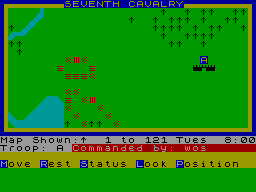
FRONTLINE SEAN MONTgomerY ON THE RUN MASTERSON, ponders on the morality of wargaming in general and finds himself fighting fires in olde London. It seems as if not only is it all quiet on the western front this month, but on every front. Horror of horrors, is this column going to disappear into oblivion just when I had begun to make it worth while reading? Maybe - but just on the assumption that it won't, I'll take this month's lack of review material as an opportunity to present a discussion for your consideration. It's a subject which many have discussed before but not, to my knowledge, within the pages of Crash, therefore it shouldn't be redundant. Consider the morality of wargames. When you load a wargame (no matter what the subject), your sole aim is to cooly and precisely kill people of conflicting ideologies. Many modern wargames bring this point closest to home with the subject of nuclear exchange. Now I'm not arguing that limited nuclear exchange is possible and that such a war could be won, but nevertheless do any of you pause before hitting the red button? Even in a game, would you rather lose before resorting to the most desperate means or is winning that important? There are those who argue that wargaming is unhealthy because it breeds cynicism and callousness. Having been a wargamer for some years now, I often overheard conversations by table-top generals boasting about how they had won an engagement by 'napalming the lot of them' or 'nuking them and got away with it.' Then, in more conventional games there are those whose fumbling, incompetent handling of a situation causes them to throw entire units (or armies) away on lost causes. Or they fight to the death so they can say they have never surrendered. If you have come across any of these people, you can see why there are those who think the whole hobby is a perverse waste of time. My argument would be that these boastful buffoons are the ones who have totally missed the point of wargaming. They are the egotistical bigots who exist in any society and have simply clung to wargaming to fulfil their need to sound superior. Unfortunately wargaming does attract rather more than its fair share of this sort. But wargaming, if it breeds anything, breeds pacifism. If there is any point to wargaming at all, then this must be it. Rarely does anyone win their first wargame. Instead they see their armies wiped out (usually by the computer) all because of the instructions they gave to their troops. They learn that it can be no fun to play with men's lives. Or perhaps wargames can show the futility of war itself. Certainly, from an abstract point of view, they can discipline the mind and encourage logical thinking. But never, never should they be used as a vehicle to revel in the grotesquerie of the real thing. It may be that you decide to employ nuclear weapons in a game and that as a result of your actions you win. But it should be important to remember that if the game makes such a victory possible, then it is only reflecting the designer's philosophy and not hard fact. And the best, indeed ideal commander would be the one who could win a battle without any losses at all. That would be the most efficient and palatable victory. Obviously, as an ideal it is unlikely to be realised, even in a game. However, it can still act as a guideline and if you had to use even one small tactical nuclear device, it would have resulted in a phenomenal number of casualties. It should encourage you to find a better way next time. I will leave you to consider this. I once had an Atari computer which meant I had access to SSI wargames (arguably the best home computer simulations in the world). I was playing Reforger 88, a tactical simulation of a Soviet invasion of West Germany, centered around the crucial Fulda Gap. I only won the game once. The East Germans began their advance and I immediately withdrew. The only combat which took place was air to air, where I fared well and suffered few casualties. At the end of the second turn, unopposed, the Soviets took Frankfurt. At this point, I called a truce. I was given a marginal victory. SEVENTH CAVALRY Producer: Black Knight Computers Retail Price: £3.50 Black Knight have managed to find an interesting yet not overkilled subject for this wargame. Though it's not strictly speaking a simulation, it is a single player game involving the famous out fit's stand against overwhelming odds. As the version I received was only a preproduction copy, I had no idea as to what were the goals of the game, though these became more evident as time went on. You begin the game in control of twelve cavalry troops, each of fifty or so men. The map depicts a fort (where you are based) and some of the surrounding countryside. At the bottom of the screen there are several options made available, these being Move, Rest, Look, Position and Status. As the computer handles your units alphabetically, you can select each of these options for all the units so long as you make Move or Rest your last choice. Look and Position is a kind of game status update available at any point. Status displays all the relevant information about the unit currently selected and Move opens a further option screen for Charge, Gallop, Trot and Walk. Each one taking less energy to accomplish but also taking longer to achieve. Once you have selected the type of movement you require, you are invited to select one of eight different compass directions. Your units are displayed as single blue coloured character blocks, each labelled alphabetically. When the Indian units appear, they are simply red blocks with an 'I' for easy identification. Each unit moves as soon as you have entered your orders and enemy movement takes place in between. Combat with adjacent units is automatic and a message window tells you how many casualties you suffered in that action. The game takes place over several days and there is no option for a shorter scenario. However, there is a save game facility, so you can play the campaign when you want to. Night affects playing conditions. Whilst I agree that it should, I'm not so sure that movement should only be at walking pace at night. Still, the idea is workable. After suffering considerable losses on behalf of the United States cavalry, it became app-was the destruction of Indian camps. If you travel far enough, then you find them as the map scrolls automatically when required. You need to destroy fifteen of these camps in order to win the game and this will take some considerable amount of time. The game seems to play rather well and is not in the least sense pretentious or distasteful. The one feature which is annoying is the game's speed, Mainly because it is written in BASIC, it often takes several seconds to respond to keypresses. This can lead to some confusion over whether the game has indeed received orders for a particular unit and such distractions can quite easily become terribly frustrating if you play the game for several hours and from the few games played for this review, it does seem to be the sort of challenge to last for more than one day. Fatigue is handled extremely well, as speed of travel, terrain crossed and amount of time spent resting, are all considered. On the whole, however, I found this game enjoyable and challenging to play and for £3.50 you could do far worse than add it to your collection.
Advert1
- Computer Gamer #12Mar 1986 · p.50
Review1
- Popular Computing Weekly #45Nov 1985 · p.12
Related
- Elsewhere
- UVL
- Same entry at
- Spectrum ComputingZXInfo
Reviews from people here
Sign in to write about this, or make an account. It takes a minute and lets you correct the catalogue too.
No description, tag recorded.
Sign in to correct or add to this.
Hold the rights to this and want it taken down?