
Shadow of the Unicorn
Adventure Game: Graphic · ZX-Spectrum 48K · 1 players · English
Mikro-Gen Ltd · 1985 · Pound sterling 14.95
Discussion
Nobody has started a thread about this yet.
Remarks
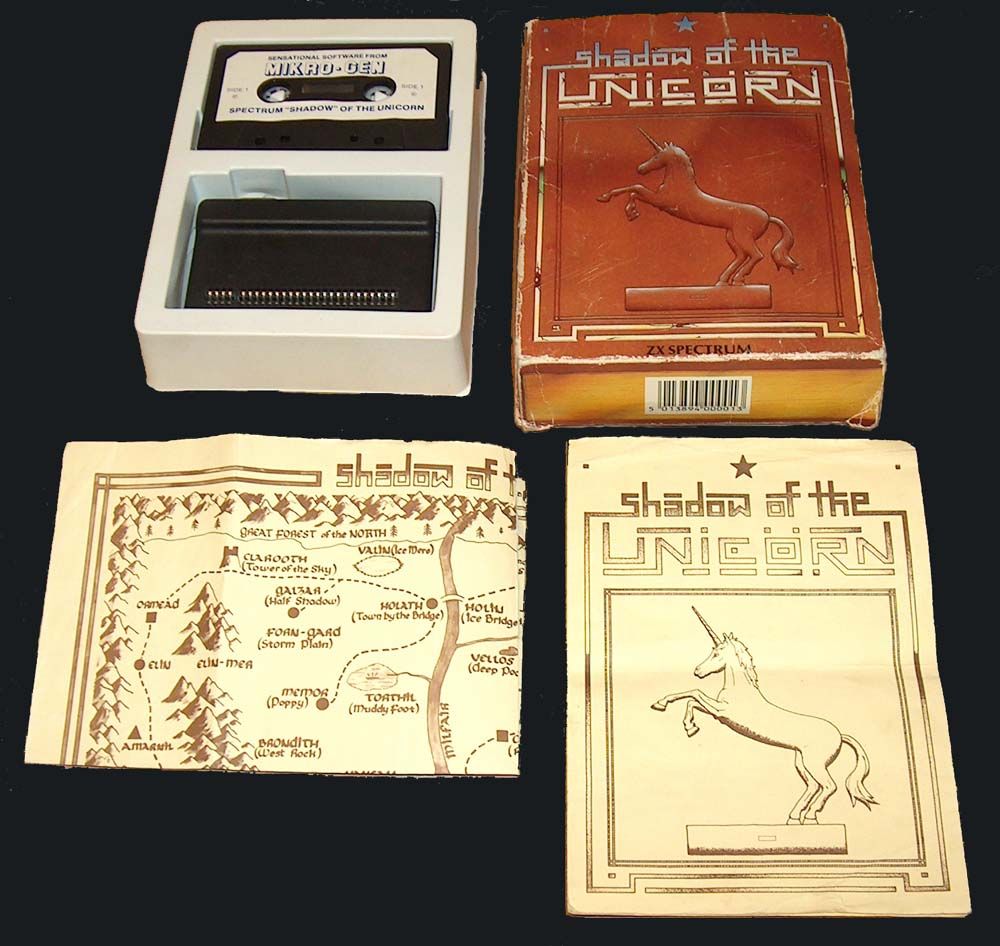
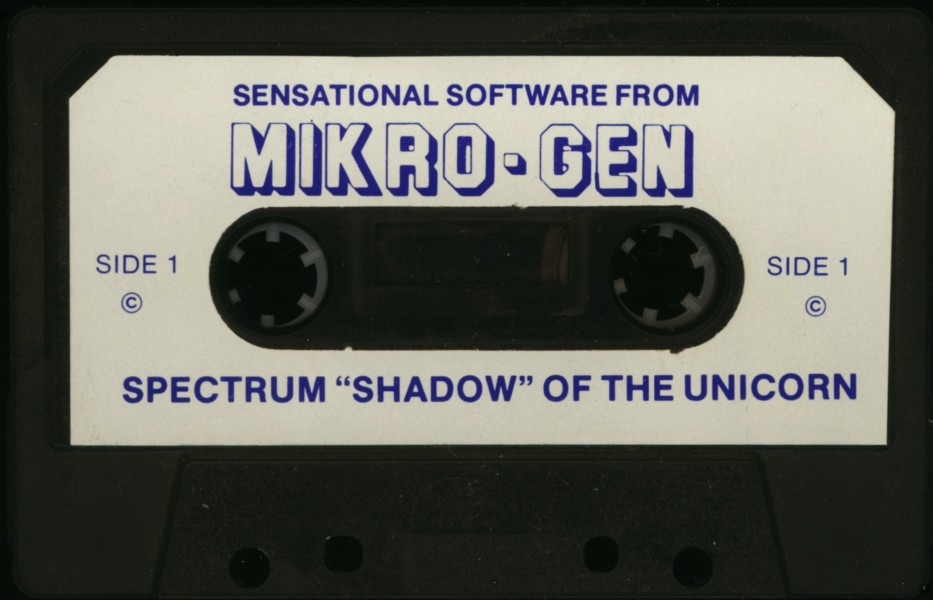
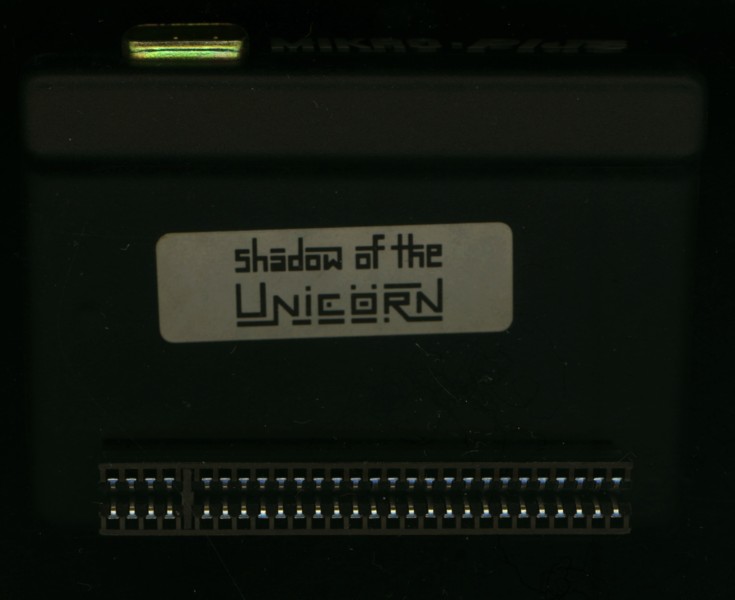
ZXSR: Came with 16k Mikro-Plus cartridge that plugged into interface slot to increase memory. This was the first and last game to use this.
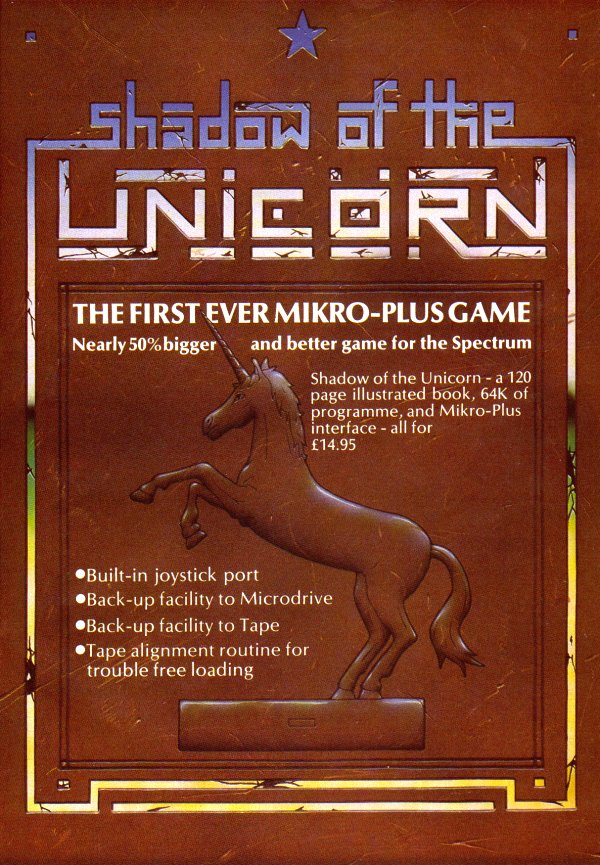
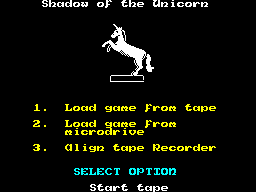
This game came with the {Mikro-Plus|Mikro-Gen Ltd|1000941} interface, containing a 16K shadow ROM and joystick port. The ROM image can be found in the 'Additional material' section below. Fraser Ross created a {Shadow of the Unicorn ROM Loader|Fraser Ross|0023000} for the +2A/+3, which loads this ROM into RAM, allowing playing the game without the additional hardware device.
SPOT: with Mikro-Plus 16k plug-in; first -and last- Mikro-Plus game
Releases
- 1985Mikro-Gen LtdPound sterling 14.95
- 1985Erbe Software S.A.
Play
- ShadowOfTheUnicorn.rom.zipComputer/ZX Interface 2 cartridge ROM image dump English12 KB
- shadowunicorn.zipRZX playback file
- ShadowOfTheUnicorn.z80.zipSnapshot image English24 KB
- ShadowOfTheUnicorn.tzx.zipTape image English22 KB
Documents
- ShadowOfTheUnicorn(ErbeSoftwareS.A.).pdfInstructions Spanish16 KB
- ShadowOfTheUnicorn(EN).pdfInstructions English4,819 KB
- ShadowOfTheUnicorn.txtInstructions English3 KB
Other files
- ShadowOfTheUnicorn_Novella.txt? 292 KB
- ShadowOfTheUnicorn.rom.zip? 13 KB
- Shadow of the Unicorn (1985)(Mikro-Gen).pokPOK pokes file 0 KB
Files and rights
Distribution permission is on record, granted to another archive rather than to this one. Screens and pictures are copied here; everything else links to the archive that holds it.
- AllowedMikro-Gen Ltd → WorldOfSpectrum
Credits
- Dale McLoughlincredited
- Shelley McLoughlincredited
Sign in to credit somebody, or say what these people did.
Awards
Scores
In the magazines
- Sinclair User #451985 · Overall5/5
- Your Sinclair #11986 · Overall7/10
- Crash #241986 · Overall7/10
Elsewhere on the web
- WorldOfSpectrum 28 votes8.15
In the magazines 47
Crash #24Jan 1986 · p.1647/107/106/107/107/107/10
Atmosphere 7/10
Graphics 7/10
Logic 6/10
Addictive Quality 7/10
Overall 7/10
Derek Brewster 7/10
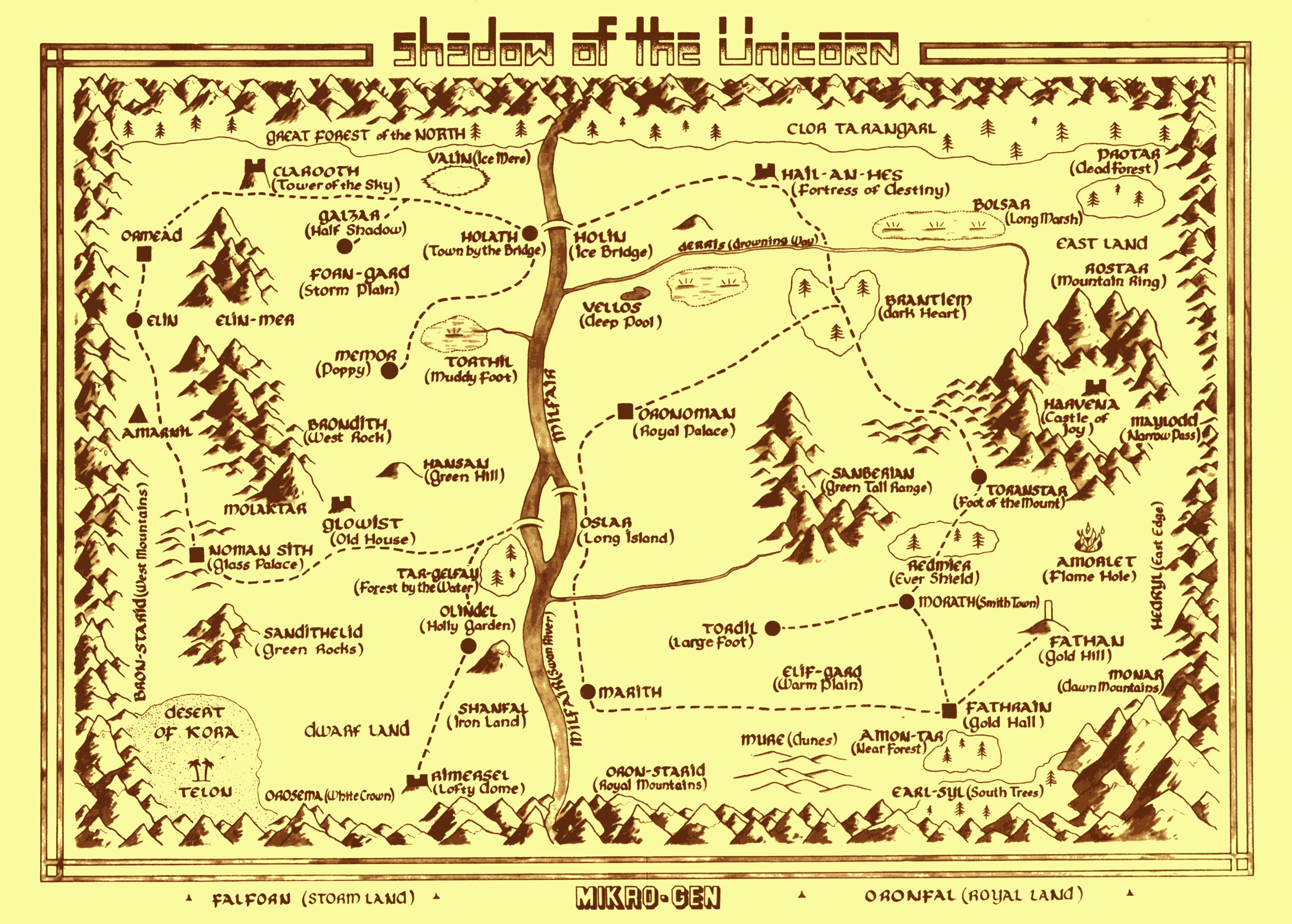
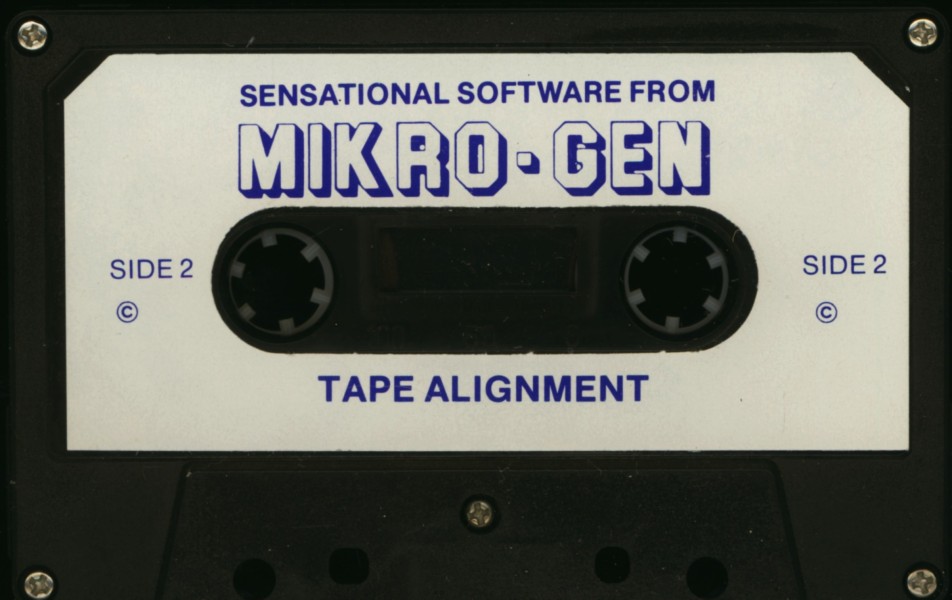
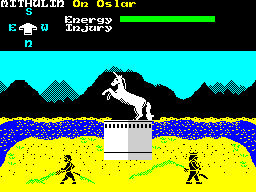
DEREK BREWSTER'S ADVENTURE TRAIL YOUNG AND INNOCENT (DADDY, WHAT WAS THE FUTURE LIKE?) It is always a difficult task summing up a year in home computing. Even more difficult is to try and predict what the coming twelve months might unleash upon us. I say unleash because whatever else might be said about the home games world, it is never dull: the competition is ruthless, and it is peopled by the sort of mathematical genius who is past his mental zenith at the age of twenty-five years, give or take a few million brain cells. The press and media are at a loss to explain why Britain, a rather insignificant and petty nation, should concern itself with such an exciting and blatantly intellectual pastime. After all, isn't this a country in decline, a divided nation where the people who read the lightweight newspapers await an answer to all the problems while the people who read the heavyweights are struggling hopelessly with the economic conundrums of interest rates and exchange rates. Perhaps it's time to start thinking straight and doing things which come rather more easily to nations not so schizophrenic. Buying your own country's goods isn't a bad start. I remember when I was at school, and it wasn't all that long ago, much time in geography lessons would be spent learning about the manufacturing base of the British Isles. In Lancashire they had the cotton industry, in the coalfields of the Midlands and North they had steel, while in the mountains that divided these areas you had hydroelectric power, sheep, and mineral mines. I'd give away a whole shelf-load of silly pencil-top gonks to sit in such a geography lesson now (just how many different breeds of sheep are there)? The House of Lords, by far the most coherent chamber as, despite the participants' ages, they are not honour-bound by political allegiance, stated Britain should look to the new technologies as herein lies the next revolution. Couldn't agree more. And so it would seem to be with the public who went out and bought the Sinclair computers despite much in the press about the unreliability of the machines. Much was made of the lack of sound when everyone knew full well that Sinclair's competitors were caught in the no man's land between beeps and buzzes and the full-bodied melodies of a synthesizer. The truth is the sound on these machines grinds after a short time and the demure bleeps of the Spectrum come as a blessed relief. I read a local paper recently that put forward the reasons behind buying a microcomputer this Christmas. Quite rightly some of the points they raised included amount of software available, price, and whether little Johnny's friends had the micro. It was curious to find the article extolling the BBC computer over the Spectrum. Let me put this as bluntly as I can. The Spectrum microcomputer is a brilliant device both for learning BASIC etc, and for playing games. I own, or have owned, an Atari, a BBC, an Amstrad, and a C64 and all have some major flaw in design, screen layout, add-on capability or available memory. What is more, the Spectrum was quite merrily computing away long before the others and so has a quantity and breadth (and availability) of software which leaves the others looking nice in the shops. As for the QL, yes, the microdrives are unreliable, but we live in times where rapidly-developing technology must be offered at an affordable price, and who would begrudge Clive Sinclair when NASA's budgetry constraints had DIY men throughout the world laughing at some tiles which just wouldn't stick. And it's no use laughing at the C5 while you pollute the atmosphere in your heap of rusting junk whose technology has changed little since its inception. Arthur C Clarke's (and Daddy's) visions of the future, with the printless world, gigantic space colonies, and the kind of mentality that goes with them, may not ever be quite as anticipated, but there is no need for the cynical technofear as displayed in such media mishmashes as Tomorrow's World and Micro Live. I suggest the first person who had the ludicrous idea of making technology more palatable in this dreadful manner go and write some techno-fear soap operas and leave the task to someone who is prepared to deal with the facts sensibly and reliably. Admittedly, this would remove any chance of political tampering with the facts, but it is a political reality that the new technologies are coming whether we like it or not. Any nation which actually gets to grips with the technology as opposed to the 'subject for discussion' will reap the undoubted rewards. 1985 was notable for the demise of MSX. MSX was a good idea, making a range of machines between which software was fully compatible. The only problem was, there was already a great deal of compatibility between the Spectrums that everyone was buying in droves. The Spectrum has, and will, last longer than either myself or other commentators thought possible. This year was notable for the escalation in the tie-in battles with major film titles such as Gremlins, Rambo, View to a Kill and Never Ending Story gracing the computer store shelves. The advantage to these deals is the recognition a product gets through the public's familiarity with the concept and storyline. TV tie ins can be even more effective in terms of public awareness of the product. These thoughts lead me on to an area which, to me, has really made itself plain over the last year. The perceivable age of the home games playing market seems to have dropped steadily down through the teens to the point where anything beyond a platform game is seriously questioned in terms of its likely viability in the market place. There's nothing inherently wrong or worrying about the spectre of a carry-cot Spectrum attachment with that all important fire button within reach of tiny hands, it's just that one shudders to think what popular music there would be right now if it wasn't for the older listeners pulling the whole standard of music up by its bootstraps. It is my guess that if the reading age of Sounds and NME fell by a few years those who, on paper, would benefit by such a fall would loose interest in the whole ostensibly uplifting exercise. And all this brings me back to adventuring (believe it or not). The demise of the intelligent, text-only, adventure epitomised by Level 9's Snowball, and mourned in SIGNPOST, is a part of this lowering of the intellectually exacting nature of computer games. In a nutshell, programs have become simpler. Utilities such as the Quill and Illustrator will continue to figure prominently in adventuring, and it doesn't take much of a jump to realise that they will be more important in all games' design in the near future. In America the computer games market is older because the machines Americans own are larger and more expensive, and more useful to the whole household. In Britain home computers are toys. It remains to be seen whether the market is going for the gutter or searching for the stars. SHADOW OF THE UNICORN Producer: Mikro-Gen Price: £14.95 Language: Machine code Author: Mikro-Gen Team This latest game from Mikro-Gen has a lot to live up to. It has been hailed as the first Mikro-Plus game with an additional 16K memory supplied via a piece of hardware which plugs into the back of the Spectrum. This Mikro-Plus interface has a joystick port and so the game can be played with a joystick. This facility also allows copies to be transferred to tape or microdrive. Without a joystick the game plays well on a keyboard and on side two of the tape you receive with the game is a head alignment routine to ensure trouble free loading from your tape recorder. Shadow of the Unicorn is the first piece of software to be actually marketed with a hardware add-on (Psyclapse and Bandersnatch from the old Imagine team never saw the light of day). The surprising thing about the game is its conspicuous lack of the sort of mind-blowing features one might expect from such an innovative breakthrough. The celebrated Lords of Midnight is now one and a half years old and it must be a sad reflection on games design when this game is far inferior in terms of basic structure than that first Midnight game. The fundamental flaw in Unicorn is the curious state of affairs that has your character looking, say, south when he is travelling west. The character is literally not looking where he is going! Were this not strange enough there is an added complication found when a character is in a town or village. He may be in a settlement but may only know it for sure after looking through all four compass directions. Getting to a village, castle or other distant object isn't as effective as in the true landscaping adventures, as, ignoring the virtually unchanging backdrop of distant mountains; you can only see the terrain of the adjacent square next to you in the viewing direction. You don't feel as if you are approaching them, you literally see them, you turn and move toward them and then that's it, you're on top of them, whether it be a castle or a windmill. Compare this to Lords of Midnight where you could aim for distant lakes and towers and you might see the point I'm making. In these games you get the impression that the towers, keeps etc. actually exist whereas here it is only too obvious that they are an artifice of computer memory. When considering some of the finer aspects of this game, these flaws in design may shrink somewhat but only when games such as Lords of Midnight and Runestone have temporarily slipped the mind. It is not only in the area of games design where Mikro-Gen have me puzzled. The game is marketed with a (too) large booklet which is fashioned along Tolkien lines but, as in so many books and booklets that accompany adventures, falls somewhat short of the narrative powers of the great master himself. None but the final two chapters has any great relevance to the computer program. You might think that a game which makes use of a new piece of technology would have a fine instruction booklet. Not a bit of it. This game has only a flimsy sheet of card giving you a very short summary of the story (much too short given the length of the book) and a few instructions concerning the hardware and its implications. I found on one occasion some difficulty in finding out exactly how to save a game and ended up loosing it, much to my chagrin as I had put in a long session and had progressed well. After the joystick controls (Left Right for movement, Up to take or drop, Fire to fight, Down to turn view to the right) you get a rather plain list of the characters with 1) Mithulin, King of Oronfal, 2) Avarath. Wizard of the Zim-Faranid, and 3) Holdin, Captain of Falforn up to 10) Lairmath, another Captain of Falforn. Not all of these characters hold equal sway in the stormy lands of Falforn and the royal lands of Oronfal. The three main characters are Mithulin the king of the royal lands, Rolquin queen of the storm lands and Avarath the wizard who is distinguished by his ability to fireball the irritating monkey-like figure who attacks characters willy-nilly throughout the entire course of the game (later research reveals this persistent assailant to be a nalesh). Actually, while I'm about it, how about this tip for avoiding the pain in the neck nalesh. Because characters are safe unless you select to move them (there is no real-time element or any urgency with the other characters), and because the nalesh always attacks from the side of the screen furthest from you, avoid the beast by quickly flicking between characters as you move your chosen character across the screen. After only two or three flicks your character ends up being attacked by the nalesh from the wrong side of the screen leaving the character to peacefully leave the screen in the direction chosen and be happily on his or her way. A convenient way to take you through the logistics of this game is to look at the screen which retains the same format throughout (and should be on this page somewhere unless the powers that be mix up the pictures as with Warlords/Red Moon). At the top left is the name of the character you are using at that particular time. Next to this name is the location you are passing through which generally is helpful enough to locate your approximate position on the map supplied with the game (if you are following one of the paths, or you have entered a castle, this position can be verified accurately). Below the name of the character presently playing is the compass whose arrow does not indicate direction of travel but the viewing direction which only becomes the direction of travel if you swing it around to lie left or right on the screen. The yellow and red bars adjacent have variable lengths to represent generally decreasing energy and (thanks to the aforementioned pain in the necks) increasing injury. Decreasing energy is reversed on eating at one of the magical berry bushes which can be puzzlingly sparse when you really need them, and no doubt there exists some spell to undo the harm of injury. To take no action with either injury or energy can result in a character's death, and loosing an important character can see you starting a new game. The standard of graphics in this game is rather puzzling given its added memory resources and its destiny as a mega-game. There are quite a number of heavy-handed colour clashes and one piece of animation has the king doing a sort of constipated break-dance. One thing you can do is hand it to the game for clever music effects; the music is in keeping with the game and is very tuneful indeed. Shadow of the Unicorn is a very good game by any standards. It is complex, has a story-line which is worth the considerable effort getting to know and yet is instantly and enjoyably playable. The tone of this review has been F flat for one very significant reason; the game is costly due to the Mikro-Plus add-on necessary for the additional 16K the game offers. What is a little puzzling (even worrying) is just where this extra memory has been allocated, as the improvements such additions might bring are not immediately apparent. COMMENTS Difficulty: the most difficult thing is reading the book Graphics: good, but not as might have been expected Presentation: simple and easy to get to terms with Input facility: perhaps could have done with some textual information
Your Sinclair #1Jan 1986 · p.385/108/109/106/107/107/10
Graphics 5/10
Playability 8/10
Value For Money 9/10
Addictiveness 6/10
Overall 7/10
Steve Malone 7/10
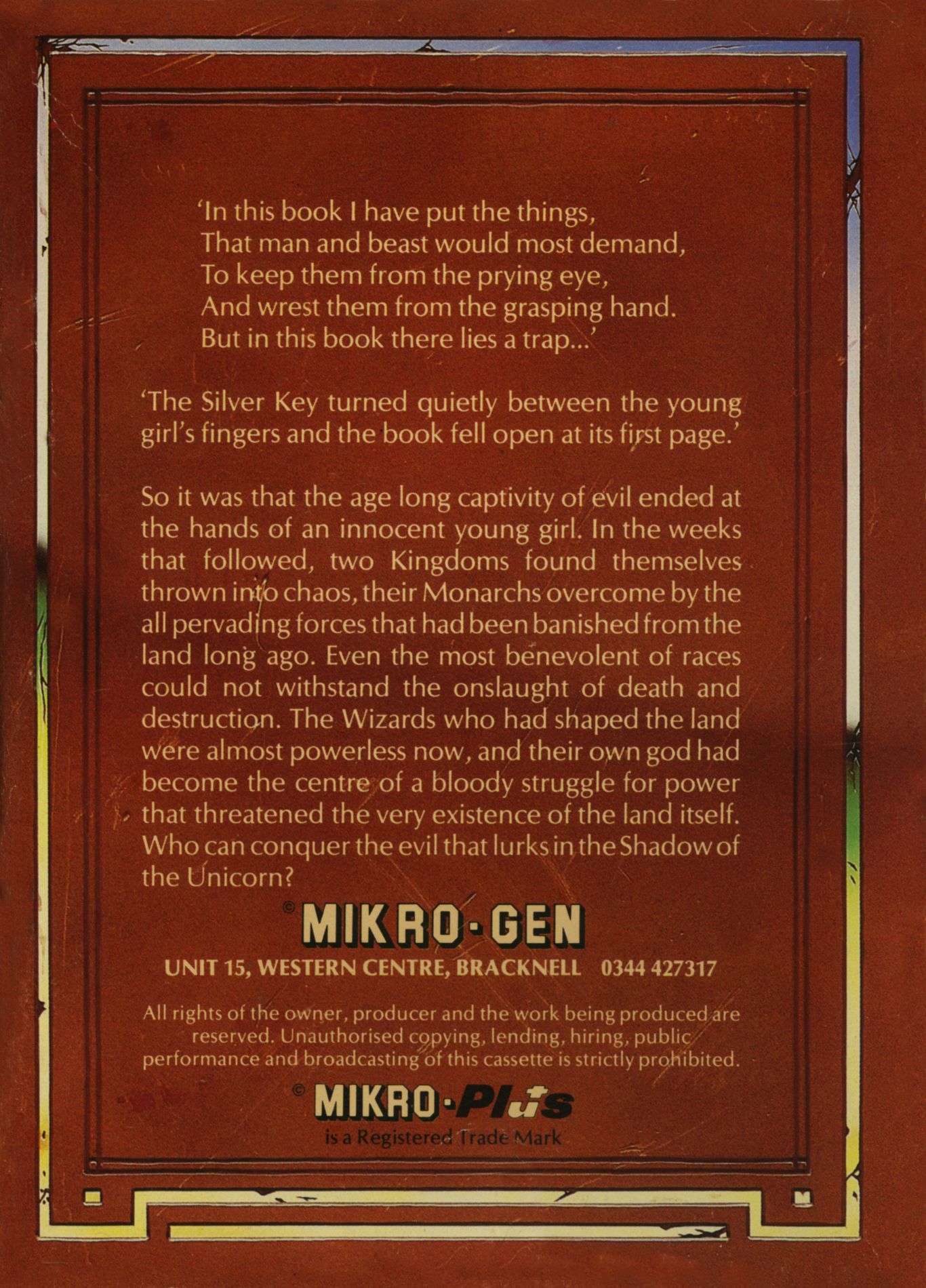
Mikro-Gen £14.95 Reviewer: Steve Malone Pssst! Hey, kid, wanna buy a game? Not any old game you understand - this one gives you a fancy set of fins that bolt on the back of your Spectrum.That not only means a whole 16k more to splash around in - but a joystick port as well. But what of the game? Shadow Of The Unicorn is an arcade adventure, rather in the vein of the excellent Lords Of Midnight.The goal is to rescue the lands of Oronfal and Falforn from evil. Of course, baddies abound in the game and each character has different powers to deal with the assorted nasties.The ones that you're most likely to meet in the early stages are small hideously misshapen dwarves.These are easily zapped by the magician, but for the likes of Gail, the best strategy is to leg it. There's a mountain more to this game - and many a player will spend happy hours wandering across the extra 16K's of peaks and deserts.
C&VG (Computer & Video Games) #50Dec 1985 · p.297/108/107/108/10
Graphics 7/10
Sound 8/10
Value 7/10
Playability 8/10
MACHINE: Spectrum SUPPLIER: Mikro-Gen PRICE: £14.95 So here it is. The first Mikro-Plus game from the people who brought you the chartbusting Wally saga. Ever since the long lost Imagine company began talking about mega-games which would only work with extra-bits stuck into the back of your computer, people have been waiting to see just what it was all about. They waited, and waited... But now something of the sort has appeared. Is it a genuine way of producing better games? Or simply a new way to stop you people pirating software? Let's look what you get for your £15. To start with you get the Mikro-Plus gadget which adds an extra 60K of usable memory to your Spectrum. You plug it into the back of your machine like any other interface and stick your joystick into the built-in socket. Then you get the Unicorn game-tape, a map and instruction booklet, plus a 100+ page novel giving the background to the lands which lie under the Shadow of the Unicorn. The game won't work without the Micro-Plus. The tape also includes a tape head alignment utility on the B-side - which is pretty useful. So you've already got quite a bit for your money. But what about the game itself? It has a basic swords and sorcery plot. Your task is to recapture the evil forces that have been released on the two kingdoms of Oranfal and Falforn. Like Lords of Midnight you can control - to start with - three characters. These are Mithulin, King of Oranfal; UlinGail, a satyr and the King's friend, and the Wizard Avarath. But as you explore and meet more people your forces increase. Each are accessed - Wally style - by pressing the appropriate key. Each have their very own purpose and affect the success of your mission. At first glance the game doesn't look that impressive. The graphics just are not up to the quality of Pyjamarama or Herbert's Dummy Run for example. And despite all that extra memory there are still colour clash problems. The main characters are depicted as black outline silhouettes - with a bit of grey shading in some cases. It's a good idea to simply take one character and wander about and explore once you've loaded the game for the first time. Pay close attention to the compass at the top of the screen and the location details which flash up - Dun Darch/Tir Na Nog style at the top of the screen. Also above the main window you'll see two bar graph readouts. Green for your energy rating, red for your injury status. It helps to use the map supplied, although not all the locations are marked on it. So beware! Once you've got your bearings end are happy with the controls, it's time to start on your quest. In true Mikro-Gen style, you have to find certain objects and use them in the right way. You really MUST take time to read the novel which comes with the game, otherwise you won't pick up on some of the useful clues contained within its pages. It would also be advisable for the player to make a map as you play. You can get lost very easily - told you it was BIG! Is the Mikro-Plus a great new innovation? We reckon that still remains to be seen with the arrival of the second game based on the TV cartoon series Battle of the Planets. In the meantime, if you can persuade your parents to part with the dosh - Christmas IS corning up fast - then put Shadow of the Unicorn on your shopping list. Your won't be disappointed.
Sinclair User #45Dec 1985 · p.25Sinclair User Classic5/55/5
Sinclair UserSinclair User Classic
Overall 5/5
Chris Bourne 5/5
Publisher: Mikro-Gen Price: £14.95 Memory: 48K + 16K included Joystick: Kempston interface included A long, long time ago somebody wrote a book full of evil, and then somebody else found it and read it, and all the evil flew out and infected a vast fantasy land, and you've got to make it right again. There are ten characters to control, but you start with three - King Mithulin, Avarath the Wizard, and Ulin-Gail the Satyr. Yes, it's that sort of game - lots of strange names and places to explore, all very Tolkienish. You also get to see the latest wheeze from Mikro-Gen, the Mikro-Plus interface which has 16K of the game ROMmed into it. Most of the extra memory seems to be about having a really enormous playing area. The graphics themselves are not particularly special, but you get attractive views of the land and your characters, which you play one at a time, are animated. Mikro-Gen seems to have been unable to reproduce the masking effects of Everyone's a Wally for the graphics, but the colour-clash really isn't too bad. It's very much an adventure game on a grand scale. Most of the heroes have objects associated with them - Holdin's Helm, or the Veil of Guinol. Clues to the appropriate use of such objects are to be found in a 100 page novelette called Shadow of the Unicorn, written by Dale and Shelley McLoughlin. The book tells of what happened prior to the adventure. It is particularly helpful in explaining who the various characters are and also filling out places on the map provided with the game - which is neither complete nor entirely accurate. Characters vary in abilities. Avarath is clearly the most useful to start with, because he can zap the nasties with his magic staff. Unfortunately, he loses energy fast, so he'll have to look out for magic bushes and wells to replenish his energy. Some characters, such as Avarath and Mithulin, are vital to the game and you lose if they die. Others are less important, and serve to protect or run errands for the major players. Shadow is obviously a big game, and after hours of play we felt we had only scratched the surface. At the price it's clearly great value, since you get the 16K black box and joystick interface thrown in, as well as a novel. Unfortunately, you can only use the interface with the game. We've given it a Classic after a bit of soul-searching - somehow you expect miracles just because there's some hardware hanging off the back of the Spectrum, and miracles you don't get. But the full quest, if you can fathom out what's going on, is obviously going to take a while to sort out, and the setting is atmospheric and intelligently worked out.
Full-page ad18
- Sinclair User1986 · p.63
- Crash #23Dec 1985 · p.128
- Sinclair User #44Nov 1985 · p.57
- C&VG (Computer & Video Games) #49Nov 1985 · p.53
- Crash #22Nov 1985 · p.122
- Sinclair User #43Oct 1985 · p.51
- Popular Computing Weekly #44Oct 1985 · p.6
- Popular Computing Weekly #42Oct 1985 · p.41
- Home Computing Weekly #133Oct 1985 · p.39
- Home Computing Weekly #132Oct 1985 · p.39
- C&VG (Computer & Video Games) #48Oct 1985 · p.99
- Crash #21Oct 1985 · p.57
- Home Computing Weekly #128Sep 1985 · p.47
- Home Computing Weekly #131Sep 1985 · p.39
- Home Computing Weekly #130Sep 1985 · p.39
- Home Computing Weekly #129Sep 1985 · p.39
- Home Computing Weekly #128Sep 1985 · p.27
- Home Computing Weekly #127Aug 1985 · p.39
News/Note9
- Sinclair User #46Jan 1986 · p.5
- Your Computer #11Nov 1985 · p.23
- Popular Computing Weekly #46Nov 1985 · p.32
- Your Spectrum #19Oct 1985 · p.5
- C&VG (Computer & Video Games) #47Sep 1985 · p.19
- Home Computing Weekly #130Sep 1985 · p.11
- Popular Computing Weekly #34Aug 1985 · p.4
- Your Computer #8Aug 1985 · p.13
- Home Computing Weekly #123Jul 1985 · p.4
Feature4
- ACE (Advanced Computer Entertainment) #3Dec 1987 · p.20
- Sinclair User #46Jan 1986 · p.54
- Crash #20Sep 1985 · p.14
- Crash #19Aug 1985 · p.20
Solution3
- MicroHobby #73Apr 1986 · p.14
- MicroHobby #72Apr 1986 · p.11
- MicroHobby #71Mar 1986 · p.26
Review3
- MicroHobby #52Nov 1985 · p.12
- Popular Computing Weekly #46Nov 1985 · p.14
- Popular Computing Weekly #44Oct 1985 · p.36
Advert2
- Home Computing Weekly #127Aug 1985 · p.17
- Home Computing Weekly #126Aug 1985 · p.17
Information1
- SSD-IISep 1999
Tips1
- Crash #23Dec 1985 · p.82
Map1
- MicroHobby #52Nov 1985 · p.14
Preview1
- Sinclair User #43Oct 1985 · p.23
Related
Reviews from people here
Sign in to write about this, or make an account. It takes a minute and lets you correct the catalogue too.
Everything ZXDB can hold about this is here.
Sign in to correct or add to this.
Hold the rights to this and want it taken down?