
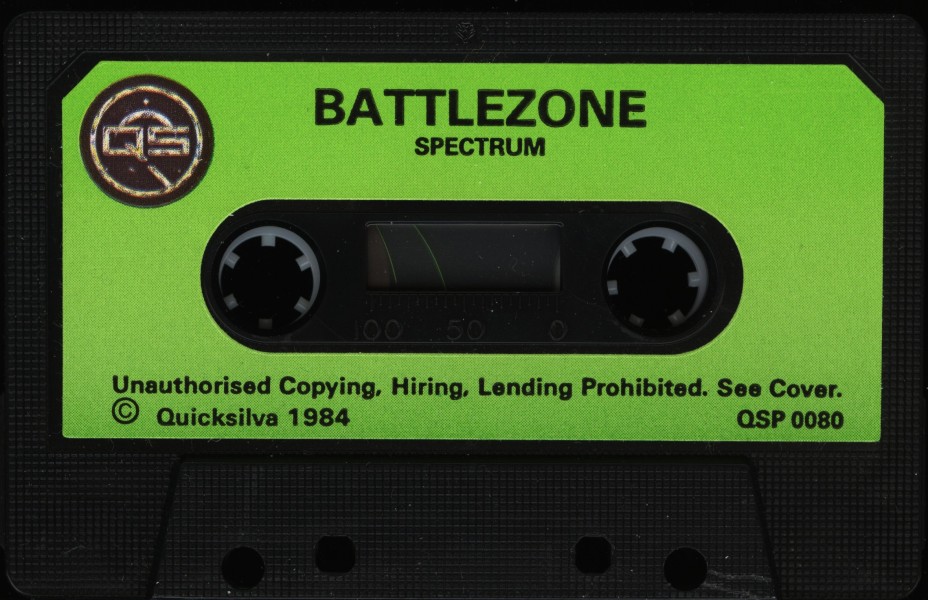
Battlezone
Game: Tactical Combat · ZX-Spectrum 48K · 1 players · English
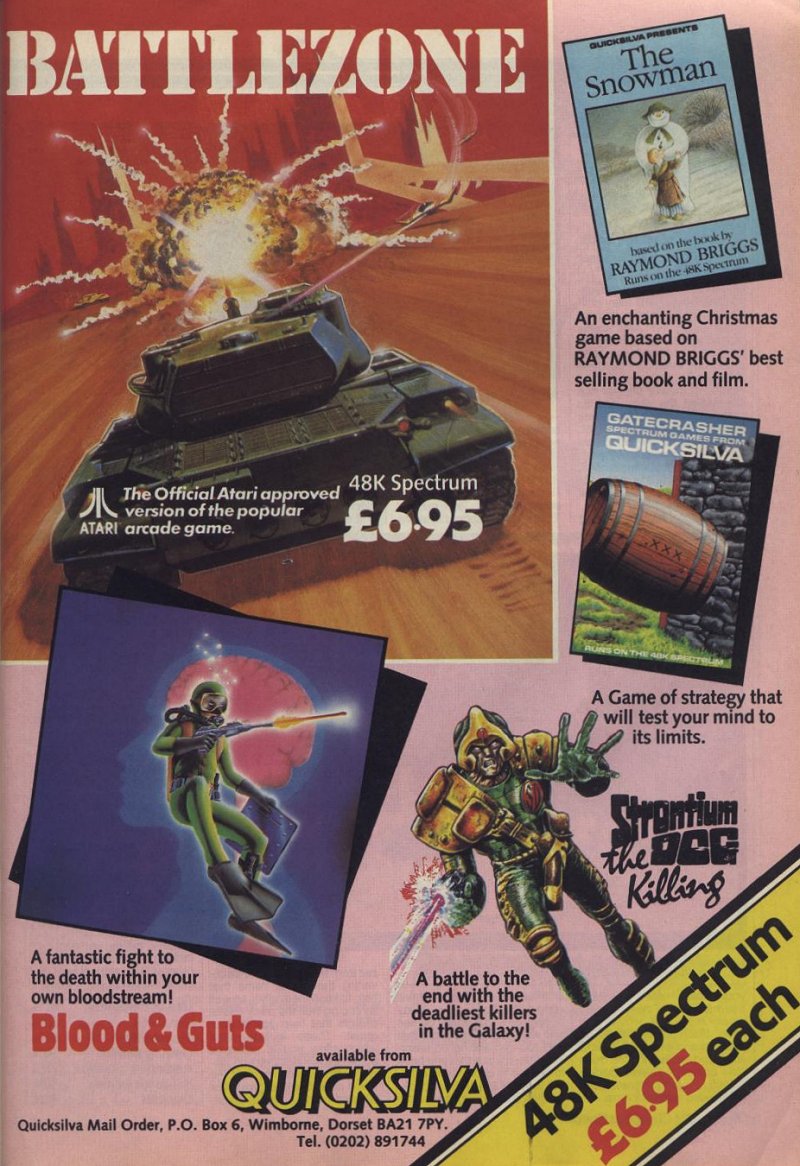
Quicksilva Ltd · 1984 · Pound sterling 6.95
Discussion
Nobody has started a thread about this yet.
Known Errors
Controls only work on a ZX Spectrum issue 2.
Play
- Battlezone.tzx.zipTape image English16 KB
- Battlezone.tap.zipTape image English16 KB
- Battlezone.tap.zipTape image English14 KB
Documents
- Battlezone(EN).txtInstructions English1 KB
Other files
- Battlezone (1984)(Quicksilva).pokPOK pokes file 0 KB
Files and rights
No permission is on record either way. Screens and pictures are copied here on a take-down basis: if you hold the rights and want something removed, say so and it goes.
Credits
- Bill Wittscredited
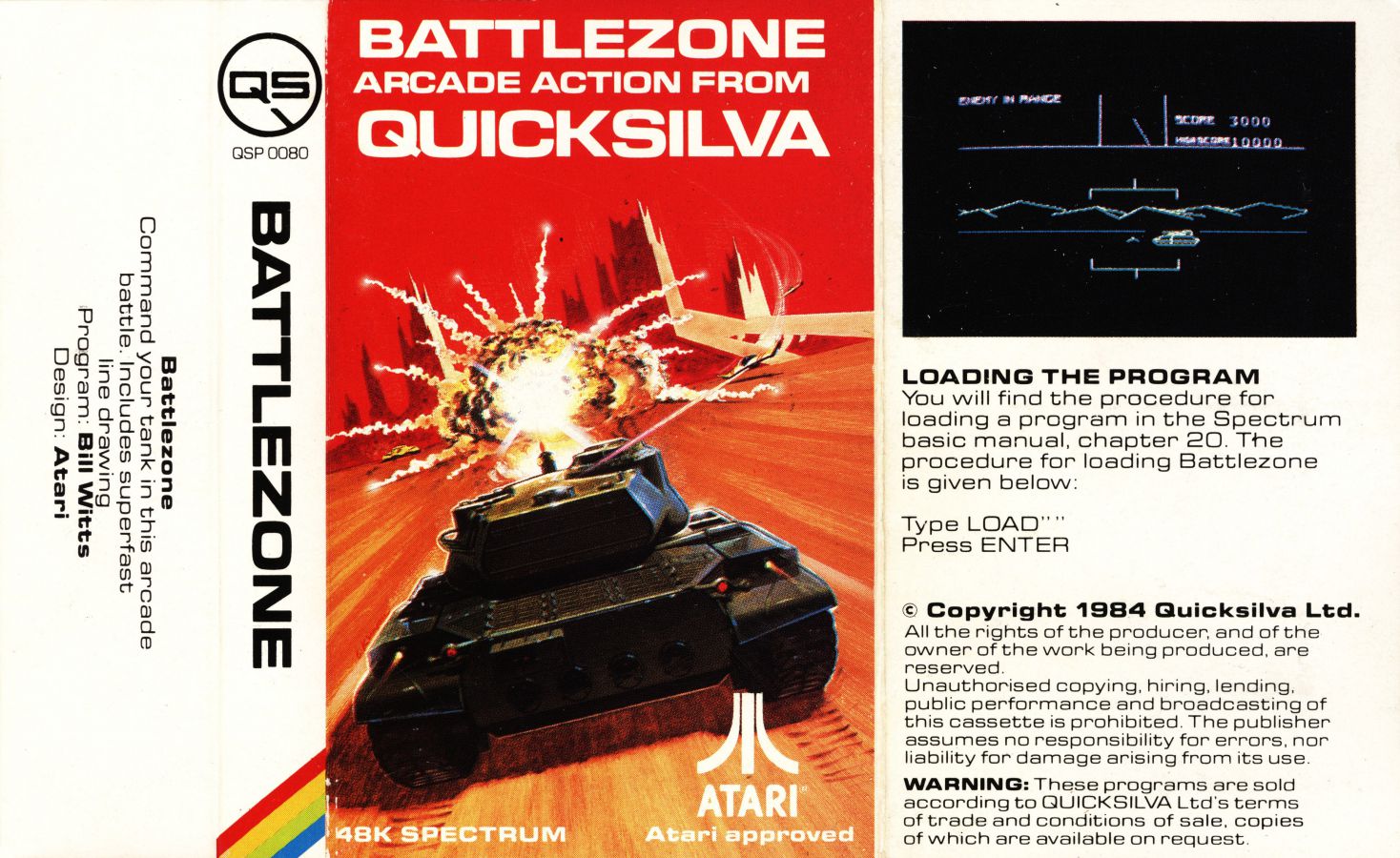
- Chris KenyonInlay/Poster Art
Sign in to credit somebody, or say what these people did.
Scores
In the magazines
- Sinclair User #331984 · Gilbert Factor5/10
- Crash #111984 · Overall74%
- Big K #91984 · Overall2/3
- Personal Computer News #851984 · Overall8/10
Elsewhere on the web
- WorldOfSpectrum 20 votes7.39
In the magazines 24
C&VG (Computer & Video Games) #40Feb 1985 · p.438/107/107/108/10
Graphics 8/10
Sound 7/10
Value 7/10
Playability 8/10
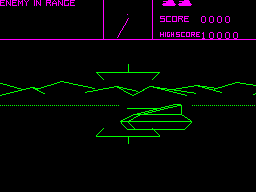
B'ZONE/TANK DUEL MACHINE: Spectrum SUPPLIER: Battlezone - Quicksilva; 3D Tank Duel - Realtime PRICE: £6.95 (Battlezone), £5.30 (3D Tank Duel) Battlezone was originally an Atari arcade game. You are in charge of a tank and your mission is to destroy the enemy tanks. Like the original, the graphics on the Spectrum version are made up of straight lines which are used to draw all the banks and missiles. Some clever programming means that the objects come towards you in 3D, with the computer performing what's known as hidden line removal. This means making sure that if one side of a tank is obscured by something, the invisible part is not drawn on screen. With Quicksilva's game, the graphics are all drawn in green on a black screen with the background the same colour. At the top, the score panel is in purple but still on black. Realtime's version is called 3D Tank Duel and has different background colours for the land and the sky. The 3D movement is the key to a good version of Battlezone and I found Realtime's the smoother. Both games have blocks which you can use as shields and moving in and out of them produced some good effects. Realtime's also has some special features. Pressing the 4 key will copy the screen to a printer which will give you a print of the high score table if you want one. Control for both games is via keyboard or joysticks. You look at the radar at the top of the screen and manoeuvre your tank accordingly. There are four keys used to move the tank - two for each track. Each can be moved forwards or backwards so to turn round at double speed you move one track in each direction. So which one to buy? Frankly, I think that Realtime's 3D Tank Duel just comes out on top and, at £1.45 less than the official Quicksilva offering, it's better value.
Battle Zone.
Your Spectrum #11Feb 1985 · p.592.5/5 MISS3/5 HIT3/5 MISS
Dave Nicholls 2.5/5 MISS
Roger Willis 3/5 HIT
Ross Holman 3/5 MISS
JOYSTICK JURY All the latest software from around the houses! Passing judgement this month are Dave Nicholls, Ross Holman and Roger Willis. Our regular crew of software screw balls are in fine form this month. Draining the dregs of Christmas spirit are Dave Nicholls, the hairy hacker; JSW champion Ross Holman; and our own two-wheeled terror, Roger Willis. Just in case you find our scoring system too confusing, here's what it's all about. The score out of five at the end of each person's review is based on their own experience of the game. But that's pretty subjective... so, they also use the HIT and MISS system to indicate its potential as a commercial success. BATTLEZONE Quicksilva £6.95 Ross: This is the Atari approved version and as such, is a very competent copy of the original. Quicksilva must be on its knees praying there's still someone left who's waited for the 'official' Battlezone, but after all the copies there've been, there can't be many! The game itself contains all the features you'd expect, including some very clever missiles. You get to control a tank, trundling across a flat plain that's occasionally littered with large cubes and pyramids. A radar at the top of the screen shows the position of approaching enemy vehicles, and messages pop up on the left to let you know when an enemy is in range (although they'll probably send you an explosive reminder!). The controls take a little getting used to; they stimulate the two-level controls as used by the arcade game, rather than the standard joystick layout. The line drawing of the graphics is, as Quicksilva claims, fast - and this is probably the best version I've played on the Spectrum. Honest!
Big K #9Dec 1984 · p.382/32/32/32/32/3
Graphics 2/3
Playability 2/3
Addictiveness 2/3
Overall 2/3
Fin Fahey 2/3
MAKER: Quicksilva Software FORMAT: cassette PRICE: £6.95 One of the arcade greats this, and in an Atari-approved version. Battlezone is probably the earliest attempt at a game with a true 3-D feel, and in the arcade it succeeded rather well. We find ourselves in charge of a tank trundling around a barren desert. In the far distance are a range of mountains which sadly can never be reached. Enigmatic solids: cubes; pyramids, and oblong boxes are strewn around. This unprepossessing ground is contested by enemy tanks, flying saucers, missiles and other machines. It being essential to zap them before they make scrap metal out of you, you are equipped with a radar scope to warn you of enemies behind and to the side, and a forward gun sight which changes shape when the enemy is bracketed. Enemy machines are drawn in wire graphics, so everything has a ghostly transparency, which adds to the eerie atmosphere. This version is much jerkier than the arcade model, but it's a tricky bit of programming. The big let down is the total lack of documentation. It didn't take me long to figure out how to turn the tank, but forward and backward motion took a little longer. In fact the controls are rather like those on a real tank. Q and P make the left and right tracks run forward and Z and space backward, so you turn by running one track forwards while the other is stopped or running backwards. The zero key fires the gun. Very playable once you know how, but really, Quicksilva, we're not all telepathic you know.
Crash #11Dec 1984 · p.1576%77%72%78%70%70%74%
Use of Computer 76%
Graphics 77%
Playability 72%
Getting Started 78%
Addictive Qualities 70%
Value For Money 70%
Overall 74%
Unknown
Unknown
Unknown
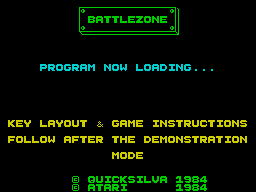
Producer: Quicksilva Memory Required: 48K Retail Price: £6.95 Language: Machine code Author: Bill Witts The Official Atari approved version of the popular arcade game. 'Insist on the original version, accept no substitutes', shouts the inlay of Battlezone. Very little other detail is given on the inlay (although the loading screen helpfully informs you that instructions and keyboard controls will be given immediately after the auto-run demo). What has happened to the justly famed Quicksilva absurd scenario? Is this lack an indication that Atari didn't approve or a case that under their new masters (ASP) Quicksilva have taken a turn for the serious? In any event it seems a shame, and an indication of Atarian sluggishness, that one of their most popular arcade games should be converted to a home micro in time to be at the tail end of a whole series of similar games. Battlezone surely requires no introduction (serious one that is). The Spectrum version comes complete with tanks, flying saucers and missiles and uses the keyboard to simulate caterpillar track movement, which is to say that the two top quarters control forward movement on left and right tracks, while the two bottom quarters control reverse movement on left and right tracks. This means that you can move forward or backward in a straight line, turn slowly or spin faster on the spot by using opposed quarters diagonally. The screen display shows a mountainous backdrop (including an unanimated volcano) with a few objects here and there which may be used as shields. Above the viewscreen is the radar, an indication of enemy to the left or right, whether the enemy is in range, and the score lines. COMMENTS Control keys: left track: 1-5 & Q-T forward - A-G & CAPS-V reverse. Right track: 6-9 & Y-P forward - J-ENTER & B-SPACE reverse, with zero to fire Joystick: Kempston Keyboard play: layout works well, positive Use of Colour: just green and purple Graphics: quite good line graphics, reasonably smooth Sound: continuous, above average Skill levels: 1 with some progressive difficulty Lives: 3 Screens: Special features:
It's nice to know that when you blow one up, the tank has been officially Atari-approved in BATTLEZONE.
Sinclair User #33Dec 1984 · p.385/105/10
Gilbert Factor 5/10
John Gilbert 5/10
BATTLE OF THE TANKS BATTLEZONE Memory: 48K Price: £6.95 Joystick: Kempston 3D TANK DUEL Memory: 48K Price: £5.95 Joystick: Kempston, Sinclair, Cursor It would have been better if Atari had not given its permission to Quicksilva to produce Battle Zone as the game is no better than the original arcade version. Many companies at least try to add a new element to such games or put something extra into the graphics. If by now you have not heard of the game the object is to move your tank around a landscape in which other tanks, space craft and flying saucers are on the prowl. The bare instructions, found in the game and not on the cassette insert, tell you to hide behind objects which are littered around so that the enemy cannot see you before you make your move. The movement of your tank is difficult to master as the tank is on tracks. If you press the lefthand side of the keyboard the left track moves forward, shifting the tank right, and if you push the righthand keys the tank moves left. Time to reach for the Kempston joys- tick. Forward movement shows the clumsiness of the 3D graphics which are inferior to the original. Outlines crack up, objects jerk when they move and missiles on target do not always score a hit. While no better than Battlezone the Real Time Software 3D Tank Duel does have a coloured landscape, the former being only green and black. The standard of graphics is slightly better than the Quicksilva version and the action is smoother but the tanks, spaceships and flying saucers move faster than your gun sights which will cause a problem if you are lucky enough not to have played the game before. The instructions and key layout are better than the Quicksilva version so at least you can use the cassette insert if you need reminding about controls during play. Neither of these games have much to recommend them except that you do not have to pay 50 pence a time to play in an arcade. If you are after classic original arcade simulations then both games are good buys. If you want excitement from your computer then just pass them by.
Personal Computer News #85Nov 1984 · p.518/108/10
Overall 8/10
Bob Chappell 8/10
PRICE: £6.95 PUBLISHER: Quicksilva [redacted] Although there have been quite a few versions of this type of game, this is the only one to be officially approved by Atari, the original designer. The title sequence should be familiar to anyone who has played Battlezone in the arcades. The lettering appears in the distance and spins smoothly, end over end, towards you. The scenario is similarly faithful to the original. You're looking out from a tank across a plain towards a mountainous skyline. Imposed on the screen is a large central cross-sight. When an enemy is in range and lined up, the edges of the sight flip - your signal to fire. Since the view from your tank is limited, a radar display at the top of the screen helps pinpoint the enemy's position. You can be attacked from the rear, as well as left, right and front. As reinforcements to the ordinary tanks, the enemy has supertanks and diamond-like flying saucers at its disposal. There are also assorted cubes and pyramids strewn around the plain; these can be used as shields when confronting the enemy. All the objects are three-dimensional, not solid but wire-frame. Your tank has two caterpillar tracks, each of which is controlled independently. Moving your tank around without getting into a muddle takes some practice. In fact the mountains never seem to get any nearer or further away which makes it just that bit harder. Movement is smooth and natural, the scene slips effortlessly in the appropriate direction. Any objects or tanks in view change in perspective as you or they alter position. The game may now be a bit old hat to do well in the charts, but if you're looking for a first rate implementation of the original, this has to be it.
Advert14
- Computer Gamer #1Apr 1985 · p.90
- Home Computing Weekly #102Mar 1985 · p.28
- Sinclair User #36Mar 1985 · p.148
- Your Spectrum #12Mar 1985 · p.2
- Sinclair User #35Feb 1985 · p.148
- Your Spectrum #11Feb 1985 · p.73
- Crash #12Jan 1985 · p.35
- C&VG (Computer & Video Games) #38Dec 1984 · p.69
- Sinclair User #33Dec 1984 · p.43
- Home Computing Weekly #92Dec 1984 · p.10
- Your Computer #12Dec 1984 · p.105
- Your Spectrum #10Dec 1984 · p.47
- Home Computing Weekly #88Nov 1984 · p.23
- Popular Computing Weekly #42Oct 1984 · p.8
Review2
- TV GamerJan 1985 · p.56
- Home Computing Weekly #87Nov 1984 · p.26
Feature1
- Your Computer #12Dec 1984 · p.65
News/Note1
- Games ComputingDec 1984 · p.8
Licensed from
- BattlezoneArcade coin-opAtari Games Ltd
Related
- Ports
- (Atari 5200), (Commodore 64), (Atari ST), (Atari 2600), Battlezone (VIC-20)
- Tags
- Vector Graphics
- Same entry at
- Spectrum ComputingZXInfo
Reviews from people here
Sign in to write about this, or make an account. It takes a minute and lets you correct the catalogue too.
Everything ZXDB can hold about this is here.
Sign in to correct or add to this.
Hold the rights to this and want it taken down?