
Show Jumping
Sport Game: Action · ZX-Spectrum 48K · 8 players · English
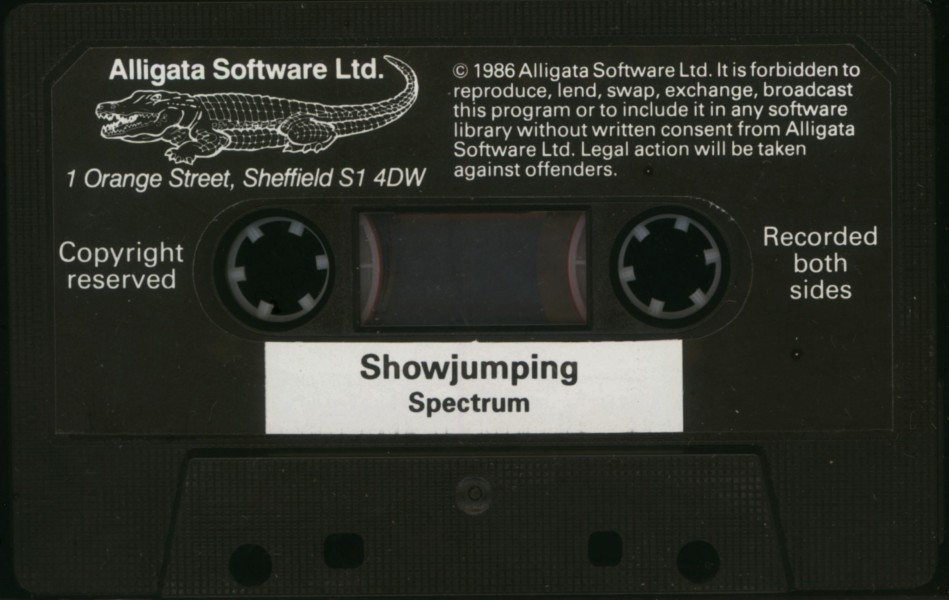
Alligata Software Ltd · 1986 · Pound sterling 7.95
.jpg)
Discussion
Nobody has started a thread about this yet.
- Control Option
- Cursor, Kempston Joystick
Releases
- 1986Alligata Software LtdPound sterling 7.95
- 1986Magic Team
- 1986Zafiro Software DivisionSpanish peseta 399.00
Play
- showjumping.zipRZX playback file
- ShowJumping.tzx.zipTape image English25 KB
- ShowJumping.tap.zipTape image English28 KB
- ShowJumping(MagicTeam).tzx.zipTape image English24 KB
Documents
- ShowJumping.txtInstructions English2 KB
- ShowJumping(MagicTeam).pdfInstructions Spanish24 KB
Music
- ShowJumping.ay.zipRipped in-game/theme music in AY format 1 KB
Other files
- Show Jumping (1986)(Alligata Software).pokPOK pokes file 0 KB
Files and rights
No permission is on record either way. Screens and pictures are copied here on a take-down basis: if you hold the rights and want something removed, say so and it goes.
Credits
- Elliot Gaycredited
- F. David ThorpeLoad Screen
Sign in to credit somebody, or say what these people did.
Awards
Scores
In the magazines
- Sinclair User #491986 · Overall4/5
- Your Sinclair #51986 · Overall6/10
- Crash #271986 · Overall70%
Elsewhere on the web
- WorldOfSpectrum 27 votes8.08
In the magazines 11
Your Sinclair #5May 1986 · p.366/106/107/106/106/106/10
Graphics 6/10
Playability 6/10
Value For Money 7/10
Addictiveness 6/10
Overall 6/10
Rick Robson 6/10
Alligata Software £7.95 Reviewer: Rick Robson What do you get if you cross a kangaroo with a sheep? Yeh, a woolly jumper. But there's nothing woolly about this show jumping game that'll leave the family hoarse with delight. The game is simplicity itself and works precisely because of that. You and your sturdy mount must negotiate a jump ring. You're given a choice of eight mounts, two levels of difficulty, the game has six different courses and up to eight players can take part. Pre-jump you are given a course map - worth remembering when best speeds are wanted. You're then given one hundred seconds to complete the course (usually within a set number of faults) if you wish to move on to the next course. The game is keyboard definable but it works best on the joystick. Speed (walk to walloping gallop) varies enormously and with the possible control of your horse through 360 degrees your tactics will vary between the Schockomile school of slow and steady and the Harvey Smith hell for leather theory. The course doesn't scroll but unfolds over several screens. The facility to 'walk the course' as in the real McCoy is a distinct advantage. The only unrealistic facet is that you can go behind jumps - normally faulted - but your average gamer would probably never complete without it. Having done the hard part well - horse and jump simulation - Alligata falls at the final fence by failing to recognise the thrills of the original sport. The crowd graphics are tinny, no one falls off and the paraphernalia of the ring are missing - why aren't real horse, rider or tournament names used? Three faults for this refusal but a clear round for a game as sweet as a (pony) nut.
Sinclair User #49Apr 1986 · p.464/54/5
Overall 4/5
Chris Bourne 4/5
Publisher: Alligata Price: £7.95 Memory: 48K Joystick: Kempston, cursor Show Jumping is one of those sports which hasn't been over-exposed on the Spectrum. Maybe that's because there's no equivalent in the amusement arcades, or perhaps software houses think show jumping is just for the girls, and not worth bothering about. Anyway, Alligata has more than compensated with a fine simulation which should have you on the edge of your seat during the jump-offs and your family imitating the strangled tones of horse-loving commentators. You can play on your own or with up to eight people in a grand competition. The solo version is really a training mode, starting with easy courses and building up to the more complex arrangements of the competition courses. Although the screen is dull in comparison to some of the more spectacular sports simulations, the animation of the horse and rider more than makes up for that. Alligata claims around 190 different positions for the horse, and the result is very realistic, particularly when you jump a fence. The horse leaps up effectively, the rider leans forward and the back legs kick as it clears the fence. Control is nevertheless easy, with left and right turning the horse, up and down accelerating and decelerating, and fire for jump. Your turning circle is naturally larger if you are cantering than if you are at a standstill. The essence of show jumping is that the horse does the jumping while the rider guides the horse, and that is what happens in the Alligata game. The easy part is getting over the fence. The difficult part is making sure your horse is in the right position and moving at a reasonable speed to give it a chance. The course is spread over four screens, and before you start you are shown a diagram of the fences and the order in which you must jump them. When, at the difficult level, you have to remember ten or more fences, that in itself is a major problem. Each fence is lettered and the letter flashes to indicate the next fence, but you also have to remember from which side to jump it. If you can't visualise the position offences off-screen, you are also likely to find yourself coming in at quite the wrong angle, and may even crash into one by mistake. All the courses must be completed within 100 seconds, which is easy if things go right but hard when you have to start making detours to get back to the right place. If you don't go fast enough, or if you try to jump the wrong fence, your horse will refuse - it's an intelligent being and doesn't see why it should put up with stupid orders. Three refusals and you're disqualified, so it's better to go for broke and hope you don't knock too many fences down on the way. Each fence down costs four faults, and I was pleased to see that you can knock the bars with your front feet as well as hind legs. The one thing you don't seem to be able to do is fall off the horse. That's probably a blessing. Show Jumping is immensely enjoyable, partly because it doesn't try to be too ambitious and just concentrates on the basic mechanics of the game and getting them right. Presentation is a bit sparse - notably, there isn't any sound during the game itself. We also found a minor bug, in that some courses stop the clock when you jump the final fence, instead of when you cross the finishing gates. That doesn't spoil the enjoyment, though, and Alligata has promised to look into the matter and fix it before the game is finally released. If you require all the splashy background graphics and other frills, you may be a little contemptuous of Show Jumping, but fans of the sport and those who attach more importance to the game should certainly check it out - it's one of the more attractive simulations around.
Eleven fences make this a tricky course, especially in the closing stages. The direction of Jump is given by a flashing arrow later.
Right: The first fence is neatly lined up for you. Below: The rider must make a difficult turn to be safe at the brick wall.
ZX Computing #24Apr 1986 · p.14ZX Computing Globella
ZX ComputingZX Computing Globella
Alligata £7.95 As a spectator sport show-jumping has about as much appeal as a snail race for me, but I have to confess that this simulation had me hooked and if you are looking for an engrossing and enjoyable multi-player game this is a real contender. A simulation like this stands or falls on its animation and the horse movement and jumping in the game are surprisingly good for the Spectrum. The horse has 12 angles of movement which means that subtle control is needed even on a joystick to steer your steed round the course within the 100 second time limit. Judging the right approach angle to the fence is vital to get a faultless clearance otherwise it's four faults for a fence down and three faults for a refusal. If you forget to jump at the right moment the horse and rider crumple into the fence. Just about the only familiar sight missing from the simulation is the rider spreadeagled over a fence after his mount has made an unscheduled emergency stop. With six different courses for up to eight players Showjumping makes a compelling competitive game, and if there's a tie the remaining competitors go on to a more difficult jump-off round. Definitely a game where you'll be itching for your next turn.
Crash #27Apr 1986 · p.3273%71%74%69%67%63%70%
Use of Computer 73%
Graphics 71%
Playability 74%
Getting Started 69%
Addictive Qualities 67%
Value For Money 63%
Overall 70%
Unknown
Unknown
Unknown
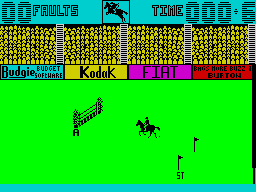
Producer: Alligata Retail Price: £7.95 Author: Elliot Gay Alligata offer you the opportunity to experience the thrills of showjumping without having to go to the expense of buying and keeping a horse - indeed you don't even need to be able to ride to play Show Jumping on your Spectrum. Once the game has loaded you are treated to a rendition of the TV Show Jumping theme before moving on to the menu screen. Up to eight players can compete against one another, in which case each rider has to choose a computerised horse from a list of steeds which, coincidentally, have been named after Alligata games. The horses are all of the same standard, so there's no advantage to be had in consulting CRASH back issues before you select a mount! in single player mode you have no choice but to accept the anonymous horse provided by the program. The game contains six courses, of varying difficulty. In the one player mode, which is primarily intended to allow horse control skills to be practised and improved, you can choose between two skill levels before entering the arena. You have a one hundred second time limit in which to complete the course, and are allowed a total of three refusals before being disqualified. Four faults are collected for each fence you knock down and the first two refusals collect three faults each. In the multi-player mode the scoring and time limit are the same, but the course is selected by the computer and the players take it in turns to ride into the arena. The winner is the rider who completes the designated course with the least faults - a tie results in a jump-off on a harder course, and a further tie in the jump-off is settled by awarding the top rosette to the competitor who completes the round in the fastest time. Once the course has been selected the computer displays a schematic view of the arena showing the start and finish gates and the order in which the gimps must be attempted. Pressing SPACE moves the viewpoint to a flip-screen 3D representation of the course and the competition begins. Your horse can stand, walk, trot or canter and can be speeded up or slowed down as appropriate. Fine directional control can be achieved - the horse turns a full circle in twelve increments, turning to the left or right 30 degrees with each appropriate key press or joystick movement. In order to jump a fence successfully you have to line your steed up so that you approach the bars at right angles, select an appropriate pace and press fire at the critical moment to take to the air. To help you remember the order in which to take the jumps a window at the top centre of the screen indicates the direction of the next fence by moving a graphic of a horse so that its head points in the right direction. A digital readout displays the time you have taken, accurate to a tenth of a second, while a scoreboard counts the number of faults you make. COMMENTS Control keys: definable Joystick: Kempston, Cursor Keyboard play: responsive Use of colour: tidily done Graphics: detailed animation Sound: good tune at beginning, otherwise minimal effects Skill levels: two Screens: six different courses
Putting the finishing touches to a clear round in under 55 seconds - SHOW JUMPING from Alligata.
10 Computer Hits 3 carries this game and has 1 reference of its own.
Action Pack 1 carries this game and has 2 references of its own.
Games Compendium carries this game and has 13 references of its own.
Review2
- Computer Gamer #13Apr 1986 · p.74
- MicroHobby #73Apr 1986 · p.13
Information1
- SSD-IISep 1999
Feature1
- MicroHobby Especial #7Dec 1987 · p.27
Full-page ad1
- Computer Gamer #13Apr 1986 · p.82
CompoEntry1
- Sinclair User #49Apr 1986 · p.24
News/Note1
- Home Computing Weekly #130Sep 1985 · p.8
Related
Reviews from people here
Sign in to write about this, or make an account. It takes a minute and lets you correct the catalogue too.
No description recorded.
Sign in to correct or add to this.
Hold the rights to this and want it taken down?