
Sorcerer Lord
Strategy Game: War · ZX-Spectrum 48K · 1 players · English
PSS · 1987 · Pound sterling 12.95
Discussion
Nobody has started a thread about this yet.
Play
- SorcererLord.tzx.zipTape image English16 KB
- SorcererLord.tap.zipTape image English17 KB
Documents
- SorcererLord.txtInstructions English27 KB
- SorcererLord(EN).pdfInstructions English4,541 KB
Files and rights
No permission is on record either way. Screens and pictures are copied here on a take-down basis: if you hold the rights and want something removed, say so and it goes.
Credits
- Cybercon Enterprisescredited
Sign in to credit somebody, or say what these people did.
Awards
Scores
In the magazines
- Sinclair User #701988 · Overall10/10
- Your Sinclair #271988 · Overall9/10
- Crash #491988 · Overall70%
- ACE (Advanced Computer Entertainment) #61988 · Ace Rating844/1000
Elsewhere on the web
- WorldOfSpectrum 8 votes7.75
In the magazines 5
Your Sinclair #27Mar 1988 · p.54Your Sinclair Megagame9/108/109/108/109/109/109/109/10
Your SinclairYour Sinclair Megagame
Graphics 9/10
Playability 8/10
Value For Money 9/10
Addictiveness 8/10
Strategy 9/10
Overall 9/10
Audrey Bishop 9/10
Owen Bishop 9/10
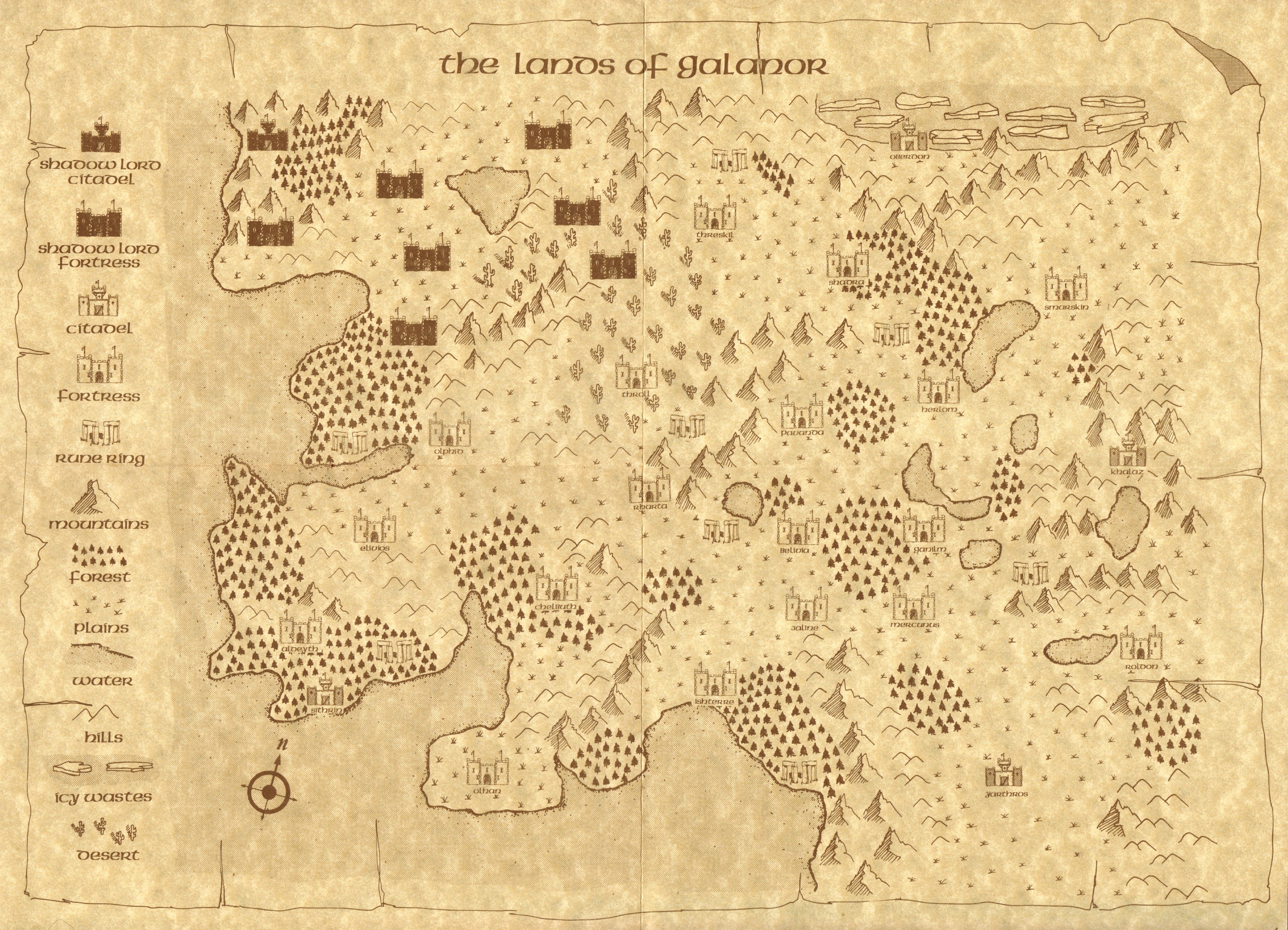
PSS Cassette £12.95, Disk £17.95 Reviewer: Owen Bishop, Audrey Bishop At last! A game that looks like a wargame and plays like a wargame! Let the canikin clink long into the night as we pit ourselves against the mighty Shadowlord! Sorceror Lord comes in a nicely designed and printed cardboard box, just like the ones that real (board) wargames come in, instead of those pop-album-style plastic cases. Inside you find an exciting assortment of goodies - a handbook (beautifully illustrated, simply laid out and clearer than most we have seen lately) and a handy card summarising symbols, terrain preferences and so on, to prop up beside the TV screen. There's also a large map of the Lands of Galanor printed on parchment-like paper to lend an air of romance and authenticity to the proceedings. With all this plus a copy of PSS's glossy catalogue, we already begin to feel that we're getting value for money. The game, written by the author of Battlefield Germany, is an imaginative fantasy conflict at tactical level. You are the Sorceror Lord, defending Galanor from the hordes of warriors and riders under the command of the Shadowlord (played by the computer). The enemy advances quickly in large numbers, at high speed and with devastating effect. It's a waste of effort to try to halt them at first. The better tactic is to send your leaders to visit the fortresses and citadels of the land to recruit as many men as you can muster. The warriors at your service include the Barbarians of Savantor, the Elves of Imryth, and several others, each with their own preference for different terrains, carrying different arms, and with leaders skilled in Sorcery to different degrees. All these features are taken into account as you mobilise your army and throw it against the forces of the Shadowlord. It's an easy game to get into, yet it may take you some time to master its intricacies. We found the computer opponent most formidable, even at Level 1, possibly because of its new routines based on artificial intelligence techniques. Graphics are good and non-fussy, though the 'ancient script' of the text is hard to read, especially as many messages are not on the screen very long. There is a large scrolling map (based on hexes, in true wargame style), with an overall strategic map on call whenever you need it. The information appears just above the map and the screen is uncluttered with graphical bric-a-brac at other times. This could be taken as a model for other wargames. Oh yes, and - wonder of wonders - there are no stupid sound effects either! The control system is easy to learn and operates perfectly. Sorceror Lord allows you to concentrate on the game itself without distractions. Whether you are into fantasy or not, the tactical aspects of this particular wargame will hold you spellbound. Recommended.
ACE (Advanced Computer Entertainment) #6Mar 1988 · p.548/10N/A8/108/10844/1000844/1000
ACE (Advanced Computer Entertainment)
Graphics 8/10
Audio N/A
IQ Factor 8/10
Fun Factor 8/10
Ace Rating 844/1000
Andy Smith 844/1000
PSSst - wanna play a wargame? Tough times are ahead in the once-peaceful lands of Galanor. That old rogue the Shadowlord is, even as you read this, marching forth from his citadel with a hideous army that is hell-bent on capturing the citadel of Yarthros. and thereby ruling the land. Unless of course you can stop him. This solo fantasy wargame puts the player in charge of the three remaining race types that inhabit the lands of Galanor. At the start of the game only a small number of characters know of the Shadowlord's invasion, and the player controls these few characters and attempts to rouse the rest of the forces within the land. Recruiting armies to your noble and worthy cause is not difficult - a unit merely has to land on the fortress or citadel where an army is located, and the army is allied to your cause. No fantasy wargame would be complete without the addition of a little magic to spice it up, and Sorcerer Lord has its fair share, which can have the player winning or losing a vital battle. The strength of magic that the player is able to summon (though when it's used is decided by the computer) is determined by the number of Rune Rings (physical terrain features looking like Stonehenge) that the player controls. At the start of the game the player has control of all eight Rune Rings, but as the play progresses, the Shadowlord is swift to take possession of them. Apart from the tactical map, which can be scrolled in any direction, a strategic map can be called up at the touch of a button. This map shows the whole of the lands of Galanor, together with terrain features and the approximate positions of the units. Terrain plays an important part in the game, as each unit has a set number of movement points at the start of each turn, and the various types of terrain affect the various units to different extents. Sorcerer Lord is certainly no pushover. A player will lose either if the citadel at Yarthros is captured, or if the Shadowlord captures any fortress and holds it for twelve consecutive turns. An absorbing and atmospheric game that will keep you playing for a long time to come. Reviewer: Andy Smith RELEASE BOX Spec, £12.95cs, Out Now Amstrad, £12.95cs, £17.95dk, Out Now C64/128, £12.95cs, £17.95dk, Imminent Predicted Interest Curve 1 min: 78/100 1 hour: 60/100 1 day: 80/100 1 week: 88/100 1 month: 70/100 1 year: 30/100
Amstrad: hexagons replace squares. You've got few forces to manage at the start of the game.
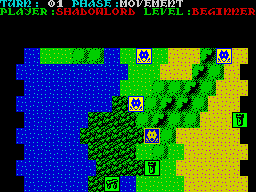
Spectrum: well into the game and most of your forces are committed to the struggle.
AMSTRAD VERSION The most striking thing about the Amstrad version is the hexagonal display of the playing area. The colours, though, are garish and dull, and the unit symbols are not as detailed as with the Spectrum version. just as difficult and just as absorbing on the Amstrad as it is on the Spectrum. Graphics: 7/10 Audio: 3/10 IQ Factor: 8/10 Fun Factor: 8/10 Ace Rating: 838/1000 Predicted Interest Curve 1 min: 70/100 1 hour: 60/100 1 day: 80/100 1 week: 85/100 1 month: 60/100 1 year: 30/100
SPECTRUM VERSION The screen display is colourful and well designed, though the information screen does not remain visible for long enough to absorb all the statistics at one go. The screen is divided into squares, not hexagons, but this doesn't affect the overall playability of the game. For those that enjoy PSS's arcade sequences, well I'm afraid you don't get one this time.
Crash #49Feb 1988 · p.5080%75%64%70%70%
Presentation 80%
Graphics 75%
Playability 64%
Overall 70%
Philippa Irving 70%
FRONTLINE With Philippa Irving THE DEVIL AND THE 'DEEP' PC At last, after months of bashing out Frontline on my old battered typewriter, I have a shiny new superconvenient Amstrad PC word processor. With this marvel of fairly modern technology I can rearrange all my sarcastic comments at the touch of a button, instantaneously delete paragraphs of philosophical waffle, change typeface to my heart's content, and even correct my appalling spelling. I am enchanted. I am also discovering for the first time that computers really can be useful. Obviously computers can play an important everyday role in a business. But it was one of the fanciful fallacies of what the popular press called 'the computer boom' - the flurry of home-computer-buying that has slowed down because most people who want one have now got one - that a home computer could work the same kind of labour-saving wonders. One heard stories of somebody's friend who had 'computerised his home' or ran his central heating with the computer. Parents bought computers in the firm belief that a Spectrum or Commodore would give their child an education in the modern and apparently all-important mystery of the computer, hoping that once they'd got tired of the games that came with it - Horace Goes Skiing, Scrabble, the immortal Radar Rat Race - they would start to put their machines to 'proper' use. But what really happened was that the child, having got tired of Horace Goes Skiing and perhaps found that BASIC could make the border go a funny colour or print 'Dundee United Rules' thousands of times on the screen, would proceed to more sophisticated game software. Parental scorn would start: 'You've not bought another stupid game, have you? I didn't buy that computer so you could spend time playing silly games on it. Why don't you do something useful? Why don't you learn to program?' Some young computer-owners did indeed learn to program. But what did they program? What was the only thing there was any point in programming? Games! Perhaps you could run the central heating from a Spectrum, but modern heating systems have perfectly adequate control systems of their own. The contents of the freezer can be monitored by opening the door and looking in. The small memory of home computers, and the tacky keyboards of early Spectrum models, preclude serious word processing, in fact, the home computer has only one nongaming function; it provides a kind of familiarisation course for the few schoolchildren who do go on to commercial programming. Whatever uncomprehending parents may believe, a home computer is nothing more than a flexible, fascinating games machine. And we should not be ashamed of that. It can be frustratingly difficult to convince those who have never come across a good computer game that they can be as valid an intellectual pastime as traditional board games and puzzles; they lack the social aspect of group gaming, but properly used they offer the solo player a wealth of entertainment at his convenience. It's only prejudice that compartmentalises entertainment, finding live theatre and reading thoroughly good, television dubious, and computer games a mind-rotting invention of the devil. There are bad and good plays and bad and good computer games. And it is only a more specialised prejudice that considers a poky little home computer - with what is, these days, a tiny memory - wasted on games. Though my gleaming new word processor is a great convenience, and invaluable for processing PBM turns, nothing will convince me to write my novels on it. SORCEROR LORD Producer: PSS Retail Price: £12.99 (cassette), £17.99 disk Fantasy games always provide a refreshing alternative to the interminable mud and metal of the Second World War, but it's unusual for a fantasy war game to be as complex as a simulation of a historical battle. It's probably not that authors are incapable of making up detailed statistics, landscapes and backgrounds - more likely they believe that people who want to play fantasy games are less concerned with such fiddly details and want simple combat, lots of D&D-inspired races, and the chance to throw fireballs around. But I for one would love to see a fully-fledged war-gamer's fantasy war game - and with Sorcerer Lord the ever-enterprising PSS makes a gallant though flawed attempt. So don't be put off by the box, which declares that Sorcerer Lord is by the author of PSS's Battlefield Germany, a game I found almost unplayable (it was credited to Cybercon Enterprises). Inside the box is a player's manual, a glossy PSS catalogue almost as large as the rulebook, a reference card listing the control keys and the meanings of the symbols, and an extremely well-drawn map of the lands Of Galanor on sepia fake parchment. The detailed rulebook opens with The Scenario. And, naturally, sinister and evil twisted ghostie things from the north are marching southward from their wastelands to do battle with the clean-limbed, upstanding, civilised races in the south. It's one of the great mythological patterns of computer war-gaming that the enemy marches from the east if it's historical and the north if it's fantasy. The citizens of a mysterious region called the Shadowlands have, after several unexciting millennia, acquired a new Shadowlord. His predecessor was a peace-loving sort, but the newcomer wants to stir things up. The ambitious new Shadowlord has sent his Shadow Legions - not people, but magically-engineered Wolf riders and warriors commanded by misguided humans - to invade the Lands Of Galanor and recapture the enchanted rune rings which were created there by the magic people of the Shadowlands long ago. The player's task - as the clean-shaven men of Galanor, of course - is to repel the Shadow Legions, preventing them from capturing and holding fortresses and rune rings for more than 12 consecutive days (if they manage to, they achieve victory.) The fortresses are also the player's only sources of reinforcements, so the more that are in the power of the Shadowlord the less chance Galanor will have to raise troops to recapture them. There are five different races in Galanor, and all have special characteristics. Elves move and fight well in woodland, of course; the Men Of Rovanium (the most southerly and so naturally the most civilised nation) are skilled in sorcery; and the Mountain Warriors Of Morgalion are adept at fighting in mountainous terrain. After the opening menu (where you choose one of three skill levels, and can load a previouslysaved game), Sorcerer Lord launches abruptly into the Shadowlord's first movement phase. In fact, three phases quickly tumble across the screen and the Shadow Legions are already streaming southward before the players gets a chance to intervene. Anyone who has played Battlefield Germany will recall waiting for 15 minutes while the computer plodded through its turn. I lavished scorn on this appalling piece of programming (it got 42% Overall in Issue 40), and so I'm almost ashamed to admit that Sorcerer Lord goes to the opposite extreme with an effect almost as damaging to playability. The Shadowlord whizzes through his movement phase like Battlefield Germany 20 times faster and then - which is more serous - resolves battles so quickly that it's extremely difficult to follow what's going on. A summary of the riders and warriors lost by each side is flashed on the message area for just a few moments. But most maddening of all is the war report, a full screen of detailed and interesting Information about the state of each army and the ownership of the many fortresses and rune rings. This is the sort of thing that one would wish to study at leisure, and frequently. On some versions of Sorcerer Lord you can summon it with a key-press at any time; but on the Spectrum, it appears for two seconds - literally -at the end of each combat phase. It's as if the author realised that Battlefield Germany is too slow, changed a few variables to a lower value picked at random, and never checked whether the new speed is any more convenient. The screen map is hexagonal, as in Battlefield Germany. The Sorcerer Lord map is a little more attractive, though the ragged edges made inevitable by the hexagonal layout are untidy and the contours of the land are blocky. The fortresses, citadels and rune rings are set in a varied landscape of forest, mountains, plains, deserts and the occasional patches of wasteland. Though there are several hundred riders and warriors stationed in every fortress, they cannot be mobilised without a leader (here Sorcerer Lord resembles Lords Of Midnight). As the player starts off with about 20 unmanned fortresses and just three leaders under his command, things are rather discouraging. But fortunately, every turn there is a Galanor Alliance phase, when new leaders wake up to the imminent danger and materialise for use in their own fortresses. Fortresses also generate extra troops at random. And any leader can build up a huge army simply by going round the map recruiting warrior and riders, but this takes time - and meanwhile the Shadow Legions will have taken over the undefended fortresses and rune rings. The abilities of each army are defined by four factors: the value of its leader, its leader's skill in sorcery, its fatigue level, and its movement rate. Combat between adjacent enemy units is not inevitable; the player can decide to attack by moving onto the enemy's square, which is then marked with a battle sign. Combat is resolved after the player ends the movement phase, and various factors, including leadership values and terrain type, determine the result. The most novel factor is Sorcery. If the battle takes place near a rune ring - and the nearer the better - the side which controls the rune ring can take power from it to summon Sorcery. The strength of the Sorcery cannot be predicted, but is affected by the leader's Sorcery skill and distance from the rune ring. Weak Sorcery merely alters the weather conditions in the caster's favour (perhaps it only rains on half the battlefield...), but Devastating Sorcery brings down a whole host of screaming demons on the enemy. Despite all the imagination that has gone into Sorcerer Lord, and the obvious potential for varied and thoughtful tactics, the gameplay is awkward and dull (though technically it's a great improvement on Battlefield Germany). The game lacks atmosphere, for all the care that has been put into the packaging. But some people will find a lot to enjoy in Sorcerer Lord, and it's encouraging to see this sort of fantasy war game released at all.
Sinclair User #70Jan 1988 · p.108Sinclair User Classic10/1010/10
Sinclair UserSinclair User Classic
Overall 10/10
Gary Rook 10/10
Label: PSS Author: In-house Price: £12.95 Memory: 48K/128K Joystick: various Reviewer: Gary Rook Sorcerer Lord could be PSS's finest hour. It is a one player wargame of fantastic scope and complexity. I can't remember having felt this excited about a computer wargame since Mike Singleton's Lords of Midnight. The scenario is this: you are the Sorcerer Lord, commander of an alliance of Men and Elves, fighting, as usual, for your survival against the forces of the evil Shadow Lord - mostly creatures bred from wolves and warped by sorcery into killing machines. But mankind, as ever, is slumbering on, unaware of the peril... (bear with me). You must rouse the hidden strength of the alliance, and smash your foul enemy. OK the plot is not groundbreaking. As with just about all computer wargames these days, the basic screen is a map window, showing you an area of the continent which the war is to be fought over. The total area is much larger than what you see on screen at any one time, but you can scroll around it to your heart's content, admiring the beautiful landscape and noticing in passing the disposition of various armies. Along with the armies shown on the screen, there are lots of different landscapes. As you might expect, they include such things as mountains, forests, deserts, water and wooded hills, all of which have an effect on how far your troops can move. Then there are assorted man (or elven) made landmarks: towers, citadels and the mysterious rune rings. Towers and citadels are defensive positions, and also represent the starting places of the various Lords you'll need to recruit to your aid. Rune rings are the source of all sorcerous powers, and your distance from the nearest ring determines how effectively you magic will be combat. The graphics are excellent: the map symbols are nicely detailed, as are the various shield symbols used to depict the different forces in the game. Trouble has been taken on the visual appearance of the game. At the outset you control just a few Lords and their troops. By placing the cursor over each shield symbol you can find out more information about the lord and the forces he commands. To attack an enemy force, you just move on top of it. Friendly Lords are recruited in the same way - you just move a leader to the fortress they live in, and they immediately join your gang. Not all your troops are the same; you have desert riders, elves, mountain men and ordinary men. Some seem to have particular abilities - elves can move through woods as if they were open ground, the riders of Savantor prefer the desert, the mountain men the crags and so on. You need to plan, don't ever attack unless you can get overwhelming odds, and calculate all battles carefully. I had 2,000 elves wiped out by a blunder in map reading in one game. I had intended to jump a force of 2,500 wolfheads with five elven armies simultaneously, but after I'd moved two I discovered that the rest couldn't get there! There was wailing and moaning in the old elven woods that night, I can tell you...
Tips1
- Your Sinclair #30Jun 1988 · p.78
Related
- Ports
- (Amstrad CPC), (Commodore 64), (Amiga), (Atari ST)
- Tags
- Wargamers
- Same entry at
- Spectrum ComputingZXInfo
Reviews from people here
Sign in to write about this, or make an account. It takes a minute and lets you correct the catalogue too.
No description recorded.
Sign in to correct or add to this.
Hold the rights to this and want it taken down?