
Space Intruders
Arcade Game: Shoot-em-up · ZX-Spectrum 16K · 1 players · English
Quicksilva Ltd · 1982 · Pound sterling 4.95
Discussion
Nobody has started a thread about this yet.
- Control Option
- Cursor
Releases
- 1982Quicksilva LtdPound sterling 4.95
- UnknownRiko Data
Play
- SpaceIntruders.tzx.zipTape image English3 KB
- SpaceIntruders.tap.zipTape image English3 KB
Documents
- SpaceIntruders.txtInstructions English4 KB
Other files
- Space Intruders (1982)(Quicksilva).pokPOK pokes file 0 KB
Files and rights
No permission is on record either way. Screens and pictures are copied here on a take-down basis: if you hold the rights and want something removed, say so and it goes.
Credits
- John Holliscredited
- Rich ShenfieldInlay/Poster Art
Sign in to credit somebody, or say what these people did.
Scores
In the magazines
- Sinclair User1984 · Gilbert Factor7/10
Elsewhere on the web
- WorldOfSpectrum 18 votes5.61
In the magazines 61
Crash #3Apr 1984 · p.63
Producer: Quicksilva, 16K £4.95 A close copy of Invaders with rather small graphics that work in character blocks. Fast but out of date.
Crash #2Mar 1984 · p.46
Producer: Quicksilva, 16K £4.95 A close copy of Invaders with rather small graphics that work in character blocks. Fast but out of date.
Crash #1Feb 1984 · p.46
Producer: Quicksilva, 16K £4.95 A close copy of Invaders with rather small graphics that work in character blocks. Fast but out of date.
Crash #1Feb 1984 · p.3945%40%40%
Use of Spectrum 45%
Addictive Qualities 40%
Value For Money 40%
Chris Passey
Lloyd Mangram
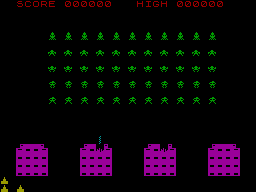
Memory Required: 16K RRP: £4.95 There was general agreement from our two players that the Space Invader game, whilst good for its time, was pretty much out of date today, so that should be borne in mind when comparing it to some of the more original phoenix and galaxian games. However, Quicksilva's Space Intruders was summarised as being a, 'reasonable copy of the original arcade game.' This is a close copy of the original. The aliens are a bit small but do include a wobbly mutant worth extra points, as well as the customary space ship across the top of the screen. Although this is a fast version, the shelters at the bottom of the screen disappear in blocks rather than the originals erosion. CHRIS PASSEY I was a bit disappointed with it, never having played this particular version before. The aliens were disappointing although there are four types as in the original, Invader games suffer from comparison anyway because they are older and there is much better software around. LLOYD MANGRAM
Sinclair User1984 · p.207/107/10
Gilbert Factor 7/10
John Gilbert 7/10
ARCADES BROUGHT INTO THE HOME John Gilbert reviews more complex games. Almost every major type of arcade game has been simulated on Sinclair computers. There are also new games which have an arcade format but have evolved on a microcomputer. The Spectrum is an ideal machine on which to play arcade games. The quality of them has improved substantially since the launch of the machine. Some of the first arcade games to be produced for the Spectrum were versions of Space Invaders, the game which started the arcade craze. Spectral Invaders was the first to be announced by Bug-Byte, which was already renowned for its arcade and adventure games on the ZX-81. So far it is the game which most closely resembles the original arcade version. Although it is slow it is difficult to score points, as you can fire only one laser blast at a time. Another invaders game, Space Intruders, was launched at about the same time as Spectral Invaders. The game is much faster and is recommended for those who like to keep their fingers on the fire button and amass a big score. The only criticism is that the aliens and mothercraft are very small and the mothership is blue on a black background and so is very difficult to hit. Apart from that Space Intruders from Quicksilva is good value at £5.95. Namtir Raiders, for the ZX-81, is a space invaders game with a difference from Artic Computing. The player still has to face the hordes of aliens which come down the screen but the laser base can be moved up and down as well as left and right. The player has five laser bases during the game and they can take only five hits from alien bombs. There are three levels of difficulty-easy to impossible. The game, costing £3.95, is addictive and the graphics are neither awkward in design nor jerky in movement. The game which is gaining popularity with 48K Spectrum owners is Time Gate, from Quicksilva. The authors claim that it is the ultimate in 3D arcade space action. The game is loaded in two parts, the first being a lengthy instruction manual. After the manual has finished you can load the game. The object is to destroy a race of aliens called the Squarm who are trying to colonise Earth. The enemy fighters are also seen in 3D and so are the planets on which the player can land to refuel and repair the ship. It is by far the best arcade action game so far for the Spectrum and costs only £6.95. Asteroids is also becoming popular on Sinclair machines. One of the first companies to launch a version for the ZX-81 was Quicksilva. It was a good version on such a small machine and is still proving popular. Quicksilva has also introduced a Spectrum version called Meteor Storm. It has the added attraction of speech before play. It is difficult to hear the words but we are informed by the authors that it says "Meteor Alert... Meteor Alert...". Meteor Storm is a novel version of Asteroids and costs £5.95. Sinclair Research has a good game of asteroids, called Planetoids, in its new Spectrum Software library. The asteroids are in 3D and much careful design work on both the asteroids and the player's ship seems to have gone into the game. Planetoids costs £5.95. Artic Computing seems to be the only company to have produced a version of Galaxians for the ZX-81. ZX-Galaxians looks like Space Invaders but the invaders are 'V'-shaped and are supposed to be inter-galactic birds. The birds swoop from formation and bomb the player's laser base. ZX-Galaxian is slow in action but can still be a very addictive game. It costs £4.95. Defender is still a much-sought-after game in the arcades and Artic Computing took advantage of that early by producing a version for the ZX-81. The graphics are not particularly interesting and the spaceship which the player flies across the landscape is made up of a series of blocks which look only slightly like a ship. Despite those criticisms, the original idea behind the game is still there and the Artic version can be exciting, as you see the enemy ships rushing at you from the other side of the screen. With the arrival of the Spectrum, many manufacturers found an interest in the arcade game Scramble. The best and fastest version so far is from Mikro-Gen. In the game you have to go through caves which become smaller and smaller as it progresses. The game becomes progressively more difficult and can be run in slow, normal and fast modes. It costs £3.95. Silversoft has a Scramble-type game called Ground Attack. It works on the same principles as the Mikro-Gen game but is much slower. There is a good deal of blank screen between game rounds and the average waiting time between rounds is 15 seconds. Ground Attack costs £5.95. The range of arcade-type games on Sinclair machines is always increasing. Manufacturers seem to feel safe in producing standard arcade games such as Space Invaders and Scramble. Those games, especially for the Spectrum, are becoming more imaginative and the graphics and sound more impressive. Manufacturers have to be careful about copying ideas from other games but with the imagination of some of the firms in the Sinclair market, children and many adults will be kept happy with arcade-type games on the ZX-81 and Spectrum for a long time. Space Invaders games have now been overtaken by Pacman in popularity. Bug-Byte, [redacted]. Quicksilva, [redacted]. Artic Computing, [redacted]. Sinclair Research, [redacted]. Mikro-Gen, [redacted] RG12 2BK. Silversoft, [redacted].
Sinclair User #11Feb 1983 · p.62
John Gilbert
SINCLAIR BRINGS THE THRILL OF THE ARCADE INTO YOUR HOME With the Spectrum, program writers have been able to write more complex games. John Gilbert investigates this new move. Almost every major type of arcade game has been simulated on Sinclair computers. There are also new games which have an arcade format but have evolved on a microcomputer. The Spectrum is an ideal machine on which to play arcade games. The quality of them has improved substantially since the launch of the machine. Some of the first arcade games to be produced for the Spectrum were versions of Space Invaders, the game which started the arcade craze. Spectral Invaders was the first to be announced by Bug-Byte, which was already renowned for its arcade and adventure games on the ZX-81. So far it is the game which most closely resembles the original arcade version. Although it is slow it is difficult to score points, as you can fire only one laser blast at a time. By the time the laser bolt has reached the place where you wanted it to go, the target invader has moved on. That means that a great deal of anticipation and skill is required. Graphically, the Bug Byte Invaders is the best, with rows of different-colour aliens crossing the screen and large motherships moving from one side of the screen to the other at random intervals. Spectral Invaders is well-presented and costs £5.95. Another invaders game, Space Intruders, was launched at about the same time as Spectral Invaders. The game is much faster and is recommended for those who like to keep their fingers on the fire button and amass a big score. The only criticism is that the aliens and mothercraft are very small and the mothership is blue on a black background and so is very difficult to hit. Apart from that Space Intruders from Quicksilva is good value at £5.95. Namtir Raiders, for the ZX-81, is a space invaders game from Artic Computing with a difference. The player still has to face the hordes of aliens which come down the screen but the laser base can be moved up and down as well as left and right. The greater movement permitted to the player is compensated by the hail of bombs dropped by the aliens and the size and power of alien ships. There are four waves of aliens and as the game progresses the ships get bigger until the giant mothership arrives. The player has five laser bases during the game and they can take only five hits from alien bombs. There are three levels of difficulty - easy to impossible. The game, costing £3.95, is addictive and the graphics are neither awkward in design nor jerky in movement. The game which is gaining popularity with 48K Spectrum owners is Time Gate, from Quicksilva. The authors claim that it is the ultimate in 3D arcade space action. The game is loaded in two parts, the first being a lengthy instruction manual. After the manual has finished you can load the game. The object is to destroy a race of aliens called the Squarm who are trying to colonise Earth. To do that the player must fight the enemy in space and go through time by locating a series of Time Gates to find the Squarm's base. The pleasant thing about the game is its graphics. The player is at the controls of a space fighter and look out into a 3D representation of space. The enemy fighters are also seen in 3D and so are the planets on which the player can land to refuel and repair the ship. It is by far the best arcade action game so far for the Spectrum and costs only £6.95. Asteroids is also becoming popular on Sinclair machines. One of the first companies to launch a version for the ZX-81 was Quicksilva. It was a good version on such a small machine and is still proving popular. Quicksilva has also introduced a Spectrum version called Meteor Storm. It has the added attraction of speech before play. It is difficult to hear the words but we are informed by the authors that it says "Meteor Alert... Meteor Alert...". Meteor Storm is a novel version of Asteroids and costs £5.95. Sinclair Research has a good game of asteroids, called Planetoids, in its new Spectrum Software library. The asteroids are in 3D and much careful design work on both the asteroids and the player's ship seems to have gone into the game. Planetoids costs £5.95. Artic Computing seems to be the only company to have produced a version of Galaxians for the ZX-81. ZX-Galaxians looks like Space Invaders but the invaders are 'V'-shaped and are supposed to be inter-galactic birds. The birds swoop from formation and bomb the player's laser base. ZX-Galaxian is slow in action but can still be a very addictive game. It costs £4.95. Defender is still a much-sought-after game in the arcades and Artic Computing took advantage of that early by producing a version for the ZX-81. The graphics are not particularly interesting and the spaceship which the player flies across the landscape is made up of a series of blocks which look only slightly like a ship. Despite those criticisms, the original idea behind the game is still there and the Artic version can be exciting, as you see the enemy ships rushing at you from the other side of the screen. Now that the Spectrum has arrived, many manufacturers have found an interest in the arcade game Scramble. The best and fastest version so far is from Mikro-Gen. In the game you have to go through caves which become smaller and smaller as it progresses. There are four sectors to the game, including Missiles, UFOs and Meteors. The player has to destroy the missiles which are fired from the ground at the players' ship, destroy UFOs with a laser blaster, and dodge the meteors. The game becomes progressively more difficult and can be run in slow, normal and fast modes. It costs £3.95. Silversoft has a Scramble-type game called Ground Attack. It works on the same principles as the Mikro-Gen game but is much slower. There is a good deal of blank screen between game rounds and the average waiting time between rounds is 15 seconds. Ground Attack costs £5.95. The range of arcade-type games on Sinclair machines is always increasing. Manufacturers seem to feel safe in producing standard arcade games such as Space Invaders and Scramble. Those games, especially for the Spectrum, are becoming more imaginative and the graphics and sound more impressive. Manufacturers have to be careful about copying ideas from other games but with the imagination of some of the firms in the Sinclair market, children and many adults will be kept happy with arcade-type games on the ZX-81 and Spectrum for a long time. Space Invaders games have now been overtaken by Pacman in popularity. A number of them have been produced for the ZX-81 and several companies are producing them for the Spectrum. It looks as if Pacman may provide the next boom in Sinclair software - but that is another story. Bug-Byte, [redacted]. Quicksilva, [redacted]. Artic Computing, [redacted]. Sinclair Research, [redacted]. Mikro-Gen, [redacted]. Silversoft, [redacted].
'With the imagination of some of the firms in the market, users will be kept happy with arcade games for a long time'
ZX Computing #4Dec 1982 · p.77
Phil Garratt
NOT ALL THAT HAS COLOUR, GLITTERS. In their haste to get Spectrum software on the market, it appears that some companies have simply decided to recycle their ZX81 stuff, adding a few little squeaks from the sound, and an INK or PAPER or three. Phil Garratt takes a close look at some of the material available, and notes that among the dross, gold still shines. SPACE INTRUDERS Quicksilva The race to put new home computers on the market is matched only by the software companies race to be the first to market versions of the "standards" - Invaders, Asteroids, Defender etc. for each new machine. There must be a strong temptation to put speed before quality, but fortunately Quicksilva have produced two arcade games for the Spectrum as good as anything they produced for the ZX81. "Space Intruders" is the best version of Invaders that I have yet seen on any home computer. There are three types of invaders, plus a wobbly "mutant" which you can try to zap before it turns into an ordinary invader. Each hit is marked by a little starburst, including ones on the command ships which cross the screen in both directions. The game gets progressively harder by speeding up and by allowing the invaders to drop a greater density of bombs at you. The bombs fall at two speeds, and you have to be on your toes to avoid the quick ones. There are several features to help you win a high score - the fire button "auto-repeats", an extra base is earned at 50,000 points, and if your base does get hit, all the invaders' bombs are cleared from the screen to give your new base a fighting chance. In addition the game can be "frozen" on the screen by pressing "h" and then continued with "s". We didn't have this kind of luxury in my day - you needed endurance to win a high score then! Unfortunately the program does have one bug - every hit scores 660 points whatever kind of invader is knocked out. I found this rather spoilt the game for me as it made me change my tactics since there was no point in chasing mutant invaders. Excellent use is made of the limited Spectrum sound effects - by using warbling rather than steady tones there is no slowing of the action. On-screen scoring and highest score, plus a highscore table, full use of colour, and "self-play" demonstration mode make this a really excellent, full-featured invaders. "Space Intruders" is £5.95 from Quicksilva, [redacted].
C&VG (Computer & Video Games) #13Nov 1982 · p.1006/105/105/10
Getting Started 6/10
Value 5/10
Playability 5/10
LET'S HUNT THE INVADERS INVADERS FOR THE SPECTRUM As the race continues among software houses to produce games for the Sinclair Spectrum we decided to test the three Space Invader games that have so far been produced for this fledgling machine. Spectral Invaders was the first game on the market for the Spectrum and marked another first for the Liverpool firm Bug Byte. The game is a fairly authentic version of the arcade classic. It loaded without difficulty and started according the instructions. The main drawbacks were that the gun turret responded slowly to the keys and did not explode until a split second after it had been hit, continuing to move right or left. The missiles were also slow movers - jerking awkwardly skywards. The Invaders themselves did not explode immediately they had been hit either - causing you to hesitate, unsure if you had hit them or not. On the plus side Spectral Invaders was the only game of the three we looked at that offered a two player game. It had the fastest and most authentic mystery flying saucers, it also had the best score board, flashing to indicate player one or two. Despite its faults, Spectral Invaders was the only version that looked and felt at all similar to arcade Space Invaders. Psion Software - the official Sinclair software writers - entered the field with Space Raiders, the slowest version we tested. The Invaders don't move down the screen in vertical columns in this version making them particularly easy to hit. Their side-stepping motion means that the gaps between the columns are blocked so you can hardly fail to hit something once you get a missile in the air. The mystery flying saucers didn't look too much like flying saucers and moved so slowly they could be picked off with ease. About the only department in which the Psion game beat the other two versions was sound. The Spectrum produced clear well synchronised bleeps as the ships exploded. Space Raiders loaded well - the Psion logo appearing seconds after the play button on tape was depressed - cutting out some of the nail-biting I experienced with other Spectrum games. Southampton firm Quicksilva were hot on the heels of Bug Byte with their version of Invaders for the Spectrum - Space Intruders. This was the fastest of the three games. So fast in fact that it detracted from the playability of the game. Not because it made it impossibly difficult, but because you had such a speed advantage over the advancing fleet that you could shoot them down with ease. The missiles could be fired far too fast and furiously. You could kill a whole column of Invaders in a split second, sometimes without dodging right or left, which in turn made the fleet relatively easy to defeat. In fairness to Quicksilva their version does have a number of features which the others do not. Most useful of these is a hold button which enables you to answer the phone or make a cup of tea and then continue where you left off when you are ready. It also has a high score facility which enables you to enter the top ten high scores of the session with the initials of the players. Space Intruders displays clear instructions on the screen and also gives you the value of the various Invaders. Extra features are, however, no substitute for a good playable game, which I do not feel this version from Quicksilva gives you. For my £5 Bug Byte offers the best game of Space Invaders on the Spectrum so far.
Your Computer #9Sep 1982 · p.28
Boris Allan
SURVEY SPECTRUM SOFTWARE Boris Allan examines the first software offerings designed specially for your Spectrum. Although the Spectrum was announced in April the machine has only become available in large numbers recently. For software suppliers it is still early days. We were therefore relieved to find that most of the programs we received worked first time and reasonably well even if some of them lacked originality. Most of the software we sampled was based on ZX-81 or arcade games but we also tried out some educational and utility programs. Loading the Spectrum was far less frustrating than the ZX-81. The machine performed well, producing particularly good colours but disappointing sound. The limitations of the internal speaker can at least be bypassed by taking the cassette out of the recorder, connecting the two Mic sockets and switching on the recorder. Tone and volume can then be controlled with the recorder's own controls. Games programs are strange things. Long complex programs can be much less enjoyable than a short snappy one incorporating a good idea. So long as the programs are relatively bug-free, as most of these Spectrum games were, then evaluation of any particular cassette is bound to be subjective. To give as objective an assessment as possible we tried out the games on all age groups - even a class of five-year olds. Both Bug-Byte's Spectral Invaders and Quicksilva's Space Invaders approach the standard of real arcade games. Spectral invaders is almost an exact copy of Space Invaders, complete with four different colours for invaders, a flying saucer and high score. Some effects are slightly slower than the Atari original but the graphics quality and the use of colour and sound is excellent. Quicksilva's Space Intruders also had a mutant invader that wobbled and was worth extra points and a hold facility to allow you to stop the game at any point. While the invader programs were written in machine code, Alien Command was written in Basic and was too slow and crude for a space game. Winged Avengers from Work Force is a Galaxian-type game in which waves of attackers move down the screen towards the player's missile firer, break formation, circle about and then attack again. Six speeds are offered and the action is fast. But with the exception of a formation of birds, which appear in the second attack phase flapping their wings very effectively, the display is a little dull. Chromasoft's three programs varied from the sublime to the ridiculous. Worm is a simple but clever idea. A worm on the screen has four segments, and the player has to direct the worm around the screen, eating up numbers. Each time a number is eaten, they flash up randomly, the length of the worm increases by that amount. As the worm gets longer, it becomes more difficult to navigate, because you are not allowed to leave the screen or to cross over yourself. One player reached about 125 segments, and could not find any space. The program is as simple as the display but the idea worked. Defined colours and graphics for the segments would be improvements but only cosmeticBomber is an uninspired rendering of Blitz. Golf is not only unexciting but bug-ridden. Amongst other things the game was unwilling to play the right number of holes. AVC's Fortune could be a useful stand-in for the crystal ball at children's parties. The company's Tables has a more educational objective. The tests of multiplication tables are quite competent but the program would be more useful as a means of generating interest and enthusiasm for mathematics rather than for teaching the tables themselves. Whoever designed it has a keen appreciation of the minds of primary school children, although AVC is stretching a point when it claims the program can be used to the age of 16. One clever ploy to generate interest was the use of the ZX-Printer to give each child a permanent record of its achievement. One kid described it as 'space-age paper'. This theme is reinforced by a countdown to the launch of a rocket each time you play. Time Bandits from Newsoft comprises six separate games on side 1 all combined in an Adventure-style game on side 2. Most of the games have pretty graphics but are rather elementary. Minotaur's Labyrinth is a matter of collecting objects in a maze and Napoleon's army is similar - but without the maze. In Titanic you rely on luck to avoid being sunk by an iceberg while Tower of London is at least distinguished by the appearance of random Beefeaters. Combination is just a matter of remembering a number but Castle of Evil is a little more out of the ordinary. You have to work out the best strategy to cross a web with hostiles converging on you - rather like the Adventure game which used to be shown on BBC 2. Most of the games had not been carefully thought out. It was sometimes possible for instance to offer bribes of minus amounts of money, and thus become richer. Backgammon from Keith Archer worked well enough but was easy to beat and again vulnerable to cheating. There was nothing to prevent you putting more than five counters on a point for instance. Richard Altwasser's Cambridge Colour Collection costs £9.90 for a book of 64 pages and a cassette. Though some of the programs are original, in that they use specific features of the Spectrum, many are not: Maze is marred by a poor algorithm. There is also Breakout, Nim, and most others, including a version of King called Kingdom. The cassette was unfortunately unloadable - the company has had to replace many of the cassettes. We reviewed two graphics packages. Phantasmagraphics plots 2D and 3D patterns and allows you to modify the patterns by entering height, width, perspective and distortion variables. The program is written in Basic and takes up to six minutes to draw a shape. The program contains a bug which causes it to be interrupted by an 'integer out of range' error message for large height and width values. Superdraw 16 is an exceptional program. For £5 you are supplied with an instruction booklet, a pad of screen design pads, and a cassette with a spoken commentary on one side, all in a polythene bag. No other program gave such value for money. The program is written in Basic and allows the user to design screens which can then be saved for incorporation in other programs, which make use of high- and low-resolution graphics, text, and user-designed alphabets of large letters. The 'slide-show' option automatically toads successive screens. High-resolution pictures of a bicycle and southern England among others flash up in turn very much like a slide-show for the unemployed. Two simulation games are available from Case Computer Simulations. Autochef allows you to work your way up as manager of a small catering company. At first you have to avoid being taken over by Trust House Forte - later if you survive you can try to take over Forte yourself. Airline is exactly the same as Autochef except that you are running a small airline.- The two assemblers were useful because they save you money by not buying at inflated prices books which disassemble the Spectrum ROM. Of the two the Campbell version is more attractive as it is written in Basic, and one can learn from studying the program listing - warts and all. The Artic version was difficult to follow, as the documentation had not been prepared, but if the Spectrum documentation is as good as the ZX-81 documentation then it will be terrible. Given the incomplete nature of both offerings, the cheaper price, and the ability to convert from hex to dec and vice versa, sometimes with amusing results, the Campbell Systems offering may be better value.
30 Games carries this game and has 14 references of its own.
Select 1 carries this game and has 7 references of its own.
Games Compendium carries this game and has 13 references of its own.
Advert40
- Personal Computer Games #1Sep 1983 · p.114
- Sinclair User #17Aug 1983 · p.124
- ZX Computing #8Aug 1983 · p.148
- Sinclair User #16Jul 1983 · p.108
- Sinclair User #15Jun 1983 · p.116
- Sinclair Programs #8Jun 1983 · p.2
- Home Computing Weekly #17Jun 1983 · p.48
- ZX Computing #7Jun 1983 · p.132
- Sinclair Programs #7May 1983 · p.60
- Personal Computer News #10May 1983
- Your Computer #5May 1983 · p.20
- C&VG (Computer & Video Games) #19May 1983 · p.2
- Which Micro? & Software ReviewMay 1983 · p.3
- Sinclair User #14May 1983 · p.116
- Home Computing Weekly #13May 1983 · p.48
- ZX Computing #6Apr 1983 · p.140
- Home Computing Weekly #7Apr 1983 · p.48
- Personal Computer News #3Apr 1983
- Personal Computer News #4Apr 1983
- Your Computer #4Apr 1983 · p.58
- Sinclair User #13Apr 1983 · p.100
- Home Computing Weekly #5Apr 1983 · p.48
- Personal Computer News #2Mar 1983
- C&VG (Computer & Video Games) #17Mar 1983 · p.100
- Home Computing Weekly #3Mar 1983 · p.48
Feature4
- The Spectrum ShowDec 2013 · p.8
- Crash #1Feb 1984 · p.38
- Sinclair User #11Feb 1983 · p.62
- Your Computer #9Sep 1982 · p.28
News/Note4
- ZX Computing #5Feb 1983 · p.44
- Sinclair User #10Jan 1983 · p.23
- Your Computer #8Aug 1982 · p.14
- Popular Computing Weekly #16Aug 1982 · p.5
Review3
- Home Computing Weekly #5Apr 1983 · p.28
- Popular Computing Weekly #1Jan 1983 · p.12
- Popular Computing Weekly #18Aug 1982 · p.12
Full-page ad1
- Your Computer #10Oct 1982 · p.119
Licensed from
- Space InvadersArcade coin-opunofficialTaito Corporation
Related
- Compilations
- 30 Games, Select 1, Meteor Storm + Space Invaders, Games Compendium, Load 'n' Run issue 04
- Same entry at
- Spectrum ComputingZXInfo
Reviews from people here
Sign in to write about this, or make an account. It takes a minute and lets you correct the catalogue too.
No description recorded.
Sign in to correct or add to this.
Hold the rights to this and want it taken down?