
Knight Flight
Arcade Game: Platform · Sinclair QL · 1 players
Realtime Games Software Ltd · 1985
MIA Missing in action. This is known to have existed, and no copy has ever been found. If you own one, the archives would like to hear from you.
Discussion
Nobody has started a thread about this yet.
Files and rights
Distribution permission is on record, granted to another archive rather than to this one. Screens and pictures are copied here; everything else links to the archive that holds it.
- AllowedRealtime Games Software Ltd → WorldOfSpectrum
Scores
In the magazines
- Sinclair User #481986 · Overall3/5
- Your Sinclair #31986 · Overall7/10
In the magazines 3
ZX Computing #24Apr 1986 · p.68
QL SOFTWARE A round up of all that's new for the QL on the games, graphics and utilities scene. Two years after the launch of the QL much of the games software for the machine is still getting indifferent reviews. Not surprisingly, since, with one or two exceptions, none of it is much more sophisticated than the sort of games that were available on the Spectrum two years ago. Of course the problem is that few companies are likely to produce megagames for the QL until the size of the user-base justifies the development costs. Even so, there have been a few programs emerging just recently that are worth a second look. CHIPS IN SPACE Cuthbert in Space by Microdeal doesn't do much to push back the frontiers of QL programming, but it is a fairly enjoyable zap game in which you fly a space shuttle around the screen, collecting treasure and blasting the intergalactic Police Force. It's a pity that the game costs £14.95. Realtime Software's Knight Flight is a version of the arcade game, Joust. I've always had a soft spot for Joust ever since I first played the original arcade game and this is a very good version, with colourful graphics, smooth animation and a two player option which is great fun. Once again though the £14.95 price tag is a bit steep. OWN BRAND SOFTWARE The main supporter of the QL has always been Sinclair Research themselves and they've produced a mixed bag of programs of late. QL Jabber is a mediocre zap game that's little improvement on Space invaders, whilst QL Quboids is a colourful version of Digger. Here you face 20 screens full of platforms and hostile germs that you have to destroy by first drilling holes in the platforms for them to fall into, then you sneak up on them and drill holes in their heads it's reasonably enjoyable for a while, but still not much more advanced than many Spectrum budget titles. QL Bounder is a bit better, being a Jet Set Willy type game in which you guide a character called Quentin Jump through nearly 60 screens' worth of all the usual platform game lunacy. It's not a brilliant piece of programming, but a good platform game is always good for a few weeks' worth of fun, and the screens are varied enough to make this possibly the best of the current crop of arcade games for the QL. Like all of the Sinclair programs mentioned so far QL Bounder costs £9.95. QL GRAPICS The QL is much better served by its utilities than by its games software, and in particular there are a number of good graphics utilities available. Psion have produced some of the best QL software, and their QL Draw (£14.95) is based on the utility that they used in developing the graphics for their excellent Matchpoint games, which should give you an idea of what it's capable of. The program concentrates on colour handling rather than lots of shape-drawing options, but there is a facility for defining shapes which can then be manipulated in a variety of ways. Also at £14.95 is Paint Master from Shadow Games. This program isn't as easy to use as the Psion package, but it does have more commands for drawing shapes and also includes a short demonstration program showing how its screen displays can be incorporated into graphic adventures. This feature is particularly useful and makes me wonder why no one has yet produced a graphic adventure for the QL. UTILITIES Two major complaints about the Sinclair QL soon after its launch were the slow operating speed of SuperBASIC (no better than the 8-bit BBC micro) and the failure to meet the pre-launch promise to allow SuperBASIC programs to multitask (more than one program operating at one time). A new software package aptly named 'Supercharge' sets out to rectify both faults. Supercharge from Digital Precision, is a BASIC compiler; this converts SuperBASIC programs into machine code. As such, the programs run much faster, they can multitask, and, in general, they take up less RAM. The Supercharge package contains a 100 page A4 loose leaf manual, which can be bound in the User Guide, a single cartridge containing the software, and a security device called the 'Lenslok'. The version of Supercharge used in this review was v1.06; at the time of writing, the most recent version. Using the compiler is simplicity itself. First load the SuperBASIC program to be compiled then load the compiler. Once into Supercharge, the operator merely has to select a name for the compiled code, and whether or not a compilation listing is required, and a compilation report. Then away it goes. In four passes the code is generated (stored temporarily on the display file) in a matter of minutes, stored on disc or cartridge. The compilation report listing can be viewed on screen, or sent to a microdrive or printer. One of the attractions of the system are the well documented reports. The type of machine code produced is called 'threaded' code. This is not as fast as code produced with an assembler, but it should be fast enough for most applications. In tests, the claimed speed increase over SuperBASIC of 30 to 1000 times was substantiated, although this applied more to loops and mathematical expressions. The largest gains are made with long programs; SuperBASIC slows down as the program length increases but the speed of Supercharge coded programme is independent of length. The speed increase of the graphics commands was far more modest. Unlike 'pure' machine code. Supercharge threaded code has the advantage of producing error messages if runtime errors are encountered, rather than crashing! Supercharge requires 60K of RAM to operate, leaving only 28K as a maximum for SuperBASIC programs (about 250-1000 lines) in the unexpanded QL. However the code produced is more compact than SuperBASIC and, particularly with long programs, loads far faster with EXEC or EXEC W. The price for this product is rather high (£59.95), so is likely to appeal to the specialist user only, But the extensive claims for the product could not be faulted, and Supercharge will provide an easier alternative to assembly language, or other compiled languages, for those wanting extra speed and multitasking on the QL JOSS is a new low-price utility for the QL from WD Software which is aimed at the user who is all fingers and thumbs. If you get very annoyed at your QL when, at the slightest mistake, the machine makes you type again a 'load' or 'copy' command line, then help could be at hand. JOSS stands for Joystick Operated Software System'. Using a joystick connected to CTL1 (or the cursor keys), the user can move a cursor around a screen, pressing fire (or space) to select a number of options. Unlike 'GEMMike systems, words are used instead of icons. By going against the current fashion for symbols, the author of JOSS has created a system which is easier to master. A six page booklet is provided which takes you on a 'guided tour' of the available facilities. By first selecting a default microdrive, or floppy disc drive, the user can then obtain a directory, load or run any BASIC file (pre-selecting monitor or TV mode), or copy the file to another device - all without touching the keyboard. Other facilities include setting the QL's clock, setting the baud rate to any output device, sending or listing files on the printer, and formatting cartridges the recommended six times. Using Mode 4, JOSS has a colourful screen display, using colours to highlight commands which may cause problems. But in using the QL's 40 column mode, the screen is rather overcrowded. Also, the cursor was slow to respond, which at times, was frustrating. At £15 for the microdrive version, and £17 for JOSS on disc, this utility is reasonably priced. The overall conclusion - a poor man's ICE.
Sinclair User #48Mar 1986 · p.873/53/5
Overall 3/5
John Gilbert 3/5
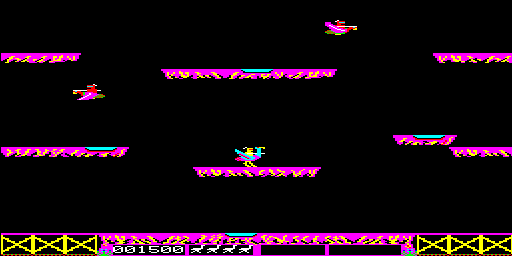
Publisher: Real Time Software Price: £14.95 Joystick Fear flutters in your belly as you mount the warbird, ready for your joust with the long lances of the opposition. Each screen is made up of a series of ledges, or perches, which make flight to the top of the screen difficult. You must manipulate your bird through the spaces between the perches and keep it in flight by continually pressing the flap key or fire button on the joystick. If you use the keyboard the flap key will take a hell of a hammering and having to continually press the fire button on the joystick makes bird movement control almost impossible. Real Time Software certainly went for realism when it designed the game. If you manage to knock a rider from a bird it will lay a green or blue egg. Pick it up and you are awarded extra points. Don't wait too long, though. Birds drop eggs for a purpose and if you don't take action quickly something not pretty and very nasty could hatch. Some of your fellow riders need a helping hand when they are unseated. They do not leave the screen and, being the kindly person you are, you score even more points for picking them up. When you have knocked off your first screenful you begin a second quest - screen two - which is called Survival wave. It includes birds which are more agile and dragons which will kill with their fiery wings or breath. If you manage to avoid all those monsters you will reach the Gladiator wave in which one mega-knight is your adversary. The mega-knight is the second player when the two-player game is in operation. Although Knight Flight does not stretch the graphics capabilities of the QL to its limit, it is the first QL game we know of which uses both control ports for joysticks. It is a fast but playable version of the arcade favourite. Joust, but could have had extra features which would make it even easier to play, such as a Pause option.
Your Sinclair #3Mar 1986 · p.678/109/105/106/107/107/10
Graphics 8/10
Playability 9/10
Value For Money 5/10
Addictiveness 6/10
Overall 7/10
Andrew Pennell 7/10
QL SOFTWARE Here's Andy Pennell's round-up of the latest games for the QL. The ideas behind them may not be that new but the programming's well up to standard. KNIGHT FLIGHT Realtime Software £14.95 Reviewer: Andrew Pennell Isn't this a version of the arcade game Joust? I'm afraid I never squandered my 20p's on this one so I'm not altogether sure how similar the two play. You're a knight on a horse flying around a screen populated with platforms. But you are not alone. The skies are full of unfriendly knights just dying for a joust - it's your job to make sure they do die. When you meet one of them for a spot of knuckle dusting, the winner is the highest player so it pays to hang around the top of the screen. If you come out on top. the rider of the defeated horse falls to ground and there are bonus points if the horse bites the dust as well. From time to time, the dragons get dragged on but they're best avoided 'cos they always cheat. The game's graphics are very neat, the sound less so, but for a while it had me hooked.
Related
- Same entry at
- Spectrum ComputingZXInfo
Reviews from people here
Sign in to write about this, or make an account. It takes a minute and lets you correct the catalogue too.
No language, credit, description, tag recorded.
Sign in to correct or add to this.
Hold the rights to this and want it taken down?