Spectrum Chess
Game: Board · ZX-Spectrum 48K · 1 players · English
Artic Computing Ltd · 1982 · Pound sterling 9.45
Also known as Spec Chess (English)
SpectrumChess, 1 of 2
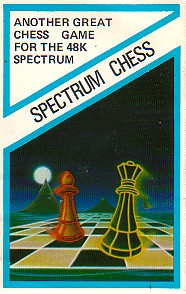
.jpg)
(Aackosoft).jpg)
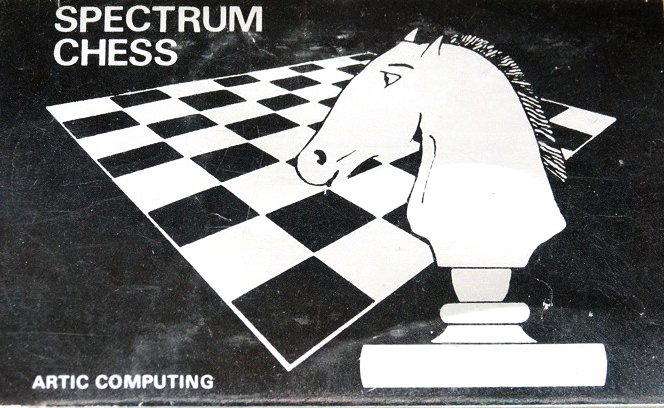
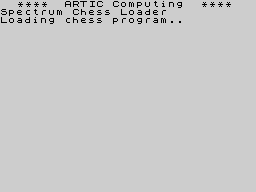
_SideA.jpg)
Discussion
Nobody has started a thread about this yet.
Remarks
non-speaking variant of Spectrum Voice Chess; also, cf. Spectrum Chess 2
Releases
- 1982Artic Computing LtdPound sterling 9.45
- UnknownAackosoft Sold as Spec Chess
- 1982Paxman PromotionsPound sterling 8.45
- 1982Profisoft [1]
Play
- spectrumchess.rzxRZX playback file
- SpectrumChess.tzx.zipTape image English8 KB
- SpectrumChess(different).tzx.zipTape image English8 KB
- SpectrumChess_2.tap.zipTape image English8 KB
- SpectrumChess(SpecChess)(Aackosoft).tzx.zipTape image English8 KB
- SpectrumChess(PaxmanPromotions).tzx.zipTape image English8 KB
- Chess(Profisoft).tzx.zipTape image 8 KB
Files and rights
No permission is on record either way. Screens and pictures are copied here on a take-down basis: if you hold the rights and want something removed, say so and it goes.
Credits
- Chris A. Thorntoncredited
- Stuart HughesInlay/Poster Art
Sign in to credit somebody, or say what these people did.
Scores
Elsewhere on the web
- WorldOfSpectrum 5 votes4.80
In the magazines 48
Crash #4May 1984 · p.62
Producer: Artic, 48K £8.45 There isn't much to choose between the quality of graphics in most of the chess programs available, all are pretty good. This program offers seven levels of play, four of which are within competition time limits. Full analysis, recommended moves, save game.
Crash #1Feb 1984 · p.59
Producer: Artic, 48K £8.45 There isn't much to choose between the quality of graphics in most of the chess programs available, all are pretty good. This program offers seven levels of play, four of which are within competition time limits. Full analysis, recommended moves, save game.
Sinclair User #16Jul 1983 · p.103
Quentin Heath
CHECKING THE BEST MOVES IN GROWING CHESS MARKET Quentin Heath emerges from the dungeons to return to the boards. In the last few months I have been stuck underground in the Sinclair User dungeons with a variety of man-eating monsters, so this month I thought I would seek some fresh air and talk about chess. In later articles I want o say something about the structure of chess programs but for now I will introduce you to what is available for Sinclair machines. Most of the early ZX-81 games were, more or less, copies of a famous American chess program called Sargon. Many manufacturers used the Sargon basic structure and re-wrote the printing routines so that they would be compatible for the ZX-81 screen format. After a few months of copying, manufacturers began to alter programs to make them play better and run faster. Out of the first batch of games to arrive on the scene, the Attic Computing ZX-81 Chess was acclaimed the best by the critics. The original Artic chess, and its upgraded version, Chess Two, have sold well and with good reason. The games include all legal moves, with castling and en passant, and can be played at six levels. The easiest level has a response time of about one second and the most difficult, level six, takes several minutes to make a move. Chess Two plays a good entertaining game for anyone with a slight knowledge of the laws of chess and when I played with it the game did not make an incorrect move, even on the simplest level. It is the game I would recommend for the average player who wants to try to beat a computer at chess. Some people may argue that a computer can play only a mechanical game with no invention or luck but playing a computer will give you some practice if no partner is available. Artic also produces a technically-excellent game which fits into the 1K ZX-81. It may not play brilliantly but it is fascinating to watch the computer scan the moves available to it graphically on the screen. The computer makes moves very quickly, although it will not allow the usual en passant and castling which are available on the bigger games. The game loads very quickly and at £2.95 it is worth the money. Artic has upgraded its ZX-81 chess games to the Spectrum. There are at present three versions but only one is for the 16K Spectrum. So far as I know it is the only chess program for the 16K machine. Its playing standard is similar to that of ZX Chess Two. The most interesting of the chess programs from Artic is Voice Chess. It not only plays as well as Spec Chess, the other game in the trio, but each move made is announced by a voice which is generated by the Spectrum loudspeaker. Some people have asked if the amount of memory used to store the voice affects the quality of the game. So far as I can tell, it does not do so noticeably. Most chess programs occupy a great deal less room than 48K and the voice is just filling the space which is not used. My own feeling is that if you want a game with novelty you should buy Voice Chess but if you just want to buy a good game with no frills, 48K Spec Chess and 16K Micro Chess are choices. Master Chess, from Mikro-Gen, also provides a formidable game. It runs on a 48K Spectrum and has 10 levels of play which are numbered from zero to nine. If you do not know which move to make the computer will suggest one for you. The game also includes an analysis option which can be used to solve chess puzzles. The Masterchess program is capable of all legal moves, including en passant and castling. To see how the games compete with a real chess machine I played a game between the Quicksilva Chess Player and a Sci-Sys chess computer. The results were interesting. Sci-Sys was slower in making moves than the Quicksilva game on level one but the dedicated chess computer earned checkmate in 67 moves. What was also interesting was that the Sci-Sys system often anticipated the moves of the Chess Player. That may indicate that most structures are similar. The final game I want to examine is the best available, in my opinion. Superchess Two is from CP Software and is a chess player's dream. The range of options includes 10 levels of play, a recommended move option, self-play, analyse and technical information. The self-play mode pits the computer against itself so that you can see how it solves game problems. You can also provide it with problems to analyse and solve. The most advanced level is level 10. At that level the computer can take several hours to make up its mind about a move. The game also includes an option which I have never seen in other chess programs. The technical information option will tell you how the program is structured and which techniques are used for the computer to find its next feasible move. Explanations of tree searches and data structures is provided to give the player a chance to further the computer's 'mind'.
Sinclair User #10Jan 1983 · p.69
Philip Joy
GRAVE DIFFICULTIES Philip Joy looks at an adventure game. Following my comments about adventure games in the last issue I have received a game called Cheops Tomb. It is available from Algor, [redacted] and the company claims it is probably the best adventure game on the market. While allowing for the natural over-enthusiasm of the producer, I found that it was one of the best adventure games I have seen for the ZX-81. It is interesting and well-presented with excellent screen display and has an addictive quality about it. The instructions are unusually well done and very clear but the game is complicated. The idea is to try to find your way out of the tomb, which consists of a 16 by 5 maze of rooms. The maze includes treasures, weapons, gods, monsters, passageways and locked doors, for which keys must be found. The player might be called on to fight a monster with varying amounts of strength. You are also able to cast spells of varying degree of effect, from sleep to death. The goal is to try to find the great key to let you out of the tomb. The animals and gods will do their best to stop you in any way possible. Gods can appear from nowhere and kill you, without warning; that can ruin the game, as you have no chance to fight. One other point is that you have to enter the whole command, which can be as much as 20 words; therefore some abbreviations should be included. The game is well-priced at £7. Now for a review of a flight simulator sent by David Cordiner of [redacted]. Pilot is a real-time aircraft simulator written entirely in Basic for the 16K ZX-81. The most obvious disadvantage of such a program is its speed. As a result of this the information displayed on the screen is updated only every few seconds. It gives the impression that the aircraft is not always responding to your inputs. The program, however, contains some exceptional points, one of which is the aircraft attitude which can make the difference between a crash and a safe landing. The controls include up, down, left and right, with power, flaps and a good display of the instruments. The game has some humour, if you can call it that, when the flaps fall off at high speed. The author says that the main reason for writing the program in Basic was so that the program could be studied and altered in places. It could therefore be used as a tool for learning about Basic. Pilot is priced at £3 which, compared to some other games, is very reasonable. I have also received two versions of chess for the 48K Spectrum. The first game is from Prism Computing, [redacted]. It is, of course, in machine code, with six levels of play, from beginners to postal chess. It can save a game on cassette and print-out a copy of the board for later reference. Prism says that the loudspeaker of the Spectrum is used in the game - that is, of course, if you can hear it. The second game is from Artic Computing, [redacted]. The cover and cassette say that it is for the Spectrum but the loading instructions are for the ZX-81. Obviously that is an oversight, but it sounds very funny when a Spectrum game tells you to set up your ZX-81. The game has seven levels of play, with response times from two seconds to several minutes. You can analyse games by setting-up your own positions. The program can also recommend a move. Now for the answer to last month's problem about adding all the prime numbers less the 5,000. There are 699 numbers, with the last one 4,999, and the sum being 1 548 135.
Sinclair User #8Nov 1982 · p.9
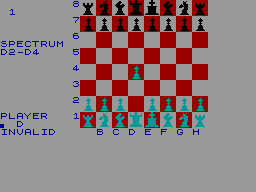
NEW CHESS ALLOWS GAMES TO BE SAVED One of the first companies to produce a chess program for the ZX-81 was Artic Computing. Now Artic has beaten even Sinclair and Psion to writing a chess game for the Spectrum. It can be used only with the 48K Spectrum but it gives options which were not possible on the ZX-81. On first loading, the program asks whether the player wants to play, analyse, or load. Taking the play Option first, there are seven levels of play with response times ranging from two seconds to five minutes. The board is represented in high resolution at the right-hand side of the screen and the moves made by player and computer are printed on the left. The players are represented using user-defined graphics but are a little too small for our liking. It would have been better to have a larger board with bigger characters on it. Using the analyse option, it is possible to set up the board to allow the computer to analyse a position with which the player may have had difficulty or has found in one of the many chess magazines and books under the heading of chess problems. The instructions for the game also say that this option is ideal for endgame analysis. The main difference between ZX-81 and Spectrum chess is the ability to save games you have not completed. You can then load the unfinished game into the machine and resume where you finished. It is irritating on the ZX-81 when it is necessary to complete a whole game which could take as long as an hour, or not finish the game. Now that problem has been overcome and it takes only seconds to re-load a game. Spectrum Chess is from Artic Computing, [redacted] and costs £9.95.
Advert38
- Computer ChoiceJan 1984 · p.39
- Personal Computer Games #2Dec 1983 · p.100
- Computer ChoiceDec 1983 · p.35
- Your Computer #12Dec 1983 · p.80
- Your Computer #11Nov 1983 · p.280
- Your Computer #10Oct 1983 · p.24
- Sinclair Projects #5Aug 1983 · p.52
- Sinclair Programs #9Jul 1983 · p.60
- Sinclair User #15Jun 1983 · p.75
- Sinclair Projects #4Jun 1983 · p.52
- Your Computer #6Jun 1983 · p.18
- ZX Computing #7Jun 1983 · p.81
- Your Computer #5May 1983 · p.123
- Sinclair User #14May 1983 · p.70
- Home Computing Weekly #12May 1983 · p.8
- Home Computing Weekly #10May 1983 · p.33
- Home Computing Weekly #6Apr 1983 · p.8
- Sinclair User #13Apr 1983 · p.24
- ZX Computing #6Apr 1983 · p.50
- Home Computing Weekly #8Apr 1983 · p.8
- Your Computer #4Apr 1983 · p.12
- Home Computing Weekly #4Mar 1983 · p.8
- Home Computing Weekly #2Mar 1983 · p.9
- Personal Computing Today #8Mar 1983 · p.100
- Your Computer #3Mar 1983 · p.156
Feature2
- ZX Computing #26Jun 1986 · p.30
- Popular Computing Weekly #3Jan 1983 · p.12
News/Note2
- ZX Computing #8Aug 1983 · p.69
- C&VG (Computer & Video Games) #14Dec 1982 · p.16
Review1
- ZX MagazínMar 2001 · p.7
Licensed from
- ChessBoard/Tabletopunofficial
Related
- Compilations
- Games Pack, ZX-Spectrum Vega
- Same entry at
- Spectrum ComputingZXInfo
Reviews from people here
Sign in to write about this, or make an account. It takes a minute and lets you correct the catalogue too.
Everything ZXDB can hold about this is here.
Sign in to correct or add to this.
Hold the rights to this and want it taken down?