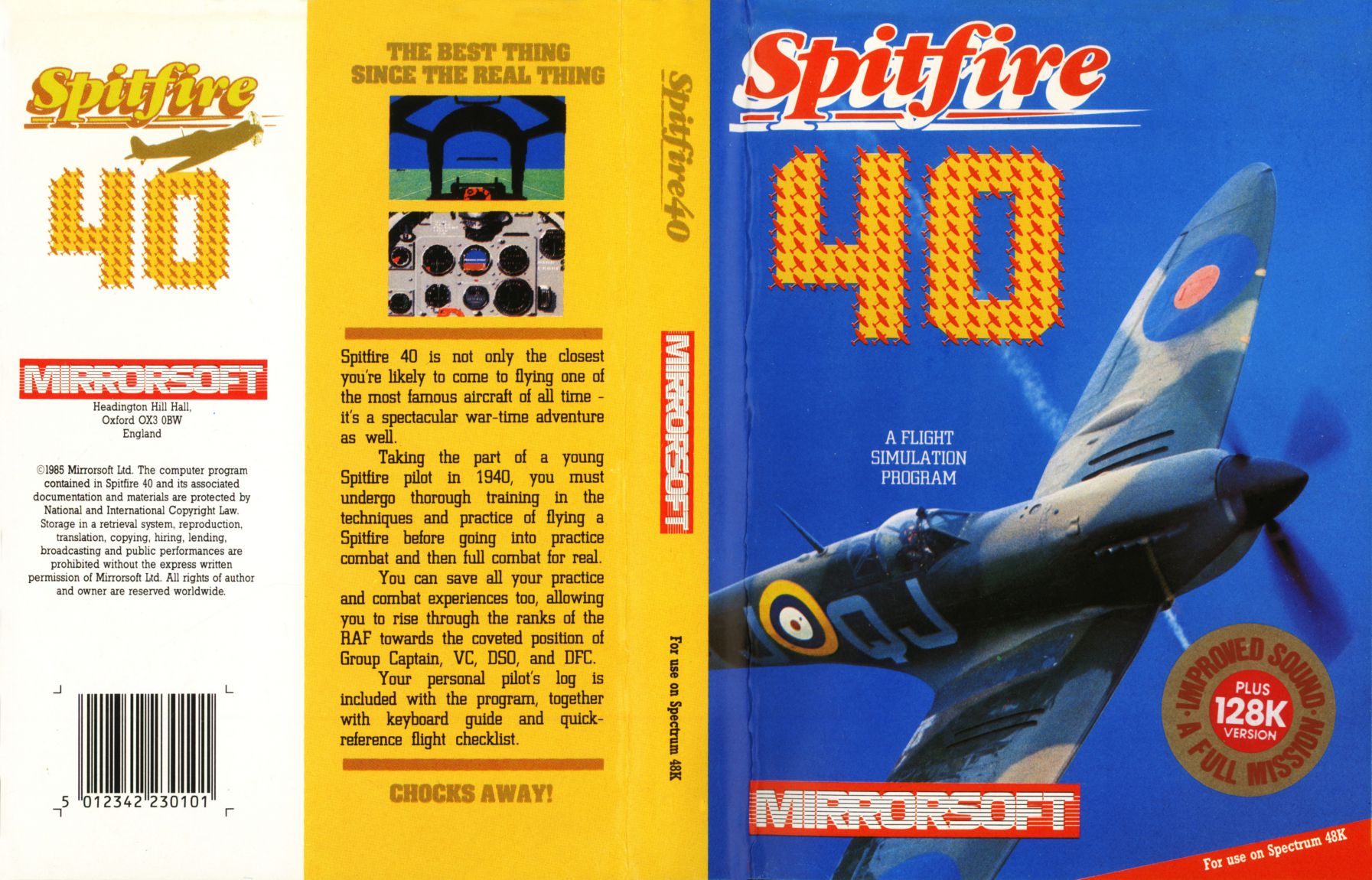
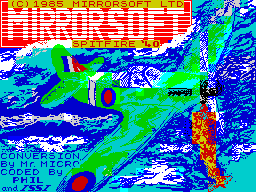
Spitfire 40
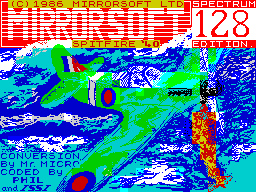
Game: Flight Simulator · ZX-Spectrum 48K/128K · 1 players · English
Mirrorsoft Ltd · 1985 · Pound sterling 9.95
Also known as Spitfire '40 (English)
.jpg)
.jpg)
.jpg)
.jpg)
_Media.jpg)
Discussion
Nobody has started a thread about this yet.
Known Errors
The 128K version is incomplete. It contains new features, such as a new star effect (that you must find in the first mission), but flying over it makes the game crash because part of the code is missing.
Publication
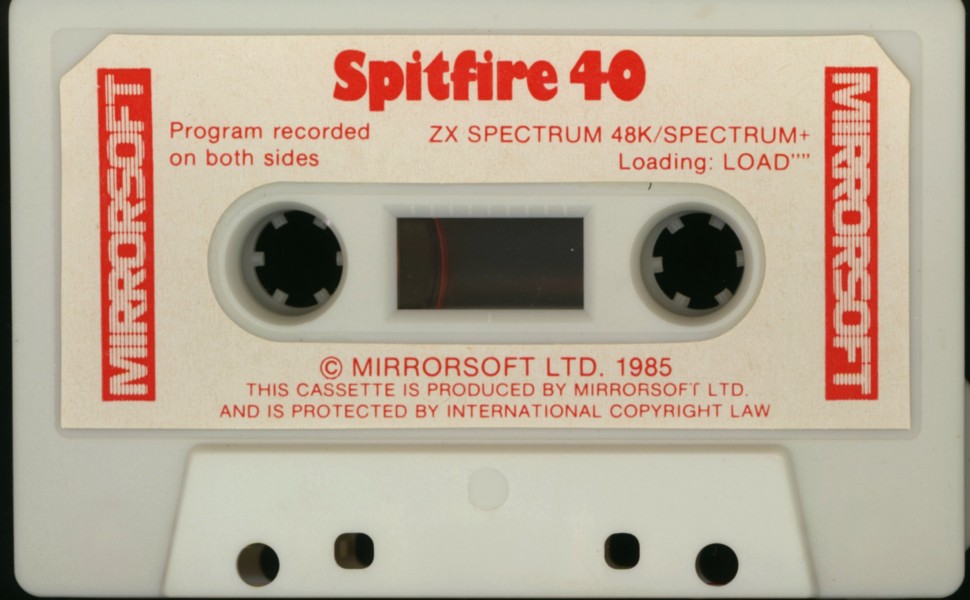
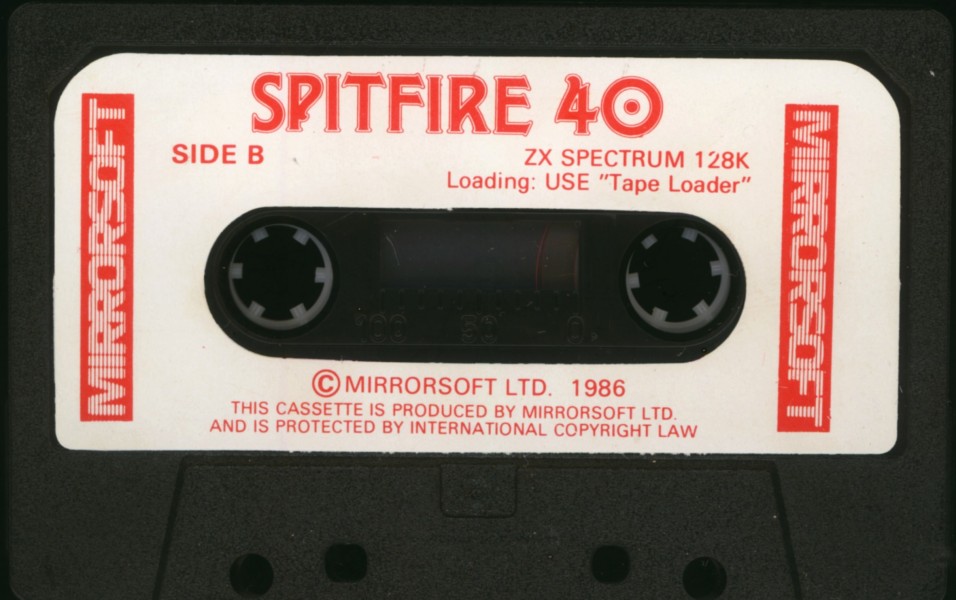
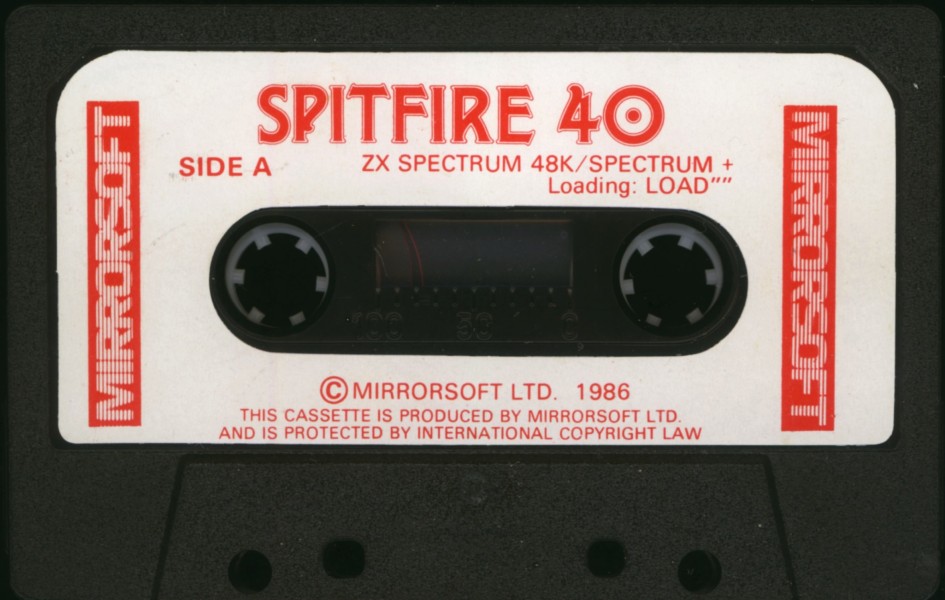
There are three know Mirrorsoft releases for this game: the original 1985 release for ZX Spectrum 48K; a second release in 1986 that includes a 48K only version on one side of the cassette and a 128K compatible version on the other side; and a third release in 1986 with an incomplete 128K enhanced version.
- Control Option
- Cursor, Interface 2 (right), Kempston Joystick
Releases
- 1985Mirrorsoft Ltd Sold as Spitfire '40Pound sterling 9.95
- 1989Alternative Software LtdPound sterling 2.99
- UnknownEDOS
- 1986Zafi Chip
- 1987Z CobraSpanish peseta 875.00
Play
- Spitfire40_128.tzx.zipTape image English24 KB
- Spitfire40_48V1.tzx.zipTape image English24 KB
- Spitfire40_48V2.tzx.zipTape image English24 KB
- Spitfire40_128.tap.zipTape image English28 KB
- Spitfire40_48.tap.zipTape image English30 KB
- Spitfire40(AlternativeSoftwareLtd).tzx.zipTape image English24 KB
- Spitfire40(ZCobra).tzx.zipTape image English24 KB
- Spitfire40(ZafiChip).tzx.zipTape image English23 KB
Documents
- Spitfire40.txtInstructions English28 KB
- Spitfire40(ZCobra).pdfInstructions Spanish275 KB
- Spitfire40(EN).pdfInstructions English1,175 KB
- Spitfire40(AlternativeSoftwareLtd)(EN).pdfInstructions English194 KB
Other files
- Spitfire 40 (1985)(Mirrorsoft).pokPOK pokes file 0 KB
Files and rights
No permission is on record either way. Screens and pictures are copied here on a take-down basis: if you hold the rights and want something removed, say so and it goes.
Credits
Sign in to credit somebody, or say what these people did.
Awards
Scores
In the magazines
- Sinclair User #491986 · Overall5/5
- Your Sinclair #41986 · Overall9/10
- Crash #261986 · Overall90%
- Your Sinclair #511990 · Overall40%
Elsewhere on the web
- WorldOfSpectrum 17 votes7.88
Awards and competitions
Crash Readers Awards 1986
- 3Best Simulation
In the magazines 48
Crash2018 · p.60
Chris Wilkins
Ryan Coleman
As the Crash annuals are still for sale ZXSR has taken the decision to remove all review text, apart from reviewer names and scores from the database. A backup has been taken of the review text which is stored offsite. The review text will not be included without the express permission of the Annuals editorial team/owners.
Your Sinclair #51Mar 1990 · p.4340%40%
Overall 40%
Marcus Berkmann 40%
BARGAIN BASEMENT Cheaper than a speeding bullet. Leaps small molehills in a single bound. Is it a bird? Is it a small piece of putty? No, it's budget hero Marcus Berkmann with the latest in low-price Spec-fun. SPITFIRE '40 Aternative £2.99 Reviewer: Marcus Berkmann Yet another rerelease - where did all the new games go? - this time of an ancient (1985) Mirrorsoft flight sim. Yes, it's back to World War II, complete with banter, enormous moustaches and chaps called Boffos and Pongo. Sadly for the Binkys and Boffos in Spitfire '40, however, this sort of game format (if 'game' it truly is) has long since been mastered by those flying jacket types at MicroProse, and this one looks a little tatty in comparison. That said, it's not bad value for three quid (although two quid would have been nearer the mark). After all, you get eight pages of instructions with the blighter, so there's go to be something to it. But any game that differentiates in the controls section between playing on a Spectrum keyboard and playing on a Spectrum + keyboard has got to be something of a dinosaur, and Spitfire is suitably wrinkly. not even a hastily applied bit of Oil of Ulay would make much difference - euthanasia would be infinitely kinder. A close decision, but down onto the pavement it goes!
Your Sinclair #4Apr 1986 · p.68Your Sinclair Hot Shot8/109/108/109/109/109/10
Your SinclairYour Sinclair Hot Shot
Graphics 8/10
Playability 9/10
Value For Money 8/10
Addictiveness 9/10
Overall 9/10
Gwyn Hughes 9/10
Mirrorsoft £9.95 Reviewer: Gwyn Hughes How I remember that cold morning in 1940. Ginger and I were in the Officers Mess. 'We really must get this mess cleared up,' I said. Suddenly the alarm! 'Scramble, Ginge, scramble!' I shouted. 'Oh dear,' he said, turning from the eggs. 'I've just started to fry them.'' Sometimes I have my doubts about Ginge... Of all the aircraft in the history of aerial combat, the Supermarine Spitfire has the greatest aura of romance and adventure, bar none. Of revolutionary design, with a top speed of 350 mph and amazing manoeuverability, it became an integral part of Britain's airborne defence against Hitler. How many thrilled to the sight of this huge mechanical bird locked in deadly combat over the fields of Kent during the Battle of Britain? Flight simulators are always among the first software releases for a home computer, but they've recently gained a new lease of life by giving you something to do once you get up into the air other than just flying from airfield to airfield. That something is... killing people! Now's your chance to test your canine canniness in a dog fight to the death against the beastly Boche, in what appears to be an accurate version of the Spitfire, with only minor compromises for the computer. We've come to expect polished presentation from Mirrorsoft and this is no exception. The twenty four page booklet contains not only excellent clear instructions and step by step guides to getting off the ground and what to do when you find Adolph up your exhaust, but also a brief note on the theory of flight and a history of the plane (from which I cribbed the above potted facts...). There's also a four page insert containing the important controls and details, such as how to regain control if you foul up. This attention to detail continues in the program, with separate options for Spectrum and Spectrum + keyboard controls! And the atmosphere is there too. Although you start with no flying hours, once you've made a successful landing you can save your log which provides continuity of character. Be warned though, as you rack up the hours you'll find the program becomes less forgiving of your errors, increasing your chances of pranging the crate - a nice way of handling difficulty levels. There are two practice modes, for flying and combat, but the real test comes when you leap into the cramped cockpit, throw out a cramped cock or two, and rev up the engine - which sadly sounds more like a gnat in your helmet thanks to the legendary Speccy sound! Space toggles between the instrument panel and the cockpit view. So, taking note of where you can expect to encounter the Hun (in feet and compass bearing), it's up, up and away - probably instrument flying until you're in the danger zone. Actually the cockpit view is fairly bare, though Mirrorsoft claims you may eventually be able to use landmarks for navigation. It's probably easier to use the map screen, again accessed by a single key stroke. Then it's war in the air and machine guns blazing as you try to out-manoeuvre the enemy. Here it's the screen view almost all the way and I found it as exciting as any arcade game, suddenly looping over to put a plane that was tailing me directly into my sights. You have to learn to pre-judge targets though and their tactics are cleverly programmed too. Mission accomplished (and it's not that easy), it's back to base to swop stories of the Heinkel that nearly got away, with a few more flying hours to your credit. Spitfire 40 is a friendly program, not nearly so difficult to get into as some earlier simulators, and it's very engaging with its role playing element. I snapped on the 'For Hire' light and prepared to taxi up the runway. 'Chocks away, Ginge!' I yelled. 'Aww - and I've only got the coffee cream and that's my favourite. he said. Quite seriously, I have my doubts about him.
Like all those Road Safety ads say, use your rear view mirror. If you find you’ve got a plane on your tail, prepare to take evasive action! Band-it’s at five o’ clock. So I’d better get this Fokker in my sights if I’m going to be home in time for Glen Miller. Though it’s not easy to see with the Spectrum’s resolution, there’s a pixel thick line here to indicate your speed. After all, when you’re locked in combat you don’t want the distractions of flicking to the instruments. A similar miniscule indicator here provides a guide to the rudder direction... if you can see the ruddy things.
No stopping to top up when you’re fighting Jerry, so keep an eye on the fuel gauge. With only 45 minutes flying time you’d be a fuel not to. The Artificial Horizon, and watch it rock ‘n’ roll as you put your Spitfire through a few acrobatics. It also flashes if you’re being shot at. If you have problems understanding it an Altitude indicator has been added, bottom left. Revving up the engine is all important in flying. You’ll need it way up at 3,400 rpm to take off then down to 1,900 for cruising, so you’re all prepared for the odd burst of speed when you see the enemy. Your altimeter has two hands, for 100’s and 1,000’s of feet. It’s wise to try and take the enemy from above, but you can also play games of chicken, going into ground scraping rolls. When you set out you’ll be given a bearing for the enemy, but take time to work out the way back, using the compass here, unless you want to ditch it in a field. A neat little trick to take you out of harm’s way is to slide sideways. The top needle here indicates how far you’re Slipping while below it is Turn.
The Hun over the Home Counties! You can use this as a rough guide bet when you reach the battle zone it’s a question of twisting and turning until you achieve visual contact. A little poetic license in the map, to show where you are. At this stage you’re still in the vicinity of you base. The Map screen also provides a useful freeze facility. A useful bit of info from the johnnies at HQ. After all, you’d hate to miss the rendezvous because Jerry flew over you, wouldn’t you? The three squares are key areas, and successive presses on ‘N’ magnify the map to help align yourself with the runway. It’s advisable to get to know those green fields a bit before you fly too far from home.
C&VG (Computer & Video Games) #54Apr 1986 · p.22C+VG Hit7/106/107/108/10
C&VG (Computer & Video Games)C+VG Hit
Graphics 7/10
Sound 6/10
Value 7/10
Playability 8/10
MACHINE: Amstrad/Spectrum SUPPLIER: Mirrorsoft PRICE: £9.95 Amstrad and Spectrum "You've bought it, old boy," read the stark message on the screen. "You came down too steeply." Picking myself up from the tangled wreckage of the crashed Spitfire I gave myself a quick dustdown, adjusted my goggles, re-groomed the handlebar moustache and it's back into the air with Mirrorsoft's wartime flight simulation, Spitfire 40. It's summer 1940 and you play the part of a newly-qualified pilot stationed somewhere in the south east of England. With practice and success in combat missions you can rise through the ranks to reach the rank of Group Captain, gaining medals such as VC, DSO and DFC. There are two main screens to the game - the cockpit controls and view from the cockpit. The controls include all the normal stuff - including air speed indicator, fuel guage, compass, engine rev counter, altimeter and artificial horizon. Pressing the M key brings up a map of the south east of England and pressing N expands the map to show greater detail ie the position of your craft and the enemy. There are three flight modes - practice, combat and combat practice. Practice just allows you to get used to the handling of the Spitfire, develop take off skills and perfect aerobatics. Flight Combat gives the battle experience without the bother of finding the enemy aircraft. While playing the Amstrad version of this mode the destroyed enemy aircraft would sometimes stick to the cockpit like a dead fly. The Combat mode starts off by giving you mission instructions - the number of enemy aircraft sighted, their distance in miles, bearing from the runway and height. The graphics - particular on the Amstrad version of Spitfire 40 - are very nice. All in all Spitfire40 is a nice flight simulation, not too complicated to prevent instant enjoyment or too easy to make the game boring after just a few plays.
ZX Computing #24Apr 1986 · p.23ZX Computing Globert
ZX ComputingZX Computing Globert
FLYING HIGH All of a sudden there's been a burst of aerial activity on the Spectrum, so let's go for a spin in some new simulators. SPITFIRE 40 Mirrorsoft £9.95 Spitfire 40 is an impressive flight simulator and aerial combat game that gives you the chance to join the few' defending South East England against the onslaught of the Luftwaffe. Switching between the authentic looking instrument panel and the cockpit view it is possible to recreate how the war must have looked from an air ace's point of view. There are three modes, practice, combat and combat practice. If you want to avoid the complexities of taking off which takes some time to master you can go immediately into a dogfight training scenario at 10,000 feet. Getting the enemy fighter into your sights is challenging and the dives and turns are simulated by an artificial horizon that unnervingly tends to put the ground above your head quite frequently. This, it must be said, is due to this pilot's inexperience as in the early stages of combat becoming disorientated is unavoidable. Destroying the enemy while flying upside down at 5,000 feet may lack a little in style but it is effective. Continued practice shows that the opposition can be brought down with a little more panache and less uncontrollable spinning. The game comes complete with a very thorough manual that takes you through the principles of fighter flying and gives tips to improve your prowess so that you can progress towards the goal of filling your mantelpiece with medals. Overall, Spitfire 40 has enough variety and difficulty to please 'the few' who are dedicated flight simulator buffs and perhaps the many who have so far shunned the lure of the computer cockpit.
A bandit is on your tail. Time for an evasive move.
Sinclair User #49Apr 1986 · p.405/55/5
Overall 5/5
Chris Bourne 5/5
Publisher: Mirrorsoft Price: £9.95 Memory: 48K Joystick: Kempston, cursor, Sinclair I say chaps, Jerry's zooming in with his Dormer und Blitzens and Englisch Sweinhunds and all that tosh again. It's chocks away time, angels at seven, bandits at nine, don't prang the kite it's the only new one we've got Algy old boy, cripes, did you see the legs on that WAAF dakka-dakka-dakka I think the Wingco's bought it, OK, that's enough jargon, let's talk about the game. Spitfire 40 is the name, Mirrorsoft is responsible for flogging it and you get no prizes for guessing it's set in the Battle of Britain. In fact what we have is a rather handsome flight simulation with combat sequences. Attention to detail is impressive at first. When you load up you choose your pilot's name from a list of five. This seems dodgy. I'm not called Smith, Jones, Mackenzie, Marcel or Bolesky. On the other hand, I'm not a Battle of Britain fighter pilot. Let's choose Marcel, vive de Gaulle and up the Free French. Marcel's details - no missions completed, no medals, no kills, no flying experience - are entered into a logbook on-screen. When Marcel proves himself this logbook gets updated and you can save it for later games. There are three modes of play - practice, combat and combat practice. Combat is the main game where you are set a mission to complete. Practice is basically there for landing and take-off, and combat practice is equally obvious. Marcel is going out on a practice flight. The screen display shows the controls of the Spitfire in excellent detail, concentrating on rather old-fashioned looking dials and some grubby shading round the edges, giving a good impression of what the real thing must have looked like. The first thing you'll notice, especially if you're a flight simulator fan, is there's no view of the horizon or landscape. Where's the window? The window is got by pressing Space. You see the full view from the cockpit but lose all your instruments. Gunsights are there, and some dots at the bottom which are supposed to indicate altitude and speed, but those are very difficult to interpret. The switching between controls and view is the major drawback of the game, especially when coming into land - you must use the view to check your course for the runway, but you'll need the controls when you're just about to touch down. It's easy to be on the wrong screen and crash through not knowing what you were doing. It's the price of that great display of dials, but is it too high a price to pay? Let's see how Marcel gets on. Taking off is dead easy. You increase throttle to 1800 revs, let the brakes off, increase power again to 3200 revs and when your speed gets to about 100mph lift the nose up and you're off. Marcel can do this in his sleep, although it's quite easy to find the Spitfire violently bucking when the undercarriage is raised or the flaps down if you're not careful about the speed. Luckily Marcel has read the useful booklet with all its tips on correct flying. Marcel is now climbing steadily over the beautiful patchwork fields and rolling downs of Kent. All he can see from the cockpit, however, is a completely flat blanket of green. It goes on and on for ever. Even the English Channel is green. Luckily Marcel doesn't get seasick. The Spitfire has, of course, no radar. Our French hero doesn't mind this, because it wasn't invented at the time. This means there's no navigational equipment like you get on modern-style aircraft, and you have to fly entirely by judgement and sight. In order to find out where you are going, look at the map. The map shows an area of Southern England with three big rectangles on it. Those contain three airfields, and some other surface detail, and if your aircraft is in one of them you can magnify it. Marcel has a quick look and notices some blue shapes marked on the map. Unfortunately, when he flies the Spitfire very close to have a look through the cockpit, they don't turn into anything except bigger blue shapes. The runway looks OK, but as for the rest of these details, they don't really seem worth defending. Let Jerry have them, thinks Marcel, and promptly crashes into a large blue triangle. Mr Churchill is not amused. Black mark, de Gaulle. Flight Officer Mackenzie - our second guinea pig - decides to skip the practice routine and go straight into combat. This is much more fun. He receives a direction: Bandits 4, Intercept 11, Bearing 253', Height 5,000'. That means there are four German fighters, 11 miles away, nearly due west at the given altitude. Off he goes in search of glory. Height is very important in combat. The traditional way to do things is to get above your enemy and behind him, then come screaming down in a furious pounding of cannon and blow him into little bits. Even better, come out of the sun so the poor sod can't even see you before he's roast pork and mostly crackling. War is not romantic, whatever you may think of Biggles. Spitfire 40 doesn't simulate the sun, but the enemy certainly does its best to get on your tail, and once there is hard to dislodge. Mackenzie discovers a most spectacular way of getting out of trouble - looping the loop and doing a half roll at the top of the loop, then pulling out of the dive before completing the loop. That brings him hurtling straight down at the enemy, and surprisingly, he manages to pull out of the dive just in time to meet another Messerschmitt or whatever on the horizon. Dogfighting is good fun. The enemy planes are small and stay small, but that's all to the good as they present a more difficult target. A mirror above the cockpit view shows an enemy fighter if there's one on your tail, and if you don't shake him fast enough your glass windows will be peppered with bullet holes and your flying jacket becomes distinctly ragged. It does seem to be much easier to shoot down planes when coming in from behind, but that's hard to assess in the hurly-burly of combat. The most exciting part of combat is the way you have to fly on vision alone - there's no time to flip screens and check your dials. What is a drawback on landing therefore becomes an advantage in fighting. Unfortunately, Mackenzie, having destroyed his four bandits, fails to make it to the runway at the right height and attitude and consequently gets posted missing in action. There won't be a dry eye in the WAAF's mess tonight. Jim Gregory and his pals have done a good job for Mirrorsoft in re-creating the atmosphere of the Battle of Britain. The concept of saving your record in order to progress in rank and glory is a good one, and the instructions state that life gets more difficult as you move up the promotion ladder - landings have to be more precise and soon. In fairness to the lack of detail on the landscaping, there are a lot of features not included in standard flight simulations which clearly eat up the memory. It would have been nice however to see something more interesting than little blue shapes on the ground, if only some patterns of dots for field boundaries and roads. The controls are suitably responsive for such a manoeuvrable aircraft, and there seems to be little you cannot do in the way of aerobatics. The alternative screen system has its drawbacks, but does at least provide an excellent array of instruments when in that mode, uncluttered and realistic. Not quite a Classic, then, but definitely Mirrorsoft's finest hour. Flight Officer Chris Bourne
A - Flaps lever - up or down B - The fuel gauge C - The attitude of the aircraft D - Speed in miles per hour E - The horizon. Enemy aircraft do not appear on this, but only with the cockpit view. F - Rate of climb or descent G - This indicates your angle of banking H - Altitude in hundreds of feet I - The gyro shows the bearing on which you are flying J - The top arrow shows your rate of turn, and the bottom the rate of sideslip, left or right K - The revs are shown in hundreds. Sudden changes in throttle power tend to have alarming effects on stability of the aircraft L - Undercarriage indicator M - Brakes - either on or off N - The oil gauge measures how much you overheat the engine
Maximum magnification on the map - the Spitfire is lined up on the runway.
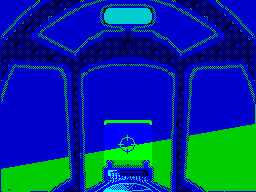
The cockpit view at take-off. The pale blue shape is your mirror.
Crash #26Mar 1986 · p.34Crash Smash90%91%88%93%91%91%90%
Use of Computer 90%
Graphics 91%
Playability 88%
Getting Started 93%
Addictive Qualities 91%
Value For Money 91%
Overall 90%
Unknown
Unknown
Unknown
Producer: Mirrorsoft Retail Price: £9.95 Author: Conversion by Mr Micro Mirrorsoft's latest release allows you to take to the skies in the cockpit of a World War II aeroplane - the Spitfire, in case there's any doubt remaining! The game first appeared on the Commodore, nearly a year ago, and has now been launched on the Spectrum. It's the summer of 1940, and you've just been posted to a Spitfire squadron - a whole world of adventure is about to open up before you... At the start of a session in the air you have to load a flying Log into the program - you can choose one of the pilots presented on screen or load in details of your own experience if you've already got some flying time in. The next task is to select which of the three modes you wish to use, choosing between Practice, Combat and Combat Practice, Practice puts you on the runway and gives you the opportunity to get to know the feel of the plane by allowing you to take off, fly around and land. In this mode there are no enemies present - it's very much a case of having the 'L' plates on. The two combat modes pit you against enemy fighters. Combat Practice puts you in the air directly behind an enemy aircraft, and you can practise your gunnery technique. After a couple of enemy fighters have been destroyed, the opposition starts to get smart, behaving more like they would in a true war situation, twisting and turning to avoid your machine gun fire. Sometimes they loop the loop and end up on your tail and start machine gunning you! You're alerted to an enemy behind you by the plane appearing in your rear mirror - a nice feature which adds realism to the simulator. True Combat mode puts you in an ongoing war situation. Starting on the airstrip you have to take off, find the enemy using the map, and fly the Spitfire for real, engaging the German pilots in dogfights. Once you have intercepted and shot down the enemy intruders you have to return to the airstrip and land safely. If the mission is a successful one then you can save your experiences to tape as a Log before going out on another interception run. The Log can then be reloaded as a flight history the next time you decide to take to the skies. This Air-ace simulation features two separate screens, the view from the cockpit and the instrument panel, which have to be used in conjunction to fly the plane - a press on the space bar toggles between the two displays. A map screen can be referred to while you're flying to help you find the current position of the enemy planes. The main map shows the South East of England with your plane marked in red and enemy fighters in black. If your Spitfire is inside one of the three squares drawn on this map, you can examine the ground below you in greater detail by pressing the N key. The game can be controlled entirely from the keyboard or from keyboard and joystick, in which case your joystick controls the Spitfire's ailerons and elevators, mirroring the stick displayed on-screen, and key-presses are required to activate other controls such as landing gear, throttle and rudder. The instruction booklet contains all you need to know about flying the Spitfire in the game, and offers a fair few tips and hints on techniques for survival in the air. There's also a potted history of the Spitfire itself, and a brief introduction to the theory of flight as well asa short section on aerobatic manoeuvers. If you do well then promotion is awarded according to your flying experience and the number of kills you achieve. If you do really well it is possible to rise through the ranks rapidly. Who knows? You could become a Group Captain with a string of medals including the VC, DSO, and DEC. Then you'd be ready for Mirrorsoft's next release... a game all about that famous Ace, Biggles! COMMENTS Control keys: Spitfire Joystick: P up, L down, A left, S right, SHIFT or ; to fire. Z/X rudder left/right, Q/W increase/decrease power, F flaps, G landing gear, B brakes, M and N map control, SPACE to toggle between screens Joystick: Kempston, Cursor, Interface 2 Keyboard play: fine, once you get used to the controls Use of colour: tasteful Graphics: very fast and realistic, excellent instruments Sound: mainly engine noise and firing Skill levels: one Screens: two, plus maps and menus
Flying along with the greatest of ease Part 1: On the tail of an enemy plane.
Flying along with the greatest of ease Part 2: The runway appears through the cockpit window.
Flying along with the greatest of ease Part 3: The map screen - there's no enemy planes out to play today!
FLAPS. 'U' for up, 'D' for down. FUEL GAUGE You have enough fuel in the tanks to remain airborne for 45 minutes... AIR SPEED INDICATOR Readout in units of 100 mph STALL SPEED INDICATOR Eek! Mind your airspeed indicator needle... ARTIFICIAL HORIZON PITCH INDICATOR Represents a sideways view of the Spitfire - in conjunction with the Artificial Horizon, helps assist orientation when diving or climbing steeply. VERTICAL SPEED INDICATOR In units of 1000 feet per minute, climb and descent. TACHOMETER Shows engine speed in 100's revs per minute. Landing gear up when light showing red, down when green. Brakes on when light showing red, off when green. RUDDER INDICATOR SLIP AND TURN INDICATOR Upper needle shows sideways movement through the air (slip), lower needle reveals the rate of turn. COMPASS ALTIMETER Large need reads out in 1,000's of feet, small needle in 100's.
Flight Ace carries this game and has 14 references of its own.
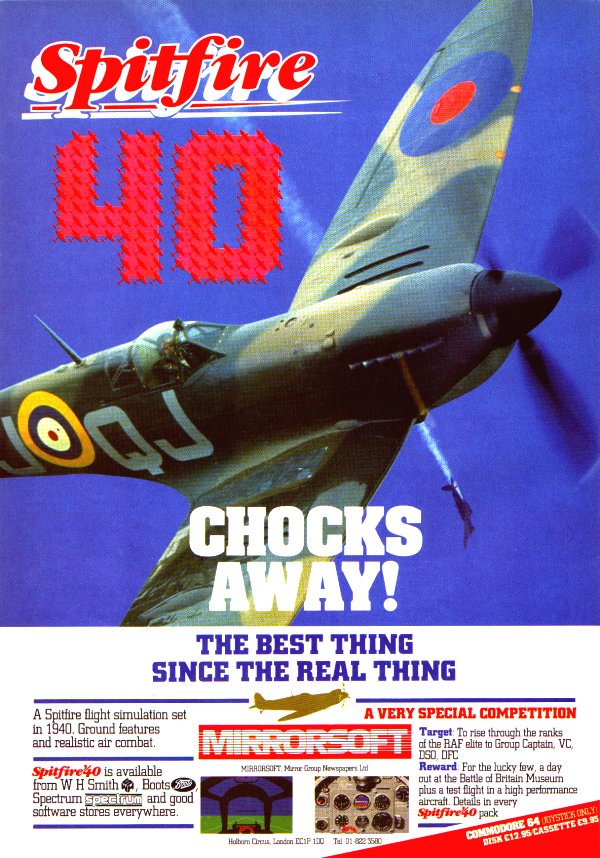
Advert21
- ACE (Advanced Computer Entertainment) #7Apr 1988 · p.48
- C&VG (Computer & Video Games) #77Mar 1988 · p.77
- ACE (Advanced Computer Entertainment) #5Feb 1988 · p.47
- ACE (Advanced Computer Entertainment) #4Jan 1988 · p.71
- C&VG (Computer & Video Games) #62Dec 1986 · p.57
- Your Computer #12Dec 1986 · p.58
- Popular Computing Weekly #15Apr 1986 · p.11
- Sinclair User #49Apr 1986 · p.31
- Crash #27Apr 1986 · p.25
- C&VG (Computer & Video Games) #54Apr 1986 · p.7
- Computer Gamer #13Apr 1986 · p.9
- C&VG (Computer & Video Games) #53Mar 1986 · p.18
- Popular Computing Weekly #12Mar 1986 · p.7
- Popular Computing Weekly #10Mar 1986 · p.7
- Sinclair User #47Feb 1986 · p.59
- Popular Computing Weekly #6Feb 1986 · p.2
- C&VG (Computer & Video Games) #51Jan 1986 · p.10
- Popular Computing Weekly #51Dec 1985 · p.7
- Popular Computing Weekly #46Nov 1985 · p.7
- C&VG (Computer & Video Games) #49Nov 1985 · p.10
- Popular Computing Weekly #42Oct 1985 · p.7
Full-page ad9
- C&VG (Computer & Video Games) #67May 1987 · p.25
- Sinclair User #46Jan 1986 · p.27
- Your Sinclair #1Jan 1986
- Crash #24Jan 1986 · p.17
- Sinclair User #44Nov 1985 · p.58
- Crash #22Nov 1985 · p.23
- Popular Computing Weekly #34Aug 1985 · p.7
- Your Computer #7Jul 1985 · p.100
- Home Computing Weekly #108Apr 1985 · p.7
Review2
- ZX MagazínApr 2001 · p.10
- MicroHobby #89Jul 1986 · p.14
Hack/Poke2
- Your Sinclair #36Dec 1988 · p.35
- Your Sinclair #30Jun 1988 · p.24
CompoEntry2
- Popular Computing Weekly #16Apr 1986 · p.21
- Popular Computing Weekly #17Apr 1986 · p.26
Information1
- SSD-IISep 1999
Solution1
- FIFO #11990 · p.22
Tips1
- Sinclair User #52Jul 1986 · p.20
Letters1
- Your Sinclair #5May 1986 · p.23
News/Note1
- Your Computer #3Mar 1986 · p.20
Related
- Ports
- (Amstrad CPC), (Atari 8-bit), (BBC Micro), Spitfire '40 (Commodore 64), (MSX), (Atari ST), (Acorn)
- Tags
- AY Sound, Crosshair, Vector Graphics
- Elsewhere
- MobyGamesThe TipshopUVL
- Same entry at
- Spectrum ComputingZXInfo
Reviews from people here
Sign in to write about this, or make an account. It takes a minute and lets you correct the catalogue too.
Everything ZXDB can hold about this is here.
Sign in to correct or add to this.
Hold the rights to this and want it taken down?