Stonkers
Strategy Game: War · ZX-Spectrum 48K · 1 players · English
Imagine Software Ltd · 1983 · Pound sterling 5.50
_WarrantyCard.jpg)
.jpg)
Discussion
Nobody has started a thread about this yet.
Awards
Rank #44 - 1984 Sinclair User Top 50 Spectrum Software Classics
Known Errors
The game can crash if the player tries to cross the only bridge. "I wasn't given any time to Q&A test", laments John Gibson. "No sooner had I written the last line of code and transferred the game to tape, it was whisked off for duplication. It was actually amazing that the game only had the one major bug. Maybe it's a testament to my programming techniques..." The bug itself caused much friendly banter in the Imagine offices. "My late dear friend Steve Cain used to play Stonkers a lot and he'd worked out how to approach the bridge in such a way as to avoid the crash." Yet many gamers didn't, and the bug created the catchphrase "don't go near the bridge" with which John is still occasionally reminded of today.
- Control Option
- Cursor, Interface 2 (left), Interface 2 (right), Kempston Joystick
Releases
- 1983Imagine Software LtdPound sterling 5.50
- 1983ABC SoftSpanish peseta 1495.00
- UnknownPRISM Micro-informatique S.A.
Play
- stonkers.rzxRZX playback file
- Stonkers.tzx.zipTape image English21 KB
- Stonkers.tap.zipTape image English29 KB
Documents
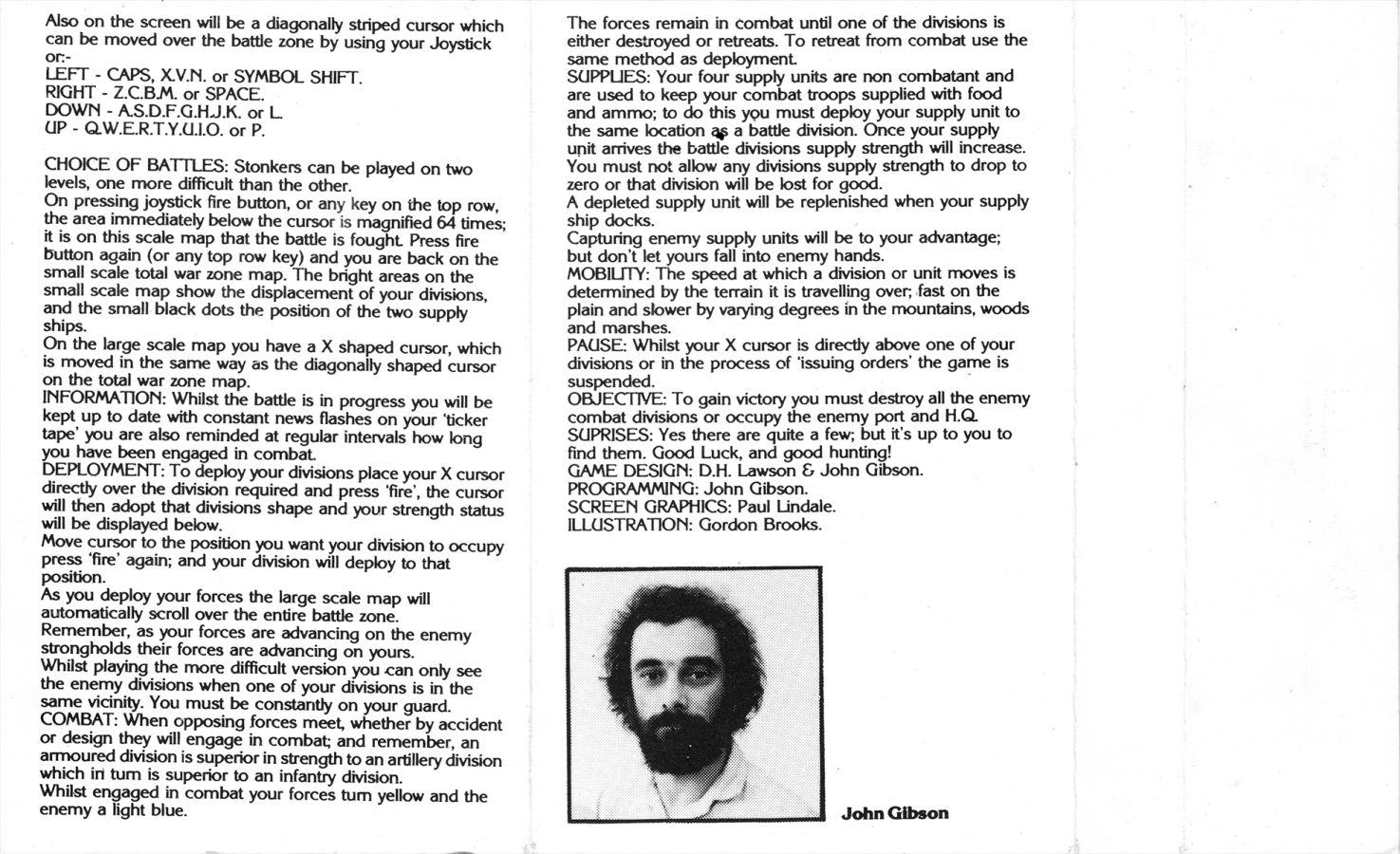
- Stonkers.txtInstructions English9 KB
- Stonkers(ABCSoft).zipScanned instructions Spanish1,926 KB
Other files
- Stonkers (1983)(Imagine Software).pokPOK pokes file 0 KB
Files and rights
No permission is on record either way. Screens and pictures are copied here on a take-down basis: if you hold the rights and want something removed, say so and it goes.
Credits
- John GibsonCode
- John GibsonGame Design/Concept
- David H. LawsonGame Design/Concept
- Paul LindaleIn-game Graphics
- Paul LindaleLoad Screen
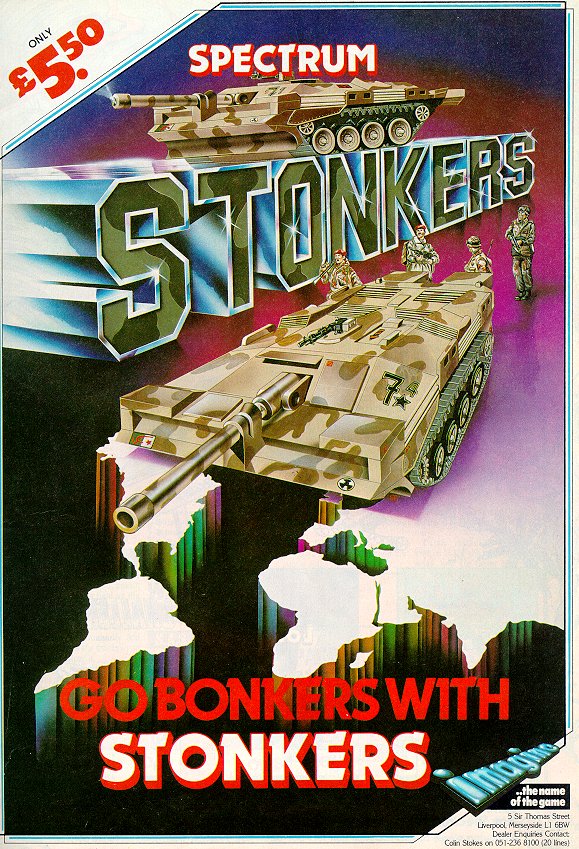
- Gordon BrooksInlay/Poster Art
Sign in to credit somebody, or say what these people did.
Scores
In the magazines
- Crash #21984 · Overall78%
- Big K #11984 · Overall3/3
- Sinclair User #271984 · Gilbert Factor9/10
- Sinclair User #321984 · Gilbert Factor9/10
- Personal Computer News #581984 · Overall Value5/5
- Sinclair User1985 · Gilbert Factor9/10
Elsewhere on the web
- WorldOfSpectrum 43 votes7.91
Awards and competitions
Crash Readers Awards 1984
- 1Best Wargame
In the magazines 55
Crash #28May 1986 · p.86
Sean Masterson
FRONTLINE With Sean Masterson READING BEHIND THE LINES - SOME STRATEGIC RETROSPECTION With the launch of the 128K Spectrum, several software houses have updated popular titles in order to take advantage of its extra memory. Sweevo's Whirled, a single load version of The Never Ending Story and a sonically improved Robin of the Wood were all mentioned in last month's Crash but strategy games manufacturers haven't made any moves as yet. With the absence of a standard fast storage device, the RAM disk facility provided by Sinclair's latest prodigy is just crying out to be taken advantage of by a good, solid wargame. A couple of issues ago, I mentioned that the author RT Smith was disappointed at having to gloss over some details in Desert Rats and last issue's FRONTLINE FORUM contained a letter from the author of Waterloo about omissions in his game. Both lay the blame on the lack of memory. Now their games can be freed of these constraints. Of course, the vast majority of Sinclair users will have standard Spectrums and to ignore these people would be foolish. But a good strategy game could be devised for the 128 that could come in multiple load format for the 48K machine. The would really be something to look forward to. Having hoped about the future, I'll now pine about the past. Good strategy games have been around on the Spectrum for longer than many people realise. Yes, longer even than Arnhem. CCS and Lothlorien are responsible for many of the pioneering titles, being the best established purveyors of such material, but others have made their mark. How many people remember the ill-fated Red Shift, for instance? Nobody? Never mind, it'll all come back to you when you start reading the next bit. The time has come to look back at some oldies, you see. There are two reasons for this. One is that it's All Quiet on the Strategy Front this month. The second is in no way connected with the fact that the spiky Mr Kidd threatened to impale me on his haircut unless I did something a different - and he wasn't too pleased about my suggestions for outlining Sean Masterson's Strip Diplomacy in these hallowed pages. So, here is the first part of a trip down memory minefield. 'Come up with a theme,' Graeme said. Well now, they're all old... They are all personal favourites as well, though some of them may no longer be in the shops. Shame on you if any of these are gathering dust on your shelf. They are all good for a few games yet. So here's Part One of a personal Strategy CRASHback. STONKERS Stonkers harkens back to the first Imagine incarnation and the daring days of software design. The game can be played either solitaire or with a second player. It's an abstract strategy game where each side controls an army consisting of four infantry divisions, four armoured divisions, four artillery divisions and four civilian supply units. Each side also controls its own port (essential for a constant flow of supplies) and HQ. A total war zone map is displayed in bright colours on the screen. A cursor can be placed over any part of this screen and can then magnify the area below to show details of terrain and units. Terrain includes hills, marshes and plains. Units can then be ordered or resupplied as necessary. The objective is to simply defeat your opponent and capture territory. Forces are initially on opposite sides of the map on areas of land separated by a bridged river. The bridge is the only means by which an army may move from one side of the map to the other. The reason why the game is so good lies in the deceptive simplicity of its playability. Terrain does affect movement, but only trial and error reveal how much. Logistics are fundamentally important to a successful game. The player must learn to pace the game, so that whilst an efficient advance is made into enemy territory, units do not risk running out of supplies too soon. This makes the game a test of both will and judgement and an ideal vehicle for beginners to play in order to realise the importance of different unit types in more complex games. Yet playing Stonkers is an easily learned and enjoyable affair in its own right. Stonkers is a remarkably straightforward game that never really had the credit it deserved. Reviewed back in CRASH No 2, the reviewers, none of whom were particularly enthusiastic wargamers, all found the game to be addictive and entertaining. One of the main problems encountered was a bug which crashed the game every so often. This bug was never really dealt with effectively but given time, it could have been rectified.
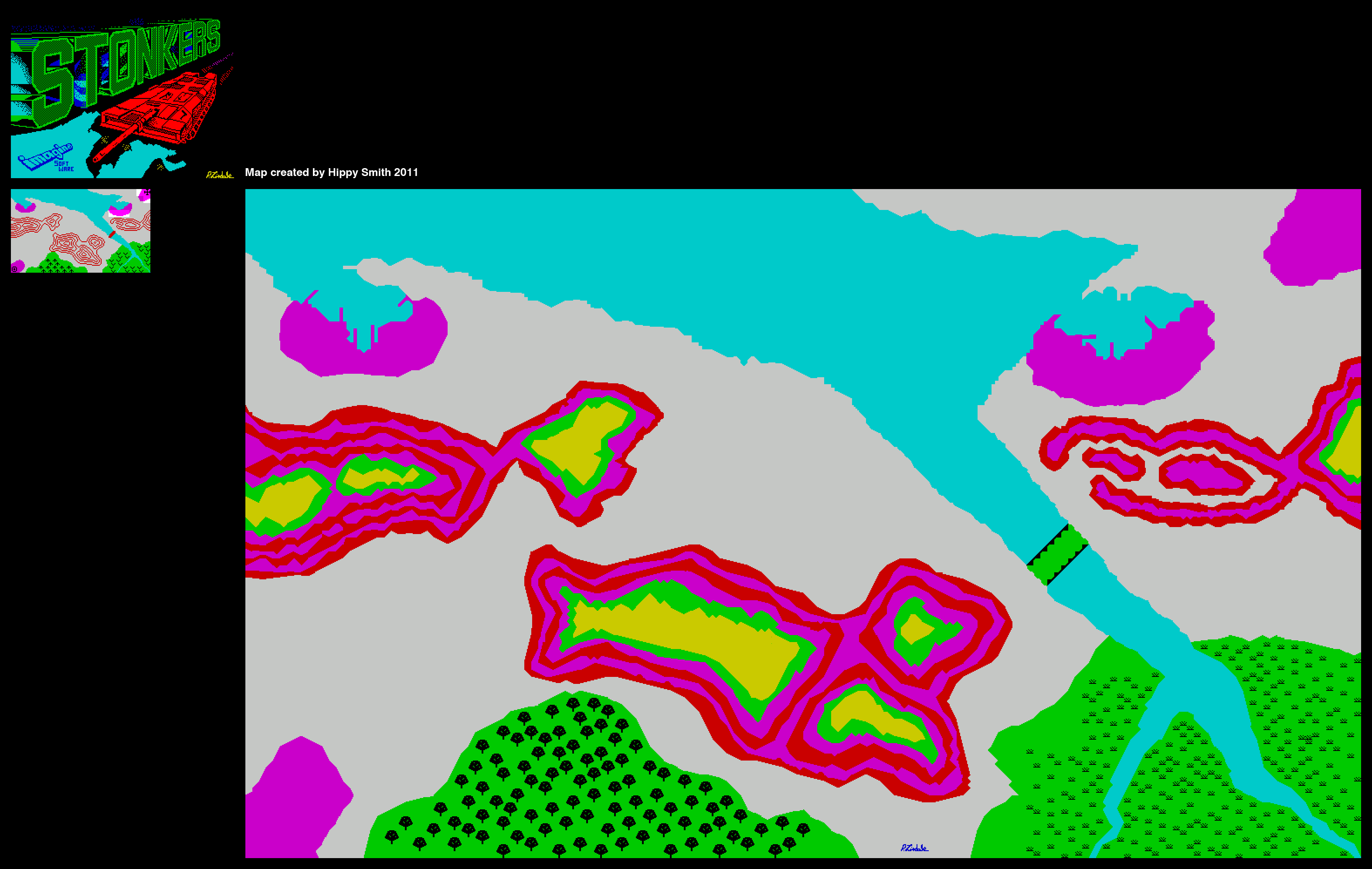
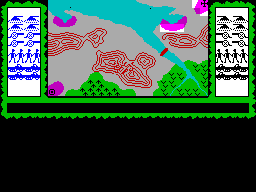
The strategic map from STONKERS. The whopping great hatched oblong isn't an enemy weapon. Press a key and the area below it expands before your very eyes.
Sinclair User1985 · p.509/109/10
Gilbert Factor 9/10
John Gilbert 9/10
SOFTWARE SCENE While some software houses are taking the Spectrum to its limits and beyond others doggedly continue to churn out ever more diabolical pieces of programmed junk. John Gilbert present a personal pick of the bunch, and Chris Bourne take an irreverent look at the dwindling ZX-81 software scene. Their talents are combinedd in listing the Top Ten Turkeys of 1984. Let the reader be warned. SPECTRUM SOFTWARE A cynic may argue that development within the software market in 1984 was non-existent. The same type of game appeared as those which took the lead in 1983, the most popular being of the arcade variety. The programs were written in the same style and to please the same type of customers. That is only a superficial view, however, and if you look at the games market as a whole, dividing it up into sectors such as strategy, arcade and adventure, you will see that substantial and sophisticated changes have taken place. Despite what some pundits have said you will find that the world of computer games is still buzzing with life. STONKERS £5.50 Imagine In Stonkers you are given command of land-based forces, including tanks and infantry, which are grouped in the top right-hand corner of the screen. The enemy is based across the river on the ether side of the screen and to reach a suitable combat position one or other side has to cross the bridge. When you Start to play, a map of the whole theatre of war is displayed. You can issue commands to active units on the map by positioning a cursor over the map position you require. One of two actions will occur. If you are on the big map you will zoom into a detailed display of the location specified. If you are already zoomed in you can position the cursor over a fighting unit and by moving the cursor to the position you want it to take up, it will start to move towards that locality.
Sinclair User #32Nov 1984 · p.469/10
Gilbert Factor 9/10
A state-of-the-art wargame in which you line up tanks and artillery to do battle with an enemy armoured in the same way. Stonkers is visually exciting as it has a map of the terrain together with the positions of each force. Certain keys allow you to zoom in on sections of the map. As well as fighting you must make sure that provisions, unloaded from a boat in the estuary, are sent out to the troop positions. The game also includes some complex artificial intelligence routines which enable the computer to become a formidable opponent. Position 44/50
Sinclair User #27Jun 1984 · p.629/109/10
Gilbert Factor 9/10
John Gilbert 9/10
THE PLOT THICKENS The frantic zap of arcade software has given way to calmer play and strategic thinking. John Gilbert investigates. TIME GATE Memory: 48K Price: £6.95 CODENAME MAT Memory: 48K Price: £6.95 STONKERS Memory: 48K Price: £3.95 HALLS OF THE THINGS Memory: 48K Price: £7.50 MAZIACS Memory: 48K Price: £6.95 The 'Zap-Em' type of arcade game, although still around, has undergone a transformation which started in earnest in the middle of last year. Games manufacturers with an eagle eye on the industry saw that the time would arrive when arcade games, such as Space Invaders and Centipede, would fade in popularity and that something had to be added to make them more appealing. The one aspect which games such as those already had was strategy. In games such as Space Invaders, strategy is needed to evade the aliens and at the same time fire at them. A good game will infer a strategy to the player and a good player is one who can assimilate that method of play quickly. Software houses decided that the most obvious way to increase interest in the arcade style of game was to emphasise the strategy aspect. That is done either by putting strategy games in an arcade format or by slowing the action to accommodate structured thought instead of quick-fire intuition. The move worked well and games like Time Gate, Stonkers and Codename Mat prove it. Time Gate reached the market shortly after the Spectrum arrived in great quantities and it is one of the first games for the machine produced by Quicksilva. The game centres on a conflict between the peoples of the free universe and the incredibly evil and ancient race of Squarm. At the launch Quicksilva promoted it as the ultimate sci-fi space adventure and, with its 3D representation of space through the window of a fighter and the depth of story deadline, it was at that time. The strategy of the game is centred on finding the aliens using the instrument panel of your spaceship and then destroying them. It was given added depth by spreading the Squarm through space and time so that the player has to lock-on to a particular sector in space and spacewarp there. In some ways Quicksilva produced a game which crosses Space Invaders with the mainframe computer game Star Trek. It was that aspect initially which drew customers who wanted something different and who were ever-willing to part with their money. Unfortunately, Time Gate is an example of how the software scene can change overnight. A few months after its release the game attracted much criticism and the Squarm have made many players squirm. At the release, about a year ago, Time Gate was described as incredible but since then players and critics alike found that it had limitations, not least of which was the plot. The storyline is too much like a revamped version of Star Trek. Time Gate is still available from Quicksilva and costs £6.95. Codename Mat, for the 48K Spectrum, is a new release from Micromega which could be described as an advanced version of Time Gate or an extremely good interpretation of the Atari Star Raiders. The strategy element in the arcade game is obvious, as you have to plot your way through the solar system, passing through star gates to spacewarp into another system. The solar system is broken into sectors which have a planet or satellite as bases. The planets are taken from our solar system and include Mars, Jupiter and Earth. Each of those planets is under attack from the Myons and it is your job, as a teenager with the knowledge of the universe, to stop them. There are two levels of play depending whether you want to use a lone ship or whether you want to be the commander of a task force. The latter is the most difficult as you can engage in several conflicts at the same time by using subspace radio, which seems to have an immediate effect on the sector you have selected. If all your ships in one sector are destroyed, the planet could be destroyed and you have lost part of the game. If you see the situation where you could lose ships in another sector you will need to use your cunning and skill to build a battle strategy. The arcade part of the game occupies about 50 percent of playing time and involves shooting through space and chasing the enemy fighters and motherships. It can only be described as classic arcade action combined with moments of strategic thinking to scan computer banks for information about the movement of hostile craft and about which planetary system are in danger. Codename Mat could almost be described as state-of-the-art in software and it is close to a simulation in space-game terms. One of the most notable aspects is that the routine to generate the 3D graphics is only 200 bytes long. The compactness of the graphics routines means that the author has been able to concentrate on developing the depth and storyline of the game and that is obvious from the start. Unfortunately, although the game is more advanced than Time Gate, the storyline is weak, as it seems to be a collection of unoriginal ideas. Luckily those ideas fuse together well and the plot stands on its own. Codename Mat can be obtained from Micromega and costs £6.95. Manufacturers and authors have not limited arcade strategy games to the depths of space. They have also done the opposite of giving arcade games touch of strategy and given strategy games on arcade feel. Stonkers, for the 48K Spectrum from Imagine, is a prime example of that type of game. The player is given command of land-based forces, including tanks and infantry, which are grouped in the top right-hand corner of the screen. The enemy is based across the river on the other side of the screen and to reach a suitable combat position one or other side has to cross the bridge. When you start to play, a map of the whole theater of war is displayed. You can issue commands to active units on the map by positioning a cursor over the map position you require. One of two actions will occur. If you are on the big map you will zoom in to a detailed display of the location specified. If you are already zoomed in you can position the cursor over a fighting unit and by moving the cursor to the position you want it to take up, it will start to move towards that locality. The use of a cursor to plot strategy is inventive and imagine has put much effort into the game. It should take weeks for a player to work out a plan of strategy to defeat the foe, mainly because of the immense landscape on which play takes place. The game is a cross between the usual type of battle strategy game such as Apocalypse from Red Shift and the arcade game Battlezone. Imagine has succeeded in producing a game which combines arcade quality graphics and strategic action. Stonkers can be obtained from imagine for £3.95. Maze games, such as Pac-man, have not escaped the eye of software houses keen to think of new plots. The munch-munch of the Pac-Man has been replaced by ponderings, such as 'Where is the treasure?' of the hero or heroine. That type of game is well-illustrated with such programs as Ant Attack, from Quicksilva, Maziacs from dk'Tronics and the irrepressible Halls of the Things from Crystal Computing, which still seems to be out-selling everything on the market. Halls of the Things, in which the player has to collect a certain number of rings of power in a maze before being destroyed by the monsters, started a craze for the so called all-graphics adventures in which cartoon-style arcade graphics were combined with adventure plots. Most of those games take place in dungeons and feature magic and sword play. Several companies have followed the excellent crystal game, although unlike the state of play with arcade games nobody has copied original Crystal ideas as the area is so rich in concept material. Halls of the Things can be obtained from Crystal Computing and costs £7.50. Maziacs, for the 48K Spectrum, is from dk'Tronics and is another example of the genre. It has a different graphics style from Halls of the Things which some would say is bolder and better and is more in line with the graphics which Ultimate Play the Game produces. The plot involves finding a treasure chest in a maze which you must drag back home without being killed by the Maziacs, which can get into terrible sword fights with your player-character. To find the way to the treasure you have to make contact with the prisoners who are strung along the corridors of the maze. The fight sequences are incredibly detailed. You will again need to develop a strategy over a period of time to win. Maziacs can be obtained from dk'Tronics and costs £6.95. To succeed, arcade-strategy games must produce an effect for the player like that produced by an ordinary zap'em game. It is the way the addiction is created which makes the difference. In an ordinary arcade game the effect is created through a need to destroy aliens and make a high score. Arcade-strategy games are different, as they rely on the user's mind. It is the strategy as well as the graphics which keeps the player returning for more. The combination of arcade techniques and strategic thinking has made the arcade-strategy game very popular. The insurgence of that type of program means that the customer has two types of game in one and the reality of the plot, through the realism of the arcade graphics, takes the games industry one step forward. The main criticism for a long time is liable to be that the plots on which the games hang are not original enough. We are, however, just beginning to see a change in arcade style, where bang and zap are replaced by plot and thought.
'Time Gate is an example of how the software scene has changed overnight. A few months after its release the game attracted criticism.'
adventures' 'Halls of the Things started the craze for all-graphic.'
Big K #2May 1984 · p.73
General Sir Jeremy Moore
BIG K CALLS IN THE EXPERTS... General Sir Jeremy Moore, Falklands victor, reviews some electronic kriegspiels... Technically successful transference of the large-format strategic wargame onto one-half of a Spectrum screen. Relatively shallow in content, it nonetheless is visually excellent (for a Spectrum) offering a genuine zoom facility. Scrolling is also available and operationally smooth. General Moore dabbled politely but the game title itself, which for some reason keeps reappearing via sort of ticker-tape device, made him visibly restless. He though his son might enjoy Stonkers. "You say this is a smaller and cheaper computer? Well I'm sure it's very creditable bit it's not really in the same class as the others you've shown me (The line YOU'VE BEEN STONKING FOR 8 MINUTES... comes up on the ticker-tape.) What's the origin of this word Stonkers? I don't like it very much, I don't think this would hold my attention for long enough though I'm sure my son would like it."
Major-General Sir Jeremy Moore, OBE, MC and Bar, was the Royal Marines amphibious and winter warfare specialist chosen to command the UK Land Forces in the 1982 campaign to retake the Falkland Islands from Argentina. That campaign was hailed as a brilliant and humanitarian use of force in pursuit of a legitimate political objective, and General Moore himself was widely seen as one of its major architects - though, as he is the first to point out, he was assisted in the repossession of the Falkland Islands "by about ten thousand other people", the squaddies and sailors for whom he clearly has the most enormous respect. It was therefore with some understandable hesitation that we approached him with the idea of asking him to visit BIG K's offices and play - and then review - a few representative computer war games. To our delight he readily agreed, and as a result spent a February afternoon and evening taking on - and trashing, let it be said - the state of the kriegspiel art (so far). The games we chose to show him were Legionaire (Avalon Hill); Stonkers (Imagine); Eastern Front (Atari), and Battle of Normandy (Strategic Simulations): one ROM, two cassettes, and a disc. (We were also planning to show Computer War and Confrontation, but the former went astray in the post and the latter, by Lothlorien, unfortunately failed to load, despite having run perfectly the previous night. Alas. etc.) General Moore tore into each game with a vigour that - we suspect - was not wholly martial. (We think he enjoyed himself.) You can read his comments on each game, as well as one or two other related matters, elsewhere on these pages.
ON COMPUTER WAR GAMES "As far as serious study goes, it seems to me that some computer games would be very useful to the professional who's got a technical - indeed, a computer - battle to fight. He can get a lot of value - say, in deciding how his missiles will perform against an opponent's - by reconstructing the combat on computer. You can also usefully use computers to calculate logistics and supply. But the moment you start dealing with people... there is no way a computer can represent a person."
ON THE ETHICS OF IT ALL "I'm certainty not in favour of glamorising war, because the last thing war is is glamorous. It's sordid and unpleasant. And any game that didn't base itself round the premise that war is both morally wrong and generally undesirable would itself be wrong. Nevertheless, wars do occasionally have to be fought from time to time. "I don't think any sort of game makes war respectable. As long as it is seen as a game."
Micro Adventurer #7May 1984 · p.21
Tony Bridge
A CHALLENGE TO FOIL ENEMY MICRO: Spectrum 48K PRICE: £5.50 FORMAT: Cassette SUPPLIER: Imagine, [redacted] Can't you just picture the scene at a certain office in Liverpool, some months ago? "What shall we call this program of John's? It's about some troops making a dash across the countryside in an attempt to capture the enemy's port and headquarters. H h how about Zipacross? No-o-o, I suppose not. I know Z-Z-yomp! Still missing something, isn't it? P-S-S-tomp?" We know it now as Stonkers, which is as daft a name as the others that Imagine dream up. However, the game is as good as they usually produce. The two protagonists face each other across a river - a small-scale map is presented to the player at the start, showing the river, which opens out to the sea in the north-west corner. This map takes up the top two-thirds of the screen, with a message area beneath. On either side of the map is a status board, showing the current strength of the computer and the player in combat and supply units. The enemy port is to the left of the map, with the human player's port to the right, about mid-screen. His headquarters are in the top right of the screen, with the enemy's diagonally opposite in bottom left. In between are a couple of mountain ranges, and the all-important river, with (as in all good war simulations) just one bridge. The rather simplistic aim for the player is to capture both the headquarters and the port of the enemy. To move your man, imagine have come up with a stunningly simple device: a large cursor which may be moved (under keyboard or joystick direction) over the unit you wish to move. The area covered by the cursor may be magnified. On this large-scale portion of the map is a small cross-hair. Move this to one of the units represented by a little man (infantry), a gun (artillery), tanks (the armoured divisions) and trucks (supply units), and information on that unit is given. Strength, morale and supply levels are detailed, and these parameters will determine how you use that unit. If you wish to move it, pick it up by pressing the appropriate key, or the joystick fire button, and move the cross-hair to where you wish the unit to end up. Pressing the key or button again at the destination point will start the unit moving towards that point. Now you can go off and look at another unit, while the previous one is moving. Each unit has a certain range, though, and this, together with the varying terrain, affects the movement of the units. During the deployment and the combat stages, each of your units must be kept properly supplied. This is achieved by ensuring that one of the four supply units is moved adjacent to the fighting unit you wish to "top up". Every so often a ship docks at your port, and vital supplies are channeled through the trucks, which are then spirited back to port to await orders. After a certain amount of time (no, I won't tell you how long), the enemy units, having lulled the player into a sense of security, start to move. You elect to see them or let yourself in for a surprise. When two opposing units meet, battle is joined and the victor is decided (I think) by comparing morale, strength and level of supply of each unit. The defeated unit is simply removed from the game. There aren't really any more rules to Stonkers. The few that are included on the inlay should be read thoroughly. In one game I sacrificed all my units, but one, and made my objective of the enemy's headquarters wondering why the victory message hadn't appeared. I read the rules again, and of course, found that I should also have occupied the port. I found it hard to be in two places with one unit, and had to admit defeat. There are some tactics that you will have to pick up as you play (even Monty didn't know all there was to know about the enemy). Stonkers is a fairly simple sort of game; an ideal introduction to computer war-gaming. It is to the great Eastern Front as Kriegspeil, for example, is to one of the huge Avalon Hill tournament board games; an ideal introduction. It may be simple but because of that, capable of becoming an exceedingly interesting way of spending the odd bit of spare time. This is one of the advantages of Stonkers. A game should only last 15 or 20 minutes, so boredom won't set in. There are no large tomes of rules to sift through, no quick reference cards to get dog-eared and lost. Colour is implemented well, and ticker-tape messages, written in a nice "World War II battered armour" script, chatter across mid-screen, informing the player of units in need of supply, units lost in combat and the amount of time the player has been "stonking". The map is well-drawn, with contours, woods and marshes apparently the map, in the design stage, covered more than 9,000 postcards, or something. It would be nice to think that Imagine could supply update modules, like Red Shift's, so that other campaigns could be fought, but the work is obviously daunting. There is a hint, however, that the same map may be used in the future with different scenarios which would be loaded into the master program (Mangle the Centurion or Nuke the Pike-Bearers, can't wait). All in all, a great little program, and great value at the usual imagine price of £5.50. Oh, the gnashing and wailing when that figure has to be increased in the future. "Good report, Carruthers. Now I have a rather, ahem, sensitive job for you. We need someone to infiltrate this Imagine place and come back with the vital information; what Stonkers means. Good show, cut along now, old boy. Oh, and Carruthers, don't come back!"
Personal Computer News #58Apr 1984 · p.365/55/55/55/5
Lasting Appeal 5/5
Playability 5/5
Use Of The Machine 5/5
Overall Value 5/5
Barry Miles
Bob Chappell
Geof Wheelwight
John Lettice
Kevin Bergin
Russel Jones
Simon Williams
Tony Harrington
PCN MICROPAEDIA VOL 21 PART 1 GAMES COMPENDIUM Atari Arcade Action BBC Blast-off Commodore 64 Cavalcade Spectrum Spectacular Dragon Digressions Welcome to gameplayers' heaven. This week sees the beginning of our two part Micropaedia devoted exclusively to games reviews. We have collected together a large selection of arcade, adventure and educational games for six of the most popular micros: the BBC B, Electron, Sinclair Spectrum, Dragon, Commodore 64 and Atari. NAME: Stonkers SYSTEM: 48K Spectrum PRICE: £5.50 PUBLISHER: Imagine, [redacted] FORMAT: Cassette LANGUAGE: Machine code OTHER VERSIONS: None OUTLETS: Mail order/most dealers Stonkers is the war strategy game, streets ahead of anything else available. It may take as long to load as the Americans took to come into World War II, but it's worth the wait. You have a port and HQ to defend while trying to attack the enemy's, and as you both start with equal numbers of divisions it's strategy that decides the outcome. There are two levels of play - in the more difficult one you don't see the enemy till it's in the vicinity of one of your own units. The action occurs at the edge of two land masses, joined by a bridge, the terrain being hilly and partially wooded. Initially you see a large scale map of the area, on which is a diagonally striped cursor. By pressing the fire-button, or appropriate key, the area under the cursor is immediately magnified 64 times and the screen switches instantly to the more detailed map. On the smaller map the cursor becomes a cross, and you can move this to scroll the map in any direction. Placing the cursor over one of the unit symbols prints its details underneath, and, provided it is not already in motion, allows you to move it. Units don't move instantly, but follow the path you take with the cursor, and will stop at the place where you next press the fire-button, or when they reach the limit of their travel for that move. Their speed is governed by the terrain. You must keep supply trucks moving to back up your forces, and take care that your cursor doesn't stray into a patch of water. Units engage in combat when they confront each other, by chance or choice, and an armoured division will always beat an artillery division, which will always beat an infantry division, though the result of a match between the same divisions depends on their fatigue through travel, back-up and so on. You can always take the coward's way out and retreat. There are also regular ticker-tape bulletins across the screen, telling you when supplies are needed, when ships or enemy divisions are moving etc. The graphics are good without being particularly spectacular, but the speed with which you can move around and switch maps, to see your mobilised forces moving across the landscape, is very impressive, and the whole game is presented with style.
Big K #1Apr 1984 · p.303/33/3
Overall 3/3
Tony Tyler 3/3
MAKER: Imagine Software MACHINE: Spectrum 48 FORMAT: cassette PRICE: £6.95 Stonkers is quite simply one of the very best general's-eye-view battle simulations around - certainly there's nothing in my knowledge to touch it for the Spectrum. Designer/programmer John Gibson has developed the available memory artfully, preferring to sacrifice some screen area for the sake of high - if miniaturised - resolution on the remainder and what must be enormous amounts of data handling. The result - complete with panic-making tickertape "intelligence reports" which only serve to fluster you - is a fast-moving, multi-screen strategic war scenario. Your overall map is of a corner of the world vaguely Middle Eastern in profile. You move a cursor to the part you want to zoom on, touch a key and there you are - the zone in close-up, complete with military units (yours and your enemy's) and full topography. This smaller area will scroll if you push with the cursor; using this facility you "deploy" (i.e. pick up and direct) troops. And - the nub of the opening strategy - each group of units must have their own supply train; or you start getting piteous bleats by way of tickertape. Eventually units peter out altogether for lack of... what can be in those trucks? Then comes the combat. Much of this game reminds me of the programming style of American designer Chris Crawford, now with Atari, who wrote Legionnaire (Avalon Hill) using many of the same quiverful of programming "licks"; automatic deployment, for instance, with units boldly plodding whence they're bidden. The smoothness and reliability of the action and the urbane tricks to delight the eye (the tickertape is great), all testify to a wholly professional piece of work. Kriegspielers will love it.
Crash #2Mar 1984 · p.10290%70%70%58%90%87%78%
Use of Computer 90%
Graphics 70%
Playability 70%
Getting Started 58%
Addictive Qualities 90%
Value For Money 87%
Overall 78%
Unknown
Unknown
Unknown
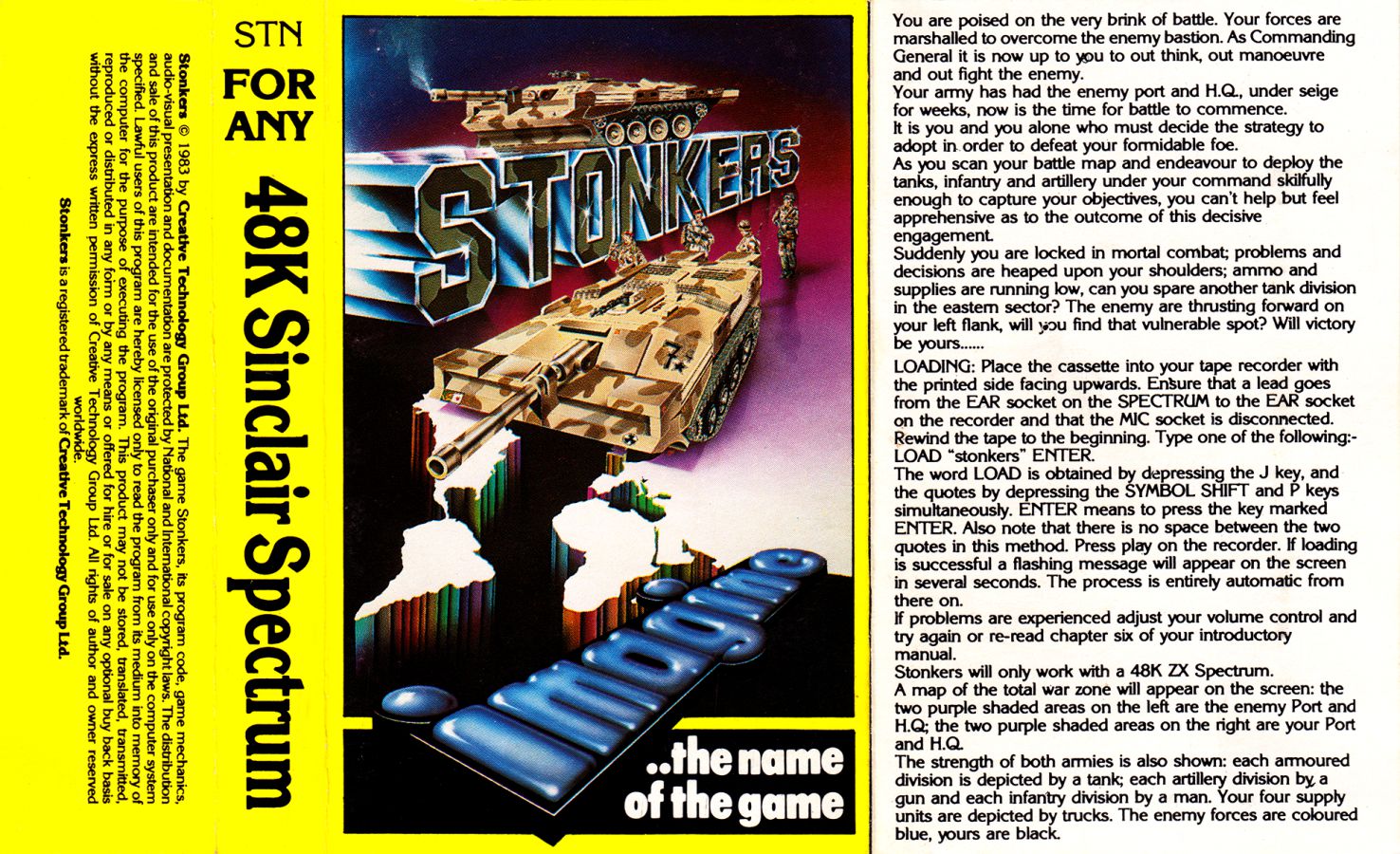
Producer: Imagine Memory Required: 48K Retail Price: £5.50 Language: Machine code Author: John Gibson In an unusually terse and to the point scenario introduction, Imagine Inform you that you are poised on the very brink of battle - the enemy have had their port and HQ under siege for weeks, and now is the eve of the battle. As commander of your forces, you must out-think, out-manoeuvre and out-fight your foe. Stonkers is a graphical strategy and tactics game between the player and the computer. Unlike many popular war games already available, in Stonkers you are not expected to spend ages setting up the scenario, distributing weapons and moving your forces unit by unit. Both of you and the enemy already have tanks, artillery and infantry positioned round the countryside, and the enemy's forces are on the move as soon as the game commences. In fact, this turns out to be a very fast moving game of an almost arcade nature. The war zone is large, and is shown on screen in two ways; a large map which shows total playing area - two chunks of land, divided by a river estuary and connected by a bridge; and a large scale map, which shows a big close up with graphical details of the various units. On this map, when a unit is being deployed, you can see it moving, its speed depends on the terrain which is also shown as contours. On the total map a cross-hatched cursor block, indicating the area of the large scale map, can be rapidly moved by directional keys. Pressing the fire key switches maps. On the close up map a X cursor is moved with directional keys, and if positioned directly above a unit, will cause it to start moving towards the coast when the fire key is pressed. Below the display area, a ticker tape keeps you informed as to what's going on and how you have been Stonking. Keeping up the strengths of your forces is done by moving supplies from your port (when the supply ship has docked) to where they are needed using your 4 supply units. If a unit fails to receive supplies in time it will be lost for good. The game moves at a fast pace and holds a number of undisclosed surprises. COMMENTS Control keys: CAPS, X, V, N left; Z, C, B, M right; 2nd row = up, 3rd row = down, top row = fire Joystick: Protek, AGF, Fuller, Sinclair, Kempston Keyboard play: responsive and fast Colour very good, lots of it Graphics: very good Sound: not much, but what is used is high quality Skill levels: 2 Screens: 2, with smooth scrolling
Stonking along with Imagine.
C&VG (Computer & Video Games) #28Feb 1984 · p.328/109/108/105/10
Getting Started 8/10
Graphics 9/10
Value 8/10
Playability 5/10
WAYS TO WIN THE WAR! Golly, chaps. Spitting game, what? These Imagine chappies have really got it right this time. Yes, it's the latest release from Imagine. In one giant leap for a software house, Eugene and Co. have released a war-type strategy game but have kept those pretty arcade type graphics. Those graphics are, in fact, well designed. But I don't think they really live up to Imagine's claim that they are as much as is technically possible on the machine. For my money I prefer Ultimate. Whoops, sorry! Anyway, chaps, this is a war strategy game. There are no fast moving meanies to zap: instead you have to move your tanks and cannons to clever positions and make sure that you are near enough to the supply ship to get some cargo when it unloads. If all this sounds very vague and I seem to give the impression that I couldn't get in to the game very far, then you're right. The whole idea is pretty complicated and I actually spent the best part of a whole day studying the instructions in front of a Spectrum. For all my gallant efforts, I succeeded in drowning my entire regiment in the sea. When opposing forces meet, whether by clever deployment or by accident, they will engage in combat. There's a predetermined hierarchy of which battalions are more powerful than others. Your forces will change colour if they're engaged in combat, During play, the screen shows the playing area on a small scale. There's a 2-character wide cursor which you can move to any point and then expand that 2-character piece to fill the whole screen. It's really quite impressive. Anything which happens to be moving will do so whether you happen to be there watching or not. The object is to destroy the enemy positions and to occupy their HQ. But I feel that this is going to take someone a long time. If you're the sort of person who likes to be able to get straight into a game once it's loaded, then this is not for you. However, if you're fed up with zapping everything in sight from Space Invaders to Mutant Telephones and man-eating toilets then this will be good value. Stonkers is from Imagine and runs on a 48K Spectrum. It costs £5.50.
Advert16
- Personal Computer Games #9Aug 1984 · p.48
- Personal Computer Games #8Jul 1984 · p.16
- Personal Computer News #65Jun 1984 · p.30
- Sinclair User #25Apr 1984 · p.36
- Your Computer #4Apr 1984 · p.97
- Crash #3Apr 1984 · p.19
- C&VG (Computer & Video Games) #30Apr 1984 · p.74
- C&VG (Computer & Video Games) #29Mar 1984 · p.48
- Sinclair User #24Mar 1984 · p.83
- Sinclair User #24Mar 1984 · p.85
- Your Computer #3Mar 1984 · p.150
- Your Computer #3Mar 1984 · p.222
- C&VG (Computer & Video Games) #29Mar 1984 · p.64
- C&VG (Computer & Video Games) #28Feb 1984 · p.52
- Your Computer #2Feb 1984 · p.60
- Sinclair User #23Feb 1984 · p.66
Feature7
- Crash #28May 1986 · p.86
- Crash #12Jan 1985 · p.100
- Sinclair User1985 · p.46
- Sinclair User #27Jun 1984 · p.62
- Big K #2May 1984 · p.72
- Computer Answers #15Apr 1984 · p.23
- Your Computer #3Mar 1984 · p.70
News/Note6
- Crash #4May 1984 · p.43
- Personal Computer Games #5Apr 1984 · p.27
- C&VG (Computer & Video Games) #30Apr 1984 · p.132
- ZX Computing #12Apr 1984 · p.118
- Home Computing Weekly #48Feb 1984 · p.6
- C&VG (Computer & Video Games) #27Jan 1984 · p.12
Full-page ad5
- Crash #2Mar 1984 · p.105
- Home Computing Weekly #50Feb 1984 · p.7
- Sinclair User #22Jan 1984 · p.136
- Your Computer #1Jan 1984 · p.205
- C&VG (Computer & Video Games) #27Jan 1984 · p.35
Tips4
- Your Sinclair #26Feb 1988 · p.63
- Your Sinclair #23Nov 1987 · p.95
- Crash #12Jan 1985 · p.143
- Crash #10Nov 1984 · p.77
Letters3
- Micro Adventurer #9Jul 1984 · p.4
- Home Computing Weekly #58Apr 1984 · p.16
- C&VG (Computer & Video Games) #30Apr 1984 · p.7
Review2
- Computer ChoiceApr 1984 · p.15
- Home Computing Weekly #50Feb 1984 · p.30
Information1
- SSD-IISep 1999
Offer1
- C&VG (Computer & Video Games) #27Jan 1984 · p.51
Related
Reviews from people here
Sign in to write about this, or make an account. It takes a minute and lets you correct the catalogue too.
Everything ZXDB can hold about this is here.
Sign in to correct or add to this.
Hold the rights to this and want it taken down?