
3D Strategy
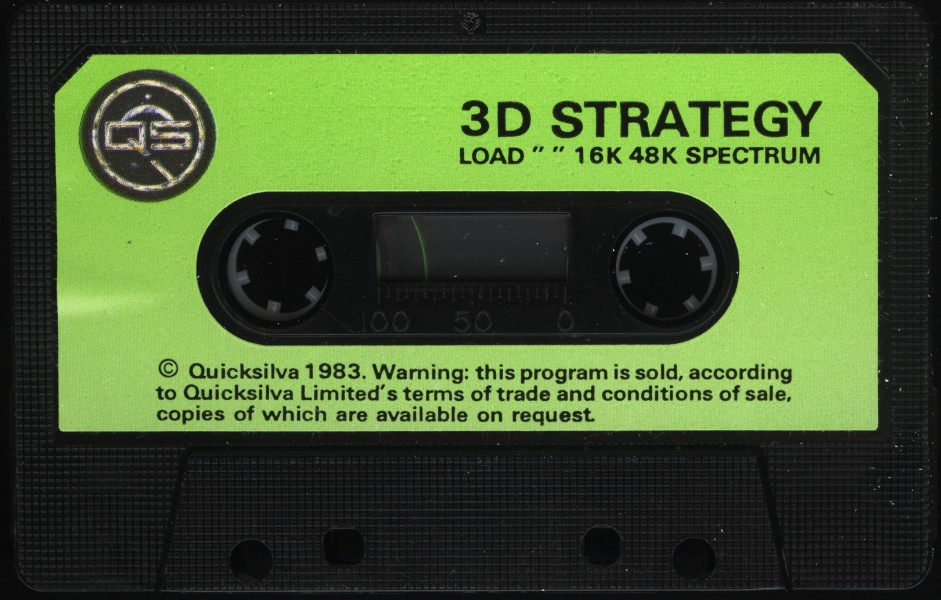
Game: Board · ZX-Spectrum 16K · 1 players · English
Quicksilva Ltd · 1983 · Pound sterling 6.95
Discussion
Nobody has started a thread about this yet.
Play
- Strategy3D.tzx.zipTape image English9 KB
- Strategy3D.tap.zipTape image English10 KB
Documents
- Strategy3D.txtInstructions English2 KB
Files and rights
No permission is on record either way. Screens and pictures are copied here on a take-down basis: if you hold the rights and want something removed, say so and it goes.
Credits
- Freddy A. Vachhacredited
Sign in to credit somebody, or say what these people did.
Scores
In the magazines
- Personal Computer Games #31984 · Overall4/10
- Sinclair User #241984 · Gilbert Factor8/10
- Sinclair User1985 · Gilbert Factor8/10
Elsewhere on the web
- WorldOfSpectrum 6 votes7.00
In the magazines 33
Sinclair User1985 · p.498/108/10
Gilbert Factor 8/10
John Gilbert 8/10
SOFTWARE SCENE While some software houses are taking the Spectrum to its limits and beyond others doggedly continue to churn out ever more diabolical pieces of programmed junk. John Gilbert present a personal pick of the bunch, and Chris Bourne take an irreverent look at the dwindling ZX-81 software scene. Their talents are combinedd in listing the Top Ten Turkeys of 1984. Let the reader be warned. SPECTRUM SOFTWARE A cynic may argue that development within the software market in 1984 was non-existent. The same type of game appeared as those which took the lead in 1983, the most popular being of the arcade variety. The programs were written in the same style and to please the same type of customers. That is only a superficial view, however, and if you look at the games market as a whole, dividing it up into sectors such as strategy, arcade and adventure, you will see that substantial and sophisticated changes have taken place. Despite what some pundits have said you will find that the world of computer games is still buzzing with life. 3D STRATEGY £6.95 Quicksilva 3D Strategy is played in a three-dimensional cube but, apart from that complication, is not much different from noughts and crosses, although that one difference is a big one. The computer will play two types of game with you. The tactical play will make the computer move in a risky and decisive way with a good chance for the calm human player. The positional play option will make the computer move in a considered way. That means the human player can tailor the game to any style of play. To make the competition even tougher you can put a time option, for minutes or seconds, into effect. It operates in a similar way to blitz chess, where the player and computer must complete a game before time expires.
Sinclair User #24Mar 1984 · p.148/10
Gilbert Factor 8/10
Memory: 16K Price: £6.95 Noughts and Crosses can be a deadly dull pastime especially when played against a computer. The concept can be turned into an interesting game when a three-dimensional aspect is incorporated into the computer. That type of thinking has gone into 3D Strategy. The game is played in a three-dimensional cube but, apart from that complication, is not much different from the original concept although that one difference is a big one. The computer will play two types of game with you. The tactical play will make the computer move in a risky and decisive way with a good chance for the calm human player. The positional play option will make the computer move in a considered way. That means the human player can tailor the game to any style of play. To make the competition even tougher you can put a time option, for minutes or seconds, into effect. It operates in a similar way to blitz chess, where the player and computer must complete a game before time expires. 3D Strategy can be obtained from Quicksilva.
Personal Computer Games #3Feb 1984 · p.575/102/108/107/103/104/104/10
Graphics 5/10
Sound 2/10
Ease Of Use 8/10
Originality 7/10
Lasting Interest 3/10
Overall 4/10
Steve Mann 4/10
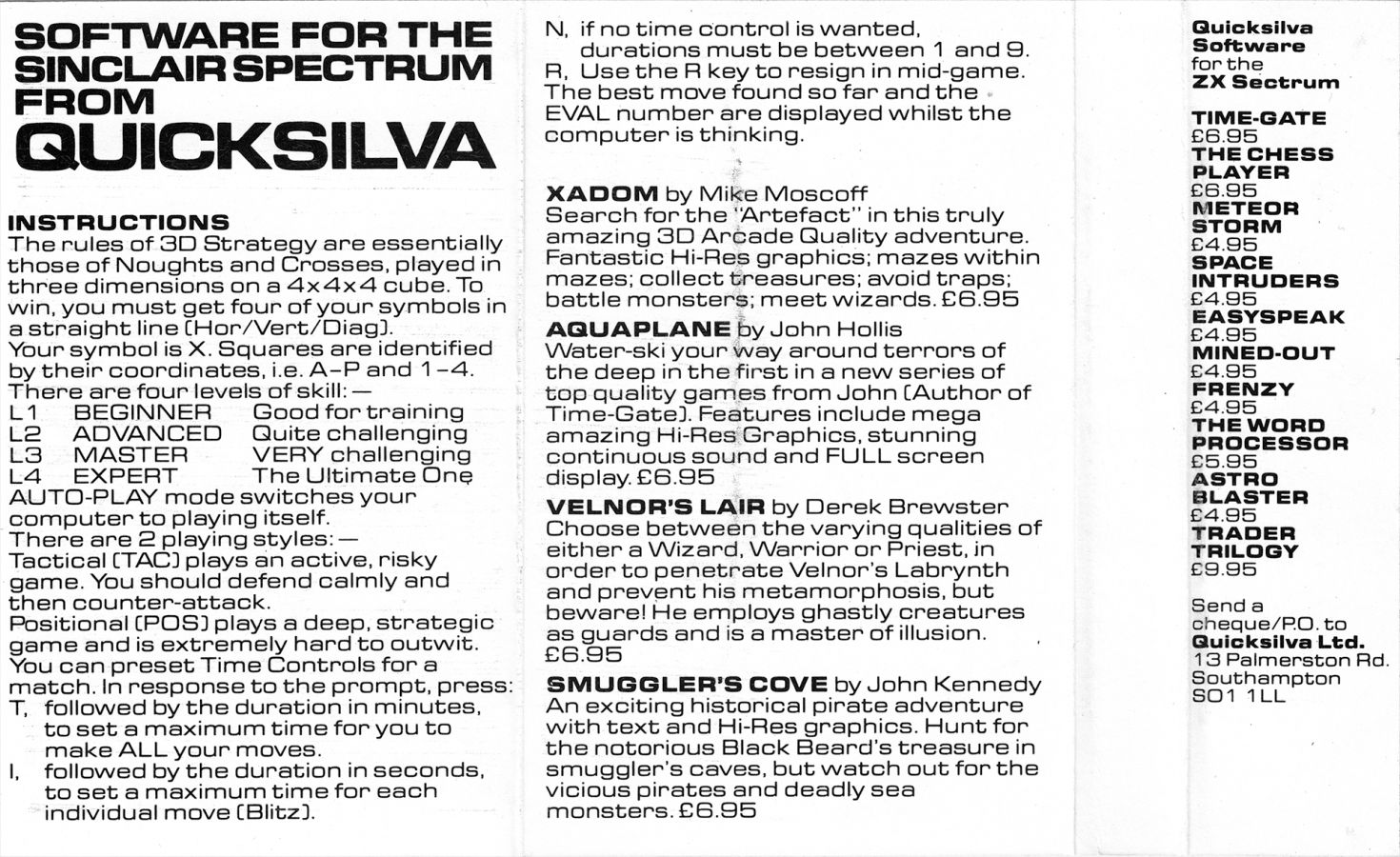
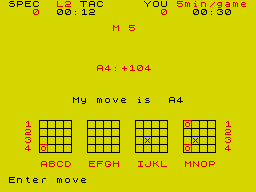
MACHINE: Spectrum 16/48K JOYSTICK: No CATEGORY: Strategy SUPPLIER: Quicksilva PRICE: £6.95 Described as 'a multi-dimensional mind game', 3D Strategy is really noughts and crosses, but noughts and crosses played on a 4 x 4 x 4 grid, with a line of four instead of three needed to win. The instructions do their best to make you feel that, as a mere human, you have absolutely no chance of winning, and, indeed, I found it almost impossible to concentrate on all the possible moves. It's easy enough to spot the winning lines on one level, but diagonal lines across four levels are another matter! The board is displayed as four separate 4 x 4 matrices, and player and computer take it in turns to place a piece. There are two possible styles of play - TAC plays an active, risky game, while POS gives a deep strategic style. There are two on-screen time clocks, chess-style, and time limits may be set for each individual move or for the game as a whole. There are four skill levels, and an auto-play mode, in which you can watch the computer play itself. The 'best move so far' is displayed at all times, and there is a 'RESIGN' key for when the going gets too tough and your ego will not stand to see the computer demolish you. Instructions are good, the screen layout is clear enough, and response times are very fast. Not particularly original, but well implemented.
Your Spectrum #1Jan 1984 · p.50
Ron Smith
SPECTRUM SOFT Ron Smith takes a slightly jaundiced look at all that's latest and greatest in games and leisure software for the Spectrum. Ever since the time home computing became big business, software producers have been writhing away in ever greater paroxisms of effort in their attempts to evolve games that are innovative, compulsive and exciting. Child geniuses have been dragged out of suburban housing estates and brutally hounded into the 20th Century equivalent of sweeping chimneys - all in pursuit of the computer game fast buck. The first waves to appear were, predictably, blatant copies of the great old arcade favourites - destroy the invading aliens, and probably your own brain cells in the process. This, of course, requires a keen eye and grand prix reactions. But for those without souped-up senses, the result is usually one of boredom and frustration. Fortunately, for those like me who would get more fun out of destroying the tape cassette than the alien invaders, other more pleasurable varieties of computer game are increasingly coming to hand. This issue we take a random stroll through a cross-section of all that's new and fantastic (it says in the press release) starting with... THEY CAME FROM OUTER SPACE The first title to fall into this category is Galactic Abductor from Anirog Software. It's not too hard to handle, and even I managed to put together a reasonable score while attempting to stem the relentless attack of invading armoured space hawks. I particularly like the fact that only three keys are used, so you don't have to keep glancing down to see where your fingers are. Unfortunately, one can't say the same for Missile Defence, also from Anirog. This uses no fewer than seven keys, four of which are the cursor control keys - which in my experience are the worst possible choice. Positioned as they arc (it's rather like the old chestnut of rubbing your stomach and patting your head at the same time) everything gets out of sync and the game's over before you can shout "Nukes away". However, after a good deal of practice (assuming you have the patience) the poor old aliens who've come to attack your cities gradually begin finding themselves in a weaker and weaker position as your skill increases. No fewer than three fire buttons are provided to wipe out the monster meanies, before they either destroy you or disappear off the edge of the screen. It's all familiar stuff. The last game doesn't fit in this section at all - but never mind. It comes from Timescape and is entitled Wild West Hero. Predictably, the hero's job is to rid the West of the gun-totin' bandits and this, with your help, he tries to do by hurtling around the screen blasting out in all directions as the gruesome gang closes in. Control, on the pre-production version, is via the keyboard, and uses four keys (two fingers per hand being the maximum for a reasonable response for most of us) - theoretically making for an easy-to-play game. However, the combatants are nothing if not fast moving - even though Timescape has already slowed down this (version 3) over the previous (version 2). Consequently, with bullets flying thicker than a hail storm and goodie and baddies moving at lunatic pace, this little number is certainly not one for those of slow or nervous disposition; even a rapidly plugged-in joystick did little to help me catch up with the action. For the record, by the way, the first two games mentioned were also joystick compatible. GRAPHIC ADVENTURES 'Ask a silly question, get a silly answer' - is a maxim that might well be seen as the basis for most adventure games with their thin plots, limited vocabulary and text-only approach. Interestingly though, the latest releases are beginning to move away from this. Two of the better new titles are Xadom and Smugglers Cove, both from Quicksilva. Xadom is a 3D hi-res arcade quality adventure where you, as SOL agent MM have to disappear off in search of some artefact that is stashed away in one of 20 rooms. Every time a room is entered, naturally, a new challenge awaits and each must be overcome before it is possible to move on to the next room. Differing slightly, and more like a traditional adventure, is Smugglers Cove. This offers text with the delights of hi-res graphics, while you visit 27 locations, somehow or other picking up 65 objects along the way (without so much as a sack). One point here is the game's lightning response to your directions, something which many previous adventure game incarnations have been less than famous for. Both of these are well worth a spin. CRL's Woods of Winter, however, is a new release that still suffers the perils of being text-only. It also has a slow response time - so much so that on several occasions I was left scratching myself and deliberating the state of the universe before - eventually - the program decided it was good manners to respond. To be fair, it does plot your progress (should you make any) through the cold woods of winter, which presumably can be quite useful at times. Should you ever manage to come in from the cold, you'll find sanctuary in a warm castle. Actually it's a good game for those with plenty of patience and an over-active imagination. Velnor's Lair, from Quicksilva, is yet another text-only adventure, but one with a faster response time that doesn't tax the patience to quite the same degree. As an adventurer you can choose to be a wizard, warrior or priest, depending on your inclination. For no particular reason I chose to be a wizard, despite my ineptitude at casting either spells or enemies into oblivion. Naturally I soon met an untimely end. But where this game triumphs over other text-only adventures is in its use of vocabulary. Often it can take aeons to get into the swing of adventure games - understanding the individual programmer's own peculiar logic and choice of words, etc. Here, for some reason not immediately apparent, I found the game responding easily to my instructions. Overall, the category contained an above average selection with one semi-adventure (Xadom), one text and graphics mixed (infinitely better in my opinion) and two giving text only. In truth, though, the big worry with all adventures is their great similarity and the obvious restriction on use of vocabulary. FUN & GAMES "Look at my wonderful new clothes!"" boasted the emperor. Everyone remained silent except the little boy who gave the straightforward opinion that the silly fool wasn't wearing any. This showed a certain degree of naivety and lack of cynicism - just the kind of qualities you might find ideal to survive the offerings ahead. Bugaboo (Quicksilva) features a likeable little flea (if that's not a contradiction in terms) which, due to some unfortunate time warp perhaps, has fallen through the inky spaces between worlds and ended up somewhere rather unpleasant. What will our micro nipper find there... will it ever survive? I had several goes at the game, reacting differently each time to it. Sometimes I felt sympathetic as the poor creature tried desperately to escape from its pursuers, sometimes an evil grin and a wicked heart triumphed as the poor fool smashed its head for the hundredth time. Love or loathing, there's always a strong feeling for the flea! Pathos, however, is unlikely to raise its tragic head in the case of Manic Miner from Bug-Byte; it's more a case of frustration and panic as you guide Willy the miner through the underground caverns to the surface, and riches. Starting off in the central cavern, he has to be helped past numerous obstacles on his way to the next. As ever, though, it's a case of one step forward, any number back, as you master the first hazard only to fail dismally at understanding the complexity of the second. LIFE'S LITTLE PLEASURES There's no real reason why computer games should always be difficult; sometimes it's fun to switch to something where success comes easily - if only to restore a damaged ego. Slap Dab from Anirog Software is just such a game, and it involves helping Sam the Painter splash around with his oversized brush so that he can get the job finished. Of course it's not quite that simple, because no sooner has he started slapping on the paint then he disturbs the woodworms - who don't fancy the idea of changing colour this week. They decide to seek revenge by chasing Sam as he works. But fortunately for him, our slimy friends can only travel on the part that's been painted, so one way of him avoiding capture is to leave by an unpainted escape route. Sounds like the stuff of which nightmares are made! Another conceptually simple game is Traxx, from Quicksilva. It opens with a large yellow grid consisting of 30 squares, and in essence it's similar to the hoary old children's pencil and paper game of 'dots', where the idea is to join the points up into squares. The game starts with one side of one square coloured red, and your spaceship (what else?) in the red sector. From then on you must move around, colouring as many squares as you can. But be warned, you are being pursued, although exactly how many enemies and at what speed they chase is entirely up to you. Choosing the fastest speed with the maximum number of pursuers (nine) makes for a near impossible task, although as usual it's easier with a joystick. Rabbit Software's Quackers is virtually identical to a shooting gallery at the fair. Ducks and rabbits glide across the screen so slowly that it's almost impossible to miss them, although it's almost more fun if you try. Slightly more difficult is the last part of the game where, having gunned down all the targets, you're given the chance to 'keep the turtle hopping' by shooting at it as it moves quickly across the screen. A few moments of gratuitous violence for all concerned. Slap Dab and Traxx are both joystick compatible, but surprisingly, Quackers isn't. It does, however, let you define your own keys. OTHER STUFF The three titles lumped together here have little in common, other than the fact that they are somewhat unremarkable - and also rather difficult. Quicksilva's 3D Strategy is a 3D noughts and crosses game that the maker claims is virtually unbeatable. Those into mind-bending puzzles will probably enjoy it. But away from strategy and on to games requiring fast reactions, there's Escape MCP from Rabbit Software and Gridrunner from Quicksilva. The first of these finds you de-atomized by a chip (Z80 in this case) and trapped in a maze. There's also something called the MCP (male chauvinist pig, perhaps?) that apparently knows your escape plan and, armed with this information, is not only going to prevent you from getting away, but is also hell bent on securing your prompt destruction. The usual, friendly, stuff. A little less strange may be Gridrunner, although it's hard to say when there's no instructions to tell you what's going on. However, it seemed safe to assume that I'd better start destroying something before it destroyed me. The screen is covered by a red grid, along the top of which moves a blue wormlike 'something' - presumably the enemy. It progresses across the screen, then down a line, and so on. But as each part of the 'something' is hit. It starts flapping about and moving much faster than before. Interesting - I can't wait to read the instructions! STIMULATING SIMULATIONS I must own up to a predilection for the kind of games that simulate 'real life' in some way. After all, how many of us get the chance to drive a racing car, fly an airliner, or practice being a brain surgeon? Well, courtesy of Psion, Rabbit Software and Protek Computing, we can indulge in renewed fantasy, over the first two at least. First of all from Psion comes Chequered Flag - a game that will find you lapping away on some of the world's most famous motor racing circuits - from the relative safety of your own living room. It also features a choice of three cars, and for those who feel a little uneasy about gear changing, an automatic has been included. Intrepid participants will have to watch the dashboard instruments carefully to make sure they're not going too fast, running out of fuel, overheating, or about to encounter any of the other hazards involved in grand prix racing. As well as watching out for mechanical failure you'll need to keep an eye out for oil, water and glass, any one of which is likely to lure you into untimely disaster. But the most impressive feature of Chequered Flag is the view from the car as you hurtle like a maniac around the track. Still behind the wheel, but not this time a simulation, is Race Fun from Rabbit Software. It's your chance to prove what a crazy driver you are, by speeding down a narrow country lane at 120mph. The faster you drive, the more points you'll make, but of course the more chance there is of crashing. Airliner, from Protek Computing, is a realistic simulation of what it's like flying a commercial aircraft. All the normal controls are present, enabling you to take off, manoeuvre, navigate and land; it's also compatible with Protek's joystick, which does add to the fun. Flying the plane successfully requires a good amount of practice - in fact I wouldn't be surprised if it was almost as complex as the real thing. A map is included to show the aircraft's position, and this can be turned on or off at the touch of a key. It's a well written and sophisticated program, but the lack of a view from the cockpit is disappointing, especially when you consider the popular Flight Simulation from Psion. However, Protek's program fits into 16K, while Psion's needs 48K. WE LOOKED AT... Galactic Abductor (16/48K), Anirog Software, £5.95 Missile Defence (16/48K), Anirog Software. £5.95 Wild West Hero (48K), Timescape, £5.90 Xadom (48K), Quicksilva, £6.95 Smugglers Cove (48K), Quicksilva, £6.95 Woods of Winter (48K), CRL, £5.95 Velnor's Lair (48K), Quicksilva, £6.95 Bugaboo (48K), Quicksilva, £6.95 Manic Miner (48K), Bug-Byte, £7.95 Ant Attack (48K), Quicksilva, £6.95 Slap Dab (16/48K), Anirog Software, £5.95 Traxx (48K), Quicksilva, £6.95 Quackers (16/48K), Rabbit Software, £5.95 3D Strategy (16/48K), Quicksilva, £6.95 Escape MCP (16/48K), Rabbit Software, £5.99 Gridrunner (16/48K), Quicksilva, £6.95 Chequered Flag (48K), Psion, £6.95 Race Fun (48K), Rabbit Software, £5.99 Airliner (16/48K), Protek. £5.95
3D STRATEGY from Quicksilva
Your Computer #11Nov 1983 · p.82
Peter Connor
NO OTHER MICRO HAS THE SOFTWARE BACK-UP OF SINCLAIR'S SPECTRUM. PETE CONNORS PLOUGHS HIS WAY THROUGH SOME OF IT FROM GRAPPLING WITH EVIL MAZIACS TO HELPING CHARLIE THE CHEF. Every software house, from the giants to the leprechauns, seems to have programmers chained to terminals, frantically churning out products for the massive Spectrum market. For Spectrum owners the pot of gold under the rainbow is the now huge variety of software available: their only problem is distinguishing the genuine article from the fake. One game you certainly will not need to bite into is Zzoom from Imagine. This is the Real McCoy, a quality arcade-style game of skill and destruction in the comfort of your own armchair. The game starts with the Dambusters theme tune, enough on its own to make you start twirling imaginary handlebar moustaches and warn Ginger about the bandits at 4 o'clock. You find yourself in command of an aeroplane whose gunsights appear on the screen; also displayed are a dibar to show your relation to the ground and a long-range scanner. Before you have time to think, hostile aircraft are approaching from the east; they speed in and suddenly, unexpectedly, wheel 90° towards you, presenting the slightest of targets for your cannon. Those earthbound refuges you are trying to protect do not have much of a chance. Poor blighters, I wish I could have done more to help. After the waves of planes, the landscape changes. Now its the desert, complete with palm trees. Over the horizon come battalions of tanks. More skill is now required, as you have to dive low enough to shoot your earthbound adversaries without crashing to your doom. After the desert - the sea, with enemy destroyers trying to blast the refugees' lifeboats. The standard of graphic display and excitement combine to make Zzoom a most exciting game, one that has deservedly become a micro-classic. DK'tronics, though, has produced a game which could rival Zzoom's popularity. Maziacs may seem, initially, to be just another maze-game. In fact, it has subtle qualities which make it one of the best available in this genre. The scenario is familiar: you must get through the maze, collect the treasure and get out. You can ask the way from prisoners, and pick up swords to combat the maziacs. What lifts Maniacs above the common land is its graphic sophistication. The monsters are the most grotesque I have ever seen on a micro; nightmarish squatting creatures, all legs and jaws who enjoy nothing more than gobbling you up. The prisoners are sad creatures, writhing in their shackles inside blue circles. One feels great pity for them but, sadly, one can do nothing to help. And you, the brave treasure-hunter, are a perky little fellow with a jaunty rhythmic step. You are never downhearted and your jubilation when you have destroyed a marine is quite heart-warming. These qualities give Maniacs that something extra, and make it a very compulsive game. Best of the other offerings from DK is Hard Cheese, in which you have to eat your way round the board, creating your own maze, in order to get at the cheese in the middle. Naturally, you are pursued by monsters. Naturally you can shoot these monsters, but this is not so easy as they move very quickly and you must replenish your energy. Again the graphics are of a high standard, and Hard Cheese is almost, but not quite, as compulsive as Maziacs. In comparison, DK's Road Toad and Jawz are rather dull. The first needs no introduction and is as expected; though the graphics are, perhaps, a little clearer than usual, and the tankers are truly fearsome. Jawz is a disappointment; here you are underwater, firing at Sharks and Jellyfish. It is quite tricky to hit them as you have two cannons converging from either side of your control. Otherwise the game is low on interest. Ultimate Play the Game has a reputation for quality software, and it does not besmirch it with Cookie and Tranzam. Cookie has one of the wackiest situations for a long time; Charlie Chef's ingredients have escaped from the pantry-yard and he must recapture them by dazing them with flour bombs and knocking them into his mixing bowl. As well as the runaways Crafty Cheese and Colonel Custard there are nasties such as Wally Washer and Terry Tack. Crazy, but true. The graphics are very good and Charlie is a sympathetic little figure in his white chef's hat. It is very difficult to avoid the nasties; if they get you, you end up in a dustbin. Cookie is a witty and enjoyable game, but one which you might do well to use a joystick for. Tranzam is set in the year 3474; it is your Red Racer versus the Deadly Black Turbos in the search for the Eight Great Cups of Ultimate. The screen displays a barren landscape where the only land-marks are cacti and petrol stations. You guide your car around looking for the cups, while trying to avoid your enemies and the obstacles. This is a tricky business if you are doing 400 mph and steering on the keyboard; again, a joystick would be useful. Tranzam is an exciting game which gives a taste of the Mad Max experience. GAME OR BLURB? And so to Quicksilva. Do people buy their programs for the game or the blurb? Aquaplane's scenario begins "The contrasting blues of sea and sky provide a perfect backdrop as I relax with a Pernod and lemonade..." and goes on in the same vein for two sides of packaging. Indeed, Aquaplane's sea and sky are very blue, suggestive of hot Mediterranean summers. And, the game is very good. There you are, out for a bit of water-skiing, when the speedboat goes bananas. You are being pulled away to almost certain death. Rocks, driftwood, tacking yachts, cruisers piloted by drunken play-boys, snapping sharks; get through all those and you have mastered the game. Aquaplane is made more intriguing because, as the boat accelerates, you are pulled to one side or another, thus increasing the risk of meeting a sticky end on a piece of driftwood. The graphics, too, are very colourful and realistic. Aquaplane is a highly entertaining game - almost as good as the blurb. On the subject of watery graves, Bug-Byte has Aquarius "an underwater espionage game". As commander of a frogman team you must destroy the bombs planted by an enemy nation. Problems you will encounter are sharks and electrifying jellyfish. Your oxygen will run out and must be replenished by collecting fresh tanks from the sea-floor. While the undersea world is fairly convincing and the sound effects are genuinely squelchy, Aquarius is not a very exciting game, lacking the speed and variety top-class programmes. ENCOUNTER WITH THE DARK ONE In Styx, also from Bug-Byte, you are supposed to be battling your way across the mythological river to Hades "towards an encounter with the Dark One himself". In fact, it is a rather boring maze game, where the "deadly spiders" look like bits of dried grass and the Piranhas - did you know there were Piranhas in the Styx? - are most unconvincing. If they have micros in Hades as well they may well be playing Pool, another Bug-Byte game. The graphics are much better than Styx; a bright green for the baize and red for the bolls. Curiously, the object balls are all the same colour. Control is straightforward, using the cursor keys. But perhaps these denizens of Hades might prefer CDS Micro Systems' Pool. I know I do, if only because the object balls are divided into blue and red. Otherwise, it is much the same as Bug-Byte's version, easy to control and pleasant to look at. Both programs are for one or two players. Purer pleasures of the mind are entered for by Artic's Chess Tutor. The novelty of this program is that it not only plays chess - at three levels - but takes the beginner through three different opening variations; King's Indian, Ruy Lopez and Sicilian Dragon. There is also a section which demonstrates the moves of each piece. This is indeed very useful and would be suitable for the absolute beginner. Unfortunately the board is none too clear, as the white pieces do not show up well on the light squares. As a game chess is not in much danger of being overtaken by any of three new programs consisting of logical board games: Hanoi King from Contrast Software, Lojix from Virgin and 3-D Strategy from Quicksilva. In the first of them you have three pillars on which are a series of rings. You have to transfer them to the third so that they are in the same order, moving only one ring at a time ind without placing a larger on top of a smaller ring. It sounds easy, and with only three or four rings, it is. More than that and it can become fiendishly difficult. Lojix is a game in which you have to fit 18 irregularly shaped pieces onto a board. A sort if fiendish jigsaw puzzle, it is difficult and interesting. Virgin is offering a cash prize for the first correct solution. 3-D Strategy is billed as "a multi-dimensional mind game". It is 3-D noughts and crosses on a 4 by 4 by 4 cube. After 3-D chess Mr Spock might not have much trouble with his, but ordinary earthlings will find it very hard to beat. Despite being essentially simple ideas, all three of these games are well produced and will provide hours of entertainment for the puzzle happy. Perhaps the most interesting new program for the Spectrum is The Forest, from Phipps Associates. This is a complex simulation of orienteering, the sport in which you have to follow a course over difficult terrain using only map and compass. The program comes with a beautifully printed orienteering map ind a long, but clear, explanatory booklet. The screen displays various topographical features and, using the map, you have to negotiate the course. Thus, The Forest is not merely a game, but an help introduce people to map-making and the relation between maps and the physical features they represent. As the program notes say, this program will be of particular interest to students and teachers of geography as well as armchair orienteerers. Plunder is a strategy game from Cases Computer Simulations. Set in 1587, the year before the Spanish Armada set sail, the game gives you the opportunity to be an English privateer whose task is to prevent gold from the New World getting back to Spain. You must also be more successful than your deadly rival Sir Francis Drake. There is more to this than mere yo-ho-ho and a bottle of rum; you must weigh up the chances of success in taking on merchant, troop and warships. Too much damage or too many lost crew and the game is up; it's Davy Jones' locker for you. Camelot, an adventure-game from the same company, is not quite so good. As Arthur Pendragon you have been banished from Camelot by the Black Knight. Understandably you want to get back; who knows what Lancelot and Guinevere are up to round the Round Table? You have some warriors and money to help you find the necessary seven items. There are graphic displays of landscapes and obstacles, unfortunately rather crude. The "evil magician" looks rather like a conjurer at a children's party. Those Spectrum owners keen to develop the machine's graphics potential should look at Melbourne House's 48K Melbourne Draw. This program will take you on a tour of the Spectrum's graphics, allowing you to choose colours, draw, and store graphic displays. Once you have drawn your picture, you might want to make it say something, in which case you are referred to Abbex's Supertalk which, with no extra hardware, will enable your Spectrum to speak. The demo facility lets you hear Supertalk's Dalek-style voice exercising its small vocabulary. To enter your own vocabulary you record the words on tape and then feed them in, afterwards adjusting them to make sentences. First "Jolson Sings!" now "Spectrum Talks". Program: Aquarius Company: Bug-Byte Memory: 16/48K Price: £5.95 Program: Styx Company: Bug-Byte Memory: 16/48K Price: £5.95 Program: Pool Company: Bug-Byte Memory: 16/48K Price: £5.95 Program: Pool Company: CDS Microsystems Memory: 16/48K Price: £5.95 Program: Jawz Company: DK'Tronics Memory: 16/48K Price: £4.95 Program: Hard Cheese Company: DK'Tronics Memory: 16/48K Price: £4.95 Program: Road Toad Company: DK'Tronics Memory: 16/48K Price: £4.95 Program: Maziacs Company: DK'Tronics Memory: 48K Price: £4.95 Program: 3-D Strategy Company: Quicksilva Memory: 16/48K Price: £6.95 Program: Aquaplane Company: Quicksilva Memory: 16/48K Price: £6.95 Program: The Forest Company: Phipps Associates Memory: 48K Price: £9.95 Program: Lojix Company: Virgin Games Memory: 48K Price: £7.95 Program: Plunder Company: Cases Computer Simulations Memory: 48K Price: £6.00 Program: Camelot Company: Cases Computer Simulations Memory: 48K Price: £5.00 Program: Hanoi King Company: Contrast Software Memory: 16/48K Price: £4.95 Program: Melbourne Draw Company: Melbourne House Memory: 48K Price: £8.95 Program: Supertalk Company: Abbex Memory: 48K Price: £5.95 Program: Chess Tutor Company: Artic Computing Ltd Memory: 16/48K Price: £6.95 Program: Zzoom Company: Imagine Software Memory: 48K Price: £5.50 Program: Tranzam Company: Ultimate Play the Game Memory: 16/48K Price: £5.50 Program: Cookie Company: Ultimate Play the Game Memory: 16/48K Price: £5.50
Personal Computer News #26Sep 1983 · p.49
Mike Gerrard
Steve McClure
SPORTING SPECTRUM Mike Gerrard and Steven McClure set up a two-man defence against the latest Sinclair hordes. Spectrum games keep coming thick and fast - some of them more thick than fast, it must be said. But this latest consignment includes at least a couple that match arcade standards and even one in which it's your shout - you literally call the shots! Start yomping .. PHEENIX (£5.50) - Megadodo Software, [redacted] Why should anyone write a fast-moving machine code version of an arcade classic, then make you wait 20 seconds between each and every game while the screen fills with stars? It's a pity because this is otherwise an enjoyable version of Phoenix... go on, admit it, you'd never have guessed. You can use the keyboard or either Kempston or AGF joysticks, and select from five skill levels. There are several screens of birds and eggs to be scrambled before you get to assault the Flagship. The hardest level is suicidal, but a few instructions wouldn't have gone amiss. It is colourful, but due to the frustrating wait between each screen change I recommend you look for a better alternative. AQUARUIS (£5.95) - Bug-Byte, [redacted] Bug-Byte bites again with a game that would grace any arcade. Using Kempston joystick or keyboard, you must negotiate your diver through a scrolling sea filled with sharks. Jellyfish, mines, strangleweed and other fishy nasties. Most of these can be despatched with a direct shot from your gun, but your oxygen is also expiring, so pick up the supplies from the seabed when you can. If you're lucky, or extremely skillful, you'll eventually come to dark caverns, at the end of which is your mission - to defuse the death machines by shooting the three-colour coded panels in the sequence given at the start of the game. Amusing graphics, if a little jerky here and there, but definitely the pick of this batch. ANT ATTACK Macronics Systems, [redacted] After a hard day's gardening you fall asleep, but your dream turns nasty as the ants decide to get their own back on you. At least that's the story behind what's claimed to be the first Spectrum game controlled partly by your voice. Yell 'fire' at your tape recorder and that's what's meant to happen. I couldn't make it work, but that's not to say it won't on other tape recorders. More of a gimmick than of practical use, unless you can shout at a very fast rate indeed. Settling for keyboard control, I enjoyed a fast and furious Centipede-type game, shooting at ants and other pests as they descend the screen in that well-known fashion. The cassette insert is cheaply done, but there's nothing wrong with the game itself. ALIEN INSECTS Macronics Systems, [redacted] Armed with a laser bolt, you must shoot down the fat little insects that are buzzing all over the screen. You can move in four directions, with a sensible layout for keyboard control. This is a game worth getting just to see what sounds can be squeezed out of the Spectrum. If you kill enough nasties then space eggs start to appear at the top of the screen, waiting to descend on you. By this time the insects are about as easy and pleasant to deal with as a swarm of wasps. 3D STRATEGY (£6.95) - Quicksilva, [redacted] As a change from killing ants, aliens, birds or jellyfish, here's a game where you could cheerfully kill the programmer. It is so hard to beat the machine in this 4x4x4 version of Noughts and Crosses or Connect Four, and I was only playing on the easiest of the four skill levels. The only drawback to this piece of software is the instructions. They drivel on for pages about how totally wonderful the game is... auto-play option, timer that can be set per move, per game or switched off, on-screen ticking clocks, two styles of play, an average response time of 1.7 seconds, machine code, over 200,000 decisions per move, and so on. The board is displayed as four separate grids at the bottom of the screen, which is a little confusing, though We no doubt a proper three-dimensional cube would have been even more so. However, it does offer a very tough opponent, and it may be as good as it claims. YOMP (£7.98) - Virgin Games, [redacted] A paratrooper opera which is fairly easy to figure out. You use four keys to manoeuvre your way through four columns of trucks and tanks and all you have to do is learn how to place yourself in the optimum position to sneak through to the other side of the moving convoys. As a video game memento of the Falklands conflict it's a pretty weak effort. SHEEPWALK (£7.98) - Virgin Games, [redacted] Sheepwalk is almost as dull as Yomp once it's in play. You're a sheepdog moving around the screen trying to catch up with miscreant sheep. While doing this you risk trampling the vegetables or bumping into walls. GOLF (£7.98) - Virgin Games, [redacted] In its Virgin form, Golf is an interesting enough game to play. It requires players to plot out each shot's direction and strength, while using the right club. There's enough of a random element to make the game more than a little irritating. When your ball lands in the rough it can take three or four strokes to get it out. This is where having a low handicap (you can choose between 1 and 28) is a real advantage. The game's designers have assumed real duffers are going to have problems in getting out of the woods.
Advert22
- C&VG (Computer & Video Games) #27Jan 1984 · p.2
- Computer ChoiceJan 1984 · p.70
- Sinclair Programs #15Jan 1984 · p.43
- Your Computer #1Jan 1984 · p.141
- Sinclair User #22Jan 1984 · p.172
- C&VG (Computer & Video Games) #26Dec 1983 · p.2
- Sinclair User #21Dec 1983 · p.204
- Your Computer #11Nov 1983 · p.253
- Sinclair User #20Nov 1983 · p.164
- C&VG (Computer & Video Games) #25Nov 1983 · p.2
- Sinclair User #19Oct 1983 · p.140
- C&VG (Computer & Video Games) #24Oct 1983 · p.2
- Your Computer #10Oct 1983 · p.94
- Your Computer #9Sep 1983 · p.121
- Sinclair User #18Sep 1983 · p.140
- Personal Computer News #26Sep 1983
- Personal Computer News #27Sep 1983
- C&VG (Computer & Video Games) #23Sep 1983 · p.2
- Sinclair Programs #11Sep 1983 · p.59
- Personal Computer News #24Aug 1983
- Home Computing Weekly #23Aug 1983 · p.40
- Home Computing Weekly #25Aug 1983 · p.48
Feature2
- Sinclair User1985 · p.46
- Your Computer #11Nov 1983 · p.85
News/Note2
- ZX Computing #9Oct 1983 · p.59
- Home Computing Weekly #22Aug 1983 · p.9
Review1
- Home Computing Weekly #29Sep 1983 · p.37
Licensed from
- Tic-tac-toeBoard/Tabletopunofficial
Related
- Compilations
- Load 'n' Run issue 09
- Elsewhere
- UVL
- Same entry at
- Spectrum ComputingZXInfo
Reviews from people here
Sign in to write about this, or make an account. It takes a minute and lets you correct the catalogue too.
No description, tag recorded.
Sign in to correct or add to this.
Hold the rights to this and want it taken down?