Strike
Sport Game: Action · ZX-Spectrum 48K/128K · 2 players · English
Mastertronic Added Dimension · 1987
Also known as Strike! (English)
.jpg)
Discussion
Nobody has started a thread about this yet.
- Control Option
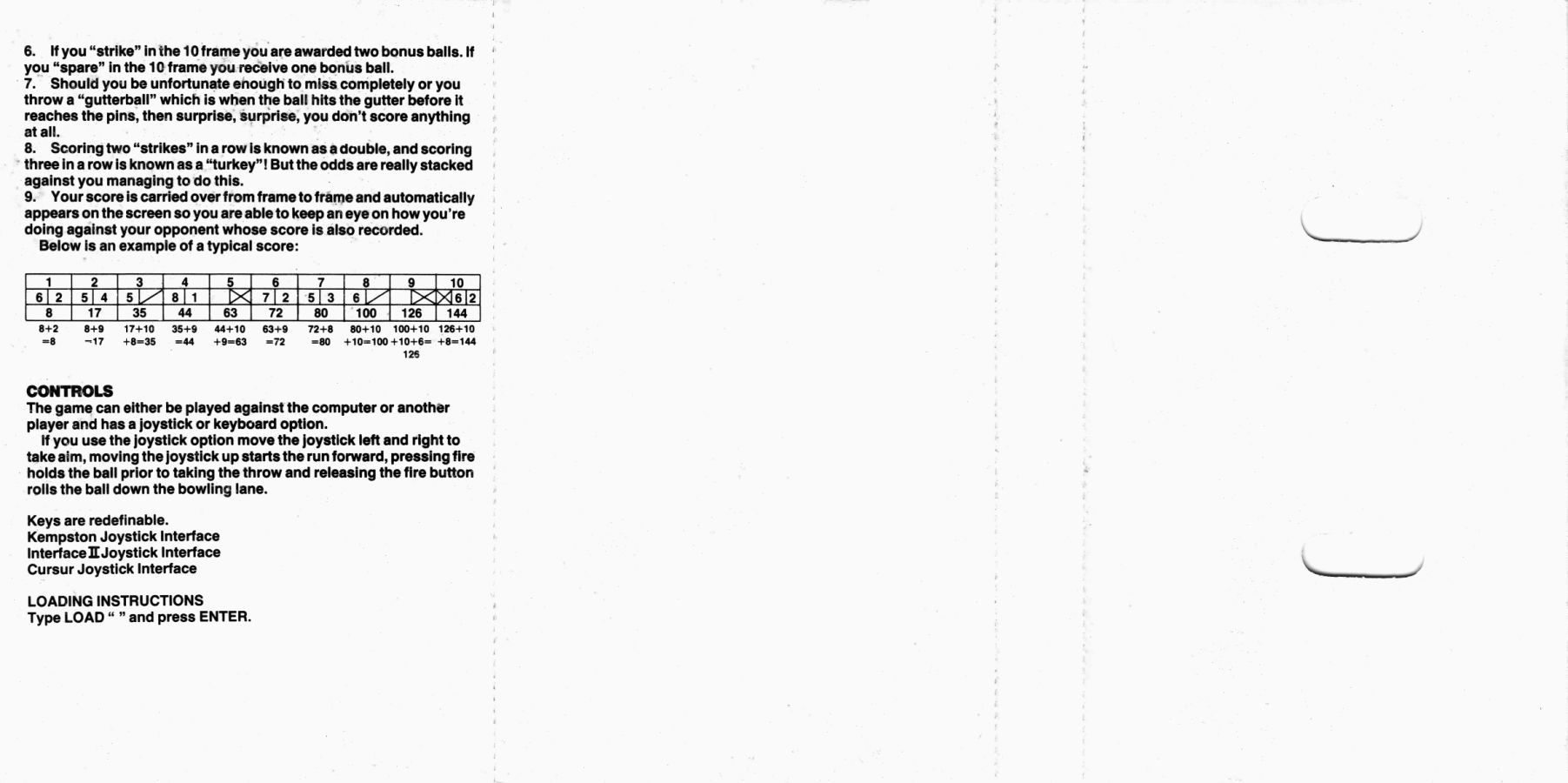
- Cursor, Interface 2 (right), Kempston Joystick, Redefineable keys
Releases
- 1987Mastertronic Added Dimension Sold as Strike!
- 1988Dro Soft
Play
- strike.rzxRZX playback file
- Strike.tzx.zipTape image English18 KB
- Strike.tap.zipTape image English21 KB
- Strike(DroSoft).tzx.zipTape image English18 KB
Documents
- Strike(DroSoft).pdfInstructions Spanish13 KB
- Strike(EN).txtInstructions English4 KB
Music
- Strike.ay.zipRipped in-game/theme music in AY format 1 KB
Files and rights
No permission is on record either way. Screens and pictures are copied here on a take-down basis: if you hold the rights and want something removed, say so and it goes.
Credits
- Jeremy Nelsoncredited
Sign in to credit somebody, or say what these people did.
Scores
In the magazines
- Sinclair User #631987 · Overall3/5
- Your Sinclair #191987 · Overall7/10
- Crash #411987 · Overall40%
Elsewhere on the web
- WorldOfSpectrum 8 votes5.75
In the magazines 11
Your Sinclair #19Jul 1987 · p.657/106/108/107/107/107/10
Graphics 7/10
Playability 6/10
Value For Money 8/10
Addictiveness 7/10
Overall 7/10
Mike Gerrard 7/10
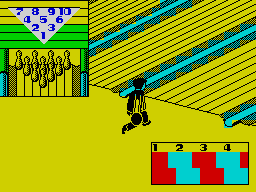
Mastertronic £2.99 Reviewer: Mike Gerrard There can't be many sports not computerised now, apart from maybe synchronised swimming, and Ocean are probably working on that one right now. Ocean... swimming? Oh please yourselves. It seems amazing that ten-pin bowling has escaped for so long, but here at last is the micro version for all those who think that life is just a bowling alley. If you know the rules then we won't waste space explaining them, and if you don't then read the cassette inlay and you too will discover how you can lose to the computer with increasing embarrassment on each of the four skill levels, though there's a two-player option so that you can get embarrassed in front of your friends, too. Control is by the redefinable keyboard or Kempston, Sinclair or Cursor joysticks. At top left of the screen you see the pins, the main display being your end of the alley, which you see from on-high over the player's right shoulder. Left and right are used for the soft-shoe shuffle either way, with up to launch him on his way. Then comes the tricky bit. Pressing fire holds the ball ready for the throw, and releasing the button/key rolls the ball down the lane. Well, to begin with it usually releases the ball on your head, foot or any other part of your anatomy. and those who are into pain are welcome to do the same with a real bowling ball if it'll help increase the reality of it all. Timing really is the key to the game, and those who master it will probably have a lot of fun at the expense of their friends, but if the game has a fault it's that the timing has to be so precise to within about one zillionth of a second that foot faults and dropped balls outnumber strikes about a thousand to one. You also can't break out of the game to start again when you're losing 113-7, which is highly unfair. Graphics aren't bad, but the sound could be better. Still, it can get quite addictive if you're prepared to put up with the initial shame, and it'll probably be one of those games you get off the shelf every once in a while for a bit of fun rather than play for hours at a stretch.
Sinclair User #63Jun 1987 · p.553/53/5
Overall 3/5
Graham Taylor 3/5
Label: Mastertronic Author: Binary Design Price: £2.99 Joystick: various Memory: 48K/128K Reviewer: Graham Taylor Strike is the latest on the Mad label from Mastertronic. It's also the latest from Binary Design - an independent development house gaining quite a lot of cred for games like Zub and Amaurote. Strike is less impressive though clever enough in its way. It's a graphically very clever simulation of ten pin bowling. This is, I think, where things went wrong. It wasn't a very good idea in the first place. True, Mastertronic did well with 180 which was a slick darts game but darts has always worked well on computer from Atari days and besides 180 was funny. I found my interest flagging in Strike after around the thirteenth ball. Ten-pin bowling is really not a very complicated game. You take a run up, drop down and release the bowl as accurately and smoothly as possible. The skittles are arranged so that it is possible to knock the lot down with one bowl - possible but not easy. The real version requires considerable skill but in this computer version there just aren't that many tactics to learn - don't run too far or else you'll get a foot fault, release the ball at the right point in the arm swing and see what you hit. The screen shows two views of the action, your man with ball and the first part of the bowling alley and an insert showing the actual skittles at the end of the track. It's nicely presented, you even get the funny tray thing that comes down and removes the knocked down skittles and sets up the skittles again that you didn't manage to get for a second try. Clearly no effort has been spared. Playing against the computer is pretty unsatisfying - you can only beat it because some sort of random factor makes it sometimes perform badly. You don't get much sense of achievement however. I don't think Strike is going to be another 180 despite being a good bit of programming - it would have been OK as part of some sort of World Games-style collection but on its own it just doesn't raise any interest.
Your Computer #6Jun 1987 · p.68
Spectrum 48/128/Plus 2 Cassette Publisher: Mastertronic Mastertronic, that pioneer of cut-price software, has produced a little gem of a game for less than £2 with Strike. This is available for the Spectrum and all its variants, like Spectrum 48/128, Plus 2, and probably the C5 as well. Joystick compatible with a zillion different interfaces, such as Kempston, Interface II, Cursor, you can also use the keyboard if you wish. You can play against the computer and throw it against the wall when you've finished, or play against a friend and shake his hand while gritting your teeth at yet another abysmal defeat. So what is it? Well, for once you are not pittied against the hell hounds of outer space, but are instead playing the humble game of ten pin bowling. The cassette inlay says that you will be hooked in minutes and playing for hours, and somehow it seems a shame that Firebird's lead in reproducing that sentence in umpteen different foreign languages has not been followed. I rather like the idea of being able to say "hooked in minutes and playing for hours" in French, somehow. The controls are very simple to master, and if you're anything like me you will be playing it for hours. Using the joystick (much easier) you move it left and right to aim your delivery, press the fire button to move a little man forward carrying the ball, and release the button when you want him to release the ball. Carry on too long and you will foot fault, and can indulge in all the McEnroe histrionics you like, but it will still be a foot fault. Aiming, despite sounding easy, is not quite so easy when you are playing, and it took some time before I managed to get a strike. Or even a spare, he said, reeling off the phrases as if he's known them for years. Strikes and spares were all Greek to me before I started playing this game, but I can now talk like an expert. Unfortunately talk is as far as it goes, since my playing ability is not yet up to world championship standards. Graphically this is very good, if limited to the one main display. I do like the way the little man rushes up and delivers the ball: it's worth making a few errors just to see what happens. I don't really see the point of displaying a message like 'player 1 thinking' while you try and aim the ball. What are you supposed to be thinking about? Cricket? Wigan's chances of promotion to division two? it seems you are supposed to be thinking of playing ten pin bowling, but it fills the screen I suppose. Having more or less - well, less rather than more - mastered aiming the ball, the next problem concerns releasing the thing. A simple matter of pressing and releasing the fire button on the joystick you might think, but alas, life is not that easy, and many is the disaster you will have before getting things right. A wonderful display of the ball landing on your foot is the reward for messing it up completely . Once you get into the swing of things it isn't too bad, and I must admit to being addicted. My scores are slowly beginning to creep up a little, although I have yet to muster two strikes in a row, never mind three - this is known as a 'turkey', apparently, which leaves one to wonder what getting four in a row might be called. - For a £1.99 game this is great fun, and even if (like me) you know nothing about ten pin bowling, it's worth getting.
Crash #41Jun 1987 · p.2653%52%43%37%45%40%
Presentation 53%
Graphics 52%
Playability 43%
Addictive Qualities 37%
Value For Money 45%
Overall 40%
Ben Stone
Paul Sumner
Richard Eddy
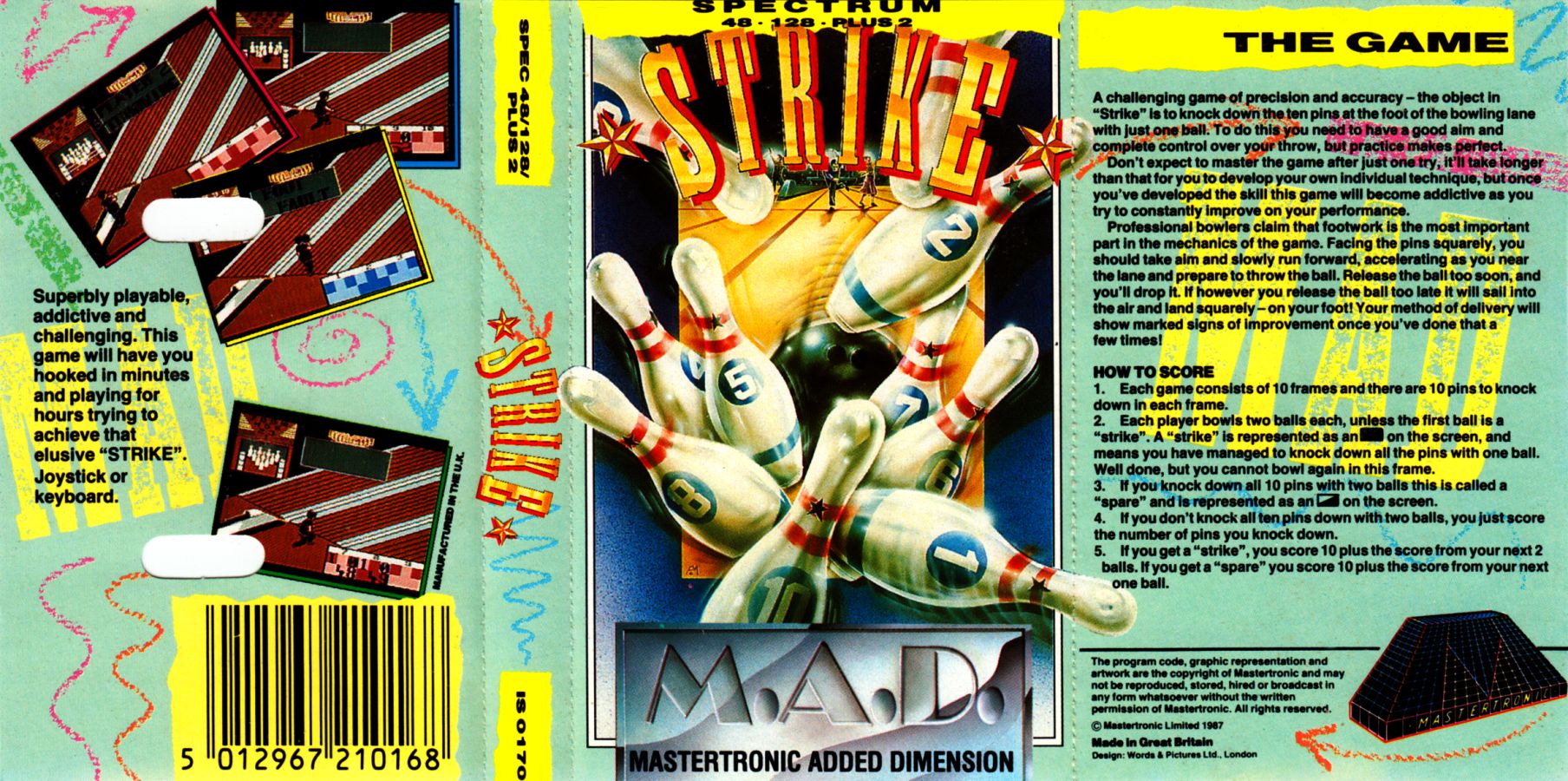
Producer: M.A.D. Retail Price: £2.99 We're back to the Ten-Pin bowling lanes again, and, similar to the 'real thing', the key to success in this simulation is correctly timing the ball's release. If this is done too soon the ball's dropped, too late and your foot's flattened! The bowler moves left and right along the 'top' of the alley (screen left actually), and pressing fire releases the ball. The alley threshold must not be crossed, doing so constitutes a foot fault and no points are scored. You have two balls with which to knock down the ten pins in a 'frame', with a point scored per toppled pin. Pins still standing after a delivery are displayed on an inset top left of the screen. A 'strike' is scored when all ten are felled with the first ball of a frame. This earns ten points, plus a bonus of the score from your next two balls. Demolishing all ten pins with both balls is a 'spare', earning a bonus of the score from your next ball. The score per frame and a running total over all frames is displayed at the bottom of the screen, the winner being the bowler who accumulates the most points at the end of ten frames. COMMENTS Control keys: definable Joystick: Kempston, Interface 2, Cursor Use of colour: restricted; brown, black and white Graphics: good bowler sprite, otherwise uniformly simple Sound: nothing inspiring Skill levels: one Screens: one (plus inset)
And aiming at the pins, it's ace ten-pin bowler Cameron. Note that smooth flick-wrist style.
Plus 3 Sports carries this game and has 6 references of its own.
Review2
- MicroHobby #176Sep 1988 · p.43
- Computer Gamer #27Jun 1987 · p.77
Tips2
- YS Smash TipsAug 1988 · p.50
- Your Sinclair #22Oct 1987 · p.27
News/Note2
- Sinclair User #62May 1987 · p.20
- Popular Computing Weekly #17May 1987 · p.61
Preview1
- Your Sinclair #18Jun 1987 · p.9
Related
- Compilations
- Sinclair Game Compilation, Plus 3 Sports
- Ports
- (Amstrad CPC), Strike! (Commodore 64), (Atari ST)
- Tags
- AY Sound, Bowling, Turn based
- Elsewhere
- Spectrum +2A/+3 IncompatibilityMobyGamesRZX ArchiveThe TipshopUVLRZX Archive - YouTubeModern ZX-Retro Gaming
- Same entry at
- Spectrum ComputingZXInfo
Reviews from people here
Sign in to write about this, or make an account. It takes a minute and lets you correct the catalogue too.
No description recorded.
Sign in to correct or add to this.
Hold the rights to this and want it taken down?