Superchess 3
Game: Board · ZX-Spectrum 48K · 1 players · English
CP Software · 1984 · Pound sterling 8.95
Also known as Chess Player 2150 (English)
Superchess, 4 of 4
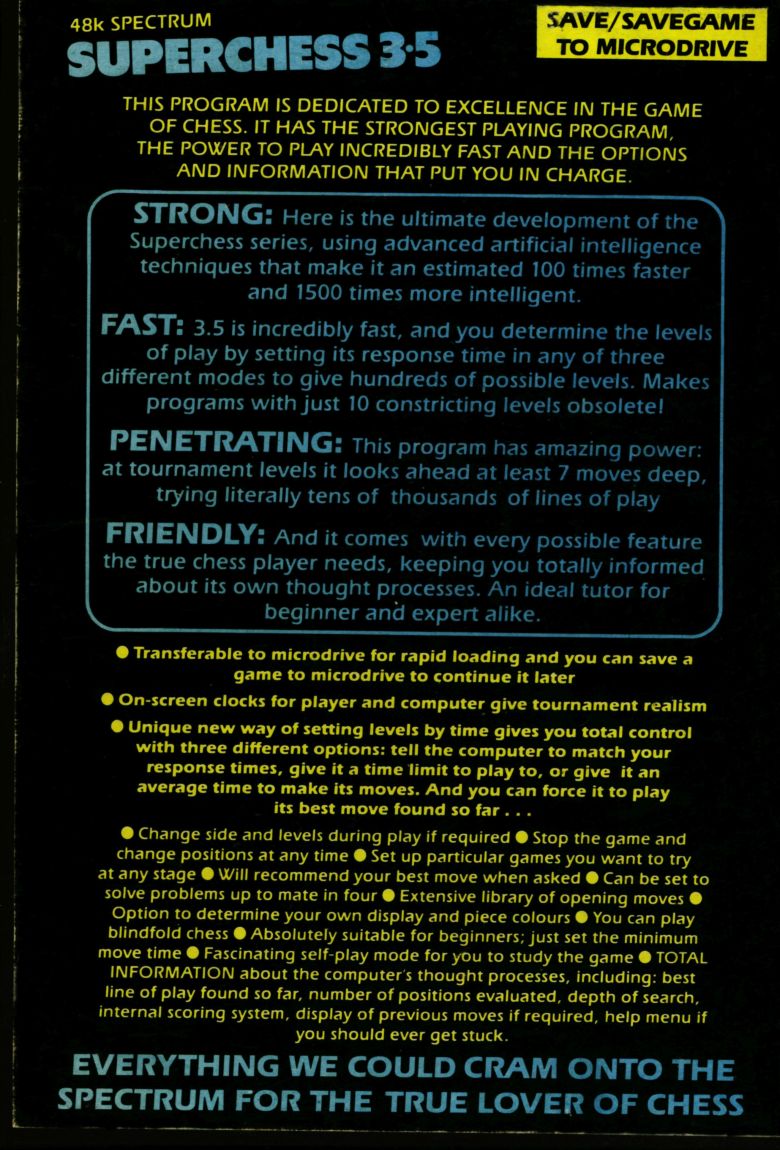
(EDOS).jpg)
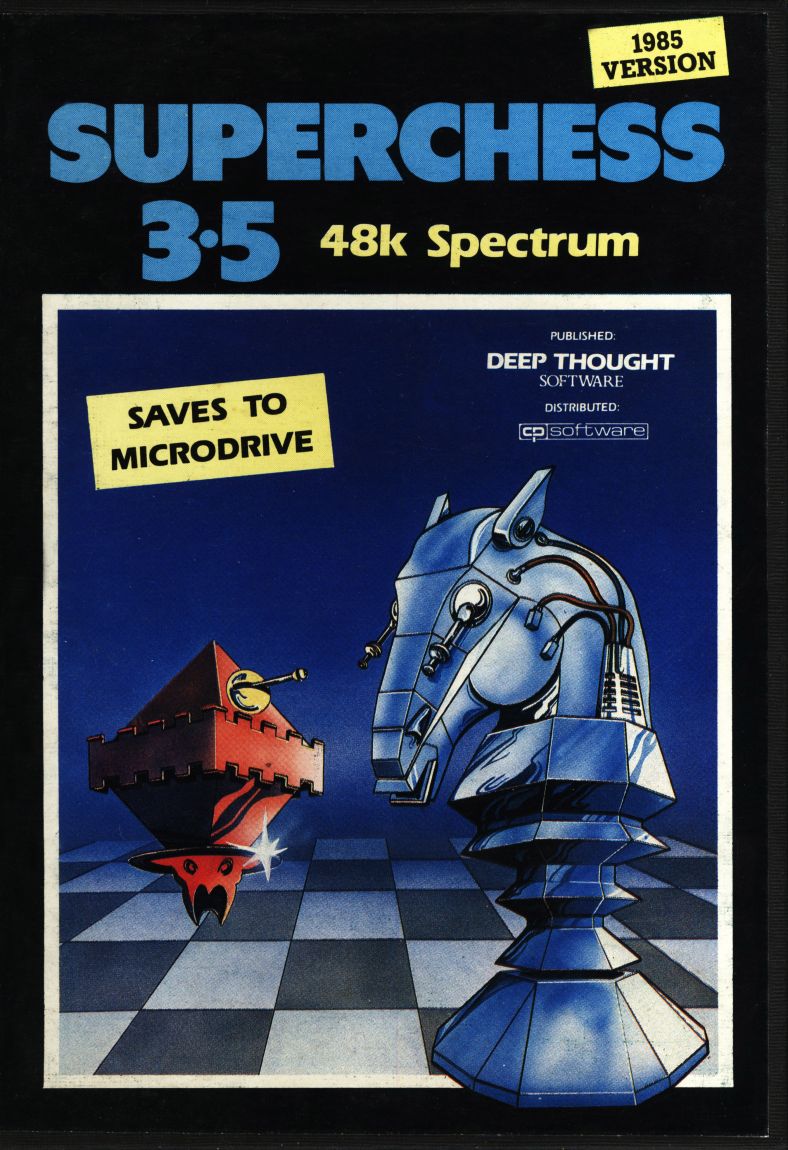
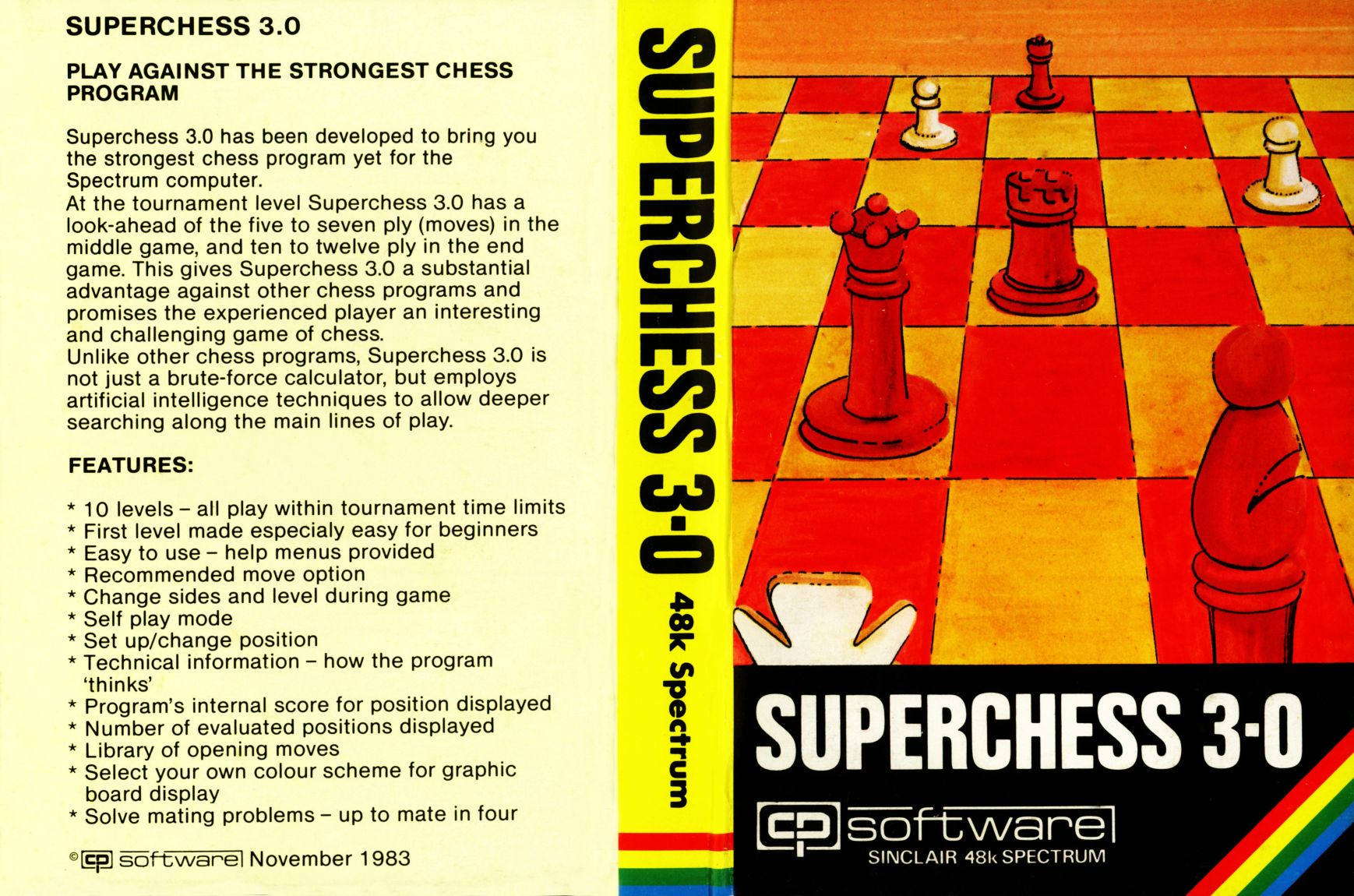
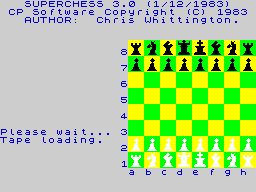
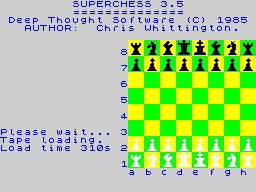
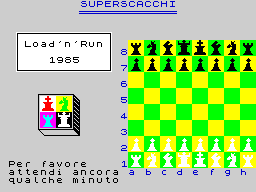
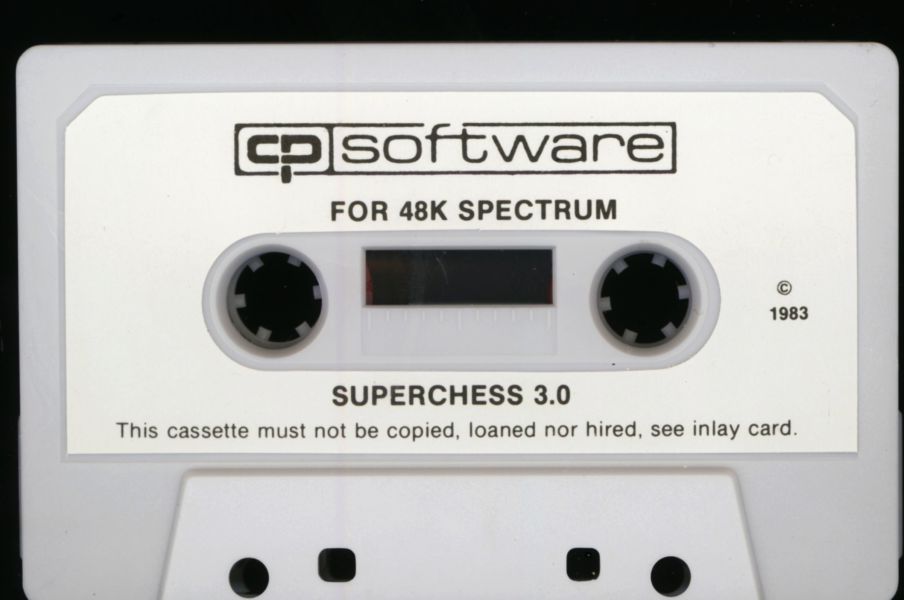
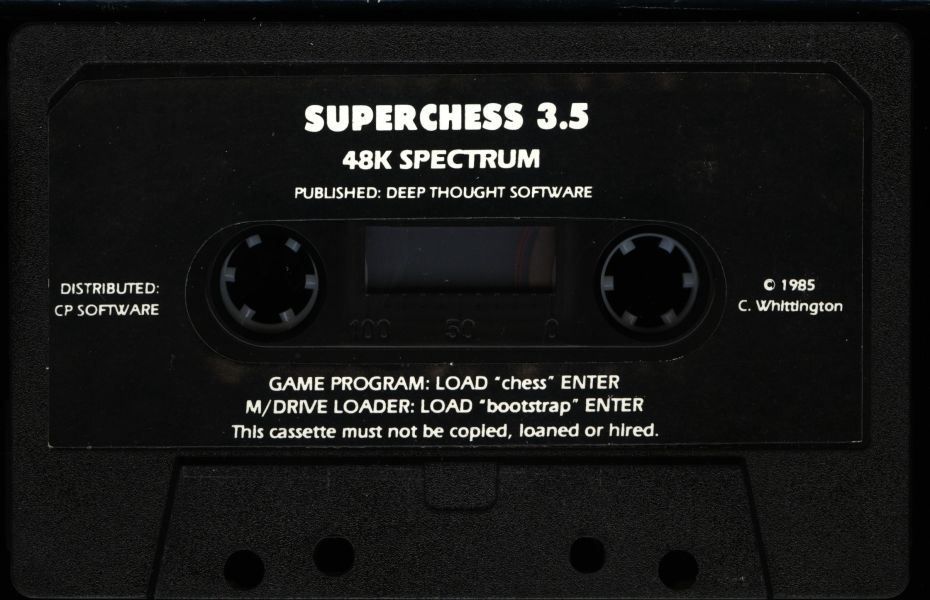
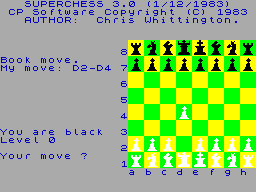
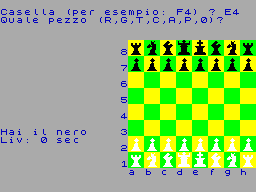
(EDOS).jpg)
Discussion
Nobody has started a thread about this yet.
Awards
Rank #49 - 1984 Sinclair User Top 50 Spectrum Software Classics
Releases
- 1984CP SoftwarePound sterling 8.95
- 1992EDOS Sold as Chess Player 2150
Play
- superchess3.zipRZX playback file
- superscacchi.rzxRZX playback file
- Superchess3V3.1.z80.zipSnapshot image English17 KB
- Superchess3V3.0.tzx.zipTape image English50 KB
- Superchess3V3.5.tzx.zipTape image English30 KB
- Superchess3V3.0.tap.zipTape image English32 KB
- Superchess3V3.5.tap.zipTape image English30 KB
- Superchess3(ChessPlayer2150)(EDOS).tzx.zipTape image English30 KB
- Superscacchi.tzx.zipTape image Italian27 KB
Documents
- Superchess3V3.0.txtInstructions English14 KB
- Superchess3V3.5.txtInstructions English5 KB
- Superchess3(EN)_v30.pdfInstructions English301 KB
- Superchess3(EN)_v35.pdfInstructions English824 KB
Files and rights
No permission is on record either way. Screens and pictures are copied here on a take-down basis: if you hold the rights and want something removed, say so and it goes.
Credits
- Chris Whittingtoncredited
Sign in to credit somebody, or say what these people did.
Scores
In the magazines
- Sinclair User #241984 · Gilbert Factor9/10
- Crash #161985 · Overall85%
- Sinclair User1985 · Gilbert Factor9/10
- Personal Computer News #1001985 · Overall8/10
Elsewhere on the web
- WorldOfSpectrum 12 votes7.50
In the magazines 70
Crash #16May 1985 · p.2985%80%80%75%85%76%85%
Use of Computer 85%
Graphics 80%
Playability 80%
Getting Started 75%
Addictive Qualities 85%
Value For Money 76%
Overall 85%
Jeremy Spencer
Unknown
Unknown
Producer: Deep Thought/CP Software Memory Required: 48K Retail Price: £9.95 Language: Machine code Author:Chris Whittington Jeremy Spencer considers his endgame. I was surprised to find that we hadn't reviewed that many chess games in CRASH, I had formed the opinion that the world was awash with them and they simply were not , good enough to find their way into these hallowed pages. This one is. Superchess 3.5 claims to be 100 times faster and 1500 times more intelligent than any other prog ram. With my chess playing ability being what it is I decided to ask in Syd, our in-house chess player. More from Syd later. A lot of chess programs must surely be sold to people who either cannot play or are weak players as well as those who are brilliant; chess programs offer an important function as tutors, they don't laugh when you make a stupid move (they simply slaughter you) and they will quickly tell you if you attempt an illegal move. A program that can suggest moves is even more useful. What does Superchess 3.5 offer? Well there are seven basic options, the first being to set up a new game. Having done that you can request that the computer will limit its 'think time' to your average, or you could simply set the amount of time you will allow it - effectively a selection of skill levels. This option lets you set up the board to solve chess problems. Option 2 allows the board play to be analysed, but should you be in the middle of a game you could use this option to reset the game by moving pieces around in answer to the prompts. If the game isn't going too well for you, now's your chance to turn the tables a little. Option 3 simply allows the user to change the playing colours. If a player is stuck for ideas then option 4 can be used either to make the computer play the player's move or to suggest a move. Option 4 can also display a review of the moves made to date. Option 5 allows the program and the current game to be saved to microdrive. The screen displays a great deal of information. At the top there is a clock showing each player's total time and move time. On the left the computer shows its favoured move but as it continues to think it may change its mind. The score gives some idea who is ahead and below that 'nodes' show how many lines of possible moves the program has analysed so far. More often than not this figure is in the hundreds of thousands. The computer also shows the moves it is predicting it will make which gives the player a very good idea of the program's strategy, and using that information the player ought to be able to utterly frustrate the machine. COMMENTS Control keys: as requested Joystick: n/a Keyboard play: very easy Use of colour: selectable Graphics: very neat Sound: spot only Skill levels: varies according to time setting Lives: n/a Screen: n/a
Your Computer #4Apr 1985 · p.47
Toby Wolpe
Spectrum 48K Deep Thought - CP Software Board-game £9.95 If you're the sort of chess player who needs to know exactly what's going on in your opponent's mind, this is the program for you. If you also want an extremely fast, challenging game, the 1985 version of Superchess again fits the bill. Down the left side of the board display is Plymax. It not only shows you how far ahead the computer is looking, but also details its best line of play together with your answering moves. Beginners will find this useful because it draws attention to traps and developments they might otherwise have overlooked. The screen also displays the times the computer and the player have taken in all, as well as the time taken for the current move. As the program is working out what to do next it tells you the move it likes best so far, how many nodes or lines of play it has analysed and your last move. Unlike most chess programs the pieces are moved round the board not with the cursor keys but by coordinates for example, E2-E4. The way you set the level of play is again unconventional. With Superchess the amount of time you are prepared to give the computer to think over its moves determines the quality of the game. Obviously the more time you give it the better it will play. Even with only an average of 10 seconds response time the program can give you a very good game.
ZX Computing #17Feb 1985 · p.20
Christopher Doran
Philip Crocker
BATTLE OF THE GIANTS Philip Crocker and Christopher Doran match Superchess 3.0 and Cyrus IS Chess in a fight to the finish Since the Spectrum first came out there have been many chess programs written for it. As the Spectrum has become more popular there has been a greater incentive to write the best Spectrum chess program. The two most obvious contenders for title best Spectrum chess program are Cyrus IS Chess and Superchess 3.0 by CP Software. Cyrus IS Chess is based on a program which won the 1981 European Microcomputer Chess Championship. While Superchess 3.0 comes with a guarantee from CP Software, that it will beat any other Spectrum chess program. CYRUS IS CHESS VERSUS SUPERCHESS 3.0 Both chess programs come in a well presented package which contains a cassette and an instruction booklet. Cyrus contains two programs: one for the 16K and one for the 48K Spectrum. Both Cyrus programs have the following features: 1 Eight playing levels. 2 Cursor key movement of pieces. 3 Auto-demonstration mode. 4 It can be used as a chessboard by two humans. 5 Take-back facility. 6 Replay a game. 7 Set up a position. 8 It solves chess problems (up to mate in three). 9 Turn round board. 10 Change sides during a game. The additional features for the 48K Spectrum are: 1 Full library of chess openings. 2 Change colour of board and 2 Change colour of board and pieces. 3 Print out a record of the game. 4 Save game on tape (for future 4 Save game on tape (for future continuation). 5 Force the computer to make its best move. Superchess 3.0 is for the 48K Spectrum only. Its features are: 1 Ten playing levels. 2 Recommended move option. 3 Change sides and level of play during game. 4 Set up a position. 5 Self-play option. 6 Technical information (how the program works). During the game Superchess gives itself a score dependent on positional factors and material advantage or loss. 7 Library of opening moves. 8 Change colour scheme. 9 Solve chess problems (up to mate in four). 10 List Moves. Cyrus definitely has more features than Superchess 3.0. For example Cyrus's take-back facility is a very useful feature which Superchess lacks. There is also a replay feature which enables the beginner and expert alike to examine the previous game, and even to begin the game at a chosen point. CHESS ABILITY In order to discover the chess ability of both programs we decided to play the two programs off against each other. We attempted to play the two chess programs off at approximately equal time limits. The results are shown in table 1. EXAMPLE GAME This game was between Cyrus (white) and Superchess (black). Cyrus played on level 6 and Superchess played on level 3. The game was typical of the games which were played. Cyrus played a fine opening due to its superior opening knowledge and the game soon reached a middlegame with a positional advantage to Cyrus. Cyrus exploited this advantage with some fine, logical play and won a pawn. However this led to a multitude of exchanges and an endgame was reached with Cyrus having some winning chances and almost certain drawing chances. However in the endgame Superchess came into its own. Its driving, delicate play forced zugzwang (the compulsion to make a move resulting in material or positional loss) upon Cyrus. Superchess then proceeded to overwhelm the depleted Cyrus and quickly concluded the game. The moves are listed in table 2. For those of you who are not familiar with the notation used in table 2, I will briefly explain how it works. The piece to be moved is shown by the first letter of its name except for the knight which is represented by N. There is then a dash, or an x if the move captures a piece. The square to which the piece should be moved is shown by the piece which would be on the same file at the beginning of a game and then by the number of squares forward (one to eight). The symbols are KR (kings rook), QR (queen's rook), QN, KN, Q, K, QB and KB. Kingside castling is shown by 0-0 and queenside castling by 0-0-0. Check is shown by + and ! indicates a good move. If for example two rooks could move to the same square then the correct rook is shown in brackets. The moves should be worked out by looking at the board from the point of view of the person who is moving. CONCLUSION Superchess was the clear winner in this contest and this supports the claim that it can beat any other Spectrum chess program. Superchess seems to improve as the game goes on. Its standard opening play and weak (compared to Cyrus) opening library convey a dubious impression. Its middlegame is sound without being spectacular but its endgame is excellent and this is where it won or drew games in which it had a material or positional disadvantage. For example in the final game Cyrus reached the endgame three pawns up and with a better position after a brilliant combination. However by playing outright blunders which lost Cyrus material and decentralised its pieces it enabled Superchess to draw the game with some subtle play. Cyrus was rather a disappointment in the game just described. Often it would play an excellent opening and middlegame and then lose a "won" endgame. Sometimes on lower levels it would play nonsensical moves in the middlegame or in the endgame. For example it would move a rook backwards and forwards for several moves which enabled Superchess to improve its position unhindered. Both packages have room for improvement. Superchess has fewer features than Cyrus and it also has a weak opening library compared to Cyrus. Cyrus has weak endgame play and it has a habit of making nonsensical moves. Cyrus iS Chess is written by Intelligent Software and is priced £9.95. It can be obtained from most computer software retailers. Superchess 3.0 costs £8.95 and can be obtained from the following address: CP SOFTWARE, [redacted] It may also be available from good software shops.
Table 1. Results from IS Chess v Superchess play off. White: Cyrus Level 1 Black: Superchess Level 0 Result: 0.5-0.5 Moves: 35 White: Superchess Level 0 Black: Cyrus Level 1 Result: 1-0 Moves: 64 White: Cyrus Level 4 Black: Superchess Level 1 Result: 1-0 Moves: 25 White: Superchess Level 1 Black: Cyrus Level 4 Result: 1-0 Moves: 57 White: Cyrus Level 5 Black: Superchess Level 2 Result: 0-1 Moves: 38 White: Superchess Level 2 Black: Cyrus Level 5 Result: 0.5-0.5 Moves: 30 White: Cyrus Level 6 Black: Superchess Level 3 Result: 0-1 Moves: 60 White: Superchess Level 3 Black: Cyrus Level 6 Result: 0.5-0.5 Moves: 65 White: Cyrus Level 5 Black: Superchess Level 1 Result: 0.5-0.5 Moves: 57 White: Superchess Level 1 Black: Cyrus Level 5 Result: 0-1 Moves: 65 White: Cyrus Level 7 Black: Superchess Level 6 Result: 0-1 Moves: 110 White: Superchess Level 6 Black: Cyrus Level 7 Result: 0.5-0.5 Moves: 81 Game: 1 Superchess: 0.5 Cyrus: 0.5 Game: 2 Superchess: 1 Cyrus: 0 Game: 3 Superchess: 0 Cyrus: 1 Game: 4 Superchess: 1 Cyrus: 0 Game: 5 Superchess: 1 Cyrus: 0 Game: 6 Superchess: 0.5 Cyrus: 0.5 Game: 7 Superchess: 1 Cyrus: 0 Game: 8 Superchess: 0.5 Cyrus: 0.5 Game: 9 Superchess: 0.5 Cyrus: 0.5 Game: 10 Superchess: 0 Cyrus: 1 Game: 11 Superchess: 1 Cyrus: 0 Game: 12 Superchess: 0.5 Cyrus: 0.5
Table 2. The Cyrus versus Superchess example game. 1.P-K4 P-QB4 2.P-KB4 N-QB3 3.N-QB3 P-Q3 4.B-Qn5 B-Q2 5.N-B3 N-B3 50.K-Q2 KxP 6.P-Q3 P-QR3 51.K-Q3 K-B4 7.BxN BxB 8.Q-K2 P-K3 9.B-K3 P-Q4 10.PxP NxP 11.NxN BxN 12.B-Q2 Q-KB3 13.Q-K5 BxN 14.QxQ PxQ 15.PxN B-N2 16.R-N1 0-0 17.B-QB3 K-R1 18.0-0-0 P-QR4 19.R-N4 P-R5 20.R(Q)N1 R-N8 21.RxB! RxR 22.BxBP R(R)N1 23.R-N5 P-QN3 24.K-N1 P-KR3 25.R-N4! K-R2 26.BxR RxR 27.P-QB4 P-KB4 28.RxR + KxR 29.K-B2 K-83 30.K-Q2 K-B2 31.K-K3 P-R4 32.P-R4 K-N3 33.P-Q4 K-82 34.P-Q5 PxP 35.PxP K-K2 36.P-N3 P-R6 37.K-Q3 P-N4! 38.P-N4 P-B5 39.K-K3 K-Q2 40.P-Q6 KxP 41.K-Q4 Kb3! 42.K-B3 K-Q4 43.K-B2 K-75 44.K-Q2 P-B6+ 45.K-K2 P-B7 46.K-Q2 P-B8(Q) 47.KxQ K-B6 48.K-Q1 KQ6! 49.K-B1 K-85 50.K-Q2 KxP 51.K-Q3 K-B4 52.K-B3 P-N5+ 53.K-Q3 K-B4 54.PxP P-R7 55.K-B2 R-R8(Q) 56.K-Q3 Q-Q5+ 57.K-B2 K-N5 58.K-N1 Kxp 59.K-B1 Q-Q5 60.Q-Q8 mate
Personal Computer News #100Feb 1985 · p.348/108/10
Overall 8/10
Bob Chappell 8/10
PRICE: £9.95 PUBLISHER: Deep Though - (Distributor CP Software) [redacted] CP Software's new chess program is a vast improvement in power, speed and facilities over its earlier 3.0 version. The main display is split in two with pertinent data on the left, the board on the right. As well as displaying its move in standard algebraic notation, the program also provides the following information as it searches: its best move found so far; a points evaluation based on material gained or lost and the general position of the pieces (a plus indicates that the program believes itself to be ahead, a minus that it is losing; number of nodes (lines of play) searched; play (moves per side) depth reached; current best line of play, showing its best moves and the expected consequential moves, down to the level of play reached in the search. In addition, there are clocks for both players, recording both the total elapsed time and the time taken for the current move. The display also shows the total number of moves and the program's time limit. While this information is all grist to the mill, what a pity the program hasn't provided the option to suppress the best line of play data. This is effectively a hint as to your next move, so whether you want a hint or not, you've got one. All this data tends to make the left side a little cluttered so that when the program displays its selected move, you must search the rest of the stuff for it. The time limit for the computer's response can be set at anything from 5-999 seconds or you can let it match your own speed. There's an excellent problem-solving mode (mate in up to four moves) which displays all mates, not just the first it finds. Other facilities let you: set up board positions, change the colours of the board and pieces, list the last 62 moves, play black or white (and invert the board) and save the program and current game to Microdrive. It plays to a good standard and is likely to be the best chess program you'll find for the Spectrum. With its many features and fast play, Superchess 3.5 is an excellent chess program and can be confidently recommended to all Spectrum owning lovers of the Royal Game.
Sinclair User1985 · p.499/109/10
Gilbert Factor 9/10
John Gilbert 9/10
SOFTWARE SCENE While some software houses are taking the Spectrum to its limits and beyond others doggedly continue to churn out ever more diabolical pieces of programmed junk. John Gilbert present a personal pick of the bunch, and Chris Bourne take an irreverent look at the dwindling ZX-81 software scene. Their talents are combinedd in listing the Top Ten Turkeys of 1984. Let the reader be warned. SPECTRUM SOFTWARE A cynic may argue that development within the software market in 1984 was non-existent. The same type of game appeared as those which took the lead in 1983, the most popular being of the arcade variety. The programs were written in the same style and to please the same type of customers. That is only a superficial view, however, and if you look at the games market as a whole, dividing it up into sectors such as strategy, arcade and adventure, you will see that substantial and sophisticated changes have taken place. Despite what some pundits have said you will find that the world of computer games is still buzzing with life. SUPERCHESS III £8.95 CP Software Only one chess program of note was launched in 1984 and that was Superchess III from CP Software. As well as allowing you to play games at 10 levels of difficulty, the program will also analyse chess problems of up to four mating moves. The option will also give you an idea of how mate in various positions should be achieved. A relative beginner can play on level one and have the feeling that he is a good match for the computer. On the higher levels, which can take some time to play, the expert at chess will find the computer an impressive opponent. All the usual features which have become part of computer chess games are included. There is a recommended move option, an option to change sides halfway through a game, and a routine which will allow you to change the colours of both the pieces and the board. An extra feature which is not included in most other chess games for the Spectrum is the technical information option. The section will tell you briefly about the techniques which the computer uses to find its moves and which are used when it analyses problems.
Sinclair User #32Nov 1984 · p.51
A game capable of playing at tournament level, it includes many features not normally incorporated into computer chess programs. It has ten levels of play all of which are timed within tournament limits and the usual options such as recommended move, setting up problems and solving mating problems are included. Extra options include information on the way the program 'thinks', a display showing the types of move that the computer is considering and the number of evaluated moves. The game is a descendant of Superchess I and II, both of which were produced by Chris Wittington, and uses sophisticated artificial intelligence routines. Position 49/50
Sinclair User #24Mar 1984 · p.149/10
Gilbert Factor 9/10
Memory: 48K Price: £8.95 Superchess Three is one of the best versions of the popular mind game for the 48K Spectrum. It is an upgrade of the CP Software original Superchess which has foxed many better-than-average players. As well as allowing you to play games at 10 levels of difficulty, the program will also analyse chess problems of up to four mating moves. The option will also give you an idea of how mate in various positions should be achieved. One of the good aspects of Superchess Three is that a relative beginner can play on level one and have the feeling that he is a good match for the computer. On the higher levels, which can take some time to play, the expert at chess will find the computer an impressive opponent. All the usual features which have become part of computer chess games are included. There is a recommended move option, an option to change sides halfway through a game, and a routine which will allow you to change the colours of both the pieces and the board. An extra feature which is not included in most other chess games for the Spectrum is the technical information option. The section will tell you briefly about the techniques which the computer uses to find its moves and which are used when it analyses problems. The program produces an absorbing game which it can modify quickly if the human player changes tactics. It is just as capable of defence as it is of attack. We have no hesitation in recommending Superchess Three as one of the best chess programs for the Spectrum. It can be obtained from CP Software.
Classic Games 4 carries this game and has 3 references of its own.
Advert51
- Sinclair User #50May 1986 · p.23
- Sinclair User #49Apr 1986 · p.69
- Sinclair User #48Mar 1986 · p.69
- Sinclair User #47Feb 1986 · p.31
- Sinclair User #46Jan 1986 · p.73
- Sinclair User #45Dec 1985 · p.133
- Sinclair User #44Nov 1985 · p.31
- Sinclair User #43Oct 1985 · p.65
- Sinclair User #42Sep 1985 · p.49
- Sinclair User #41Aug 1985 · p.57
- Sinclair User #40Jul 1985 · p.49
- Your Spectrum #15Jun 1985 · p.30
- Sinclair User #39Jun 1985 · p.57
- Sinclair User #38May 1985 · p.57
- Your Spectrum #14May 1985 · p.16
- Your Spectrum #13Apr 1985 · p.2
- Sinclair User #37Apr 1985 · p.65
- Your Spectrum #12Mar 1985 · p.71
- Sinclair User #36Mar 1985 · p.65
- Your Spectrum #11Feb 1985 · p.30
- Sinclair User #35Feb 1985 · p.31
- Sinclair User #34Jan 1985 · p.101
- Sinclair User #33Dec 1984 · p.187
- Your Spectrum #10Dec 1984 · p.81
- Your Spectrum #9Nov 1984 · p.79
Feature5
- Your Computer #1Jan 1986 · p.58
- ZX Computing #17Feb 1985 · p.20
- Sinclair User1985 · p.46
- Personal Computer Games #7Jun 1984 · p.36
- Computer ChoiceMay 1984 · p.34
Review3
- ZX MagazínMar 2001 · p.7
- Home Computing Weekly #101Feb 1985 · p.30
- Popular Computing Weekly #2Jan 1985 · p.47
News/Note3
- ZX Computing #18Apr 1985 · p.21
- Your Spectrum #7Sep 1984 · p.12
- ZX Computing #14Aug 1984 · p.37
Letters1
- Home Computing Weekly #107Apr 1985 · p.43
Licensed from
- ChessBoard/Tabletopunofficial
Related
Reviews from people here
Sign in to write about this, or make an account. It takes a minute and lets you correct the catalogue too.
Everything ZXDB can hold about this is here.
Sign in to correct or add to this.
Hold the rights to this and want it taken down?