
Think!
Puzzle Game: Problem-Solving · ZX-Spectrum 48K · 2 players · English
Ariolasoft UK Ltd · 1985 · Pound sterling 7.95
Also known as Think (English)
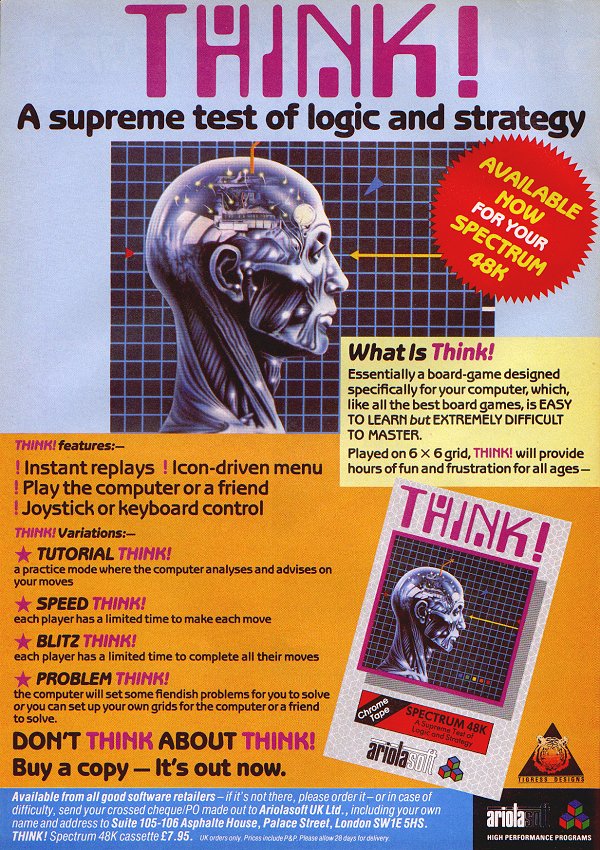
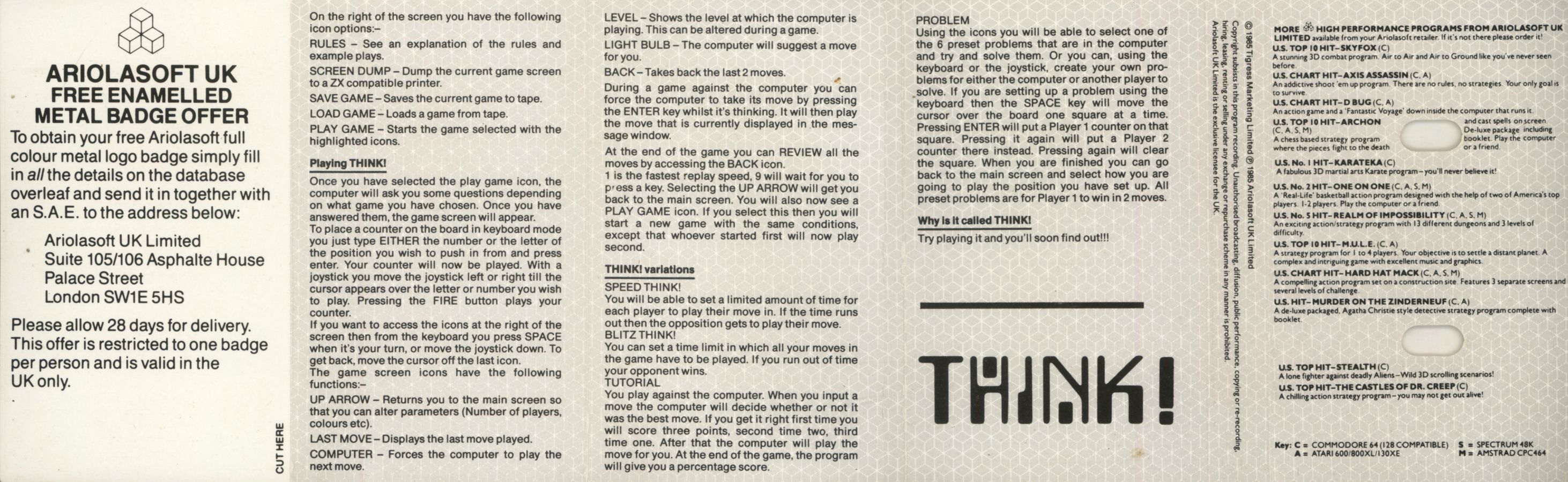
_Back.jpg)
.jpg)
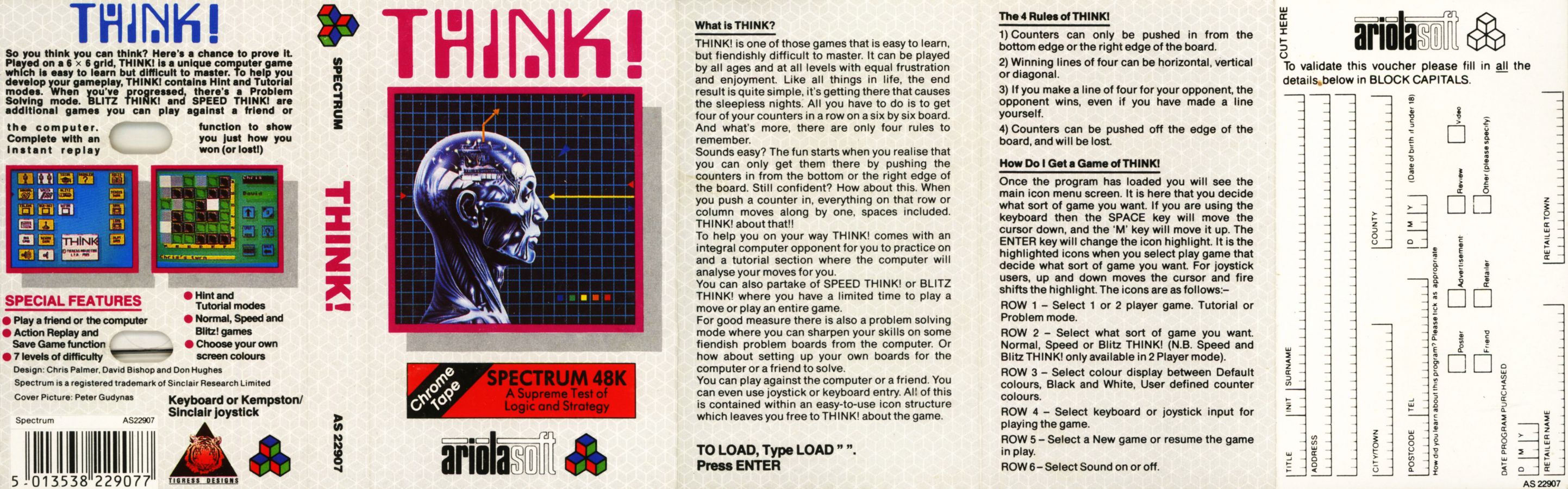
_Media.jpg)
Discussion
Nobody has started a thread about this yet.
Releases
- 1985Ariolasoft UK Ltd Sold as ThinkPound sterling 7.95
- 1985Firebird Software Ltd
Play
- think.rzxRZX playback file
- Think.tzx.zipTape image English16 KB
- Think.tap.zipTape image English15 KB
- Think(FirebirdSoftwareLtd).tzx.zipTape image English16 KB
Documents
- Think.txtInstructions English6 KB
Files and rights
Distribution permission is on record, granted to another archive rather than to this one. Screens and pictures are copied here; everything else links to the archive that holds it.
- AllowedFirebird Software Ltd → WorldOfSpectrum
Credits
- Chris PalmerGame Design/Concept
- David BishopGame Design/Concept
- Don HughesGame Design/Concept
- Tony Barbercredited
- Simon Dunstancredited
- Peter GudynasInlay/Poster Art
Sign in to credit somebody, or say what these people did.
Awards
Scores
In the magazines
- Sinclair User #471986 · Overall5/5
- Your Computer #11986 · Overall Rating5/5
- Your Sinclair #21986 · Overall7/10
- Crash #271986 · Overall82%
- Sinclair User #631987 · Overall4/5
Elsewhere on the web
- WorldOfSpectrum 35 votes7.94
In the magazines 31
ACE (Advanced Computer Entertainment) #6Mar 1988 · p.68
ACE (Advanced Computer Entertainment)
Amstrad CPC, £1.99cs Spectrum, £1.99cs A wonderful idea: make up a boardgame of pure skill, and computerise it. Originally full-price on Ariolasoft you can now pick it up as a budget brain twister, and excellent value it is too. It's a simple looking game, but appearances are misleading. Your aim is to make a horizontal, vertical or diagonal line four pieces long on the game's six by six board. You and your opponent (human or computer) take turns to push counters onto the lower or right-hand edges of the board. As the counter pushes onto the row, any counters already on the row move up or left one square. If this takes them off the edge, they disappear and are lost for good. There's no limit to the number of turns: you just keep playing till somebody wins. The game has interesting subtleties to it and the computer opposition can be very tough indeed on the-harder settings, but it's still hard to pin down quite what makes it so maddeningly addictive: probably just that it's a simple idea very well implemented. A must buy for Spectrum and Amstrad owners, in any case.
Sinclair User #63Jun 1987 · p.744/54/5
Overall 4/5
Tamara Howard 4/5
Label: Firebird Price: £1.99 Joystick: various Memory: 48K/128K Reviewer: Tamara Howard Think!, they said in the SU office. So I did. And after I'd finished thinking, about Life, the Universe and other such things, I got on and played the game from Firebird. Think!, is not really a new game, it's a budget re-release. It got good reviews when it first came out, and it's going to get a good one from me now that it's selling for only €1.99. It's a board simulation game. The idea is to place four of your counters in a line on the board before the computer or a human adversary does. A nice simple idea, and a nice simple game. Playing the computer means a more taxing game, and, indeed, a greater possibility of losing. If, on the other hand, you don't manage to thrash your best friend, or even your pet hamster, then the Tutorial Mode offers helpful and friendly advice on how to win the next time. As far as graphics go. Think!, isn't going to seem tremendously exciting. There are few moving parts, the most interesting manoeuvre being the trundling of colour counters across the board (yawn). But this is a minor fault, and you don't really expect anything more dynamic than that from a board game, do you. Do you? Think! is, though, very neat, very slick and likely to keep the little grey cells ticking over.
Crash #27Apr 1986 · p.2290%80%85%83%87%78%82%
Use of Computer 90%
Graphics 80%
Playability 85%
Getting Started 83%
Addictive Qualities 87%
Value For Money 78%
Overall 82%
Unknown
Unknown
Unknown
Producer: Ariolasoft Retail Price: £7.95 Author: RamJam Corporation, Designed by Tigress Marketing Ariolasoft have moved into the boardgame conversion market with Think! - a variant on the Connect 4 theme. The aim of the game, which can be played by two people or solo against the computer, is very straightforward. Players take turns to move a counter onto a six by six grid from the bottom or right-hand edge. If a player gets four counters in a vertical, horizontal or diagonal line then he wins the game, even if the line was produced by the player's opponent and didn't result from a masterly move on the part of the winner. When a counter is pushed onto the board and enters a row or column which already contains pieces they are all nudged along one square to make room - if the row or column already contains six counters, the sixth counter 'falls off' the board The game can be controlled from the keyboard or with a joystick and all option selections except the player's turn are icon-driven. After loading, the main option screen is presented. Using the cursor and pressing fire or ENTER to select icons, the game is configured according to the player's wishes. One or two players can participate. One player can take the computer on in a normal game of Think!, or can choose between the Tutorial and Problem modes. In the Tutorial game, the human player is allowed to make three attempts at the best move during each turn. If the best choice is made first time, then three points are awarded, two points are given for getting it right second time and one point is collected if the best move is made at the third attempt. At the end of a Tutorial Game the computer reports on the player's performance, giving a percentage rating. The Problem mode allows you to access one of the six in-built problems, which have to be solved in two moves, or devise problems of your own by setting up the board. Home-grown problems can be presented to the computer or a friend for solution. If two players are settling down to a session of Think! they can opt to play a straight game, or can select SPEED Think!, when both players have to make each move within a time limit input at the start. Alternatively, BLITZ Think! can be played, in which each player has a time allocation in which all his moves during that game have to be made - if a player runs out of time then the same is lost. The remaining game control icons on the main option screen allow sound to be toggled on and off, keyboard or joystick to be selected for input, and the colours of the counters used to be set. You can choose your own colours for the counters, accept the default colours or specify black and white if your TV isn't up to full colour display. If the player(s) are in any doubt about the rules, selecting the Rules Icon provides a quick summary of the salient points and accesses a demonstration sequence which plays a few moves on-screen. Once the options have been configured and the players are ready to do battle, selecting the Play Game icon moves the action to the playing area after a few appropriate questions about time limits and player names have been answered. The main screen contains the board itself and a panel of six icons, which give access to the following functions: return to the option screen; display the last move played; force the computer to play the next move; change the computer's skill level; ask the computer to suggest a move and go back over the last two moves. During play, a bar on the bottom of the screen displays the name of the current player, who must press the appropriate number or letter key to select the entry point for his counter. At the end of a game, all the moves can be reviewed by selecting the BACK icon, and choosing a replay speed from 1 to 9. At any point during a game it is possible to flip to the option screen and save the game to tape or dump the screen to a ZX printer. The game in progress can be resumed, or abandoned and a new game started with the same set-up. There's certainly plenty of scope for Thinking! COMMENTS Control keys: SPACE to move cursor down, M cursor up, Enter to highlight icon selected Joystick: Kempston, Interface 2 Keyboard play: fine Use of colour: definable colours for counters, well thought out Graphics: serve their purpose well Sound: just beeps to confirm selections Skill levels: seven levels for your computer opponent Screens: option screen and playing area
Cameron, our photography person, makes another bid for fame. He's just got four counters in a row and beaten the computer. Must have been THINKing hard!
The impressive front-end icon screen which is used to set up the game of your choice before playing THINK!
Your Sinclair #2Feb 1986 · p.306/108/107/108/107/107/10
Graphics 6/10
Playability 8/10
Value For Money 7/10
Addictiveness 8/10
Overall 7/10
Alison Hjul 7/10
Ariolasoft £7.95 Reviewer: Alison Hjul So much for good old fashioned thinking, you'll need a PhD in applied mathematics to get one over the computer in this souped up version of Connect 4. Well, at least that's what I thought 'til the Ed thrashed me... so what better incentive to persevere with the game?' It all sounds pretty mindless - get four counters in a row on a six by six board. But, although its easy to learn, it's a devil to master. You can only push your counters in from the bottom or right of the board and, to heighten your frustration, as soon as you make a move, all the counters on that row or column budge along one. But, just to ease things along, Ariolasoft has provided not only natty little icons with which to select the type of game you wish to play but also a tutorial mode where the computer will only let you select winning moves. Trouble is, on the lower levels, since the computer refuses to think ahead, the game's likely to get itself into a loop as you both place your counter in the only conceivable winning position! If you're into zapping and killing, give this one a miss - strictly one for the strategists.
C&VG (Computer & Video Games) #52Feb 1986 · p.35C+VG Blitz Game8/108/1010/1010/10
C&VG (Computer & Video Games)C+VG Blitz Game
Graphics 8/10
Sound 8/10
Value 10/10
Playability 10/10
MACHINE: Spectrum SUPPLIER: Ariolasoft PRICE: £7.95 Think! I thought. I moved. I lost. But was I disappointed? Not one jot. Ariolasoft, mainly known for their imports of American software, has come up with a gem of a game with Think! And it's British, designed by the brains at Tigress Marketing. Think! contains that all too rarely found quality: a new and simple idea cleverly executed. Basically, Think! is a board game on computer, easy to learn, difficult to master. All you have to do is get four of your counters in a row on a six by six grid. You play against a friend or the computer, making alternate moves. The winning lines can be vertical, horizontal or diagonal. The counters can only be moved onto the grid from the bottom or right edge of the board. When a new counter is introduced into the grid everything in that line or column is moved along - including the spaces. Get the idea? One clever - or false move - can change the whole complexion of the game. A seemingly certain victory can become defeat. There are seven levels of difficulty, hint facilities, different speed games and set problems to solve. Think, is instantly playable, brilliantly simple and lastingly addictive. We think it's a winner. The scores for graphics and sound are not really relevant as they are not vital to the game.
Sinclair User #47Feb 1986 · p.625/55/5
Overall 5/5
Chris Bourne 5/5
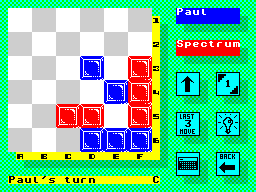
Publisher: Ariolasoft Price: £7.95 Memory: 48K Joystick: Kempston, Sinclair It's not often you find a new strategy game - most are direct copies of old fashioned board games. Think! from Ariolasoft has the advantage of being designed for a computer, and although it would be possible to play without one, it would certainly be difficult. Designers David Bishop, Don Hughes and Chris Palmer have produced a variant on the four-in-a-row group of games where you have to construct a line of four counters on a grid. Think! differs, however, by producing some radically new strategies for winning, by the addition of some novel rules. There are only four rules in all. Counters can only be placed on the bottom row or right hand edge of the six-by-six board. When a counter is placed on the board, it pushes all the other counters on its column or row one space further along - the spaces shift too. Counters can be pushed off the edge of the board and are then lost, and although the winner is the first to get a line of four, if he gives his opponent a line at the same time, he loses. Simple, eh? It is indeed, but the problems start with visualising the state of the board a couple of moves ahead, when whole lines can shift. It's very easy to give the game away by overlooking a move. You'll have gathered by now that I'm rather taken by the game, not least - perhaps - because I screwed a resignation out of designer David Bishop a few weeks ago. But the game would be nothing without the fine implementation by the programmers of Ramjam, Ariolasoft's in-house team. The game can be played via joystick using an icon system which is very clear, and offers a wide number of options. There are seven levels of play, although after level five the response gets very slow. You can opt for single, double, tutorial and problem mode. The tutorial mode scores according to the speed with which you find the best move, it's only really useful above level four, as it tends to suggest moves which can lead to perpetual stagnation. The problem mode comes with a library of 'mate in two' problems which should test your ability to spot some of the more subtle tactics in the game. You can also redesign the colours of the pieces, switch the sound on and off, watch the computer checking out its best moves, get hints, replay old games and all the usual options associated with good Chess and Othello programs. Play is very fast for the first three levels, and fast enough on the next two - the computer can analyse its position much better than you, and plays a mean game at higher levels. For strategy fans, Think! is well worth trying. While it's still hard to see whether the opening player has the advantage, some opening moves and strong positions have already been identified. For example, a counter on F or 6 is usually a good opening move, worth playing early. Strong formations include a T-square - three in a row with one piece underneath the centre - or counters on 4,5,D and E simultaneously. Those will prove winning formations if you play wisely. As well as those positions, try to build up forces around D4 and E5, which will later get shunted further afield to provide useful points for diagonal rows. As with games like chess, a direct assault is likely to fail compared to efforts to disguise your tactics and suddenly unlease several threats. In the position shown, where blue must play and win in two moves, blue can threaten to win with counters on C, D, E, F, and 6, but only the counter on six generates enough threats to win immediately. The others rapidly lose the initiative to the red player. That subtlety of tactics becomes overwhelming with a full board, particularly when it is only possible to survive by using the rule about not making a line for your opponent. Full marks, then, to Ariolasoft and Co for a demanding, intriguing game. Let's have some letters about opening tactics from those of you who find Think! as much fun as I have.
... Blue plays a counter to 6 and now red has no move left. Blue threatens to play D but any red move to prevent that will give blue a new line of three to complete.
Blue to play and win within two moves...
The menu with icon-selection. You can even print out positions.
Your Computer #1Jan 1986 · p.395/53/55/54/55/55/5
Graphics 5/5
Sound 3/5
Playability 5/5
Value For Money 4/5
Overall Rating 5/5
Lee Paddon 5/5
Spectrum Ariolasoft Board Game £7.95 Board-games on computers have had a chequered history. Playing games like Connect-4 is just as easy with a pencil and paper as on a computer. But Ariolasoft think they have a winner on their hands with a board-game which can only easily be played on a computer. The board consists of a six-by-six grid. You play counters alternately to either the bottom row or the right-hand column. If you play to a column, that column, all counters and spaces, move up one, and the same with rows. The object is to get four pieces in a row Connect-4 style. The fact that a whole row or column moves when just one piece is played makes it very hard to look more than a couple of moves ahead to try and force a win. The game is designed by Tigress Marketing, and a lot of time and effort appears to have gone into attractive presentation. The "front-end" of the game is nicely designed, with icons allowing you to select various game options. Seven levels of computer opponent, normal, timed or "blitz" play, sound, colour and joystick options. Although easy to learn, it takes a great deal of time to master. Even beating the computer at a low level is quite an achievement. At the higher levels the computer takes rather a long time, but you can prompt it to move when you get fed up. There is a tutorial mode, where the computer gives you points for the quality of your moves, there is a problem-solving mode and a move take back feature. An intriguing, original board-game well presented.
Think: Very well presented.
News/Note10
- ACE (Advanced Computer Entertainment) #8May 1988 · p.101
- ACE (Advanced Computer Entertainment) #7Apr 1988 · p.109
- ACE (Advanced Computer Entertainment) #6Mar 1988 · p.108
- ACE (Advanced Computer Entertainment) #4Jan 1988 · p.143
- Crash #41Jun 1987 · p.10
- Popular Computing Weekly #18May 1987 · p.53
- Your Sinclair #2Feb 1986 · p.5
- Crash #25Feb 1986 · p.9
- Computer Gamer #10Jan 1986 · p.6
- Home Computing Weekly #130Sep 1985 · p.9
Full-page ad6
- Your Sinclair #3Mar 1986 · p.10
- Computer Gamer #12Mar 1986 · p.33
- C&VG (Computer & Video Games) #53Mar 1986 · p.33
- Crash #25Feb 1986 · p.21
- Sinclair User #46Jan 1986 · p.121
- Popular Computing Weekly #51Dec 1985 · p.15
Feature4
- ACE (Advanced Computer Entertainment) #37Oct 1990 · p.113
- Your Sinclair #31Jul 1988 · p.72
- ACE (Advanced Computer Entertainment) #6Mar 1988 · p.65
- Popular Computing Weekly #51Dec 1985 · p.11
Review3
- MicroHobby #129May 1987 · p.17
- Popular Computing Weekly #3Jan 1986 · p.15
- Computer Gamer #10Jan 1986 · p.73
Advert1
- Crash #29Jun 1986 · p.10
Remakes
- Think Again2003PC/Windows
Miki Olsz/Action! Productions
- Kameny2003Javascript
Pavel Chalupa
- ReThink2010Java, J2ME
Unforgiven.pl
Related
- Versions
- Phipps Associates BASIC Compiler (Authored with)
- Ports
- (Amstrad CPC)
- Same entry at
- Spectrum ComputingZXInfo
Reviews from people here
Sign in to write about this, or make an account. It takes a minute and lets you correct the catalogue too.
No description recorded.
Sign in to correct or add to this.
Hold the rights to this and want it taken down?