
Time-Gate
Arcade Game: Shoot-em-up · ZX-Spectrum 48K · 1 players
Quicksilva Ltd · 1982 · Pound sterling 6.95
Also known as 4D Defender (English), 4D Time-Gate (English), 4D Timegate (English), 4D Ufo Attack (English), Time Gate (English), Time Gate (English), Time Gate (English), Timegate (English)
_Back.jpg)
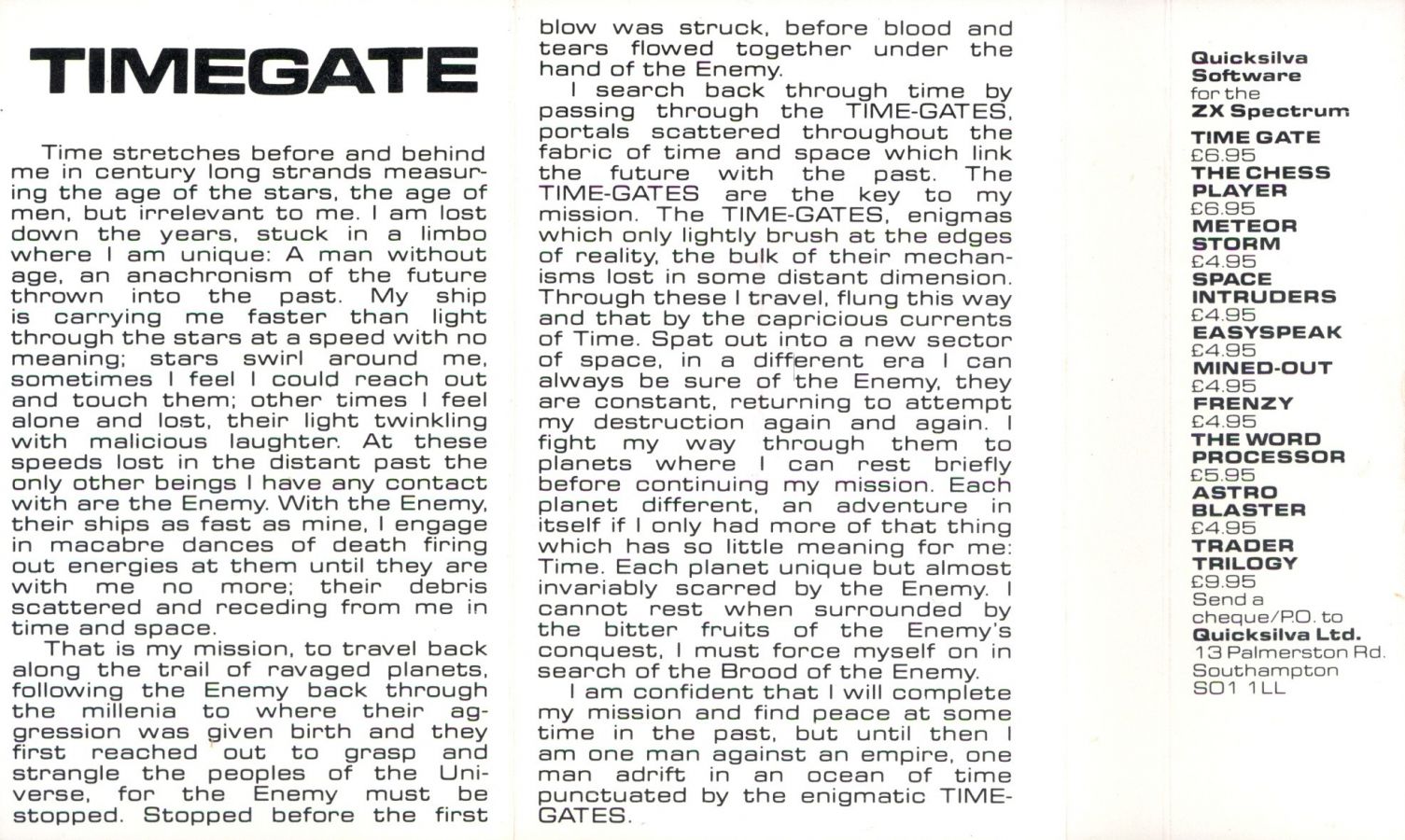
(ZXUserClub).jpg)
(InvestronicaS.A.).jpg)
(Microbyte).jpg)
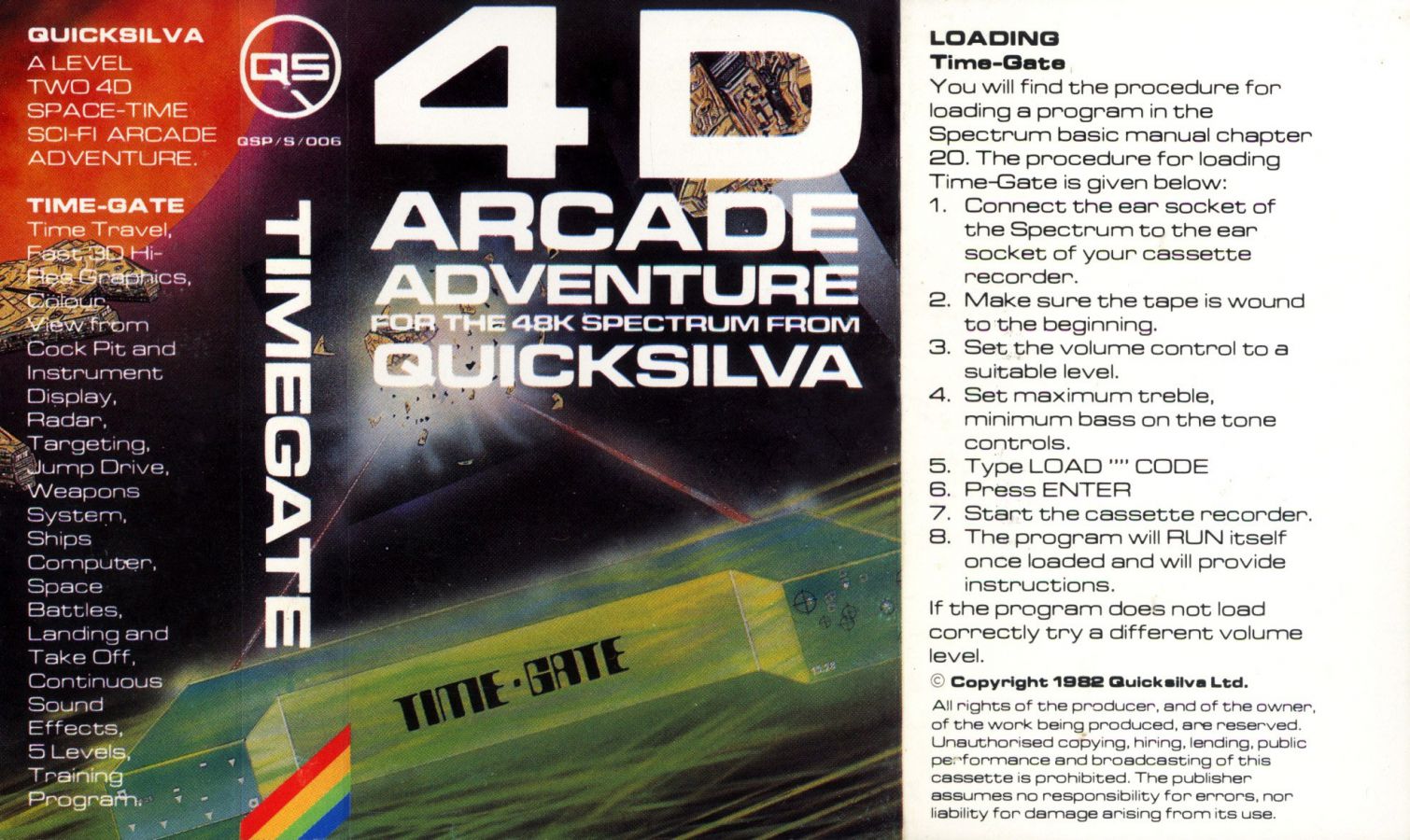
_Front.jpg)
(Aackosoft)_Front.jpg)
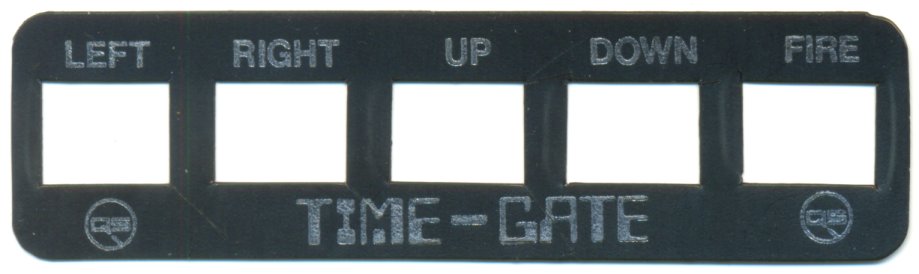
(ElettronicaCS).png)
_SideB.jpg)
(Aackosoft)_Media.jpg)
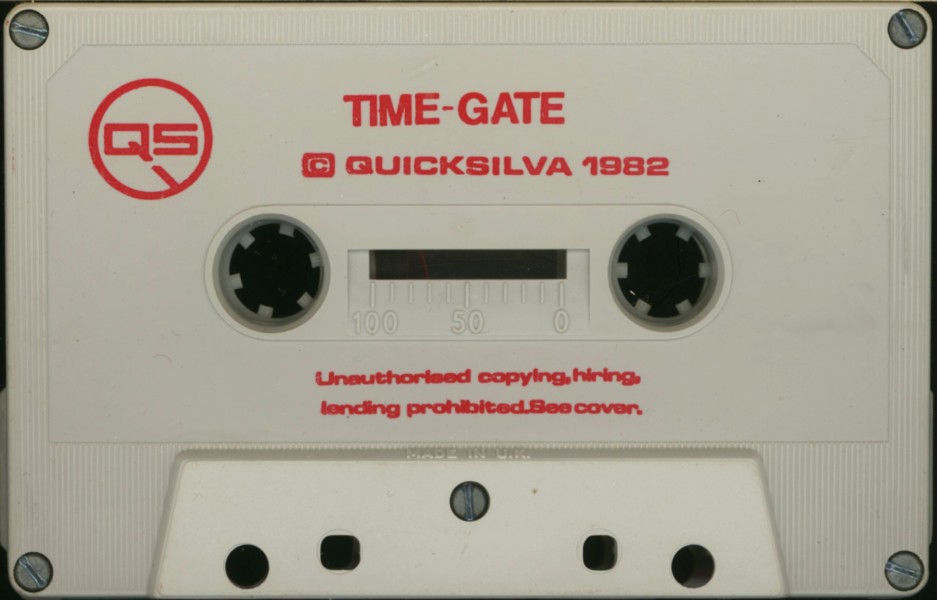
_SideA.jpg)
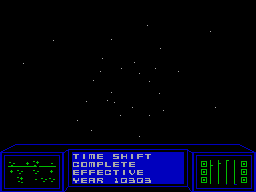
(InvestronicaS.A.).jpg)
Discussion
Nobody has started a thread about this yet.
Awards
Rank #50 - 1984 Sinclair User Top 50 Spectrum Software Classics
Releases
- 1982Quicksilva Ltd Sold as 4D Time-Gate, 4D Timegate, TimegatePound sterling 6.95
- UnknownAackosoft Sold as Time Gate
- 1983Elettronica CS Sold as 4D Defender
- 1983Investronica S.A. Sold as Time GateSpanish peseta 2350.00
- 1987Microbyte [ES] Sold as Time Gate
- UnknownZX User Club Sold as 4D Ufo Attack
- UnknownZX DataDanish krone 150.00
Play
- Time-Gate.tzx.zipTape image English14 KB
- Time-Gate.tap.zipTape image English14 KB
- Time-Gate(4DDefender)(ElettronicaCS).tzx.zipTape image English14 KB
- Time-Gate(InvestronicaS.A.).tzx.zipTape image Spanish14 KB
- Time-Gate(Microbyte1).tzx.zipTape image Spanish14 KB
- Time-Gate(ZXData).tzx.zipTape image English14 KB
- Time-Gate(TimeGate)(Aackosoft).tzx.zipTape image English15 KB
Documents
- Time-Gate.txtInstructions English2 KB
- Time-Gate(TimeGate)(Aackosoft)(NL).pdfInstructions Dutch933 KB
Files and rights
No permission is on record either way. Screens and pictures are copied here on a take-down basis: if you hold the rights and want something removed, say so and it goes.
Credits
- John Holliscredited
- Craig HamiltonInlay/Poster Art
Sign in to credit somebody, or say what these people did.
Scores
In the magazines
- Sinclair User #101983 · Gilbert Factor8/10
- Sinclair User1984 · Gilbert Factor8/10
- Sinclair User #271984 · Gilbert Factor8/10
Elsewhere on the web
- WorldOfSpectrum 35 votes8.18
In the magazines 88
Sinclair User #32Nov 1984 · p.52
The first 3D arcade game for the Spectrum was brought out in 1982 and produced mixed reaction from reviewers. It has, however, continued to be popular with gamers which is surprising in a market which is so flexible and prone to changes in taste and moods. The plot involves an attempt by the player to locate the base of the evil aliens who are intent on taking over the galaxy. That involves flights up and down the time lanes through time gates which can be accessed after all the aliens in a sector have been destroyed. Position 50/50
Sinclair User #27Jun 1984 · p.628/108/10
Gilbert Factor 8/10
John Gilbert 8/10
THE PLOT THICKENS The frantic zap of arcade software has given way to calmer play and strategic thinking. John Gilbert investigates. TIME GATE Memory: 48K Price: £6.95 CODENAME MAT Memory: 48K Price: £6.95 STONKERS Memory: 48K Price: £3.95 HALLS OF THE THINGS Memory: 48K Price: £7.50 MAZIACS Memory: 48K Price: £6.95 The 'Zap-Em' type of arcade game, although still around, has undergone a transformation which started in earnest in the middle of last year. Games manufacturers with an eagle eye on the industry saw that the time would arrive when arcade games, such as Space Invaders and Centipede, would fade in popularity and that something had to be added to make them more appealing. The one aspect which games such as those already had was strategy. In games such as Space Invaders, strategy is needed to evade the aliens and at the same time fire at them. A good game will infer a strategy to the player and a good player is one who can assimilate that method of play quickly. Software houses decided that the most obvious way to increase interest in the arcade style of game was to emphasise the strategy aspect. That is done either by putting strategy games in an arcade format or by slowing the action to accommodate structured thought instead of quick-fire intuition. The move worked well and games like Time Gate, Stonkers and Codename Mat prove it. Time Gate reached the market shortly after the Spectrum arrived in great quantities and it is one of the first games for the machine produced by Quicksilva. The game centres on a conflict between the peoples of the free universe and the incredibly evil and ancient race of Squarm. At the launch Quicksilva promoted it as the ultimate sci-fi space adventure and, with its 3D representation of space through the window of a fighter and the depth of story deadline, it was at that time. The strategy of the game is centred on finding the aliens using the instrument panel of your spaceship and then destroying them. It was given added depth by spreading the Squarm through space and time so that the player has to lock-on to a particular sector in space and spacewarp there. In some ways Quicksilva produced a game which crosses Space Invaders with the mainframe computer game Star Trek. It was that aspect initially which drew customers who wanted something different and who were ever-willing to part with their money. Unfortunately, Time Gate is an example of how the software scene can change overnight. A few months after its release the game attracted much criticism and the Squarm have made many players squirm. At the release, about a year ago, Time Gate was described as incredible but since then players and critics alike found that it had limitations, not least of which was the plot. The storyline is too much like a revamped version of Star Trek. Time Gate is still available from Quicksilva and costs £6.95. Codename Mat, for the 48K Spectrum, is a new release from Micromega which could be described as an advanced version of Time Gate or an extremely good interpretation of the Atari Star Raiders. The strategy element in the arcade game is obvious, as you have to plot your way through the solar system, passing through star gates to spacewarp into another system. The solar system is broken into sectors which have a planet or satellite as bases. The planets are taken from our solar system and include Mars, Jupiter and Earth. Each of those planets is under attack from the Myons and it is your job, as a teenager with the knowledge of the universe, to stop them. There are two levels of play depending whether you want to use a lone ship or whether you want to be the commander of a task force. The latter is the most difficult as you can engage in several conflicts at the same time by using subspace radio, which seems to have an immediate effect on the sector you have selected. If all your ships in one sector are destroyed, the planet could be destroyed and you have lost part of the game. If you see the situation where you could lose ships in another sector you will need to use your cunning and skill to build a battle strategy. The arcade part of the game occupies about 50 percent of playing time and involves shooting through space and chasing the enemy fighters and motherships. It can only be described as classic arcade action combined with moments of strategic thinking to scan computer banks for information about the movement of hostile craft and about which planetary system are in danger. Codename Mat could almost be described as state-of-the-art in software and it is close to a simulation in space-game terms. One of the most notable aspects is that the routine to generate the 3D graphics is only 200 bytes long. The compactness of the graphics routines means that the author has been able to concentrate on developing the depth and storyline of the game and that is obvious from the start. Unfortunately, although the game is more advanced than Time Gate, the storyline is weak, as it seems to be a collection of unoriginal ideas. Luckily those ideas fuse together well and the plot stands on its own. Codename Mat can be obtained from Micromega and costs £6.95. Manufacturers and authors have not limited arcade strategy games to the depths of space. They have also done the opposite of giving arcade games touch of strategy and given strategy games on arcade feel. Stonkers, for the 48K Spectrum from Imagine, is a prime example of that type of game. The player is given command of land-based forces, including tanks and infantry, which are grouped in the top right-hand corner of the screen. The enemy is based across the river on the other side of the screen and to reach a suitable combat position one or other side has to cross the bridge. When you start to play, a map of the whole theater of war is displayed. You can issue commands to active units on the map by positioning a cursor over the map position you require. One of two actions will occur. If you are on the big map you will zoom in to a detailed display of the location specified. If you are already zoomed in you can position the cursor over a fighting unit and by moving the cursor to the position you want it to take up, it will start to move towards that locality. The use of a cursor to plot strategy is inventive and imagine has put much effort into the game. It should take weeks for a player to work out a plan of strategy to defeat the foe, mainly because of the immense landscape on which play takes place. The game is a cross between the usual type of battle strategy game such as Apocalypse from Red Shift and the arcade game Battlezone. Imagine has succeeded in producing a game which combines arcade quality graphics and strategic action. Stonkers can be obtained from imagine for £3.95. Maze games, such as Pac-man, have not escaped the eye of software houses keen to think of new plots. The munch-munch of the Pac-Man has been replaced by ponderings, such as 'Where is the treasure?' of the hero or heroine. That type of game is well-illustrated with such programs as Ant Attack, from Quicksilva, Maziacs from dk'Tronics and the irrepressible Halls of the Things from Crystal Computing, which still seems to be out-selling everything on the market. Halls of the Things, in which the player has to collect a certain number of rings of power in a maze before being destroyed by the monsters, started a craze for the so called all-graphics adventures in which cartoon-style arcade graphics were combined with adventure plots. Most of those games take place in dungeons and feature magic and sword play. Several companies have followed the excellent crystal game, although unlike the state of play with arcade games nobody has copied original Crystal ideas as the area is so rich in concept material. Halls of the Things can be obtained from Crystal Computing and costs £7.50. Maziacs, for the 48K Spectrum, is from dk'Tronics and is another example of the genre. It has a different graphics style from Halls of the Things which some would say is bolder and better and is more in line with the graphics which Ultimate Play the Game produces. The plot involves finding a treasure chest in a maze which you must drag back home without being killed by the Maziacs, which can get into terrible sword fights with your player-character. To find the way to the treasure you have to make contact with the prisoners who are strung along the corridors of the maze. The fight sequences are incredibly detailed. You will again need to develop a strategy over a period of time to win. Maziacs can be obtained from dk'Tronics and costs £6.95. To succeed, arcade-strategy games must produce an effect for the player like that produced by an ordinary zap'em game. It is the way the addiction is created which makes the difference. In an ordinary arcade game the effect is created through a need to destroy aliens and make a high score. Arcade-strategy games are different, as they rely on the user's mind. It is the strategy as well as the graphics which keeps the player returning for more. The combination of arcade techniques and strategic thinking has made the arcade-strategy game very popular. The insurgence of that type of program means that the customer has two types of game in one and the reality of the plot, through the realism of the arcade graphics, takes the games industry one step forward. The main criticism for a long time is liable to be that the plots on which the games hang are not original enough. We are, however, just beginning to see a change in arcade style, where bang and zap are replaced by plot and thought.
'Time Gate is an example of how the software scene has changed overnight. A few months after its release the game attracted criticism.'
adventures' 'Halls of the Things started the craze for all-graphic.'
Crash #3Apr 1984 · p.66
Quicksilva, 48K £6.95 Excellent moving star backgrounds, in 3D give a real space feeling to this 5-skill level game. Long range scan shows you where the enemy are and you jump through space to the correct sector. Movement control is instant and keeping the enemy in your sights is a tough task helped by a joystick (Kempston). If you're successful at clearing the entire galaxy you can land on the aliens' planet to refuel before jumping the timegate to another infested galaxy. Full damage status readouts. Highly recommended.
Crash #2Mar 1984 · p.50
Quicksilva, 48K £6.95 Excellent moving star backgrounds, in 3D give a real space feeling to this 5-skill level game. Long range scan shows you where the enemy are and you jump through space to the correct sector. Movement control is instant and keeping the enemy in your sights is a tough task helped by a joystick (Kempston). If you're successful at clearing the entire galaxy you can land on the aliens' planet to refuel before jumping the timegate to another infested galaxy. Full damage status readouts. Highly recommended.
Crash #1Feb 1984 · p.48
Quicksilva, 48K £6.95 Excellent moving star backgrounds, in 3D give a real space feeling to this 5-skill level game. Long range scan shows you where the enemy are and you jump through space to the correct sector. Movement control is instant and keeping the enemy in your sights is a tough task helped by a joystick (Kempston). If you're successful at clearing the entire galaxy you can land on the aliens' planet to refuel before jumping the timegate to another infested galaxy. Full damage status readouts. Highly recommended.
Sinclair User1984 · p.208/108/10
Gilbert Factor 8/10
John Gilbert 8/10
ARCADES BROUGHT INTO THE HOME John Gilbert reviews more complex games. Almost every major type of arcade game has been simulated on Sinclair computers. There are also new games which have an arcade format but have evolved on a microcomputer. The Spectrum is an ideal machine on which to play arcade games. The quality of them has improved substantially since the launch of the machine. Some of the first arcade games to be produced for the Spectrum were versions of Space Invaders, the game which started the arcade craze. Spectral Invaders was the first to be announced by Bug-Byte, which was already renowned for its arcade and adventure games on the ZX-81. So far it is the game which most closely resembles the original arcade version. Although it is slow it is difficult to score points, as you can fire only one laser blast at a time. Another invaders game, Space Intruders, was launched at about the same time as Spectral Invaders. The game is much faster and is recommended for those who like to keep their fingers on the fire button and amass a big score. The only criticism is that the aliens and mothercraft are very small and the mothership is blue on a black background and so is very difficult to hit. Apart from that Space Intruders from Quicksilva is good value at £5.95. Namtir Raiders, for the ZX-81, is a space invaders game with a difference from Artic Computing. The player still has to face the hordes of aliens which come down the screen but the laser base can be moved up and down as well as left and right. The player has five laser bases during the game and they can take only five hits from alien bombs. There are three levels of difficulty-easy to impossible. The game, costing £3.95, is addictive and the graphics are neither awkward in design nor jerky in movement. The game which is gaining popularity with 48K Spectrum owners is Time Gate, from Quicksilva. The authors claim that it is the ultimate in 3D arcade space action. The game is loaded in two parts, the first being a lengthy instruction manual. After the manual has finished you can load the game. The object is to destroy a race of aliens called the Squarm who are trying to colonise Earth. The enemy fighters are also seen in 3D and so are the planets on which the player can land to refuel and repair the ship. It is by far the best arcade action game so far for the Spectrum and costs only £6.95. Asteroids is also becoming popular on Sinclair machines. One of the first companies to launch a version for the ZX-81 was Quicksilva. It was a good version on such a small machine and is still proving popular. Quicksilva has also introduced a Spectrum version called Meteor Storm. It has the added attraction of speech before play. It is difficult to hear the words but we are informed by the authors that it says "Meteor Alert... Meteor Alert...". Meteor Storm is a novel version of Asteroids and costs £5.95. Sinclair Research has a good game of asteroids, called Planetoids, in its new Spectrum Software library. The asteroids are in 3D and much careful design work on both the asteroids and the player's ship seems to have gone into the game. Planetoids costs £5.95. Artic Computing seems to be the only company to have produced a version of Galaxians for the ZX-81. ZX-Galaxians looks like Space Invaders but the invaders are 'V'-shaped and are supposed to be inter-galactic birds. The birds swoop from formation and bomb the player's laser base. ZX-Galaxian is slow in action but can still be a very addictive game. It costs £4.95. Defender is still a much-sought-after game in the arcades and Artic Computing took advantage of that early by producing a version for the ZX-81. The graphics are not particularly interesting and the spaceship which the player flies across the landscape is made up of a series of blocks which look only slightly like a ship. Despite those criticisms, the original idea behind the game is still there and the Artic version can be exciting, as you see the enemy ships rushing at you from the other side of the screen. With the arrival of the Spectrum, many manufacturers found an interest in the arcade game Scramble. The best and fastest version so far is from Mikro-Gen. In the game you have to go through caves which become smaller and smaller as it progresses. The game becomes progressively more difficult and can be run in slow, normal and fast modes. It costs £3.95. Silversoft has a Scramble-type game called Ground Attack. It works on the same principles as the Mikro-Gen game but is much slower. There is a good deal of blank screen between game rounds and the average waiting time between rounds is 15 seconds. Ground Attack costs £5.95. The range of arcade-type games on Sinclair machines is always increasing. Manufacturers seem to feel safe in producing standard arcade games such as Space Invaders and Scramble. Those games, especially for the Spectrum, are becoming more imaginative and the graphics and sound more impressive. Manufacturers have to be careful about copying ideas from other games but with the imagination of some of the firms in the Sinclair market, children and many adults will be kept happy with arcade-type games on the ZX-81 and Spectrum for a long time. Space Invaders games have now been overtaken by Pacman in popularity. Bug-Byte, [redacted]. Quicksilva, [redacted]. Artic Computing, [redacted]. Sinclair Research, [redacted]. Mikro-Gen, [redacted] RG12 2BK. Silversoft, [redacted].
ZX Computing #6Apr 1983 · p.83
Phil Garratt
INTO THE FOURTH DIMENSION A review of the new 4-D adventure from Quicksilva, with Phil Garratt at the helm. Three dimensions were not enough for the latest addition to Quicksilva's long line of machine code arcade games. Time-Gate involves travelling backwards through the fourth dimension, time itself. We are told that the two thousand year old interstellar Empire founded by Earth was happily going the way of all empires, that is into decline, when the Squarm turned up. They are a race of insectoid reptiles, and before long they had taken over the entire Empire, except for a few planets centered on the Earth. The Temporal Brotherhod decide to overthrow the Squarm, but instead of doing the decent thing and fighting it out man to man (or rather man to reptile), they hit on a sneaky trick. They dig out the two thousand year old Void-Runner 1, a trans-dimensional space ship, and give you the mission of travelling back through time via the Time-Gate until you can destroy the Squarm's home planet before they ever left it. THE EMPIRE STRIKES BACK The galaxy is made up of 18 sectors, one of which contains the Time-Gate which your ship will automatically pass through provided there are no enemy ships in the sector. Knocking out the enemy ships is the central part of the game which all the rest has been tacked onto. The top two thirds of the TV display are used for the three-dimensional view of space, and as you steer your craft, the stars swirl round according to your movement. When ships appear they weave in every direction, diving nearer and further away, all the time firing pot shots at you. You have to manoeuvre your craft until the enemy is in line with your two lasers, which fire from either side converging into the centre. I found it best to try to line up the alien along one or other of the beams rather than try to hit it at the narrow point where the beams meet. Unless you get a lucky shot, it will usually take four hits to knock out the opposition, and you can tell when a hit has registered because the enemy ship changes colour. An unusual arrangement of keys are used for movement - 6 and 7 for left and right, 8 and 9 for up and down. Zero fires the lasers. The program comes with a little keyboard overlay to help you remember them, but before long the keys are memorised and then the overlay tends to get in the way rather than help. The bottom third of the TV display is your instrument panel. To the left is the long range scanner which shows all 18 sectors. Alien ships are marked as a short line, and a planet, where you can have repairs done, is shown as a cross. The display is very small indeed, and some people with ropey TVs (or eyesight!) may have some difficulty. In the centre of the console display is the message system, which flashes up details about damage sustained and other information as the game progresses. To the right is the target computer display, which consists of four horizontal lines each with a marker on it and is only active when there are enemy ships in the area. The first two lines are the vertical and horizontal tracking indicators and when you have steered Void-Runner 1 so that the markers are in the middle, you are right behind the 'baddie'. The third indicator gives the closing speed and the fourth, the distance between you and the target. The enemy are scattered randomly within the sector, and you can have quite a long wait before they appear on the upper display. SET THE CONTROLS... The last console instruments are the status indicators for shields, weapons, engines, etc. They start off green and go steadily darker as the systems are damaged, until they turn blue which means that that function is knocked out. When you take a hit, the damage seems to be allocated randomly to one of the various systems, so if you're unlucky all the damage may be done to just one system, and if it takes another hit after the indicator has turned blue, your ship is destroyed. The rest of the control keys are as follows - 1 to 5 control your warp speed, and you can tell when you go faster because the stars rush by, and the engines, which make a constant hissing sound, go to a higher pitch. To jump to a different sector, you press 'L' until the flashing indicator on the long range scanner is over the sector you require, and then press 'J'. You then make your jump, accompanied by some impressive sound and visual effects. To carry out repairs, you have to jump to a sector with a planet and knock out any aliens. Then pressing 'P' causes a landing, also accompanied by very ingenious graphics. All your systems are then restored to 'green' status; however, this does result in the unfortunate planet's destruction. Perhaps they would have been better off under the Squarm! 'H' suspends the game and 'S' restarts it, and 'Shift Space' aborts the current run. The game progresses by knocking out as many aliens as possible, finding the Time-Gates, stepping back through time to year zero, then finding the Squarm home planet and firing your Meson Ram to destroy it. The game can be played on 5 levels, and at the higher levels the time steps get smaller, and as each earlier galaxy has more and more aliens, the game gets progressively harder. IS THAT ALL!! The biggest fault with Time-Gate is undoubtedly the scoring system. Several times I battled my way through hordes of aliens, eventually to destroy the Squarm home base, to find I had scored between 10 and 40 points! I queried this with Quicksilva, and they said that the score is based more on your skill factor, ie how quickly and efficiently you knock out the aliens, rather than how many. I was told that the best tactics were to stay at warp 1 (the slowest) while in a sector chasing and fighting aliens, only using warp 5 for the jump to the next sector, and putting off repairs for as long as possible. The program comes in two 34K parts. The first gives you the scenario and rules, and goes through the cockpit display and function keys. The program has provision for the use of a Kempston joystick, and has information about how to link in other makes. The second lot of 34K is the program proper. The documentation is rather lacking - you have to note down the control keys yourself, no information is given about scoring, and nowhere is it mentioned that you can LOAD the second part (the game proper) without going through the instructions. Still, graphics are what arcade games are all about, and Time-Gate certainly has great graphics. At £6.95 (48K Spectrum only), another winner for Quicksilva. Time-gave is available from Quicksilva, [redacted].
Sinclair User #11Feb 1983 · p.62
John Gilbert
SINCLAIR BRINGS THE THRILL OF THE ARCADE INTO YOUR HOME With the Spectrum, program writers have been able to write more complex games. John Gilbert investigates this new move. Almost every major type of arcade game has been simulated on Sinclair computers. There are also new games which have an arcade format but have evolved on a microcomputer. The Spectrum is an ideal machine on which to play arcade games. The quality of them has improved substantially since the launch of the machine. Some of the first arcade games to be produced for the Spectrum were versions of Space Invaders, the game which started the arcade craze. Spectral Invaders was the first to be announced by Bug-Byte, which was already renowned for its arcade and adventure games on the ZX-81. So far it is the game which most closely resembles the original arcade version. Although it is slow it is difficult to score points, as you can fire only one laser blast at a time. By the time the laser bolt has reached the place where you wanted it to go, the target invader has moved on. That means that a great deal of anticipation and skill is required. Graphically, the Bug Byte Invaders is the best, with rows of different-colour aliens crossing the screen and large motherships moving from one side of the screen to the other at random intervals. Spectral Invaders is well-presented and costs £5.95. Another invaders game, Space Intruders, was launched at about the same time as Spectral Invaders. The game is much faster and is recommended for those who like to keep their fingers on the fire button and amass a big score. The only criticism is that the aliens and mothercraft are very small and the mothership is blue on a black background and so is very difficult to hit. Apart from that Space Intruders from Quicksilva is good value at £5.95. Namtir Raiders, for the ZX-81, is a space invaders game from Artic Computing with a difference. The player still has to face the hordes of aliens which come down the screen but the laser base can be moved up and down as well as left and right. The greater movement permitted to the player is compensated by the hail of bombs dropped by the aliens and the size and power of alien ships. There are four waves of aliens and as the game progresses the ships get bigger until the giant mothership arrives. The player has five laser bases during the game and they can take only five hits from alien bombs. There are three levels of difficulty - easy to impossible. The game, costing £3.95, is addictive and the graphics are neither awkward in design nor jerky in movement. The game which is gaining popularity with 48K Spectrum owners is Time Gate, from Quicksilva. The authors claim that it is the ultimate in 3D arcade space action. The game is loaded in two parts, the first being a lengthy instruction manual. After the manual has finished you can load the game. The object is to destroy a race of aliens called the Squarm who are trying to colonise Earth. To do that the player must fight the enemy in space and go through time by locating a series of Time Gates to find the Squarm's base. The pleasant thing about the game is its graphics. The player is at the controls of a space fighter and look out into a 3D representation of space. The enemy fighters are also seen in 3D and so are the planets on which the player can land to refuel and repair the ship. It is by far the best arcade action game so far for the Spectrum and costs only £6.95. Asteroids is also becoming popular on Sinclair machines. One of the first companies to launch a version for the ZX-81 was Quicksilva. It was a good version on such a small machine and is still proving popular. Quicksilva has also introduced a Spectrum version called Meteor Storm. It has the added attraction of speech before play. It is difficult to hear the words but we are informed by the authors that it says "Meteor Alert... Meteor Alert...". Meteor Storm is a novel version of Asteroids and costs £5.95. Sinclair Research has a good game of asteroids, called Planetoids, in its new Spectrum Software library. The asteroids are in 3D and much careful design work on both the asteroids and the player's ship seems to have gone into the game. Planetoids costs £5.95. Artic Computing seems to be the only company to have produced a version of Galaxians for the ZX-81. ZX-Galaxians looks like Space Invaders but the invaders are 'V'-shaped and are supposed to be inter-galactic birds. The birds swoop from formation and bomb the player's laser base. ZX-Galaxian is slow in action but can still be a very addictive game. It costs £4.95. Defender is still a much-sought-after game in the arcades and Artic Computing took advantage of that early by producing a version for the ZX-81. The graphics are not particularly interesting and the spaceship which the player flies across the landscape is made up of a series of blocks which look only slightly like a ship. Despite those criticisms, the original idea behind the game is still there and the Artic version can be exciting, as you see the enemy ships rushing at you from the other side of the screen. Now that the Spectrum has arrived, many manufacturers have found an interest in the arcade game Scramble. The best and fastest version so far is from Mikro-Gen. In the game you have to go through caves which become smaller and smaller as it progresses. There are four sectors to the game, including Missiles, UFOs and Meteors. The player has to destroy the missiles which are fired from the ground at the players' ship, destroy UFOs with a laser blaster, and dodge the meteors. The game becomes progressively more difficult and can be run in slow, normal and fast modes. It costs £3.95. Silversoft has a Scramble-type game called Ground Attack. It works on the same principles as the Mikro-Gen game but is much slower. There is a good deal of blank screen between game rounds and the average waiting time between rounds is 15 seconds. Ground Attack costs £5.95. The range of arcade-type games on Sinclair machines is always increasing. Manufacturers seem to feel safe in producing standard arcade games such as Space Invaders and Scramble. Those games, especially for the Spectrum, are becoming more imaginative and the graphics and sound more impressive. Manufacturers have to be careful about copying ideas from other games but with the imagination of some of the firms in the Sinclair market, children and many adults will be kept happy with arcade-type games on the ZX-81 and Spectrum for a long time. Space Invaders games have now been overtaken by Pacman in popularity. A number of them have been produced for the ZX-81 and several companies are producing them for the Spectrum. It looks as if Pacman may provide the next boom in Sinclair software - but that is another story. Bug-Byte, [redacted]. Quicksilva, [redacted]. Artic Computing, [redacted]. Sinclair Research, [redacted]. Mikro-Gen, [redacted]. Silversoft, [redacted].
'With the imagination of some of the firms in the market, users will be kept happy with arcade games for a long time'
C&VG (Computer & Video Games) #15Jan 1983 · p.18
MISSION TO FIND THE GATEWAY A four dimensional game is the manufacturer's proud boast on the cover of this latest space game for the Spectrum. Your mission is to travel back through time to destroy the enemy before they hatch their evil plot of intergalactic tyranny. The game displays the view from the cockpit as your ship hurtles through space past stars, planets, galaxies and ultimately towards the Time Gate. Once through this you can attempt to shoot the aliens who appear momentarily in front at you. You are armed with photon torpedoes which you must fire at the aliens to destroy them. The ship is equipped with impressive flight and battle control computers. Short range radar enables you to train your photon torpedoes accurately on the aliens. Long range radar shows you the number of aliens in any given galaxy and their positions. There is also a jump drive which enables you to race through time. The game comes complete with a keyboard overlay to simplify the playing buttons on the computer. The ships computer records the level of damage sustained and the number of aliens downed. There is a lot to concentrate on so only experienced space pilots need apply. Time Gate is the latest game from Quicksilva of Southampton. It runs on a Sinclair Spectrum in 48K and costs £6.95.
Your Computer #1Jan 1983 · p.50
Simon Beesley
SPECTRUM SOFTWARE Simon Beesley brave attacks by trolls, bombardment by meteoroids, alien invasions and even English literature to bring you up to date with Spectrum software. The quality of Spectrum software has improved since our last survey but originality remains in short supply. Most of the programs looked at are games programs and the bulk of these are modelled on the arcade classics, Space Invaders, Pac-Man, Defender and Asteroids. Perhaps this is because the games-buying public is only interested in games that fall into a recognisable category. Some of the programs are written entirely in Basic. This need not count against them unless the program displays moving graphics. The Spectrum's keyboard is not very suitable for fast-moving games although Quicksilva and Softek offer a joystick option on some games. Sinclair has released a large range of programs written for them by ICL and Psion. By and large the ICL programs compare badly with those from Psion and have a rather amateurish look to them. Each of the tapes in the ICL games series, Games 1 to 4, contains four short Basic programs with titles such as Galactic Invasion, Skittles and Train Race. These are the sort of programs a reader might like to key in from a listing in a magazine. They are fairly simple and afford a limited entertainment for a short period. In view of their variety each package represents reasonable value although they are perhaps more suitable for young people. ICL has also produced five titles in a Fun to Learn series covering Music, History, English Literature, Geography and Inventions. They present a variety of quizzes on their respective subjects. Players can compete against each other in a race in which correct answers send them further along the track. It is difficult to know who these programs are aimed at. One soon runs through the stock of questions and the same names appear in different types of question. Some of the information presented is too obscure or eccentric to make the programs suitable for schools. In the English Literature quiz, for example, Ian Fleming rubs shoulders with Shakespeare and little-known seventeenth century playwrights. Psion's collection of programs is far more satisfactory. Hungry Horace is loosely related to Pac-Man but has a number of original features. Horace has to eat the flowers in a park while avoiding the park guards. Sinclair gives a fair description of Horace as a subtle and amusing cartoon-style game. Psion's 48K chess program was written in conjunction with Microgen. It plays a remarkably strong game even at the lower levels. As an averagely competent player I found it quite hard to beat at level two, although its play seemed to come adrift under pressure. The program's response time is quick and the pieces are quite easily distinguished. Space Raiders and Planetoids are Psion's versions of the arcade games Invaders and Asteroids. Anyone who still has an appetite for these games will find the Psion products more than adequate. With Vu-Calc, Psion has scaled down a Visi Calc-type program to the dimensions of the home micro. These programs, which are commonly used on business micros, are usually described as providing a financial spreadsheet. They enable the user to lay out financial data in rows and columns and enter formulae to run calculations on parts or all of the table. Vu-Calc supplies a range of commands for entering data, text or formulae and performing calculations. Basic programs which have been compiled by Softek's compiler, Super C, run - typically - 10 times faster. The compiler sits at the top of memory above RAMtop and is unaffected by a New command. It leaves room for a Basic program of up to 8K and a further 10K for data. The present version cannot cope with decimals, arrays or string variables. These limitations need not be too constricting. Strings, at least, can be stored in the data areas as ASCII codes and accessed through Peeks. At £14.95 this is good value; particularly since it enables people to write commercially respectable programs without having to master machine code. However Softek insists that anyone planning to sell programs created with the compiler should negotiate for the rights. Softek claims that trace elements have been included to detect code written with Super C. The arcade game Asteroids crops up on almost every micro. Softek's version Meteoroids is one of the fastest for the Spectrum with good colour and sound. Softime supplies the Spectrum with a digital clock and alarm at the top of the screen which remains there while other programs are loaded and running. The last program in Softek's list is Zolan Adventure, a standard text adventure game which has the merit of fitting into 16K. Quicksilva gave Time Gate considerable advance publicity claiming it would make as great an impact on the computer games' world as had Atari's Star Raiders. As it turns out the game closely resembles Star Raiders. Given that the Atari is a rather more sophisticated computer it is not surprising that the Spectrum version of the game does not match the original. Time Gate presents a view from the cockpit of a spaceship. An instrument panel below contains a long-range scanner and a variety of other indicators giving information on the ship's position and damage incurred. Your mission is to clear 18 galactic sectors of enemy craft. The business of locating and firing on enemy ships is not as interesting as attending to all the other procedures. The controls are not as responsive as on the Atari. Nonetheless this is an elaborate game with excellent graphics - certainly one of the best so far for the Spectrum. In an impressive piece of synthesised speech Quicksilva's chess program announces itself at the beginning with 'this is the Chess Player'. Rather startlingly the packaging relates how the Chess Player, an Evil Being, has called for a challenger from Earth. The planet's survival hangs on your game - and you thought you were just going to have a quiet game of chess. In the event the program plays quite a strong game with the option of six levels of play. The board is clearly displayed and the pieces are well designed. Psion's chess program, however, is probably the better player. Meteor Storm, another version of Asteroids, also announces itself but rather indistinctly. There is not much to choose between this and Planetoids or Meteoroids. The major problem for software companies writing an Asteroids-type game must be in finding an alternative title. Spectres from Bug-Bvte gives a novel twist to the Pac-Man concept. Eddie the electrician has to rewire a haunted house. Instead of eating or picking up objects in his path he lays down light bulbs. Reaching one of the four power generators enables him to illuminate the house and drive off ghosts. The game has a highly individual flavour. The characters which glide around at a fairly leisurely pace, are engagingly different from the standard Pac-Man figures. This is one of the more original games yet to appear for the Spectrum. Gulpman from Campbell Systems is also based on Pac-Man but refreshingly breaks away from the standard format. It offers a choice of 15 different mazes and allows the speed of play to be set. At the highest levels your little man dashes around the maze at quite a pace. By contrast Jega's Specman, written in Basic, is dismally slow. Sometimes the ghosts seem to be stricken with paralysis and unwilling to take up the chase. Escape from New Generation Software is a variation on the maze theme which involves escaping from dinosaurs. The dinosaurs - brontosauri, pterodactyls and such like - pursue the player's character with considerable animation through the maze which is shown in bird's-eye view. Silversoft's games Orbiter and Ground Attack are probably the best Spectrum versions of the arcade games Defender and Scramble. Ground Attack requires the player to fly a plane through a series of caverns and avoid or destroy missile attacks from the ground. Scramble from Work Force is similar but marginally slower. Likewise Avenger - Abacus' version of Defender - is competent but not quite as accomplished as Silversoft's. MYSTERY MEETING A gold sundial worth £6,000 is the prize for the first person to solve all the clues in the adventure game Pimania. As in Kit Williams' book Masquerade, deciphering all the clues will lead the winner to a meeting at a specific time and place with representatives from the authors of the game, Automata Ltd. The other side of the program tape contains a disco single. Automata say that the clues are scattered in the music, the program and the graphics. Although we did not proceed very far with the quest the music and opening graphics seemed to bear out Automata's claim that the world of the Pi Man is totally bizarre. Melbourne House has based The Hobbit, on the novel by Tolkien. It helps to have read the book in finding your way about. The Hobbit is claimed to be an advance on other adventure games because it introduces other characters from the book who react to the player in the role of Bilbo with an independent life of their own. It also allows you - in a limited fashion to enter sentences rather than single words as commands. In practice these extra features do not amount to much and give the program greater scope for the sort of inconsistencies adventure programs are prone to. Thorin, for example, repeatedly enters the scene and tells you to hurry up. This is irritating because you were unaware that he had left and he seems to be totally devoid of constructive ideas. It is not a good idea, however, to kill him off since he sometimes proves too strong for your attack. Furthermore the manual suggests that you should stay on good terms with the other members of your party if you are to succeed in your quest. Many of the locations in the adventure are illustrated by some excellent graphics. We only managed to complete 7.5 percent of the game during which the text was accompanied by six different pictures. The graphics coupled with a more varied plot than usual make The Hobbit superior to any other adventure games available for the Spectrum. Both the assemblers tested, from ACS and PI software, require Z-80 mnemonics to be entered in Rem statements and both allow addresses to be replaced by labels. The ACS assembler, Ultraviolet, costs twice as much at £7.50 but offers several extra features. It allows multiple statement lines and provides five pseudo-instructions such as DEFS, which inserts a string of ASCII characters at the current assembly position. ACS also supplies a disassembler, infrared. Like the assembler this has two different versions for 16K or 48K machines. The program is easy to use and docs all you might expect from it. Company: SN Program Name: Games 1-4 Memory Required: 16K Price: £4.95 Company: SN Program Name: Hungry Horace Memory Required: 16K Price: £5.95 Company: SN Program Name: Fun to Learn Memory Required: 16K Price: £6.95 Company: SN Program Name: Chess Memory Required: 48K Price: £7.95 Company: SN Program Name: Vu-Calc Memory Required: 48K Price: £8.95 Company: SN Program Name: Space Raiders Memory Required: 16K Price: £4.95 Company: SN Program Name: Planetoids Memory Required: 16K Price: £4.95 Company: QS Program Name: The Chess Player Memory Required: 48K Price: £6.95 Company: QS Program Name: Time Gate Memory Required: 48K Price: £6.95 Company: QS Program Name: Meteor Storm Memory Required: 16K Price: £4.95 Company: SF Program Name: Super C Memory Required: 48K Price: £14.95 Company: SF Program Name: Meteoroids Memory Required: 16K Price: £4.95 Company: SF Program Name: Softime Memory Required: 16K Price: £3.95 Company: SF Program Name: Zolan Adventure Memory Required: 16K Price: £4.95 Company: SS Program Name: Orbiter Memory Required: 16K Price: £5.95 Company: SS Program Name: Ground Attack Memory Required: 16K Price: £5.95 Company: MH Program Name: The Hobbit Memory Required: 48K Price: £14.95 Company: AU Program Name: Pimania Memory Required: 48K Price: £10 Company: WF Program Name: Scramble Memory Required: 16K Price: £4.95 Company: AB Program Name: Avenger Memory Required: 16K Price: £4.95 Company: CS Program Name: Gulpman Memory Required: 16K Price: £5.95 Company: JS Program Name: Specman Memory Required: 16K Price: £5.95 Company: AC Program Name: Ultraviolet Memory Required: 16K Price: £7.50 Company: AC Program Name: Infrared Memory Required: 16K Price: £6.75 Company: PI Program Name: Assembler Memory Required: 16K Price: £3.75 Company: NG Program Name: Escape Memory Required: 16K Price: £4.95 Company: BB Program Name: Spectres Memory Required: 16K Price: £8
And over page: Time Gate
Sinclair User #10Jan 1983 · p.208/10
Gilbert Factor 8/10
TRAVELLING IN TIME IS PROVING DIFFICULT Computer games are becoming more complicated every month but Quicksilva, the manufacturer of a new game for the 48K Spectrum called Time Gate, claims that the game is the ultimate sci-fi arcade adventure. The game is loaded in two parts. First, the lengthy instruction manual is loaded. That indicates to the player that the object of the game is to destroy a race of aliens called the Squarm who have invaded and taken over the Earth. The player must locate and travel through a series of time gates to various periods of history to find and destroy the headquarters of the Squarm. The player must destroy as many aliens as possible in the search for the base, as the score is based on the time the mission takes and the number of craft destroyed before finishing or aborting the game. If damage is sustained in space battles the player can land on a planet to do repairs and re-fuel. There are three types of planet and four types of alien craft with which to contend. The most amazing thing about the game is the graphics. The player looks through the window of a space-craft at a three-dimensional view of space. The alien craft and the planet surfaces are also three-dimensional. The sound effects have an arcade-style quality. The game has a high-score facility but high scores are difficult to obtain and we managed only 330. Time Gate is available from Quicksilva, [redacted], and costs £6.95.
Select 1 carries this game and has 7 references of its own.
Advert63
- Computer Gamer #1Apr 1985 · p.94
- Home Computing Weekly #102Mar 1985 · p.32
- Your Spectrum #6Aug 1984 · p.16
- Your Spectrum #5Jul 1984 · p.87
- Your Spectrum #4Jun 1984 · p.9
- Computer ChoiceJun 1984 · p.18
- C&VG (Computer & Video Games) #32Jun 1984 · p.2
- Big K #2May 1984 · p.23
- Sinclair Programs #19May 1984 · p.68
- Computer ChoiceMay 1984 · p.20
- C&VG (Computer & Video Games) #31May 1984 · p.2
- Your Spectrum #3May 1984 · p.52
- Your Computer #5May 1984 · p.64
- Sinclair User #26May 1984 · p.148
- Big K #1Apr 1984 · p.103
- Computer ChoiceApr 1984 · p.16
- Crash #3Apr 1984 · p.128
- C&VG (Computer & Video Games) #30Apr 1984 · p.2
- Sinclair User #25Apr 1984 · p.148
- Personal Computer Games #5Apr 1984 · p.174
- Your Computer #4Apr 1984 · p.66
- Sinclair User #24Mar 1984 · p.148
- C&VG (Computer & Video Games) #29Mar 1984 · p.2
- Crash #2Mar 1984 · p.112
- Your Spectrum #2Mar 1984 · p.33
Feature6
- Sinclair User #27Jun 1984 · p.62
- Sinclair User1984 · p.35
- Computer ChoiceDec 1983 · p.68
- Sinclair User #18Sep 1983 · p.49
- Sinclair User #11Feb 1983 · p.62
- Your Computer #1Jan 1983 · p.50
Review3
- Home Computing Weekly #1Mar 1983 · p.41
- Personal Computing Today #8Mar 1983 · p.46
- Popular Computing Weekly #1Jan 1983 · p.13
Information2
- SSD-IISep 1999
- Die Speccy CDJan 1996
Letters2
- ZX Computing #9Oct 1983 · p.9
- ZX Computing #6Apr 1983 · p.9
News/Note1
- C&VG (Computer & Video Games) #15Jan 1983 · p.18
Related
Reviews from people here
Sign in to write about this, or make an account. It takes a minute and lets you correct the catalogue too.
No language recorded.
Sign in to correct or add to this.
Hold the rights to this and want it taken down?