
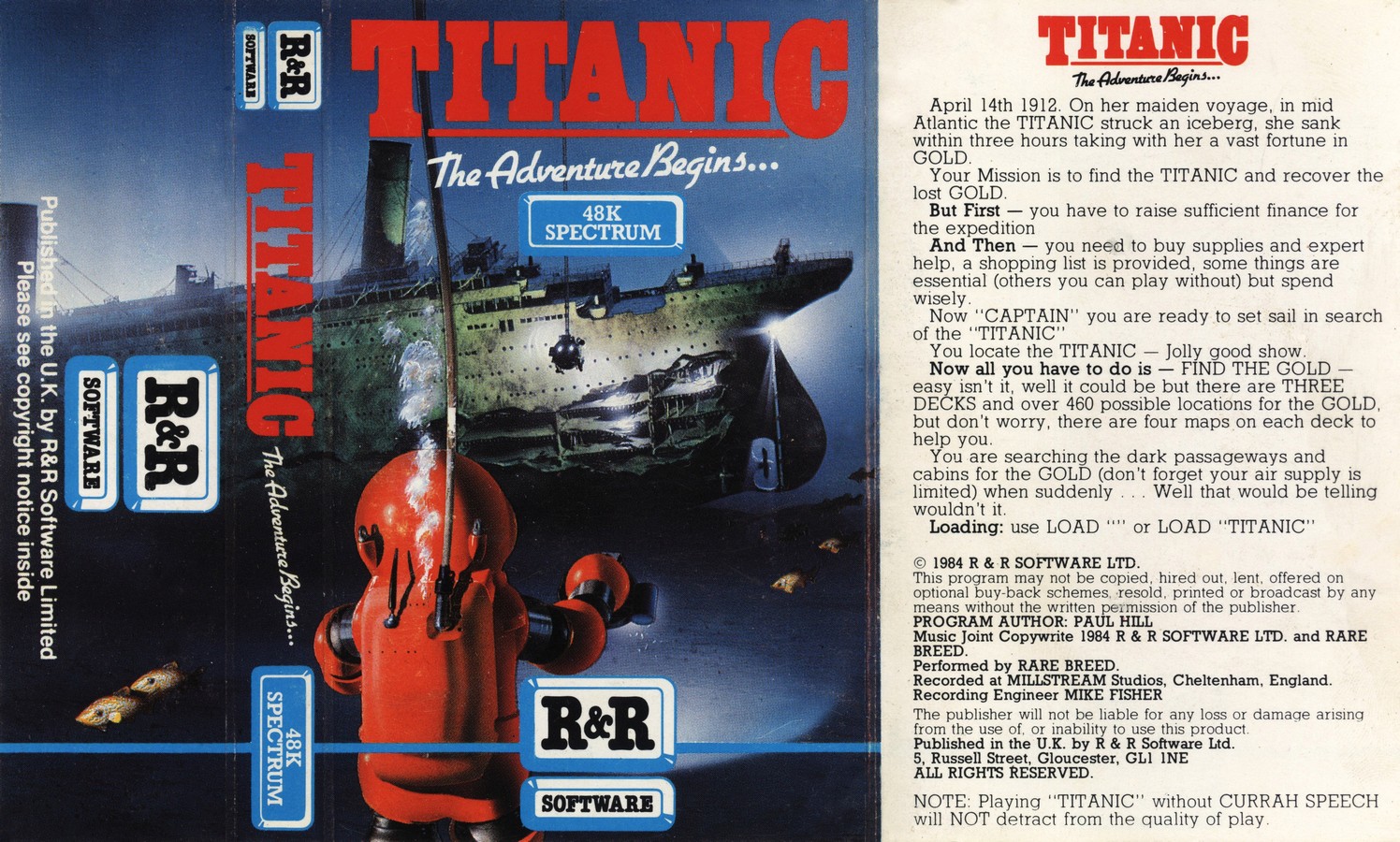
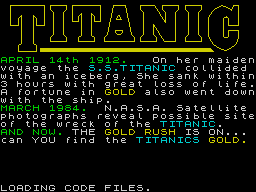
Titanic
Strategy Game: Management · ZX-Spectrum 48K · 1 players · English
R&R Software Ltd · 1984 · Pound sterling 7.95
Also known as Titanic: The Adventure Begins (English)
.jpg)
.jpg)
.png)
Discussion
Nobody has started a thread about this yet.
Remarks
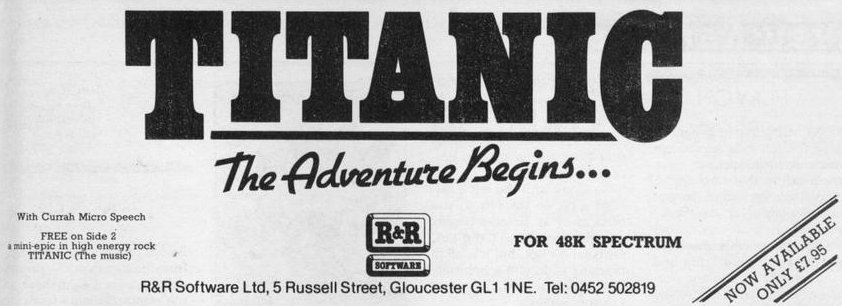
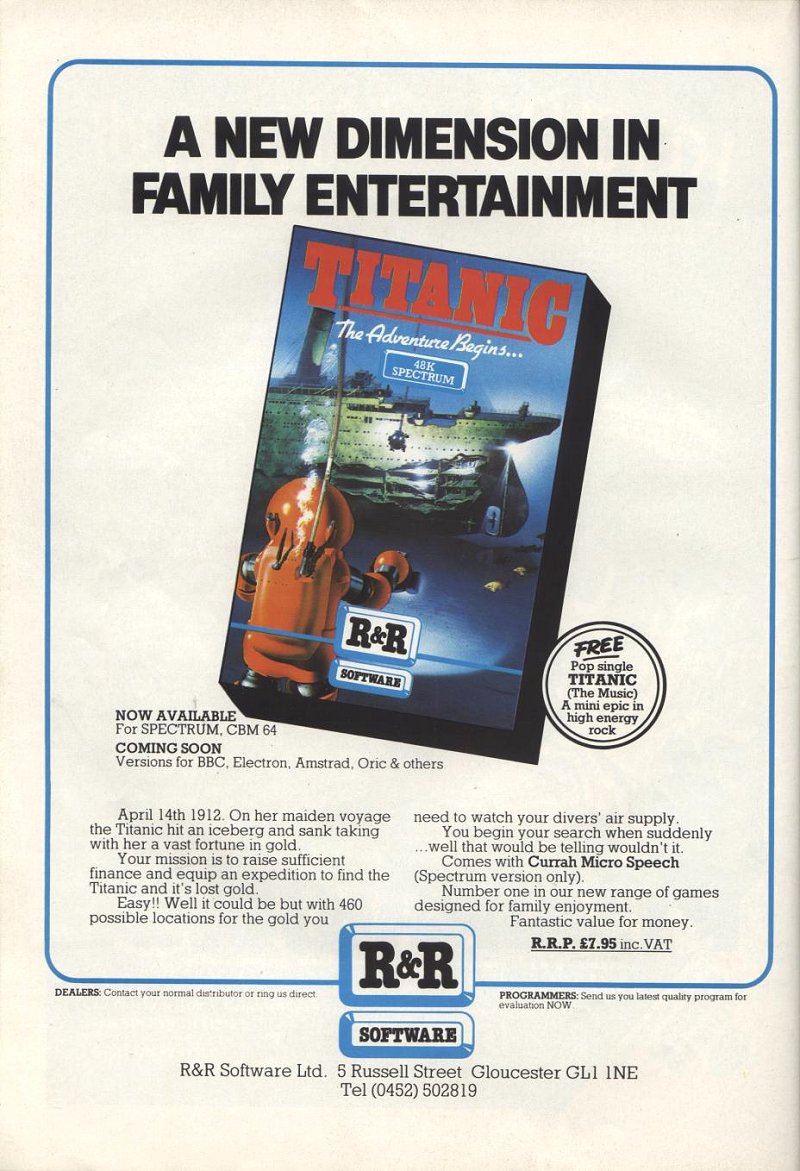
Comes with a free audio track called Titanic (The Music), performed by Rare Breed.
Releases
- 1984R&R Software Ltd Sold as Titanic: The Adventure BeginsPound sterling 7.95
- 1984V.T.R.
- 1986Prism Leisure Corporation PLC
- 1986Yes! Software
Play
- Titanic.rzx.zipRZX playback file 97 KB
- Titanic(YesSoftware).z80.zipSnapshot image English17 KB
- Titanic.tzx.zipTape image English16 KB
- Titanic.tap.zipTape image English16 KB
- Titanic(PrismLeisureCorporationPLC).tzx.zipTape image English15 KB
- Titanic(YesSoftware).tzx.zipTape image English53 KB
Documents
- Titanic.txtInstructions English5 KB
Files and rights
Distribution permission is on record, granted to another archive rather than to this one. Screens and pictures are copied here; everything else links to the archive that holds it.
- AllowedR&R Software Ltd → WorldOfSpectrum
Credits
- Paul Hillcredited
Sign in to credit somebody, or say what these people did.
Scores
In the magazines
- Crash #51984 · Overall73%
- Sinclair User #301984 · Gilbert Factor5/10
Elsewhere on the web
- WorldOfSpectrum 6 votes7.00
In the magazines 72
Micro Adventurer #13Nov 1984 · p.45
GW
WRECK RAISING MICRO: Spectrum 48K PRICE: £7.95 FORMAT: Cassette SUPPLIER: R&R Software, [redacted] Titanic is a Strategy-Adventure game with a novel, or is it naval, scenario. Once you have experimented with the strategy element, in finding a generous sponsor and selecting the best way to distribute your cash between the very essential repair kits and diving teams, the first phase of the adventure game begins. Unfortunately, this is where the random generator factor raises its ugly head in a game which is all too often over dependent upon the RND function. On screen, courtesy of a NASA photo-survey of the North Atlantic, are 16 squares randomly placed in each game. Only one is the Titanic the rest are, at best, spurious shoals of fish or, at worst, either icebergs, which consume an expensive repair kit, or a World War II wreck which detonates and destroys your (even more expensive) crew. Once you have hit your twentieth wreck, the same boring message of its discovery gets somewhat stale. Effectively, in this stage of the game, all you have to do is plough across the screen with the cursor keys, trying to stumble over the one correct square, before you run out of supplies, divers or kits. If you do run out of any, its the end of the game as simple as that. Assuming you do strike lucky, as you will about one game in three, you will be rewarded with the chance of exploring the wreck of the Titanic for gold. The game now reduces to a logically mapped maze, consisting of nearly 500 locations across three decks. Twelve of the locations contain part maps of the ship. The idea of such a plot is inventive, a pleasant change from caves, deserts and misty mountains, but the game is terribly stilted as the only course now open is to wander through the ship hoping to stumble first on the maps, then on the gold, before your supplies run out. There are none of the challenges or need for lateral thinking as in more orthodox adventures, with the monotony only broken by rare high-resolution pics of crabs and sharks which are beaten off with no effort on your part. An interesting idea, but this game is less seaworthy than the Titanic itself. By the way, the B-side of the tape offers music by Rare Breed, which is actually worse than the game!
Sinclair User #30Sep 1984 · p.125/105/10
Gilbert Factor 5/10
John Lambert 5/10
Memory: 48K Price: £7.95 On April 14, 1912 the Titanic sank taking a reputed fortune in gold to the bottom of the sea. In the game from R & R Software, your mission is to find the wreck and to recover the gold. To start you have to raise finance for the trip and then buy your supplies. That follows the strategy type of game where the first time you play it is rather like pot luck but subsequently you learn what is useful and what is not. Next you have to find the wreck. If you have the NASA map from the first section that will help as otherwise you may suffer the same fate as the Titanic. Once you have found the wreck you move on to the last section of the game - finding the gold. Each of the three levels on board contains more than 150 locations and your divers must explore them. Their time is limited and if they are not careful they may meet creatures from the deep. Titanic tries to be a jack-of-all-trades and cover as many different types of game as possible but in the end is master of none. The response times are slow, being predominantly Basic, and too much reliance is placed on random factors.
C&VG (Computer & Video Games) #35Sep 1984 · p.114
Keith Campbell
The Adventure begins. Or so says the cassette inlay. In fact, Titanic for the 48k Spectrum is not really an Adventure, but a strategy game. I always thought that a strategy game contained an algorithm that allowed the player who had developed a sound strategy to win, give or take a bit of luck. Titanic thrives on a very hit and miss approach. To begin with, you must raise enough cash to finance an expedition to find the sunken wreck and find and recover gold that was on board. This is quite fun, for there is a selection menu of 15 likely sources on finance and you must gamble, to a certain extent, on which will offer you the most. I found a publishing company that was being quite generous (could it have been EMAP??!) so I took advantage of their offer of £240,000. I then went shopping for same NASA photos of large objects in the search area, expert diving teams, repair kits for the ship and supplies. The next part of the game involves shifting your ship around the sea by using direction keys and it jumps about 0.5 centimetres per time. If you have been wise enough to purchase a photo, about 17 pink spots mark the sea at the positions of large objects. On arrival at one of these, the chances are that you will have run straight into an iceberg. Even though you knew there was something there, there was no means of detecting whether to plough on regardless, or approach with caution. Should you be lucky enough to detect a wreck below you, you may then ignore it or send down a diving team. Of course, it is quite likely to be an old wartime ship that explodes and takes your diving team with it. If and when you eventually find the Titanic, then it must be explored (limited air supply) to find the gold. The Titanic has four floors which for some peculiar reason are arranged as a maze. All is not lost, though, for a map is available to view in some of the rooms. There are more hazards down there to avoid - well, you can't actually avoid them so much as just come upon them and hope that the random fate that awaits you is favourable. To me, this made a change from Adventure. It could have made a good strategy game too, had the whole business not been so dependent on luck! As there is very little scope for planning your strategy, neither the description of strategy or Adventure would seem to apply. Titanic is for the 48k Spectrum from R&R Software, priced £7.95.
Crash #5Jun 1984 · p.1178%76%69%72%73%72%73%
Use of Computer 78%
Graphics 76%
Playability 69%
Getting Started 72%
Addictive Qualities 73%
Value For Money 72%
Overall 73%
Unknown
Unknown
Unknown
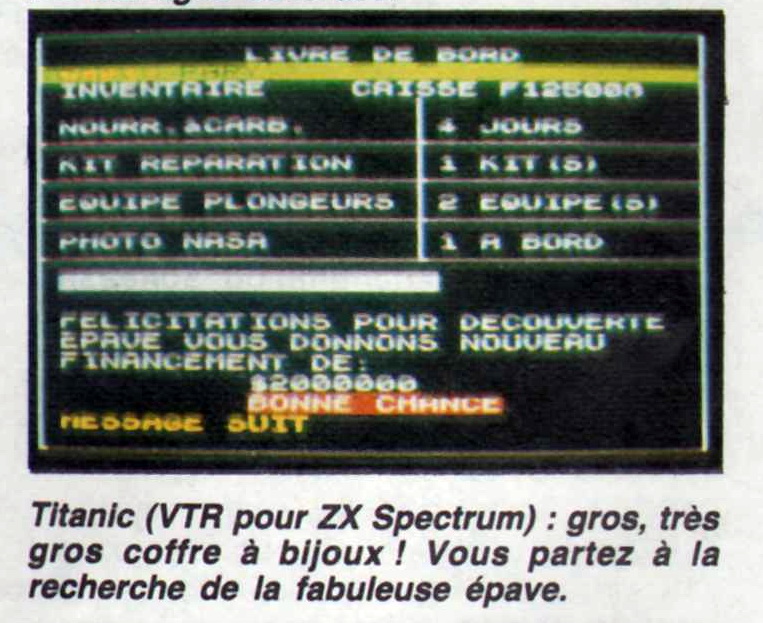
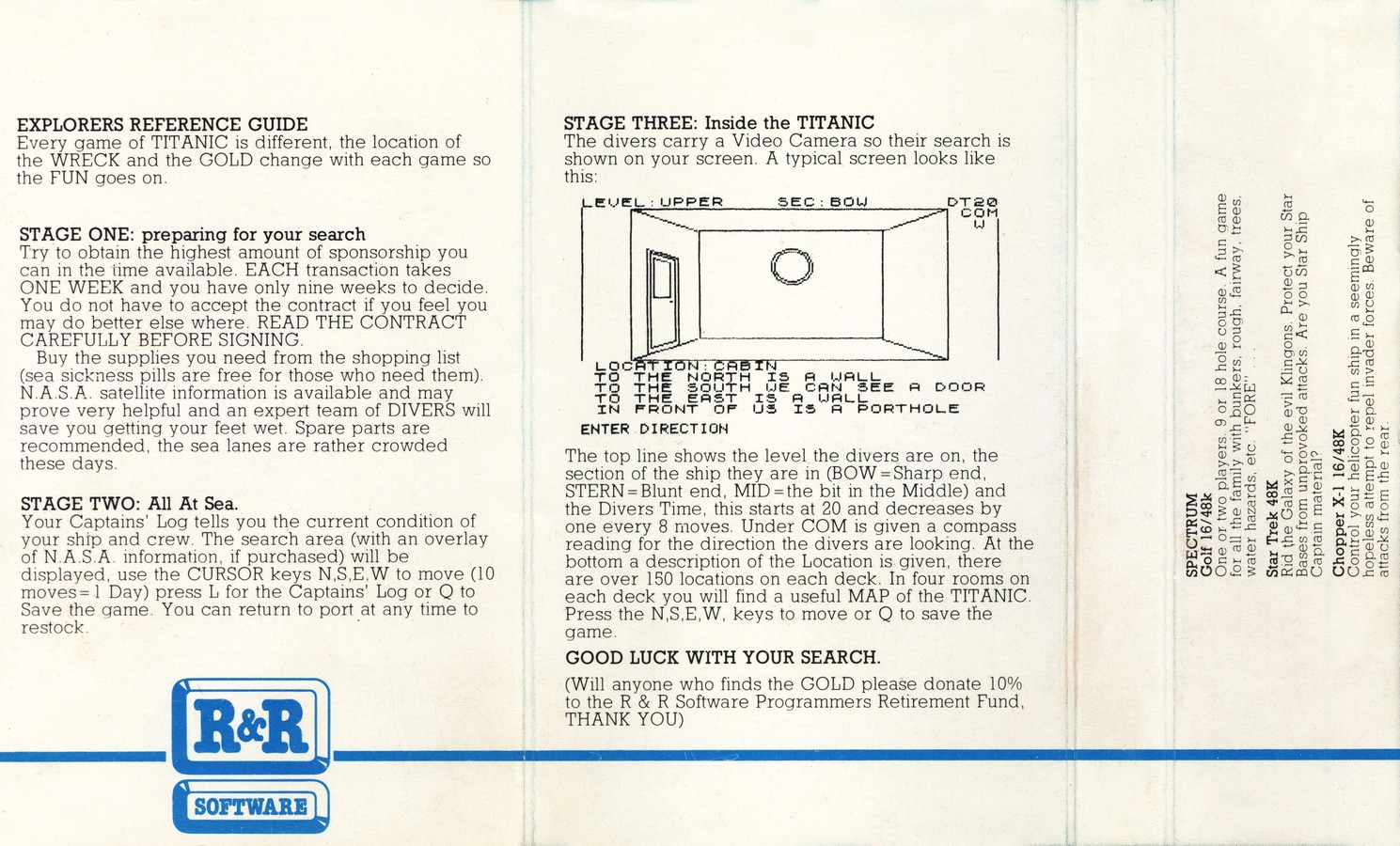
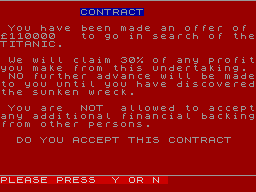
Producer: R&R Software Memory Required: 48K Retail Price: £7.95 Language: Machine code Author: Paul Hill Music: Rare Breed There have been recent programs out which have combined arcade with adventure games, ones like Phoenix's Dodge City, where you must complete the arcade game in order to play the adventure; and of course there have been arcade adventures like Atic Atac. Adventures tend to have a strategical element in them, but R&R are probably the first software house to come up with a multi-stage game which is both strategy and adventure in the accepted sense. The game is split into three stages. The first is also the shortest and involves trying to raise sufficient finance to mount a search to locate the wreck of the famous Titanic ocean liner which sank on its maiden voyage on April 14, 1912, after striking an iceberg. The scenario suggests that a fabulous fortune in gold went down with the ship, and that's what you're out to recover. Initially you are presented with a menu of 15 institutions whom you may approach for finance, and the idea is to get the best deal you can. Each contract, if accepted, restricts you to finance from that institution only. The initial sum of money is given as an advance, with further sums to be awarded if you discover a wreck. Having selected a backer and signed the contract by entering your name, it is time to spend the money on essentials. A NASA Satellite Photo (infra red) shows all large objects below the surface; you need food and supplies at a cost per day; you need teams of expert divers; and you need repair kits (quite a few actually), Once you have spent your allocation you may put to sea. Stage two presents a map of the North Atlantic with coloured blocks representing events. You only get this if you have purchased a NASA photograph, as the blocks are large objects below the surface of the sea. These may be the sites of wrecks or icebergs. Hitting an iceberg may result in sinking, but strikes can as often be repaired if you have sufficient kits. If a wreck is reported your financial backers will probably give you another advance and you have the option of ignoring the siting or sending a team of divers down. Once they dive, the message screen reports on their progress - it's dark down there - is the wreck the Titanic - or will they be killed? Your backers are understandably disinclined to come up with a further advance on sitting a second wreck, if you've already lost one team of divers! Discovering the site of the Titanic's last resting position switches you into stage three, the exploration. You are only able to explore one level at a time, and there are three. A simple 3D line drawing above the text shows the location. Commands do not have to be entered. The possible directions and location description are all combined. Pressing the desired direction key causes an instant response and carrying out of the command. Ideal locations to find are the service rooms on each deck, as these have deck plans of the ship. With something like 170 locations per deck, the plan is a valuable help. There are several types of hazard down there, and losing a team of divers can be catastrophic if you only have one left and not enough money to get back for another team. COMMENTS Control keys: cursors or N/S/W/E move the ship Joystick: Protek, AGF Keyboard play: responsive and simple with on-screen prompt. The ship moves slowly, but this avoids over-reacting Use of colour: sensible, well used Graphics: good text panels, generally good Sound: not much, but try the rock single on the reverse! Skill levels: 1 Features: good song by Rare Breed on tape, Currah compatible
For a mere £70,000 you can have a NASA Infra Red photo.
On each of the three decks one service room holds a plan of the deck.
Advert38
- Home Computing Weekly #87Nov 1984 · p.1
- Home Computing Weekly #83Oct 1984 · p.1
- Popular Computing Weekly #38Sep 1984 · p.46
- Home Computing Weekly #79Sep 1984 · p.1
- Home Computing Weekly #81Sep 1984 · p.1
- Popular Computing Weekly #36Sep 1984 · p.39
- Popular Computing Weekly #39Sep 1984 · p.44
- Popular Computing Weekly #34Aug 1984 · p.33
- Home Computing Weekly #77Aug 1984 · p.1
- Home Computing Weekly #75Aug 1984 · p.1
- Popular Computing Weekly #31Aug 1984 · p.33
- Popular Computing Weekly #32Aug 1984 · p.40
- Popular Computing Weekly #33Aug 1984 · p.26
- Popular Computing Weekly #35Aug 1984 · p.22
- Popular Computing Weekly #29Jul 1984 · p.31
- Popular Computing Weekly #28Jul 1984 · p.39
- Popular Computing Weekly #27Jul 1984 · p.36
- Popular Computing Weekly #30Jul 1984 · p.26
- Home Computing Weekly #69Jul 1984 · p.1
- Home Computing Weekly #71Jul 1984 · p.1
- Home Computing Weekly #73Jul 1984 · p.1
- Popular Computing Weekly #23Jun 1984 · p.36
- Home Computing Weekly #65Jun 1984 · p.1
- Home Computing Weekly #66Jun 1984 · p.1
- Home Computing Weekly #67Jun 1984 · p.1
Full-page ad16
- Games ComputingDec 1984 · p.123
- Games ComputingNov 1984 · p.99
- Crash #9Oct 1984 · p.114
- Big K #7Oct 1984 · p.55
- Home Computing Weekly #78Sep 1984 · p.17
- Big K #6Sep 1984 · p.79
- Games ComputingSep 1984 · p.91
- Home Computing Weekly #74Aug 1984 · p.27
- Big K #5Aug 1984 · p.42
- Games ComputingJul 1984 · p.88
- Home Computing Weekly #69Jul 1984 · p.29
- Big K #3Jun 1984 · p.4
- Home Computing Weekly #65Jun 1984 · p.4
- Home Computing Weekly #61May 1984 · p.26
- Popular Computing Weekly #14Apr 1984 · p.4
- Popular Computing Weekly #15Apr 1984 · p.4
Classified9
- Popular Computing Weekly #28Jul 1984 · p.1
- Popular Computing Weekly #27Jul 1984 · p.1
- Popular Computing Weekly #25Jun 1984 · p.1
- Popular Computing Weekly #23Jun 1984 · p.1
- Popular Computing Weekly #21May 1984 · p.1
- Popular Computing Weekly #15Apr 1984 · p.1
- Popular Computing Weekly #11Mar 1984 · p.1
- Popular Computing Weekly #13Mar 1984 · p.1
- Popular Computing Weekly #12Mar 1984 · p.1
Review2
- Sinclair Answers #1Sep 1984 · p.36
- Popular Computing Weekly #22May 1984 · p.16
CompoEntry2
- Personal Computing Today #2Sep 1984 · p.17
- Crash #7Aug 1984 · p.63
Feature1
- Your Computer #7Jul 1984 · p.56
Related
- Versions
- Currah MicroSpeech (Supports)
- Ports
- (Commodore 64)
- Same entry at
- Spectrum ComputingZXInfo
Reviews from people here
Sign in to write about this, or make an account. It takes a minute and lets you correct the catalogue too.
Everything ZXDB can hold about this is here.
Sign in to correct or add to this.
Hold the rights to this and want it taken down?